What is Stakeholder Management? Overview & Best Practices


Stakeholder management involves managing and maintaining relationships with all of the different people who have an interest in the outcome of your project, whether they are part of your org or outside it (such as a client).
Working with stakeholders (especially difficult ones) is not an easy task, but it is one that you can get a handle on with the right project stakeholder management process.
What Is Stakeholder Management?
Stakeholder management is the process of collaborating with stakeholders and maintaining stakeholder relationships and rapport. A stakeholder is either an individual, group, or organization who is impacted by the project outcome.

Stakeholders can include anyone from clients to project sponsors to suppliers to the CEO who's micromanaging your new website launch. You might have external stakeholders or internal stakeholders involved in your project.
Stakeholder Management vs. Stakeholder Engagement
The two terms are often used interchangeably, but they aren't quite the same thing. Stakeholder management is the broader discipline: identifying stakeholders, understanding their influence and expectations, and planning how you'll work with them across the project. Stakeholder engagement is the day-to-day part of that work: the conversations, check-ins, updates, and feedback loops that keep stakeholders involved and invested.
In short, management is the strategy and structure; engagement is how you put it into practice. You need both. A plan with no engagement stays on paper, and engagement with no plan tends to be reactive and inconsistent.
Why Is Stakeholder Management Important?
Projects succeed or fail on the strength of the people around them. Stakeholders control budgets, approvals, feedback, and access to information, so when they're misaligned, unaware, or unhappy, timelines slip, scope creeps, and trust erodes.
According to PMI’s Pulse of the Profession 2026, 61% of complex projects experience value or alignment gaps, and 34% of project professionals report delays in stakeholder decision-making. The same research found that high performers are more likely to continuously reassess which stakeholders need to be involved (50% vs. 42% of low performers) rather than relying on the list created at kickoff.
Good stakeholder management surfaces problems and misaligned expectations early, keeps decision-makers informed, and builds the goodwill you'll need when a project hits turbulence. It also makes you a more reliable partner, which is what leads to repeat work and long-term relationships.
6 Benefits of Stakeholder Management
There are a variety of benefits to effective stakeholder management, when it's done properly. Much of this depends on the stakeholders themselves; unfortunately, some stakeholders are just difficult, no matter what you do.
- More clarity on who is responsible for what: By setting expectations and rules of engagement up front (especially by using a RACI chart), your stakeholders will have a better understanding of what they need to deliver and when. This includes things like feedback and website content.
- Smoother stakeholder communication: A proper stakeholder management plan will help you coach stakeholders on things like response times, what level of communication to expect, and how often they will hear from you.
- More deliverables completed on time: A stakeholder management plan will ensure that stakeholders know when items that they are responsible are due, so they won't hold up timelines (and if they do, they can't blame it on you).
- Less friction and stress: It can help ease the tension that comes from working with demanding or difficult stakeholders (although not entirely, in some cases).
- Faster decision making: You won't be waiting on key stakeholders as much for information or input into your decision-making process.
- Less project risk: You can expect fewer surprises and interruptions and a higher chance of project success, as key stakeholders will be conditioned to be more transparent and forthcoming.
Stakeholder Management Process
Stakeholder management isn't a kickoff-meeting exercise you finish and file away. It's a loop you run for the life of the project. The five steps below are built around that reality, and each one ends with something you can actually produce.

1. Identify: Find Everyone, Especially Next Month's Surprise
Every project has a stakeholder nobody listed who shows up late with strong opinions. It's usually legal, security, finance, or the sponsor's boss. To avoid the ambush, ask three questions:
- Who approves this?
- Who has to live with the result?
- Who could block or delay it?
Then ask your sponsor and two team members one more: “Who am I missing?” That last question surfaces the most names.
Produce: a stakeholder register, which can be a simple spreadsheet with name, role, what they care about, and what they control.
2. Analyze and Prioritize: Map Power, Interest, and Mood
Plot each person on a power and interest grid (the stakeholder map below shows how). Then add the column most teams skip: current attitude versus the attitude you need. A common scale is unaware, resistant, neutral, supportive, leading. The gap between the two is your to-do list. A high-power stakeholder who is resistant deserves a coffee chat before the steering committee, not an apology after it.
Example stakeholder register, sorted by power:
| Stakeholder | Power | Interest | Current attitude | Desired attitude | Gap and next move |
|---|---|---|---|---|---|
| CFO | High | Low | Resistant | Neutral | Coffee chat before the steering committee; bring the budget numbers |
| VP of Sales | High | Medium | Neutral | Supportive | Show how the project ties to sales goals; share data every two weeks |
| Legal counsel | High | Low | Unaware | Neutral | Brief them early; add them to the review step in the RACI |
| Head of Marketing | Medium | High | Supportive | Leading | Invite them to co-own brand and messaging approvals |
| IT Director | Medium | High | Neutral | Supportive | Weekly tech-only touchpoint; copy only on technical topics |
| Customer support lead | Low | High | Supportive | Supportive | No gap; keep informed with a short monthly update |
Produce: the register, updated with power, interest, and current versus desired attitude.
3. Plan Engagement: Match the Cadence to the Person
One status email for everyone means the executive skims it, the developer drowns in it, and the sales lead never opens it. For each key stakeholder, write down what they need, how often, in which channel, and who owns the relationship. Use a RACI chart for deliverables and a DACI for decisions, so one person is clearly the driver and one is the approver. Then set a response-time rule up front, such as “Feedback within two business days, or we proceed with the current version.” It's much easier to enforce a rule everyone agreed to in week one.
Produce: a one-page communication plan and a RACI chart.
4. Communicate and Engage: Keep Surprises Out of the Room
The golden rule: nobody should hear bad news for the first time in a group meeting. Give key stakeholders a ten-minute heads-up call before the status meeting or steering committee. Keep your updates in a consistent format: status (red, amber, green), what changed, and what you need from them by when.
Close the loop on every request, even a “no,” with a short note on the decision and why. Keep a decision log showing who decided what and when, so you can answer “I never agreed to that” politely and with a date.
Produce: a recurring status template and a decision log.
5. Monitor and Adjust: Take the Temperature
At each phase gate, or every few weeks on a long project, ask a handful of stakeholders three questions:
- Is the amount of communication right?
- What are you not hearing from us?
- What worries you?
Then, revisit your register. A new sponsor, a reorg, or a stakeholder going quiet all mean it's time to reassess. This habit has data behind it: in PMI's Pulse of the Profession 2026, 50% of high performers continuously reassessed which stakeholders needed to be involved, compared with 42% of low performers.
Produce: an updated register and a three-question pulse check.
Stakeholder Management Best Practices
Here are four best practices for managing stakeholders. It's also worth considering how you can use AI in stakeholder management alongside these best practices.
- Schedule regular check-ins. You're likely to have these scheduled already throughout the project life cycle to review status and progress (or as part of your stakeholder engagement plan), but build in some time to ask stakeholders how they are feeling about the level of communication and project visibility.
- Use project management software. Software tools can store documents like your RACI chart and stakeholder matrix, and can track project progress and status, which will speed up the process of creating status reports and ease the process of keeping stakeholders informed on project progress.
- Use collaboration software. The main benefit of collaboration software is that they are specifically built to allow project managers to keep in touch with their teams and project stakeholders, and they are especially useful when the team is working remotely.
- Send out a post-project survey. Use this to gather feedback from stakeholders on how communication and expectation management went, and to gauge their overall satisfaction with the project and the team.
How To Create A Stakeholder Management Plan
Here are five steps to create a stakeholder management plan:
1. Create A Stakeholder Map
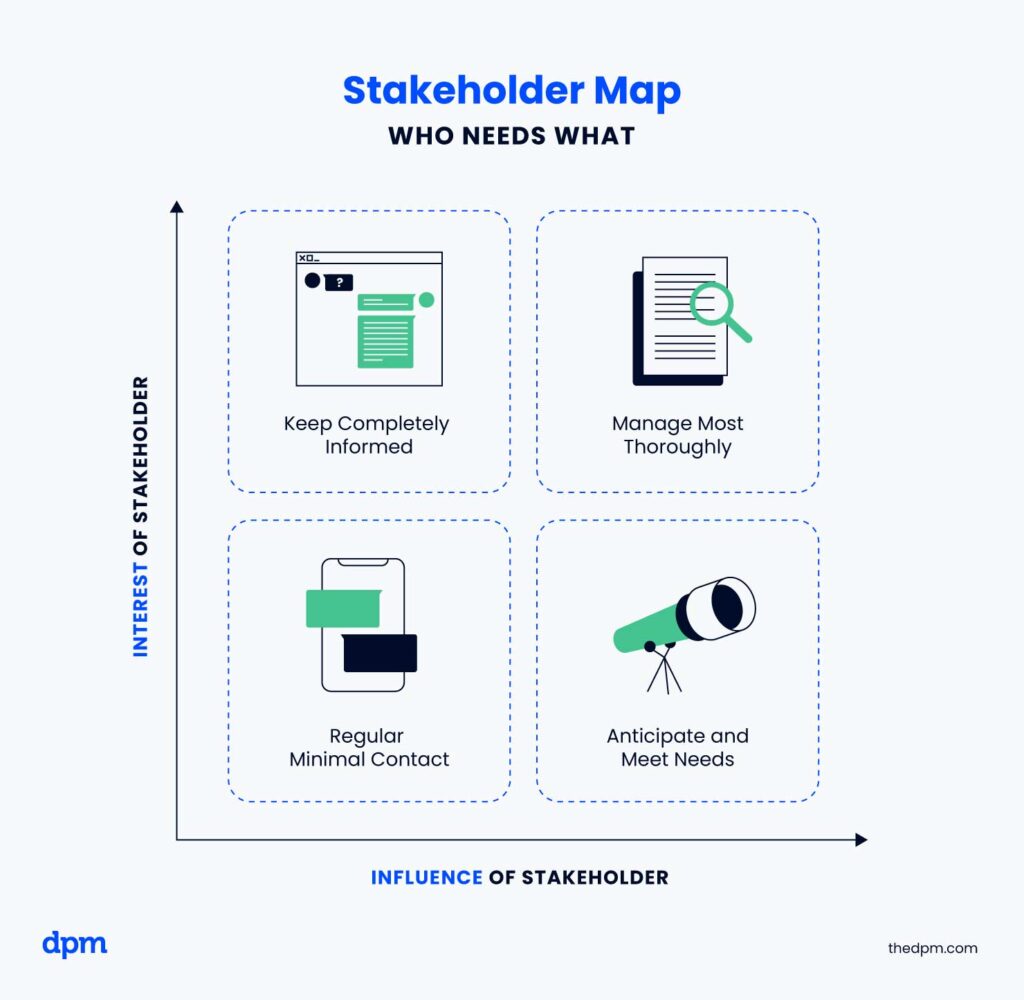
Create a list of everyone involved with or affected by your project, and hold a stakeholder mapping and stakeholder analysis session with your internal team. The outcome will be a stakeholder map—a grid that looks akin to a prioritization matrix, with level of interest on one axis and level of power (or level of influence) on the other axis.
Their level of power relates to the potential impact that they could have on the project, and their level of interest is related to how much they need to know.
- Stakeholders with high interest and high power or high influence must be managed most thoroughly. These are your most important stakeholders.
- Stakeholders with high interest but low power or low influence should be kept completely informed.
- Stakeholders with low interest but high power should have their needs anticipated and met.
- Stakeholders with low interest and low power should be provided with regular minimal contact.
2. Determine Stakeholder Needs and Expectations
Conduct interviews or surveys to understand what each stakeholder hopes to gain from the project and what they are expecting to get out of the project. It's important to determine expectations as early as you can, so you can set misaligned or out of sync expectations right. This will prevent challenges down the road stemming from the avoidable delta between expectations and the reality of the project.
Make sure all stakeholders are clear on what you'll be delivering (the statement of work will be helpful here) and what's in scope and out of scope, and get buy-in. This will help you avoid scope creep later.
3. Write A Communication Plan
Next, create a communication plan. A communication plan is a way to formalize a process for managing communication between your team and your stakeholders.
The communication plan should outline all stakeholders, titles, the frequency at which you will communicate with them, the channel of communication you’ll use, and any notes regarding preferences specific to each stakeholder.
4. Make A RACI Chart
Next, I suggest you and your internal project team make a RACI chart. This chart allows you and your team to define who is responsible for, accountable for, consulted about, and informed about the project deliverables, milestones, assets, etc. This RACI chart will include both client stakeholders and internal stakeholders, alike.

5. Monitor and Adapt the Plan
Throughout the plan, refer back to your stakeholder management plan and adjust it as needed according to stakeholder feedback and project progress. Your stakeholder's priorities might change, or you might get a request to provide updates to certain stakeholders more often or less often.
Occasionally, a stakeholder might leave a project, or you might identify a new stakeholder that you didn't know about at the beginning of the project. Your stakeholder management plan should be updated to reflect these types of changes as well.
Understanding The Needs of Your Stakeholders
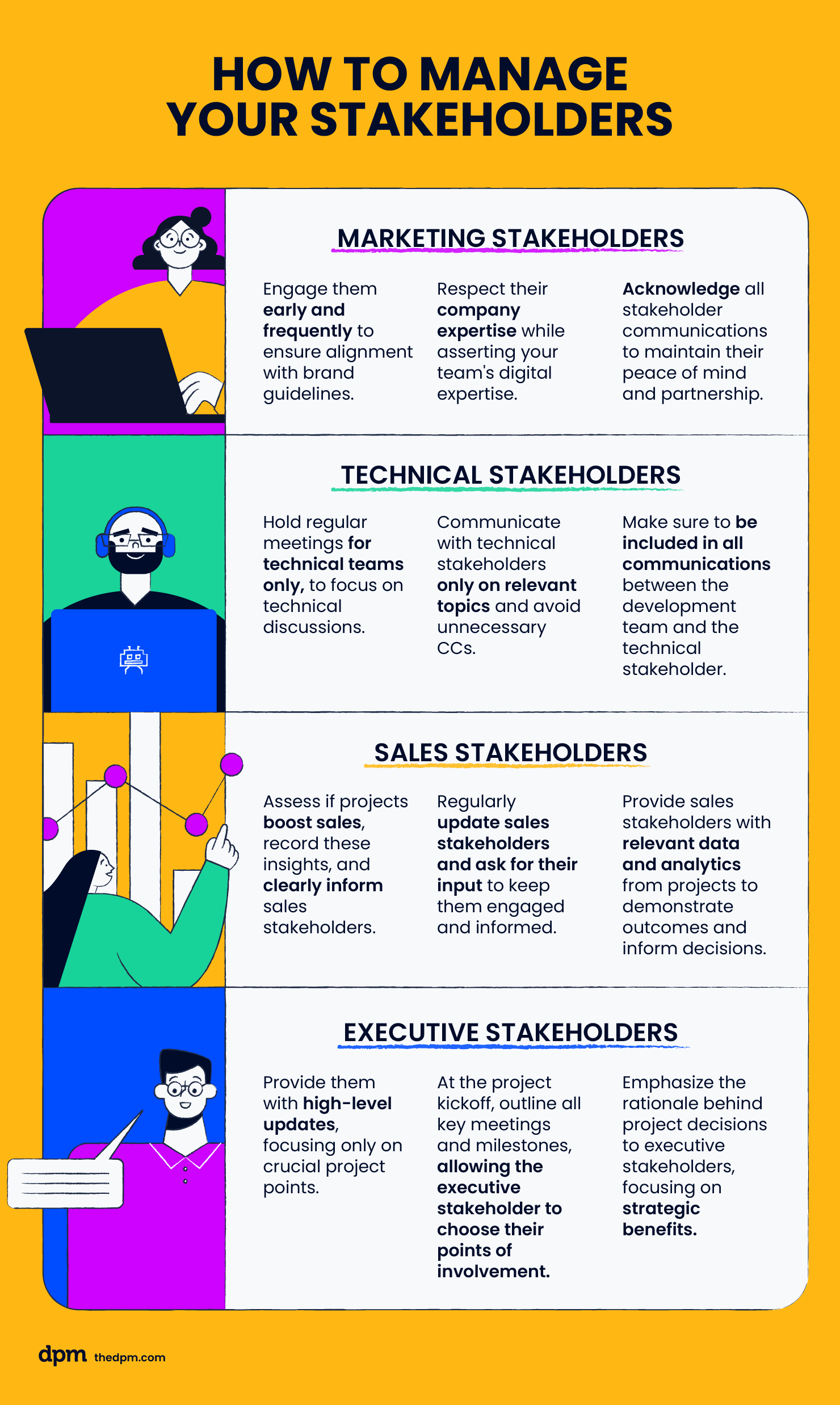
Depending on the size of the organization, your project may have several types of stakeholders. Here's a quick guide to four common ones in the digital industry.
1. Marketing Stakeholders
If you're building a website or running SEO or an ad campaign, someone from marketing or communications will be at the table. Consider them your subject matter expert on the company, its brand, and its audience.
Why they're valuable
- They can provide brand guidelines, assets, and creative contacts, and they fuel persona definition.
- They're usually the approval point for marketing, communications, and digital strategy.
How to manage them
- Involve them early and often, so the work stays within brand guidelines and trust builds.
- Give them room to guide decisions, but know when to recommend best practices. They're the experts on their company; you're the expert on digital implementation.
- Make sure they feel heard. You won't agree with every request, but you must acknowledge it, route it, and follow up to close the loop.
2. Technical Stakeholders
This is usually a head of technology: an internal technical director, an external consultant, or, in smaller organizations, an in-house developer or IT assistant.
Why they're valuable
- They can help you and your team clean up messy data and databases.
- They have context from past projects: what worked, what didn't, and why.
- They speak a technical language few other stakeholders do, which your development team will appreciate.
How to manage them
- Schedule a regular touch base with just the technical teams, so tension doesn't build when technical and non-technical people debate solutions.
- Only cc them on technical topics such as documentation, requirements, hosting, security, and data, unless they ask for more.
- Stay included when your developers and the stakeholder talk, even if you don't weigh in. It keeps technical conversations within scope.
3. Sales Stakeholders
Look for a sales director or sales and marketing manager who can speak to, or sign off on, anything tied to sales goals.
Why they're valuable
- They know the company's sales goals. They probably won't share much detail, but it's enough to shape your digital objectives.
- They're close to the C-suite. If the project helps their numbers, they're more likely to champion budget for future work.
- They're in the field more than anyone else, so they hear timely news about the market and customers, often stored in the CRM.
How to manage them
- Keep asking, “Will this drive sales?” Document the answer and communicate it clearly.
- Prompt their input. Sales stakeholders rarely volunteer it, so reach out every other week with a status update and ask what they've seen or heard.
- Feed them data. Set up analytics or reporting so you can show results.
4. Executive Stakeholders
Executives are typically director level or above and ultimately determine your budget. If your point person isn't the executive, they probably report to one.
Why they're valuable
- They either fund your project or report to the person who does.
- What they say goes. If you can tell a story about the project's benefit and they buy in, a long-term partnership is possible.
How to manage them
- Keep updates at a 10,000-foot view unless they ask for detail. Vet what counts as important with your main contact first.
- At kickoff, walk through all review meetings, sign-offs, and milestones, and have them mark where they want to be involved.
- Lead with the “why”: why this will work and why it's best for the company, not the technical details or analytics.
What's Next?
Want to improve your stakeholder management skills? Check out these top stakeholder management courses.
Looking for even more tips for stakeholder management? Join the conversation in Slack with 100's of other digital project managers with DPM Membership! You'll also get access to 100+ templates for key project documents like project plans, statements of work, and communication plans.