

10 Best Resource Management Software For Agencies In 2026

10 Best Agency Resource Management Software Shortlist


Managing your agency resources is difficult without software—you'll struggle to manage staff and budgets effectively, which means more failed projects and lower profitability. There are tons of agency resource management software tools out there, and choosing the right option can be tricky.
I'll help make your choice easy by sharing my picks for the best agency resource management software, as well as my personal experiences using dozens of different resourcing tools with various agencies.
What is Agency Resource Management Software?
Agency resource management software is a tool that helps agencies efficiently manage their internal resources. This includes organizing staff assignments, tracking time and budgets, overseeing project progress, and facilitating better team collaboration.
Essentially, it's a comprehensive solution for agencies to optimize their operations, from resource allocation to project delivery, so every aspect of the agency's work is effectively managed and coordinated.
Why Trust Our Software Recommendations
Our team has been testing and reviewing software since 2012. As project managers ourselves, we know how difficult—and important—it is to choose the right software.
For this guide, we evaluated tools using hands-on testing and independent research, scoring tools using our selection criteria. We also draw on insights from industry thought leaders and practicing project management experts.
Our reviews reflect our human editorial judgment, not a sales pitch.
Expert reviewers:
Agency Resource Management Software Comparison Table
This comparison table summarizes pricing details for my top agency resource management software selections:
| Tool | Best For | Trial Info | Price | ||
|---|---|---|---|---|---|
| 1 | Best for resourcing with financial visibility | 30-day free trial available | From $7/scheduled user/month | Website | |
| 2 | Best for resource planning and forecasting | 14-day free trial + free demo available | From $10/user/month (billed annually) | Website | |
| 3 | Best for real-time operations management | 14-day free trial | From $19.90/user/month (billed annually) | Website | |
| 4 | Best for integrated sales and resource planning | Free demo available | Pricing upon request | Website | |
| 5 | Best for agency resource and capacity planning | Free demo available | Pricing upon request | Website | |
| 6 | Best for robust project management features | Free plan + 14-day free trial + free demo available | From $10/user/month (billed annually) | Website | |
| 7 | Best for capacity planning reports | Free trial available | From $5/user/month (billed annually) | Website | |
| 8 | Best for simple capacity planning needs | Free plan + 14-day free trial available | From $9/user/month (billed annually) | Website | |
| 9 | Best for people-centric resourcing | Free demo available | Pricing upon request | Website | |
| 10 | Best for client-facing project collaboration | 14-day free trial + free demo available | From $19/user/month (billed annually) | Website |


Overviews of the 10 Best Agency Resource Management Software
Here’s a brief description of each agency resource management software, its best use case, and noteworthy features. I’ve also included screenshots to give you a snapshot of the user interface.

Best for resourcing with financial visibility

Float is a resource management platform for agencies that brings together project scheduling, team capacity planning, time tracking, and financial forecasting in one workspace.
Who Is Float Best For?
Float is a good fit for creative and digital agencies that need to manage team schedules and project budgets in one place.
Why I Picked Float
Float earns its spot on my shortlist because it ties resourcing decisions directly to financial outcomes in a way most scheduling tools don't. I use Float's budget tracking to compare planned costs against actuals in real time—so if a project is drifting over budget mid-delivery, I can see it before it becomes a problem. I also like the project cost estimation feature, which lets me model staffing scenarios using real bill rates and cost rates before a project kicks off, so margin is built into the plan from day one, not calculated after the fact.
Float Key Features
- Visual resource scheduling: Allocate work by hours or percentages on a drag-and-drop schedule, with live over-capacity warnings and utilization indicators.
- Time off management: Set custom leave policies, approval workflows, and auto-assigned regional holidays so availability is always accurate in the schedule.
- Pre-filled timesheets: Float auto-populates timesheets from scheduled allocations, with automated reminders and timesheet locking to protect data integrity.
- Utilization reporting: Track billable vs. non-billable hours across roles, teams, and projects to monitor how your team's time is actually being spent.
Float Integrations
Float offers native integrations with Slack, Google Calendar, Outlook, Microsoft Teams, Asana, Jira, Trello, and QuickBooks, and connects with Zapier. An API is available for custom integrations.
New Product Updates from Float.com

Float Adds Rate Cards and Multi-Currency Billing
Float introduced centralized rate cards to standardize bill rates across projects and added multi-currency support to bill clients consistently across regions. For more information, visit Float's official site.
Best for resource planning and forecasting

Productive is an agency resource management platform that brings together resource planning, forecasting, project tracking, budgeting, and time tracking in one system.
Who Is Productive Best For?
Productive is built for agencies and professional services teams that need to manage people, projects, and budgets in one place.
Why I Picked Productive
Productive earns its spot on my shortlist because of how tightly its resource planning and forecasting features connect to real financial outcomes. I like that the resource planner shows team availability, time off, and capacity in one view—so when I'm deciding whether to take on a new project, I can see exactly who has room and who's already stretched. The Scenario Builder lets me model different scheduling and pricing outcomes before committing to a plan. I can also track billable utilization by person, team, or month, and Productive flags budget overruns before they occur.
Productive Key Features
- Project templates: Duplicate tasks, subtasks, descriptions, and assignees from a saved template to spin up new projects.
- Budget phase management: Split large, long-term project budgets into separate phases to manage complex, multi-stage client work.
- Time approval workflows: Review submitted time entries, mark hours as billable or non-billable, and request changes before approving.
- Automated budget alerts: Set custom warnings to trigger when a project hits a defined percentage of its budget spend.
Productive Integrations
Productive offers native integrations with Slack, Xero, QuickBooks, Google Calendar, and HubSpot, and connects with Zapier. An API is available for custom integrations.
New Product Updates from Productive
Productive Adds Voice Dictation, Slack Connector, Proposals, and Overtime
Productive adds voice dictation, a Slack Connector, proposal controls, and overtime tracking. These updates support faster AI interactions, client proposals, and time management. For more information, visit Productive’s official site.

Scoro
Best for real-time operations management

Scoro is an agency resource management platform that brings together project planning, resource scheduling, time tracking, budgeting, and collaboration tools in one system.
Who Is Scoro Best For?
Scoro is a good fit for mid-sized agencies and professional services firms that need a single platform to manage projects, people, and finances together.
Why I Picked Scoro
I've included Scoro in my top picks because of how well it connects real-time data across every layer of agency operations. What I like most is the live dashboard and reporting setup—you can track budget burn, team utilization, and project profitability without pulling data from separate tools. The utilization heatmap is particularly useful: it shows you at a glance who's overbooked and who has capacity, so you can rebalance workloads before a deadline slips. I also find the "Quoted vs Actual" view genuinely useful for ops leaders who need to catch margin issues mid-project, not after the invoice goes out.
Scoro Key Features
- Gantt chart scheduling: Visualize project timelines and task dependencies with drag-and-drop Gantt charts that update as work progresses.
- Retainer management: Track recurring client work, budgets, and hours within dedicated retainer views to keep ongoing engagements on schedule.
- Invoicing automation: Auto-generate invoices directly from approved quotes, with built-in payment processing via Stripe integration.
- Customizable dashboards: Build role-specific dashboards that surface the project health metrics, tasks, and financial data most relevant to each team member.
Scoro Integrations
Scoro offers native integrations with Google Workspace, Microsoft 365, Xero, QuickBooks, Sage, Exact, and Azure. An API is available for custom integrations.
New Product Updates from Scoro

Scoro Adds Time Mobile App and ELI Improvements
Scoro adds the Scoro Time mobile app for iOS/Android to track time anywhere and expands ELI with attachments, smarter filtering, and trigger-based actions. For more information, visit Scoro's official site.

Accelo
Best for integrated sales and resource planning
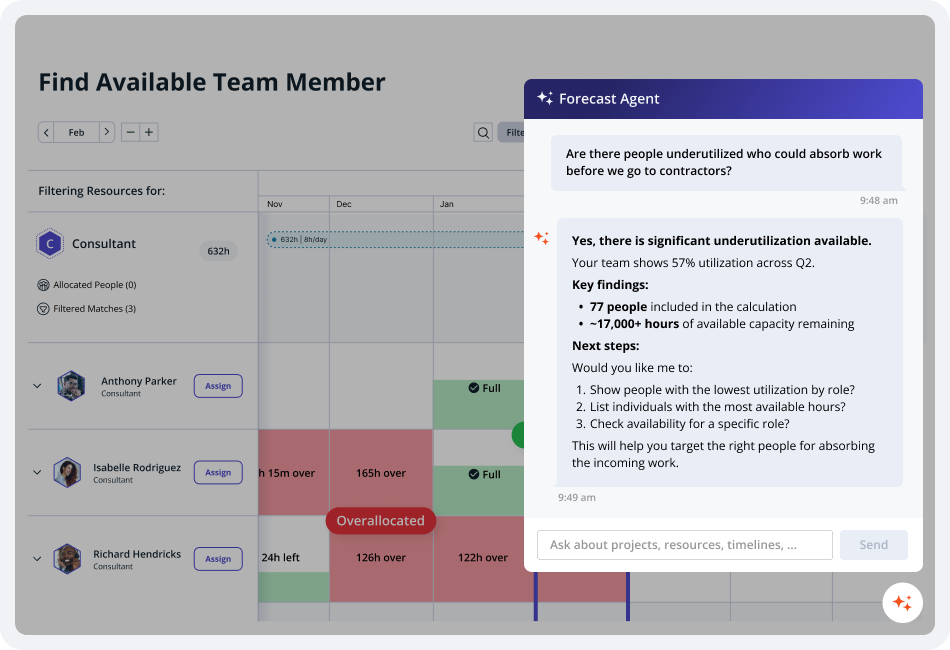
Built for agencies and professional services firms, Accelo is a PSA platform that covers the full client lifecycle—from pipeline and quoting through project delivery, resource scheduling, and billing.
Who Is Accelo Best For?
Accelo is a strong fit for mid-size digital agencies, IT consultancies, and professional services firms that need one platform to manage client work from sale through invoice.
Why I Picked Accelo
I picked Accelo for integrated sales and resource planning because it's one of the few platforms that connects your sales pipeline directly to capacity forecasting. It uses AI to model both tentative and confirmed work, forecast future demand, and help you align hiring, resources, and delivery before projects are won. This gives agency leaders a clear view of future capacity so they can decide whether to take on new work without relying on guesswork.
Accelo Key Features
- AI-assisted resource scheduling: Recommends the best-fit team members for tasks based on skills, availability, and workload.
- Sales-to-project automation: Converts won opportunities into projects, carrying over client, budget, and work details to reduce manual setup.
- Retainer management: Tracks recurring client engagements, logs change orders, and monitors retainer performance against agreed scope.
- Profitability dashboards: Displays real-time project, client, and team profitability to help monitor margins and financial performance.
Accelo Integrations
Accelo integrates with Google Workspace, Microsoft 365, Xero, QuickBooks Online, HubSpot, Salesforce, Mailchimp, Slack, and Zapier. An API is available for custom integrations.
Pros and Cons
Pros:
- Automated time capture logs billable hours
- Forecasts future resource demand
- Sales-to-delivery handoff is built in
Cons:
- Reporting customization is limited
- UI feels dated and loads slowly
New Product Updates from Accelo
Accelo Adds Quote Designer and Pipeline Management
Accelo adds Quote Designer, enhanced pipeline views, and quote tracking with version history. This helps teams create proposals and manage opportunities from scoped work. For more information, visit Accelo’s official site.

Best for agency resource and capacity planning

Screendragon is an agency resource management platform for project-based teams that need workflow automation, resource scheduling, and capacity planning in one system.
Who Is Screendragon Best For?
Screendragon is a strong fit for mid-to-large agencies and in-house creative teams that need to manage complex, multi-project workloads across large teams.
Why I Picked Screendragon
I picked Screendragon as one of the best because of how well it handles capacity planning at scale. What I find genuinely useful is the ability to toggle between task-based, hour-based, and percentage-based resource views—so when I'm juggling multiple client projects, I can instantly see where my team is overloaded without digging through spreadsheets. I also like the one-click auto-assignment feature, which matches team members to projects based on skills and availability rather than gut instinct. It also includes built-in demand forecasting, which lets me model future workload and spot resourcing gaps before they become a problem.
Screendragon Key Features
- Flexible filters and role-based views: Drill down by department, skill set, region, or custom role to find the right people for any project.
- Integrated timesheets and project data: Link resourcing directly to live project plans and timesheet data for a unified view of team performance.
- Digital approval workflow management: Capture decisions, comments, and markups centrally, with version comparison and an automated audit trail.
- No-code visual workflow builder: Design custom workflows from scratch or use templates, with full control over process logic and automation rules.
Screendragon Integrations
Screendragon offers native integrations with Microsoft 365, Google Workspace, Slack, Jira, Salesforce, SAP, Oracle, and Adobe Creative Cloud. An API is available for custom integrations.
New Product Updates from Screendragon
Screendragon Unveils New AI Hub
Screendragon introduced AI Hub, a new capability that lets teams build and manage AI agents directly within workflows. The update helps marketing teams automate tasks, maintain governance controls, and scale AI-driven operations more efficiently. For more information, visit Screendragon's official site.
Wrike
Best for robust project management features

Wrike is a project and resource management platform for agencies that brings together task tracking, workload planning, time tracking, and team collaboration in one workspace.
Who Is Wrike Best For?
Wrike is a good fit for mid-size to large agencies that need a structured, scalable platform to manage complex projects across multiple teams.
Why I Picked Wrike
I included Wrike on my shortlist because it packs a lot of project management depth into a single platform. I particularly like the Gantt chart scheduling, which lets my team map out task dependencies across multiple concurrent client projects and immediately see how a timeline shift on one project ripples into another. I rely on the resource bookings feature—I can reserve a team member by role, estimate hours, and check their availability before committing them to a new project. Wrike's effort management lets me assign effort estimates at the task level, which makes workload forecasting across a full project portfolio much more accurate.
Wrike Key Features
- Custom project views: Switch between Board, Table, Gantt, Calendar, and Chart views to visualize project progress in the format that works best for your team.
- Scrum boards: Manage Agile workflows with backlog prioritization, sprint planning, and real-time collaboration on shared Scrum boards.
- External request forms: Collect and route incoming work requests from clients or non-Wrike users directly into your project workspace.
- User activity reports: Pull on-demand audit reports to track what each team member has created or changed across your account.
Wrike Integrations
Wrike offers hundreds of integrations through its built-in connectors and marketplace, including tools like Google Workspace, Microsoft 365, Salesforce, and Slack. It also supports Zapier and provides an API for custom integrations.
New Product Updates from Wrike

Wrike Adds Quick Search to Table View
Wrike adds Quick Search to Table View with full-table search across titles, descriptions, and fields, plus highlighted matches. This helps users find tasks faster in large tables. For more information, visit Wrike’s official site.

Best for capacity planning reports

Resource Guru is a resource management platform for agencies that brings together resource scheduling, team availability tracking, project allocation, and capacity planning in one place.
Who Is Resource Guru Best For?
Resource Guru is a good fit for agencies and professional services teams that need a dedicated tool for scheduling people across multiple projects and clients.
Why I Picked Resource Guru
I picked Resource Guru as one of the best because its capacity planning reports give you a genuinely clear picture of where your team stands. The people and resource utilization report breaks down demand versus capacity so you can see exactly when your team is stretched thin and when there's room for more billable work. I also like the bookings-by-type report, which lets you model scenarios based on tentative or unapproved work—so if a client confirms a project, you can already see how that affects your schedule before it becomes a problem. The forecast vs. actuals reporting is another feature I rely on, since it shows whether you're over- or under-servicing clients and helps you quote future work with more confidence.
Resource Guru Key Features
- Clash management: Flags scheduling conflicts in real time and holds unresolved bookings in a waiting list until they can be properly assigned.
- Auto-suggested timesheets: Pulls scheduled work directly into each team member's timesheet so they can log a full week with one click.
- Custom fields: Tag resources with skills, roles, or any business-specific attribute so you can filter the schedule to find the right person for each project.
- Time off report: Tracks all absence types—vacation, sick leave, public holidays, parental leave—so you can plan around team availability before gaps become problems.
Resource Guru Integrations
Resource Guru offers native integrations with Outlook Calendar, Google Calendar, Jira, Slack, Microsoft Teams, Google Sheets, Salesforce, Workday, Basecamp, and QuickBooks. It also connects with Zapier and provides an API for custom integrations.
New Product Updates from Resource Guru

Resource Guru Adds More Control Over Calendar Sync
Resource Guru adds more control over Google and Outlook Calendar sync, including source calendar selection and destination calendar options. These updates help users manage external events and Resource Guru bookings with less clutter. For more information, visit Resource Guru’s official site.
 .
.
Best for simple capacity planning needs
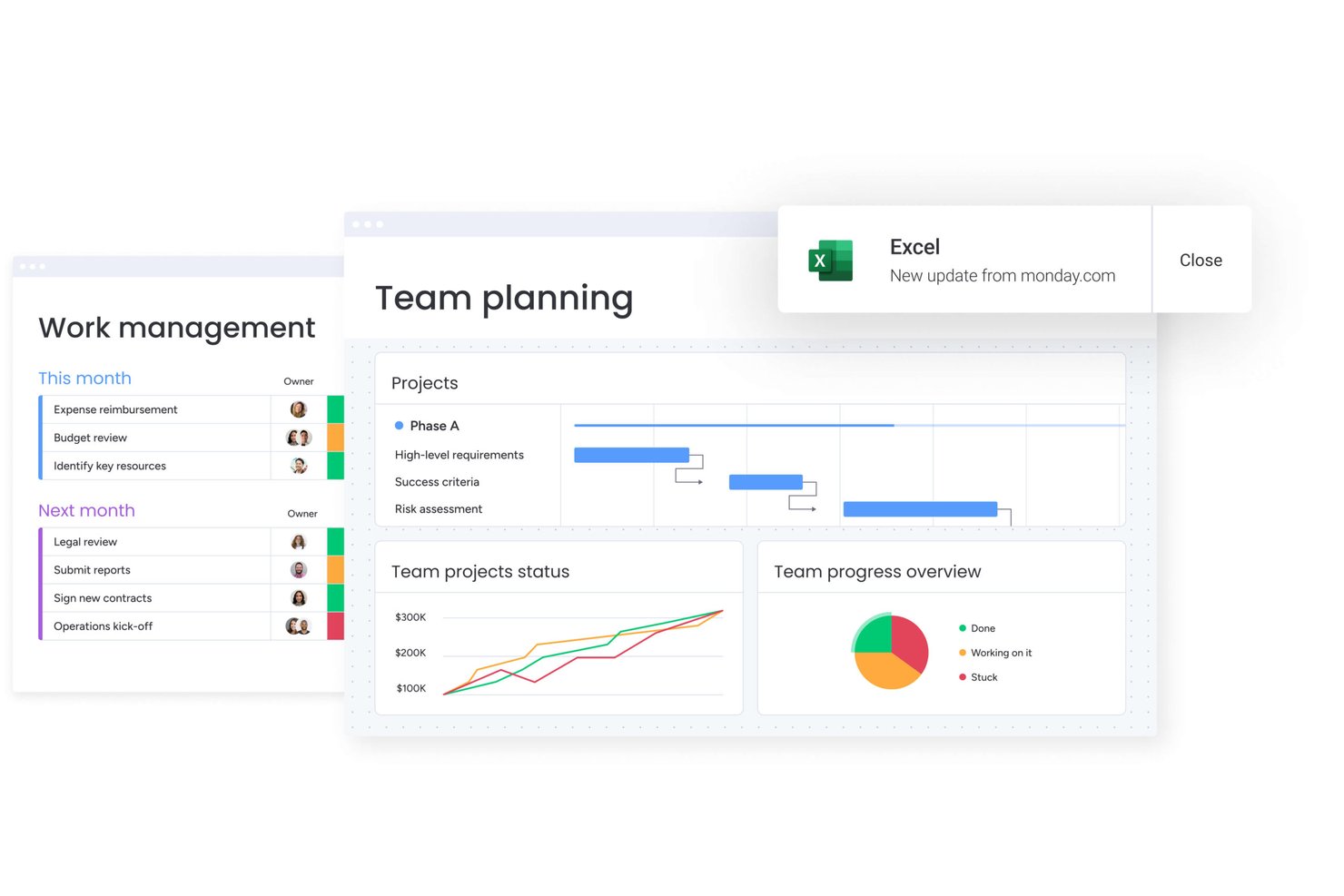
monday AI Workspace is a work management platform that combines project planning, resource scheduling, capacity tracking, and AI-powered workflow automation across teams and client projects.
Who Is monday AI Workspace Best For?
monday AI Workspace suits mid-sized agencies and operations teams that want an adaptable work OS without the complexity of a purpose-built resource management platform.
Why I Picked monday AI Workspace
I picked monday AI Workspace because its Capacity Manager aggregates workload data across multiple Resource Planners, giving my team a single view of who's overbooked and who has room. When I assign a new client project, I can filter the Resource Directory by role, skill set, or location to find the right person fast. Placeholder roles also let me flag staffing gaps before a project is even confirmed, which keeps pipeline planning from becoming reactive.
monday AI Workspace Key Features
- AI-powered workflow automation: Automates routine project updates, status changes, and assignments based on custom triggers and conditions.
- Customizable dashboard views: Offers visual widgets for timelines, Gantt charts, workloads, and project health, all configurable to agency preferences.
- Integrated time tracking column: Lets users log hours directly on tasks for better visibility across client project boards.
- Resource Directory: Stores searchable staff profiles including skills, roles, location, and availability in a central place.
monday AI Workspace Integrations
monday AI Workspace offers hundreds of native integrations through its built-in integrations and marketplace, including Slack, Google Workspace, Microsoft 365, Jira, Dropbox, Zoom, HubSpot, Salesforce, GitHub, and Outlook. It also supports Zapier and provides an API for custom integrations.
Pros and Cons
Pros:
- AI automates routine task assignment and updates
- Placeholder roles support pre-project staffing planning
- Visual capacity planning across multiple client projects
Cons:
- Reporting lacks agency-specific utilization KPIs natively
- Not purpose-built for billable rate tracking
New Product Updates from monday AI Workspace
monday AI Workspace Adds Human Approval Routing
monday AI Workspace adds a human-in-the-loop approval block to AI Workflows, sending approval requests and routing workflow paths based on responses. For more information, visit monday AI Workspace's official site.

Kantata
Best for people-centric resourcing

Kantata is an agency resource management platform designed for project-based businesses that need resource planning, project management, time tracking, and analytics in one system.
Who Is Kantata Best For?
Kantata is a good fit for professional services firms and agencies that need to manage complex, people-driven projects across multiple clients and workstreams.
Why I Picked Kantata
I picked Kantata as one of the best because of how deliberately it's built around people as the core unit of delivery. Where most resource management tools treat headcount as a scheduling variable, Kantata's resource management and forecasting module lets my team see availability by skill set, identify gaps before they become blockers, and shift people across projects in real time. That level of granularity matters when you're juggling multiple client engagements with overlapping timelines. I also like that Kantata's AI Expertise Engine learns from past project data to surface smarter staffing recommendations over time, so resourcing decisions get sharper the longer you use the platform.
Kantata Key Features
- Time and expense tracking: Log billable hours and expenses directly within projects, with built-in automation to keep records accurate and finance teams on schedule for period close.
- Financial management: Connect project delivery to invoicing, revenue recognition, and margin tracking in one place, with real-time visibility into costs and profitability.
- Kantata Pulse: Collect client and employee sentiment data alongside operational metrics to monitor project health and catch delivery risks before they escalate.
- Generative AI project assistant: Automatically draft status reports, executive updates, and project case studies by pulling from live project data.
Kantata Integrations
Kantata offers native integrations with Salesforce, Slack, Jira, HubSpot, QuickBooks, Xero, Microsoft 365, Google Workspace, Expensify, and NetSuite. An API is available for custom integrations.
New Product Updates from Kantata

Kantata Adds Access Group Change History
Kantata adds Access Groups History, letting account administrators track changes to group details, membership, and permissions in Recent History. The update also makes these events available through the Subscribed Events API for broader monitoring. For more information, visit Kantata’s official site.
 .
.
Rocketlane
Best for client-facing project collaboration
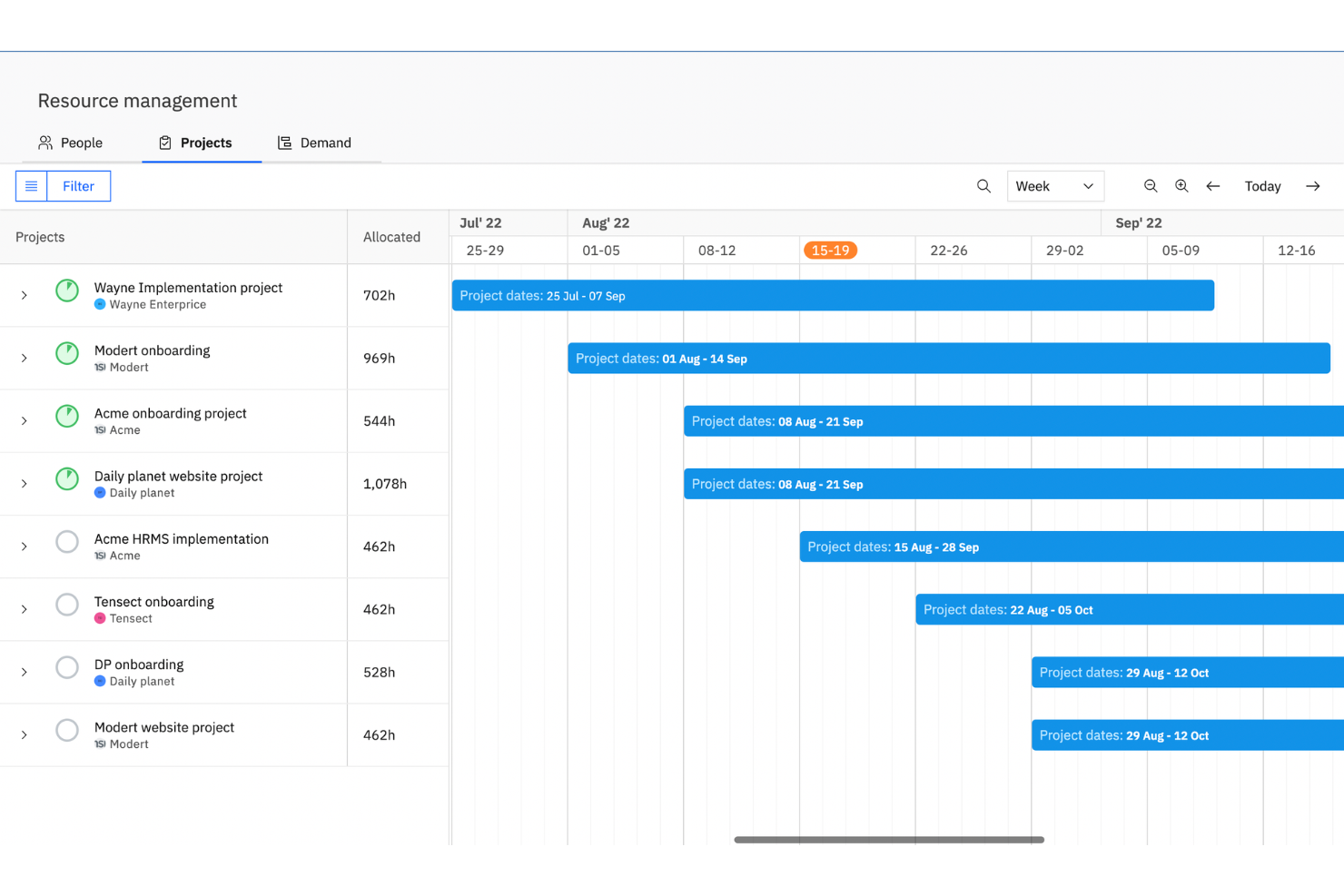
Rocketlane is a professional services automation platform that combines resource planning, capacity management, time tracking, client portals, and project delivery tools in a single workspace.
Who Is Rocketlane Best For?
Rocketlane is a strong fit for professional services and SaaS implementation teams that manage structured, client-facing project delivery at scale.
Why I Picked Rocketlane
I've included Rocketlane in my top picks because its branded client portal goes well beyond basic project sharing. Clients get a single hub where they can view project plans, access files, respond to tasks, and track progress without needing a Rocketlane login. I also like that the portal is fully white-labeled, so your team's branding stays front and center throughout the entire engagement, not just at kickoff. When you're managing multiple client projects simultaneously, that shared workspace cuts down on the back-and-forth email chains that slow delivery down.
Rocketlane Key Features
- Resource planning: Assign team members to projects based on availability, skills, and workload across your portfolio.
- Time tracking: Log hours directly within tasks and submit timesheets for manager approval without leaving the platform.
- Project templates: Build reusable project blueprints with pre-set tasks, timelines, and assignees to standardize delivery.
- Budget tracking: Monitor project spend against forecasts with margin tracking and rate card management built in.
Rocketlane Integrations
Rocketlane offers native integrations with Slack, Salesforce, HubSpot, Jira, Google Calendar, Outlook, and Zapier. An API is available for custom integrations.
Pros and Cons
Pros:
- Built-in timesheet tracking per project task
- Reusable project templates speed up onboarding
- Client portal gives customers direct project visibility
Cons:
- Switching between multiple projects feels slow
- Reporting filters lack advanced customization options
New Product Updates from Rocketlane

Rocketlane Introduces Governance and Workforce Agents
Rocketlane introduces Governance Agents and Workforce Agents to automate delivery processes and recurring tasks. These updates help teams enforce rules and streamline project execution. For more information, visit Rocketlane’s official site.
 .
.Other Options
Here are a few more worthwhile options that didn’t make my list of the best agency resource management software:
- Forecast
For mid-sized agencies and consultancies
- ActiveCollab
For small teams
- awork
For AI-powered task scheduling
- Bonsai Agency Software
For utilization and profitability
- ProjectManager
For IT agencies
- Ganttic
For remote teams
- Parallax
For predictive resource intelligence
- Function Point
For design studios
- Mosaic
For visualizing team workload
- Ravetree
For custom project workflows


How I Evaluate Agency Resource Management Software
I split my evaluation into two layers: the baseline capabilities a tool needs to manage billable staff across client projects, and the differentiators that separate one platform from the next.
Core Functionality (Table Stakes For This List)
When I'm selecting tools for my list, I rank each one on a scale from 0 (does not offer the functionality) to 5 (excels in this area) for each core functionality listed below. Then, I calculate the tool's total score into a percentage. Each tool needs to achieve a minimum total score of 65% to be considered for inclusion.
- Resource Scheduling & Allocation: I evaluate whether you can drag-and-drop assignments across a visual timeline, split bookings between projects, and spot conflicts when two PMs book the same designer.
- Capacity & Utilization Tracking: Real-time visibility into who's at 40% utilization and who's booked at 120% matters here, especially across departments like creative, dev, and strategy.
- Skills & Availability Management: I check whether the tool lets you filter resources by skill tags, role, and PTO status so you can find an available senior copywriter without pinging five team leads.
- Time Tracking & Timesheets: The tool should connect logged hours back to project allocations, with billable and non-billable flags, so ops leads can compare planned vs. actual time per client.
- Forecasting & Pipeline Planning: I look for tentative booking support and pipeline views that help you plan staffing around pitched-but-not-won work, not just confirmed projects.
- Billing Rates & Budget Management: Each tool should let you set cost and bill rates per resource or role and track budget burn against those rates to surface project margin in real time.
Once I have a list of tools that meet the criteria, I consider what sets each platform apart.
Differentiating Factors (What Sets Vendors Apart)
Here's how I compare and contrast different vendors:
Standout Features
Scenario planning is a big differentiator—I want to model what happens to capacity if the team wins two pitched accounts next month before scrambling to hire. Freelancer and contractor management also matters, since most agencies blend full-time staff with external talent and need separate rate cards and availability windows for each. I also look for retainer tracking that handles recurring hour caps and rollover, which is how a lot of ongoing client work actually gets staffed.
Beyond Features
Integrations matter a lot here—I check whether a tool connects to the PM and finance apps your agency already runs, like Jira, Asana, QuickBooks, or Xero, since resource data loses value when it's siloed. Pricing structure is another factor I weigh, especially whether a vendor charges per managed resource or offers cheaper view-only seats for execs who just need dashboards. I also evaluate built-in reporting for agency KPIs like utilization rate, realization rate, and project margin, since rebuilding those in a spreadsheet defeats the purpose.
Agency Resource Management Software FAQs
Let’s take a look at a few of the most frequently asked questions about resource management software.
Why do agencies need resource management software?
Having an understanding of how resources like people, money, and technology are currently and prospectively being utilized within your organization allows you to accurately forecast future opportunities. When you land a new account or project, resource management software can help you understand your resource capacity and work within project budgets and the project schedule. This ensures that you deliver the work in a manner that maximizes profitability. Professional services firms often rely on specialized resource management tools to streamline workforce allocation, monitor project financials, and maintain visibility across multiple engagements.
What are the key features of resource management software for agencies?
The most common features of resource-focused agency management systems include:
- Time tracking and timesheets
- Workflow creation
- Custom dashboards
- Drag-and-drop scheduling
- Integrations with other communication, accounting, and project management tools
- Automated approvals
- Custom Kanban boards, Gantt charts, and other visual elements
- Milestone tracking
- Notifications at key points in the project life cycle
What are the benefits of using resource management in agencies?
Within an agency, effective resource planning can contribute to so many positive outcomes:
- Mitigates the risk of team burnout (and keeps employees happy!)
- Keeps an eye on expenses to ensure you stay on budget
- Helps manage scope creep and maintain profitability in the face of change
- Equips your team to take on new opportunities for growth without sacrificing work/life balance
How do you humanize project resourcing to boost an agency’s culture?
Resource allocation isn’t just about the numbers. When we interviewed Morgan Megannety for The Digital Project Manager Podcast, she told us:
“For me, the most interesting part of it is keeping people from burning out. Pairing skills to tasks. Understanding what people… need to do to… keep themselves interested in their career.”
How do I select resource management software?
You can select resource management software by asking yourself certain questions, like:
- Do I need a dedicated software?
- Do I want it to be a cloud-based or on-premise solution?
- Does it have the integrations I need to make the most out of the software I currently use?
- Is the price worth the features that I will get for it?
We have all the answers to those questions in our resource management buyer’s guide.