


ProjectManager Review: Pros, Cons, Features & Pricing



ProjectManager is a project management software built for teams that need structured project planning with Gantt charts, resource management, and real-time dashboards. I'd look at it if you want the scheduling depth of Microsoft Project without the steep learning curve or on-premise complexity—particularly if your team is distributed and needs live visibility into timelines, workloads, and project status in a cloud-based environment.
ProjectManager Evaluation Summary
- From $15/user/month
- 30-day free trial
Why Trust Our Software Recommendations
Our team has been testing and reviewing software since 2012. As project managers ourselves, we know how difficult—and important—it is to choose the right software.
For this guide, we evaluated tools using hands-on testing and independent research, scoring tools using our selection criteria. We also draw on insights from industry thought leaders and practicing project management experts.
Our reviews reflect our human editorial judgment, not a sales pitch.
Expert reviewers:
ProjectManager Overview
In my opinion, ProjectManager is a solid choice for teams that need a comprehensive project management tool. It has an intuitive user interface and robust feature set, which makes it ideal for industries like construction and IT. The pricing is competitive, but the tool may not offer the same level of customization as some competitors.
Its strong customer support and effective onboarding process make it a compelling option if you’re prioritizing ease of use and team collaboration. If you're looking for a reliable tool that balances functionality and cost, ProjectManager should be on your shortlist.
pros
-
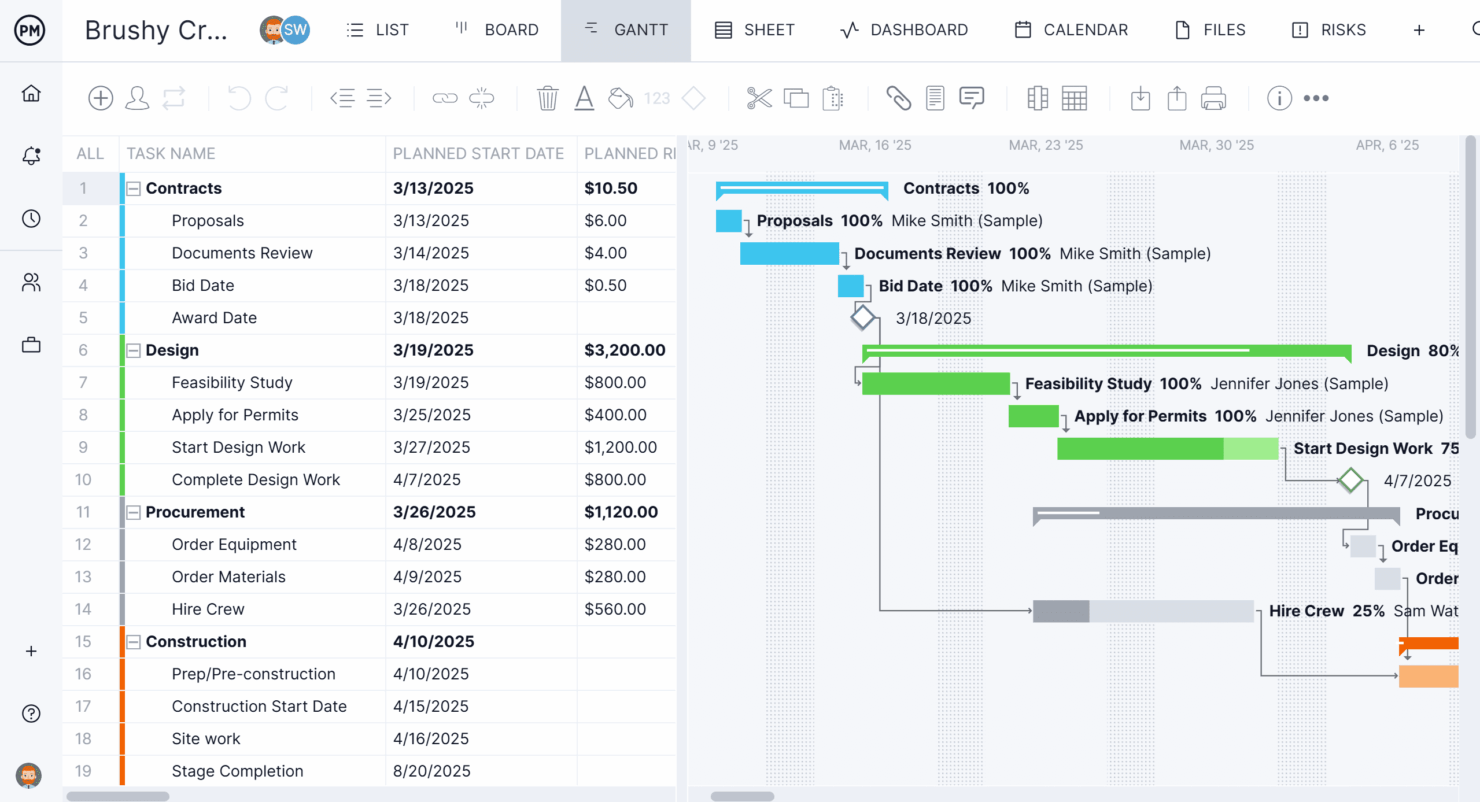
Gantt chart features let you filter for the critical path, track dependencies, and set baselines.
-
Detailed reporting tools let you monitor progress, resource allocation, and performance.
-
Built-in time tracking features simplify the process of logging time and monitoring productivity.
cons
-
It may lack some customization options compared to other tools.
-
The tool has a steeper learning curve than some competitors due to the extensive feature set.
-
The tool’s resource management capabilities are more limited than you would get in a dedicated resourcing tool.
-

Celoxis
Visit WebsiteThis rating combines scores from multiple user review sites to reflect overall customer sentiment about the product.4.5 -
Smartsheet
Visit WebsiteThis rating combines scores from multiple user review sites to reflect overall customer sentiment about the product.4.5 -
Accelo
Visit WebsiteThis rating combines scores from multiple user review sites to reflect overall customer sentiment about the product.4.4




Our Review Methodology
How We Test & Score Tools
We’ve spent years building, refining, and improving our software testing and scoring system. The rubric is designed to capture the nuances of software selection and what makes a tool effective, focusing on critical aspects of the decision-making process.
Below, you can see exactly how our testing and scoring works across seven criteria. It allows us to provide an unbiased evaluation of the software based on core functionality, standout features, ease of use, onboarding, customer support, integrations, customer reviews, and value for money.
Core Functionality (25% of final scoring)
The starting point of our evaluation is always the core functionality of the tool. Does it have the basic features and functions that a user would expect to see? Are any of those core features locked to higher-tiered pricing plans? At its core, we expect a tool to stand up against the baseline capabilities of its competitors.
Standout Features (25% of final scoring)
Next, we evaluate uncommon standout features that go above and beyond the core functionality typically found in tools of its kind. A high score reflects specialized or unique features that make the product faster, more efficient, or offer additional value to the user.
We also evaluate how easy it is to integrate with other tools typically found in the tech stack to expand the functionality and utility of the software. Tools offering plentiful native integrations, 3rd party connections, and API access to build custom integrations score best.
Ease of Use (10% of final scoring)
We consider how quick and easy it is to execute the tasks defined in the core functionality using the tool. High scoring software is well designed, intuitive to use, offers mobile apps, provides templates, and makes relatively complex tasks seem simple.
Onboarding (10% of final scoring)
We know how important rapid team adoption is for a new platform, so we evaluate how easy it is to learn and use a tool with minimal training. We evaluate how quickly a team member can get set up and start using the tool with no experience. High scoring solutions indicate little or no support is required.
Customer Support (10% of final scoring)
We review how quick and easy it is to get unstuck and find help by phone, live chat, or knowledge base. Tools and companies that provide real-time support score best, while chatbots score worst.
Customer Reviews (10% of final scoring)
Beyond our own testing and evaluation, we consider the net promoter score from current and past customers. We review their likelihood, given the option, to choose the tool again for the core functionality. A high scoring software reflects a high net promoter score from current or past customers.
Value for Money (10% of final scoring)
Lastly, in consideration of all the other criteria, we review the average price of entry level plans against the core features and consider the value of the other evaluation criteria. Software that delivers more, for less, will score higher.
Core Features
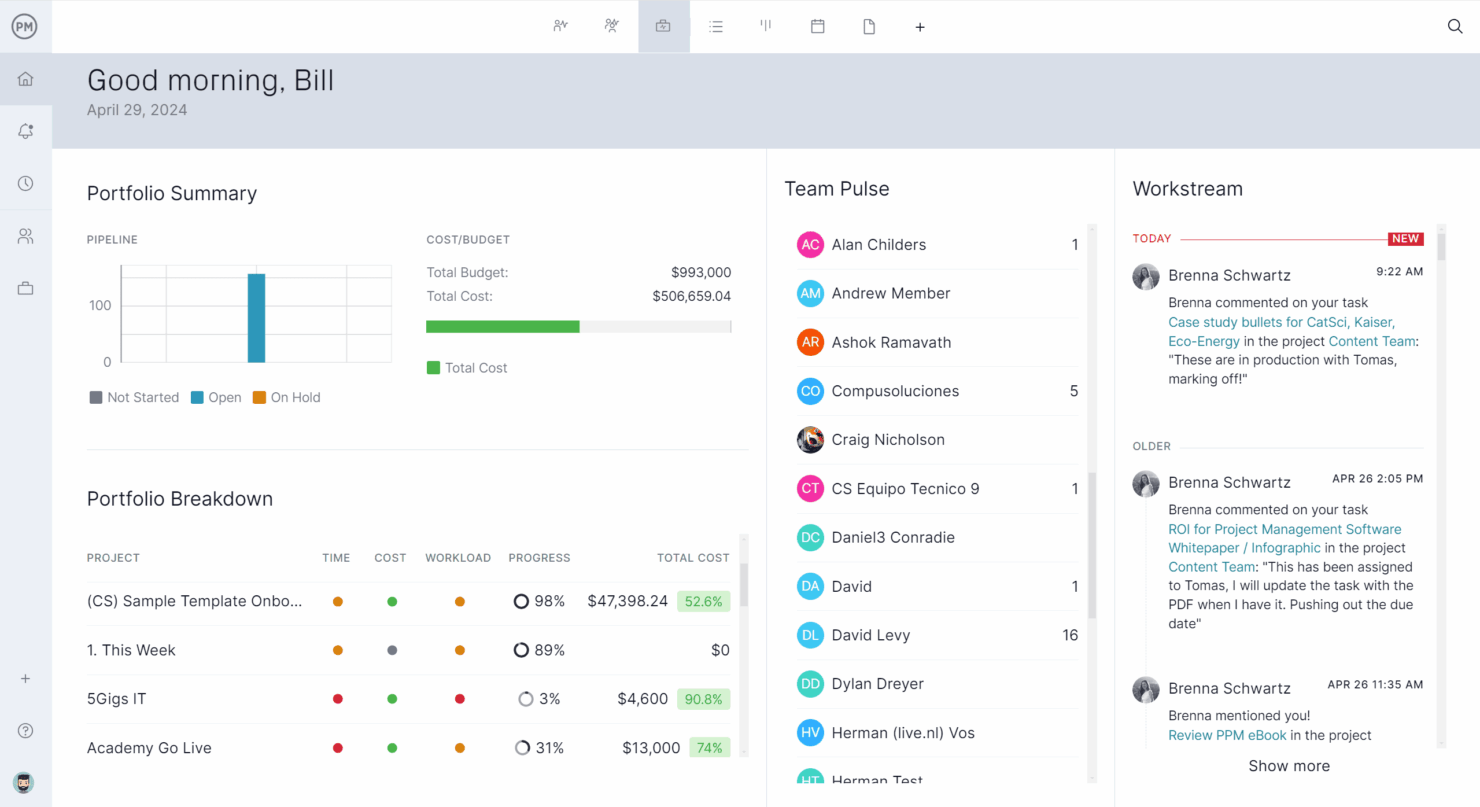
Task Management: You can easily assign tasks, set deadlines, and track progress to keep your team organized and on schedule. There are five project views you can use to help your team see what needs to be done at a glance: the task list view, Gantt chart view, Kanban board view, dashboard view, and calendar view.
Gantt Charts: ProjectManager’s Gantt charts let you filter for the critical path, track different dependencies, set baselines based on actual vs planned data, and see resource availability. This helps make sure nothing falls through the cracks and visualize the entire project lifecycle.
Resource Management: You can allocate resources efficiently with tools that let you see who's available and who's overloaded. This feature helps balance workloads and avoid burnout.
Reporting Tools: You can generate detailed reports to keep stakeholders informed on project status and performance. Use these insights to make data-driven decisions.
Time Tracking: ProjectManager lets your team track time spent on tasks so you can make sure projects stay within budget and deadlines. This helps you analyze productivity and manage time better.
Collaboration Tools: You can facilitate team collaboration with comments, workflow automations, guest licenses for external stakeholders or clients, and task approvals. These tools improve teamwork and streamline project updates.

Ease of Use
ProjectManager stands out for its user-friendly, intuitive interface that makes managing projects straightforward and accessible. The number of features can make for a bit of a learning curve, but your team can easily navigate features like task management and project scheduling.
The visual layout is clear and lets you see project timelines and dependencies at a glance. Some users find the mobile app less responsive, but the tool’s overall ease of use helps your team focus on delivering results.
ProjectManager Specs
- API
- Batch Permissions & Access
- Budgeting
- Calendar Management
- Collaboration Support
- Contact Management
- Contact Sharing
- Customer Management
- Dashboard
- Dashboards
- Data Export
- Data Import
- Data Visualization
- Dependency Tracking
- Document Sharing
- Expense Tracking
- External Integrations
- File Sharing
- Gantt Charts
- Kanban Boards
- Multi-User
- Notifications
- Project Management
- Resource Management
- Scheduling
- Task Scheduling/Tracking
- Third-Party Plugins/Add-Ons
- Time Management
- Travel Management
- Workflow Management
Alternatives to ProjectManager


ProjectManager FAQs
Can I customize workflows in ProjectManager?
How does ProjectManager handle data security?
Is there a mobile app for ProjectManager?
How can I track project progress in ProjectManager?
Does ProjectManager support agile project management?
Can I use ProjectManager for remote team collaboration?
How does ProjectManager handle resource management?
What kind of support can I expect from ProjectManager?
What's Next?
Want to connect with other digital project managers to share resources and best practices? Join our membership community and get access to 100+ templates, samples, and examples and connect with 100s of other digital project managers in Slack.