

The Project Resource Management Process: 5 Step Expert Guide


The project resource management process is the approach used to plan, acquire, allocate, monitor, and optimize project resources. Whether those resources are people, equipment, or materials, it ensures that you have the right things at the right time.
This guide will help you navigate the project resource management process, including practical examples that you can apply to your own projects.
What Is Project Resource Management?
Project resource management is the key PM function of forecasting, assembling, and managing the team members, equipment, and other materials needed to execute a project.

In the broader project management ecosystem, it acts as a bridge between project strategy and execution by aligning organizational capacity with project demands.
The Project Resource Management Process
In my 13 years of experience, I've come to determine what, in practice, are the five stages or processes involved in the resource management process (as opposed to the six stages described in the PMBOK). These include:
- Resource Planning
- Resource Estimation / Resource Allocation
- Resource Acquisition
- Team Development & Management
- Continuous Resource Evaluation
Step 1: Resource Planning
Resource planning is the process of determining what people, skills, tools, equipment, and budget are needed to complete a project successfully. Its goal is to ensure you have the right resources available at the right time—without overloading teams or creating delivery bottlenecks.
However, before you can estimate resources, you need to understand:
- the work being delivered,
- the timeline,
- the dependencies,
- and the level of expertise required.
| Questions You Need to Ask Yourself |
|---|
| What are the project deliverables? |
| What tasks are required to produce them? |
| Which skills are needed? |
| How much effort will each task require? |
| When does the work need to happen? |
Additionally, defining requirements also requires listening to what your stakeholders say they want, but especially what they aren’t saying.
Use your decision-making skills (one of many resource management skills) to read between the lines and ask intelligent questions. For example, if your stakeholders are insisting on a software engineer with 30+ years of experience to build a simple app, get curious about that. Would substituting a less seasoned developer with more in-depth knowledge of a newer programming language be a better fit? Why or why not?
At the end of the planning step, you should be able to understand what you need, when, and whether your timeline is realistically achievable.

Step 2: Resource Estimation / Resource Allocation
Resource estimation and allocation determine how much effort the project requires and who will realistically perform the work within the available timeline and budget.
In this stage, you'll need to:
- Estimate the work required
- Determine the skills needed
- Calculate available team capacity
- Assign resources based on priority and availability
- Adjust timelines or scope if capacity doesn’t match demand
Once you’ve identified what types of resources you need, there are many methods of resource allocation you can employ. In this stage, you’ll need to get more specific about resource scheduling. How much time will these people dedicate to project delivery?
You can approach this estimation in two main ways:
- Bottom-up: Estimate the number of hours required to complete each requirement and how many hours each person will need to contribute to each deliverable. This approach is best when the scope is well-defined, accuracy matters, and timelines are flexible.
- Top-down: If you have a fixed budget to work with based on your project management plan, start with this constraint and then allocate human resources based on the most critical roles required for project success. This approach is best when budget or deadlines are fixed,
- and tradeoffs must be made early.
Use my resource allocation spreadsheet template to speed up this process—it does the calculations for you so you can quickly see where your budget is being used.
To guide your allocation process, you may also consider creating a resource breakdown structure (RBS) — a hierarchical framework that categorizes all resources—human, material, and equipment—by type and function. It’s particularly useful for visualizing the full range of resources required and ensuring that nothing critical is overlooked.
If you’re not sure which roles are critical, interview colleagues who’ve executed similar projects in the past. Also, don’t be afraid to tap into your subject matter experts for their wealth of knowledge. They can certainly educate you about how many hours they need to do their best work.

Step 3: Resource Acquisition
Resource acquisition is the process of securing the people, equipment, tools, and materials needed to execute the project on time and within budget. The challenge is balancing speed, cost, availability, and skill fit—because the ideal resource is not always available when you need them.
Regarding human resources, here are two main ways to staff your projects:
- Hire internally. Mainly through your boss or relationships you've cultivated within your organization. Internal hires are faster to onboard, familiar with company workflows, and lower risk operationally. However, they may already be overallocated.
- Hire externally. Partnering with recruiting, a staffing agency, or getting employee referrals can be a great tool to attract new hires. Although for this last one you may need to structure your referral program to reduce bias. External hires can fill skill gaps quickly, bring specialized expertise, or increase capacity. However, they typically require more onboarding time and budget.
While it can be tempting to ignore red or yellow flags during the interview stage in the interest of getting ramped up quickly, be as deliberate as the project schedule permits to ensure you find the right person. It will save you hours of time later on.
In this step, you’ll also want to source the supplies you need for the project. Request quotes from multiple vendors and negotiate to find the best price. Consider using resource booking software to efficiently schedule and allocate shared resources, such as equipment or meeting spaces
Step 4: Team Development & Management
Team development and management focus on helping project resources work effectively together throughout project delivery. At this stage, the project manager’s role shifts from staffing the project to maintaining team performance, collaboration, accountability, and morale over time.
If you thought project planning, estimating, and acquiring resources was challenging, that’s nothing compared to how hard it is to develop and manage a team. You could dedicate an entire article to managing people, so here’s the TLDR; version: cultivate conditions that let people do their best work.
Effective team management includes:
- clarifying responsibilities,
- balancing workloads,
- removing blockers,
- resolving conflicts,
- tracking performance,
- and supporting collaboration across the team.
Keep in mind that as projects evolve, resource managers often need to rebalance workloads, adjust responsibilities, and adapt team structures to keep delivery on track.
Step 5: Continuous Resource Evaluation
Every new project starts with positive intention, but it can be difficult to think about lessons learned and metrics once you’re in the thick of it and getting barraged with stakeholder requests from every angle.
PMI calls this step “control resources.” I get the sentiment, but don’t love the connotation.
To make sure you don’t lose sight of performance, schedule periodic project health checks before your effort gets underway. As part of your health check, you’ll:
- Review actual hours/costs against estimated hours/costs (you can do this in Excel or the free resource management tool of your choice)
- If you’re noticing staff overallocation and don’t see a way to course correct, inform your clients of resource utilization status so this doesn’t come as a surprise later on. Also, share your ideas about how to reduce spend to get back on track.
- Regularly engage with your project team to ensure they are aligned with work they find valuable
- Be on the lookout for work that has shifted from plan. Identify opportunities to make more cost-effective substitutions that increase staff motivation while reducing project costs.
- Conduct periodic agile retrospectives to revise and update project processes based on learnings.
Project Resource Management Process Example
Now that we’ve got the steps down, let’s apply this methodology to the following example:
"You’re a project manager tasked with delivering training to government officials in the next six months."
To keep it simple, I used spreadsheets for this exercise, but any resource management tool will do.
Step 1: Resource Planning
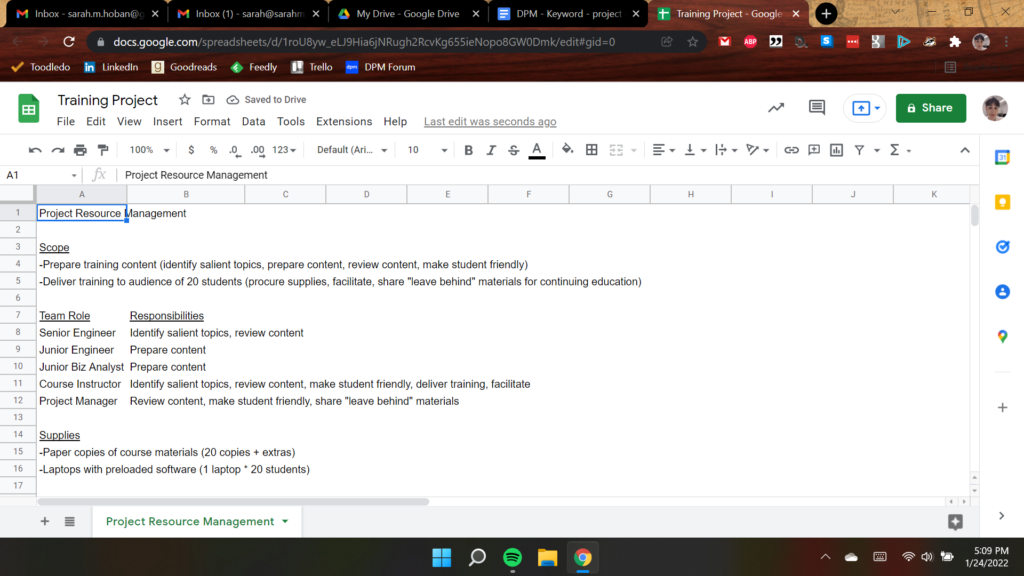
- Document your understanding of the project scope in a project scope statement, based on available documentation, interviews, etc. and validate with your stakeholders
- Based on the project scope, identify the types of people that you’ll need to execute the project work, along with their proposed responsibilities by role
- List the supplies you’ll need to execute the training
- If you're planning resources for multiple projects at once, organize them by priority
Step 2: Resource Estimation / Resource Allocation
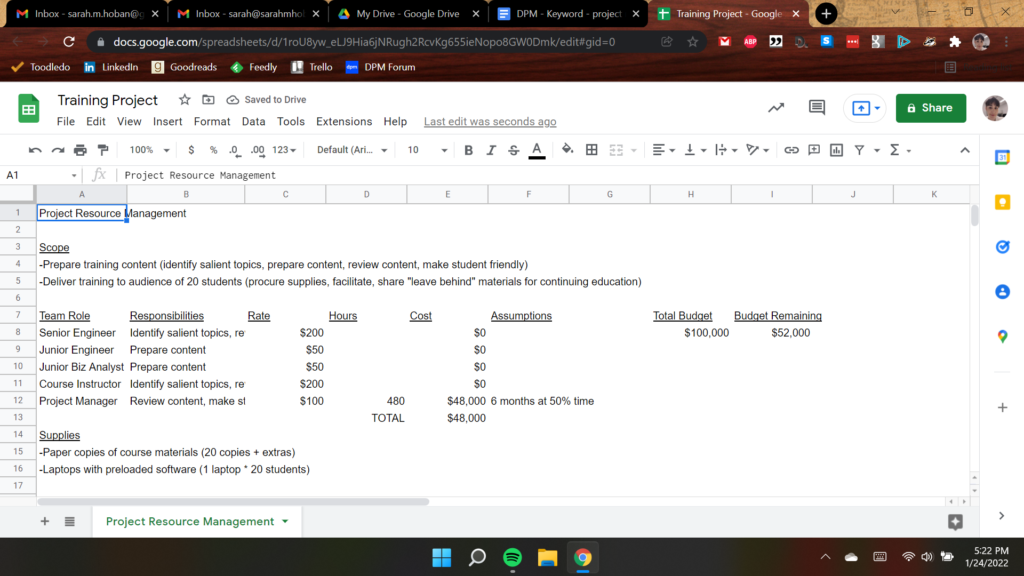
- Let’s imagine your client is giving you a $100,000 budget for this training, the project duration is six months, and the client wants the project manager to allocate 50% of their time to this engagement. Assume ballpark hourly rates for each position, document your assumptions, and run the numbers.
- When you do the math, you can see that, based on your client’s request, roughly half your budget is going to your PM. Reflect on whether that makes sense based on your prior experience. I decide that it is—given this training is for high-profile individuals and requires technical content development, I’m guessing I’ll be pretty hands-on.
- Then, estimate activity resources for the remaining roles and document your assumptions. Don’t forget to reserve 10% for contingency.
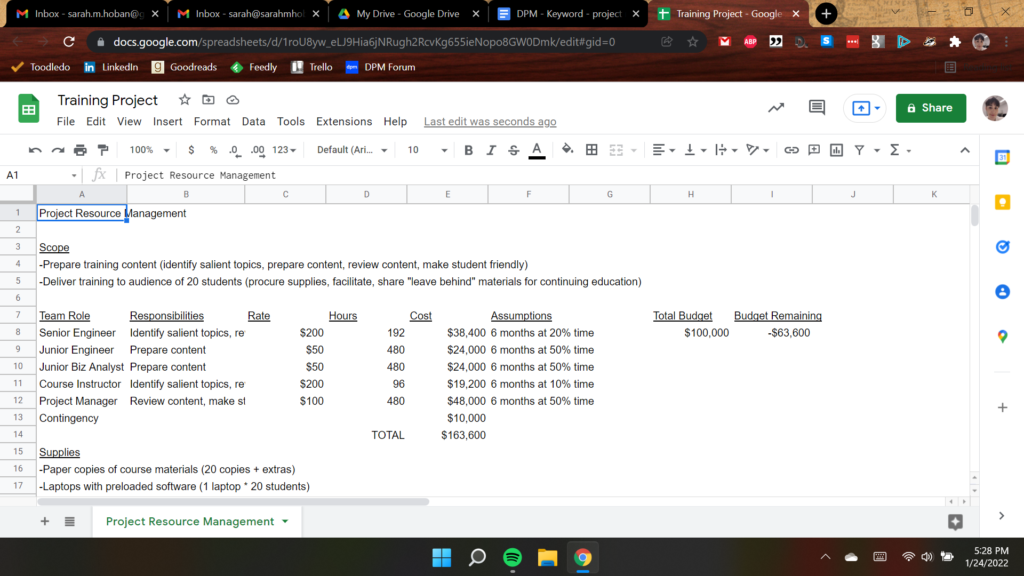
- In my first attempt, I come out $60,000 over budget. Yikes. This means I’ll need to figure out how I can cut costs through resource leveling.
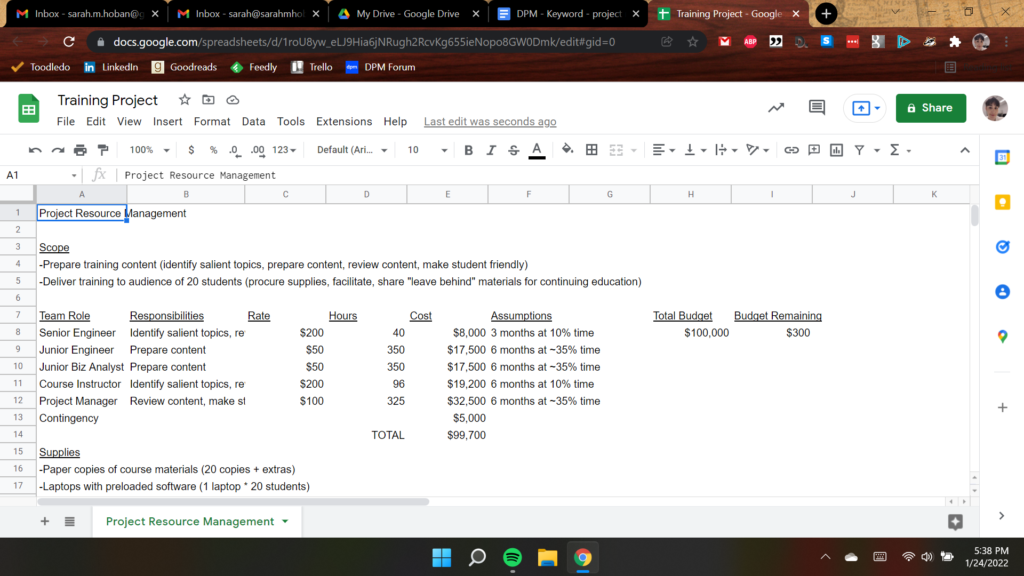
- I have my senior engineer at 20% of their time throughout the project, but I probably only need them in the first month to help identify course topics and again in months 4 and 5 to review the content. Also, I probably only need them 1 day a week on average, rather than 2 days. I shave $30,000 from my budget.
- I adjust the remaining hours based on what I think I can live with. I have to cut PM hours to 35% and reduce the contingency from 10% to 5% to balance the budget. That only leaves $300 for supplies. It’s going to be tight.
- I have my senior engineer at 20% of their time throughout the project, but I probably only need them in the first month to help identify course topics and again in months 4 and 5 to review the content. Also, I probably only need them 1 day a week on average, rather than 2 days. I shave $30,000 from my budget.
- At this point, I’ll typically go back and have a conversation with the client about ways to reduce project scope. This might mean shortening the training to 3 days instead of 5 to save on instructor and analyst time, reducing the number of participants to cut supply costs, or altering course content so that a senior engineer is no longer required.
Step 3: Resource Acquisition
I’ll use a combination of techniques to staff this engagement based on resource availability:
- Internal Hire: The junior engineer and junior business analyst are easy. I have two rock stars on my team that work well with me and are looking for a challenge. I can even train the analyst to pick up some of my project management duties over time to realize cost savings. After a quick conversation to confirm their interest and availability, they’re in.
- External Hire: The senior engineer is tricky to fill. Internal candidates are scarce, and it’s hard to hire someone externally with such a niche skill set. Luckily, someone in my network knows a former employee who would be willing to pitch in on an hourly basis. After filling out some paperwork, we’re in business.
- Contract Position: The client already has a course instructor in mind. I engage with my recruiting team and senior engineer to interview this candidate and then work with procurement to engage them on a part-time basis. I won’t need to do this type of training again in the future, so it doesn’t make sense to pursue a full-time hire.
Step 4: Team Development & Management
Outside of recurring team meetings, I set up weekly 1:1s with the people on the project that I am managing. We discuss their challenges, aspirations, and how I can help them stay motivated and best recognize them for their contributions.
For those that I don’t manage directly, I set up a monthly conversation to make sure they are satisfied with the project and to surface any feedback they may have for me about how to improve.
Because I take the time to get to know their career objectives and because I am transparent with them about their performance and how they can improve, they trust me enough not only to do their best work but also to give me the feedback I need to become a better manager.
Step 5: Continuous Resource Evaluation
Even though the project is burning hot to start, as I reconcile my monthly budget, I’m gradually finding that my coaching is paying off, and I’m having to spend less time on project delivery. As the analyst assumes more project management duties, it becomes easier for us to meet our initially tight budget.
We also establish monthly agile retrospectives where we discuss and document lessons learned, which we review before beginning each new deliverable. Doing so helps us reduce the number of hours we spend on each training module.
We’re able to include an extra module without incurring additional costs, a gesture of goodwill that motivates our clients to engage us for an even bigger project next year.
Why Is Project Resource Management Important?
Effective resource management can transform your project from an unholy mess to a walk in the park. While it’s possible to deliver a project without a plan and staffed by people ill-suited to or unmotivated by the work, I wouldn’t recommend it. The project is needlessly challenging, and the environment is downright unpleasant.
If done correctly, developing an effective resource management plan benefits the project manager, the team members, the stakeholders, and the business.
- The project manager has an easier job managing the project if the work, estimated level of effort, and skill sets required are scoped appropriately at project initiation
- Team members are motivated by and engaged in their work, improving productivity and reducing turnover
- Meeting, or even exceeding, stakeholder expectations becomes easier if the project is scoped and staffed with the right resources
- Successful project delivery promotes continued growth via requests for new or repeat business.
Read more about why resource management is important here.
How Can Resource Management Software Help?
While it's possible to conduct resource planning using Excel, doing so requires manual data entry and constant updating. By investing in resource management software, you unlock a whole host of automated features that can save you time and reduce the risk of errors.
So, what should you look for in a resource management tool? Helpful features include real-time resource tracking, skill matching, and workload balancing. Capacity planning tools, a related type of software, can help you balance tasks to prevent overworking your team and gather feedback to ensure continuous improvement.
Many tools also integrate seamlessly with other project management software you may already be using, allowing you to get a holistic view of project progress and resource utilization rates.
Looking for the right resource management tool? Check out this resource management software demo guide to help you make an informed decision.
-

Float.com
Visit WebsiteThis rating combines scores from multiple user review sites to reflect overall customer sentiment about the product.4.4 -
Saviom
Visit WebsiteThis rating combines scores from multiple user review sites to reflect overall customer sentiment about the product.4.3 -
Retain
Visit Website





What’s Next?
Want to master the finer points of resource management? Check out expert-created training from DPM School, or one of these top resource management courses.


