How To Write An Easy Project Scope Statement: 5 Steps + Tips 2026


Getting the project scope statement right is important because it helps teams align on deliverables, timelines, responsibilities, and project expectations before work begins. Without a clearly defined scope, projects can quickly run into confusion, misaligned expectations, scope creep, delayed approvals, and budget overruns.
What Is A Project Scope Statement?
A project scope statement is a documented description of a project's scope, including its major objectives, deliverables, exclusions, constraints, and assumptions. The statement serves as the foundational reference for all project decisions.
A project scope statement answers the question every project must answer before work begins: what exactly are we building, delivering, or achieving, and what are we explicitly not doing. Project scope statements are usually found within a Statement of Work (SoW) but can also exist independently to provide details for a project estimate.

60 seconds on keeping your project on track here:

Key Components Of A Project Scope Statement
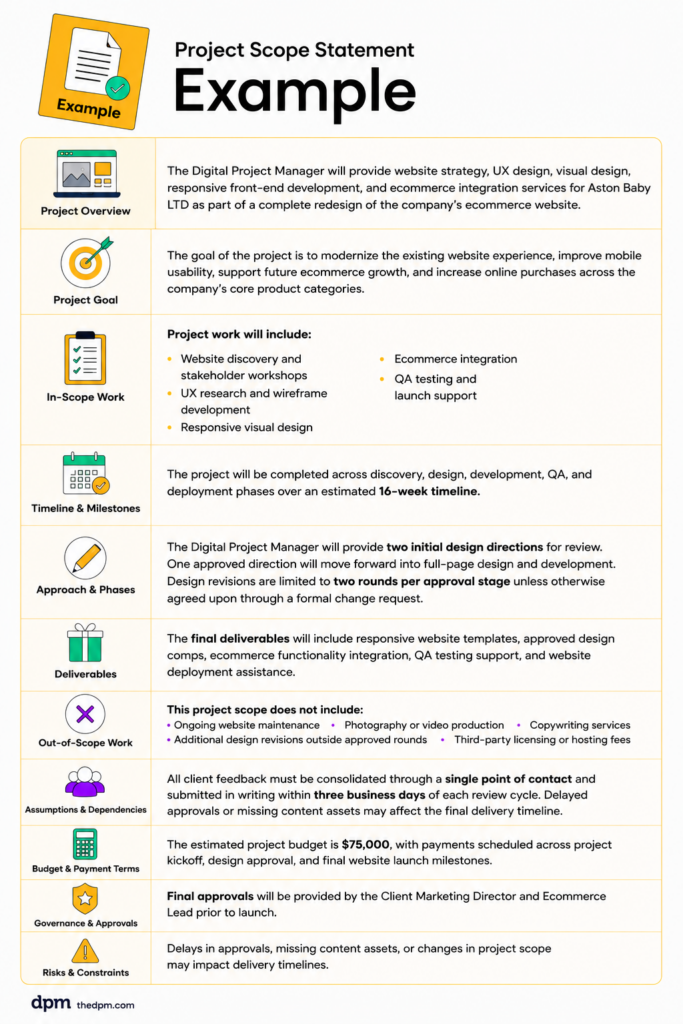
A project scope statement defines the boundaries of the project, including what the team will deliver, how the work will be completed, and what is excluded from the project. The key components of a project scope statement include:
| Scope Statement Component | What to include |
|---|---|
| Project overview | A short summary explaining what the project is, why the project is happening, the business need, and the overall project goal |
| In-scope work | The final outputs, assets, products, or services that the project team will produce |
| Out-of-scope work | Deliverables, requests, features, or activities specifically excluded from the project to prevent scope creep |
| Project deliverables | The final outputs, assets, products, or services the project team will produce |
| Project approach and phases | How the project will be completed, including workflows, methodologies, phases, major tasks, or implementation approach |
| Timeline and milestones | Key project deadlines, milestones, launch dates, approvals, and delivery schedules |
| Budget and payment schedule | Project estimates, budgets, payment terms, billing schedules, or financial assumptions |
| Assumptions and dependencies | Project assumptions, dependencies, conditions, or external factors affecting project delivery |
| Governance and approvals | Stakeholders, approvers, decision-makers, escalation paths, and approval responsibilities |
| Clarifications and exclusions | Additional notes, clarifications, definitions, or exclusions needed to avoid misunderstandings about the scope of work |
Project Scope Statement Sample
Below is an example of a simplified project scope statement for a website redesign project.
5 Steps To Create A Project Scope Statement
Here are five steps to write a bulletproof project scope document, along with plenty of examples showing how to implement them.
1. Start With A Clear Project Overview
This high-level scope statement defines what the project is, why it’s happening, and what it will achieve. Start the scope statement with a concise summary explaining:
- What the project is
- Why the project is happening
- The business goal or objective
- The value the project is expected to deliver
This section should provide enough context for stakeholders to understand the purpose of the project before reviewing detailed deliverables or timelines. Make sure to:
- Keep it short. You’ve sold the project—now we’re just teeing up the details.
- Add in any KPIs accountable within this agreement.
I suggest having your account manager or salesperson write this part if they are in the picture.
Project Scope Statement Overview Examples

Bad Example of Project Scope
The Digital Project Manager will create a new site for Aston Baby LTD. The site is to be live in 2025 and reflect the company's product offerings for purchase online.
Better Example of Project Scope
- This SoW aims to align the Client’s website presence with the retail sales growth and business objectives (the “Project”).
- The Digital Project Manager will provide complete website discovery, comprehensive user experience (“UX”), creative redesign and development of the new Aston Baby LTD website.
- The project's primary goal will be to express the brand’s position and personality while enhancing visitor interactions and engagement.
- The Digital Project Manager will work with Aston Baby LTD to expand existing website functionality to include:
- Ecommerce: Ability for visitors to purchase baby products directly on the website.
- Expanded support for 3 product sub-categories.
- Increase branded content presence on the Aston Baby LTD website, including the integration of social, video, photos, videos, etc.
Notice how this better project scope example already defines the project vision that can be used to align the project team and your client. I would circle back to this as you continue to search and ensure you’re providing value to your clients.
2. Define Deliverables And Milestones
Next, clearly define what will be delivered, when it will be delivered, and in what format.
Be specific about:
- Deliverables
- Platforms or devices included
- Number of revisions
- Timelines and milestones
- Dependencies
Avoid vague language wherever possible. The more detailed your deliverables are, the easier it becomes to manage expectations and avoid scope creep later. For example, if you’re providing wireframes—are you providing them for the entire desktop and mobile experience? Just tablet? How many templates? How many screens?
Project Deliverables Examples
Bad Project Deliverables Example
The Digital Project Manager will provide up to 2 rounds of designs for the website.
Better Project Deliverables Example
The Digital Project Manager will design the look and feel of the [Name of client] website through the following deliverables.
Design deliverables:
Design Directions (Meeting & InVision)
The Digital Project Manager will create 2 unique Design Directions evidenced through a single page of the [Name of client] website. Each direction will be designed in full for a tablet viewport. The client will choose (1) direction to move forward with (includes 1 round of revisions).
Design Comps (Meeting & InVision)
Based on approved design direction, wireframes, and page tables, The Digital Project Manager will provide design comps for all key pages and modules as required for the [Name of client] website in the tablet viewpoint. This allows for rapid production of pages in development. Please note that the designs presented in this stage will include lorem-ipsum copy as placeholder, representing suggested placement and length. The Digital Project Manager will include for placement only (i.e., FPO) imagery, representing the suggested style/tone/topic of imagery the page/module should contain. As appropriate, The Digital Project Manager will leverage existing imagery from the [Name of client] asset library and include it within design comps (includes up to 2 rounds of revisions).
3. Outline The Approval Process
A strong project scope statement should explain how reviews, approvals, and feedback will work throughout the project lifecycle.
Define:
- Who provides feedback
- How feedback should be submitted
- Approval timelines
- Stakeholder responsibilities
- Review processes
This creates accountability and prevents delays caused by fragmented or late feedback. Typically, I include this language under the 'dependencies and assumptions' section. Then, I have a verbal conversation with the client(s) to ensure we have alignment on the expected feedback/approval process.
Approval Process Scope Example
Bad Approval Definition Statement
(In an out-of-the-blue email to the client after the first round of review) “Any feedback for us?”
Better Approval Definition Statement
Dependencies & Assumptions:
- All feedback from the client must be in a written and consolidated format and come from the single point of contact, [Name of contact].
- The client must ensure all necessary and appropriate stakeholders are available to participate in necessary creative and technical reviews.
4. Clarify Inclusions and Exclusions
One of the most important parts of a project scope statement is defining what is included and excluded from the project. This section helps:
- Prevent scope creep
- Reduce disputes
- Improve budget control
- Set realistic expectations
Here’s a project scope example with some of my favorite statements. Feel free to pick and choose from it. Obviously, curate this list to be unique to your project.
Examples of Inclusions in Project Scope Statements
Here are 14 example statements that clarify generic dependencies and assumptions within your project scope:
- All feedback must be written and consolidated by the Client and come from one point of contact [name here].
- The Client must ensure all necessary and appropriate stakeholders are available to participate in necessary creative and technical reviews in accordance with the creative project workflow.
- Upon completion of the Discovery Work Session, [Your company] will evaluate project objectives & key performance indicators against listed deliverables to ensure project requirements are met. If needed, [Your company] will issue a Change Order to this SoW reflecting the shift in deliverables for the Client’s signature.
- Any structural changes to design once the Development Phase has begun will constitute a scope change to both budget and schedule.
- The [Name of client] online store will leverage an existing third party such as Shopify, Gocart, etc. to be mutually determined prior to development kickoff.
- This scope is based upon the understanding that there will be no more than 20-24 unique modules.
- A detailed timeline will be published upon signature to this work order.
- If Client elects to approach this Project with two or more deployments, a Change Order will be issued with additional costs for the additional QA & development staging time required.
- If Client elects to cancel the Project or put the Project on hold for longer than 60 days, Client will pay for work completed to date plus a 10% kill fee on the remainder of the Project scope.
- The client is responsible for all production design.
- Agency retains the right to reproduce, publish and display project details in its portfolios and websites, and in galleries, design periodicals, and other media or exhibits for the purposes of recognition of creative excellence or professional advancement, pending written approval by Client.
- Full access to hosting environment(s) and technology platforms including related third-party services such as analytics tools.
- Access to all necessary functional specifications and/or data sources.
- [Your company] will build the site according to the WGAC 2.0 Level A accessibility guidelines. Although comprehensive audit-compliance is not in-scope, [your company] will work alongside the client to ensure that any critical compliance issues are resolved within the approved timeline.
Project Scope Exclusion Examples
If you want to be able to use your resource management software properly (and avoid having a client-induced brain aneurysm in the process), you also need to clarify what you won't do.
Here are 12 project scope sample exclusions that clarify out-of-scope items:
- Any deliverables, activities, core functionality, or rounds of revisions beyond what is outlined here will constitute a scope change and subsequent change request to both budget and schedule. This includes development collaboration endeavors if the levels of effort deviate outside the original estimate.
- Support of operating systems and browsers that is not explicitly stated above.
- CMS Training Documentation ([Your company] provides basic training for implementation and key leave-behind document).
- All branding and/or identity work explorations.
- Usability testing.
- Support, maintenance, tracking, and measurement of the live site once it has been deployed.
- Liabilities for third parties and service partners.
- Licensing and hardware costs.
- Photography, music, video production ,and talent costs.
- Hosting, font, and service fees.
- Detailed digital style guide or UI kit.
- Photo asset production and image post-production services (touch up and color correction).
- Product/lifestyle imagery production design.
5. Create A Scope Tracking System
For larger or more complex projects, create a system for tracking approvals, deliverables, reviews, and scope changes throughout the project.
Many project managers use:
- Scope matrices
- Review trackers
- Approval logs
- Project management software
5 Tips And Tricks For Defining Scope Statements
Even with a well-written project scope statement, unclear expectations and vague assumptions can still create confusion later in the project. Use the following tips to create clearer, more actionable scope statements that are easier for stakeholders and project teams to follow.
1. Avoid Ambiguous Language
Vague language creates misunderstandings and makes it harder to manage scope changes later in the project.
Instead of writing:
- “Design support included”
- “Website updates as needed”
- “Additional revisions if required”
Define:
- The exact deliverables
- Number of revisions
- Supported platforms or templates
- Specific project phases or responsibilities
The more specific your scope statement is, the easier it becomes to manage expectations.
2. Define What “Done” Looks Like
Clearly explain how deliverables will be reviewed, approved, and finalized.
This helps avoid situations where:
- Stakeholders continue requesting revisions indefinitely
- Teams disagree on completion criteria
- Deliverables remain stuck in review cycles
Define:
- Approval stages
- Acceptance criteria
- Revision limits
- Sign-off requirements
3. Document Assumptions Early
Many project issues happen because teams assume something is included without documenting it clearly.
Use the scope statement to document assumptions around:
- Content delivery
- Stakeholder availability
- Third-party tools
- Integrations
- Access to platforms
- Approval timelines
If the project depends on something external, include it in writing.
4. Plan For Scope Changes
Even strong scope statements cannot prevent every change request. Projects evolve, priorities shift, and stakeholders often request additional work after kickoff.
Instead of trying to avoid scope changes entirely, define:
- How change requests will be handled
- Who approves scope changes
- How timeline or budget impacts will be assessed
- When additional estimates or change orders are required
This creates a structured process for handling changes without disrupting the project unnecessarily.
5. Keep The Scope Statement Easy To Scan
A scope statement should be detailed, but it should also be easy for stakeholders to review quickly.
Use:
- Clear headings
- Bullet points
- Tables
- Short paragraphs
- Defined sections
Avoid overly legal or complicated language unless required by your organization or contract structure.
FAQs
Why are scope statements important?
The project scope is important because it defines the extent of your work based on how much you are being paid to do it. Here are a few other reasons:
-
- Stakeholders and clients want to know what they’re paying for. Projects, by their very nature, have constraints. Stakeholders want to know the boundaries of the project, the process that will be followed, the participants, and how the work breakdown structure (WBS) translates into actual work delivered (the deliverables).
-
- Your scope statements will be your saving grace when (not if) things go off the rails. Not to get weird and heavy, but these statements can make or break a lawsuit. It can make or break a client relationship—or your job. A lazily-written scope statement can ruin your chances of project success before the project even starts.
-
- It defines the grey areas in your project. If you don’t know the ins and outs of the scope of work for your project, you will be brewing tension the whole way and dealing with scope creep.
Is a project scope statement the same as a statement of work (SoW)?
No. A project scope statement is usually one part of a larger Statement of Work (SoW). Here are the differences between the two:
| Aspect | Project scope statement | Statement of Work (SoW) |
|---|---|---|
| Primary purpose | Defines project boundaries and deliverables | Defines the full commercial and project agreement |
| Main focus | Scope, assumptions, exclusions, and deliverables | Scope, pricing, legal terms, timelines, and responsibilities |
| Usage | Clarifies what is and isn’t included in the project | Governs the overall working relationship |
| Format | Can exist as a standalone document | Often contains the project scope statement within it |
What’s the difference between a project scope statement and a project proposal?
A project proposal is typically used before project approval, while a project scope statement is used after the project is approved.
| Aspect | Project proposal | Project scope statement |
|---|---|---|
| Project stage | Created before project approval | Created during planning or kickoff |
| Primary purpose | Helps pitch or win the work | Helps define and manage the work |
| Main focus | Solutions, pricing, and business value | Scope, deliverables, timelines, and project boundaries |
| Audience | Decision-makers evaluating the proposal | Teams and stakeholders managing project delivery |
What’s the difference between a scope statement and a scope management plan?
A scope statement defines the actual project scope, while a scope management plan explains how the project scope will be managed and controlled throughout the project.
| Aspect | Scope statement | Scope management plan |
|---|---|---|
| Primary purpose | Defines project deliverables and scope boundaries | Defines how scope will be managed and controlled |
| Main focus | What is included and excluded from the project | How scope changes, approvals, and validation will be handled |
| Content | Deliverables, assumptions, exclusions, timelines, and constraints | Scope control processes, approval workflows, and change management procedures |
| Usage | Helps stakeholders understand project expectations | Helps teams manage scope throughout project execution |
| Project phase | Created during project planning | Created during project planning and governance setup |
| Goal | Prevent misunderstandings about project work | Prevent uncontrolled scope changes and scope creep |
What’s the difference between a project scope statement and a project charter?
A project charter formally authorizes the project and defines the high-level business objectives, while a project scope statement defines the detailed project boundaries, deliverables, and expectations.
| Aspect | Project charter | Project scope statement |
|---|---|---|
| Primary purpose | Officially authorizes the project | Defines the detailed project scope and deliverables |
| Project stage | Created during project initiation | Created during project planning |
| Main focus | Business goals, stakeholders, budget, and project authority | Scope boundaries, deliverables, timelines, assumptions, and exclusions |
| Level of detail | High-level overview | More detailed and execution-focused |
| Audience | Sponsors, executives, and leadership stakeholders | Project teams, clients, and delivery stakeholders |
| Usage | Confirms project approval and direction | Helps manage expectations and prevent scope creep |
What other documents are commonly used alongside a project scope statement?
Project teams often use additional project and legal documents throughout the project life cycle to define responsibilities, protect confidential information, and manage service agreements.
Common examples include:
- NDA (Non-Disclosure Agreement): Protects confidential information shared between both parties before or during project discussions.
- MSA (Master Service Agreement): Defines the long-term legal and commercial relationship between the client and service provider and usually governs future project engagements before individual Statements of Work are created.
- ICA (Independent Contractor Agreement): Defines the working relationship, responsibilities, and legal terms for freelancers, contractors, or external service providers.
- SLA (Service-Level Agreement): Defines hosting, maintenance, support, uptime, or service commitments between the client and service provider.
- Contracts: Define legal responsibilities, payment terms, liabilities, and obligations between both parties.
- Project proposals: Outline the proposed solution, pricing, approach, and business value before project approval.
Can a project scope statement be updated after the project starts?
Yes. Scope statements are often updated when project requirements, timelines, deliverables, or priorities change.
However, any scope changes should follow a documented change management process that explains:
- What is changing
- Why the change is needed
- Timeline impacts
- Budget impacts
- Required approvals
Is a project scope statement legally binding?
A project scope statement on its own may not always be legally binding unless it is included within a signed contract or Statement of Work.
However, scope statements are still important because they document:
- Project expectations
- Deliverables
- Scope boundaries
- Approval processes
- Responsibilities
Many teams include the scope statement within legally binding project agreements.
What's Next?
Want to connect with other digital project managers to share resources and best practices? Join our membership community and get access to 100+ templates, samples, and examples and connect with 100s of other digital project managers in Slack.
NOTE: None of the above is intended as professional legal advice, and I’m not qualified to give any kind of legal counsel. If you do not have templates that cover these non-SoW items, I highly encourage you to check out the project templates in our Membership area and customize them as you see fit with the help of legal counsel.