

12 Best Resource Management Courses to Upskill in 2026

Balancing team capacity, managing competing priorities, and keeping projects on track requires more than instinct. I sifted through the available resource management courses to find options that cover the skills project managers actually need—from forecasting and allocation to workload planning—so you can find the right fit for your experience level and goals.
DPM School Spotlights
Master RACI Charts - DPM School
Best for: Project managers clarifying ownership across teams

Our DPM School mini course teaches you to build and refine RACI charts, helping clarify who owns project work and decisions. Templates and examples support practical role mapping for your projects.
What you’ll learn: Decide when to use a RACI chart, create one, review examples, optimize role assignments, and compare alternatives.
Course details:
- Format: Self-paced, on-demand video with a downloadable resource pack
- Duration: Under 60 minutes; 12 months’ access for individual purchases
- Level/prerequisites: Beginner; no prerequisites required
- Price: $49 USD per course; also included with paid DPM membership
- Assessment: Optional quiz available by email for the microcredential
- Certificate/credits: DPM microcredential available after completing the course and quiz; course-specific PMI PDUs not verified
Considerations: The course focuses on RACI and role clarity rather than a full stakeholder-management curriculum.
Other DPM School Courses
This DPM School mini course complements resource management training with practical support for cross-functional team collaboration. It uses an on-demand video lesson and downloadable resources, with access through individual purchase or paid DPM membership. A quiz-based DPM microcredential is optional.
| Mini course | Best for | Learning outcomes | Price |
|---|---|---|---|
| Master Cross-Functional Team Cohesion | Project leads improving team collaboration | Assess team dynamics; align shared goals; build accountability; address cohesion challenges | $89 USD |
12 Best Resource Management Courses
Below are my summaries of the best resource management courses. My reviews offer a look at each course’s learning objectives, best fits, cost, and more.
1. Resource Management Certified Professional (RMCP)® - Resource Management Institute
Best for: Resource managers seeking a dedicated RM certification


The RMCP® from the Resource Management Institute is the only certification built exclusively around resource management as a discipline. It combines structured instruction with case studies across six core RM competency areas, earning you a globally recognized credential.
What you'll learn: How to manage a skills inventory, match staff to project demand, forecast resource supply, source talent to fill gaps, and govern RM processes consistently.
Course details:
- Format: In-person (3-day classroom), live virtual instructor-led (six 2-hour sessions), or self-paced on-demand
- Duration: 3 days (in-person); ~12 hours over ~3 weeks (virtual); ~8.5 hours of content within a 90-day access window (on-demand)
- Level/prerequisites: Intermediate to advanced; 2–4 years of relevant professional experience required depending on educational background
- Price: $1,995 USD per learner for in-person or virtual instructor-led; $1,895 USD for on-demand; includes a non-refundable $250 registration fee
- Assessment: Exam required to earn the RMCP® credential; included in the program fee
- Certificate/credits: RMCP® professional certification with a unique credential number and digital badge via Credly; certification is valid for 2 years
Considerations: The 90-day completion window for the on-demand format is a firm deadline, so plan your schedule before you register.

2. Introduction to Resource Management - Resource Management Institute
Best for: New resource managers building foundational RM skills

The Resource Management Institute (RMI) offers Introduction to Resource Management as a self-paced video course built around its own Just-in-Time Resourcing® methodology. It's designed for professionals new to resource management in consulting or IT organizations, making it a focused starting point before pursuing the RMCP® certification.
What you'll learn: Identify foundational resource management concepts, characterize resource supply and demand, process staffing requests, forecast future demand, and understand governance and technology's role in resource management.
Course details:
- Format: Self-paced, on-demand video; individual access only—group viewing is not permitted
- Duration: 90-day access from purchase date
- Level/prerequisites: Designed for professionals new to resource management; prerequisites not specified
- Price: $499 USD per person; a $250 rebate is available if you complete the RMCP® certification within 24 months of completing this course
- Certificate/credits: Certificate details not published; course qualifies for the RMCP® rebate upon completion
Considerations: The 90-day access window is shorter than many comparable courses, so it's worth enrolling when you have dedicated time to complete it.
3. Project Resource Management - LinkedIn Learning
Best for: Project managers who want a quick RM skills refresher

LinkedIn Learning's Project Resource Management, taught by Claudine Peet, covers the full resource lifecycle in just over an hour. Its 4.7/5 rating from 3,270+ learners, plus coverage of both agile and waterfall resourcing, reflects its broad, practical appeal.
What you'll learn: How to plan and estimate project resource needs, acquire internal and external team members, assess skill gaps, resolve resourcing conflicts, and coordinate team performance through project close.
Course details:
- Format: Self-paced online video; includes quizzes, exercise files, and AI-powered role-play simulations
- Duration: 1 hour 3 minutes of video content
- Level/prerequisites: Intermediate; no prerequisites specified
- Price: LinkedIn Learning subscription required: $39.99 USD/month or $239.88 USD/year; 1-month free trial available for new subscribers
- Assessment: 6 quizzes included throughout the course
- Certificate/credits: Certificate of completion, shareable to your LinkedIn profile; continuing education units (CEUs) available
Considerations: Access requires an active LinkedIn Learning subscription, so if your employer doesn't cover it, you'll pay an ongoing fee for what is a single hour of content.
4. Resource Management Strategies for Reaching Business Goals - LinkedIn Learning
Best for: Managers aligning resource planning with business goals

Resource Management Strategies for Reaching Business Goals is a LinkedIn Learning course taught by Andrea Davis. It takes a strategic view of RM, linking allocation decisions directly to business outcomes rather than focusing on project-level execution.
What you'll learn: How to align resources with business goals, forecast and plan resource needs, monitor utilization, leverage technology, and manage risk in resource allocation.
Course details:
- Format: Self-paced online video; includes 1 exercise file; accessible on desktop and mobile with offline download via the LinkedIn Learning app
- Duration: 42 minutes of video content
- Level/prerequisites: General; no prerequisites specified
- Price: LinkedIn Learning subscription required: $39.99 USD/month or $239.88 USD/year; 1-month free trial available for new subscribers
- Certificate/credits: Certificate of completion, shareable to your LinkedIn profile; continuing education units (CEUs) available
Considerations: At 42 minutes, the content is intentionally high-level, so if you need depth on any specific topic — forecasting, risk, or technology — you'll need to supplement it with additional learning.
5. Planning and Managing Resources - eCornell
Best for: Project managers refining resource planning with Ivy League depth

eCornell's Planning and Managing Resources is an instructor-led Cornell University course grounded in engineering systems thinking. It addresses why projects routinely run over schedule and what project managers can do about it, covering estimation bias and resource constraints alongside scheduling decisions.
What you'll learn: Perform resource leveling, identify critical resources, assess schedule compression options, handle overly optimistic estimates, and mitigate effort and scope creep.
Course details:
- Format: 100% online, instructor-led
- Duration: 2 weeks; 3–5 hours of study per week
- Level/prerequisites: Requires prior completion of eCornell's "Organizing the Project and Its Components" or equivalent experience
- Price: $1,199 USD per learner
- Certificate/credits: Can stack toward multiple eCornell certificate programs; standalone completion credential details not published
Considerations: The required prerequisite course adds to your total time and cost commitment before you can enroll, which is worth factoring in if this is the specific module you need.
Find more training options specific to time management on this list of time management courses.
6. Project Resource Management - Pluralsight
Best for: PMP candidates covering resource management knowledge area
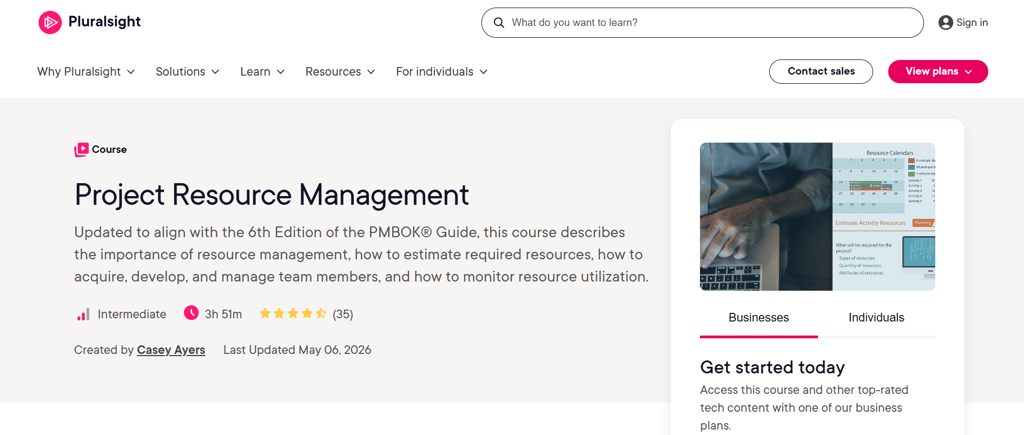
Project Resource Management is a Pluralsight course by Casey Ayers that maps directly to the PMBOK® Guide's resource management knowledge area—making it practical for working project managers and useful for PMP® exam preparation at the same time.
What you'll learn: How to plan and estimate resources, acquire project teams, apply resource leveling, manage team conflict, and control resource utilization across the project lifecycle.
Course details:
- Format: Self-paced online video; accessible on desktop and mobile; offline downloads available with a paid subscription
- Duration: 3 hours 51 minutes of video content
- Level/prerequisites: Intermediate; no prerequisites listed, though the course assumes familiarity with project management concepts
- Price: Pluralsight subscription required; from $21 USD/month (billed yearly); 10-day free trial available
- Certificate/credits: Certificate of completion available; course hours and certificate can be submitted toward PMI® PDUs or PMP® exam contact hours
Considerations: The course is built around the PMBOK® 6th Edition, so check whether that framework aligns with your exam prep track or your organization's current methodology before enrolling.
7. Resource Management for One or Multiple Project Efforts - Udemy
Best for: Beginners managing resources across multiple projects at once

This Udemy course by Susan Beauchamp is one of the few beginner-level options that addresses resource planning across multiple concurrent projects. It covers both traditional and Agile approaches and includes 17 downloadable templates.
What you'll learn: How to build Gantt charts, identify resource gaps and bottlenecks across multiple projects, adjust plans using leveling and crashing techniques, and apply Agile capacity planning.
Course details:
- Format: Self-paced online video; accessible on desktop, mobile, and TV; full lifetime access included
- Duration: 1 hour 58 minutes of video content; includes 1 article and 17 downloadable resources
- Level/prerequisites: Beginner; no previous experience required
- Price: $19.99 USD one-time purchase, or from $13 USD/month via Udemy subscription
- Certificate/credits: Udemy certificate of completion; no PDUs or professional credits verified
Considerations: This course doesn't carry verified PMI® PDUs, so it won't count toward PMP® certification maintenance hours.
For more training on managing multiple projects at once, try these portfolio management courses, these PMO courses, or these PMO certifications.
8. Resource Management Soft Skills Development - Resource Management Institute
Best for: Resource managers building stakeholder communication skills

Resource Management Soft Skills Development is an on-demand course from the Resource Management Institute (RMI), the organization behind the RMCP® certification. It's one of the only courses focused entirely on the interpersonal side of resource management.
What you'll learn: How to build trusted advisor relationships with stakeholders, communicate good and bad news, manage expectations, push back on problematic behavior, and run more productive resource management meetings.
Course details:
- Format: Self-paced, on-demand video; hosted on RMI's learning management system; individual access only—group viewing is prohibited
- Duration: 4 hours of video content; 90-day access period
- Level/prerequisites: Intermediate; designed to complement existing resource management process and tools knowledge
- Price: $499 USD per person
- Certificate/credits: 4 PCU (Professional Certification Units) toward RMCP® certification maintenance, awarded by the Resource Management Institute
Considerations: The 90-day access window is relatively short for a $499 investment—if your schedule is unpredictable, that timeline could be a real constraint.
9. Project Management in Practice – Planning, Scheduling and Resource Management - Alison
Best for: Project managers handling resources across multiple projects at once
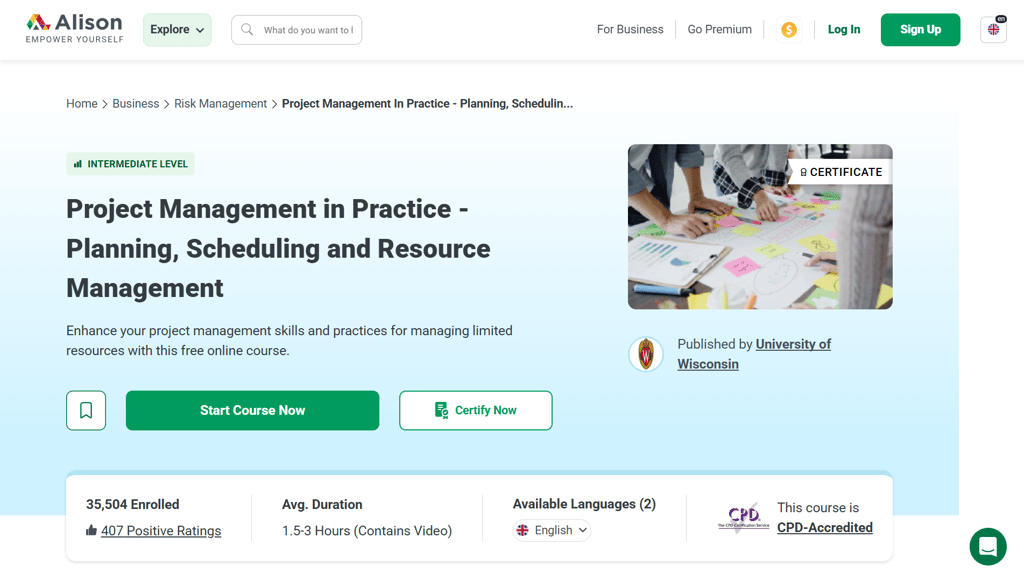
This free Alison course, published by the University of Wisconsin, covers resource management and key project management principles, within the full project planning lifecycle. It's CPD-accredited and requires no payment to complete the content.
What you'll learn: How to plan projects, build schedules, allocate limited resources, manage project budgets and costs, and identify and respond to project risks.
Course details:
- Format: Self-paced online; includes video and text-based lessons; accessible via web browser and mobile app (iOS and Android); available in English and Spanish
- Duration: 1.5–3 hours of content
- Level/prerequisites: Intermediate, per the provider; no prerequisites specified
- Price: Free to access; optional digital certificate approximately €21–€26; printed certificate approximately €27–€31, plus shipping
- Assessment: Final assessment; a score of 80% or higher is required to earn the certificate
- Certificate/credits: CPD-accredited certificate of completion issued by Alison, accredited by the UK CPD Certification Service; purchased separately after passing the assessment
Considerations: The course content is entirely free, but the CPD-accredited certificate requires a separate purchase—if the credential matters to you, factor that cost into your decision upfront.
For more on project planning and scheduling, try this list of courses on project scheduling. You can also find a list of technical project management certifications here.
10. Defining Project Scope and Managing Resources in Projects - Udemy
Best for: Project managers connecting scope decisions to resource planning
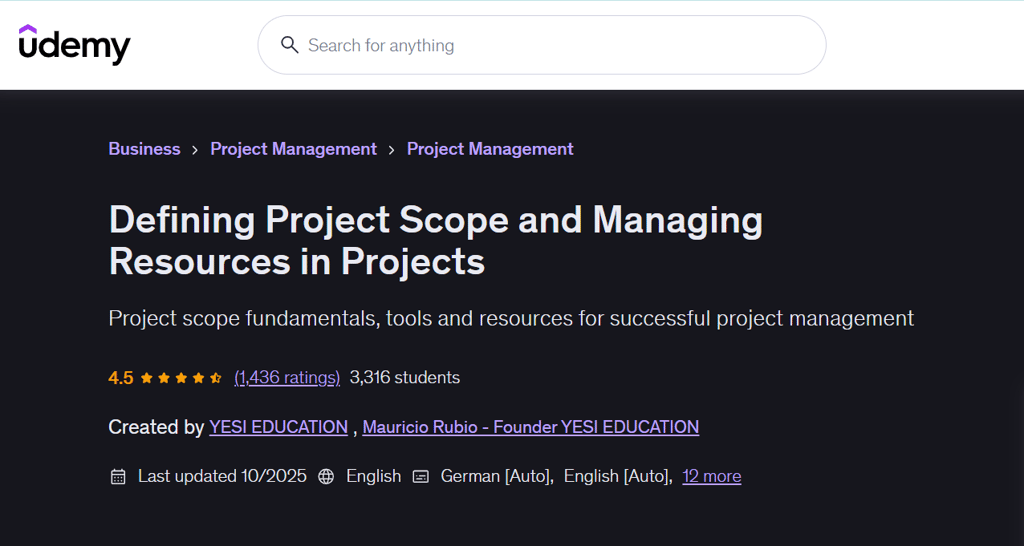
This Udemy course by YESI Education focuses on how project scope decisions affect resource planning. If scope creep is a recurring problem for your team, it covers an angle that most resource management courses skip entirely.
What you'll learn: How to define and manage project scope, prevent scope creep, plan and allocate resources, and apply change management principles when scope shifts affect your project.
Course details:
- Format: Self-paced, on-demand video on Udemy; accessible on desktop, mobile, and TV; closed captions available in English, German, and additional languages
- Duration: 2 hours 18 minutes across 19 lectures
- Level/prerequisites: Beginner; no prior knowledge or experience required
- Price: From $49.99 USD per learner; also available via Udemy Personal Plan subscription
- Certificate/credits: Udemy certificate of completion; YESI Education certificate and digital badge upon completion; no PMI PDUs or external professional credits
Considerations: Resource management content accounts for roughly 22 minutes of the 2 hours 18 minutes total—if in-depth resource management training is your primary goal, the coverage here is too limited to stand on its own.
11. Budgeting and Scheduling Projects - University of California, Irvine (via Coursera)
Best for: Project managers who want university-backed scheduling and budgeting skills

Budgeting and Scheduling Projects is a University of California, Irvine course on Coursera that pairs resource identification with cost estimation and scheduling. It's a practical course for project managers who need to connect resource planning directly to realistic budgets and schedules.
What you'll learn: Identify project resource needs, decompose work packages into activities, estimate resource quantities and costs, determine critical path and float, and use a responsibility assignment matrix.
Course details:
- Format: Self-paced, online; flexible schedule
- Duration: Approximately 5 hours of instructional content across 5 modules
- Level/prerequisites: Foundational; prerequisites not specified
- Price: Free to audit; certificate requires purchase or Coursera Plus subscription ($239 USD/year)
- Assessment: 3 module quizzes and 1 final exam (AI-graded)
- Certificate/credits: Shareable completion certificate issued by Coursera, addable to LinkedIn; part of the Project Management Principles and Practices Specialization
Considerations: Earning the certificate requires a paid purchase or active Coursera Plus subscription—auditing gives you content access but no credential.
12. Master Advanced Project Planning, Resource And Scheduling - Udemy
Best for: Project managers who want scheduling and resource planning in one place

Expert Academy's Udemy course covers resource allocation, scheduling, and risk management in under an hour, using real-world case studies and downloadable worksheets to ground each concept in practice.
What you'll learn: Apply CPM, PERT, and Gantt charts for scheduling, allocate resources across finances, people, and equipment, use a RACI framework for stakeholder accountability, and monitor projects for reallocation needs.
Course details:
- Format: Self-paced, on-demand video on Udemy; accessible on desktop, mobile, and TV; includes 6 downloadable worksheets and English auto-generated captions
- Duration: 55 minutes across 8 lectures; lifetime access included
- Level/prerequisites: Foundational; no requirements listed
- Price: From $19.99 USD per learner; also available via Udemy Personal Plan subscription
- Assessment: One quiz included
- Certificate/credits: Udemy certificate of completion; no PMI PDUs or other external professional credits
Considerations: At 55 minutes total, with roughly 15 minutes of direct resource management content, this course works better as a quick refresher than standalone resource management training.
How to Choose a Resource Management Course
Start by identifying the specific problem you're trying to solve. Whether that's scope creep, inaccurate estimates, or poor visibility into team capacity, the right course depends on what's actually breaking down in your work.
- Match the curriculum to your gap. Check the module breakdown, not just the title. A course called "advanced scheduling" might spend only 15 minutes on resource allocation. Look for courses where resource management is a primary topic, not a supporting one.
- Be honest about how much time you have. Course lengths here range from under an hour to over 30 hours. A 55-minute course can reinforce a concept you mostly understand; it won't build a skill from scratch. If you need depth, budget accordingly.
- Check whether the format fits how you actually learn. Self-paced video works well for concept-building, but if you need to practice applying frameworks to real scenarios and complex projects, look for courses that include hands-on assignments, worksheets, or projects rather than video plus a quiz.
- Verify credential requirements before you enroll. A Udemy certificate of completion and a PMI-accredited PDU course are not interchangeable. If you're maintaining PMP certification or pursuing a recognized credential, check the accreditation details explicitly.
- Factor in the full cost. Some courses are available via subscriptions you may already pay for (Coursera Plus, LinkedIn Learning). Others are low-cost individually. A $15 course that doesn't cover what you need costs more than a $239 subscription that gets you there.
Resource Management Courses FAQ
What should a project resource plan include?
A resource plan should identify the people, skills, equipment, materials, and budget needed, along with when they’ll be needed and who is responsible for them. Include availability assumptions and a process for handling changes so the plan can be updated as the project evolves.
How can you tell if a project's resources are overallocated?
Look for sustained workloads above people’s capacity, competing assignments, missed milestones, bottlenecks, or rising overtime. Check forecasts and commitments regularly so you can address conflicts before they disrupt delivery.
Should you learn resource-management software before taking a course?
Usually, learn the underlying concepts first; they’re useful even if your organization changes tools. Then practice with the software your team uses, since features and workflows vary across platforms.
How can you apply what you learn in a course to a live project?
Start with a manageable project or workstream: estimate its resource needs, map responsibilities, and compare planned availability with actual workloads. Review the plan regularly and adjust assignments when scope, timing, or capacity changes.
What's Next?
Want to connect with other digital project managers to share resources and best practices? Join our membership community and get access to 100+ templates, samples, and examples, and connect with hundreds of digital project managers in Slack.


