

10 Best GanttPRO Alternative Tools for Planning in 2026

10 Best Alternatives To GanttPRO Shortlist


GanttPRO is a project management tool that offers interactive Gantt charts to facilitate project planning, team collaboration, and progress tracking. While GanttPRO can be beneficial for many, users may seek alternatives due to cost, feature preferences, or the need for a different user experience. Here are my suggestions for the best GanttPRO alternatives.
What Is GanttPRO?
GanttPRO is a project management tool that utilizes Gantt charts for planning and tracking project schedules. It is designed for project managers, team leaders, and individual contributors who need to maintain a clear overview of project timelines and resource allocation. The software serves to establish deadlines, assign tasks to team members, and monitor project progress, ensuring that projects are completed on time and within scope.
Why Trust Our Software Recommendations
Our team has been testing and reviewing software since 2012. As project managers ourselves, we know how difficult—and important—it is to choose the right software.
For this guide, we evaluated tools using hands-on testing and independent research, scoring tools using our selection criteria. We also draw on insights from industry thought leaders and practicing project management experts.
Our reviews reflect our human editorial judgment, not a sales pitch.
Expert reviewers:
GanttPRO Alternatives Comparison Table
This comparison table summarizes pricing details for my top GanttPRO alternative selections:
| Tool | Best For | Trial Info | Price | ||
|---|---|---|---|---|---|
| 1 | Best for enterprise-grade project management | Not available | From $679.99 one-time | Website | |
| 2 | Best for visual project collaboration | Free plan + free trial available | From $5/user/month (billed annually) | Website | |
| 3 | Best inexpensive solutions for small teams | 14-day free trial | From $45/month (billed annually) | Website | |
| 4 | Best for strategic marketing management | Not available | Pricing upon request | Website | |
| 5 | Best for flexible project views | Free plan + 14-day trial available | From $9/user/month (billed annually) | Website | |
| 6 | Best for detailed planning and execution | 30-day free trial + demo available | From $15/user/month (billed annually) | Website | |
| 7 | Best for visualizing project timelines | Not available | Pricing upon request | Website | |
| 8 | Best for predictive project scheduling | Free plan + 7-day trial + demo available | Pricing upon request | Website | |
| 9 | Best for enterprise-grade work management | Free demo available | Pricing upon request | Website | |
| 10 | Best for breaking down complex projects | Free plan + 30-day free trial available | From $7.65/user/month (billed annually) | Website |
Overviews Of The Best GanttPRO Alternatives
Here are my detailed thoughts on each software on this list, including what they do well and best use cases for each.
Best for enterprise-grade project management
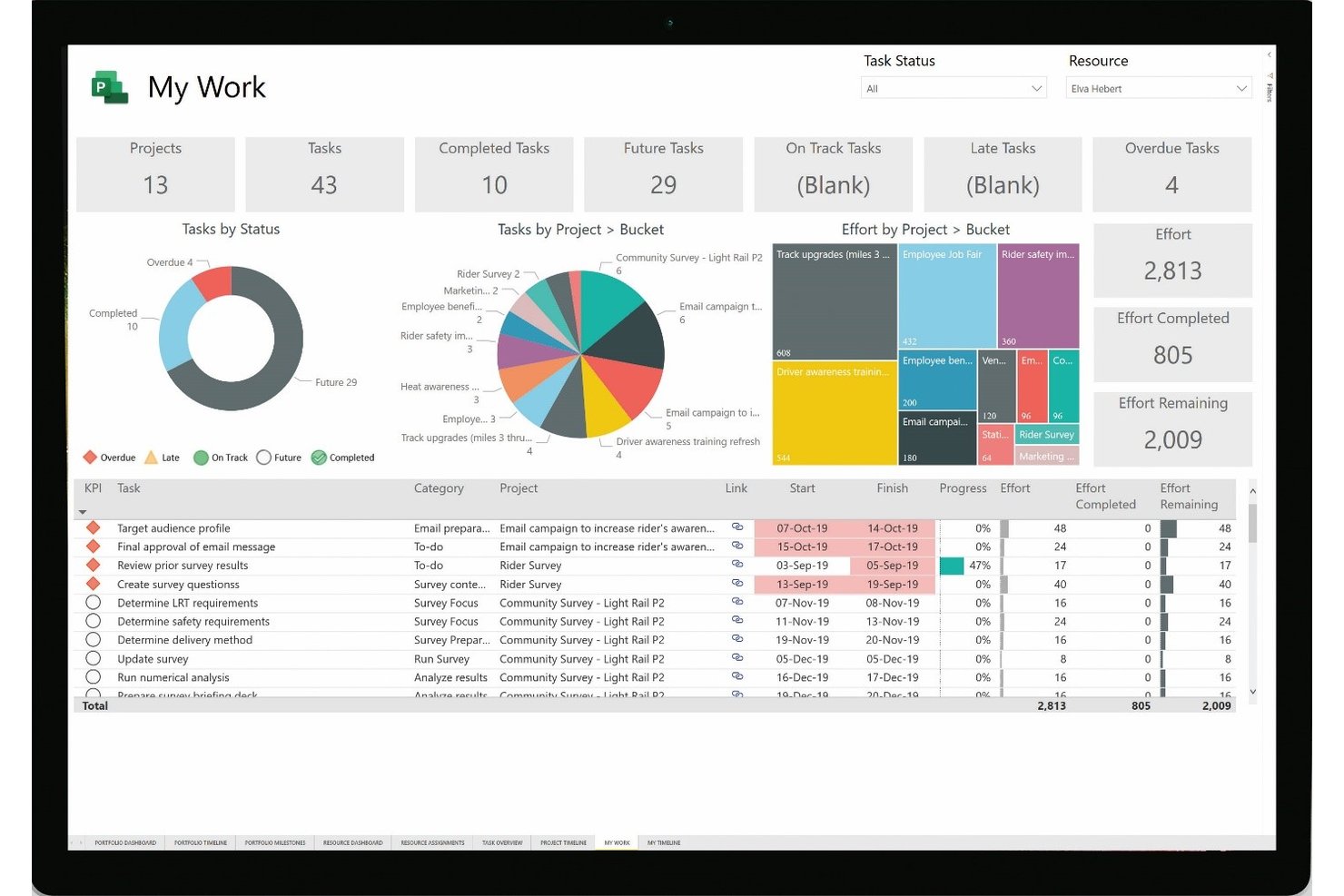
Microsoft Project is a project management platform from Microsoft that covers Gantt chart scheduling, task dependencies, resource planning, and portfolio roll-up views across both a web-based Planner experience and a desktop application.
Who Is Microsoft Project Best For?
Microsoft Project is a strong fit for project managers at larger organizations already running Microsoft 365 who need enterprise-grade scheduling, dependency tracking, and portfolio visibility.
Why I Picked Microsoft Project
Microsoft Project earns its spot on my shortlist because it's one of the few tools that handles true enterprise-grade scheduling without cutting corners. I'm particularly drawn to its Tracking Gantt view, which lets me compare baseline versus actual timelines side by side, and its portfolio Roadmap, which rolls multiple plans into a single visual timeline. For organizations already in the Microsoft 365 ecosystem, those two features alone cover most of what GanttPro users outgrow.
Microsoft Project Key Features
- Task dependency types: Set finish-to-start, start-to-start, start-to-finish, and finish-to-finish links between tasks, with automatic schedule recalculation when predecessors change.
- Resource leveling: Automatically delay or split tasks to resolve overallocated resources in Project desktop.
- Custom fields: Add up to ten custom fields to premium Planner plans, with Text, Date, Number, Yes/No, and Choice field types.
- Microsoft 365 integrations: View and update plans directly from Teams, SharePoint, and Outlook without leaving those apps.
Microsoft Project Integrations
Microsoft Project has native integrations across the Microsoft ecosystem, including Microsoft Teams, SharePoint, Outlook, and Microsoft 365. Microsoft Graph’s REST API supports custom integrations, though Planner API support is limited to basic plans and tasks.
Pros and Cons
Pros:
- Four dependency types recalculate linked schedules
- Portfolio roadmaps summarize multiple project timelines
- Baseline-versus-actual tracking clarifies schedule variance
Cons:
- No native GanttPro migration path
- Complex schedules take time to configure
Trello
Best for visual project collaboration
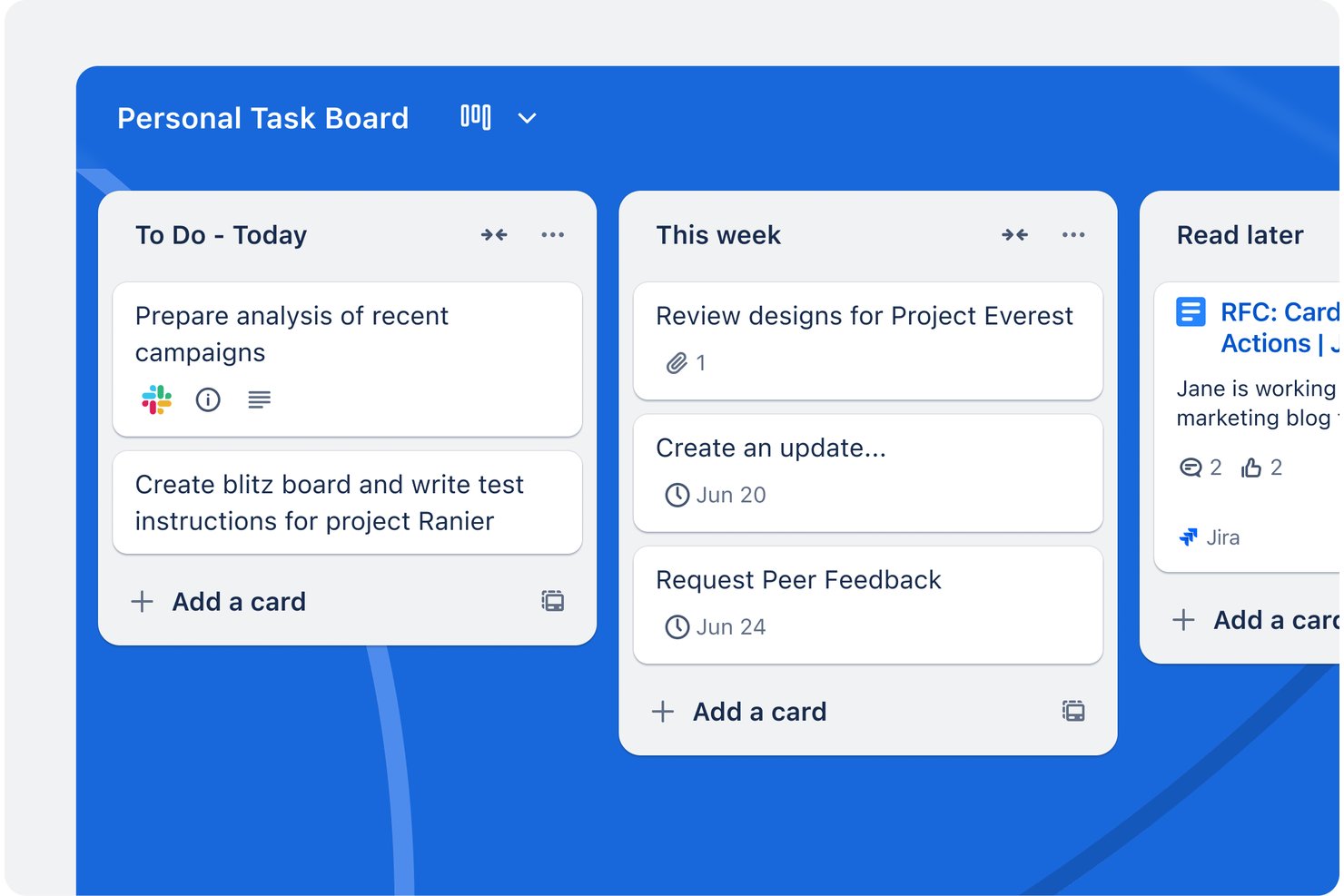
Trello is a visual project management tool built by Atlassian that organizes work through boards, cards, and lists, with added views like Timeline, Calendar, and Table for teams that need more than basic Kanban.
Who Is Trello Best For?
Trello works best for small teams and team leads who need a simple, visual way to organize tasks without a steep learning curve.
Why I Picked Trello
Trello earns its spot on my shortlist because its visual-first approach to project work is genuinely hard to replicate. I love how the board, card, and list structure makes it easy to see exactly where tasks stand at any moment, and the Workspace Calendar and Table views let me pull cards from up to 20 boards into one place for a cross-project snapshot. The Timeline view adds date-range planning with grouping by member or label, which covers lighter scheduling needs without the overhead of a dedicated Gantt tool.
Trello Key Features
- Butler automation: Set rule-based triggers to automatically move cards, update due dates, and change card states when specific conditions are met.
- Custom Fields: Add structured data fields to cards—such as dropdowns, numbers, or dates—to capture workflow-specific information beyond default card attributes.
- Card mirroring: Display and edit a single card across multiple boards simultaneously, keeping the same task visible in different team workspaces without duplication.
- Power-Ups: Connect Trello boards to 200+ third-party tools, including time trackers, Gantt add-ons like TeamGantt, and communication apps like Slack.
Trello Integrations
Trello offers 236 marketplace integrations, including Slack, Jira Cloud, Microsoft Teams, Miro, and the TeamGantt Power-Up. Its REST API supports custom integrations, subject to request limits.
Pros and Cons
Pros:
- Automation can update linked-card states and dates
- Workspace views summarize work across 20 boards
- Visual boards clarify task status at-a-glance
Cons:
- Dependency workarounds require manual card links
- Timeline isn’t a full Gantt schedule

ProofHub
Best inexpensive solutions for small teams
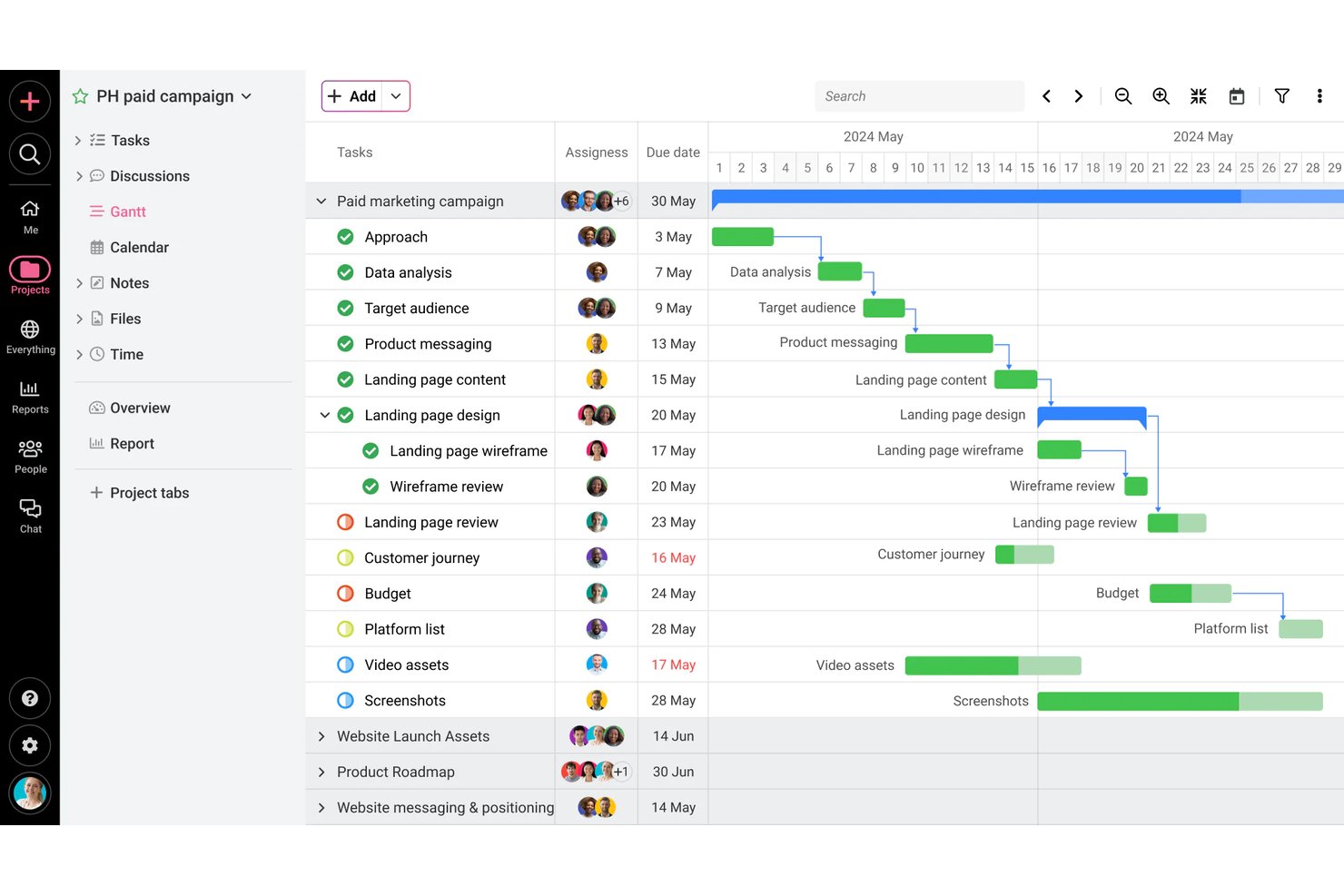
ProofHub is an all-in-one project management and collaboration platform with Gantt chart scheduling, task dependencies, multiple project views, time tracking, and built-in team communication tools.
Who Is ProofHub Best For?
ProofHub is a strong fit for small teams that want one flat-rate tool covering project scheduling, communication, and file sharing without paying per seat.
Why I Picked ProofHub
I picked ProofHub as one of the best because its flat-rate, unlimited-user pricing makes it a genuinely practical swap for small teams paying per seat on GanttPro. I especially like the "All Gantt" view, which pulls tasks across every project into one timeline so you can spot conflicts without jumping between plans. The four dependency types with cascade rescheduling also mean that when one task slips, the rest of the schedule adjusts automatically.
ProofHub Key Features
- Critical path highlighting: Identify which tasks directly impact your project end date by enabling the critical path view in the Gantt chart.
- All Gantt cross-project view: See tasks from every project on a single timeline, with filters by project and assignee for quick focus.
- Time tracking with accounting exports: Log time manually or with timers, then export timesheets directly to QuickBooks or FreshBooks for invoicing.
- Custom fields: Add field types like dropdown, currency, percentage, and date to task lists to capture project-specific data.
ProofHub Integrations
ProofHub offers native integrations with Slack, Box, Dropbox, Google Calendar, iCal, OneDrive, FreshBooks, FreshBooks Classic, and QuickBooks. Its REST API accepts and returns JSON for custom integrations.
Pros and Cons
Pros:
- Dependency changes can cascade through schedules
- Reviewers value centralized task and timeline coordination
- Cross-project Gantt consolidates schedule visibility
Cons:
- Reviewers report awkward dependency controls
- Workload reports lack Gantt-based capacity warnings

Best for strategic marketing management
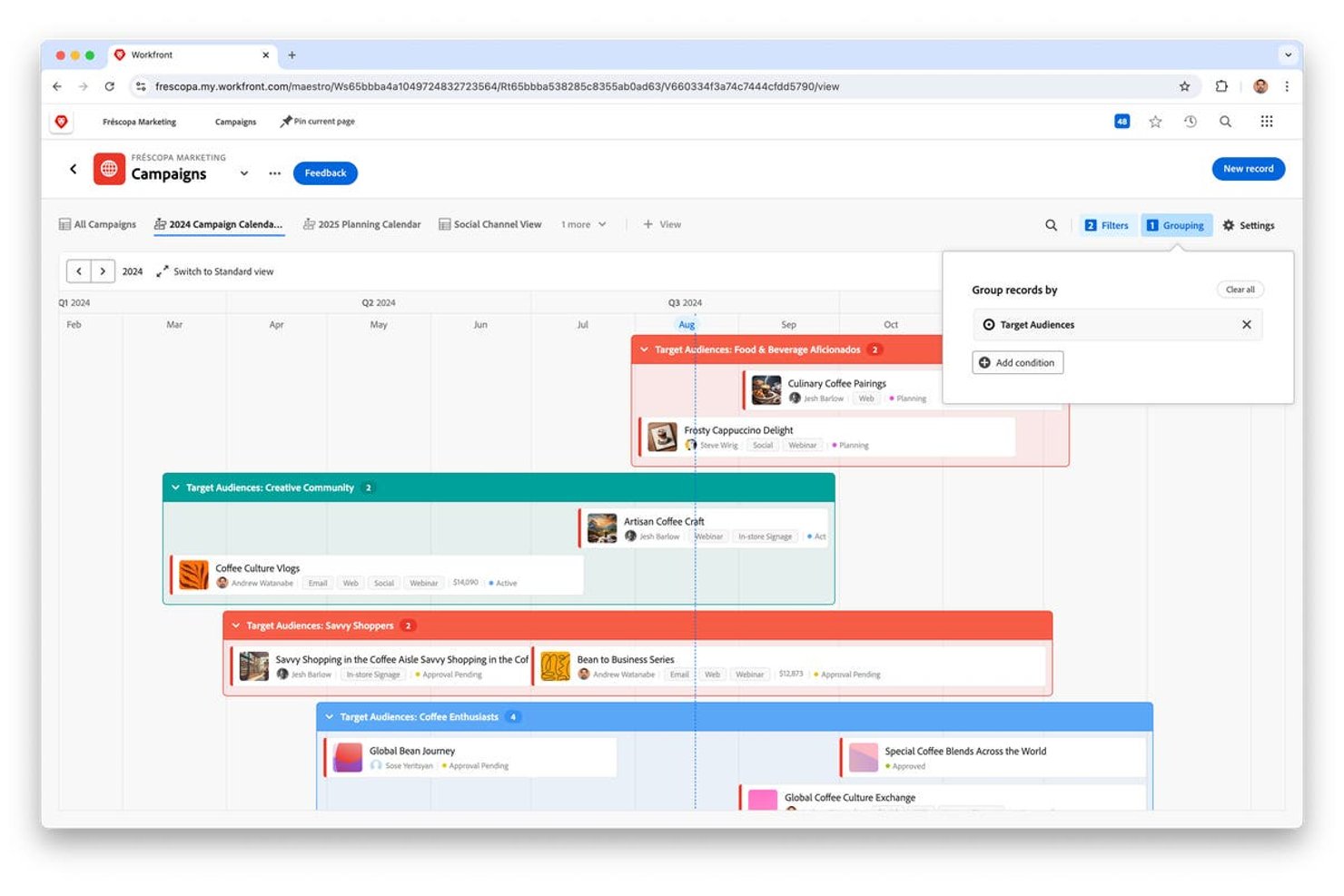
Adobe Workfront is an enterprise work management platform that covers project planning, Gantt scheduling, resource management, intake workflows, and multi-stage review and approval across teams.
Who Is Adobe Workfront Best For?
Adobe Workfront is built for enterprise marketing and operations teams that need to connect strategic campaign planning with day-to-day project execution across large, cross-functional organizations.
Why I Picked Adobe Workfront
I picked Adobe Workfront as one of the best because it connects strategic campaign planning directly to project execution in a way few other tools do. I love how portfolio-level Gantt charts roll up tasks across multiple projects, so my team can track cross-project dependencies and milestones in one view. Workfront's Workload Balancer also gives me a real-time visual of who's overallocated before it becomes a problem, which is invaluable when managing large marketing operations across multiple concurrent campaigns.
Adobe Workfront Key Features
- Multi-stage review and approval workflows: Set up single- or multistage approval sequences with dependencies between review stages, markup tools, and support for a range of file types.
- Project baseline snapshots: Capture point-in-time baselines to compare your current project plan against earlier versions using Gantt charts and baseline reports.
- Centralized intake and request routing: Collect incoming work requests through a single intake channel, gather required details, and route them to the right teams based on defined rules.
- Workfront Fusion automation: Connect Workfront to external apps using low-code visual scenarios that sync data and trigger workflows across your full tech stack.
Adobe Workfront Integrations
Adobe Workfront integrates with Adobe Experience Manager Assets, Adobe Creative Cloud, Frame.io, Adobe Express, Slack, Microsoft Teams, Figma, Google Workspace, Microsoft Office 365, and Salesforce. It also offers Workfront Fusion and RESTful APIs for custom integrations.
Pros and Cons
Pros:
- Workload views expose team overallocations
- Baselines show changes against earlier plans
- Cross-project dependencies connect related schedules
Cons:
- Report setup can require substantial configuration
- Cluttered interface takes time to learn
Redbooth
Best for flexible project views
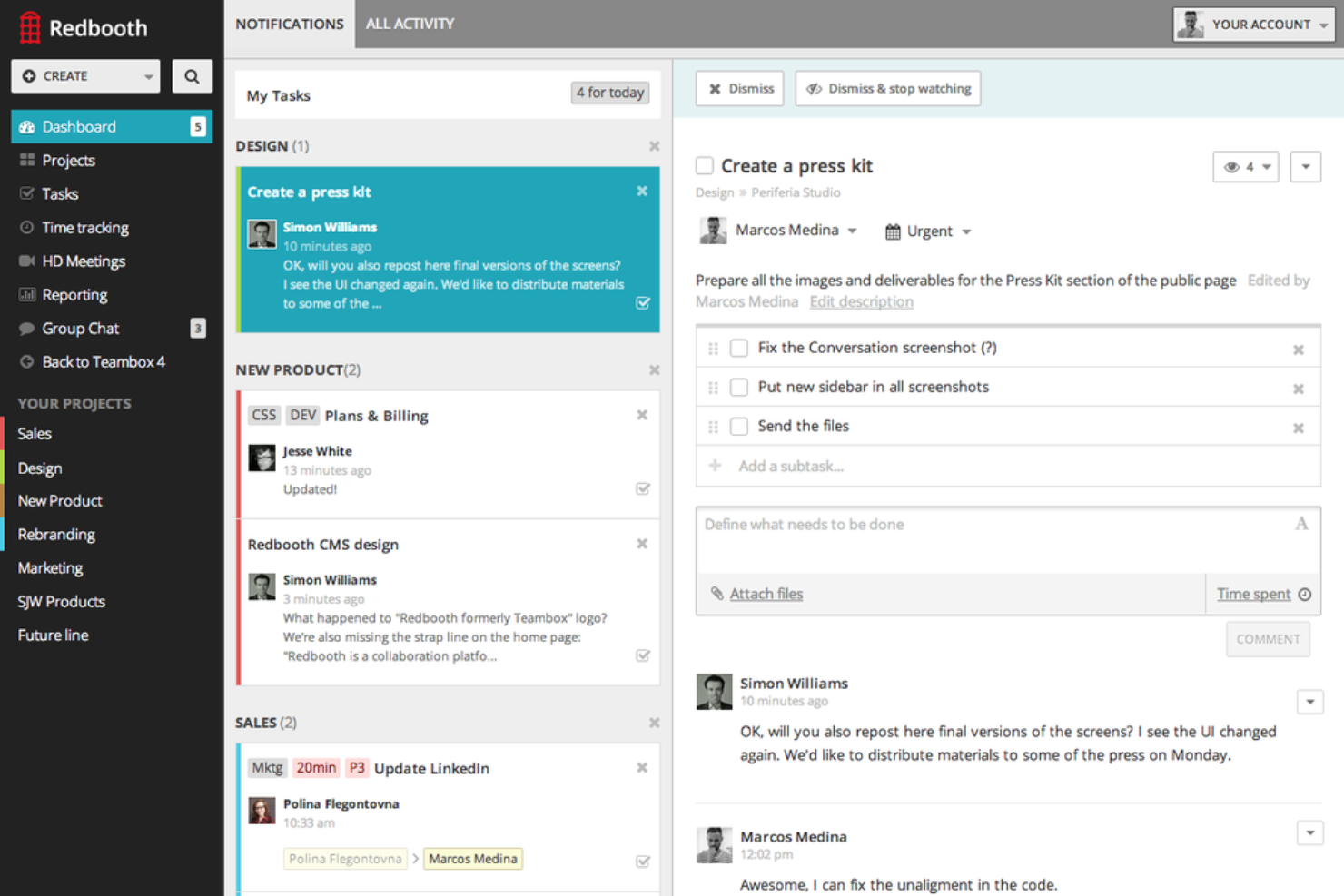
Redbooth is a project management tool that offers task tracking, Kanban boards, Timeline/Gantt scheduling, and team collaboration across list, board, and calendar views.
Who Is Redbooth Best For?
Redbooth suits small teams and small business owners who want an approachable tool with multiple ways to view and manage project work.
Why I Picked Redbooth
Redbooth earns its spot on my shortlist because of how genuinely flexible its project views are. I can switch the same workspace between a task list, Kanban board, drag-and-drop Timeline/Gantt, and calendar without any reconfiguration. The Timeline view is particularly useful: it color-codes active, overdue, and resolved tasks and lets me reschedule work by dragging task bars directly on the chart, which makes replanning feel fast rather than tedious.
Redbooth Key Features
- Task dependencies: Link tasks with finish-to-start relationships so dependent due dates update automatically when a parent task shifts.
- Time tracking: Log time directly against tasks and review weekly breakdowns in time-tracking reports filtered by user or workspace.
- Workload report: See each team member's active task load in one view and reassign work directly from the report.
- Workspace templates: Save any workspace as a reusable template to spin up recurring projects without rebuilding structure from scratch.
Redbooth Integrations
Redbooth offers native integrations with Slack, Google Drive, Dropbox, Box, OneDrive for Business, Zoom, Microsoft Outlook, Gmail, and Okta. It also supports Zapier and API-based custom integrations through webhooks and OAuth 2.0.
Pros and Cons
Pros:
- Reviewers value clear task ownership and project visibility
- Drag task bars to adjust project schedules
- Switch between task, board, calendar, and timeline views
Cons:
- Workload reports don’t flag overallocation on timelines
- Dependencies support finish-to-start links within one workspace
Best for detailed planning and execution
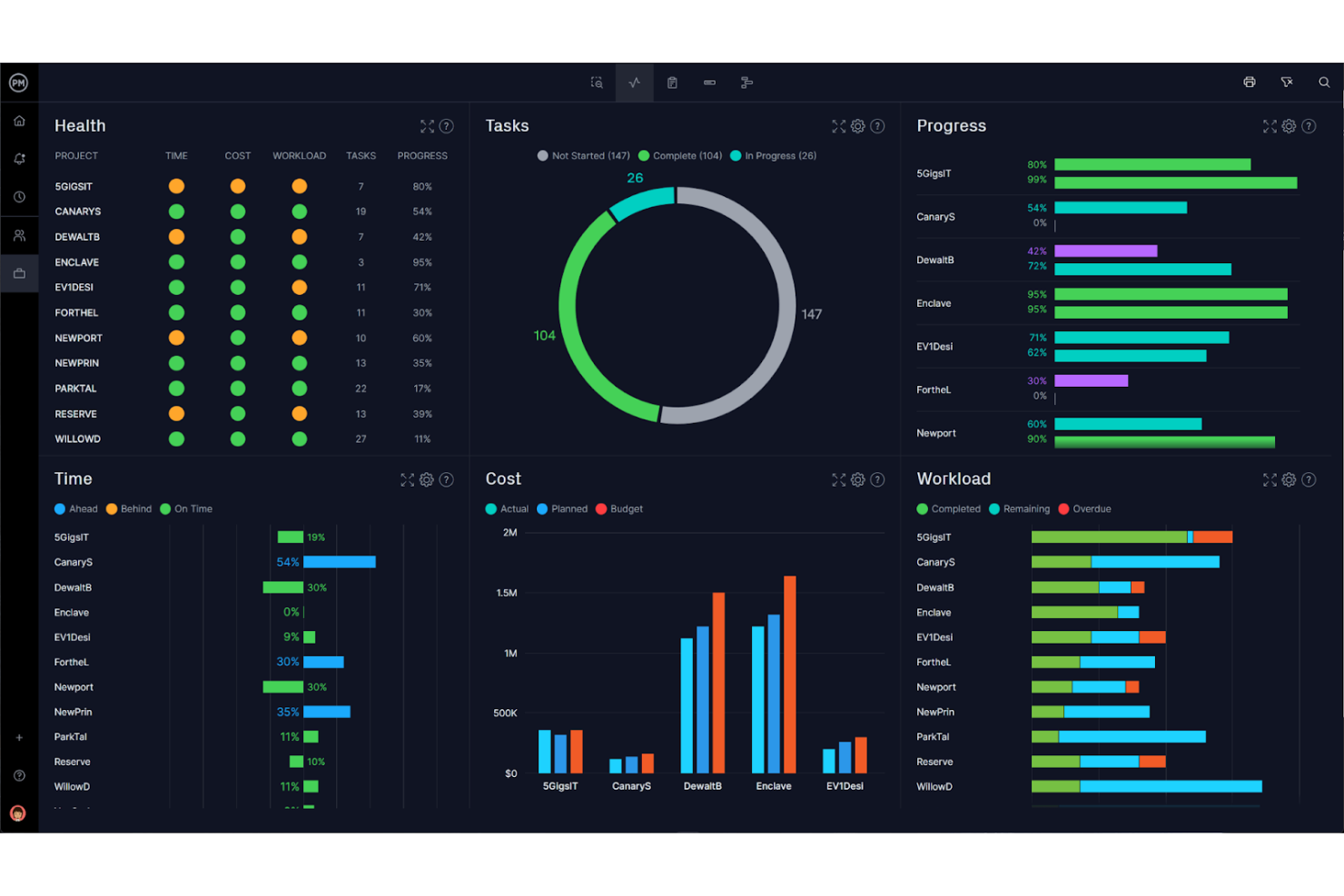
ProjectManager is a project management platform with interactive Gantt scheduling, multiple project views, resource management, and portfolio-level reporting across teams and projects.
Who Is ProjectManager Best For?
ProjectManager suits project managers and team leads who need detailed scheduling controls—like baselines, critical path, and resource workload balancing—across multiple active projects.
Why I Picked ProjectManager
I picked ProjectManager as one of the best because it gives you genuinely detailed scheduling controls that GanttPro doesn't match, particularly baselines and critical path filtering built into the Team tier. I find the baseline feature especially useful: you lock in your planned schedule, then watch actual progress diverge in real time on the Gantt chart. Add resource workload balancing across multiple projects, and you have a planning and execution setup that holds up when schedules shift and priorities change.
ProjectManager Key Features
- Multiple project views: Switch between Gantt, List, Sheet, Board, and Calendar views, with changes syncing in real time across all five.
- Portfolio dashboard: Roll up tasks, costs, and workload data across all active projects into a single portfolio-level view.
- Workflow automation: Build no-code automation rules to trigger actions across tasks and projects without manual intervention.
- AI Project Insights: Get AI-generated recommendations covering project progress, risk, resource use, and task execution.
ProjectManager Integrations
ProjectManager supports integrations with over 1,000 business and project management apps, including native Slack, Microsoft Teams, Jira, QuickBooks Online, Power BI, Microsoft Project, Excel, and Azure DevOps. It also offers a REST API and Zapier/iPaaS integrations.
Pros and Cons
Pros:
- Reviewers value workload visibility across projects
- Five synced views keep plans consistent
- Baselines reveal schedule drift against plans
Cons:
- Mobile app feels limited for complex updates
- Dense screens can overwhelm new schedulers
nTask
Best for visualizing project timelines
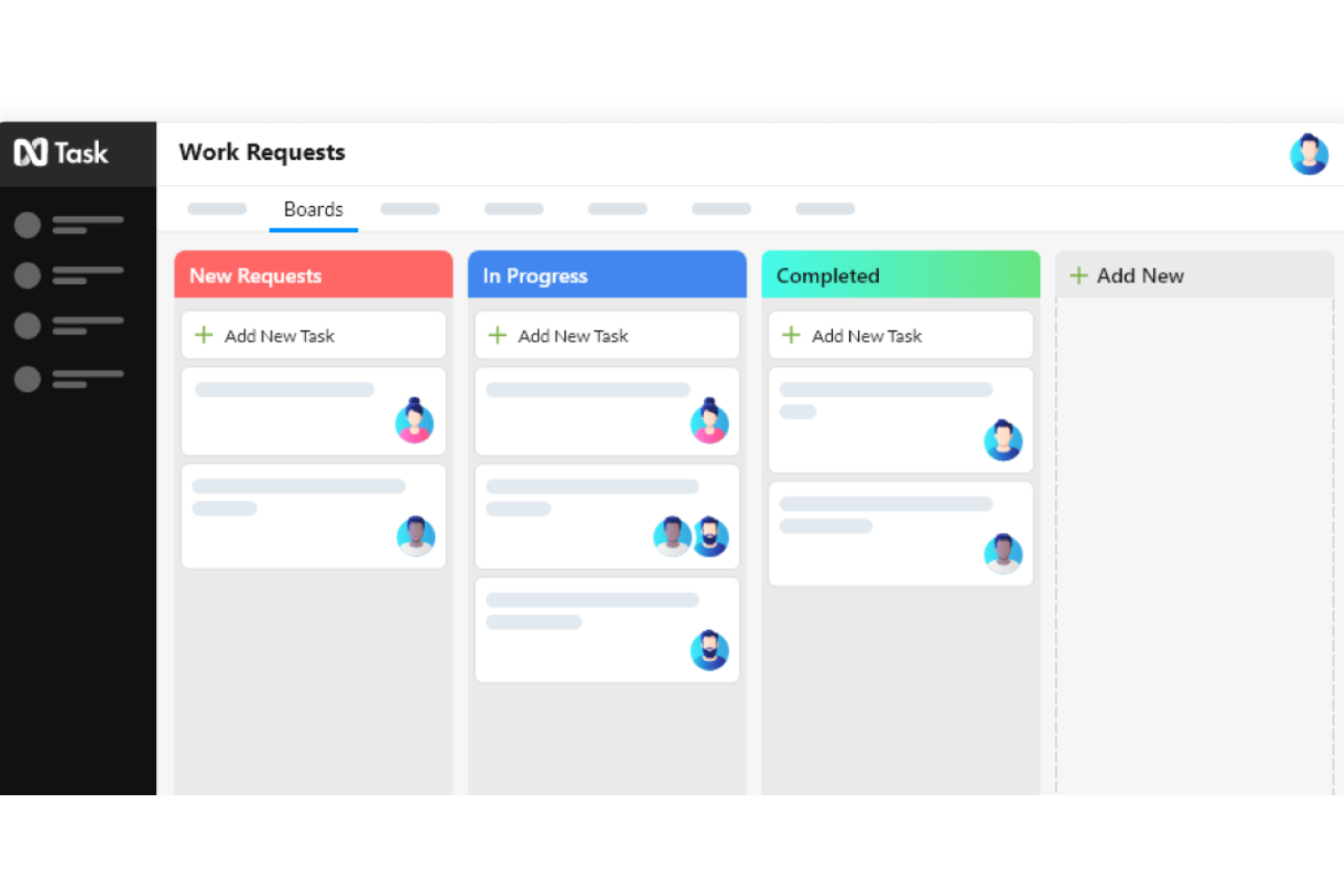
nTask is a project management tool with interactive Gantt charts, Kanban boards, task dependencies, time tracking, and built-in issue and risk management.
Who Is nTask Best For?
nTask is a good fit for small teams and freelancers who need visual project timelines without paying for a feature-heavy enterprise tool.
Why I Picked nTask
I picked nTask as one of the best because its interactive Gantt chart lets you see planned versus actual dates side by side, which makes schedule slippage obvious before it becomes a real problem. I also like that you can assign issues and risks to team members directly from the Gantt view, so you're not jumping between modules to act on what the timeline is telling you. The critical path identification adds another layer of clarity when you need to know exactly which tasks can't slip.
nTask Key Features
- Task dependencies: Set Start to Start, Finish to Start, Start to Finish, and Finish to Finish dependencies between tasks directly in the project timeline.
- Built-in risk management: Evaluate risks using a risk matrix, create mitigation plans, and assign risks to team members from the Gantt view.
- Time tracking with timesheet approval: Log time manually or with an automatic timer, mark hours as billable or non-billable, and submit timesheets for manager approval.
- Kanban boards: Organize work on customizable boards with drag-and-drop tasks, custom statuses, and hundreds of pre-built templates across categories like Engineering, Sales, and Marketing.
nTask Integrations
nTask offers integrations with Slack, Zoom, Google Calendar, Outlook Calendar, and Apple Calendar. It also connects to more than 1,000 apps through Zapier.
Pros and Cons
Pros:
- Task-linked time tracking supports billable work
- Task progress stays visible across project views
- Planned-versus-actual dates expose slippage early
Cons:
- No documented cross-project Gantt roll-up
- Gantt edits can take too many clicks
Best for predictive project scheduling
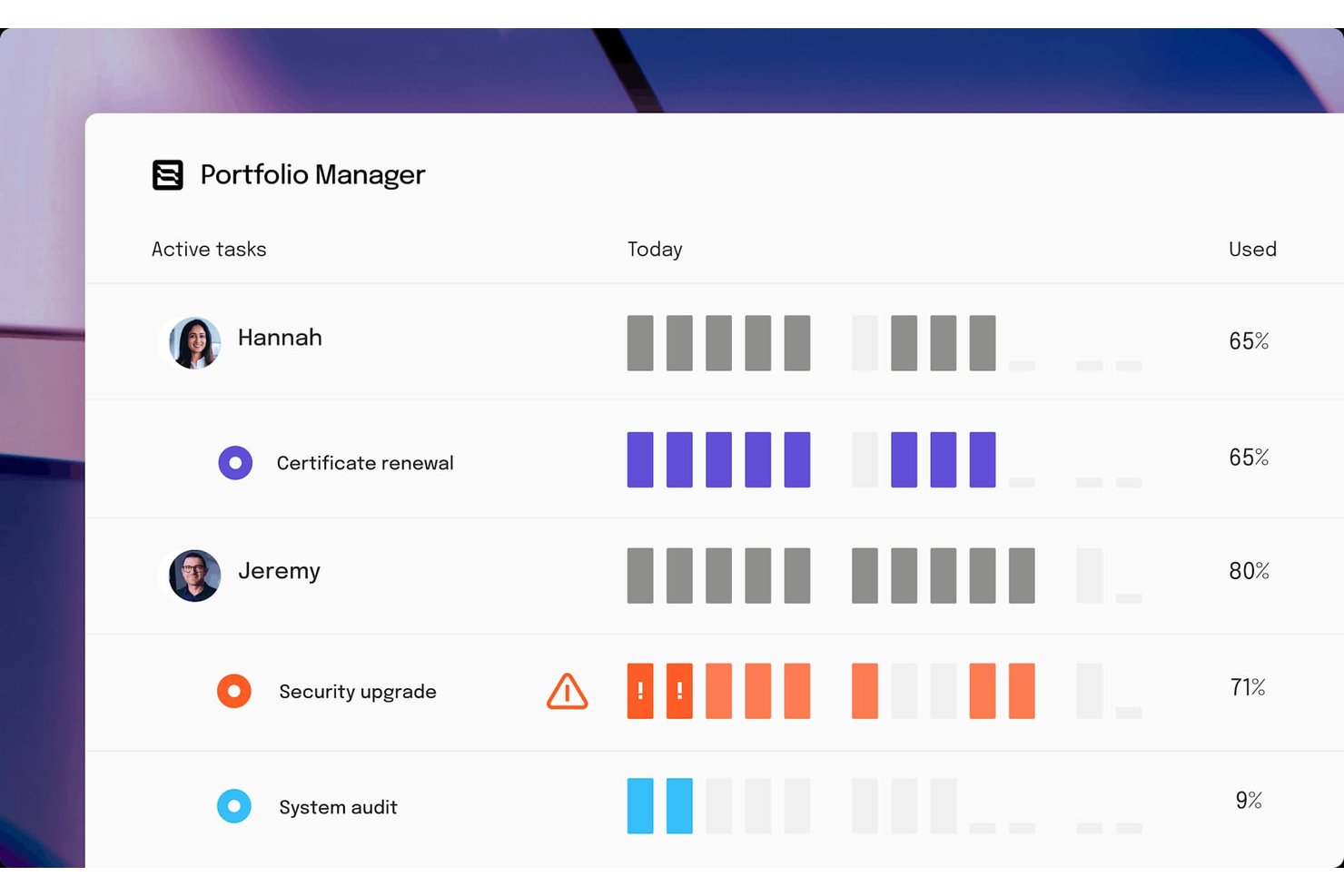
Tempo Portfolio Manager is a project management platform that uses predictive scheduling, workload balancing, and portfolio-level rollups to help teams plan and track work across multiple concurrent projects.
Who Is Tempo Portfolio Manager Best For?
Tempo Portfolio Manager is a strong fit for project managers running multiple concurrent projects who need predictive scheduling and portfolio-wide workload visibility.
Why I Picked Tempo Portfolio Manager
I picked Tempo Portfolio Manager because it's the only tool on this list that uses Monte Carlo simulations to forecast project timelines, calculating expected start and finish dates at a 90% confidence level based on ranged estimates, team capacity, and priorities. When a deadline is at risk, schedule bars turn red and Insights surface the exact hours that won't be completed on time, so you're never guessing where a project stands. I also like that workload views show how work is distributed across your entire portfolio over 30-, 60-, 90-, and 180-day windows, and managers can reassign tasks directly from that view.
Tempo Portfolio Manager Key Features
- Finish-to-start task dependencies: Link tasks, sub-folders, projects, and packages so successors schedule automatically after predecessors complete.
- Board view with status tracking: Move task cards across status columns to update scheduling and view logged and remaining hours per task.
- Project and package templates: Reproduce project structures across packages, including descriptions, estimates, assignments, dependencies, and custom data fields.
- Jira integration with two-way sync: Import Jira projects and issues as Portfolio Manager tasks, then push status changes, reassignments, and priorities back to Jira.
Tempo Portfolio Manager Integrations
Tempo Portfolio Manager has documented native integrations with Jira and Slack. Its Open API, available on paid ULTIMATE, supports custom connections and plan-item updates.
Pros and Cons
Pros:
- Project and package schedules roll up task data
- Portfolio workload views support direct task reassignment
- Monte Carlo forecasts adapt to changing priorities
Cons:
- Setup can require weeks of dedicated learning
- Gantt view cannot be edited directly

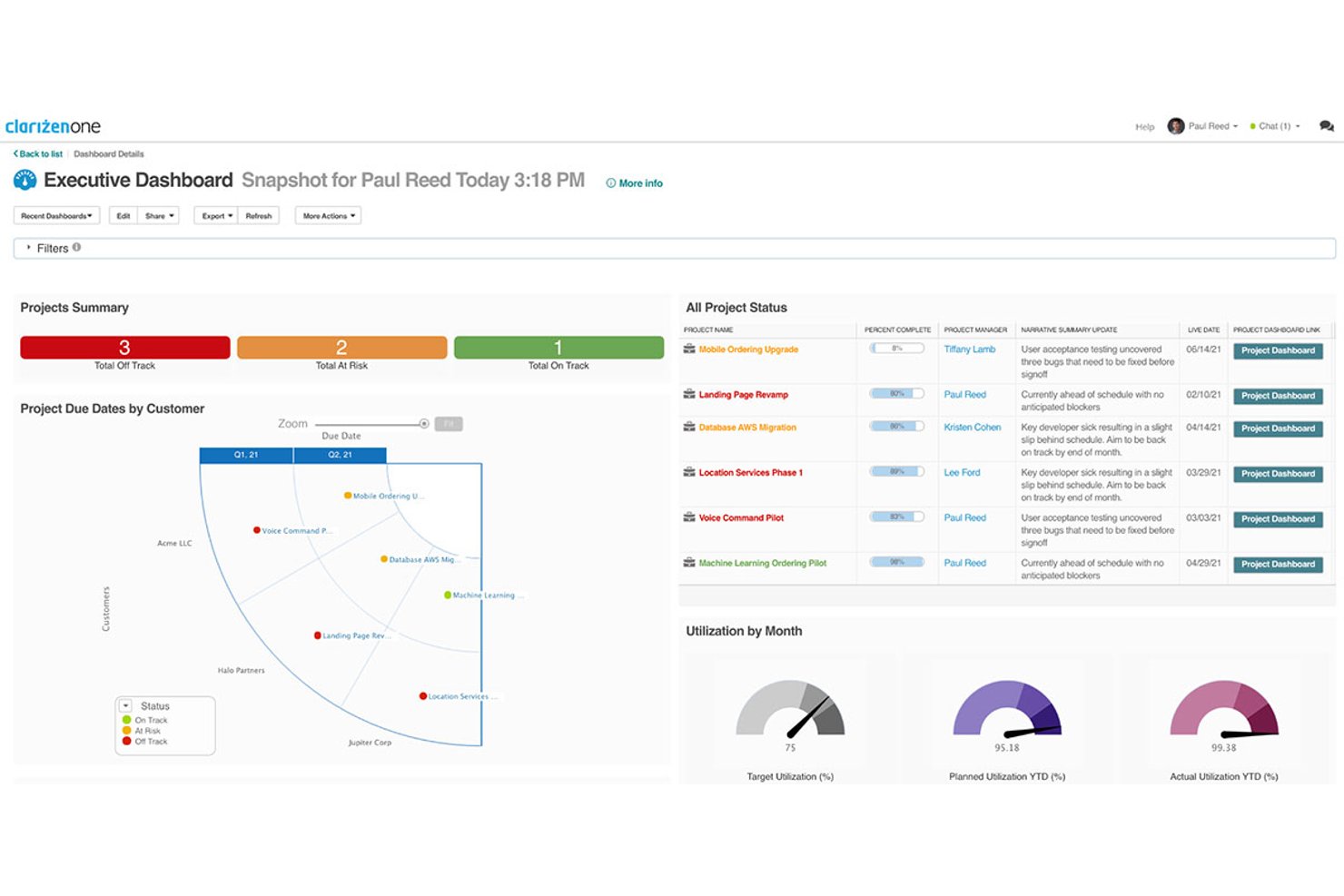
Planview AdaptiveWork (formerly Clarizen) is an enterprise project portfolio management platform that combines Gantt chart scheduling, work breakdown structures, capacity planning, and portfolio-level reporting across projects, teams, and programs.
Who Is Planview AdaptiveWork Best For?
Planview AdaptiveWork suits enterprise project managers and PMO leaders who need to manage portfolios, programs, and cross-team workloads from a single platform.
Why I Picked Planview AdaptiveWork
Planview AdaptiveWork earns its spot on my shortlist because it's built for teams managing work at a scale that GanttPro simply wasn't designed to handle. I'm particularly impressed by its Portfolio Timelines, which give you a color-coded, scrollable view of every project sorted by due date and state, so you can see the full picture without digging into individual plans. The Daily Trend Snapshots feature tracks expected versus actual progress day by day, which I find invaluable when reporting to stakeholders who need more than a static percentage.
Planview AdaptiveWork Key Features
- Workflow automation: Automates repeatable processes, alerts, and approval routing to reduce manual work across projects.
- Hybrid work management: Supports waterfall, collaborative, and agile delivery methods, with a native Jira integration for syncing effort and status updates.
- Time and expense tracking: Logs billable and non-billable hours against work items or projects, with submission supported directly through Microsoft Teams or Slack.
- Custom fields and project templates: Lets you build ready-made or custom project templates with configurable fields, workflow stages, triggers, and inputs from external systems.
Planview AdaptiveWork Integrations
Planview AdaptiveWork offers integrations with Jira, Microsoft Teams, Slack, Salesforce, SharePoint, Box, Google G Suite, Procore, and Zapier. It also provides an API and scheduled exports to Amazon Redshift, Amazon S3, and Microsoft Azure Blob Storage.
Pros and Cons
Pros:
- Templates adapt plans to team workflows
- Daily snapshots compare expected and actual progress
- Portfolio timelines clarify cross-project status
Cons:
- Configuration demands slow initial rollout
- Large schedules become difficult to adjust

Quire
Best for breaking down complex projects
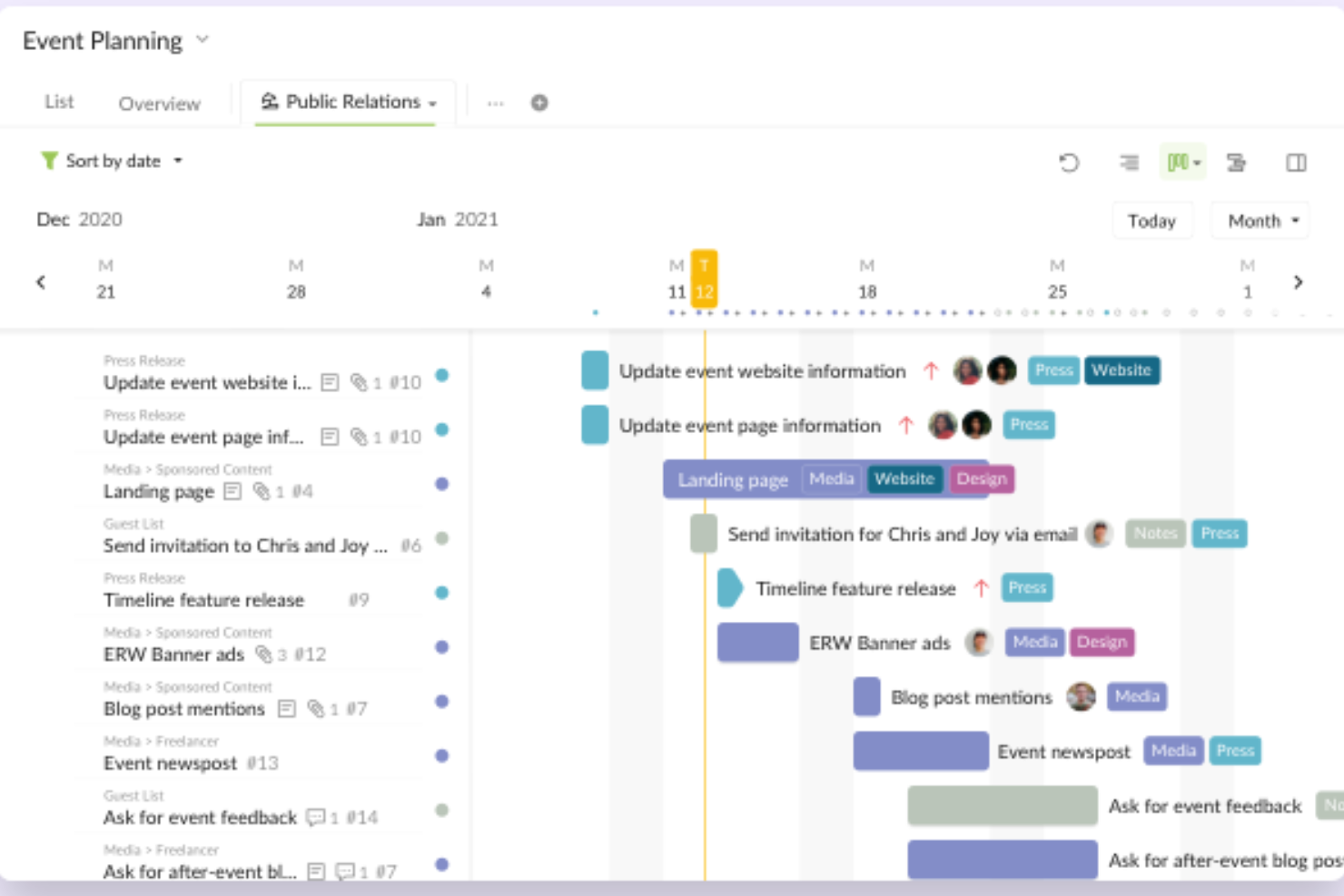
Quire is a project management tool that pairs a deeply nested task hierarchy with a Gantt-style timeline, Kanban board, calendar, and table views for planning and tracking work across teams.
Who Is Quire Best For?
Quire is a strong fit for small business owners and team leads who need to break multi-layered projects into manageable pieces without the overhead of an enterprise tool.
Why I Picked Quire
I picked Quire as one of the best because it handles deeply nested work in a way few Gantt tools actually commit to. Its unlimited subtask hierarchy lets you break a major deliverable into as many layers as the work genuinely requires, then view the same tasks on an interactive Timeline with drag-and-drop scheduling and milestone markers. I also find the Blocked widget genuinely useful: it surfaces every task stalled by an unfinished predecessor, along with who owns it.
Quire Key Features
- Kanban board view: Visualize tasks as cards moving through workflow stages, giving teams a real-time status snapshot without leaving the project.
- Smart Folders: Group tasks and projects from across your organization into a single aggregated view, filterable by Tree, Board, Timeline, or Calendar.
- Multi-assignee task support: Assign a single task to more than one team member so shared ownership is explicit and trackable.
- Time tracking with estimates: Log time via stopwatch, Pomodoro timer, or manual entry, and compare recorded hours against a set task estimate directly in the Time Report.
Quire Integrations
Quire offers documented integrations with Slack, Microsoft Teams, Google Calendar, GitHub, Box, and Microsoft OneDrive, plus 2,000+ apps through Zapier. It also provides a REST API with OAuth 2.0 and webhooks for custom integrations.
Pros and Cons
Pros:
- Six views share the same project tasks
- Timeline bars adjust dates and durations directly
- Nested subtasks preserve complex project structure
Cons:
- No critical-path or baseline analysis
- Finish-to-Start conflicts require manual date fixes
New Product Updates from Quire
Quire Adds Custom Field Locking and Comment Reaction API Support
Quire adds custom field locking and API support for reading and setting emoji reactions on comments. These updates give teams more control over field data and expand comment interaction options for developers. For more information, visit Quire’s official site.
 .
Other GanttPRO Alternatives
Below is a list of additional GanttPRO alternatives that I shortlisted, but did not make it to the top list. It’s worth checking them out.
- Zoho Projects
For comprehensive project management
- GoodDay
For supporting Agile and Waterfall
- Smartsheet
For spreadsheet-based projects
- Basecamp
For simple, efficient team collaboration
- Paymo
For small business project management
- Wrike
For scalable project management
- Kantata
For resource management capabilities
- monday AI Workspace
With AI-powered risk identification
- Airtable
For database-driven planning
- ClickUp
For custom task views
- TeamGantt
For efficient resource allocation
- Notion
For integrated workspace needs
- Asana
For AI work management features


How I Evaluate GanttPro Alternatives
I evaluate GanttPro alternatives in two layers: baseline must-haves like dependency tracking and resource views, then differentiators that separate tools built for PMOs from general task managers.
Core Functionality (Table Stakes For This List)
When I'm selecting tools for my list, I rank each one on a scale from 0 (does not offer the functionality) to 5 (excels in this area) for each core functionality listed below. Then, I calculate the tool's total score into a percentage. Each tool needs to achieve a minimum total score of 65% to be considered for inclusion.
- Interactive Gantt Chart View: I look for drag-and-drop scheduling on a visual timeline, not just a static bar chart—tools should let you adjust task durations and dates directly on the Gantt.
- Dependencies & Milestones: Each tool should support multiple dependency types (finish-to-start, start-to-start, etc.) and milestone markers so you can map a real critical path.
- Resource & Workload Management: I check whether you can assign team members to tasks and spot overallocation—like seeing a developer booked at 150% capacity across two sprints.
- Baselines & Progress Tracking: The ability to save a baseline snapshot and compare it against actual progress matters, especially for tracking schedule drift on multi-phase rollouts.
- Team Collaboration Features: I evaluate whether teammates can comment on tasks, attach files, and receive notifications without leaving the platform to chase updates in Slack or email.
- Budget & Cost Tracking: Tools should let you attach cost estimates to tasks or resources and compare planned vs. actual spend, which is especially useful for agency teams billing by project.
Once I have a list of tools that meet this criteria, I consider what sets each platform apart.
Differentiating Factors (What Sets Vendors Apart)
Here's how I compare and contrast different vendors:
Standout Features
Auto-scheduling is a big differentiator—when a task slips, I want to see downstream dates adjust automatically instead of manually updating dozens of rows. Portfolio management matters for PMO leads juggling multiple projects who need rolled-up timelines and resource visibility in one dashboard. I also look at whether a tool supports custom views like Kanban or calendar alongside its Gantt, which helps hybrid teams that blend Waterfall planning with Agile execution.
Beyond Features
Integration support is one of the first things I check—especially MPP import/export for teams migrating from MS Project or GanttPro. A tool that connects to Jira, Slack, or Google Workspace saves you from duplicating updates across platforms. Pricing structure also matters here. I evaluate whether per-user costs scale reasonably as your team grows, and whether there's a free tier or trial for hands-on evaluation. Finally, I consider team fit—a tool built for construction scheduling has different strengths than one designed for Agile software delivery teams.
Why Look For A GanttPRO Alternative?
You might be looking for an alternative to GanttPRO for various reasons, including:
- Cost Concerns: You find GanttPRO's pricing model to be outside your budget.
- Feature Set: The features offered by GanttPRO do not meet the specific needs of your projects.
- User Experience: You or your team find GanttPRO's interface to be unintuitive or difficult to navigate.
- Integration Capabilities: You require integrations with other tools that GanttPRO does not support.
- Customer Support: The level of customer service and support provided by GanttPRO is not satisfactory.
Alternatives to GanttPRO can provide different pricing structures, additional features, or a more user-friendly experience that better aligns with your project management needs. They may also offer superior integration options and customer support, addressing some of the limitations you might encounter with GanttPRO.
Key Features to Look for in GanttPRO Alternatives
Here are some key features of GanttPRO that your alternative software should be able to replicate or improve upon to be a good fit:
- Gantt Chart: This feature is a visual project planning tool with tasks, dates, deadlines, and assignees.
- Board View: This feature is a Kanban-style task management view with drag & drop functionality.
- List View: This feature allows users to organize their tasks in a list format with quick task addition and filtering.
- Portfolio View: This feature can give users high-level control of multiple projects with access to detailed updates.
- Dependencies: This feature can connect tasks with dependencies and auto-scheduling for changes.
- Custom Fields: This feature allows users to add custom fields to track various project aspects.
- Collaboration: These features can include real-time data synchronization, file attachments, comments, and mentions.
- Resource Management: These features can include workload management, virtual resources, and the ability to send work to multiple assignees.
- Budget Tracking: This feature allows users to conduct project budgeting with cost calculation based on tasks and resources.
- Mobile App: This feature allows for on-the-go project management and team collaboration for iOS and Android.
Are There Any Free GanttPRO Alternatives?
When looking for free alternatives to GanttPRO, there are several options available. These tools offer various features that can cater to different project management needs. Here are some of the free alternatives to GanttPRO:
- OpenProject: An open-source software for project management with a wide set of features and plugins. It supports project timelines/Gantt charts, issue tracking, wiki, document management, time and cost reporting, code management, Scrum, and more.
- Wrike: A work management platform that streamlines workflows, automates processes, and coordinates strategy across an organization. It offers task management, Gantt charts, real-time collaboration, and customization of the workspace.
- GanttProject: A cross-platform desktop tool for project scheduling and management. It runs on Windows, Linux, and macOS, is free, and its code is open source.
- ProjectLibre: A Java-based project management solution that offers a UI similar to Microsoft Project. It includes features like Gantt charts, resource tracking, and task management.
- Bitrix24: A collaboration software with complete tools for management, collaboration, communication, and sales. It provides a unified platform for files, projects, messages, tasks, and contacts.
- Smartsheet: A web-based project management, task management, and work collaboration software. It offers Gantt charts, real-time collaboration, and integrated file sharing.
- GoodDay: A project, product, and work management platform that provides tools for planning, day-to-day work, and continuous improvement of processes based on transparency, accountability, agility, and recognition.
- TeamGantt: An online Gantt chart software that makes project planning and collaboration effortless. It combines beautiful Gantt charts with task-level communication and file sharing.
Find more options on this list of alternatives to Office Timeline.