

10 Best Professional Services Automation Software 2026

10 Best Professional Services Automation Software


The best professional services automation software helps you manage project delivery, track utilization and billable rates, and improve operations and business processes to deliver a better experience for clients. You can use it to maintain strong relationships with your clients, develop a good reputation, and scale your business to provide more services to more clients.
I've used my 15 years of experience in professional services and project management to evaluate 20+ professional services automation tools. Read my analysis of each tool, key features, and use cases below. I'll help you find the right tool to improve visibility, resource allocation, and billing, as well as get better insights into your finances, operations, and overall client satisfaction.
Professional Services Automation Software Solutions Comparison Chart
Compare pricing and specs for each tool on my list of the best professional services automation software tools below.
| Tool | Best For | Trial Info | Price | ||
|---|---|---|---|---|---|
| 1 | Best for all-in-one work management automation | 14-day free trial | From $19.90/user/month (billed annually) | Website | |
| 2 | Best for tracking time and expenses together | Free demo available | From $20/user/month | Website | |
| 3 | Best for maximizing project profitability from quote-to-cash | Free demo available | Pricing upon request | Website | |
| 4 | Best for IT automation | 30-day free trial + free demo available | From $129/technician/month (billed annually) | Website | |
| 5 | Best for end-to-end PSA management | 14-day free trial + free demo available | From $10/month (billed annually) | Website | |
| 6 | Best for full lifecycle service delivery | Free demo available | Pricing upon request | Website | |
| 7 | Best for built-in client collaboration automations | 14-day free trial + free plan available | From $10/user/month (billed annually) | Website | |
| 8 | Best for service organizations with global resources and projects | Free trial available | From $16/user/month (billed annually) | Website | |
| 9 | Best for MSP operational growth | 21-day free trial + free demo available | From $149/technician/month (billed annually) | Website | |
| 10 | Best with 1,000+ prebuilt app connectors | 30-day free trial | Pricing upon request | Website |


Why You Can Trust Us
We’ve been testing and reviewing project management software since 2012. As project managers ourselves, we know how critical and difficult it is to make the right decision when selecting software.
We invest in deep research to help our audience make better software purchasing decisions. We’ve tested more than 2,000 tools for different project management use cases and written over 1,000 comprehensive software reviews. Learn how we stay transparent & our software review methodology.
Overviews of the Best Professional Services Automation Software Solutions
Here’s a brief description of each professional services automation solution on my list, its best use case, some noteworthy features, and screenshots to give you a snapshot of the user interface.

Scoro
Best for all-in-one work management automation
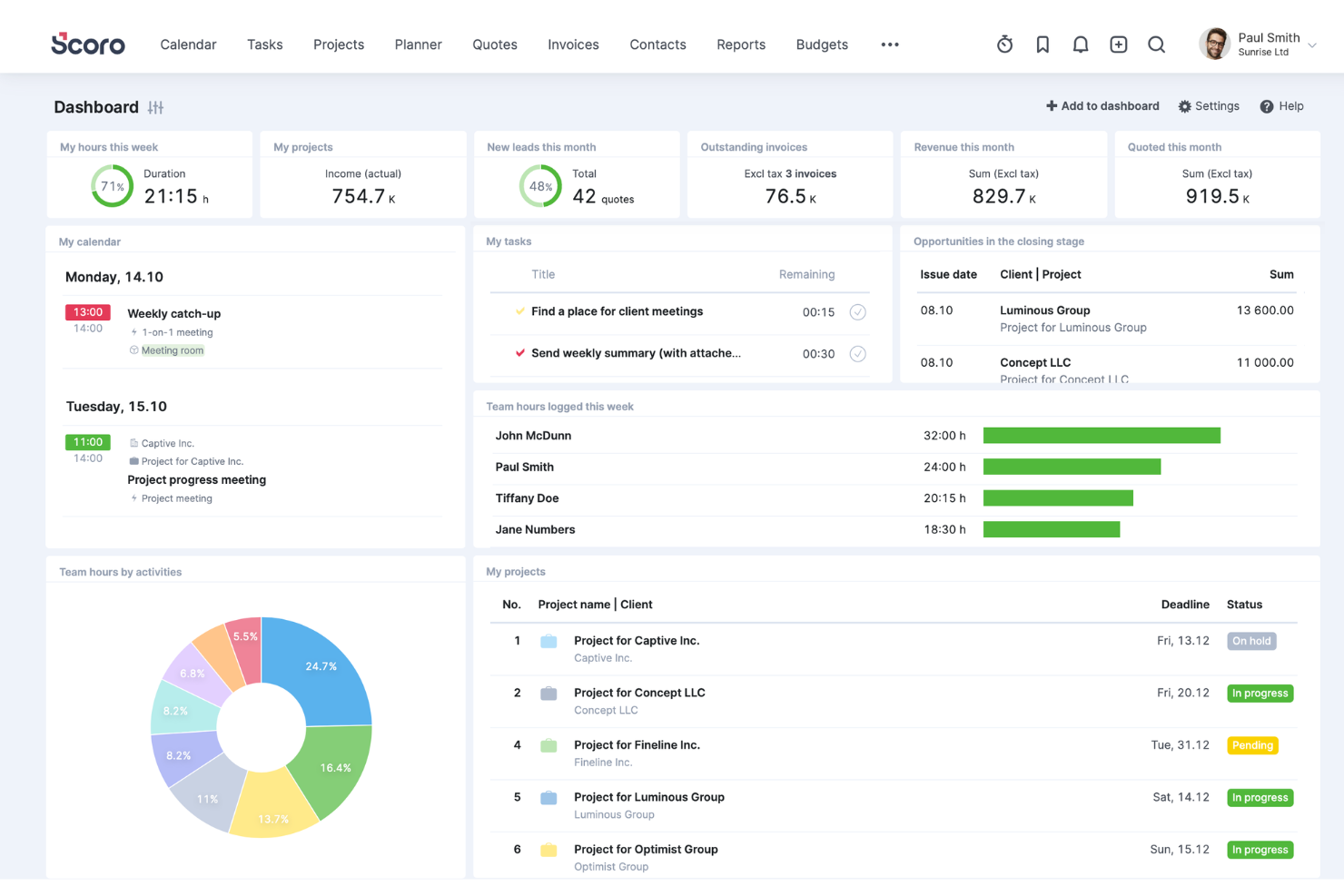
Scoro is a professional services automation software that can help you manage your operations more effectively. It provides a suite of tools for various roles within an organization and addresses every aspect of service delivery from project planning and execution to customer relationship management and billing. This level of integration is essential for services firms that need to maintain alignment across various departments and projects.
Why I Picked Scoro
Scoro excels in automating the critical yet time-consuming aspects of professional services, such as time tracking, invoicing, and reporting. The automated billing features let you quickly create detailed invoices based on the tracked time and expenses, which reduces errors and saves valuable administrative time. The software's ability to generate in-depth, customizable reports also gives you and your stakeholders insights into business performance, client profitability, and operational efficiency.
Another key aspect that sets Scoro apart is its CRM functionality, which allows for a seamless flow of information from initial client contact to project delivery and follow-up. You can manage client interactions, store critical data, and track communication history. Furthermore, the ability to link CRM data with project management and billing processes helps you keep clients informed and contributes to better client satisfaction and retention.
Scoro Key Features
Scoro also offers a range of other features that are designed to help you improve your professional services operations.
- Task Management: This helps you simplify task assignment and tracking, so your team stays organized and on schedule.
- Time Tracking: Scoro provides multiple options for logging hours, including a built-in timer for real-time tracking.
- Collaboration Tools: This centralizes project-related communication to foster better collaboration and let team members comment and tag each other.
- Customizable Dashboards: You can tailor your workspace to your needs and get a personalized view of KPIs and project statuses.
Scoro Integrations
Integrations include Google Calendar, Microsoft Exchange, Xero, QuickBooks, Sage Intacct, Expensify, Stripe, Jira, Slack, Asana, Dropbox, and PayPal.
Pros and Cons
Pros:
- AI assistant surfaces actionable insights
- Interlinked internal and external cost tracking
- Quote estimation matrix with margin insight
Cons:
- Gaps in mobile functionality compared to desktop features
- Custom reporting may need technical setup
New Product Updates from Scoro

Scoro Adds Quote Timelines, ELI Automation, and Partial Invoicing
Scoro now supports quote line start/end dates to build project timelines that carry into tasks and PDFs, expands ELI automation and conversation navigation, and adds partial invoicing by amount plus new accounting and HR integrations. For more information, visit Scoro's official site.

BigTime
Best for tracking time and expenses together
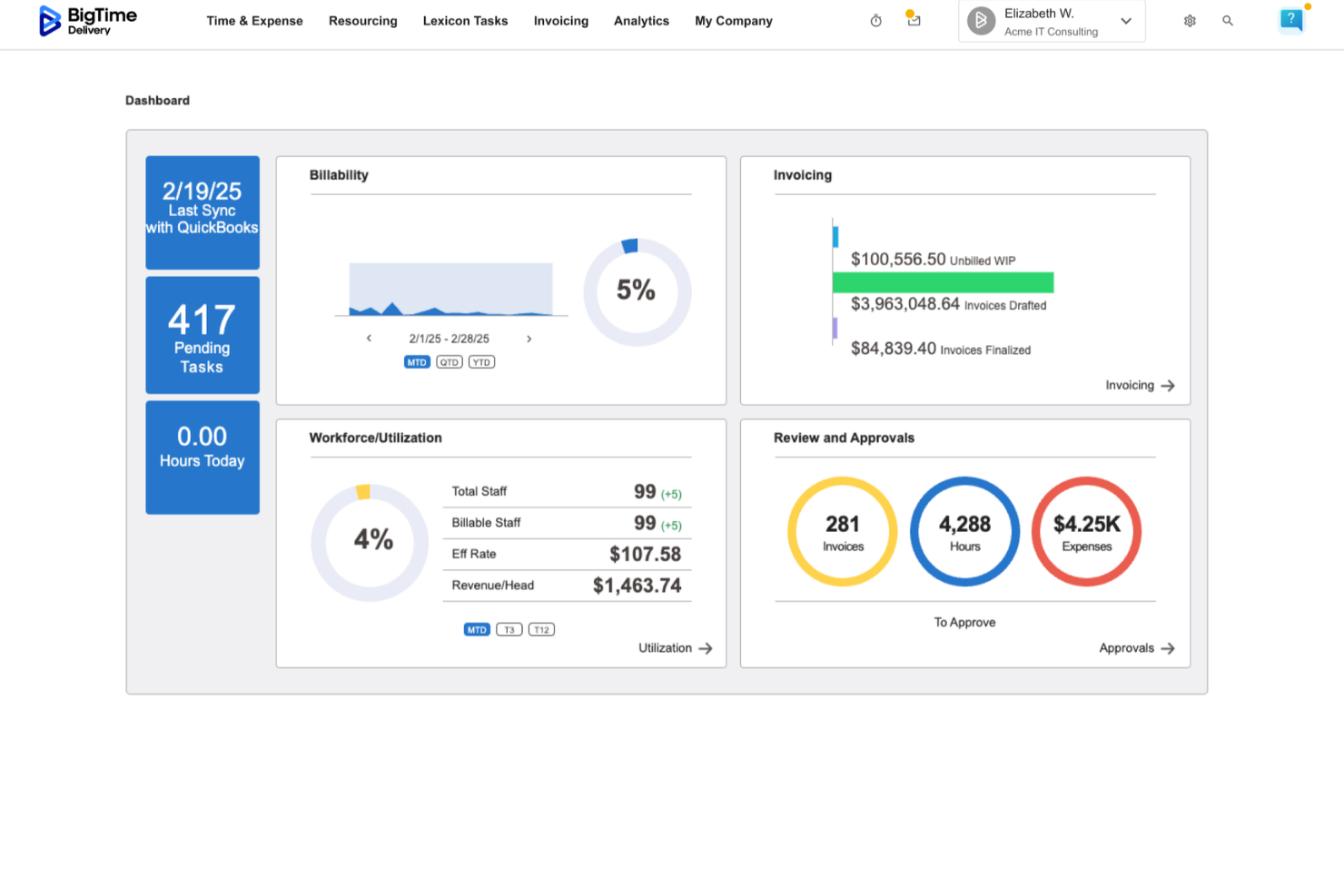
BigTime is a professional services automation (PSA) platform designed for IT, engineering, and consulting firms. It connects time tracking, billing, and financial reporting in a single system, helping teams manage projects from initial time entry through invoicing and revenue tracking. The software supports firms that rely on tools like QuickBooks and Sage by syncing financial data across systems. Billing rules, rate cards, and revenue recognition settings can be configured within BigTime to align with existing accounting structures. This allows finance teams to monitor work-in-progress (WIP), margins, and invoicing activity without relying solely on end-of-period reporting.
I recently spoke with Moti Gamburd, CEO of CARE Homecare, about how his team uses BigTime to manage time tracking and billing. He noted that time entries flow directly into billable hours with minimal manual adjustment. According to Gamburd, this helped reduce administrative errors and improved visibility into project-level profitability as work progressed.
Why I Picked BigTime
I picked BigTime because it combines time tracking, billing, and financial reporting within a system that integrates closely with general ledger platforms like QuickBooks and Sage. Teams can begin with core functionality such as time and expense tracking, billing, and profitability reporting. Additional modules, including resource management, quoting, and payment processing, can be added as operational needs expand. Each module uses the same underlying financial configuration, so billing structures and reporting logic remain consistent as usage grows. For finance leaders who need visibility into billing accuracy, WIP balances, and project margins, BigTime provides reporting and controls without requiring a full enterprise system implementation.
BigTime Key Features
BigTime offers a suite of other features that can help improve the way you manage your professional services offerings.
- Project portfolio management: Centralized visibility into active projects, including budget tracking and performance monitoring.
- Expense tracking: Capture and allocate project-related expenses to maintain budget control.
- Invoicing and payments: Generate invoices based on tracked time and expenses, with tools for monitoring payment status.
- Reporting and analytics: Access dashboards and reports focused on utilization, profitability, WIP, and financial performance.
BigTime Integrations
Integrations include QuickBooks, Salesforce, HubSpot, Jira, Xero, and Sage.
Pros and Cons
Pros:
- Unified time, billing, and financial tracking
- Modular structure allows expanded functionality over time
- Auto reminders help team compliance
Cons:
- Financial configuration may require upfront setup
- Less focused on client collaboration features compared to delivery-first tools

Accelo
Best for maximizing project profitability from quote-to-cash

Accelo is a professional services automation platform that helps businesses manage their operations more effectively. It offers features that automate various aspects of client management, project management, resource management, and financial management.
I recently spoke with Mircea Dima, the founder, CEO, and CTO of AlgoCademy. He's used Accelo in the past, and he says that "it simplified the process of project management...it was easy to coordinate with other members of my team and keep everything under control." He found the automation feature particularly useful. "Workflow automation made sure that tasks were being done on schedule and everybody remained on the same eye level," he says.
Why I Picked Accelo
Accelo links your sales process right to project delivery and invoicing, so there’s less friction handing off work. It also offers quote templates that let easily you turn estimates into project plans with time budgets, smart resource allocation to keep utilization high, and real-time cost vs. time tracking so you can see when a job is unprofitable. Built-in dashboards let you monitor margins across all open projects so small losses don’t become big ones.
Accelo Key Features
In addition to helping you optimize profitability, Accelo offers more features that can improve your team's productivity and service delivery.
- Task Management Dashboard: This feature provides a centralized view of all tasks to help your team prioritize and manage workloads effectively.
- Client Portal: This lets clients access project updates and billing information in real-time to foster transparency and better client relationships.
- Custom Reporting: You can create detailed reports tailored to your business needs, get insights into project performance, and make data-driven decisions.
- Automated Time Tracking: This feature can automatically log time spent on various tasks to maintain accurate billing and resource allocation without manual entry.
Accelo Integrations
Integrations include Google Workspace, Microsoft 365, Xero, QuickBooks Online, HubSpot, Mailchimp, Salesforce, Zapier, Stripe, PayPal, Jira, Continuum, Microsoft Power BI, Expensify, and Gusto.
Pros and Cons
Pros:
- Alerts help catch cost overruns early
- Adaptive schedules adjust with changes
- Better visibility into project profit margins
Cons:
- Mobile app more limited than web
- Some reports lack deep customization

Atera
Best for IT automation
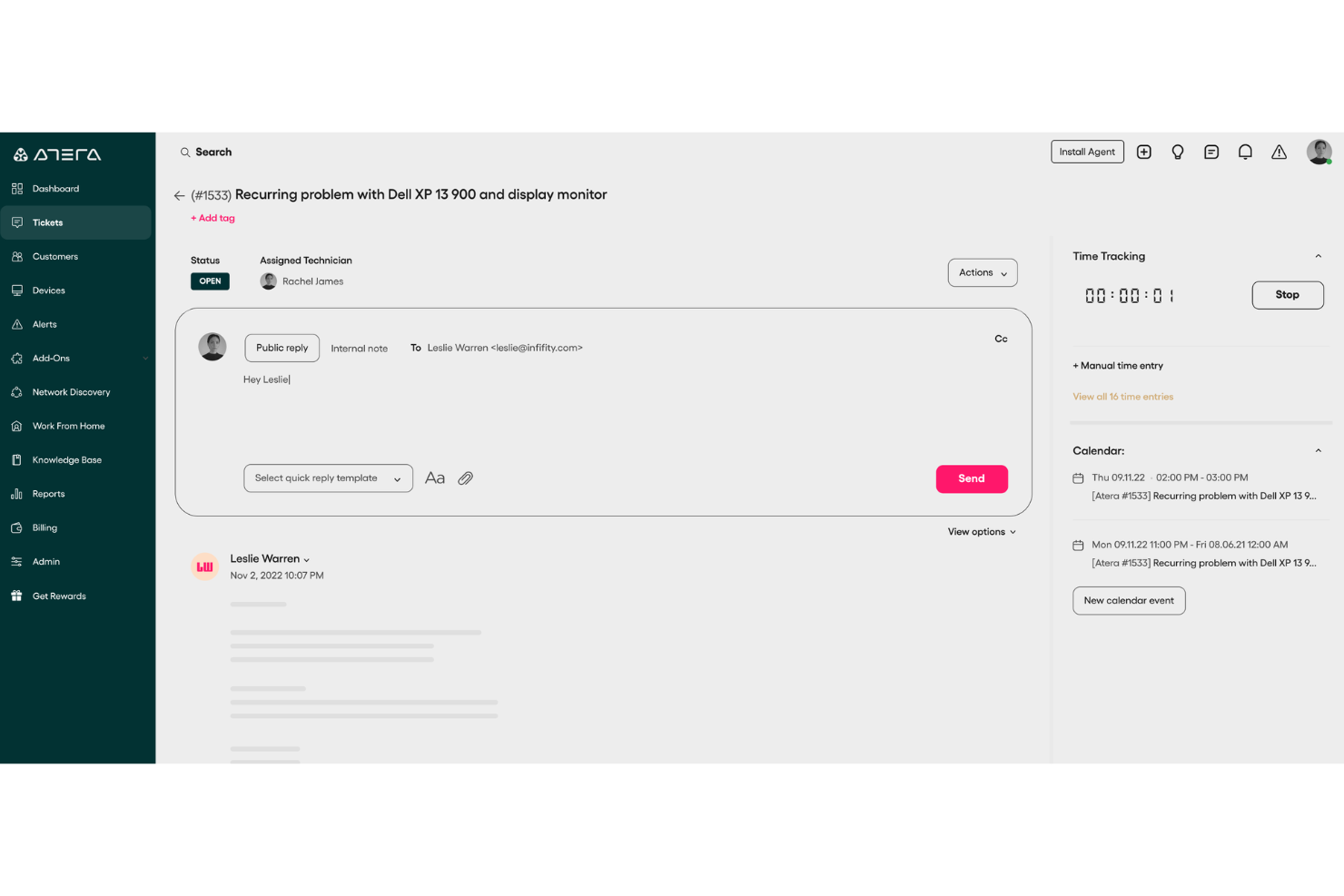
Atera offers an integrated platform that simplifies IT management for managed service providers (MSPs) and IT professionals by combining remote monitoring, management, and professional services automation. Its all-in-one nature makes it particularly appealing to businesses looking to streamline their IT operations and enhance service delivery.
Why I Picked Atera
I picked Atera because of its unique integration of remote monitoring and PSA functionalities, which is vital for IT service management. Its comprehensive ticketing system, combined with AI-powered insights, ensures that your team can manage client requests and issues effectively. Additionally, Atera's automated reporting feature allows you to track performance metrics and make informed decisions, which is crucial for maintaining service quality and client satisfaction.
Atera Key Features
In addition to its ticketing and reporting capabilities, I also found several other noteworthy features:
- Customer Portal: Provides clients with a dedicated platform to submit requests and track their status, enhancing transparency and communication.
- Flexible Contracts and Billing: Allows customization of contracts and billing processes to suit different client needs and agreements.
- Time Tracking: Facilitates accurate tracking of time spent on various tasks and projects, essential for billing and performance assessment.
- AI Ticket Tagging: Automates the classification of tickets using AI, improving response times and ticket management efficiency.
Atera Integrations
Integrations include QuickBooks, Xero, FreshBooks, Dropbox, Google Workspace, Microsoft 365, TeamViewer, Splashtop, AnyDesk, and Zapier. An API is also available for custom integrations.
Pros and Cons
Pros:
- AI-driven automation improves service quality and reduces workload.
- Integrated RMM and PSA features reduce tool redundancies.
- Centralized dashboard enhances IT management efficiency.
Cons:
- Additional costs for advanced reporting features.
- Less granular control for highly complex custom workflows or integrations.
New Product Updates from Atera

Atera Adds Webhook Triggers for Technician Assignment Changes
Atera ticket automation rules now support a webhook trigger when a ticket’s technician assignment changes, expanding automation beyond creation, status updates, and closure/resolution events. For more information, visit Atera's official site.

Best for end-to-end PSA management

Productive is a professional services automation software that's designed to help businesses streamline their operations. It's an end-to-end tool that covers everything from project management and time tracking to sales pipeline and profitability analysis.
I recently spoke with Miguel Angel Gongora Meza, the founder and director of Evolution Treks Peru, about his org's use of Productive. "I liked the fact that it presented the number of the hours worked as compared to the planned expenditures," he says. This saved them money as well. "In one of our projects we were able to save nearly 500 dollars as we were in a position to detect the inefficiencies early. It provided me with a clearer idea of how money and time were being spent and this is quite important when the resources are limited," he explains.
Why I Picked Productive
The project management feature is particularly impressive. It lets you plan projects, assign tasks, track progress, and forecast future work. The sales pipeline feature gives you a clear overview of your sales process, and the profitability analysis feature helps you understand your financial performance.
Productive's resource management and utilization insights provide a deep understanding of their team's workload and availability, which allows for better resource allocation and preventing burnout. The platform provides detailed reports and visualizations that display workloads, capacity, and efficiency levels so you can make informed decisions on task assignments and redistribute workloads as needed to optimize team performance and project efficiency.
Productive Key Features
Here are several other features offered by Productive that can help you with professional services automation.
- Time Tracking: This feature lets your team log hours with ease so you can get real-time insights into project timelines and resource allocation.
- Revenue Forecasting: You can predict future revenue streams based on current projects and resource availability, which helps with strategic planning.
- Profitability Analysis: This feature offers detailed reports on the profitability of projects and clients to help you make informed financial decisions.
- Integration with Accounting Tools: You can connect Productive to popular accounting software to facilitate efficient financial management and reporting.
Productive Integrations
Integrations include Quickbooks, Jira, Xero, Exact, Slack, Fortnox, and Personio.
Pros and Cons
Pros:
- Profitability insights available in real time
- Automations reduce repetitive task load
- End-to-end linking of projects to finances
Cons:
- You may need support to use advanced features effectively
- Customization limits in niche workflows
New Product Updates from Productive

Productive Adds Agent Triggers, Teams Integration, and Time Controls
Productive adds automated agent triggers, broader AI file support, Microsoft Teams integration, Resource Planner improvements, and new time entry controls. These updates expand automation while improving scheduling, collaboration, and time tracking. For more information, visit Productive’s official site.

Kantata
Best for full lifecycle service delivery

Kantata is a professional services automation (PSA) platform for firms that need to manage projects, resources, and financials in one place. Instead of juggling multiple systems, Kantata brings the entire service delivery lifecycle into a single cloud-based solution. This makes it easier to plan, staff, track, and report on client work with full visibility from start to finish.
Why I Picked Kantata
The software features powerful resource management and scheduling tools, project and portfolio management capabilities, and built-in financial oversight. Business intelligence dashboards and real-time analytics provide actionable insights, so leaders can make informed decisions on timelines, budgets, and client outcomes. The result is better visibility, stronger profitability, and smoother service delivery.
Kantata also supports ongoing collaboration and client engagement. Features like activity feeds, task boards, time tracking, and pulse surveys keep professional services teams aligned and give leaders feedback on both team morale and client sentiment throughout the project lifecycle. This people-first layer adds another dimension to traditional PSA software and makes delivery more predictable and client-focused.
Kantata Key Features
Kantata also offers several other features that make it useful as a professional services automation software.
- AI-Powered Tools: This feature uses artificial intelligence to help you optimize resource allocation and project delivery so you can make sure your team is always working at its best capacity.
- Collaboration Tools: You can facilitate seamless communication and collaboration among team members and clients to keep everyone aligned and informed.
- Advanced Business Intelligence: This provides real-time insights and analytics that empower your team with data-driven decision-making capabilities to improve project outcomes.
- Customizable Workflows: You can tailor processes to fit your specific operational needs to improve efficiency and make sure the software adapts to your business rather than the other way around.
Kantata Integrations
Integrations include Salesforce, SAP, Jira, Xero, BambooHR, Slack, Workday, QuickBooks, HubSpot, and NetSuite.
Pros and Cons
Pros:
- Built-in feedback mechanisms
- AI forecasting built in
- Multi-currency and multi-rate support
Cons:
- Configuration overhead for customization
- Implementation can be complex
New Product Updates from Kantata

Kantata Adds Access Group Change History
Kantata adds Access Groups History, letting account administrators track changes to group details, membership, and permissions in Recent History. The update also makes these events available through the Subscribed Events API for broader monitoring. For more information, visit Kantata’s official site.
 .
.
Wrike
Best for built-in client collaboration automations

Wrike is a comprehensive project management platform for agencies, marketing teams, and professional services providers. It provides a versatile professional services management and automation solution that can help you optimize your service delivery process.
I recently spoke with Danilo Coviello, the Founder of Espresso Translations, who mentioned that Wrike has helped improve their bottom line. "The tracking reports showed...that our Portuguese translations always came in 15-percentage points higher than the original time estimates," he says. "I immediately fixed our pricing model, and the outcome was a happier clientele and a better profit margin," he explains.
Why I Picked Wrike
Wrike provides you with a 360-degree view of all active projects, so you can effectively manage resources, keep track of billable hours, and make data-driven decisions with relative ease. It also helps you improve client collaboration by letting you invite clients into Wrike and make them a part of the work process. Clients can provide direct feedback and approvals on critical project decisions, and you can reduce the tedious back-and-forth process of getting requirements from clients or scope changes by using automations and customizable request forms. This lets you quickly collect all the necessary information from clients in one location and set up fully planned projects with predefined actions, task assignees, and timelines.
The automation engine can also help optimize team workload. It lets you offload otherwise repetitive tasks from the team's task list. Admins can also efficiently allocate client work to the most qualified team member based on their role and expertise. This lets you make sure team members are given the right amount of work and can avoid burnout.
Wrike Key Features
Wrike offers several other features that will help you and your team improve your project and service operations.
- Resource and Budget Management: This feature provides detailed tools for resource planning, budgeting, and time tracking to help your team maintain project profitability.
- Gantt Charts: The visual project timelines help you better plan and track project progress, which makes it easier for your team to stay on schedule.
- Customizable Dashboards: You can get real-time visibility into project progress and team performance with customizable dashboards and visualizations like Kanban boards.
- Client Communication: You can let clients actively participate in the project process, which helps foster trust and transparency.
Wrike Integrations
Integrations include Salesforce, Jira, Google Drive, Microsoft Office 365, Slack, Zoom, and Adobe Creative Cloud.
Pros and Cons
Pros:
- Blueprint templates reduce setup time
- Visual whiteboards facilitate group ideation
- External clients can use request forms directly
Cons:
- Client-facing features limited in lower plans
- External permissions require careful configuration
New Product Updates from Wrike

Wrike AI Agents Create Full Blueprints and Formatted Items
Wrike’s AI Agent can now create full blueprints (parent items plus subtasks) in one step and generate richer, formatted descriptions. This makes automated workflow creation more complete. For more information, visit Wrike’s official site.

VOGSY
Best for service organizations with global resources and projects

VOGSY is a cloud solution that brings together project delivery, resource planning, and finance across multiple geographies. It’s for firms operating in several countries that need to manage international projects, staffing, and financials, and it supports opportunity management, allocation, time tracking, invoicing, and financial consolidation.
Why I Picked VOGSY
This tool lets you and your team run work across borders without losing track of local financial rules or currency conversions. VOGSY lets you set up multiple legal entities, local accounting tools, and tax regimes while maintaining a shared resource pool and unified dashboards. It provides intercompany invoicing and revenue distribution so internal costs are handled automatically. You also get opportunity pipelines that are linked to resource forecasts, project budgets tied into local and consolidated financials, and reports that roll up across all your entities. It's built to connect your global operations rather than forcing you to adopt a one-size-fits-all system.
VOGSY Key Features
In addition to global resource management capabilities, VOGSY offers several other features that improve your operational efficiency.
- Time and Expense Tracking: This feature lets you automate time tracking with auto-populated timesheets and simplifies expense management through easy receipt uploads.
- Task Management: This provides visual task tracking for team members across projects and improves collaboration and accountability.
- Billing and Invoicing: You can automate billing processes, as well as schedule invoices for various project types. This helps maintain accuracy and timeliness.
- Real-Time Reporting: You can create custom reports for stakeholders and your team, and use them for informed decision-making and strategic planning.
VOGSY Integrations
Integrations include Google Workspace, Jira, Microsoft 365, Xero, QuickBooks, Copper, HubSpot, Salesforce, and Zoho.
Pros and Cons
Pros:
- Intercompany revenue and cost automation
- Shared resource pool across entities
- Handles multi-country operations in one system
Cons:
- Requires careful configuration for tax regimes
- Setup complexity in multinational contexts
New Product Updates from VOGSY
VOGSY Adds Practices and Financial Totals in Planning Views
VOGSY adds a new Practices layer for consolidated reporting and displays revenue and cost totals directly in planning views so you get high-level insights and instant financial context without extra steps. For more information, visit VOGSY’s official site.
 .
.
SuperOps
Best for MSP operational growth

For IT teams and managed service providers that want to improve their operational efficiency, SuperOps provides an AI-driven professional services automation solution that offers essential functionalities like service desk management and contract oversight. It simplifies ticketing and resource tracking, can help you improve your workflows, and offers features like mobile device management and integrations with other remote monitoring tools.
Why I Picked SuperOps
I chose SuperOps because it's a unified PSA and remote monitoring and management platform that includes service desk management, contract management, and service automation, and it can drive MSP operational growth. The AI-driven profitability tools and advanced policy management for endpoint discovery are standout features that can help improve your efficiency and automate routine tasks.
The platform's ability to streamline processes and improve service delivery makes it an ideal choice for MSPs that want to grow their operations. These functionalities save time and increase profitability, which makes SuperOps a strategic asset for any MSP that wants to increase service quality and client satisfaction.
SuperOps Key Features
SuperOps offers a range of other features that professional services teams will find useful.
- Task and Reply Templates: These let your team save time and maintain consistency by using pre-defined templates for common tasks and responses.
- Kanban View: This provides a visual representation of your workflows to help you and your team track progress and manage tasks more effectively.
- Customer Satisfaction Surveys: You can gather valuable feedback from your clients with built-in surveys to continuously improve service quality and client satisfaction.
- Runbooks: You can automate routine tasks and streamline approvals using runbooks, which help maintain consistency and reduce manual errors in operations.
SuperOps Integrations
Integrations include ESET, Splashtop, Acronis, QuickBooks, Xero, Microsoft Azure, Stripe, and TeamViewer.
Pros and Cons
Pros:
- AI-driven features for improved IT management
- Solid service desk and project management tools
- Strong automation capabilities improve operational efficiency
Cons:
- Relatively few integrations
- Limited customization options compared to competitors
New Product Updates from SuperOps

SuperOps Improves Ticket Visibility, Dynamic Forms, and Dashboard Views
SuperOps introduces improvements to ticket visibility, dynamic forms, and dashboard visualizations. These updates help technicians manage customer conversations, simplify ticket creation, and keep dashboard views consistent across teams. For more information, visit SuperOps' official site.
 .
.

Celigo is an integration and automation platform for professional services teams that connects business applications, automates workflows, and manages data across multiple systems.
Who Is Celigo Best For?
Celigo suits IT and operations teams at mid-sized to large organizations that need to automate and connect multiple business applications.
Why I Picked Celigo
I picked Celigo as one of the best because I can access over 1,000 prebuilt app connectors, which makes connecting our core business tools fast and reliable. My team uses these connectors to automate project handoffs between CRM, ERP, and time tracking platforms. I like that we can quickly deploy integrations for new clients without building custom connections from scratch.
Celigo Key Features
- Workflow automation designer: Build and customize multi-step workflows across business applications.
- Error management dashboard: Monitor, troubleshoot, and resolve integration errors from a single interface.
- Role-based access controls: Set permissions and manage user access for sensitive data and workflows.
- Real-time data synchronization: Keep information updated instantly between connected systems.
Celigo Integrations
Celigo offers 1,000+ native prebuilt connectors, including Salesforce, NetSuite, Microsoft Dynamics 365, SAP, QuickBooks, Shopify, HubSpot, Jira, Slack, Google Sheets, and Snowflake. An API is available for custom integrations.
Pros and Cons
Pros:
- Supports SOC 2 Type II and GDPR compliance
- AI-guided integration builder accelerates setup
- Offers 1,000+ prebuilt app connectors
Cons:
- Limited offline or on-premises deployment options
- Advanced features require higher-tier plans
New Product Updates from Celigo
Celigo Ora Graduates to General Availability
Celigo Ora, its natural-language interface, has moved from beta to general availability, enabling users to build, troubleshoot, manage, and analyze integrations with approval before changes are applied. For more information, visit Celigo's official site.
 .
.Other Professional Services Automation Software Options
Here are some tools that did not make my top list, but which are still worth your consideration if you didn’t find what you were looking for above.
- Rocketlane
For AI-powered project delivery
- Forecast
For mid-sized agencies and consultancies
- Projectworks
For linking resources and financial data
- Workday
For fast-moving businesses
- Birdview
For automating and optimizing service delivery cycle
- Polaris PSA By Replicon
For AI-driven resource optimization
- PSOhub
For automating recurring project work
- ProjectManager
For no-code workflow automation
- Hello Bonsai
For managing projects, clients, and finances
- Parallax
For efficient resource management
- ConnectWise
For intelligent automation for small businesses
- Ravetree
For retainer contracts
- Dynamics 365 Project Operations
For connecting sales and project delivery
- NinjaOne
For PSA and billing alignment
- Smartsheet
For customer onboarding and project visibility
- Celoxis
For managing your project portfolio, resources, and budgets
- ClickTime
For mid-sized businesses with employees across projects
- Screendragon
AI-powered workflow and automation for PSA
- Planview
For more predictable and profitable customer engagements
- Dayshape
With real-time reporting dashboards


Related Project Management Software Reviews
How I Evaluate Professional Services Automation Software
I split my evaluation into two layers: the baseline capabilities a tool must have—like time tracking, billing, and resource planning—and the differentiators that set the best options apart.
Core Functionality (Table Stakes For This List)
When I'm selecting tools for my list, I rank each one on a scale from 0 (does not offer the functionality) to 5 (excels in this area) for each core functionality listed below. Then, I calculate the tool's total score into a percentage. Each tool needs to achieve a minimum total score of 65% to be considered for inclusion.
- Project & Engagement Management: I look for structured project planning with Gantt views, dependencies, and templates built around client engagements rather than generic task boards.
- Resource Planning & Utilization: Each tool should let you match consultants to projects by skill, availability, and capacity so you can spot staffing gaps before they hit delivery.
- Time & Expense Tracking: Billable vs. non-billable hour capture tied to specific clients and projects matters here, along with expense logging and approval workflows.
- Billing & Invoicing: I evaluate whether a tool supports multiple billing models like fixed-fee, time & materials, and milestone-based, since most services firms juggle several across their book of business.
- Project Financials & Profitability: Real-time budget-to-actual tracking and margin visibility at the project level are what I check for, especially the ability to flag at-risk engagements early.
- Services Analytics & Reporting: Dashboards covering utilization rates, realization, backlog, and project performance help services leaders make staffing and pricing decisions with actual data.
Once I have a list of tools that meet the criteria, I consider what sets each platform apart.
Differentiating Factors (What Sets Vendors Apart)
Here's how I compare and contrast different vendors:
Standout Features
Quote-to-cash automation is a big differentiator—tools that connect SOW creation to invoicing and revenue recognition save finance teams from chasing approvals across spreadsheets. I also evaluate AI-powered forecasting, which helps resource managers predict demand and flag margin risk before a project goes sideways. Subcontractor management matters too, especially for firms that blend internal and external talent across engagements and need unified billing for both.
Beyond Features
Integrations are a major consideration—I check whether a tool connects natively to accounting systems like QuickBooks or Sage Intacct and CRMs like Salesforce, since broken data flows between PSA and finance create billing nightmares. Industry fit also matters. A platform built for IT consulting firms won't always suit a creative agency. I look at whether vendor-specific templates and workflows align with the buyer's delivery model. Finally, I evaluate implementation support, because PSA rollouts touch every department and a poor onboarding experience stalls adoption.
How to Choose Professional Services Automation Software
It’s easy to get bogged down in long feature lists and complex pricing structures. To help you stay focused as you work through your unique software selection process, here’s a checklist of factors to keep in mind:
| Factor | What to Consider |
|---|---|
| Scalability | Make sure the software can grow with your business. Look for features like flexible user limits and the ability to handle increasing project complexity. |
| Integrations | Check that it connects with tools you already use, like CRM, accounting, or project management platforms. |
| Customizability | Check whether you can tailor dashboards, workflows, and reports to match your team’s specific needs and processes. |
| Ease of Use | Choose software that’s intuitive and easy for your team to use without extensive training. This helps speed up onboarding and improves productivity. |
| Budget | Assess upfront costs, subscription fees, and any hidden charges. Compare pricing models to make sure the solution fits your financial goals. |
| Security Safeguards | Make sure the software has robust data protection features like encryption, role-based access, and compliance with industry standards like GDPR. |
| Reporting | Look for advanced reporting tools to give your team actionable insights into performance, resource allocation, and profitability. |
| Support Options | Confirm that there’s reliable customer support, whether through live chat, email, or a dedicated account manager, to address issues quickly. |
Trends in Professional Services Automation Software
Here are some of the emerging trends I’m keeping an eye on:
- AI-driven insights: Vendors are adding AI features that can analyze project data and predict risks, delays, or resource bottlenecks, which gives teams a chance to course-correct before problems arise. For example, some tools now suggest resource reassignments based on historical performance.
- Dynamic pricing models: Some vendors are offering tools that you can use to calculate real-time pricing for services based on market trends, resource availability, and project scope. This means better flexibility for both clients and providers.
- Employee experience focus: Platforms are introducing features like skills tracking, career development dashboards, and team wellness insights to support employee growth and engagement.
- Decentralized project tracking: With hybrid work here to stay, tools are evolving to support decentralized teams with multi-time zone support, asynchronous communication options, and real-time global dashboards.
What Is Professional Services Automation Software?
Professional services automation software is a tool used by service-based organizations like consultancies, accounting firms, and legal firms to manage and automate operations like finances, resource management, time tracking, and billing.
It integrates project management, client relationship management, financial management, and time and expense tracking into one system to improve efficiency in managing projects and resources, increase billing accuracy, improve team collaboration, and reduce administrative overhead.
Features of Professional Services Automation Software
When selecting professional services automation software, keep an eye out for the following key features:
- Project management: Simplify project planning, task assignment, and progress tracking so you can keep everyone organized, spot bottlenecks early, and keep deadlines in check.
- Time tracking: Accurately record billable hours with easy-to-use timers or manual entry, make sure you don’t leave money on the table, and easily bill clients.
- Resource allocation: See who’s available and match the right people to the right projects to avoid burnout and make sure your team’s skills are put to the best use.
- Invoicing and billing: Generate invoices fast, track payments, and manage your accounts receivable to stay on top of your cash flow.
- Expense management: Store receipts, categorize expenses, and link costs directly to projects, as well as keep track of how much you’re spending and on what.
- Client management (CRM): Keep client info, communications, and contracts in one place. This makes it easy to nurture relationships and deliver top-notch service.
- Reporting and analytics: Get clear insights into team performance, project margins, and profitability with customizable reports.
- Document management: Store, share, and organize project files securely, so everyone on your team always has the latest version at their fingertips.
Common Professional Services Automation Software AI Features
Beyond standard professional services automation software features, many AI-powered PSA tools offer features like:
- Automated task prioritization: Uses AI to analyze workloads and deadlines and recommend which tasks you should focus on first to maximize efficiency.
- Predictive resource forecasting: Uses project trends and team utilization to help you anticipate staffing needs and avoid last-minute scrambling.
- Smart time capture: Tracks work activity automatically and suggests time entries, so you and your team never forget to log billable hours.
- AI-driven project risk alerts: Monitors project health and identifies potential risks before they become problems, so you can course-correct early.
- Chatbots for client interaction: Handles simple client queries or onboarding steps to free up your team to focus on more complex client needs.
FAQs About Professional Services Automation Software
Here are the answers to some frequently asked questions about professional services automation software.
What integrations should I look for in PSA software?
Make sure the PSA software you’re considering can integrate with any project management platforms, CRM systems, accounting tools, and time tracking apps you’re already using. Integrations with tools like Salesforce, QuickBooks, Slack, and Microsoft Teams can help connect your team’s workflow, reduce manual data entry, and automate reporting. Think about which systems your team already uses daily and prioritize PSA solutions that sync with them.
How can I measure the ROI of PSA software?
To measure the ROI of PSA software, you can track the time it saves, improvements in billable resource utilization, reduced project overruns, and fewer errors in invoicing or finance. Compare project delivery times, profit margins, and client satisfaction before and after implementation. Most PSA platforms should offer dashboards that show utilization rates, project costs, and margins so you can quantify the value you’re getting out of the system.
What challenges might I face when implementing PSA software?
Common challenges include getting buy-in from your team, migrating existing data, and training users on new systems. Projects can stall if setting up integrations with your existing tools is complex or if the PSA platform isn’t customizable for your workflows. To ease the process, provide clear guides for your team, designate an internal champion, and prioritize platforms that offer strong onboarding support.
Does PSA software help with resource management and forecasting?
Yes, PSA software can help you manage resources and forecast workloads. It lets you see who’s assigned to what, identify bottlenecks, and analyze capacity for upcoming projects. Many tools include visual scheduling, demand forecasting, and availability tracking so you can optimize utilization and avoid under- or over-booking your team.
What's Next?
Want to connect with other digital project managers to share resources and best practices? Join our membership community and get access to 100+ templates, samples, and examples and connect with 100s of other digital project managers in Slack.