

10 melhores ferramentas alternativas ao Teamwork para projetos em 2026

Lista das melhores alternativas ao Teamwork


As melhores alternativas ao Teamwork oferecem relatórios e painéis mais flexíveis para monitorizar o progresso, métricas adicionais, opções de edição em massa e mais funcionalidades na aplicação móvel. Com a alternativa certa ao Teamwork, pode acompanhar melhor os projetos, gerir cronogramas e criar um ambiente colaborativo para a sua equipa.
Utilizei a minha experiência em gestão de projetos e mais de 3 anos de testes de software para analisar dezenas de alternativas ao Teamwork, para que possa encontrar a ferramenta certa para ajudar a sua equipa a colaborar no trabalho de projetos entre departamentos, gerir cargas de trabalho e recursos e organizar portefólios de projetos em toda a sua organização. Abaixo, abordo os pontos fortes e as principais diferenças, as vantagens e desvantagens e os casos de utilização ideais de cada ferramenta.
O que são alternativas ao Teamwork?
As alternativas ao Teamwork são software de gestão de projetos e ferramentas de colaboração que oferecem funcionalidades comparáveis às do Teamwork, mas que também podem incluir mais funcionalidades de relatórios e análises, maior flexibilidade e possibilidade de personalização e funcionalidades de armazenamento de ficheiros. Podem também oferecer uma aplicação móvel mais funcional ou ser mais adequadas para grandes organizações com portefólios de projetos extensos.
As alternativas ao Teamwork também incluem normalmente as funcionalidades padrão de gestão de projetos e colaboração, como a gestão de recursos, a gestão de cronogramas e o planeamento de projetos.
Why Trust Our Software Recommendations
Our team has been testing and reviewing software since 2012. As project managers ourselves, we know how difficult—and important—it is to choose the right software.
For this guide, we evaluated tools using hands-on testing and independent research, scoring tools using our selection criteria. We also draw on insights from industry thought leaders and practicing project management experts.
Our reviews reflect our human editorial judgment, not a sales pitch.
Expert reviewers:
Tabela de comparação das alternativas ao Teamwork
Esta tabela de comparação resume os detalhes de preços das minhas principais escolhas de alternativas ao Teamwork:
| Tool | Best For | Trial Info | Price | ||
|---|---|---|---|---|---|
| 1 | Best for team communication and collaboration | Free plan available | From $7.25/user/month (billed annually) | Website | |
| 2 | Best for comprehensive agency project management | 14-day free trial | From $10/user/month (billed annually) | Website | |
| 3 | Best for managing client billing within projects | Free demo available | Pricing upon request | Website | |
| 4 | Best for breaking down large projects | Free plan + 15-day trial + demo available | From $4/user/month (billed annually) | Website | |
| 5 | Best for extensive workflow and dashboard customization | Free plan + 14-day trial + demo available | From $10/user/month (billed annually) | Website | |
| 6 | Best for agency quote-to-cash project tracking | 14-day free trial | From $17/user/month | Website | |
| 7 | Best for interactive Gantt charts | 14-day free trial + free demo available | From $7/user/month (billed annually) | Website | |
| 8 | Best for client onboarding management | 14-day free trial | From $49/user/month (billed annually) | Website | |
| 9 | Best for uniting teams, goals, and processes | Free plan + 14-day free trial available | From $10/user/month (billed annually) | Website | |
| 10 | Best for unlimited storage | Free plan + 14-day trial available | From $2.49/user/month | Website |


Análises das melhores alternativas ao Teamwork
Nesta secção, apresentarei uma análise detalhada e uma visão geral de cada uma das alternativas ao Teamwork. Abordarei as vantagens e desvantagens de cada ferramenta, as suas funcionalidades e os melhores casos de utilização.

Slack
Best for team communication and collaboration
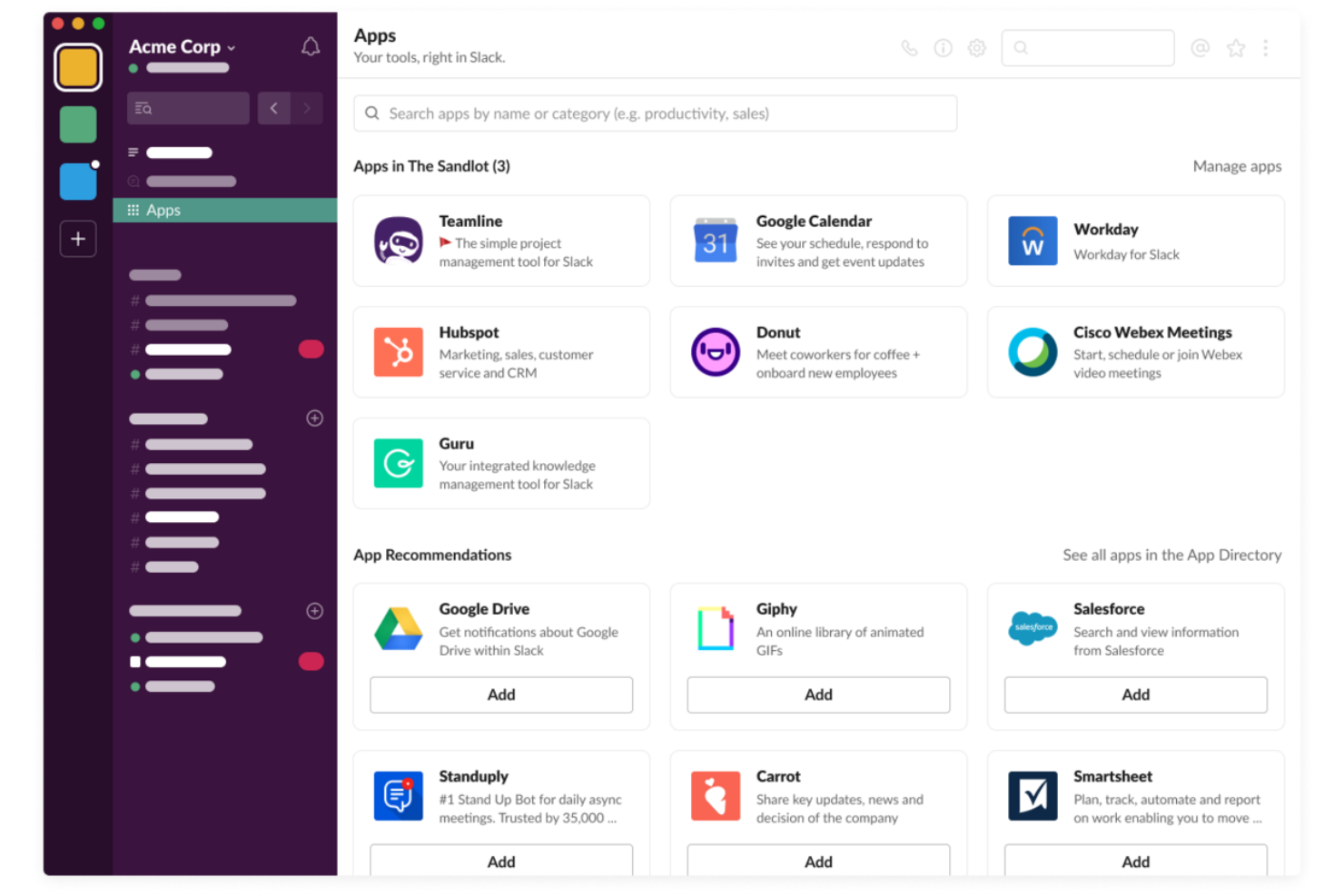
Slack is a powerful communication platform designed to facilitate team collaboration and streamline communication. It offers a centralized space for messaging, file sharing, and integrating other tools, making it essential for teams seeking efficient and organized communication channels.
Why it's a good Teamwork alternative:
Slack’s powerful communication features help to manage and improve team collaboration through channels, direct messaging, and integration with numerous productivity tools. Its real-time messaging, file sharing, and searchable history enhance team connectivity and efficiency, making it ideal for teams looking to improve their communication and project coordination.
Standout features & integrations:
Features include real-time messaging, file sharing, searchable message history, customizable channels, direct messaging, video and voice calls, notifications, workflow automation, custom emojis and reactions, pinning important messages, and advanced security features.
Integrations include Google Drive, Google Calendar, Dropbox, Trello, Asana, and Microsoft Office 365.
Pros and Cons
Pros:
- Powerful search functionality
- Extensive integration options
- Real-time messaging and notifications
Cons:
- Notification management can be challenging
- Can become cluttered with excessive channels

Best for comprehensive agency project management
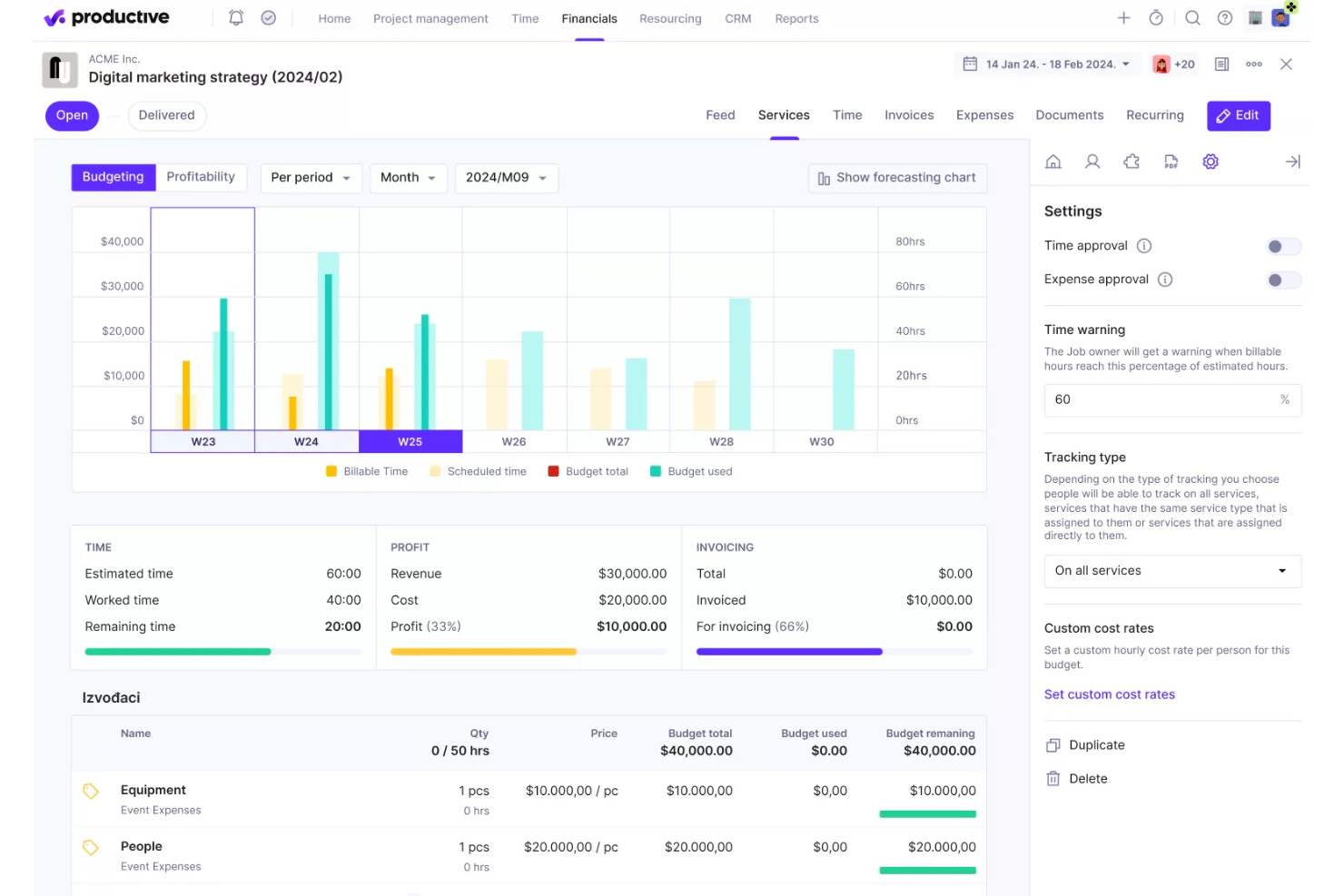
Productive is a professional services management platform that brings together project tracking, resource planning, time tracking, budgeting, invoicing, and financial reporting in a single workspace.
Who Is Productive Best For?
Productive is a strong fit for agencies and professional services teams that need project management, time tracking, and client billing to work together in one place.
Why I Picked Productive
I've included Productive in my top picks because it's built specifically for agency project management, where project tracking and financial visibility need to live in the same place. I particularly like how budgets, tracked time, and profitability data sit directly alongside tasks and timelines, so you can see a project's financial health without switching tools. The Resource Planner also gives you top-down capacity planning across your whole team, making it easier to staff client work before you've mapped out every task.
Productive Key Features
- Client invoicing: Create, send, and automate invoice drafts directly from tracked time and project budgets, with connections to accounting tools like QuickBooks and Xero.
- Task dependencies: Set blocking, waiting-on, or linked dependencies between tasks to control sequencing and surface them in Gantt views.
- Time tracking with approvals: Log hours via timer or manual entry across web, desktop, and mobile, then submit timesheets for manager review and approval.
- Automation builder: Configure workflow automations—including AI-created ones from plain-language descriptions—to reduce repetitive manual steps across projects.
Productive Integrations
Productive offers native integrations with Jira, QuickBooks, Xero, Google Calendar, Slack, HubSpot, Microsoft Outlook, and HRIS platforms. It also provides an open API, webhooks, and Zapier connectivity for custom integrations.
Pros and Cons
Pros:
- Resource planning shows capacity across projects
- Gantt dependencies clarify task sequencing
- Project budgets connect tracked time and profitability
Cons:
- Workload view lacks daily hour allocation
- Dense navigation can slow daily workflows
New Product Updates from Productive
Productive Adds Voice Dictation, Slack Connector, Proposals, and Overtime
Productive adds voice dictation, a Slack Connector, proposal controls, and overtime tracking. These updates support faster AI interactions, client proposals, and time management. For more information, visit Productive’s official site.

Accelo
Best for managing client billing within projects
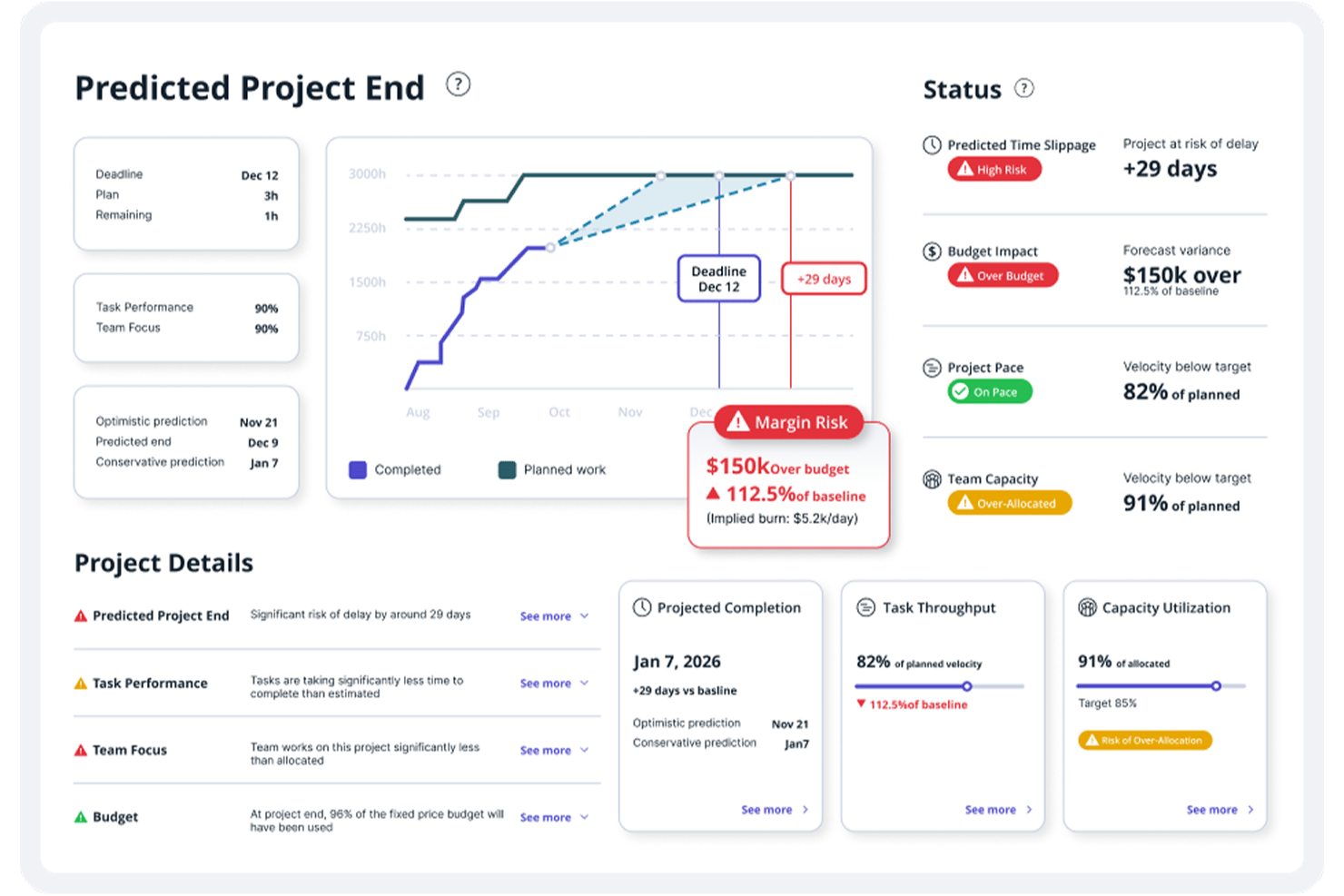
Accelo is a professional services automation platform that connects project management, time tracking, resource scheduling, client billing, and financial reporting in one system.
Who Is Accelo Best For?
Accelo is a strong fit for client-services teams—agencies, consultancies, and professional services firms—that need to connect project delivery with billing in one place.
Why I Picked Accelo
I picked Accelo as one of the best because it's the only tool on this list that treats client billing as a native part of project delivery, not a separate step. When my team logs time against a project or ticket, that data flows directly into invoices, whether the engagement is fixed-price or time-and-materials. I also like how retainer tracking works in practice: you can see hours burned against budget in real time, and clients can view that same data through the branded client portal without needing a separate report.
Accelo Key Features
- Resource scheduling: Assign and view team availability across projects using soft and hard allocations, with capacity forecasting and utilization reporting built in.
- AI-assisted timesheets: Accelo suggests time entries based on actual work activity, reducing manual logging for individual team members.
- Client portal: Give clients a branded workspace to view project status, access shared files, complete assigned tasks, and submit sign-off approvals.
- Portfolio views: Review progress, budget usage, and status across multiple projects from a single rollup view.
Accelo Integrations
Accelo integrates with Microsoft 365, Google Workspace, Xero, QuickBooks, Jira, and Zapier. Its REST API, Forms API, and webhooks support custom integrations.
Pros and Cons
Pros:
- Shares approvals and project status with clients
- Tracks milestones, dependencies, and portfolio progress
- Connects logged work directly to client invoices
Cons:
- Reviewers report crowded screens and slow updates
- Setup demands time across connected workflows
New Product Updates from Accelo

Accelo Rebuilds Mobile App for Project and Time Management
Accelo rebuilds its mobile app with task management, new work creation, and mobile timesheets for Forecast customers. This helps teams keep project and time data current while working away from a desktop. For more information, visit Accelo’s official site.

Best for breaking down large projects
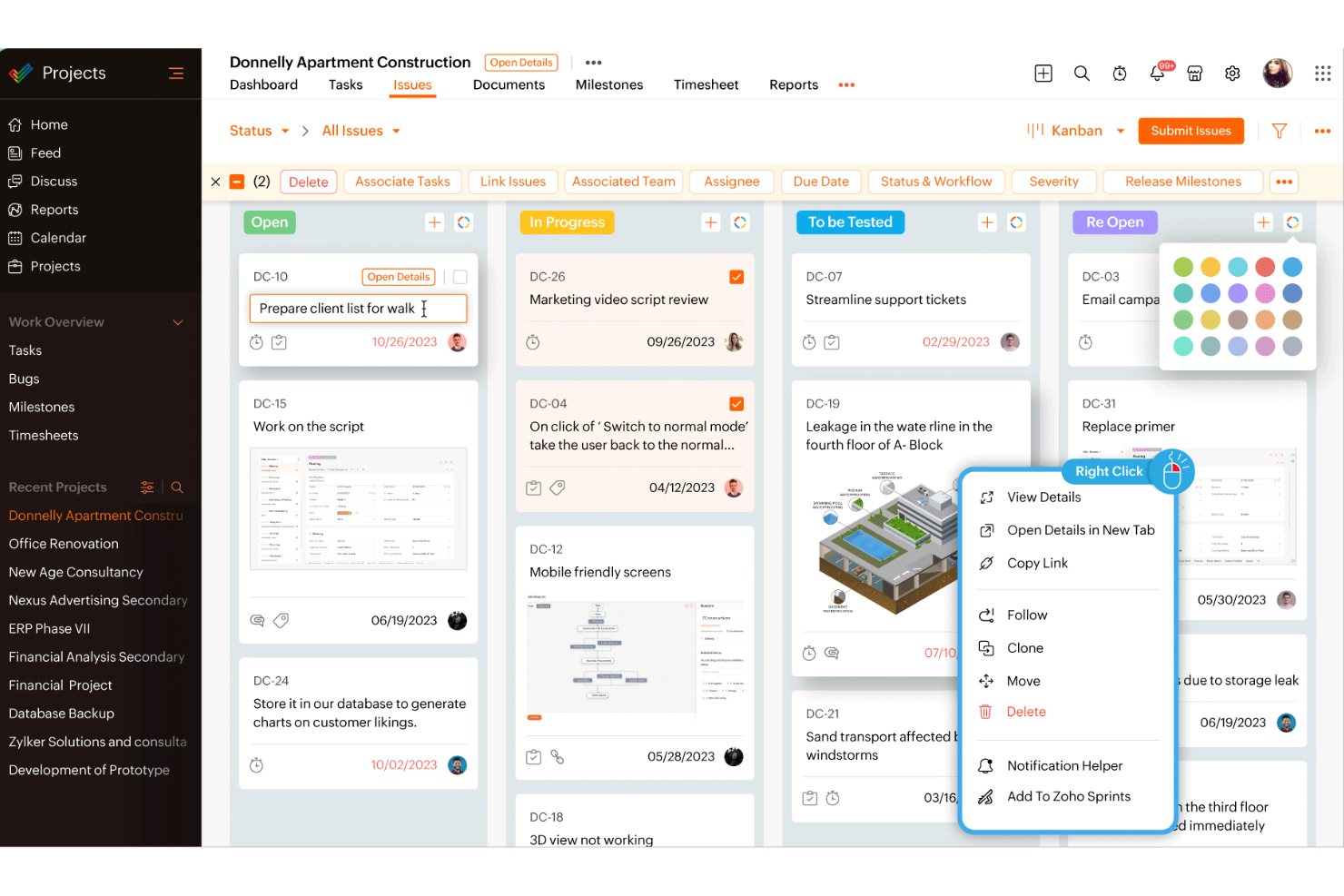
Zoho Projects is a project management platform with task breakdowns, Gantt charts, time tracking, resource management, workflow automation, and built-in collaboration tools across Kanban, list, and calendar views.
Who Is Zoho Projects Best For?
Zoho Projects is a strong fit for project managers who need to break large, complex projects into structured, trackable work across distributed teams.
Why I Picked Zoho Projects
I've included Zoho Projects in my top picks because it's built specifically around breaking complex work into structured, trackable layers: milestones, task lists, tasks, and subtasks, each with owners, dependencies, and progress tracking. I like how the critical path analysis (on Enterprise) lets you immediately see which tasks would delay the entire project if they slip. The blueprint feature also lets you design task workflows that automatically reassign work and alert the right people as statuses change, which removes a lot of manual coordination on larger projects.
Zoho Projects Key Features
- Time tracking with billable logs: Log hours via timers or manual entry, mark them billable or non-billable, and submit them for approval directly within tasks.
- Task blueprints: Design step-by-step task workflows that automatically reassign work, update fields, and notify the right people as statuses change.
- Portfolio dashboard: View progress across all projects, tasks, and issues in one place, with status, ownership, and budget-health reporting.
- Earned value management: Compare planned versus actual schedule, cost, and time to measure project performance and forecast outcomes.
Zoho Projects Integrations
Zoho Projects offers 50+ marketplace integrations, plus native connections with Zoho Books, Zoho CRM, Slack, Microsoft Teams, Google Drive, GitHub, GitLab, and Basecamp. It also provides a REST API and Zapier integration for custom connectivity.
Pros and Cons
Pros:
- Billable time logs support approval workflows
- Workload views clarify team assignments
- Detailed task breakdowns with dependency tracking
Cons:
- Mobile app offers fewer desktop features
- Crowded menus can slow task navigation
New Product Updates from Zoho Projects
Zoho Projects Adds CodeX Scripts for Custom Modules
Zoho Projects now supports CodeX Scripts for custom modules, enabling conditional logic and rules for creating, updating, and deleting records. For more information, visit Zoho Projects' official site.
 .

Wrike
Best for extensive workflow and dashboard customization
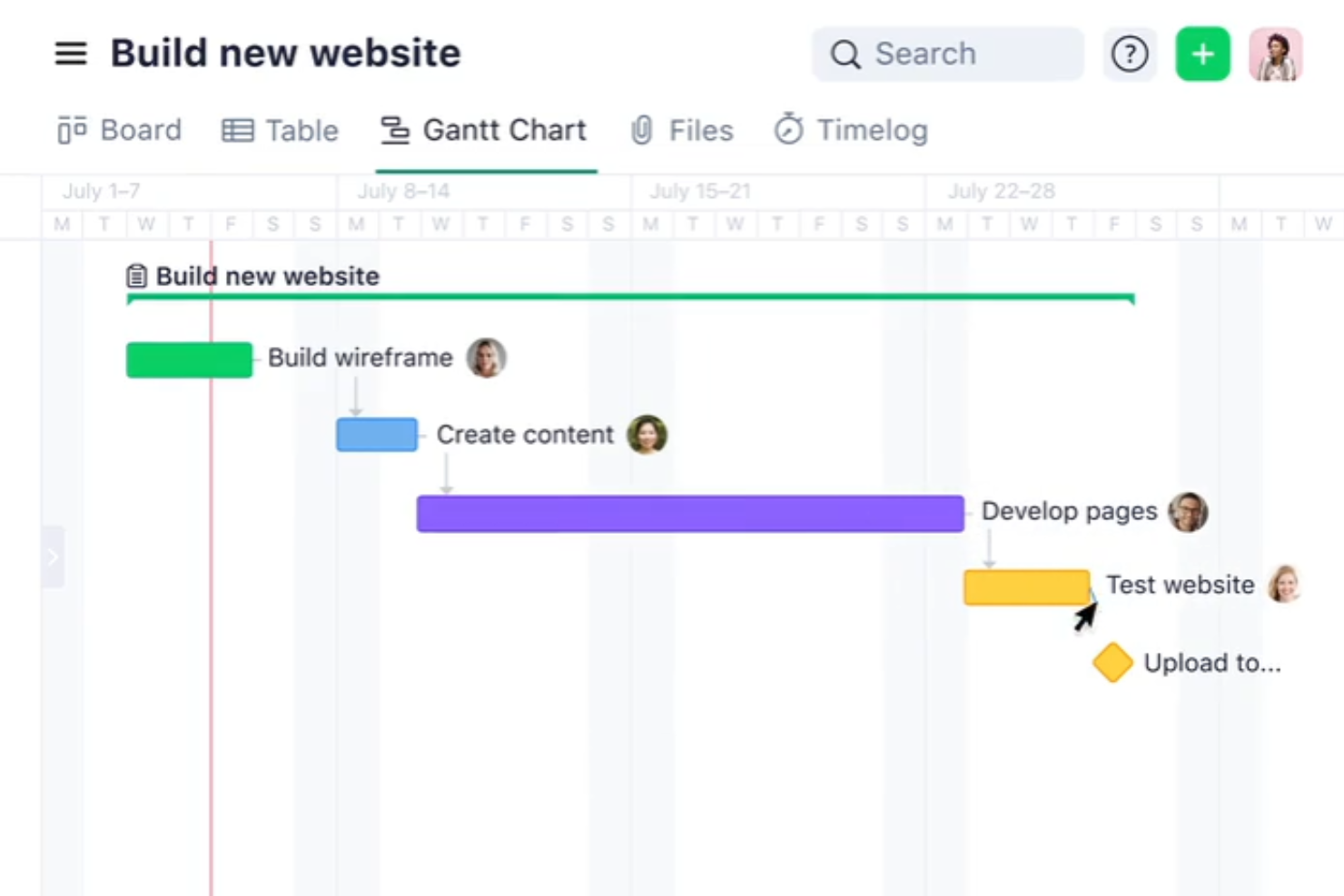
Wrike is a work management platform that covers project planning, task tracking, resource scheduling, workflow automation, and cross-project reporting in a single configurable workspace.
Who Is Wrike Best For?
Wrike is a strong fit for project managers and operations teams at mid-sized to large organizations that need to customize how work flows, gets tracked, and gets reported across multiple teams.
Why I Picked Wrike
Wrike earns its spot on my shortlist because of how far you can push its workflow and dashboard customization without touching a line of code. I like that you can build dashboards with custom widgets that pull live data across every project in your portfolio, so stakeholders get a real-time view instead of a manually updated slide deck. The rule-based automation and blueprints let my team standardize how projects are set up and handed off, cutting the repetitive admin that slows things down between sprints.
Wrike Key Features
- Workload charts: View team capacity across projects, flag overloaded members, and hold unassigned tasks in a backlog for redistribution.
- Proofing and guest approvals: Leave comments directly on images, videos, PDFs, and Office files, and invite external reviewers to approve assets without giving them access to your workspace.
- Cross-tagging: Track the same task across multiple spaces, folders, and projects without duplicating it.
- Time tracking with billable categorization: Log hours against tasks, mark work as billable or non-billable, and export time entries to QuickBooks Online (available from Business for time tracking; billable time and QuickBooks export from Pinnacle).
Wrike Integrations
Wrike offers 400+ pre-built native integrations, including Slack, Microsoft Teams, Google Drive, Dropbox, QuickBooks, Jira, Salesforce, and Tableau. It also provides an open REST API and Wrike Integrate for no-code connections and workflow automation.
Pros and Cons
Pros:
- Proofing keeps client feedback on assets
- Task ownership and dependencies reduce update chasing
- Cross-project dashboards clarify portfolio status
Cons:
- Time tracking feels basic for detailed work
- Work hierarchy complicates setup and navigation
New Product Updates from Wrike
Wrike Expands Gantt Planning, Approvals, and AI Work Intake
Wrike adds cross-project Gantt dependencies, flexible approval routing, and AI work intake through Wrike MCP. These updates give teams more control over planning, decision-making, and incoming work. For more information, visit Wrike’s official site.
Scoro
Best for agency quote-to-cash project tracking
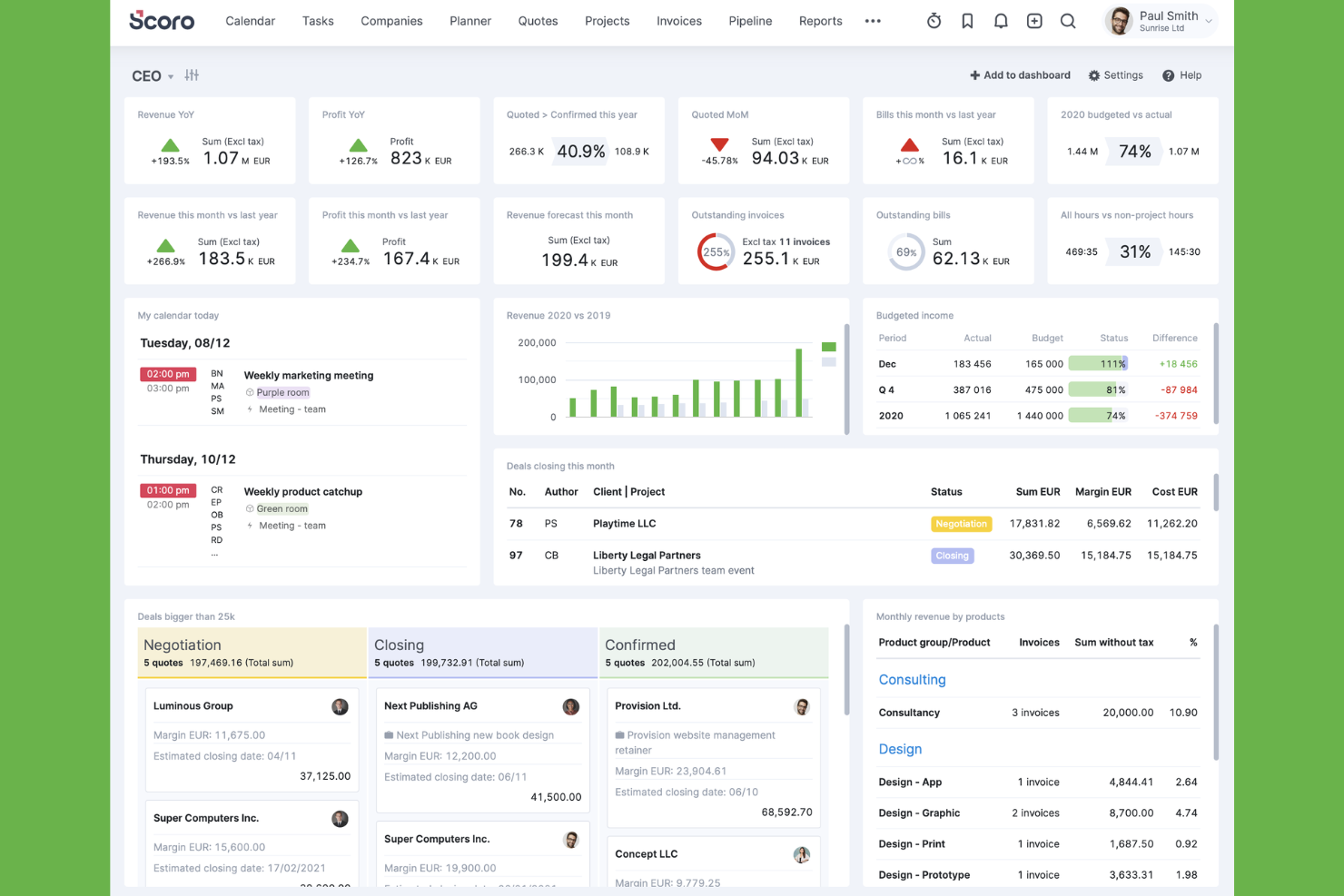
Scoro is a professional services automation platform that connects project management, resource planning, time tracking, CRM, quoting, and client invoicing in a single system.
Who Is Scoro Best For?
Scoro is a strong fit for client-services teams and agencies that need to manage the full project lifecycle—from quoting and delivery to invoicing—in one place.
Why I Picked Scoro
Scoro earns its spot on my shortlist because it genuinely closes the loop between winning work and getting paid for it. I love how you can build a client quote, convert it into a live project budget, log time against tasks, and push a final invoice to Xero or QuickBooks, all without leaving the platform. The budget-health charts that forecast profit from both delivered and planned work are something I haven't seen done this cleanly elsewhere.
Scoro Key Features
- Task dependencies: Set finish-to-start, start-to-start, finish-to-finish, and start-to-finish relationships with day-based lag or lead buffers between tasks.
- Planner: View scheduled work, remaining availability, time off, and overtime by team member, and distribute or reschedule tasks directly from the same view.
- Customer Portal: Give clients permissioned access to projects, files, comments, tasks, and invoices through a dedicated portal.
- ELI AI assistant: Ask natural-language questions to retrieve operational data, generate reports, and carry out routine tasks like updating budgets or sending reminders.
Scoro Integrations
Scoro lists 40+ integrations, including native Xero, QuickBooks, HubSpot, Salesforce, Jira, Slack, Google Drive, Dropbox, and Stripe connections. It also supports REST and HTTP/JSON APIs, webhooks, MCP, and Zapier.
Pros and Cons
Pros:
- Quote-to-invoice tracking connects delivery with profitability
- Planner helps teams balance cross-project workloads
- Detailed dependencies support complex project schedules
Cons:
- Custom reports can require spreadsheet work
- Task navigation can require extra clicks
New Product Updates from Scoro

Scoro Adds Time Mobile App and ELI Improvements
Scoro adds the Scoro Time mobile app for iOS/Android to track time anywhere and expands ELI with attachments, smarter filtering, and trigger-based actions. For more information, visit Scoro's official site.

GanttPRO
Best for interactive Gantt charts
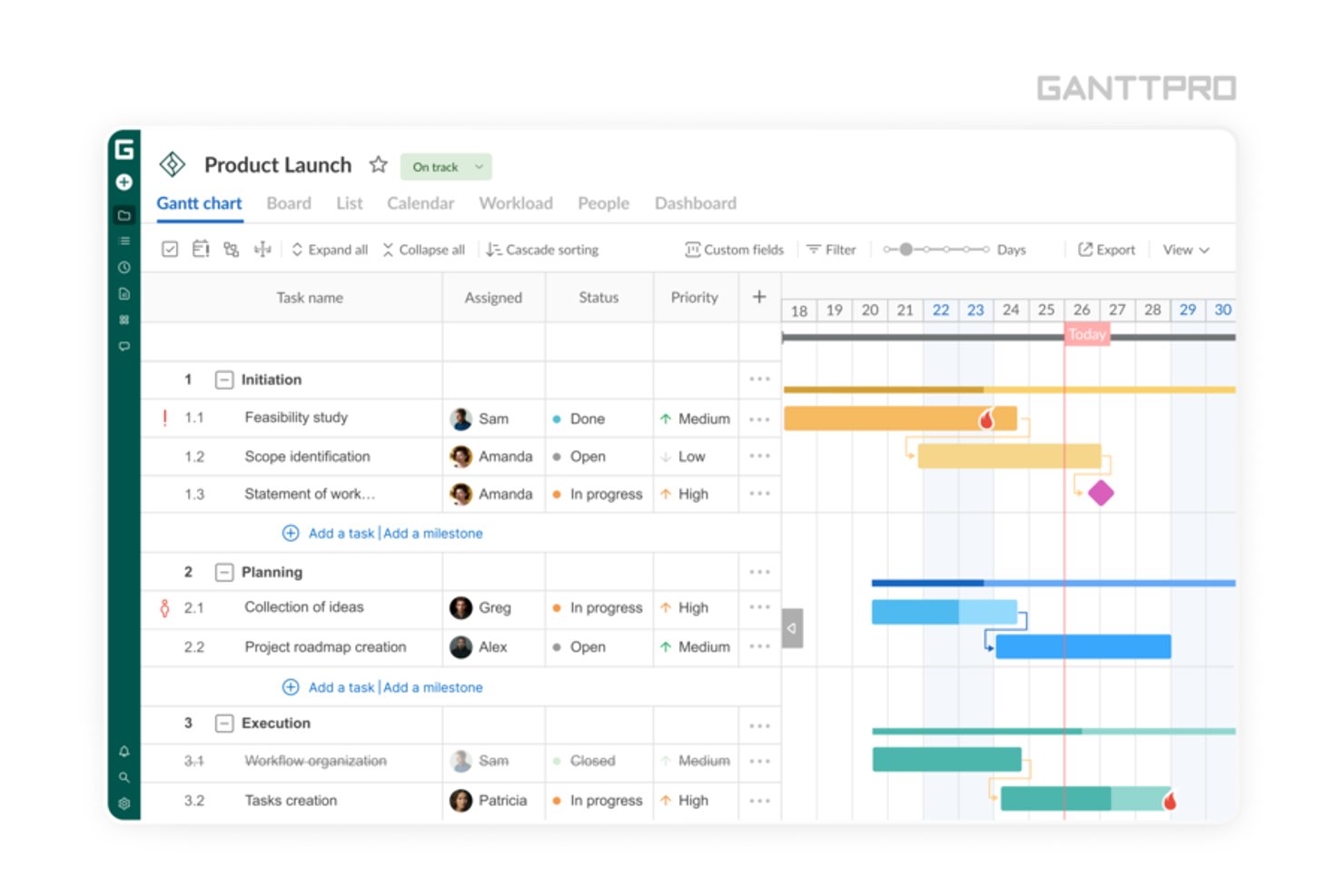
GanttPRO is a cloud-based project management tool built around interactive Gantt charts, with task tracking, dependency management, workload views, and portfolio planning across multiple projects.
Who Is GanttPRO Best For?
GanttPRO is a strong fit for project managers who need precise timeline control and dependency tracking across multiple concurrent projects.
Why I Picked GanttPRO
I picked GanttPRO as one of the best because its interactive Gantt charts go well beyond a visual timeline. Dependencies with lead and lag times, auto scheduling that ripples date changes across connected tasks, and a critical path view make it genuinely useful when you're managing complex, multi-phase projects where one slip affects everything downstream. I also like the cross-project workload view, which lets you see at a glance where team members are overloaded before it becomes a problem.
GanttPRO Key Features
- Baseline tracking: Save an initial project version and compare it against the current plan to see how far things have drifted.
- Time logging: Log hours directly against tasks using a built-in timer or manual entry, with exportable time-log reports available on Business and Enterprise plans.
- Budget planning: Calculate project costs from tasks and resources, track actual spend against estimates, and export budget analysis reports covering assignees, time, and cost.
- Shareable project links: Share a static or dynamic view of your project plan with external stakeholders via a private link, no registration required on their end.
GanttPRO Integrations
GanttPRO offers native integrations with Slack, Microsoft Teams, Google Drive, OneDrive, Jira Cloud, Microsoft Project, and Microsoft Excel. It also provides an open API on Business and Enterprise plans for custom integrations.
Pros and Cons
Pros:
- Workload views reveal cross-project team overload
- Auto scheduling recalculates dependent task dates
- Reviewers praise clear Gantt scheduling and dependencies
Cons:
- Resource views lack detailed forecasting depth
- No built-in invoicing or proofing workflows
Best for client onboarding management
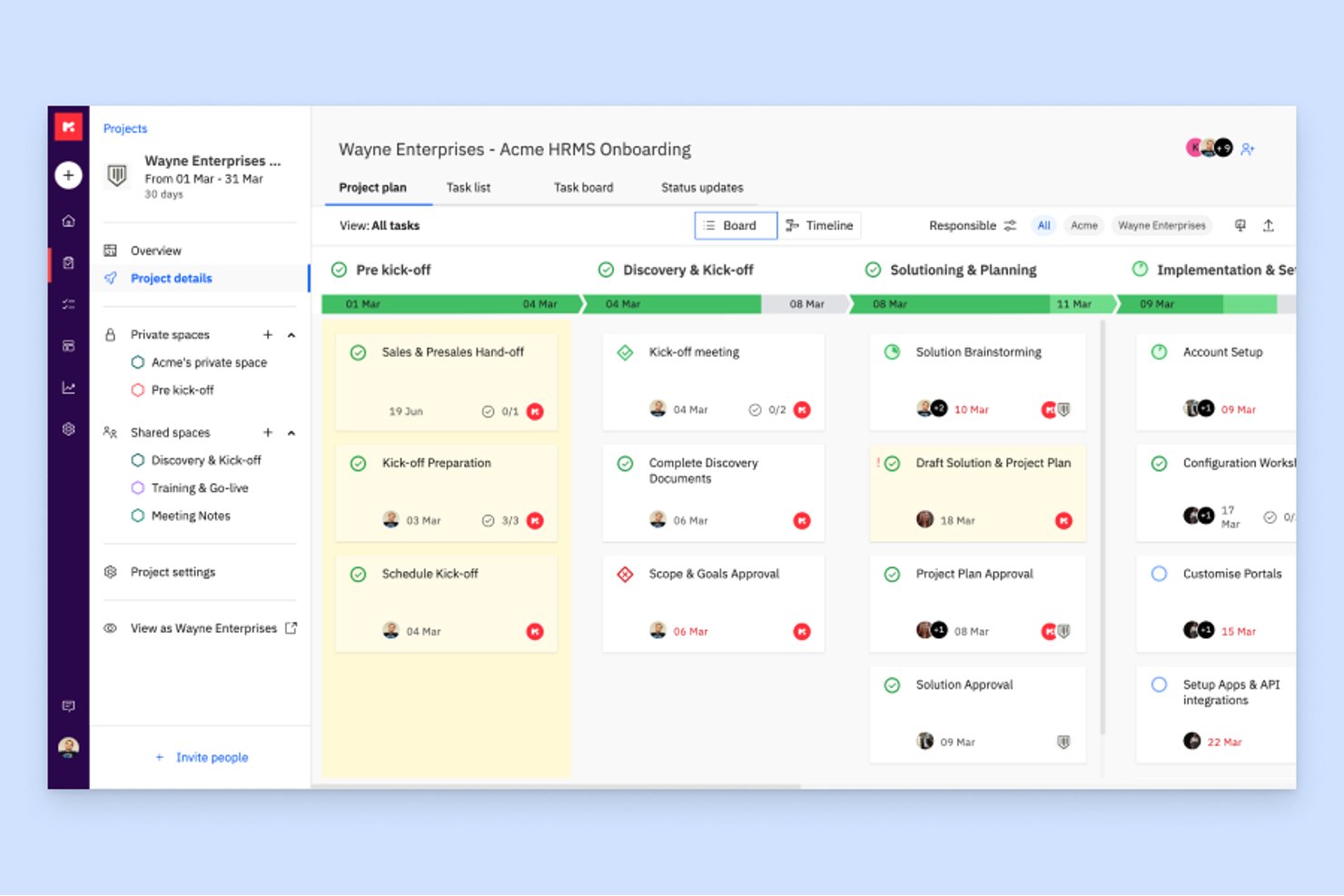
Rocketlane is a professional services automation platform that combines project management, client onboarding, resource planning, time tracking, and financial management tools for client-facing delivery teams.
Who Is Rocketlane Best For?
Rocketlane is a strong fit for professional services and client delivery teams that need to manage projects, track time, and give clients direct visibility into progress—all in one place.
Why I Picked Rocketlane
I picked Rocketlane as one of the best because it's purpose-built for client onboarding management in a way most project tools simply aren't. The branded customer portal gives clients real-time visibility into tasks, timelines, and ownership, which cuts down the back-and-forth that slows onboarding down. I also love that milestones can trigger CSAT surveys automatically, so you're capturing client sentiment at the moments that actually matter.
Rocketlane Key Features
- Resource AI: Evaluates team members' forecast utilization and capacity to recommend hard or soft bookings across projects using load-balance, maximize-margins, or manual planning methods.
- Time tracking and timesheet approvals: Lets team members log billable and non-billable time against specific tasks, then submit timesheets for manager review and approval.
- Annotations and proofing: Supports version-controlled file markup with arrows, freehand drawings, and comment threads that can be shared with or hidden from clients.
- Custom automations: Triggers workflow actions across projects based on defined conditions, with up to 200 runs per user per month on Standard and 500 on Premium.
Rocketlane Integrations
Rocketlane offers native integrations with Salesforce, HubSpot, Jira, Slack, Google Calendar, Outlook Calendar, QuickBooks, and Workato, plus Zapier. It also provides a REST API and webhooks for custom integrations.
Pros and Cons
Pros:
- Timesheets connect project effort and resources
- Reusable templates organize onboarding tasks
- Branded client portals reduce status chasing
Cons:
- Configuration takes time for complex workflows
- Dependency changes can require repeated updates
Nifty
Best for uniting teams, goals, and processes
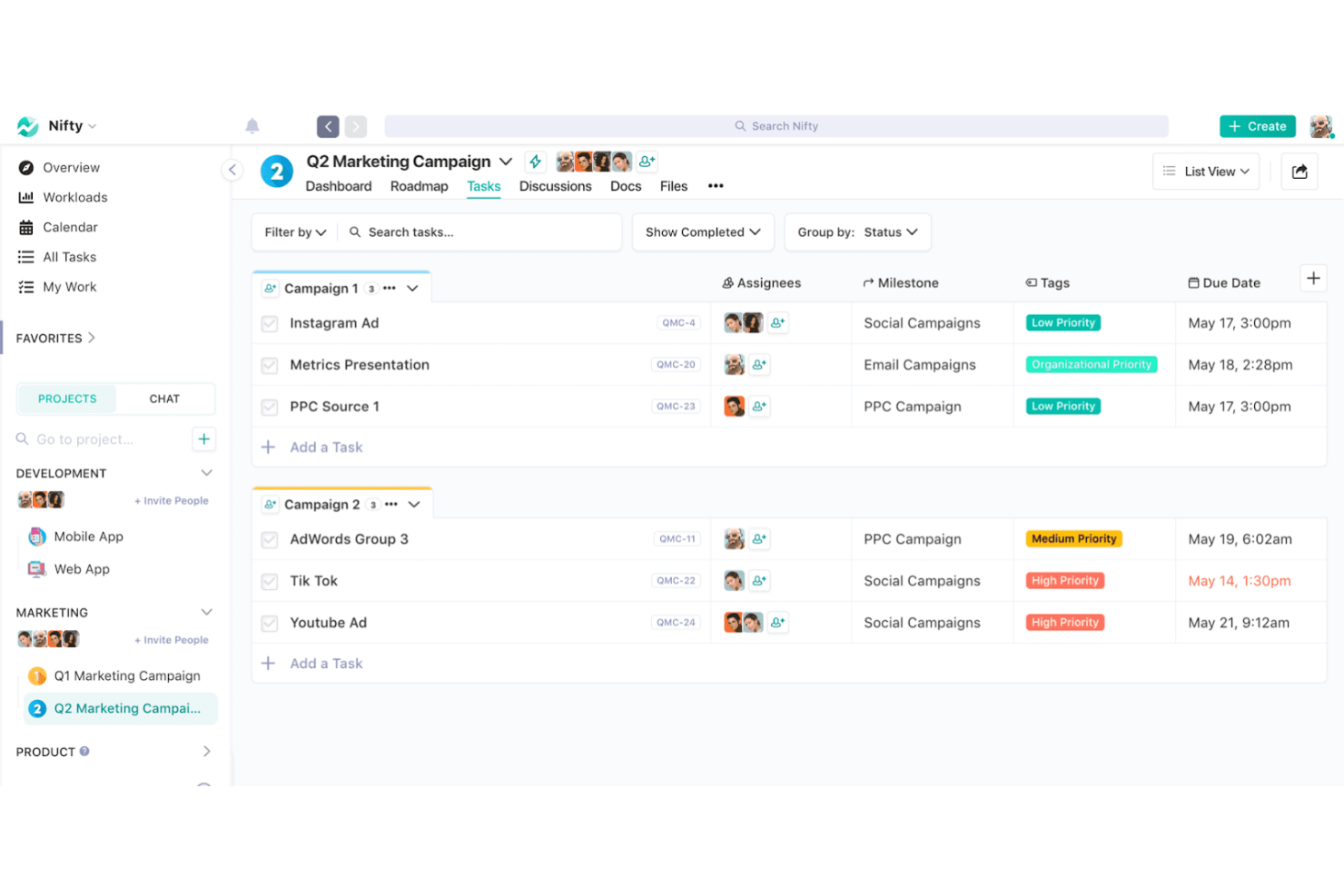
Nifty is a project management platform that brings together task tracking, milestone roadmaps, team discussions, docs, and workload management in a single workspace.
Who Is Nifty Best For?
Nifty is a strong fit for agencies and client-services teams that need to manage tasks, milestones, and client communication in one place.
Why I Picked Nifty
I've included Nifty in my top picks because it genuinely unites the pieces that usually live in separate tools: milestone roadmaps, task boards, team discussions, and goal tracking all sit inside the same workspace. I especially like how milestones roll up progress automatically from task completion, so my team's roadmap reflects reality without manual updates. Portfolios let me group client projects and view status across all of them from one dashboard, which keeps delivery visible at every level.
Nifty Key Features
- Task dependencies: Link tasks so that dependent work is blocked from being moved or completed until its prerequisite task is finished.
- File proofing: Leave annotated comments on images, files, and videos attached to tasks, with annotations converting automatically into subtasks.
- Workflow automations: Set up if/then rules to assign users, update deadlines, and manage tasks based on defined conditions.
- Orbit AI: Generate structured projects, tasks with assignees and due dates, and project-specific documents directly from a text description.
Nifty Integrations
Nifty offers native integrations with Slack, Google Drive & Calendar, Microsoft Suite, GitHub, HubSpot, Harvest, Zoom, and Microsoft Teams. It also supports Zapier and a REST API with webhooks on Business plans and above.
Pros and Cons
Pros:
- Proofing comments become assignable subtasks
- Client discussions and deliverables stay project-linked
- Milestone progress updates automatically from tasks
Cons:
- Advanced reports offer limited export customization
- Notifications can be inconsistent across devices

Freedcamp
Best for unlimited storage
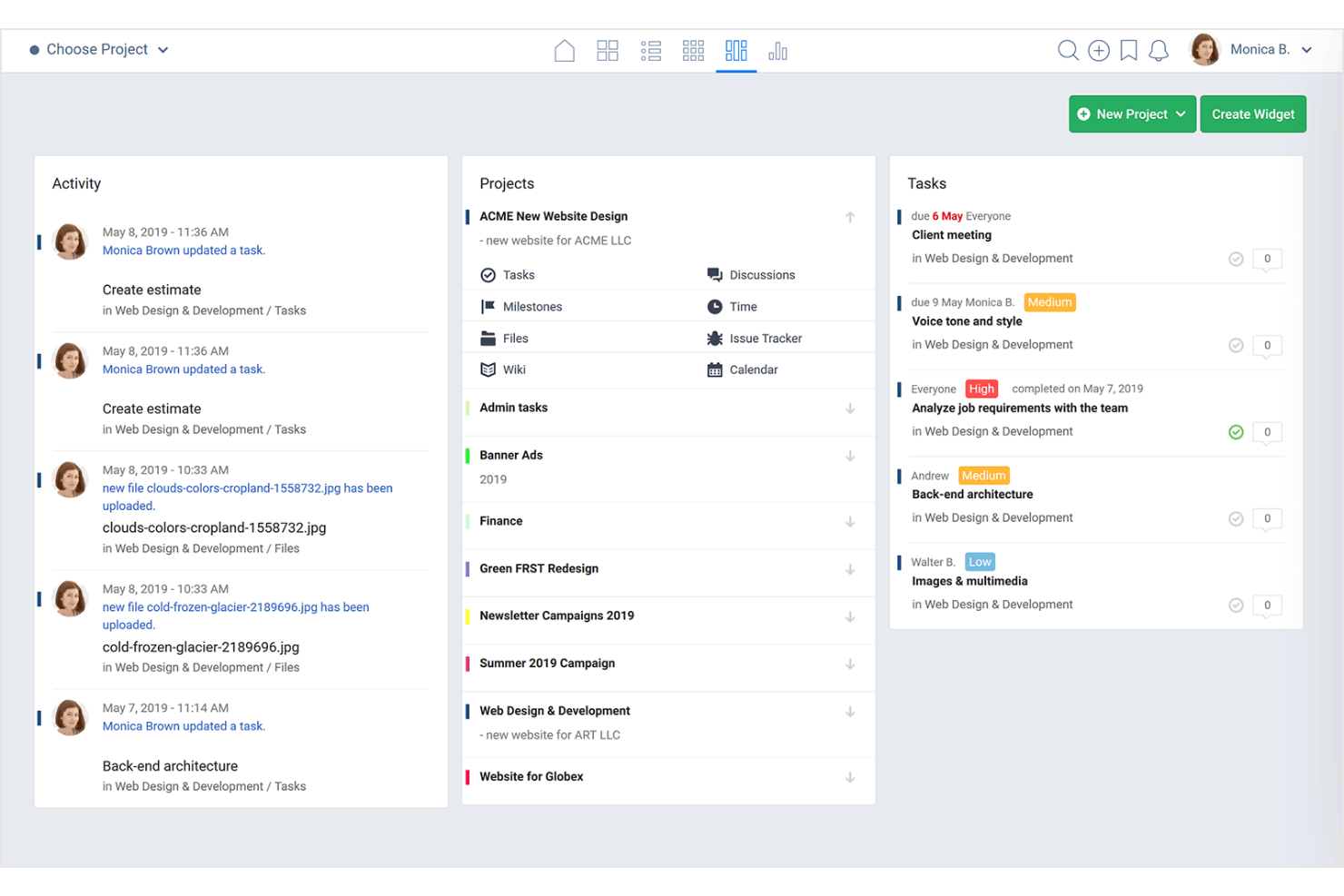
Freedcamp is a project management platform that covers task tracking, milestones, time tracking, Kanban and Gantt views, team discussions, and invoicing in a single workspace.
Who Is Freedcamp Best For?
Freedcamp is a strong fit for small-to-midsize teams that need solid project tracking and client collaboration without a high per-seat cost.
Why I Picked Freedcamp
I've included Freedcamp in my top picks because its free plan offers genuinely unlimited tasks, projects, and storage, which is rare at this price point. I particularly like how it pairs that with private project discussions you can share with specific clients without opening up your whole workspace, and a White Label option that lets you brand the environment with your own domain and logo. That combination makes it easy to run client-facing work without paying for a separate portal tool.
Freedcamp Key Features
- Task dependencies and milestones: Link tasks together and mark key project dates so your team always knows what's blocking what.
- Threaded project discussions: Hold searchable, topic-organized conversations separate from task comments, with the option to include clients in specific threads.
- Time tracking with invoicing: Log time against tasks and pull those records directly into client invoices without switching tools.
- Gantt resource view: See each team member's workload in hours or task counts across projects from a single board.
Freedcamp Integrations
Freedcamp offers native integrations with Google Drive, OneDrive, Dropbox, Google Calendar, and Slack. It also provides a public HTTP/JSON API and supports Zapier.
Pros and Cons
Pros:
- Task comments and calendars clarify delivery
- Private discussions keep client work scoped
- Unlimited storage for shared project files
Cons:
- Workload views lack availability-based capacity
- Gantt dependencies don't block premature starts
Outras alternativas ao Teamwork
Segue-se uma lista de alternativas adicionais ao Teamwork que selecionei. Embora não tenham entrado nas 10 melhores, continuam a ser opções valiosas que vale a pena investigar mais aprofundadamente.
- Workzone
For real-time project visibility
- Process Street
For project management workflow templates
- ProofHub
For all-in-one project management
- Microsoft Teams
For Microsoft integrations
- Bonsai Agency Software
For centralized client and project management
- Taskworld
For integrated chat and analytics
- Podio
For workflow automation
- Bitrix24
For CRM business management
- Redmine
For open-source project management
- Ravetree
For flexible project methodologies


Análises relacionadas de software de gestão de projetos
Se ainda não encontrou o que procura, consulte estas outras ferramentas relacionadas que testámos e avaliámos:
- Software de gestão de projetos
- Software de gestão de recursos
- Software de automatização de fluxos de trabalho
- Software de controlo de tempo
- Software de gestão de tarefas
- Ferramentas de colaboração
- Criador de gráficos de Gantt
- Ferramentas de produtividade
- Software de acompanhamento de projetos
- Software de planeamento de projetos
How I Evaluate Teamwork Alternatives
I look at Teamwork alternatives in two layers: the core features a tool must have—task management, time tracking, client access—and the differentiators that separate the best options.
Core Functionality (Table Stakes For This List)
When I'm selecting tools for my list, I rank each one on a scale from 0 (does not offer the functionality) to 5 (excels in this area) for each core functionality listed below. Then, I calculate the tool's total score into a percentage. Each tool needs to achieve a minimum total score of 75% to be considered for inclusion.
- Task & Project Management: I look for structured task hierarchies, dependencies, and milestones—things like mapping a website redesign across phases with subtasks under each deliverable.
- Multiple Project Views: Each tool should offer at least list, board, Gantt, and calendar views so teams can switch between planning a sprint backlog and reviewing a monthly timeline.
- Time Tracking & Billing: Billable vs. non-billable tagging matters here, along with budget tracking per project—essential when your team logs hours across multiple client retainers.
- Client & Guest Collaboration: I evaluate whether external stakeholders can access projects with permission controls, like giving a client comment-only access to a deliverables board.
- Resource & Workload Management: Tools should surface capacity at a glance so a PM can spot an overloaded designer and redistribute tasks before deadlines slip.
- Team Collaboration Tools: I check for in-context communication features like threaded comments, @mentions, file sharing, and proofing tied directly to tasks rather than siloed in separate apps.
Once I have a list of tools that meet this criteria, I consider what sets each platform apart.
Differentiating Factors (What Sets Vendors Apart)
Here's how I compare and contrast different vendors:
Standout Features
Automation rules are a big differentiator—I look for tools that let you auto-assign tasks, trigger status changes, and send notifications based on conditions, which saves hours on repetitive project setup. Proofing and approval workflows also matter, especially for creative teams routing design files through multiple review rounds. I evaluate reporting dashboards for cross-project profitability tracking, since agency leaders need to see which accounts are eating into margins without exporting data to a spreadsheet.
Beyond Features
Integrations matter a lot when switching from Teamwork. I check whether each tool connects natively to accounting platforms like QuickBooks or Xero, since billable-hours workflows break down without that link. Pricing transparency is another key factor—I evaluate whether mid-tier plans include time tracking and client access or gate them behind enterprise pricing. I also consider onboarding support, particularly migration assistance, because moving active projects with task histories and logged hours to a new platform is where most transitions stall.
Porquê procurar uma alternativa ao Teamwork
O Teamwork é um software valioso de gestão de projetos, com funcionalidades e integrações avançadas. No entanto, pode não ser a opção certa para todas as equipas. Normalmente, poderá procurar uma alternativa ao Teamwork se:
- Precisar de uma opção mais económica: O Teamwork disponibiliza planos a partir de $11/utilizador/mês, mas, se for uma pequena empresa ou precisar de mais lugares, poderá beneficiar mais de uma solução mais barata.
- Quiser uma interface mais intuitiva: Embora o Teamwork tenha uma interface bastante fácil de utilizar, esta pode tornar-se mais complexa com projetos maiores, levando-o a procurar uma alternativa.
- Procurar mais opções de personalização: As vistas e os modelos personalizados são mais importantes do que a maioria das pessoas imagina para simplificar os processos, tornando valiosa uma solução com estas funcionalidades.
- Precisar de uma melhor integração: O Teamwork integra-se com várias ferramentas, mas, se não estabelecer uma boa ligação com o seu conjunto atual de ferramentas, poderá precisar de uma solução alternativa.
- Desejar mais apoio ao cliente: Nas situações em que simplesmente não consegue encontrar a resposta, precisa de um software que disponibilize apoio dedicado ao cliente.
Em última análise, encontrar a ferramenta certa pode aumentar a produtividade da equipa, simplificar a execução dos projetos e contribuir para o sucesso geral da empresa. Ao analisar alternativas, pode garantir que o software escolhido corresponde aos seus requisitos específicos, promovendo a eficiência e a colaboração gerais da equipa.
Principais funcionalidades das alternativas ao Teamwork
Eis algumas funcionalidades essenciais do Teamwork que o seu software alternativo deverá conseguir replicar ou melhorar para se adequar às suas necessidades:
- Gestão de tarefas: O software escolhido deve permitir-lhe criar, atribuir e acompanhar tarefas facilmente. Defina prazos, estabeleça prioridades e monitorize o progresso para manter os vários projetos no caminho certo.
- Registo de tempo: Com o seu software, deverá conseguir acompanhar as horas faturáveis e gerar relatórios para analisar como o tempo é utilizado em diferentes atividades.
- Gráficos de Gantt: Com os gráficos de Gantt, pode planear e agendar tarefas, ajustar prazos e gerir o progresso dos projetos com uma visão geral clara e detalhada.
- Marcos: A alternativa certa ao Teamwork permitir-lhe-á definir pontos importantes no painel do projeto e monitorizar a sua concretização para se manter alinhado com os objetivos gerais.
- Partilha de ficheiros: As principais alternativas ao Teamwork ajudam os responsáveis a garantir que todos os membros da equipa têm os ficheiros e as informações necessárias sempre à mão.
- Colaboração da equipa: Um bom software melhora o trabalho em equipa e simplifica a comunicação, mantendo todos informados e envolvidos.
- Modelos de projetos: Com a sua alternativa ao Teamwork, deverá conseguir personalizar modelos para responder às suas necessidades específicas e iniciar rapidamente novos projetos.
- Relatórios: Utilizar o software alternativo certo permite-lhe acompanhar facilmente as métricas, analisar dados e apresentar conclusões às partes interessadas.
- Integrações: Certifique-se de que a solução escolhida consegue ligar-se a outras ferramentas, como o Slack, o Google Drive e muitas mais, para simplificar os fluxos de trabalho e aumentar a produtividade.
- Aplicação móvel: Uma alternativa de software valiosa ajudá-lo-á a manter-se ligado, atualizar tarefas recorrentes e colaborar com a sua equipa a partir de qualquer lugar, garantindo a continuidade do progresso dos projetos.
Ao avaliar alternativas ao Teamwork, é essencial comparar as suas principais funcionalidades para garantir que respondem às suas necessidades de gestão de projetos. Quer dê prioridade a interfaces intuitivas, ferramentas avançadas de colaboração ou capacidades detalhadas de elaboração de relatórios, existe uma solução que se adapta aos requisitos únicos da sua equipa.