

15 Best Kanban Courses to Upskill in 2026


Finding the right Kanban courses means sorting through a wide range of options, from quick overviews to certification prep. I've rounded up courses by skill level and focus so you can quickly find training that fits your current experience and goals.
The 15 Best Kanban Courses
Below are my summaries of the best Kanban courses. My reviews offer a look at each course’s learning objectives, best fits, cost, and more.
1. Kanban System Design (KSD) - Kanban University
Best for: Teams pursuing official Kanban University certification


Kanban System Design (KSD) is Kanban University's foundational course, delivered by accredited trainers worldwide. It teaches the STATIK framework—a structured method for designing Kanban systems around real work—making it the starting point for the official KMP credential path.
What you'll learn: Design a Kanban system using STATIK, apply WIP limits and pull-based flow, read flow metrics like Cumulative Flow Diagrams, and structure Kanban cadences to coordinate team work.
Course details:
- Format: Live instructor-led; available in-person or online with hands-on simulation and group exercises
- Duration: 2 days in-person or 16 hours online
- Level/prerequisites: Beginner to intermediate; no formal prerequisites required
- Price: Not published centrally; typically $1,000–$2,500 USD per learner, set by each accredited trainer
- Certificate/credits: Kanban University KSD certification upon full participation; counts as the first half of the Kanban Management Professional (KMP) credential
Considerations: Pricing varies by trainer, region, and format, so you'll need to request a quote directly from an accredited trainer rather than comparing a fixed price.
Find more Kanban certifications here.
2. Professional Scrum with Kanban (PSK) - Scrum.org
Best for: Scrum teams adding Kanban flow practices to sprints

Scrum.org's Professional Scrum with Kanban (PSK) is built for Scrum practitioners who want to improve Sprint flow. Co-designed with Kanban experts Daniel Vacanti and Yuval Yeret, it layers Kanban practices directly onto existing Scrum events.
What you'll learn: Visualize Sprint Backlog workflows, apply WIP limits to manage flow, use a Service Level Expectation for delivery predictability, and integrate Kanban practices into Scrum events like Sprint Planning and the Daily Scrum.
Course details:
- Format: Live instructor-led; available in-person or live virtual with hands-on exercises and activity-based learning
- Duration: 2 days in-person; live virtual sessions may be split across additional shorter days
- Level/prerequisites: Intermediate; for experienced Scrum practitioners; reading the Kanban Guide for Scrum Teams and passing the Scrum Open assessment is recommended
- Price: Set by individual Professional Scrum Trainers; the standalone PSK I assessment is $200 USD per attempt
- Assessment: PSK I certification assessment; 45 questions, 60-minute time limit, 85% passing score required; one free attempt included with course attendance
- Certificate/credits: PSK I certification (lifetime, no renewal fees) awarded by Scrum.org; 14 PMI PDUs; Credly digital badge upon passing
Considerations: Because trainers set their own course fees, you'll need to contact trainers directly for pricing rather than comparing a fixed rate.
For more on Scrum, check out our list of Scrum courses and certifications.
3. Applying Professional Kanban (APK) - ProKanban.org
Best for: Scrum practitioners improving Sprint flow with Kanban

Applying Professional Kanban (APK) is ProKanban.org's entry-level Kanban course. It uses a simulation called TWiG to teach flow through doing, then moves into metrics—cycle-time scatterplots, SLEs, and CFDs—to build delivery predictability.
What you'll learn: Build a visual Kanban board, apply WIP limits, capture flow metrics like cycle-time scatterplots and Cumulative Flow Diagrams, set a Service Level Expectation, and identify improvement opportunities using data.
Course details:
- Format: Live instructor-led; available in-person or virtual, with hands-on exercises and the TWiG flow simulation
- Duration: 2 days in-person; virtual delivery runs as 4 sessions of approximately 3 hours each
- Level/prerequisites: Beginner; no prerequisites required
- Price: Set by individual trainers. The standalone PK I assessment is $200 USD per attempt
- Assessment: PK I certification assessment; 80 questions, 60-minute time limit, 85% passing score; two free attempts included with the course
- Certificate/credits: PK I certification (no expiry) issued as a Credly digital badge by ProKanban.org; 14 PMI PDUs and 14 Scrum Alliance SEUs
Considerations: The PK I exam has roughly a 50% first-attempt pass rate, so plan to review the Kanban Guide before sitting the assessment—even after completing the course.

4. Team Kanban Practitioner (TKP) - Kanban University
Best for: Whole teams earning a Kanban credential in one day

Team Kanban Practitioner (TKP) is Kanban University's one-day entry course for teams new to the Kanban Method. No exam is needed—the TKP credential is earned through active participation, making it one of the fastest paths to a recognized Kanban credential.
What you'll learn: Visualize work on a Kanban board, apply WIP limits, run flow-focused team meetings, and read lead-time signals to understand delivery patterns.
Course details:
- Format: Live instructor-led; available in-person or online, with hands-on exercises and an interactive Kanban simulation
- Duration: 1 day in-person; online delivery may be split into 2 half-day sessions (approximately 8 hours total)
- Level/prerequisites: Beginner; no prerequisites required; all experience levels welcome
- Price: Set by individual accredited trainers. Examples range from roughly $500–$1,000 USD
- Certificate/credits: TKP credential and certificate of completion from Kanban University, awarded through active participation; 6 PMI PDUs
Considerations: Because the credential requires participation rather than a passed assessment, it may carry less weight in organizations that expect demonstrated, exam-verified knowledge.
5. Kanban Systems Improvement (KSI) - Kanban University
Best for: Practitioners optimizing flow in connected Kanban systems

Kanban Systems Improvement (KSI) is Kanban University's advanced course for practitioners already running a Kanban system who want to improve it using data—CFDs, lead-time distributions, and throughput analysis—rather than intuition.
What you'll learn: Analyze cumulative flow diagrams and lead-time distributions, run Kanban cadences across connected services, identify bottlenecks, and apply evolutionary change to improve flow and throughput.
Course details:
- Format: Live instructor-led; available in-person or online, with hands-on exercises, scenario-based workshops, and group discussion
- Duration: 2 days in-person; 16 hours online, which may be split across multiple shorter sessions
- Level/prerequisites: Advanced; prior completion of Kanban System Design (KSD) is strongly recommended
- Price: Set by individual accredited trainers. Estimates range from approximately $1,000–$1,400 USD per participant
- Certificate/credits: KSI credential from Kanban University, awarded through active participation (no exam required); completing KSD and KSI earns the Kanban Management Professional (KMP) credential, a lifetime designation; 12 PMI PDUs
Considerations: KSI doesn't stand alone as a path to the KMP credential—you must also complete KSD, meaning the full credential requires two separate courses and roughly $2,000–$2,800 USD combined.
6. Kanban: Getting Started - Pluralsight
Best for: Self-paced learners exploring personal and team Kanban

Kanban: Getting Started is a self-paced Pluralsight course by Steve Smith covering personal and team Kanban in just over two hours. It's a low-commitment way to build foundational knowledge before deciding whether a multi-day certification makes sense for you.
What you'll learn: Visualize and manage projects on Kanban boards, apply WIP limits, map value streams, distinguish cycle time from lead time, and manage individual priorities with personal Kanban.
Course details:
- Format: Self-paced, on-demand video; online only
- Duration: 2 hours 16 minutes of video content
- Level/prerequisites: Beginner; no prerequisites required
- Price: Included with a Pluralsight subscription; individual plans start at approximately $29/month or $299/year; a 10-day free trial is available
- Certificate/credits: Pluralsight course completion record; no formal credential awarded; content maps to PMBOK® Process Groups and Knowledge Areas
Considerations: This course is only accessible through an active Pluralsight subscription—there's no option to purchase it individually, so the value depends on whether you'll use the broader platform.
7. Agile Kanban: Kanban for Software Development Teams - Udemy
Best for: Software developers learning Kanban in an Agile context

Agile Kanban is a Udemy course from GenMan Solutions covering Kanban boards, flow metrics, and tools like Jira and Trello—alongside a broad Agile project management principles and foundations module for learners new to both frameworks.
What you'll learn: Set up Kanban boards, apply WIP limits, read cumulative flow diagrams, measure cycle time and throughput, and work hands-on with tools including Jira, Trello, and Azure DevOps.
Course details:
- Format: Self-paced, on-demand video; online only
- Duration: 3 hours 37 minutes; lifetime access included
- Level/prerequisites: Beginner; No prior experience required
- Price: Dynamic Udemy pricing; also accessible via Udemy Personal Plan subscription
- Certificate/credits: Udemy certificate of completion; no formal Kanban credential awarded
Considerations: Roughly half the course covers broader Agile concepts—user stories, estimation, burndown charts, and velocity—rather than Kanban-specific content, so it's more of a Kanban-plus-Agile introduction than a focused Kanban curriculum.
8. Stay Lean with Kanban - LinkedIn Learning
Best for: Lean-focused Kanban with LinkedIn profile credit

Stay Lean with Kanban is a LinkedIn Learning course taught by Doug Rose. At just over an hour, it grounds Kanban in its lean manufacturing origins—making it a good fit if you want to understand why the method works, not just how to set up a board.
What you'll learn: Map value streams, build pull systems, set WIP limits, read cumulative flow diagrams, and configure classes of service on a Kanban board.
Course details:
- Format: Self-paced, on-demand video; online only
- Duration: 1 hour 2 minutes of video content; includes 5 quizzes
- Level/prerequisites: Beginner; no prerequisites required
- Price: Included with a LinkedIn Learning subscription; individual plans start at $39.99/month or $239.88/year; a 1-month free trial is available
- Assessment: 5 quizzes included throughout the course
- Certificate/credits: Shareable certificate of completion, addable directly to your LinkedIn profile; course awards Continuing Education Units (CEUs)
Considerations: The course was released in 2018 and hasn't been updated since, so it doesn't cover more recent practices like Scrumban or modern estimation techniques.
9. Increasing Efficiency with Kanban - Pluralsight
Best for: Scrum teams making a structured move to Kanban

Increasing Efficiency with Kanban is a Pluralsight learning path of five sequenced courses. It spans beginner to advanced, making it the right fit if you want to build Kanban knowledge progressively rather than pick up a standalone intro course.
What you'll learn: Map value streams, apply WIP constraints, read cumulative flow diagrams, integrate Kanban with CI/CD pipelines, and manage a Scrum-to-Kanban transition.
Course details:
- Format: Self-paced, on-demand video; online only; five sequenced courses with a Skill IQ assessment
- Duration: Approximately 11 hours across five courses; access requires an active subscription
- Level/prerequisites: Beginner to advanced; no prerequisites required
- Price: Pluralsight subscription required; plans from approximately $29/month or $299/year; 10-day free trial available
- Assessment: Skill IQ assessment to benchmark Kanban competency across the full path
- Certificate/credits: Pluralsight course completion records for each of the five courses; Skill IQ competency score; no formal Kanban credential awarded
Considerations: The second course in this path, Kanban: Getting Started, is also listed as a standalone entry in this roundup—if you've already completed it, you can jump into the path at the intermediate level rather than starting from the beginning.
10. Kanban for Agile/Scrum Practitioners - Pluralsight
Best for: Scrum or waterfall teams transitioning to Kanban
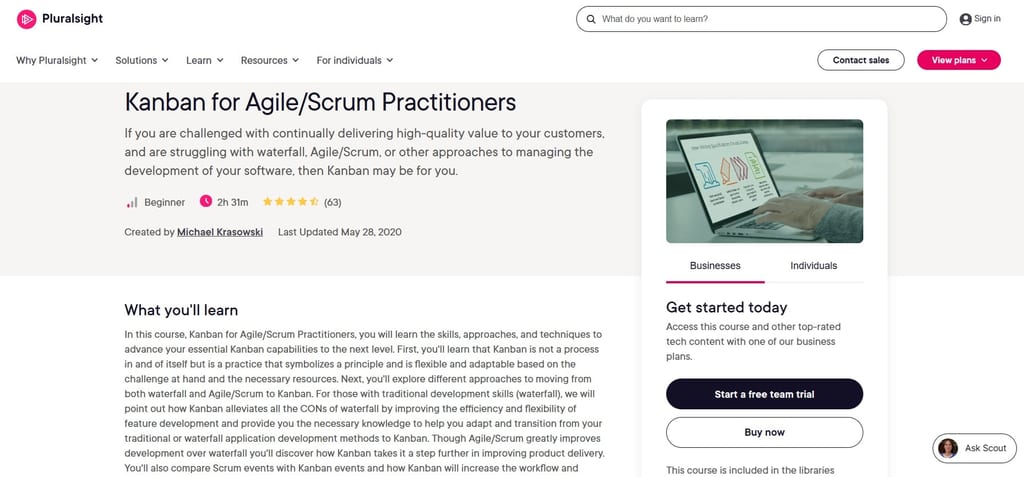
Kanban for Agile/Scrum Practitioners is a Pluralsight course by Michael Krasowski. At 2.5 hours, it focuses on the practical challenges of Kanban adoption: workflow transitions, organizational buy-in, forecasting, and managing variability in real teams.
What you'll learn: Transition from Scrum or waterfall to Kanban, manage WIP limits and variability, read cumulative flow diagrams, forecast delivery, and plan organizational adoption.
Course details:
- Format: Self-paced, on-demand video; online only
- Duration: 2 hours 31 minutes; accessible with an active subscription
- Level/prerequisites: Beginner per Pluralsight; content suits learners with prior Scrum or waterfall experience
- Price: Pluralsight subscription required; plans from approximately $29/month or $299/year; 10-day free trial available
- Certificate/credits: Pluralsight course completion record; no formal Kanban credential awarded
Considerations: This is the third course in the "Increasing Efficiency with Kanban" path (item #9 in this list)—if you plan to take that full path, there's no need to enroll here separately.
11. Kanban Fundamentals: How to Become Insanely Productive - Udemy
Best for: Non-technical teams building their first Kanban system
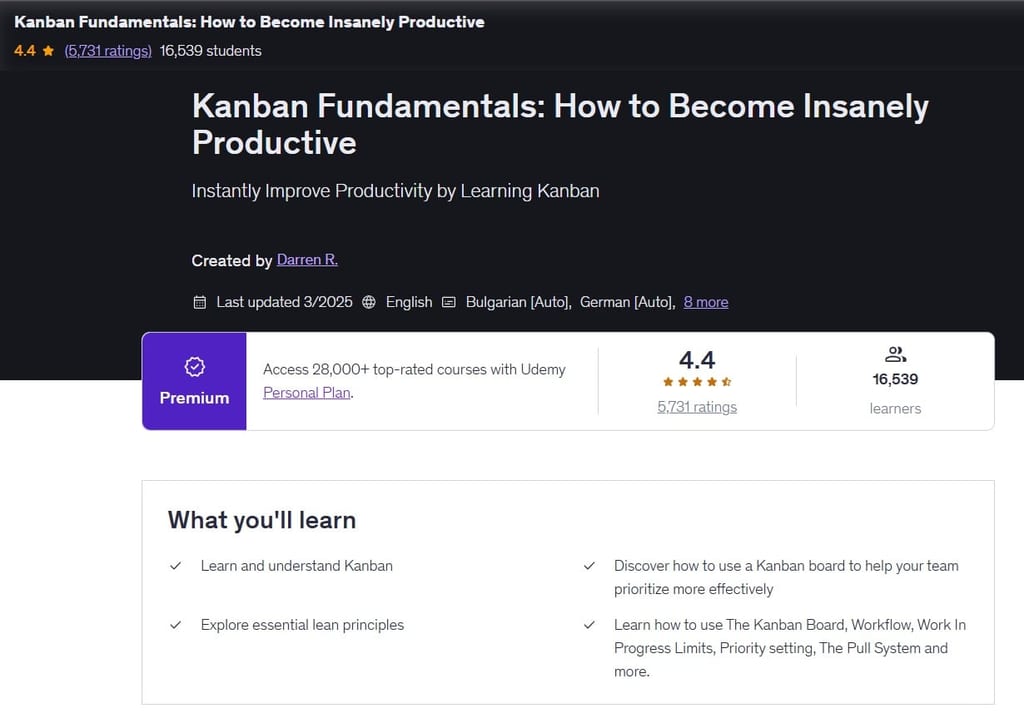
Kanban Fundamentals: How to Become Insanely Productive is a one-hour Udemy course by Darren R. It targets non-technical teams—managers, sales, and support—rather than software practitioners.
What you'll learn: Map value streams, set WIP limits, build a Kanban board, read cumulative flow diagrams, and identify common adoption challenges.
Course details:
- Format: Self-paced, on-demand video; online only; mobile and TV access included
- Duration: 1 hour 2 minutes of video content; lifetime access on purchase
- Level/prerequisites: Beginner; no prerequisites required
- Price: $39.99 one-time purchase with lifetime access; also available via Udemy Personal Plan from $12.99/month
- Certificate/credits: Udemy certificate of completion; no formal Kanban credential awarded
Considerations: The instructor is listed as Darren R. with no published bio or credentials on the course page, so you'll need to rely on learner reviews to gauge fit before purchasing.
For more training on productivity, try these productivity courses or these time management courses.
12. Kanban for Software Project Management - Packt (via Coursera)
Best for: Software project managers new to Kanban and Agile

Kanban for Software Project Management is a Packt course on Coursera that pairs Kanban board mechanics with broader Agile concepts—useful if you're new to both and want to cover them in one place.
What you'll learn: Set up and manage a Kanban board, identify workflow inefficiencies, define done, run daily standups, and apply Agile estimation techniques like planning poker and burndown charts.
Course details:
- Format: Self-paced, on-demand video; online only; includes Coursera Coach AI
- Duration: Approximately 5 hours total
- Level/prerequisites: Beginner; basic software development knowledge recommended
- Price: Included with Coursera Plus at $59/month or $239/year; 7-day free trial available on monthly plans
- Assessment: 4 graded assignments, including a 60-minute full course assessment
- Certificate/credits: Shareable Coursera certificate of completion; no formal Kanban credential awarded
Considerations: Roughly 3 of the 5 course hours cover general Agile concepts—backlogs, velocity, burndown charts—rather than Kanban-specific content, so if you want a pure Kanban deep-dive, the coverage here is relatively thin.
For more on project management specifically, check out this list of training courses in project management.
13. Agile Software Development: Kanban for Developers - LinkedIn Learning
Best for: Developers with Agile experience learning Kanban via Trello
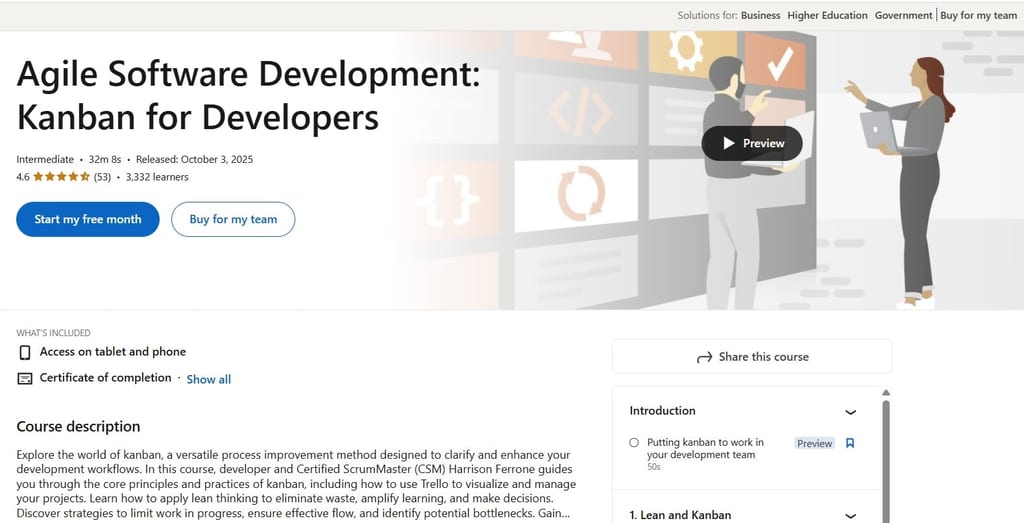
Agile Software Development: Kanban for Developers is a 32-minute LinkedIn Learning course by Certified ScrumMaster Harrison Ferrone. It's built for developers, not managers, and uses a live Trello demo to show Kanban applied to a real software project.
What you'll learn: Apply lean thinking and Kanban principles, set up a Kanban board in Trello, limit work in progress, manage flow, and spot common Kanban pitfalls.
Course details:
- Format: Self-paced, on-demand video; online only; mobile and tablet access included
- Duration: 32 minutes of video content; lifetime access with active subscription
- Level/prerequisites: Intermediate; some prior familiarity with Agile concepts recommended
- Price: $29.99/month or $19.99/month billed annually ($239.88/year); 1-month free trial available
- Certificate/credits: LinkedIn Learning Certificate of Completion; shareable directly to your LinkedIn profile
Considerations: At 32 minutes, this is a primer—if you need depth on topics like cumulative flow diagrams or value-stream mapping, you'll need to supplement it with another course.
14. Transitioning from Scrum to Kanban - Pluralsight
Best for: Scrum teams moving to Kanban with delivery metrics

Transitioning from Scrum to Kanban is a Pluralsight course by Milena Pajic. It's the only course in this roundup built for teams already running Scrum who need a practical migration path to Kanban.
What you'll learn: Visualize workflow, set WIP limits, resolve bottlenecks, analyze demand, and track Kanban metrics to predict delivery.
Course details:
- Format: Self-paced, on-demand video; online only
- Duration: 2 hours 1 minute of video content
- Level/prerequisites: Intermediate; prior familiarity with Scrum and Agile concepts required
- Price: Pluralsight Core Tech plan at $29/month or $299/year; 10-day free trial available
- Certificate/credits: Pluralsight course completion record added to your learner profile; no formal Kanban credential awarded
Considerations: The course was last updated in July 2020, so some tool-specific references may look dated compared to more recently updated courses in this roundup.
15. Build a Lean Workflow with Kanban Frameworks in Miro - Coursera
Best for: Remote teams setting up Kanban boards in Miro

This Coursera Guided Project from Freedom Learning Group teaches Kanban by having you build a real workflow in Miro. At two hours, it's a focused, hands-on exercise for teams already using Miro for visual collaboration.
What you'll learn: You'll learn the Kanban method's purpose and use cases, identify visualization components, and build and configure a Kanban workflow directly in Miro.
Course details:
- Format: Self-paced Coursera Guided Project; browser-based split-screen workspace with prerecorded video instruction alongside a live Miro environment
- Duration: 2 hours
- Level/prerequisites: Intermediate; some familiarity with Agile processes recommended by the provider
- Price: Included with Coursera Plus ($239/year); individual guided project pricing not confirmed on the course page
- Certificate/credits: Shareable Coursera certificate of completion; no formal Kanban credential or professional development credits awarded
Considerations: This project runs in a desktop browser only, so it's not an option if you need mobile access.
How to Choose a Kanban Course
Start by naming the specific problem you're trying to solve. Are you trying to get a team off email and into a visual workflow? Building fluency in the Kanban Method before pursuing a credential? Improving flow metrics on an existing board?
- Match the depth to your actual knowledge gap. Introductory courses cover Kanban examples, boards, columns, and WIP limits. If you already run Kanban daily, look for courses that teach flow metrics, cycle time analysis, or system design—you'll plateau fast in anything pitched at beginners.
- Check whether the curriculum is tool-specific or method-focused. Some courses teach Kanban through Jira, Trello, or Miro. That's valuable if you use that tool, but you'll spend a portion of the time on the platform rather than the method. If you want transferable knowledge, prioritize courses that treat the tool as secondary.
- Decide whether you need a formal credential. A Coursera or Udemy certificate of completion isn't a professional certification. If your organization or career path requires a recognized Kanban credential, look specifically for courses tied to Kanban University or similar accreditation bodies.
- Factor in the full time commitment. A two-hour guided project and a 10-hour lecture course both have value, but they serve different needs. Short projects are good for immediate application; longer courses are better for building foundational knowledge you can explain and defend.
- Consider whether live instruction matters to you. If you learn better with feedback, Q&A, or cohort pressure, a self-paced video course won't replicate that—even a high-quality one.
Kanban Courses FAQ
Is Kanban only useful for software teams?
No. Kanban can help you visualize and improve workflows in marketing, HR, operations, and personal task management. The underlying ideas—making work visible and limiting work in progress—apply across many kinds of work.
Do you need Agile or project management experience to learn Kanban?
No, you can start with a beginner course without prior experience. More advanced training may assume you already manage a workflow or understand Agile concepts, so check the stated prerequisites before enrolling.
Can you learn Kanban without using a dedicated software tool?
Yes. You can practice the fundamentals with a physical board, sticky notes, or a simple digital whiteboard—specialized software is optional. Choose tool-focused training only if learning a particular platform is part of your goal.
How can you tell whether a Kanban course is still current?
Check the last-updated date and whether the lessons reflect the current version of any software they teach. If the course focuses on the method rather than a tool, look for coverage of its core principles and practices rather than relying mainly on interface demonstrations.
What's Next?
Want to connect with other digital project managers to share resources and best practices? Join our membership community for access to 100+ templates, samples, and examples, plus a Slack community of hundreds of digital project managers.


