

Agile Project Management: What It Is And Its Key Principles

What Is Agile Project Management?
Agile project management is an approach that helps teams deliver work in smaller, iterative cycles so they can adapt quickly, incorporate feedback, and improve continuously throughout the project life cycle.
Unlike more rigid project management methodologies, agile practitioners work in smaller delivery cycles that make it easier to test ideas, adjust priorities, and respond to change. While some refer to agile as a methodology, it’s really more of a mindset built around adaptability, collaboration, and continuous improvement.
For a quick explanation (using burgers!), check out this video.


Agile Vs. Traditional Waterfall Methods
The main difference between agile and waterfall project management methods is that agile approaches prioritize quick increments of work and frequent feedback from stakeholders, while waterfall is sequential and focuses on completing a project in one, linear process.
| Agile | Waterfall |
|---|---|
| Iterative and flexible | Sequential and structured |
| Requirements can evolve throughout delivery | Requirements are typically defined upfront |
| Work is delivered incrementally | Work is delivered at the end of the project |
| Continuous stakeholder feedback | Limited feedback after planning begins |
| Better suited for evolving priorities | Better suited for predictable scope and requirements |
| Teams adjust plans continuously | Teams follow fixed project plans |
One important tradeoff is that Agile offers more flexibility, but it also requires more consistent stakeholder involvement and faster decision-making throughout delivery. Teams that lack regular feedback loops or clear prioritization processes often struggle to execute Agile effectively.
Check out this video to learn more.

Agile Project Management Values & Principles
The Agile Manifesto introduced core values and agile principles that shape how Agile teams plan, collaborate, and deliver work. The core values:
- Individuals and interactions over processes and tools: Agile teams prioritize direct communication and faster decision-making over rigid workflows.
- Working software over comprehensive documentation: Teams focus on delivering usable work early instead of waiting until the end of the project.
- Customer collaboration over contract negotiation: Stakeholders stay involved throughout delivery so teams can adjust priorities based on feedback.
- Responding to change over following a plan: Agile teams continuously adapt as requirements, risks, and business priorities evolve.
In practice, these principles help teams release work in smaller increments, gather feedback earlier, and improve continuously throughout delivery. For example, a product team may launch a smaller feature release first, analyze user feedback, and adjust the roadmap before building additional functionality.

When To Use Agile
There are several project situations that lend themselves well to agile project planning.
- Changing requirements: Agile works well when project requirements are likely to evolve throughout delivery, especially in software, product, or digital projects where stakeholder feedback changes priorities quickly.
- Ongoing stakeholder feedback: Agile is useful when teams need regular input, approvals, or collaboration from stakeholders instead of waiting until the end of the project for review.
- Rapid testing and prototyping: Agile helps teams test ideas early, refine solutions incrementally, and adapt quickly during app, website, or product development. This is also something that AI in agile project management can help accelerate.
- Incremental delivery: Agile is effective when work needs to be released in smaller phases instead of waiting for a single final delivery at the end of the project.
For example, a product team building a new customer-facing app may release smaller features incrementally, analyze user feedback, and adjust priorities throughout delivery instead of committing to every requirement upfront.
Agile Project Management Pros & Cons
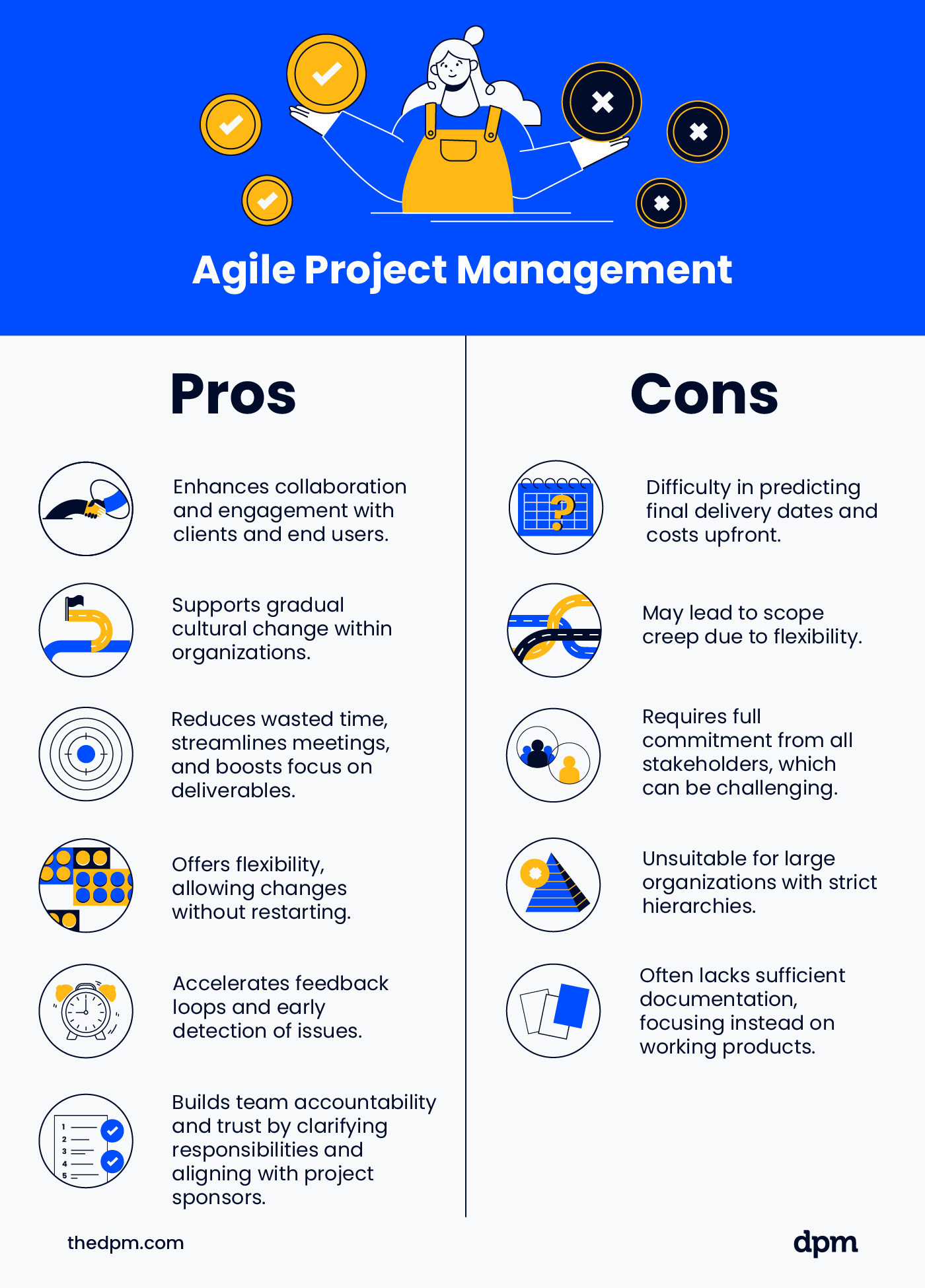
Pros
- Speeds up decision-making and adaptability
- Delivers usable results earlier in the project
- Improves transparency through regular updates
- Encourages continuous customer feedback
- Helps identify risks earlier
- Supports ongoing team improvement
Cons
- Requires strong leadership and prioritization
- Frequent changes can create uncertainty
- Demands constant communication and collaboration
- Can be difficult for new teams to adopt
- Long-term budgeting and timelines are harder to predict
4 Popular Agile Methodologies
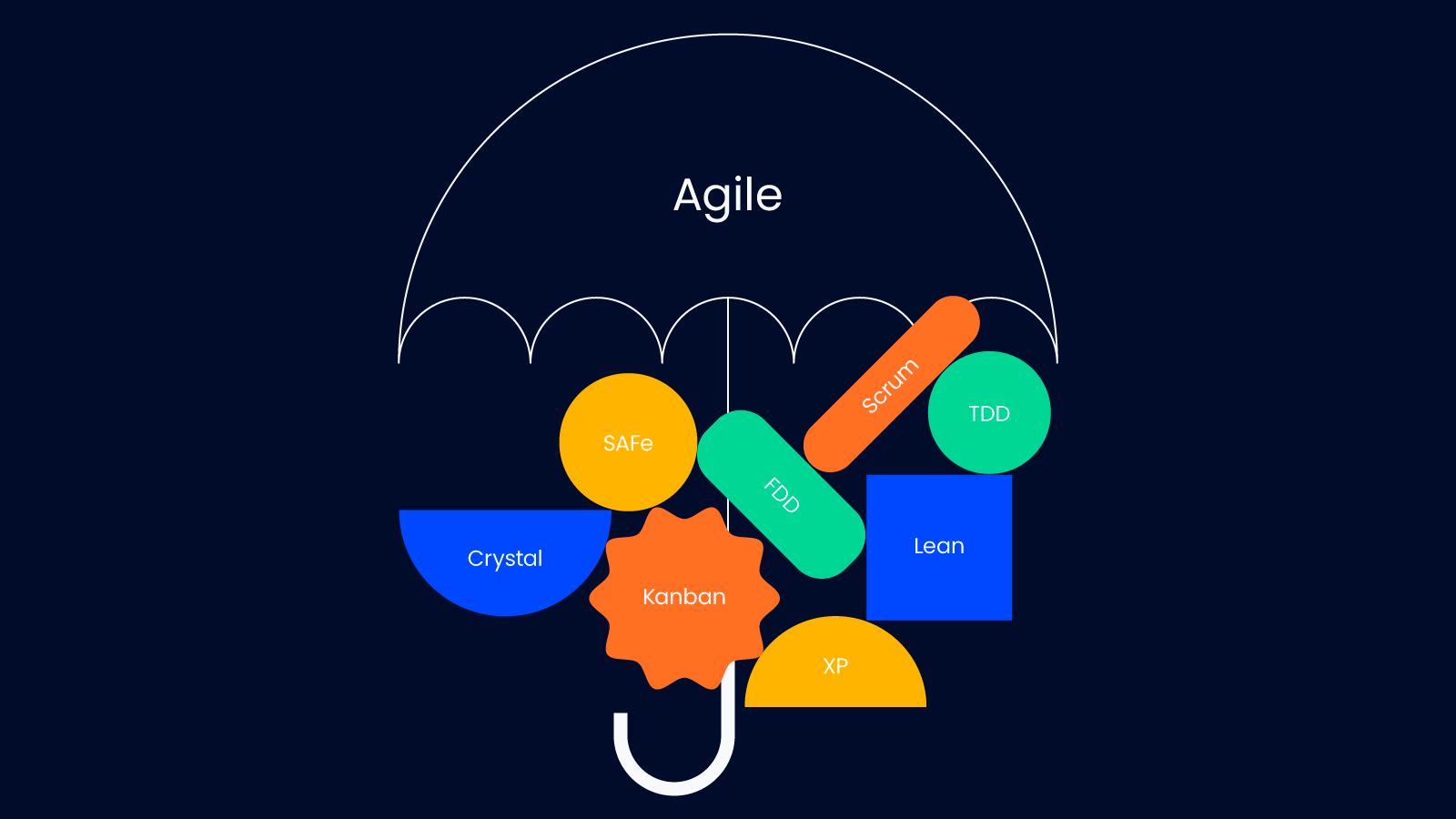
There are over 50 agile methodologies under the umbrella of the agile mindset. This implies that even though we can talk about an “agile methodology,” the reality is that the concept means different things to different people.
- Scrum: Uses fixed delivery cycles called sprints alongside structured Scrum ceremonies like sprint planning, standups, reviews, and retrospectives. It works well for teams that want predictable delivery cadences, clearly defined roles, and regular stakeholder feedback.
- Kanban: Uses a visual workflow system to help teams manage tasks, limit work in progress, and improve delivery flow continuously. Teams often use Kanban when priorities shift frequently or when ongoing operational work makes fixed sprint planning difficult. This also makes Kanban capacity planning easier to manage.
- Scrumban: Combines Scrum’s planning structure with Kanban’s flexible workflow management. Teams may still use sprint planning and daily standups while managing work visually through a Kanban board and adjusting priorities more continuously during delivery.
- Lean: Focuses on reducing waste, improving workflow efficiency, and delivering value faster by removing unnecessary steps, delays, or process overhead from project delivery.
Other popular agile methodologies with agile practices are eXtreme Programming, Crystal, and the Dynamic System Development Method (DSDM). There are even some advocates of agnostic agile, an agile framework that prioritizes what’s best for the software development project, rather than a specific agile methodology.
Example of Agile in Action
One instance where agile is particularly useful is in website design and development projects. Paul Naybour, Managing Director at Parallel Project Training, is currently using an agile approach for a website redesign and development project, in order “to both speed up the development process and better control changes to the design of the website as we move into the development phase.”
Agile brings other benefits to Naybour’s project as well:
By using Kanban board-style tools we have implemented a user-friendly way to more easily visualise workflows and manage backlogs – all underpinned by an agile framework. The result is a re-designed website that is on track to fully deliver on the initial objectives of the project on a short timescale.

Similarly, agile is useful for mobile app development projects. Airteam, a digital agency based in Australia, recently completed an app for Doctors’ Health Fund using agency agile methods. Delivery Manager Ben Mullaley noted that “agile rituals like weekly stand-ups played a pivotal role in ensuring the app's success. By promptly addressing emerging requirements through these sessions, we directly benefited our client, Doctor[s’] Health Fund.”
He continued:
The agile approach enabled us to swiftly adapt to their evolving needs, resulting in a tailored solution that enhances their service offerings to their members, ultimately strengthening their position as a provider of private health insurance in Australia.

8 Myths About Agile
Agile has become quite a buzzword in digital industries recently. With any good buzz word comes a bunch of misunderstandings about what it is or isn’t. A few of my favorite well-socialized myths about agile include:
- Agile is only for software projects: Agile is commonly used in software development, but teams also apply Agile practices to marketing campaigns, product launches, operations, customer service, and website projects.
- Agile replaces traditional project management: Agile does not eliminate traditional project management practices—it changes how teams plan, prioritize, and deliver work using more iterative workflows and faster feedback loops alongside modern project management tools.
- Agile sacrifices quality for speed: Agile encourages faster delivery cycles, but high-performing Agile teams maintain quality through continuous testing, regular reviews, and incremental improvements throughout delivery.
- Agile is just a team structure: Agile is not defined by standups or team roles alone. Successful Agile delivery depends just as much on collaboration, prioritization, stakeholder feedback, and continuous improvement.
- Agile teams don’t commit to deadlines: Agile teams still work toward delivery targets and release goals, but plans are adjusted continuously as priorities and requirements evolve. Agile delivery still requires roadmap planning, prioritization, and coordination.
- Agile eliminates documentation: Agile reduces unnecessary documentation, not useful documentation. Teams still document requirements, decisions, workflows, and compliance needs throughout delivery.
- Agile does not involve stakeholders: Agile relies heavily on stakeholder participation from initiation through delivery to provide feedback, clarify priorities, and support faster decision-making.
- Agile avoids accountability: Agile teams rely on visibility, collaboration, and shared ownership to improve accountability across delivery teams, stakeholders, and business leaders.
How To Implement Agile Into Your Projects
Transitioning to agile requires more than a change or process, it requires the whole team to have a change of mindset, of heart, and fully buy-in to a new way of working. This includes establishing proper agile contracts that support this flexible approach, especially if you're implementing agile in an agency setting.
| Focus Area | What Teams Should Do |
|---|---|
| Team trust and collaboration | Build psychological safety and trust so team members feel comfortable raising risks, feedback, and delivery concerns early |
| Communication and decision-making | Encourage open communication and involve the team in prioritization, planning, and delivery decisions |
| Agile training and adoption | If using Scrum or another framework, have team members complete formal training and follow the process consistently before customizing it |
| Continuous improvement | Use regular project retrospectives to evaluate workflows, identify blockers, and improve delivery practices over time |
| Stakeholder alignment | Set expectations early and establish proper agile contracts, especially in agency or client-facing environments |
Agile implementation works best when teams treat Agile as an operational mindset, not just a delivery framework or meeting structure. Many teams also rely on agile project management software to manage backlogs, track workflows, improve collaboration, and monitor delivery progress throughout the project life cycle.
Best Practices For Delivering Projects In Agile
Agile is great for all the reasons listed above. However, when considering agile for your approach, there are a couple of things to be mindful of:
| Best Practice | Why It Matters |
|---|---|
| Communicate estimates regularly | Agile projects evolve over time, so timelines, scope, and resources may shift. Regular communication and an agile approach to capacity planning help manage expectations. |
| Keep long-term goals visible | Agile supports incremental delivery, but teams still need visibility into larger business goals and project outcomes. |
| Maintain strong collaboration | Agile depends on continuous collaboration between stakeholders, delivery teams, and agile project leaders. |
Of course, the above can be mitigated by having an experienced, committed team well as by using the right tools. Follow this step-by-step project guide to ensure nothing is overlooked.
What’s Next?
Agile project management frameworks and other project management approaches are covered more in-depth in our Mastering Digital Project management course.
If you're serious about upskilling, these agile project management courses and agile project management conferences can also help you stay ahead of the curve.



