

20 Best Scrum Courses to Upskill in 2026

Finding the right Scrum course depends on where you are in your agile journey and what you want to do next. I've rounded up the best Scrum courses across skill levels and formats so you can compare options by credential value, delivery method, and practical fit for your role.
The 20 Best Scrum Courses
Below are my summaries of the best Scrum courses. My reviews offer a look at each course's learning objectives, best fits, cost, and more.
1. Professional Scrum Master™ Training - Scrum.org
Best for: Scrum Masters who want a credential with no renewal fees

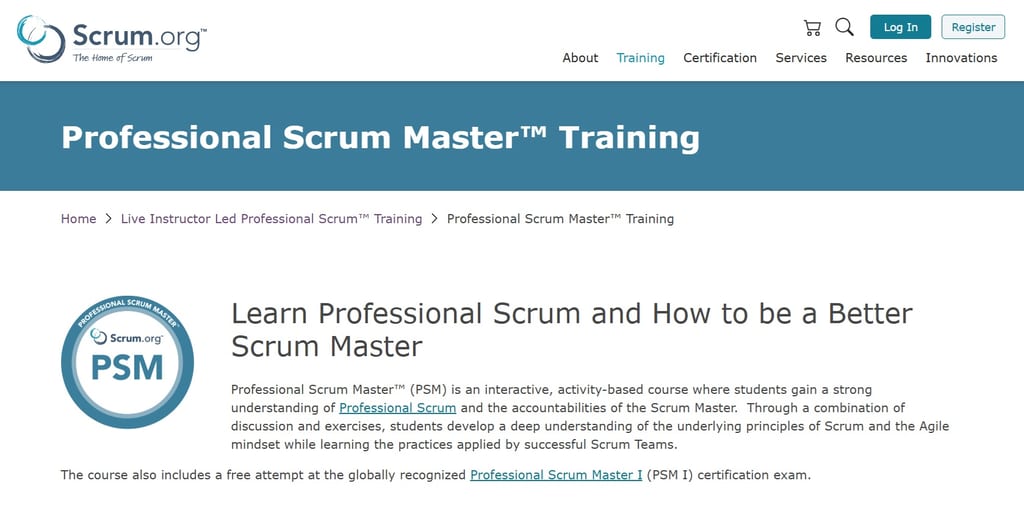
Scrum.org's Professional Scrum Master™ Training is built directly from the Scrum Guide by the organization co-founded by Scrum co-creator Ken Schwaber. The activity-based format and consistent trainer standards make it one of the most credible options available.
What you'll learn: Apply Scrum theory and empiricism, fulfill the Scrum Master accountability, facilitate Scrum events, support self-managing teams, and distinguish professional Scrum from mechanical Scrum.
Course details:
- Format: Live instructor-led (in-person or live virtual); self-paced online version also available
- Duration: 2 days (live); approx. 4.5 hours (self-paced)
- Level/prerequisites: Beginner to intermediate; no prerequisites stated
- Price: Live class pricing varies by trainer, typically $999–$1,450 USD; self-paced online $279 USD (includes one PSM I exam attempt)
- Assessment: PSM I certification assessment (85% passing score required); separate from course completion
- Certificate/credits: Professional Scrum Master I (PSM I) certification from Scrum.org (lifetime validity, no renewal fees); 14 PMI PDUs for the 2-day live course
Considerations: Live class pricing and scheduling are set by individual Professional Scrum Trainers, so cost and availability vary depending on which trainer or training partner you book through.
2. Certified ScrumMaster® (CSM) - Scrum Alliance
Best for: Scrum Masters who want a credential with no renewal fees
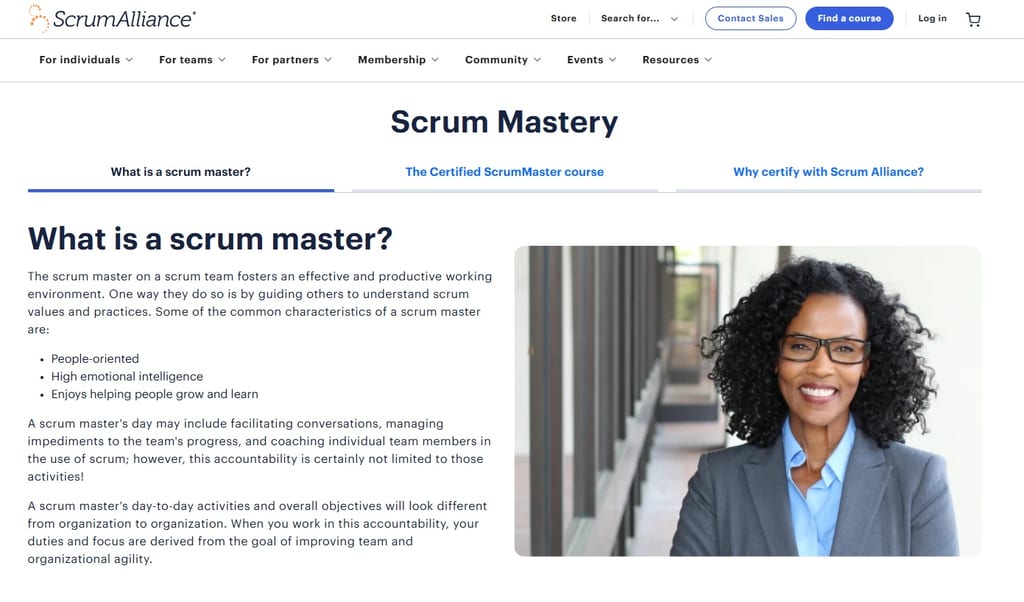
The CSM is Scrum Alliance's foundational Scrum certification course, taught by Certified Scrum Trainers who bring real-world context to a standardized curriculum. It's one of the most recognized credentials in Scrum-related job postings.
What you'll learn: Apply Scrum accountabilities, events, and artifacts, practice servant leadership and coaching, support cross-functional team dynamics, and facilitate continuous improvement within Scrum teams.
Course details:
- Format: Live instructor-led; available in-person or live virtual; no self-paced option
- Duration: At least 16 hours of instruction, typically delivered over 2–3 days
- Level/prerequisites: Beginner; no prerequisites required
- Price: $250–$2,495 USD per learner; set by individual trainers and varies by region and format; two exam attempts included in course fee
- Assessment: 50 multiple-choice questions; 74% passing score (37/50); 1-hour time limit; must be completed within 90 days of course completion
- Certificate/credits: CSM® certification from Scrum Alliance, including a certification badge and Scrum Alliance membership
Considerations: The CSM® must be renewed every two years by earning Scrum Education Units and paying a renewal fee, which adds ongoing cost after you've earned the credential.
Find more Scrum certifications here.
3. Professional Scrum Master™ Self-Paced Course - Scrum.org
Best for: Self-paced learners who want an affordable PSM I path
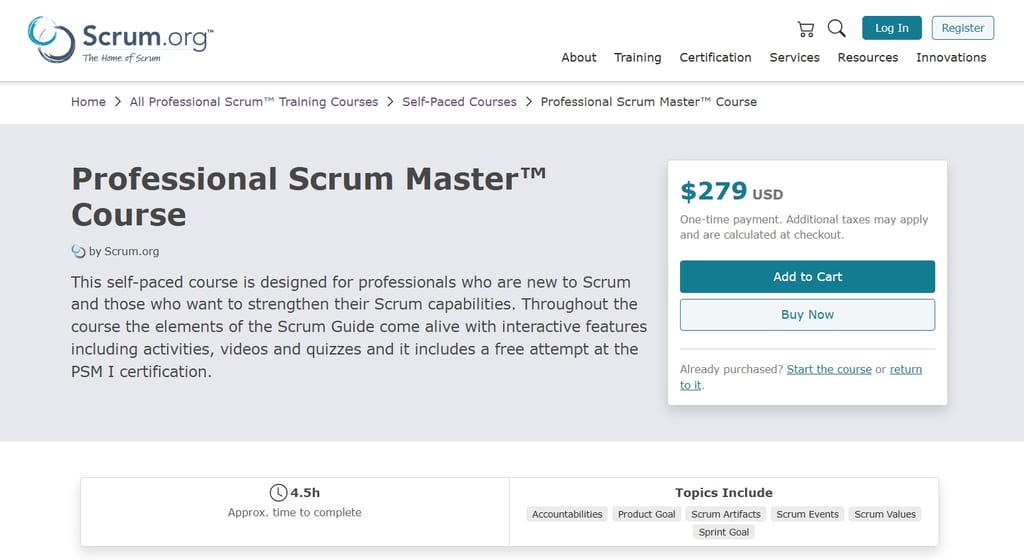
Scrum.org's self-paced PSM course covers the same curriculum as its live training, but on your schedule. At $279 with a PSM I exam attempt included, it's the most affordable direct path to a lifetime-valid Scrum.org certification.
What you'll learn: Apply Scrum theory and empiricism, fulfill the Scrum Master accountability, distinguish professional from mechanical Scrum, and support self-managing teams.
Course details:
- Format: Self-paced online; includes interactive activities, videos, quizzes, and checkpoints; no live instruction
- Duration: Approx. 4.5 hours
- Level/prerequisites: Beginner; no prerequisites required
- Price: $279 USD per learner; includes one PSM I assessment attempt (valued at $200 separately)
- Assessment: PSM I certification assessment; 85% passing score required; separate from course completion
- Certificate/credits: PSM I certification from Scrum.org upon passing the assessment; lifetime validity, no renewal fees
Considerations: The 85% passing threshold for the PSM I assessment is notably higher than comparable entry-level Scrum exams, so plan for dedicated exam prep beyond the course itself.
4. Agile Project Management by Google - Google (via Coursera)
Best for: Project managers who want Scrum within a broader Agile PM program
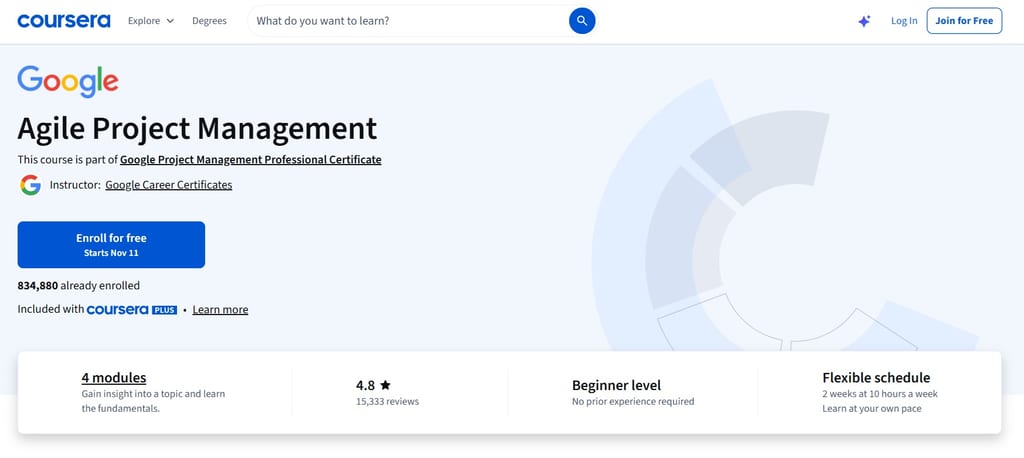
Google's Agile Project Management course teaches Scrum inside a full Agile PM curriculum. It's a strong pick if you want Scrum skills grounded in real project delivery context, not just framework theory.
What you'll learn: Apply Scrum roles, events, and artifacts; build and manage a Product Backlog; plan Sprints; use burndown charts and Kanban boards; and introduce Agile practices to an organization.
Course details:
- Format: Self-paced online; videos, readings, quizzes, and hands-on assignments; no live instruction
- Duration: Approx. 20 hours of content; estimated 2 weeks at 10 hours/week
- Level/prerequisites: Beginner; no prior experience or degree required
- Price: Included with Coursera Plus ($49 USD/month or $239 USD/year); free audit available without certificate
- Assessment: Quizzes and graded assignments throughout; required to earn the certificate
- Certificate/credits: Shareable Google course completion certificate via Coursera; counts toward the Google Project Management Professional Certificate, which qualifies for 100+ hours of PMI-eligible education (CAPM®)
Considerations: Scrum is covered extensively but sits within a broader Agile PM program, so if you want a Scrum-only course, this one will cover more ground than you strictly need.
Find more project management certifications tailored for beginners here.

5. Scrum Master Certification Specialization - LearnQuest (via Coursera)
Best for: Beginners exploring Scrum before committing to certification
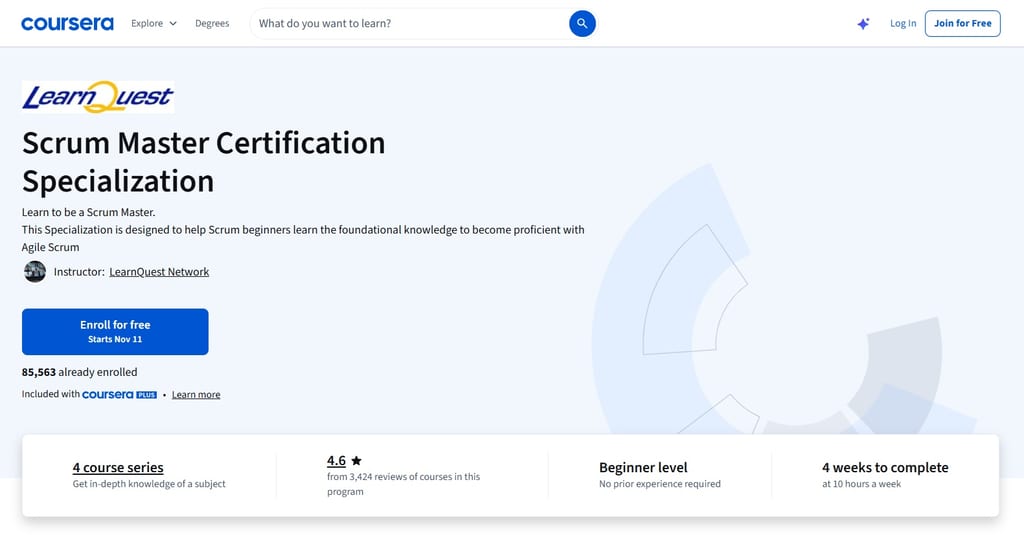
LearnQuest's four-course Coursera specialization moves from Scrum basics to scaling and adjacent Agile practices like Kanban and DevOps. It's a low-cost way to explore the Scrum Master role before investing in a formal certification program.
What you'll learn: Define Scrum roles, events, and artifacts; write user stories; estimate with story points; scale Scrum using team-of-teams approaches; and combine Scrum with Lean, Kanban, and DevOps practices.
Course details:
- Format: Self-paced online; video lectures, readings, quizzes, and graded assignments; no live instruction
- Duration: Approx. 25 hours across 4 courses; estimated 4 weeks at 10 hours/week
- Level/prerequisites: Beginner; no prerequisites required
- Price: Included with Coursera Plus ($49 USD/month or $239 USD/year after a 7-day free trial); financial aid available
- Assessment: Quizzes and graded assignments required throughout each course to earn the certificate
- Certificate/credits: Coursera specialization completion certificate from LearnQuest; shareable to LinkedIn
Considerations: Despite "Certification" in the name, the credential is a Coursera completion certificate—not a CSM® or PSM designation—so it won't satisfy employer requirements for a recognized Scrum Master certification.
6. Advanced Certified ScrumMaster® (A-CSM) - Scrum Alliance
Best for: Experienced Scrum Masters pursuing their next credential
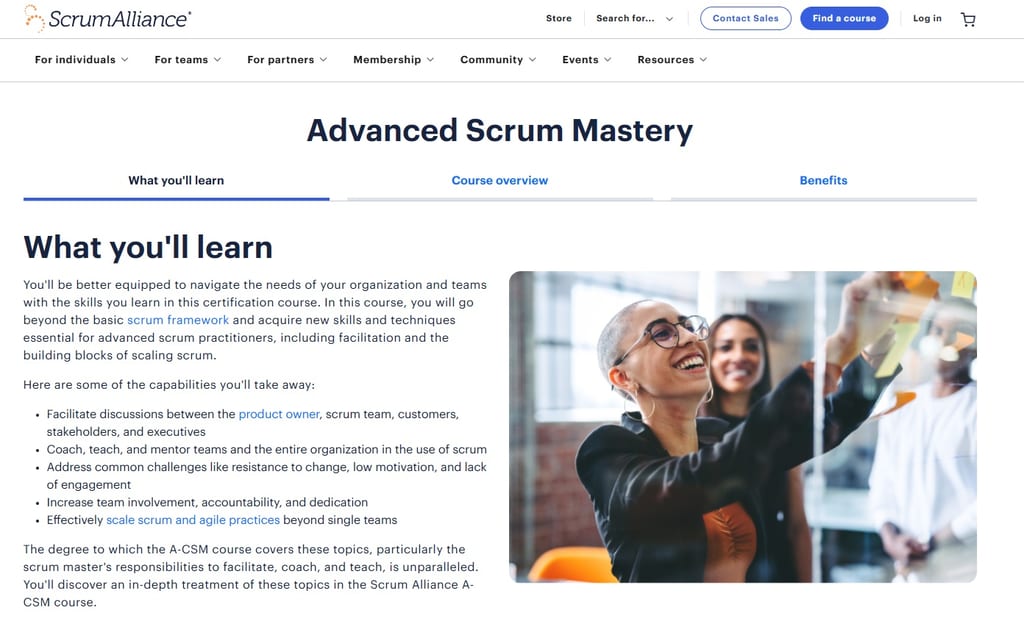
The A-CSM is Scrum Alliance's live, instructor-led course for practicing Scrum Masters ready to move past framework mechanics. Delivered by approved trainers, it builds facilitation, coaching, and scaling skills that CSM training doesn't cover.
What you'll learn: Facilitate dialogue across stakeholders, coach and mentor teams through resistance and low engagement, scale Scrum beyond individual teams, and strengthen organizational buy-in for Agile practices.
Course details:
- Format: Live instructor-led; available in person or live virtual depending on the training provider
- Duration: At least 16 hours of interactive instruction, typically over 2–3 days; additional pre- or post-course work may apply
- Level/prerequisites: Intermediate; requires an active CSM certification and at least 12 months of Scrum Master work experience within the past five years
- Price: Approx. $700–$1,900 USD per learner, depending on provider and format; certification cost is included in tuition
- Certificate/credits: A-CSM® credential from Scrum Alliance; includes a 2-year membership and counts toward renewing an expired CSM; serves as a prerequisite for the CSP®-SM
Considerations: The credential renews every two years, requiring 30 Scrum Education Units (SEUs) and a $175 renewal fee—an ongoing cost worth factoring in before you enroll.
7. Professional Scrum Product Owner™ Training - Scrum.org
Best for: Product managers stepping into a Scrum product owner role
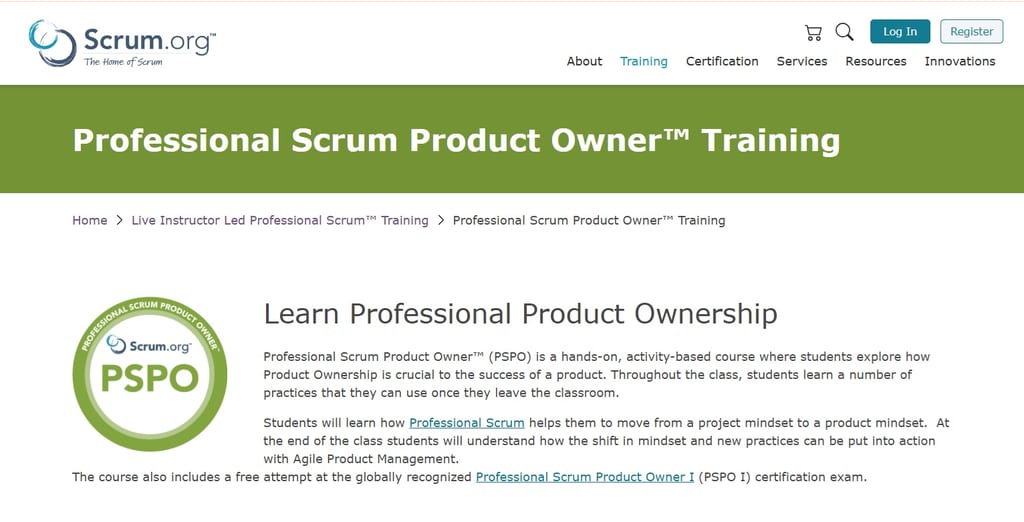
Scrum.org's PSPO training teaches product ownership from the ground up—strategy to execution—in a live two-day format or a 5.5-hour self-paced version. It's from the organization co-founded by Scrum co-creator Ken Schwaber, and the certification requires passing a scored assessment.
What you'll learn: Define a product vision and Product Goal, manage and order the Product Backlog, communicate strategy to stakeholders, and apply value metrics and release management techniques to guide delivery.
Course details:
- Format: Live instructor-led (in person or live virtual) through authorized training partners, or self-paced online directly from Scrum.org
- Duration: 2 days for the live instructor-led format; approx. 5.5 hours for the self-paced online version
- Level/prerequisites: Intermediate; Scrum fundamentals recommended—Scrum.org suggests passing the free Scrum Open assessment before enrolling
- Price: Live instructor-led approx. $1,295 USD per learner (includes one PSPO I assessment attempt); self-paced $279 USD (includes one PSPO I attempt)
- Assessment: PSPO I assessment: 80 questions, 60-minute time limit, 85% threshold to pass; a free second attempt is available to official-class students who don't pass within 14 days
- Certificate/credits: PSPO I certification from Scrum.org—a lifetime credential with no renewal fees; live course attendance earns 14 PMI PDUs
Considerations: This course develops the product owner role specifically—if your goal is a Scrum Master credential, you'll need a different course in this list.
For more courses on engaging and managing stakeholders and clients on your projects, try these client management training courses.
8. Certified ScrumMaster - Mountain Goat Software
Best for: Organizations booking private CSM training for their teams

Mountain Goat Software delivers private CSM training for organizations, designed by Mike Cohn—a co-founder of Scrum Alliance. Because it's not open enrollment, it's built for teams adopting Scrum together rather than individual learners booking their own seats.
What you'll learn: Apply Scrum roles, events, and artifacts; facilitate Sprint ceremonies; remove team impediments; and build organizational support for Scrum adoption.
Course details:
- Format: Private instructor-led; live online or in person, booked exclusively for one organization at a time
- Duration: 2 days (minimum 16 hours per Scrum Alliance requirements)
- Level/prerequisites: Beginner; no prerequisites required
- Price: Contact Mountain Goat Software directly for a quote
- Assessment: CSM exam—50 multiple-choice questions, 60-minute time limit, 74% to pass; two attempts within 90 days of course completion
- Certificate/credits: Certified ScrumMaster® (CSM®) from Scrum Alliance; renews every two years with SEUs and a renewal fee
Considerations: This is organizational training only—individual learners can't book a seat directly, so you'll need your employer to arrange the engagement.
9. Applied Scrum for Agile Project Management - University of Maryland (via edX)
Best for: Project managers learning Scrum through a university-backed MOOC
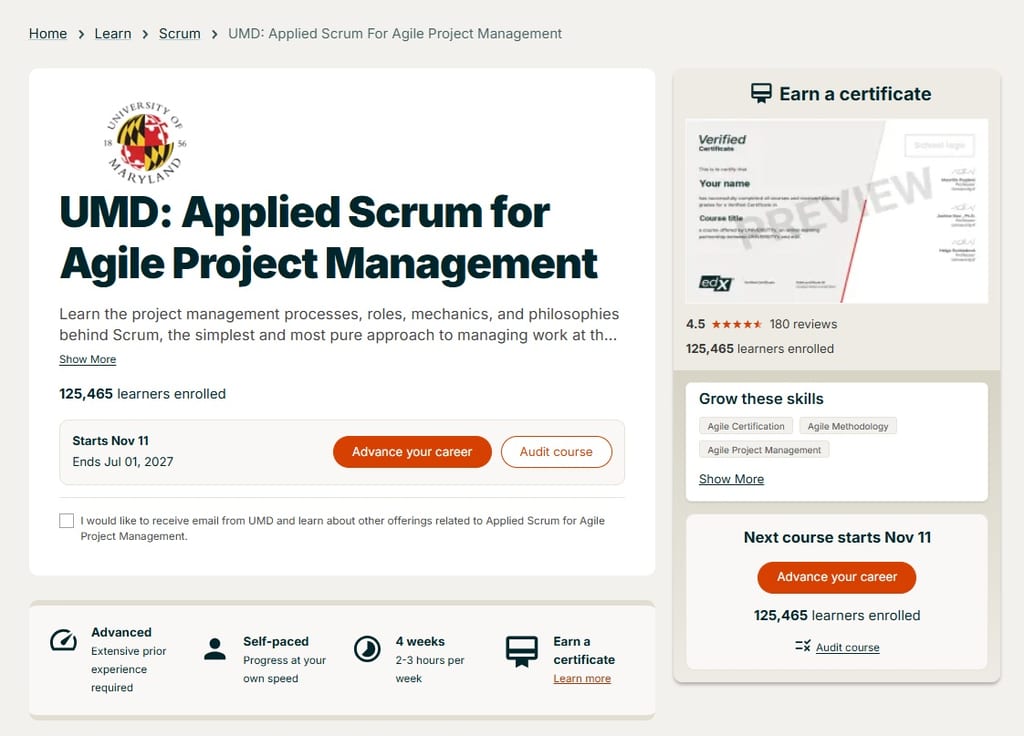
University of Maryland delivers this Scrum course on edX through a project management lens. It's free to audit, has earned 125,000+ enrollments, and awards 10 PMI PDUs—a practical entry point for project managers exploring Agile delivery.
What you'll learn: Apply Scrum roles, events, and artifacts; plan and run sprints; write user stories; facilitate retrospectives; and understand how Scrum scales across programs and portfolios.
Course details:
- Format: Self-paced online via edX; free audit or paid verified certificate track
- Duration: 4 weeks at 2–3 hours per week (approx. 8–12 hours total)
- Level/prerequisites: Labeled "Advanced" on edX; extensive prior project management experience expected
- Price: Free to audit; $249 USD for the verified certificate track
- Certificate/credits: edX verified certificate from University of Maryland; 10 PMI PDUs upon completion
Considerations: This course awards a completion certificate and PMI PDUs, but it doesn't lead to a PMI-ACP or Certified ScrumMaster credential—if certification is your goal, another course on this list will serve you better.
For more online training options, check out this list of online certifications in project management.
10. Professional Scrum Master Level I (PSM I) - Agilemania
Best for: Budget-conscious learners pursuing PSM I certification
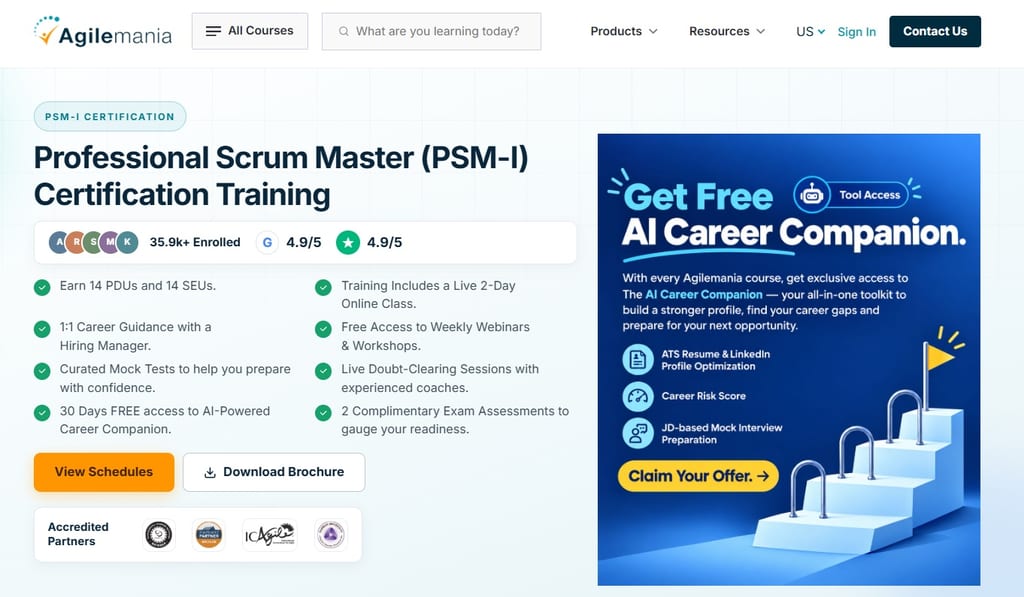
Agilemania's PSM I training follows the official Scrum.org curriculum, delivered by certified Professional Scrum Trainers. At $600 including the exam fee, it's one of the more affordable ways to earn PSM I without compromising on credential quality.
What you'll learn: Apply Scrum accountabilities, events, and artifacts; facilitate sprints; coach self-managing teams; and serve the Product Owner and organization as a Scrum Master.
Course details:
- Format: Live instructor-led online; open enrollment with interactive activities, role-play, and simulations
- Duration: 2 days at approximately 7–8 hours per day
- Level/prerequisites: Beginner; no prior experience or prerequisites required
- Price: $600 USD per learner (discounted from $800); includes PSM I assessment fee and bundled extras
- Assessment: PSM I assessment from Scrum.org—80 questions, 60-minute time limit, 85% to pass; free retake available within 14 days if first attempt scores below 85%
- Certificate/credits: Professional Scrum Master I (PSM I) from Scrum.org—lifetime certification with no renewal fees; 14 PMI PDUs and 14 SEUs awarded
Considerations: Sessions are scheduled around UTC-compatible times that suit Asia-Pacific and European learners, so check the session calendar carefully if you're based in the Americas.
11. Advanced Certified ScrumMaster® (A-CSM) Training - Learning Tree
Best for: CSM holders advancing to the A-CSM certification
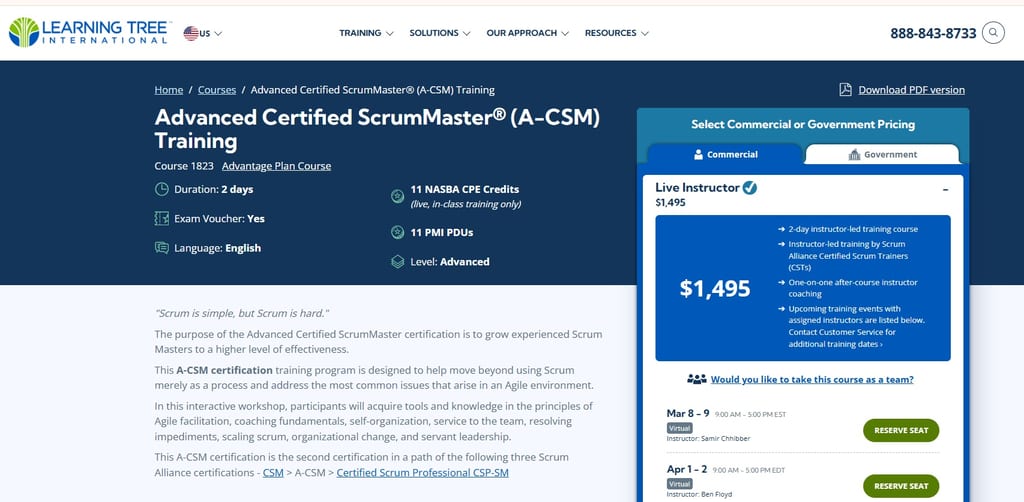
Learning Tree's A-CSM course is a two-day, instructor-led training for practicing Scrum Masters who already hold a CSM. Delivered by Scrum Alliance Certified Scrum Trainers, it includes one-on-one post-course coaching—rare in A-CSM offerings.
What you'll learn: Deepen your facilitation and coaching skills, enable self-managing teams, resolve organizational impediments, support the Product Owner, and apply scaling approaches as a servant-leader Scrum Master.
Course details:
- Format: Live instructor-led; available both in-person and online (virtual classroom); open enrollment with private team training also available
- Duration: 2 days at approximately 8 hours per day; pre-course preparation required before attending
- Level/prerequisites: Advanced; requires an active CSM credential from Scrum Alliance and 12 months of documented Agile experience
- Price: $1,495 USD per learner; includes certification with no separate exam fee; government pricing available but not publicly listed
- Certificate/credits: Advanced Certified ScrumMaster (A-CSM) from Scrum Alliance, valid for 2 years; 16 SEUs, 11 PMI PDUs, and 11 NASBA CPE credits (CPE for in-person attendance only)
Considerations: Missing more than 30 minutes of the training disqualifies you from the A-CSM credential, so treat both days as fully committed time before you enroll.
12. Complete Agile Scrum Master Certification Training - Omni Academy (via Udemy)
Best for: Self-paced learners prepping for PSM I on a budget
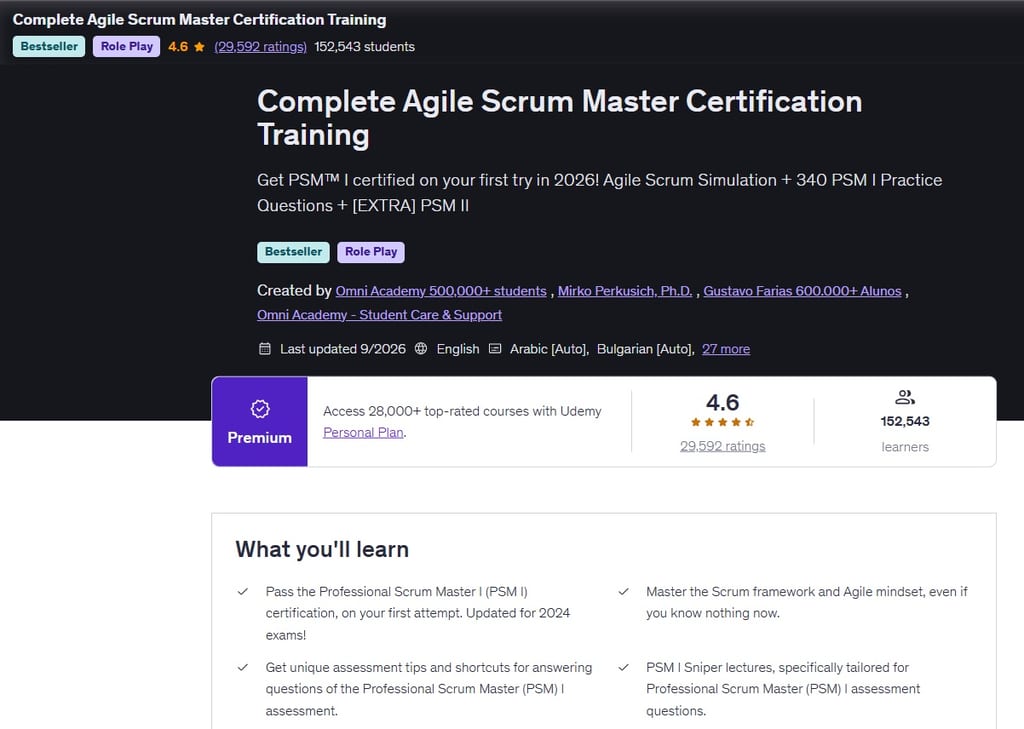
Omni Academy's Udemy course covers Scrum fundamentals and PSM I exam prep through on-demand video and 340+ practice questions. At under $20 during sales, it's the most affordable self-study path on this list—though the $200 PSM I exam fee is paid separately to Scrum.org.
What you'll learn: Apply Scrum theory, accountabilities, artifacts, and events; track sprint progress with burndown charts; and practice answering PSM I-style questions using targeted exam strategies.
Course details:
- Format: Self-paced online (on-demand video) via Udemy; includes quizzes, practice exams, and downloadable resources
- Duration: 5 hours 46 minutes of video across 123 lectures; lifetime access after purchase
- Level/prerequisites: Beginner; no prior Scrum or Agile experience required
- Price: $17.99 USD at time of research (list price $124.99); also available via Udemy Personal Plan from $12.99/month; PSM I assessment fee ($200) not included
- Assessment: 340+ practice questions and section quizzes built into the course; no final exam required for course completion
- Certificate/credits: Udemy certificate of completion upon finishing the course; the PSM I credential from Scrum.org requires passing the separate $200 assessment (80 questions, 85% to pass)
Considerations: The $200 PSM I assessment fee is paid directly to Scrum.org and not included in the course price, so budget for it separately if earning the certification is your goal.
13. Agile Scrum for Beginners + Scrum Master Certification Prep - Valentin Despa (via Udemy)
Best for: Beginners who want deep Scrum training with Jira examples
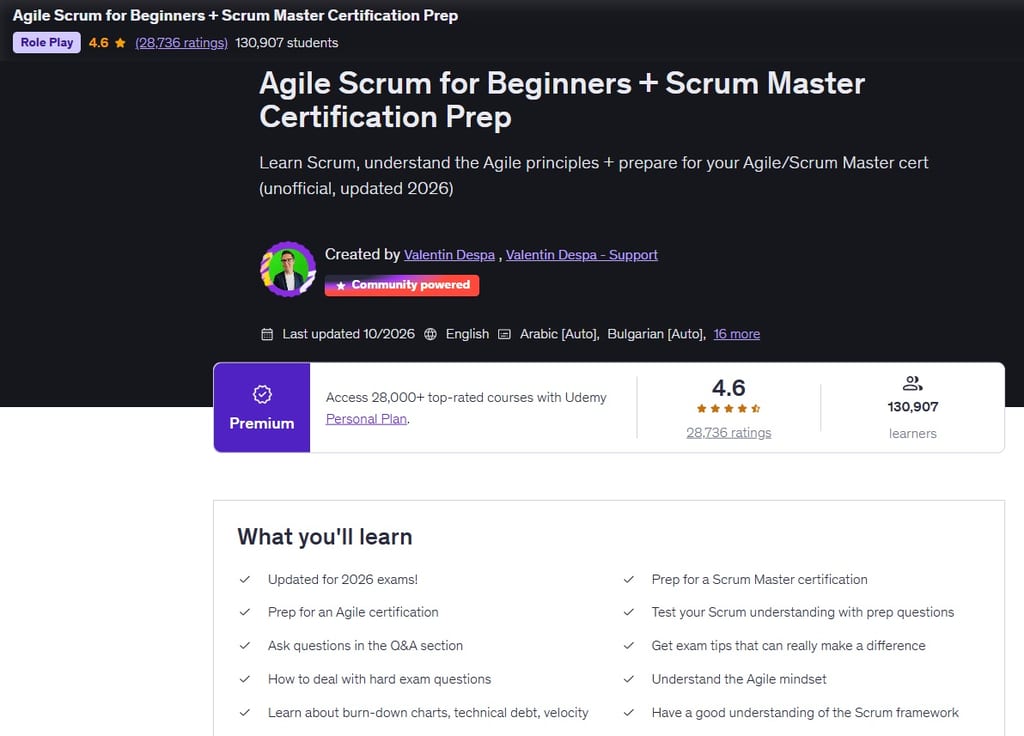
Valentin Despa's Udemy course packs 14.5 hours of Scrum training into a self-paced format, covering fundamentals through scaling with real Jira walkthroughs—more depth than most budget-friendly alternatives at a comparable price.
What you'll learn: Apply Scrum theory, manage the Product Backlog in Jira, run Scrum events, track velocity with burndown charts, and prepare for the PSM I assessment using practice tests and exam strategies.
Course details:
- Format: Self-paced online (on-demand video) via Udemy; includes practice tests, assignments, a role-play activity, articles, and Q&A
- Duration: 14 hours 25 minutes of video across 134 lectures; lifetime access after purchase
- Level/prerequisites: Beginner; no prior Scrum or Agile experience required
- Price: $15.99 USD at time of research (list price $109.99); also available via Udemy Personal Plan from $12.99/month; PSM I assessment fee ($200) not included
- Assessment: 2 practice tests, section quizzes, and assignments built into the course; no final exam required for completion
- Certificate/credits: Udemy certificate of completion upon finishing the course; active PMI credential holders can claim PDUs; PSM I requires passing the separate $200 Scrum.org assessment
Considerations: PMI PDUs are only claimable if you already hold an active PMI credential—the course doesn't award SEUs or other third-party credits on its own.
14. Introduction to Professional Scrum - Pluralsight
Best for: Aspiring Scrum Masters who want Scrum.org-endorsed prep
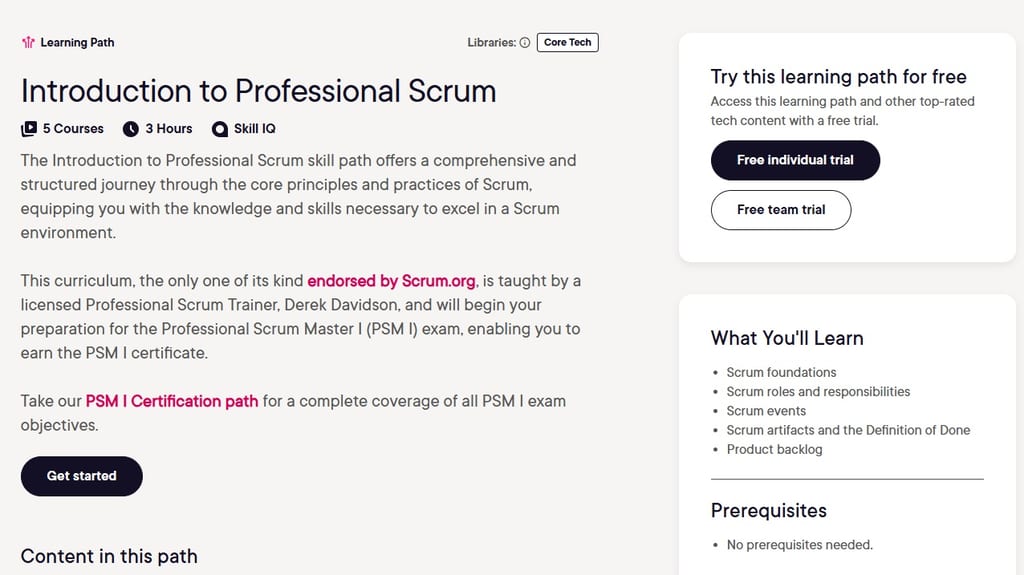
This Pluralsight learning path is the only Scrum curriculum endorsed by Scrum.org, taught by a licensed Professional Scrum Trainer. Five sequenced courses cover Scrum foundations through Product Backlog management in just three hours.
What you'll learn: Apply Scrum theory and values, run Scrum events, define accountabilities, manage Scrum artifacts, and use Product Backlog techniques including user stories and release tracking.
Course details:
- Format: Self-paced online (on-demand video) via Pluralsight; includes 5 sequenced courses, a Skill IQ assessment, and closed captions
- Duration: 3 hours of video across 5 courses; self-paced with access while your subscription is active
- Level/prerequisites: Beginner; no prior Scrum or Agile experience required
- Price: Included with Pluralsight subscription ($29/month or $299/year); 10-day free trial available; PSM I assessment fee ($200) not included
- Certificate/credits: No formal certificate of completion; PSM I certification requires passing the separate $200 Scrum.org assessment
Considerations: Scrum.org notes this path alone isn't typically enough PSM I exam preparation—you'll need to supplement it with the Scrum Guide and additional practice assessments, or upgrade to Pluralsight's full PSM I Certification path.
15. Scrum Master Fundamentals - Becoming a Great Scrum Master - Pluralsight
Best for: Scrum Masters ready to master ceremony facilitation

Jeremy Jarrell's Pluralsight course focuses on the practical craft of being a Scrum Master—how to facilitate each ceremony, lead servant-style, and drive team improvement—rather than Scrum theory or exam prep.
What you'll learn: Facilitate Sprint Planning and Daily Scrums, refine the Product Backlog, run Sprint Reviews and Retrospectives, and apply servant leadership traits to support your team.
Course details:
- Format: Self-paced online (on-demand video) via Pluralsight; 7 sections with closed captions, accessible on desktop and mobile
- Duration: 2 hours 46 minutes of video; full access while your subscription is active
- Level/prerequisites: Intermediate; some foundational Scrum knowledge assumed
- Price: Included with Pluralsight subscription ($29/month or $299/year); 10-day free trial available
- Certificate/credits: No formal certificate of completion; progress tracked in your Pluralsight profile; no PDUs or SEUs awarded
Considerations: The course was last updated in November 2016 and predates the 2020 Scrum Guide, which introduced meaningful terminology and role changes—so I'd recommend cross-referencing the current Scrum Guide alongside it.
16. Scrum Master Cert Prep - LinkedIn Learning
Best for: Practitioners studying for a Scrum Master cert exam
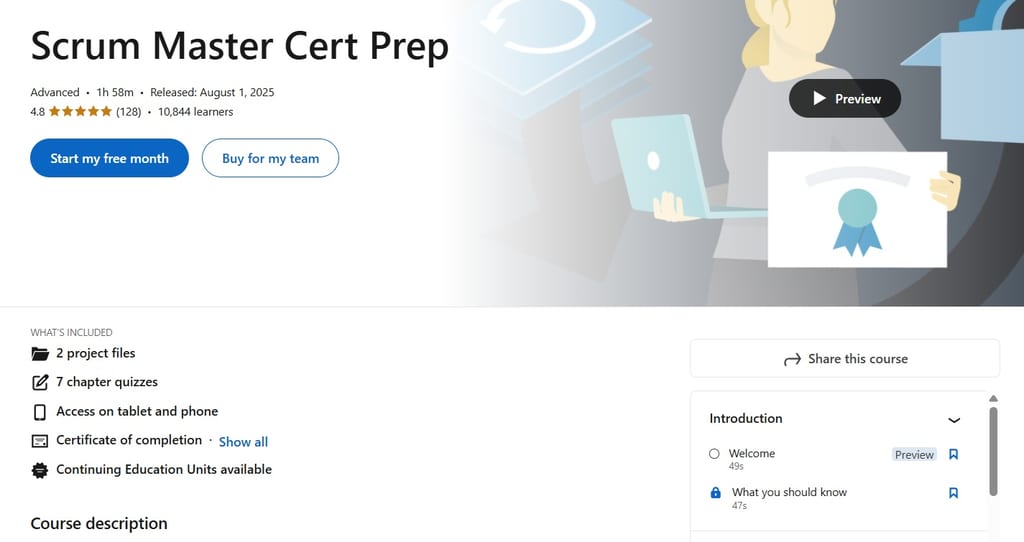
Kelley O'Connell's LinkedIn Learning course is a focused, under-two-hour review of the Scrum concepts most likely to appear on Scrum Master certification exams, updated in 2025 to reflect current Scrum Guide terminology.
What you'll learn: Distinguish Scrum roles and accountabilities, facilitate Scrum events, manage the Product Backlog, interpret burndown and burnup charts, and apply CSM exam tips.
Course details:
- Format: Self-paced online (on-demand video) via LinkedIn Learning; 8 sections, 7 quizzes, and 2 exercise files; available on desktop and mobile
- Duration: 1 hour 58 minutes of video; full access while your subscription is active
- Level/prerequisites: Advanced (LinkedIn Learning's label); no prerequisites stated, though basic Scrum familiarity is beneficial
- Price: Included with LinkedIn Learning subscription ($39.99/month or ~$19.99/month billed annually); 1-month free trial available; CSM and PSM I exam fees paid separately
- Assessment: 7 quizzes built into course sections
- Certificate/credits: LinkedIn Learning Certificate of Completion; earns Continuing Education Units (CEUs); shareable directly on your LinkedIn profile
Considerations: This course is not an approved Scrum Alliance training, so it can't substitute for the required Scrum Alliance class needed to sit for the CSM exam—treat it as supplementary prep alongside an approved course.
17. Scrum Fundamentals Certified (SFC™) - SCRUMstudy
Best for: Beginners who want a free Scrum certification
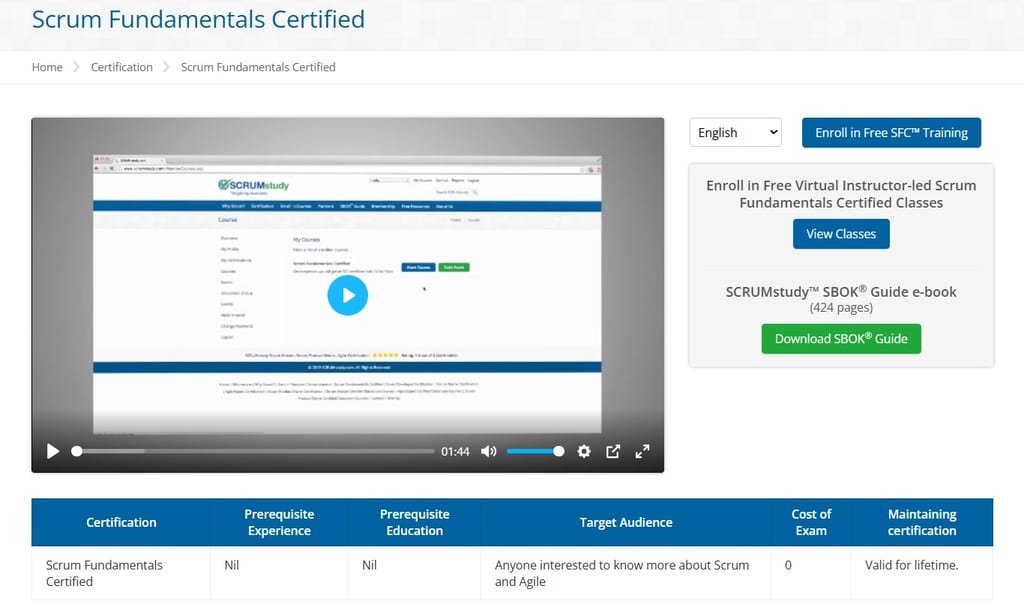
SCRUMstudy's Scrum Fundamentals Certified is a fully free course and certification covering core Scrum concepts through the SBOK® Guide. It's a no-cost entry point for anyone exploring Scrum before committing to a paid, more widely recognized credential.
What you'll learn: Identify Scrum roles and principles, apply the five Scrum process phases, manage Product Backlog basics, and distinguish Scrum from traditional project management approaches.
Course details:
- Format: Free instructor-led virtual class (2 hours); accessible via VMEdu mobile app
- Duration: 30-minutes free Scrum webinar followed by 2 hours of live virtual class
- Level/prerequisites: Beginner; no prerequisites required
- Price: Free with a SCRUMstudy primary lifetime membership; course materials, exam, and digital certificate are all included at no cost
- Assessment: 40 multiple-choice questions; 60 minutes; 75% passing score; unproctored online exam; unlimited free retakes allowed
- Certificate/credits: SFC™ credential from SCRUMstudy upon passing; lifetime valid; not recognized by Scrum.org, Scrum Alliance, or PMI
Considerations: The SFC™ is a SCRUMstudy proprietary credential not recognized by Scrum.org, Scrum Alliance, or PMI, so it won't substitute for or count toward PSM or CSM certification pathways.
18. Agile Scrum Master Basics - Simplilearn
Best for: Job seekers preparing for Scrum Master interviews
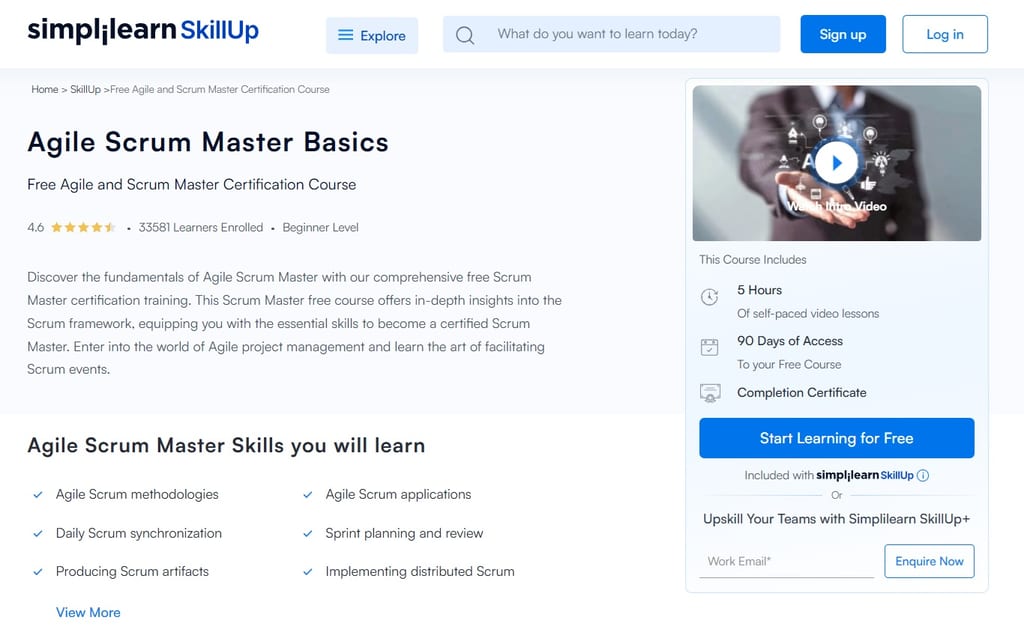
Simplilearn's free SkillUp course covers Scrum fundamentals and dedicates over 80 minutes to Scrum Master and Agile interview prep—practical content you won't find in most introductory Scrum courses.
What you'll learn: Apply core Scrum events and artifacts, write user stories, understand the Scrum Master role, and prepare for Scrum Master and Agile job interviews.
Course details:
- Format: Self-paced online (on-demand video) via Simplilearn's SkillUp platform; accessible on desktop and mobile
- Duration: 5 hours of video across 9 lessons; course access expires 90 days after enrollment
- Level/prerequisites: Beginner; no prerequisites required
- Price: Free; no subscription required
- Certificate/credits: Simplilearn completion certificate upon finishing all lessons; not recognized by Scrum.org, Scrum Alliance, or PMI
Considerations: The course awards a completion certificate with no formal assessment, so it won't satisfy any prerequisite or eligibility requirement for PSM, CSM, or other recognized Scrum certifications.
19. Agile & Scrum Crash Course: Agile Project Management w/Jira - Udemy
Best for: Beginners who want Scrum theory and Jira practice
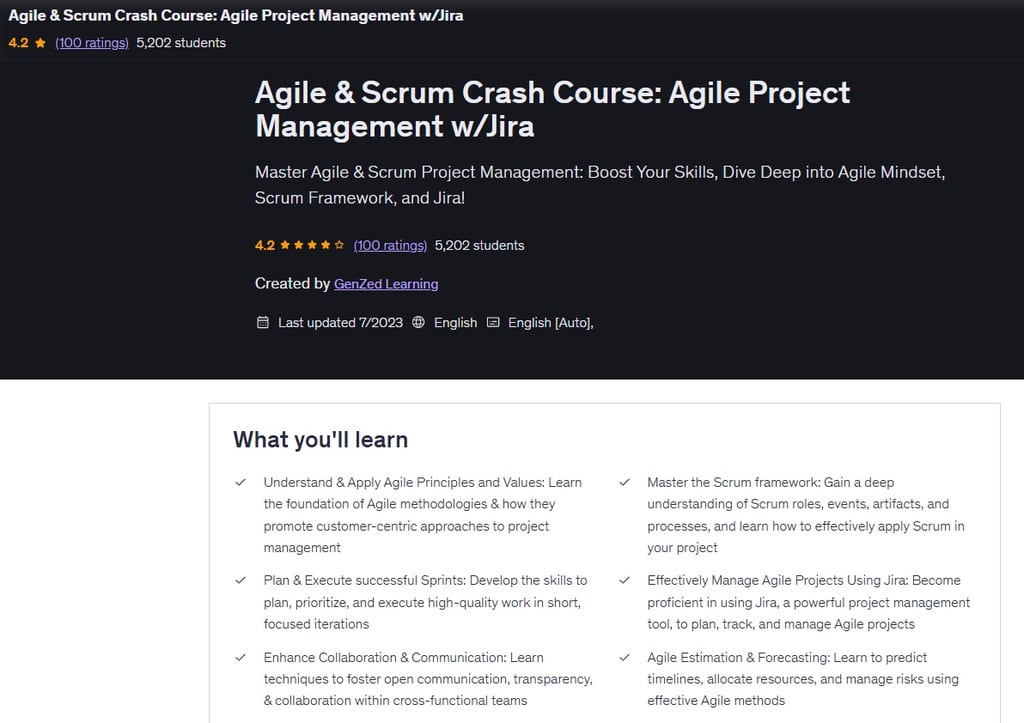
GenZed Learning's Udemy course pairs Scrum framework fundamentals with hands-on Jira instruction—covering sprint planning, backlog management, and estimation techniques in a single under-five-hour course.
What you'll learn: Apply Agile and Scrum principles, manage a Product Backlog, run sprint ceremonies, use estimation techniques like Planning Poker and T-shirt sizing, and set up a Scrum project in Jira.
Course details:
- Format: Self-paced online (on-demand video) via Udemy; accessible on desktop, mobile, and TV; English auto-generated captions available
- Duration: ~5 hours of video across 44 lectures; lifetime access after individual purchase
- Level/prerequisites: Beginner; no prerequisites required
- Price: ~$11.99 USD (sale price; list price $59.99); also available via Udemy subscription from $12.99/month; 30-day money-back guarantee
- Certificate/credits: Udemy Certificate of Completion upon finishing all lectures; not recognized by Scrum.org, Scrum Alliance, or PMI
Considerations: The course awards a completion certificate with no formal assessment, so it won't satisfy eligibility requirements for PSM, CSM, or any other recognized Scrum certification.
20. SSGI Scrum Master Certification - Six Sigma Global Institute (SSGI)
Best for: PMP holders adding a Scrum cert while earning PDUs
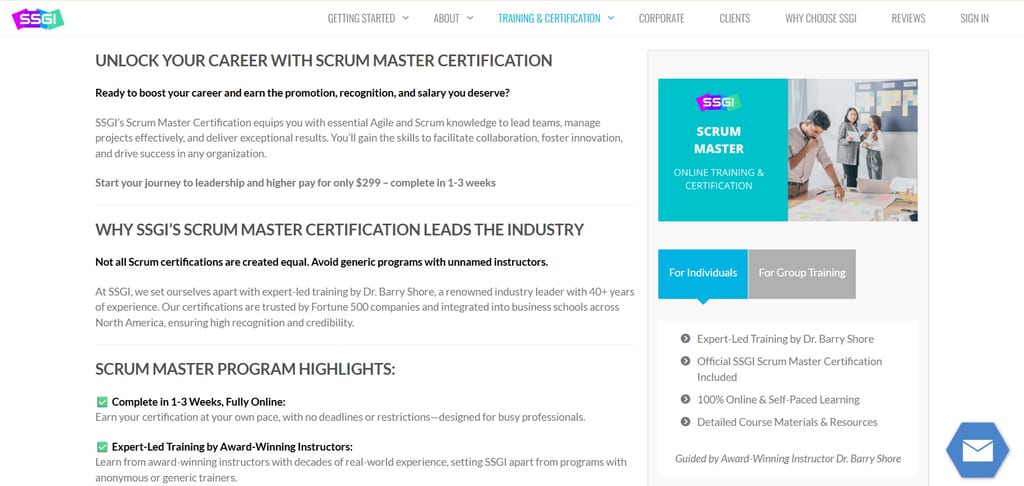
SSGI bundles Scrum Master training and a certification exam into a single $299 purchase with lifetime access and unlimited retakes. As a PMI Authorized Training Partner, it awards 15 PDUs—a tangible benefit if you hold a PMP and need continuing education credits.
What you'll learn: Define Scrum roles and responsibilities, facilitate sprint ceremonies, manage the Product Backlog, apply Agile principles, and lead Agile teams across sprints.
Course details:
- Format: Self-paced online; narrated presentations, case studies, templates, quizzes, and digital flashcards; mobile-friendly
- Duration: ~15 hours of content; lifetime access with no deadlines or time restrictions
- Level/prerequisites: Beginner; no prerequisites required
- Price: $299 USD one-time fee; buy now, pay later from $26.99/month; 24-hour money-back guarantee if exam is not attempted
- Assessment: 100 multiple-choice and true/false questions; 2-hour time limit; 80% passing score required; unlimited retakes at no extra cost
- Certificate/credits: SSGI Scrum Master Qualified (SMQ) credential upon passing; lifetime valid, no renewal required; 15 PDUs (PMI) and 15 PDCs (SHRM) claimable
Considerations: The SMQ is an SSGI proprietary credential—it's not affiliated with Scrum.org, Scrum Alliance, or any PSM or CSM certification body, so it won't satisfy prerequisites for those exams.
How to Choose a Scrum Course
Start by identifying what you actually need from this course—whether that's passing a specific exam, landing your first Scrum role, or upskilling a team mid-project. That answer will cut most of the list immediately.
- Match the credential to your goal. A Udemy or SSGI completion certificate won't satisfy PSM I or CSM eligibility requirements. If you're preparing for a Scrum.org or Scrum Alliance exam, confirm the course explicitly aligns with that framework before enrolling.
- Check whether the curriculum goes beyond theory. Some courses cover Scrum events and artifacts at a conceptual level only. If you need to run sprint ceremonies, write user stories, or manage a backlog in Jira, look for courses that include hands-on exercises, templates, or tool walkthroughs.
- Be honest about your experience level. Beginner courses move through fundamentals quickly. If you're already facilitating retrospectives or managing backlogs, a course pitched at career changers will feel slow—look for one that covers scaling, metrics, or advanced facilitation instead.
- Factor in the full time commitment. A five-hour crash course and a 15-hour certification program both show up as "beginner-friendly," but they serve different schedules and depth needs. Know how much time you can realistically dedicate before the course's access window closes.
- Weigh PDUs and professional credits if you hold other credentials. If you're a PMP or SHRM credential holder, a course from a PMI Authorized Training Partner can earn you PDUs or PDCs simultaneously—making the same purchase do double duty.
Scrum Course FAQ
Do you need a Scrum certification to become a Scrum Master?
No, there’s no universal certification requirement for Scrum Master roles. Employers set their own expectations, and many hiring managers weigh hands-on facilitation experience as heavily as a credential—sometimes more. That said, certifications like PSM I or CSM signal that you understand the framework and are serious about the role, which helps when you’re breaking in without a track record.
If you’re competing for roles at companies that explicitly list a certification as preferred, it’s worth having one. Otherwise, focus on building real experience alongside any coursework.
Is Scrum useful outside software development?
Yes, Scrum can work well beyond software—teams in marketing, product design, research, and even operations have applied it successfully. The key is whether the work suits an iterative structure: short delivery cycles, regular stakeholder feedback, and a team that can self-organize around a backlog. If the work is highly linear, heavily regulated, or relies on long fixed-scope contracts, Scrum is a harder fit.
It’s worth evaluating the nature of your work before committing to the framework, rather than assuming Scrum automatically transfers from one context to another.
How do you choose between a Scrum course and a broader Agile course?
Choose a Scrum course if you want to learn the specific mechanics of the framework—its three roles, five events, and three artifacts—and how to apply them on a real team. A broader Agile course makes more sense if you’re still figuring out which approach fits your environment, or if you need to compare Scrum with Kanban, SAFe, or other ways of working.
If your team already runs Scrum and you need to get better at it, a focused Scrum course will get you there faster than a survey-level overview.
How can you tell whether a Scrum course is up to date?
Check the course’s last updated date and confirm its syllabus reflects the current 2020 Scrum Guide. The 2020 version removed the concept of the “Development Team” as a subgroup, introduced the term “Developers,” dropped the “three questions” mandate from the Daily Scrum, and reframed Sprint Goals as a commitment.
If a course still uses outdated terminology or describes the framework in ways that contradict the current Guide, that’s a signal the content hasn’t kept pace—which matters if you’re preparing for a Scrum.org or Scrum Alliance exam.
What's Next?
Want to connect with other digital project managers and share resources and best practices? Join our membership community to access 100+ templates, samples, and examples, and connect with hundreds of digital project managers in Slack.


