

10 Best Quote and Proposal Software in 2026

Best Quote and Proposal Software Shortlist


Quote and proposal software helps salespeople create professional quotes, sales proposals, and sales documents without relying on disconnected spreadsheets or manual templates. The right quoting software can streamline your quoting process, reduce manual errors, and give your team a clearer view of the sales cycle from first conversation to signed agreement.
Whether you need sales quote software for a growing service business, CPQ software for complex product configurations, or cloud-based quotation software for client-facing teams, this guide compares the best quoting software for different workflows. You’ll see which tools can help you create quotes, manage approval workflows, support a smoother proposal process, and deliver a stronger customer experience.
Why Trust Our Software Recommendations
Our team has been testing and reviewing software since 2012. As project managers ourselves, we know how difficult—and important—it is to choose the right software.
For this guide, we evaluated tools using hands-on testing and independent research, scoring tools using our selection criteria. We also draw on insights from industry thought leaders and practicing project management experts.
Our reviews reflect our human editorial judgment, not a sales pitch.
Expert reviewers:
Quote and Proposal Software Comparison Table
This comparison table summarizes pricing details for my top quote and proposal software selections:
| Tool | Best For | Trial Info | Price | ||
|---|---|---|---|---|---|
| 1 | Best for booking-to-payment workflows | 30-day free trial | From $29/month (billed annually) | Website | |
| 2 | Best for packaged services and deposits | Free demo + 7-day free trial | From $9/user/month (billed annually) | Website | |
| 3 | Best for CRM-to-accounting integrations | Free trial available | From $45.83/user/month (billed annually) | Website | |
| 4 | Best for complex guided selling | Free demo available | Pricing upon request | Website | |
| 5 | Best for real-time contract negotiation | 14-day free trial available | From $272/month (billed annually) | Website | |
| 6 | Best for no-code branded document design | 14-day free trial | From $13/user/month (billed annually) | Website | |
| 7 | Best for controlled content reuse | 14-day free trial + free demo available | From $19/user/month (billed annually) | Website | |
| 8 | Best for interactive web-based sales content | 14-day free trial | From $35/user/month (billed annually) | Website | |
| 9 | Best for flexible document automation | Free plan available + 14-day free trial available | From $19/user/month (billed annually) | Website | |
| 10 | Best for video-enabled buyer engagement | 14-day free trial + free demo available | From $25/user/month (billed annually) | Website |
Best Quote and Proposal Software Reviews
Below are my detailed summaries of the best quote and proposal software that made it onto my shortlist. My reviews offer a detailed look at the features, pricing, and integrations of each platform to help you find the best one for you.

Best for booking-to-payment workflows
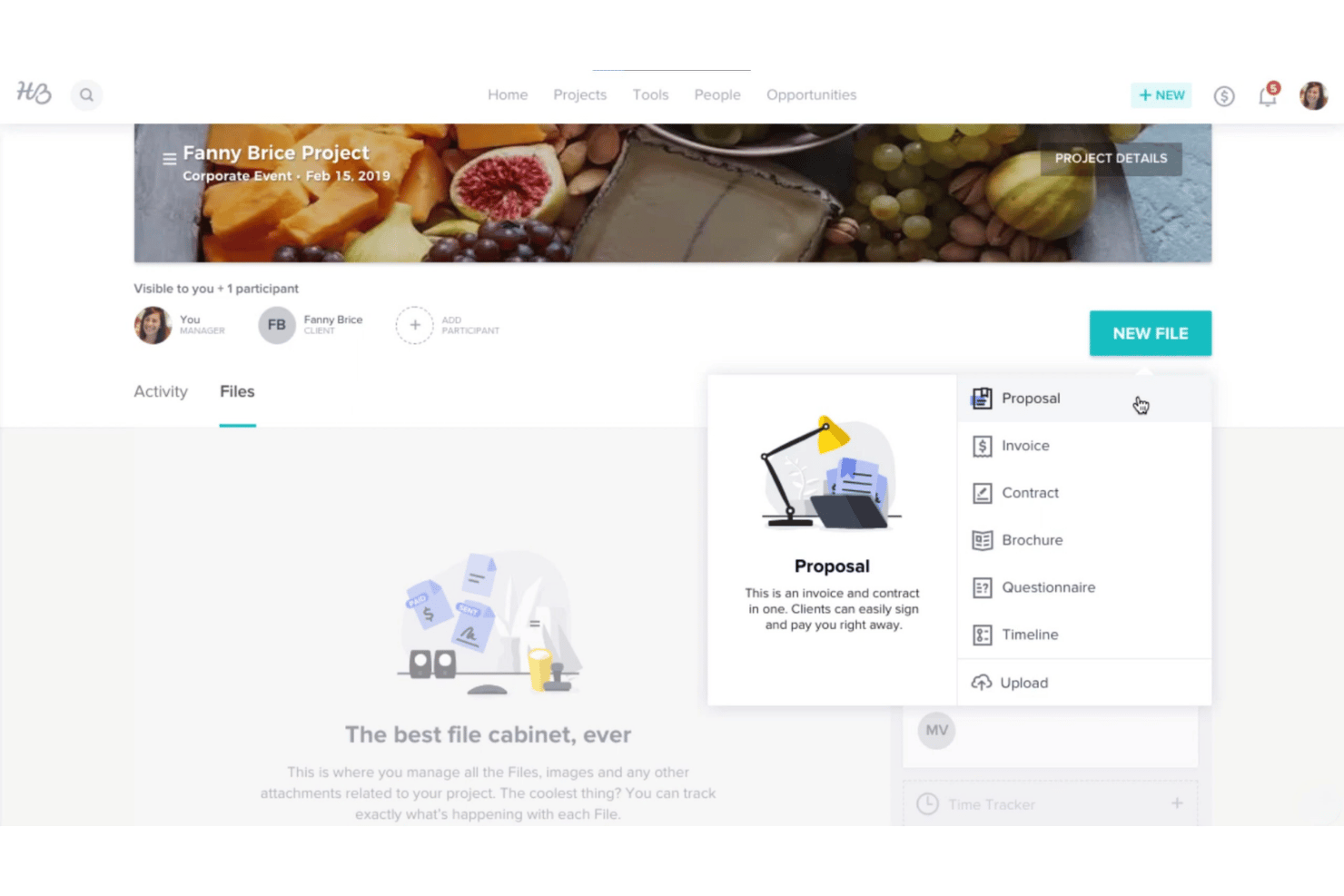
HoneyBook is a clientflow platform for small service businesses and independent professionals that combines branded proposals, e-signature contracts, invoicing, and payment collection into a single interactive client-facing document.
Who Is HoneyBook Best For?
HoneyBook is a strong fit for freelancers and solo service providers in creative industries who need a lightweight, end-to-end client booking system.
Why I Picked HoneyBook
I picked HoneyBook because it combines service selection, contract signing, invoicing, and payment collection in one client-facing file. Clients can review an offer, sign the agreement, and submit payment without moving between separate documents. Payment schedules, payment plans, and autopay can also be configured as part of the booking workflow.
HoneyBook Key Features
- Template library: Access reusable proposal, contract, and invoice templates designed for service businesses.
- Native e-signature: Collect legally binding electronic signatures directly within proposal and contract files.
- Client portal: Give clients a personalized dashboard to view files, pay invoices, and check project status.
- File tracking: Monitor when a client views, signs, or submits payment for any sent proposal or contract.
HoneyBook Integrations
HoneyBook connects with Gmail, Google Calendar, QuickBooks Online, Zoom, Canva, Flodesk, Acuity, Calendly, Pic-Time, Prismm, and Meta lead forms. It also supports Zapier connections with apps such as Asana, monday.com, and Slack. QuickBooks Online, Flodesk, Zapier-based workflows, and HoneyBook Automations require Essentials or Premium. HoneyBook provides an API key specifically for its Zapier connection, but it does not document a general public API for custom development.
Pros and Cons
Pros:
- Tracks client actions with timestamped file history
- Automates payment schedules inside proposals
- Combines proposal, contract, and invoice in one file
Cons:
- Starter is intended for a single business owner
- QuickBooks Online and automations require Essentials

Bonsai
Best for packaged services and deposits
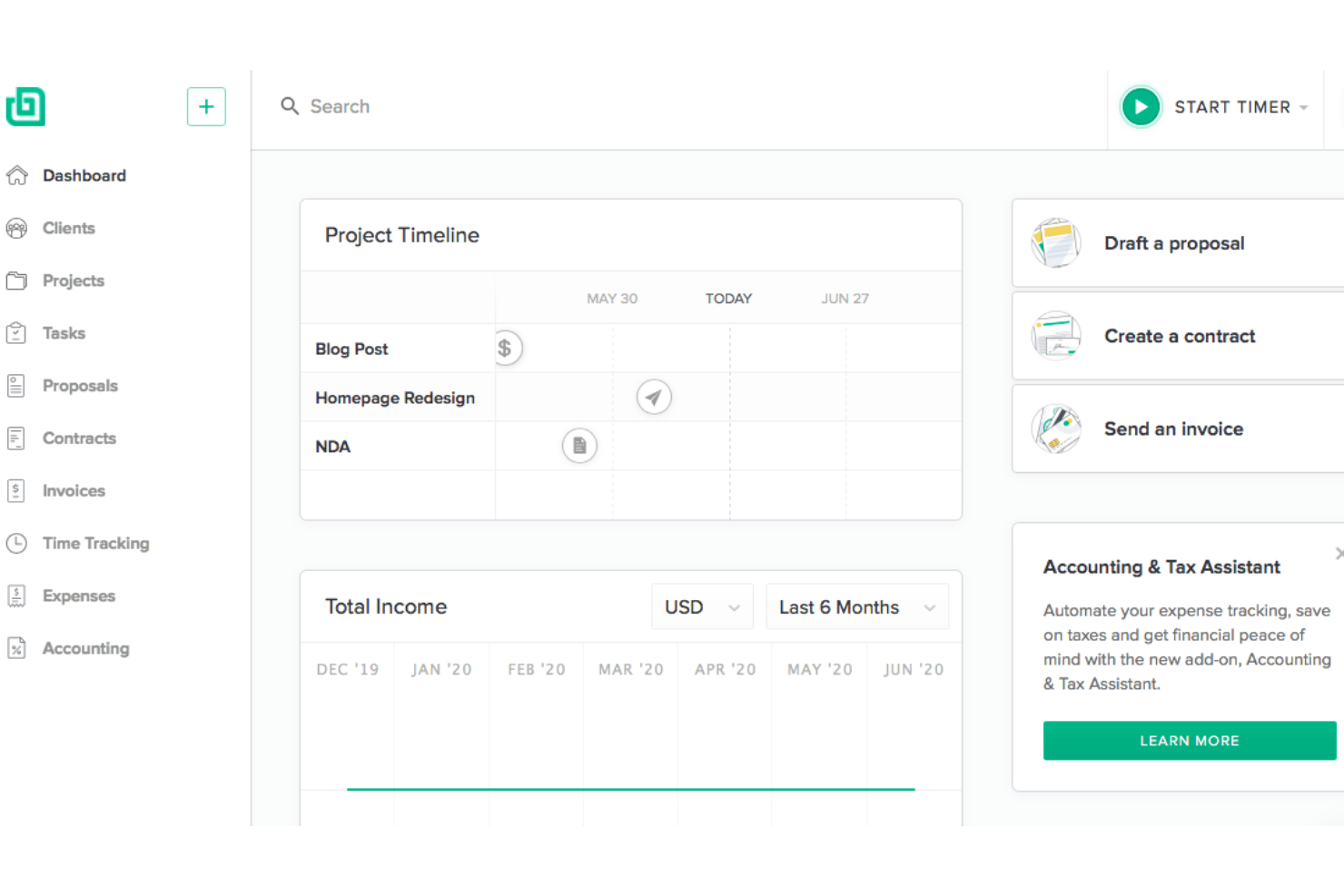
Bonsai is an all-in-one platform for freelancers and small agencies that combines proposal building, contracts, invoicing, time tracking, and project management in a single workspace.
Who Is Bonsai Best For?
Bonsai is a natural fit for freelancers and small creative or consulting agencies that send client proposals and need to connect them directly to contracts and invoices.
Why I Picked Bonsai
I picked Bonsai because it lets clients choose between service packages and pay an upfront deposit as part of proposal acceptance. Deposits require Bonsai Payments, which is currently available in the US, Canada, UK, and Australia. The platform then connects accepted work with contracts, invoicing, project management, and client records.
Bonsai Key Features
- Branded proposal templates: Choose from a variety of customizable templates to create professional-looking proposals.
- Client e-approval: Clients can approve proposals with a single click, making approvals fast and traceable.
- Service library: Save frequently used services for rapid quoting and consistent proposals.
- Proposal seen receipts: Get notifications when clients open and view your proposals.
- Upfront proposal payments: Require a percentage-based deposit through Bonsai Payments before a client can complete proposal acceptance.
Bonsai Integrations
Bonsai documents integrations with QuickBooks Online, Zapier, Calendly, Xero, HiBob, and Zoom. QuickBooks Online, Zapier, Calendly, and Google-related connections require Premium, while Xero requires Elite. Stripe and PayPal are supported payment methods, not general workflow integrations. Bonsai does not currently document Slack as an integration or provide a general public API for custom integrations.
Pros and Cons
Pros:
- Contracts, invoicing, and proposals in one app
- Built-in deposit and retainer payment workflow
- Proposal templates support custom service packages
Cons:
- QuickBooks Online and Zapier require Premium
- Proposals are unavailable on Basic and Limited plans

Best for CRM-to-accounting integrations
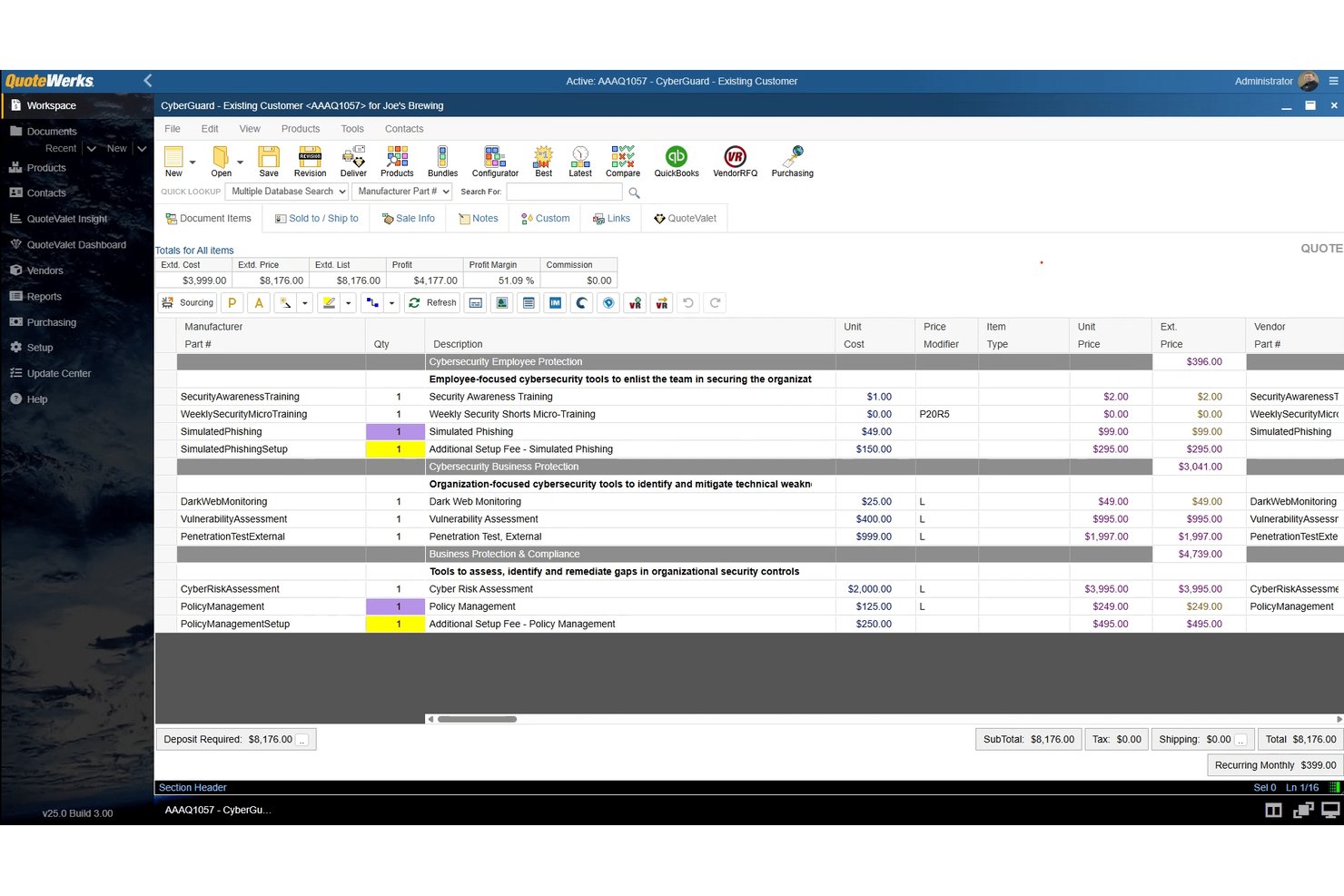
QuoteWerks is a CPQ and quoting tool for building itemized quotes, proposals, and SOWs with product configuration, pricing rules, approvals, and CRM or PSA connections. QuoteWerks Web is the current platform for new customers; online acceptance, e-signatures, and payments through QuoteValet begin on the Balanced plan.
Who Is QuoteWerks Best For?
QuoteWerks is a strong fit for IT resellers and MSPs that rely on PSA tools like ConnectWise or Autotask and need quoting tightly connected to their service delivery stack.
Why I Picked QuoteWerks
I picked QuoteWerks because it connects quote data with CRM, PSA, accounting, distributor, and procurement workflows. Its configurator and bundle features support complex hardware and service combinations, while accepted quotes can move into connected systems without rebuilding line items manually. Exact capabilities differ between QuoteWerks Web and the legacy Desktop editions, so teams should confirm their required integrations before selecting a deployment.
QuoteWerks Key Features
- Peer review and approval workflows: Route quotes for internal approval before sending them to clients.
- Branded proposal templates: Build and customize proposals with SOWs, T&Cs, and your company branding.
- QuoteValet online acceptance: Balanced and Pinnacle users can let clients review, accept, e-sign, and pay for quotes online.
- Centralized quote management: Store, filter, and track all quotes by date, company, or sales rep in one database.
QuoteWerks Integrations
QuoteWerks documents more than 115 integrations across CRM, PSA, accounting, shipping, distributor, tax, and payment categories. QuoteWerks Web includes core CRM and PSA connections such as HubSpot CRM, Salesforce, Pipedrive, Zoho CRM, ConnectWise PSA, and Autotask PSA. QuickBooks Online is a separate native accounting add-on priced at $20/site/month. Sage 50 and certain other accounting connections belong to QuoteWerks Desktop rather than every QuoteWerks Web plan. API and SDK options are also available for custom work.
Pros and Cons
Pros:
- Document audit trail tracks quote status
- Advanced internal approval workflows built in
- Handles complex hardware and service bundles
Cons:
- QuickBooks Online costs an additional $20/site/month
- E-signatures and online payments require Balanced

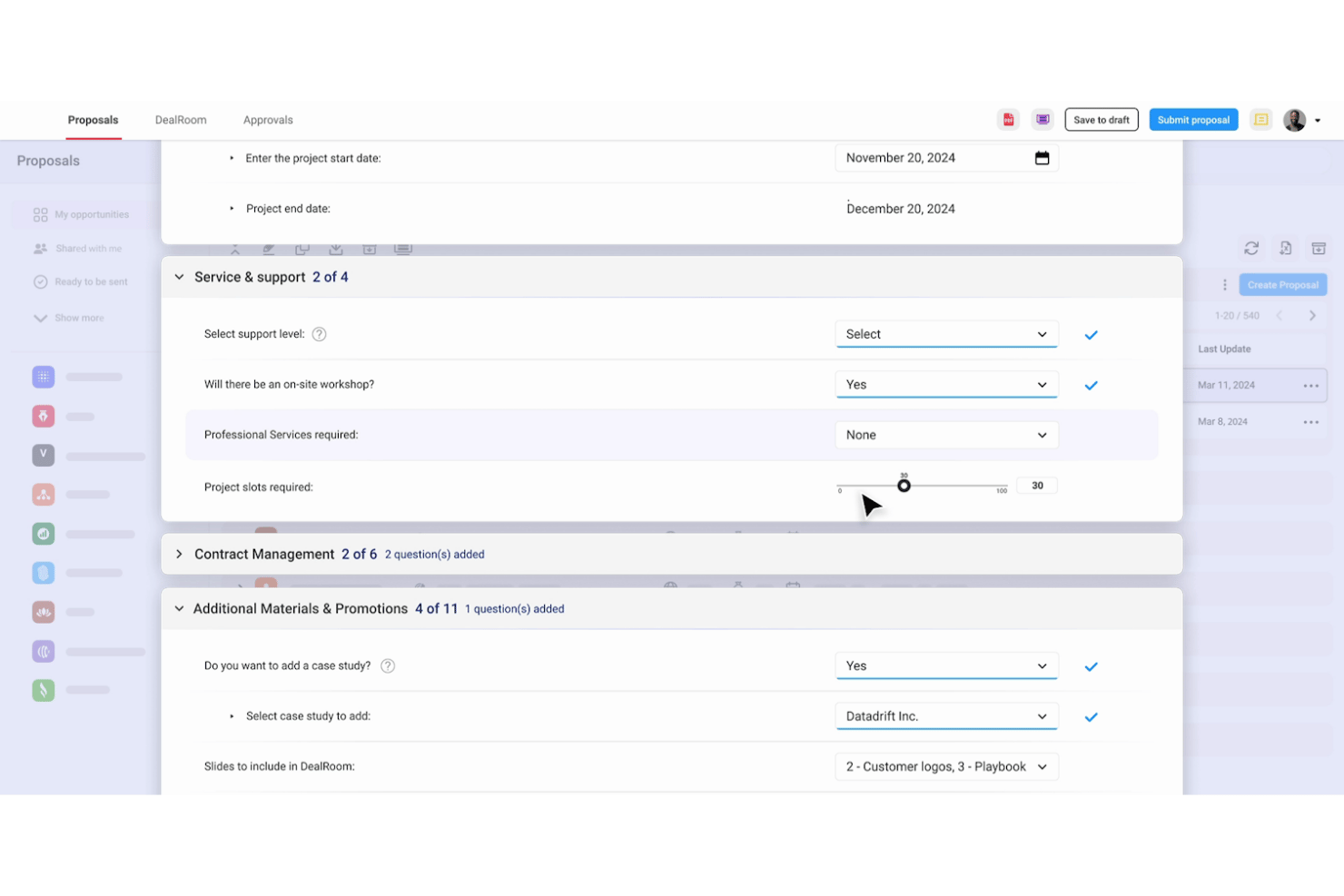
DealHub is an AI-powered quote-to-revenue platform that combines CPQ, digital DealRooms, contract management, subscription management, and billing. Its current plans are organized around Growth for governed revenue execution and Scale for advanced billing control.
Who Is DealHub Best For?
DealHub is a strong fit for mid-market and enterprise SaaS companies with dedicated RevOps, sales, and finance teams managing complex, multi-stakeholder deal cycles.
Why I Picked DealHub
I picked DealHub because it brings guided configuration, pricing controls, approvals, and buyer-facing DealRooms into one workflow. Its playbooks can apply product, bundle, discount, and approval rules as a quote is built. The resulting quote and supporting content can then be shared through a DealRoom where buyers review, collaborate, and sign.
DealHub Key Features
- Contract lifecycle management: Create, store, and manage contract templates, dynamic clauses, and a searchable contract repository.
- Built-in and external signing options: Use DealHub’s own signing functionality or connect an existing DocuSign subscription to the DealRoom workflow.
- Analytics and reporting: Track proposal views, engagement, section-level insights, and deal progression in real time.
- Multi-currency and billing options: Support for recurring, one-time, and usage-based billing across multiple currencies and entities.
DealHub Integrations
DealHub documents integrations with Salesforce, HubSpot, Microsoft Dynamics 365, NetSuite, Priority ERP, Sage Intacct, Intuit QuickBooks, Xero, Avalara, Stripe, DocuSign, Slack, Gong, SendGrid, SSO providers, and Google authentication. DealHub also offers its own CRM API and Prismatic-based integration tooling for custom connectivity. DocuSign remains an external service and requires an existing DocuSign subscription.
Pros and Cons
Pros:
- Complex approval workflows for sales and finance
- Real-time tracking of proposal engagement
- Guided selling playbooks prevent quoting errors
Cons:
- Advanced billing controls are reserved for the Scale tier
- Pricing and billing terms require a custom quote

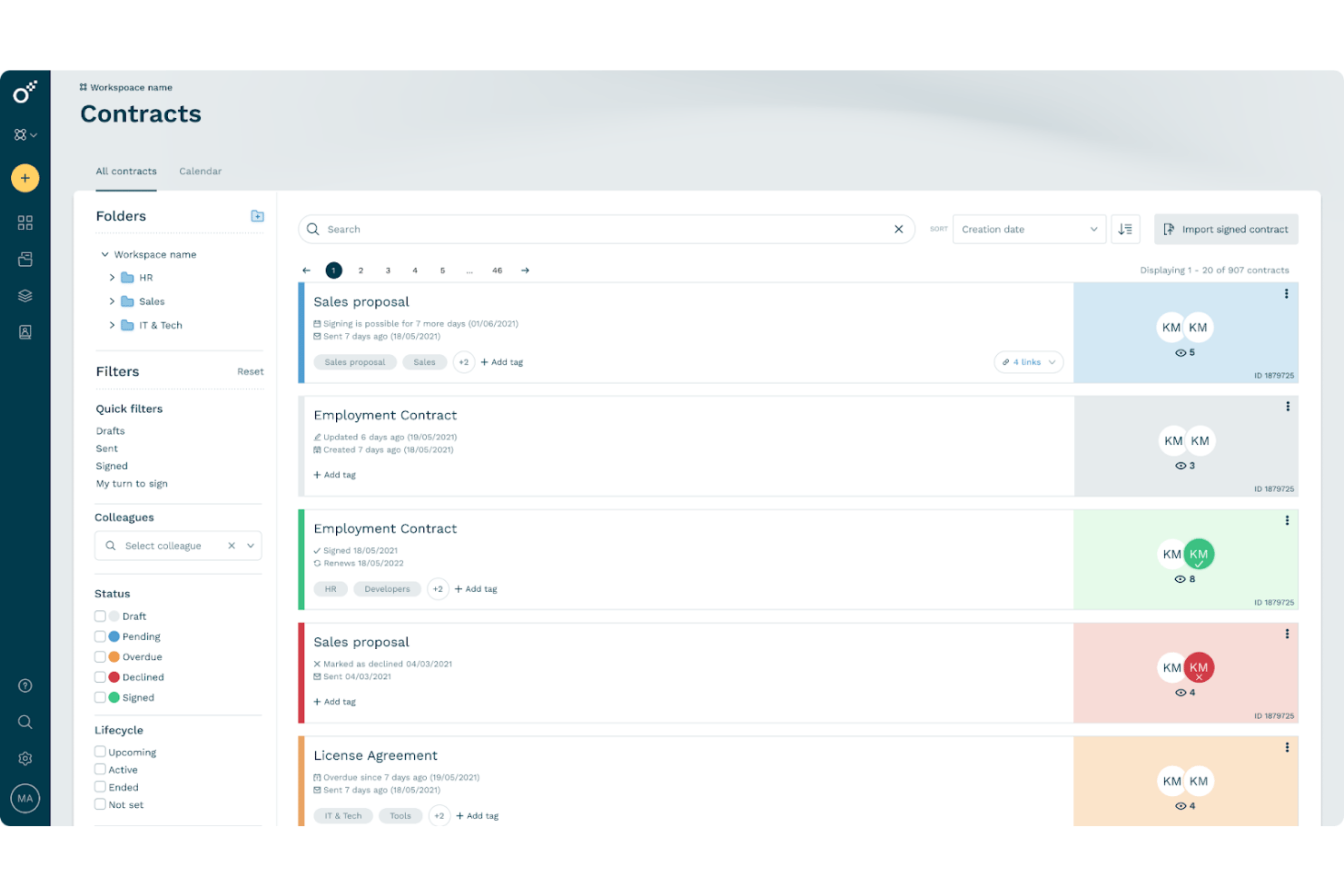
Oneflow is a contract management platform that replaces static PDF proposals with dynamic HTML documents, supporting real-time collaborative editing, pricing tables, approval workflows, and legally binding e-signatures across the full proposal lifecycle.
Who Is Oneflow Best For?
Oneflow is a strong fit for consulting and professional services teams at small to midsize companies that need to move proposals through negotiation and into signed contracts quickly.
Why I Picked Oneflow
I picked Oneflow because both sides can collaborate on the same interactive contract instead of exchanging multiple static files. Users can edit permitted content, comment inline, update pricing tables, and move the final document into signing without recreating it in a separate tool. This makes Oneflow particularly useful when proposal negotiation and contract execution are part of the same workflow.
Oneflow Key Features
- Lifecycle management: Set contract lifecycle rules, receive automated notifications, and use calendar-based views to track upcoming contract events.
- Multi-step approval workflows: Set up proposal review and routing to ensure team sign-off before sharing with clients.
- Template library: Access and customize reusable proposal and contract templates for different sales scenarios.
- Engagement analytics dashboard: Track client interactions, including views, time spent on sections, and status updates.
Oneflow Integrations
Oneflow documents integrations with Salesforce, HubSpot, Microsoft Dynamics 365, Pipedrive, Teamtailor, HiBob, Jobylon, Slack, Google Workspace, Microsoft 365, SuperOffice, and other sales and HR platforms. Its Google Workspace connection includes a Workspace add-on, while additional Google-app automation can use Zapier. Oneflow also provides Zapier, webhooks, and custom-integration options; feature and add-on availability varies by plan.
Pros and Cons
Pros:
- Legally binding e-signatures with audit trail
- Converts proposals into contracts instantly
- Real-time collaborative proposal editing
Cons:
- SSO, shared templates, section rules, and account audit logs require Enterprise
- Business requires a five-user annual commitment

Best for no-code branded document design
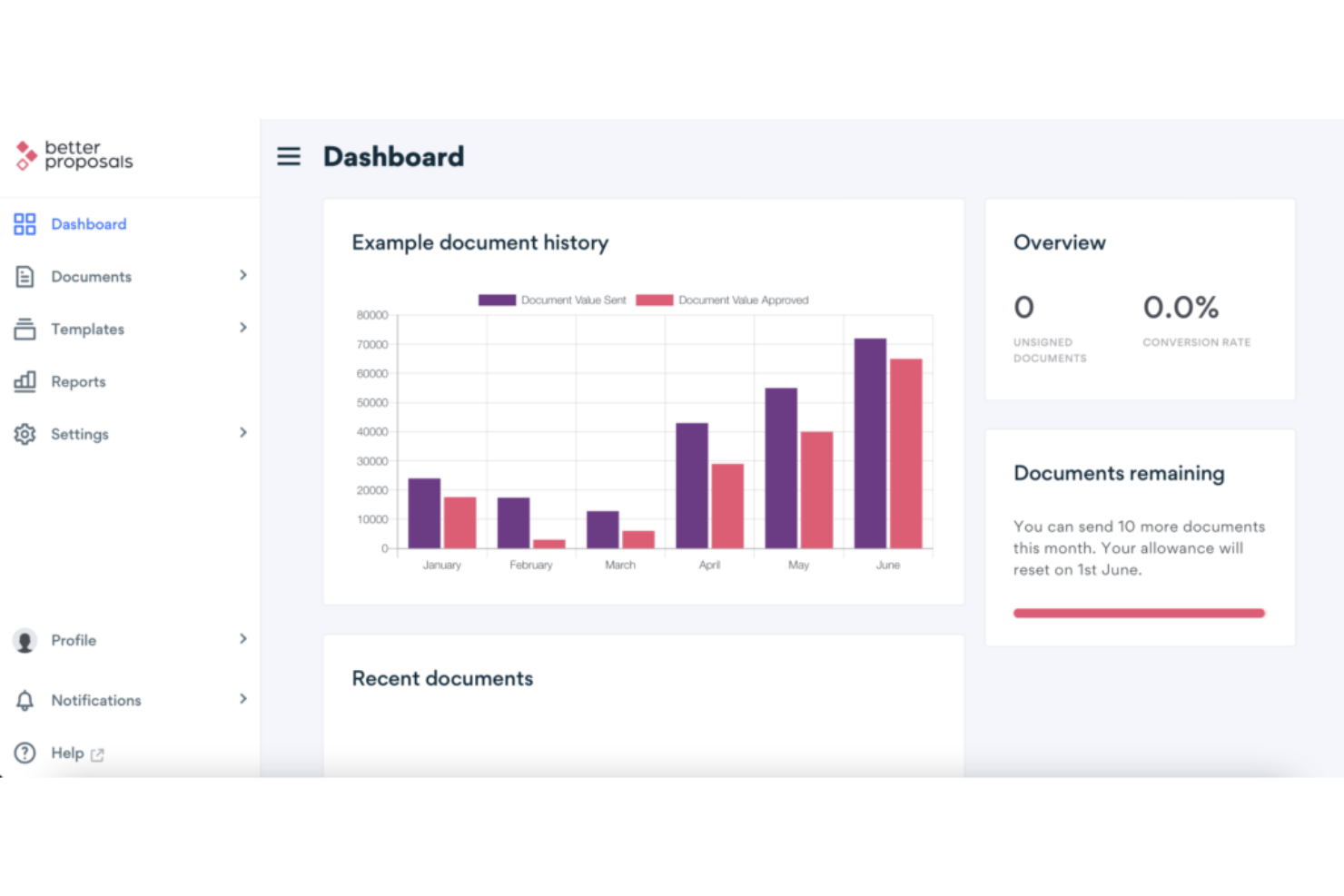
Better Proposals is a proposal creation platform that lets you build interactive, web-based client documents with pricing tables, e-signatures, post-signature onboarding flows, and section-level engagement tracking.
Who Is Better Proposals Best For?
It's a strong fit for small agency owners and independent consultants who send branded proposals regularly and want a polished client experience without hiring a designer.
Why I Picked Better Proposals
I picked Better Proposals because it offers detailed control over proposal branding without requiring code. You can upload custom fonts, connect Adobe Fonts, create multiple brand profiles, and use a custom domain on Premium and Enterprise. Proposals are delivered as interactive web documents, allowing pricing tables, payments, tracking, and live-chat integrations to sit within the document clients review.
Better Proposals Key Features
- Section-level engagement analytics: Track exactly how much time clients spend reading each part of your proposal.
- Legally binding e-signatures: Collect electronic signatures from clients with an audit trail and multi-signer support.
- Post-signature onboarding flows: Premium and Enterprise users can direct clients to onboarding forms, scheduling links, or other next steps after a document is signed.
- 260+ pre-made proposal templates: Access a wide range of industry-specific templates for proposals, quotes, SOWs, and contracts.
Better Proposals Integrations
Better Proposals offers direct connections across CRM, payment, live-chat, and project-management categories, including HubSpot, Salesforce, Pipedrive, Zoho CRM, Stripe, PayPal, GoCardless, Asana, Basecamp, ClickUp, Teamwork, Trello, and Wrike. CRM integrations, Zapier, and API access require Premium or Enterprise. Zapier is a third-party connector for additional applications rather than a native integration with each connected app.
Pros and Cons
Pros:
- Custom domain and multiple brand profiles
- Section-level client engagement tracking
- Proposals display as interactive web pages
Cons:
- Manager approvals and inline comments require Enterprise
- Starter is limited to one user and 10 sends/month

Best for controlled content reuse
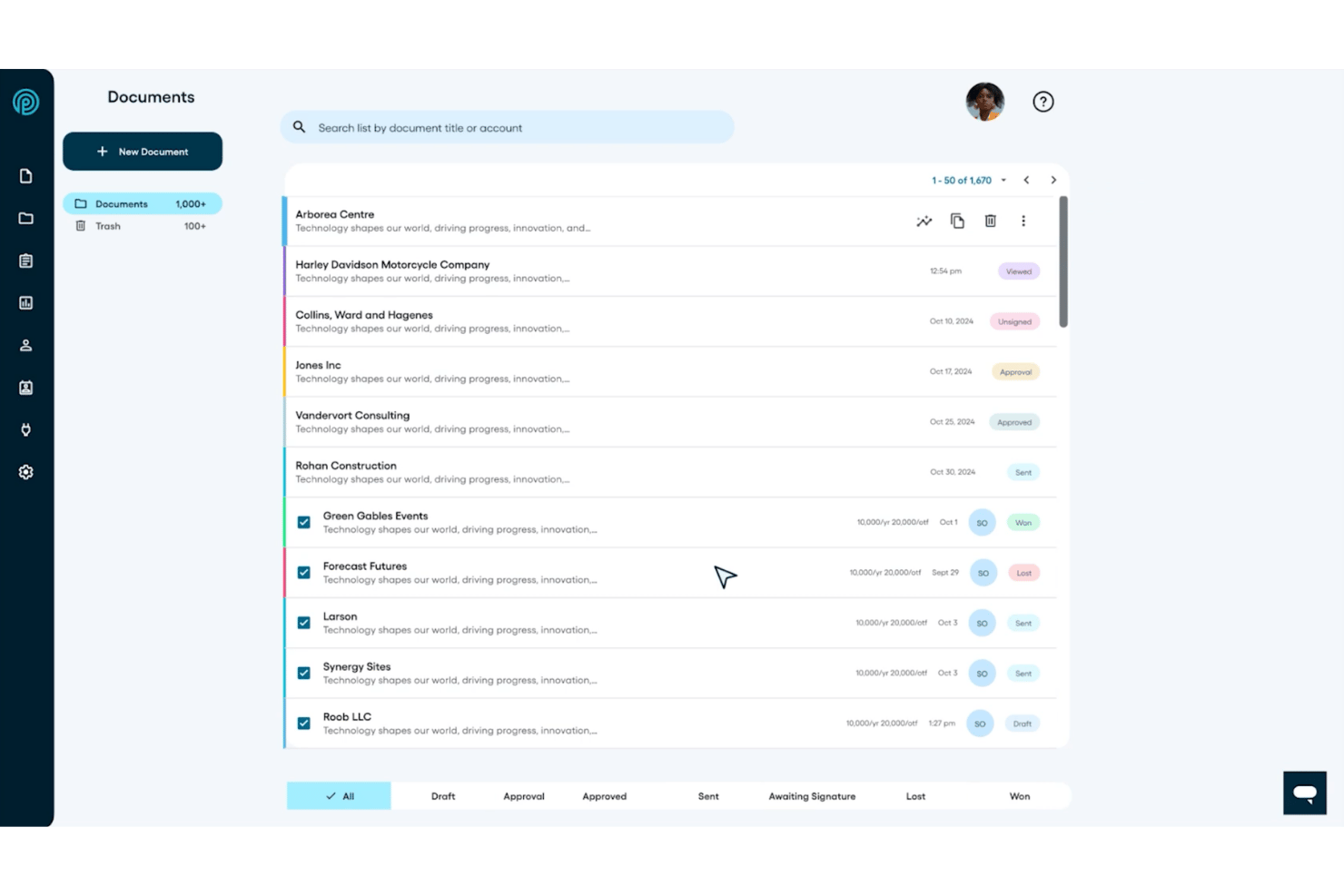
Proposify is a proposal and quoting platform with a drag-and-drop editor, interactive pricing tables, a reusable content library, e-signatures, approval workflows, and section-level engagement tracking.
Who Is Proposify Best For?
Proposify suits sales teams at agencies and professional services firms that send high proposal volumes and need brand-controlled, consistently structured documents.
Why I Picked Proposify
I picked Proposify because of the control it gives teams over reusable proposal content. Its content library stores approved case studies, team bios, pricing sections, and other reusable material, while roles and permissions let administrators control what users can edit. Custom roles, user groups, conditional approval workflows, API access, and multiple workspaces are Business-plan features.
Proposify Key Features
- Drag-and-drop proposal editor: Build and customize proposals using text, tables, images, and YouTube video embeds.
- Interactive pricing tables: Enable clients to select options and adjust quantities directly within a proposal.
- Section-level analytics: Track exactly how much time each recipient spends on every proposal section.
- Native e-signatures: Collect legally binding client signatures digitally on every proposal.
Proposify Integrations
Proposify offers direct integrations with HubSpot, Pipedrive, Zoho CRM, Microsoft Dynamics 365, QuickBooks, Stripe, Basecamp, Drift, FreshBooks, Gong, and Intercom. Salesforce and Aspire are premium integrations priced at an additional $9/user/month. Google Drive, Microsoft Teams, Asana, Slack, and many other apps connect through Zapier rather than through native Proposify integrations. Integration and automation features begin on Team, while API access requires Business.
Pros and Cons
Pros:
- Section-level analytics for recipient engagement
- Granular roles and editing permissions on Business
- Strong content library with reusable snippets
Cons:
- API access and conditional approvals require Business
- Basic plan is limited to 10 sends per month

Qwilr
Best for interactive web-based sales content
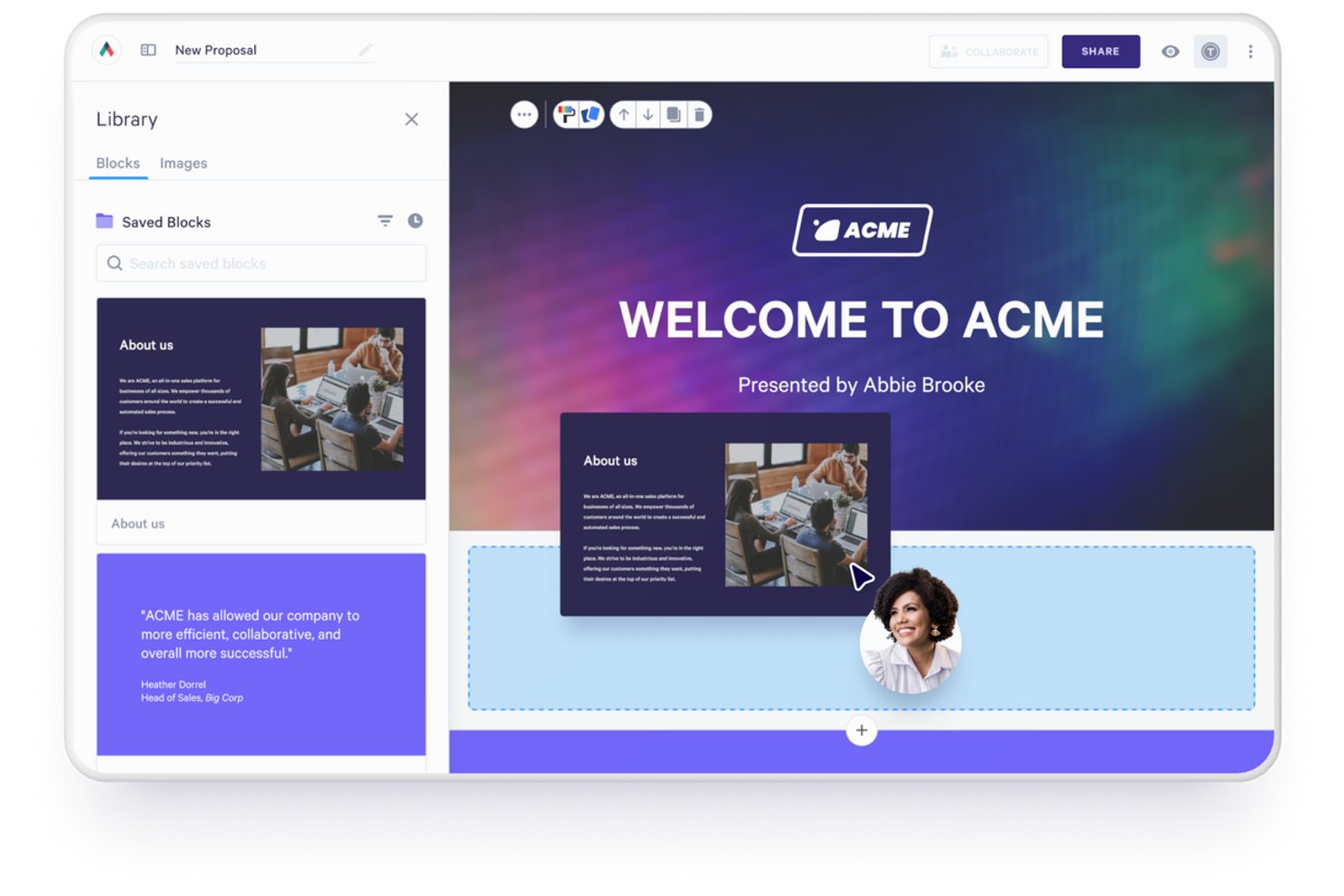
Qwilr is a proposal and quoting platform that lets sales teams build interactive, web-based proposal pages with embedded pricing tables, e-signatures, and payment collection in place of static PDF documents.
Who Is Qwilr Best For?
Qwilr is a strong fit for small-to-mid-market agencies and B2B service providers whose sales process centers on visually polished, client-facing proposals.
Why I Picked Qwilr
I picked Qwilr because it delivers proposals as interactive web pages rather than relying solely on static PDFs. Buyers can review options and adjust quantities in quote blocks, while page analytics show which content received attention. This gives sales teams more context for follow-up while keeping pricing, acceptance, and payment within the proposal experience.
Qwilr Key Features
- Drag-and-drop block editor: Build proposals from modular sections using an intuitive editor.
- Template and saved block library: Start quickly with reusable templates and content blocks for proposals and quotes.
- Native e-signature support: Secure client acceptance with legally binding e-signatures directly on pages.
- CRM and accounting integrations: Push and pull data from tools like HubSpot, Salesforce, QuickBooks, and Pipedrive.
Qwilr Integrations
Qwilr documents direct integrations with HubSpot, Salesforce, Zoho CRM, Pipedrive, Slack, Stripe, and QuickBooks Online. Zapier connects Qwilr with additional cloud apps. Starter includes HubSpot, Zoho CRM, and Pipedrive integrations; other integration and automation availability varies by plan. API access is available on every plan, but usage fees apply.
Pros and Cons
Pros:
- AI-supported template and proposal generation
- Section-level engagement analytics for proposals
- Interactive quote blocks with pricing logic
Cons:
- Automation and custom branding require Growth or above
- Growth and Scale require annual billing and seat minimums
PandaDoc
Best for flexible document automation
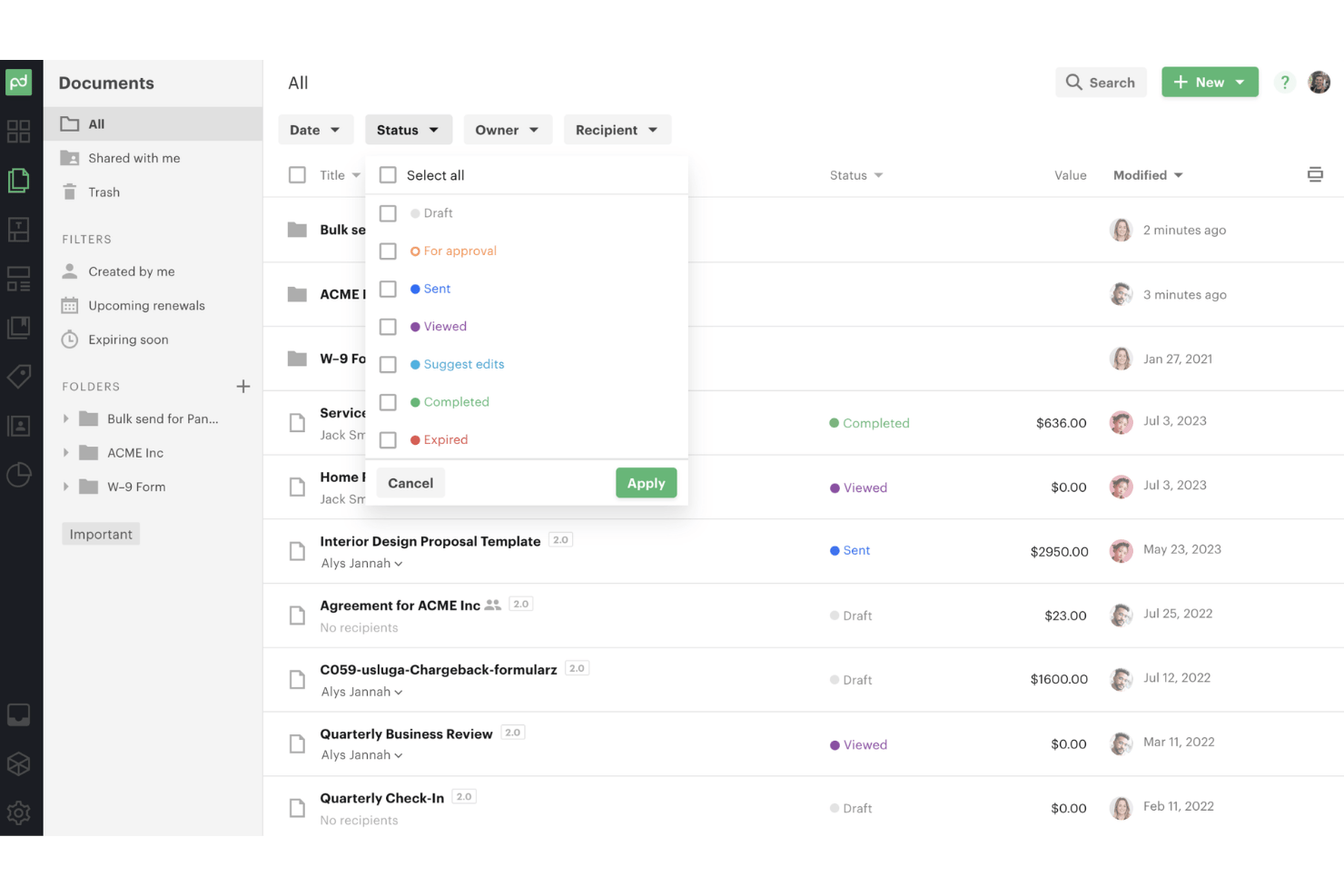
PandaDoc is a document automation platform that combines document building, pricing tables, e-signatures, and tracking in one editor. Approval workflows and CRM integrations are available on the Business plan, while CPQ, workflow automation, conditional smart content, SSO, and API access are Enterprise features or add-ons.
Who Is PandaDoc Best For?
PandaDoc is a strong fit for sales teams and client-facing roles at small to mid-sized businesses that send a high volume of proposals and contracts.
Why I Picked PandaDoc
I picked PandaDoc because its document automation extends beyond basic proposal building. Teams can restrict editing within templates while leaving selected sections open for customization, helping sales reps keep documents consistent. Conditional smart content can also insert different pricing, terms, or SOW content based on document data, although this functionality requires the Enterprise plan.
PandaDoc Key Features
- Interactive pricing tables: Let recipients select packages or adjust quantities directly within the proposal.
- Legally binding e-signatures: Collect secure, compliant electronic signatures on every plan.
- Approval workflows: Route proposals for internal review and signoff before sending to clients on the Business plan and above.
- Document analytics: Track when proposals are viewed, for how long, and by whom with real-time notifications.
PandaDoc Integrations
PandaDoc documents embedded integrations with HubSpot, Salesforce, Pipedrive, monday.com, Zoho CRM, Microsoft Dynamics 365, Slack, Google Docs, Dropbox, Stripe, PayPal, Square, QuickBooks Online, and other platforms. Salesforce and QuickBooks Online are marked as premium integrations, while API access is an Enterprise feature. Zapier and Make can be used as third-party integration platforms for additional automated workflows.
Pros and Cons
Pros:
- Built-in legally binding e-signature
- Advanced conditional logic for dynamic proposals
- Conditional smart content for dynamic proposals on Enterprise
Cons:
- CRM integrations and approval workflows require Business or above
- CPQ and conditional smart content require Enterprise

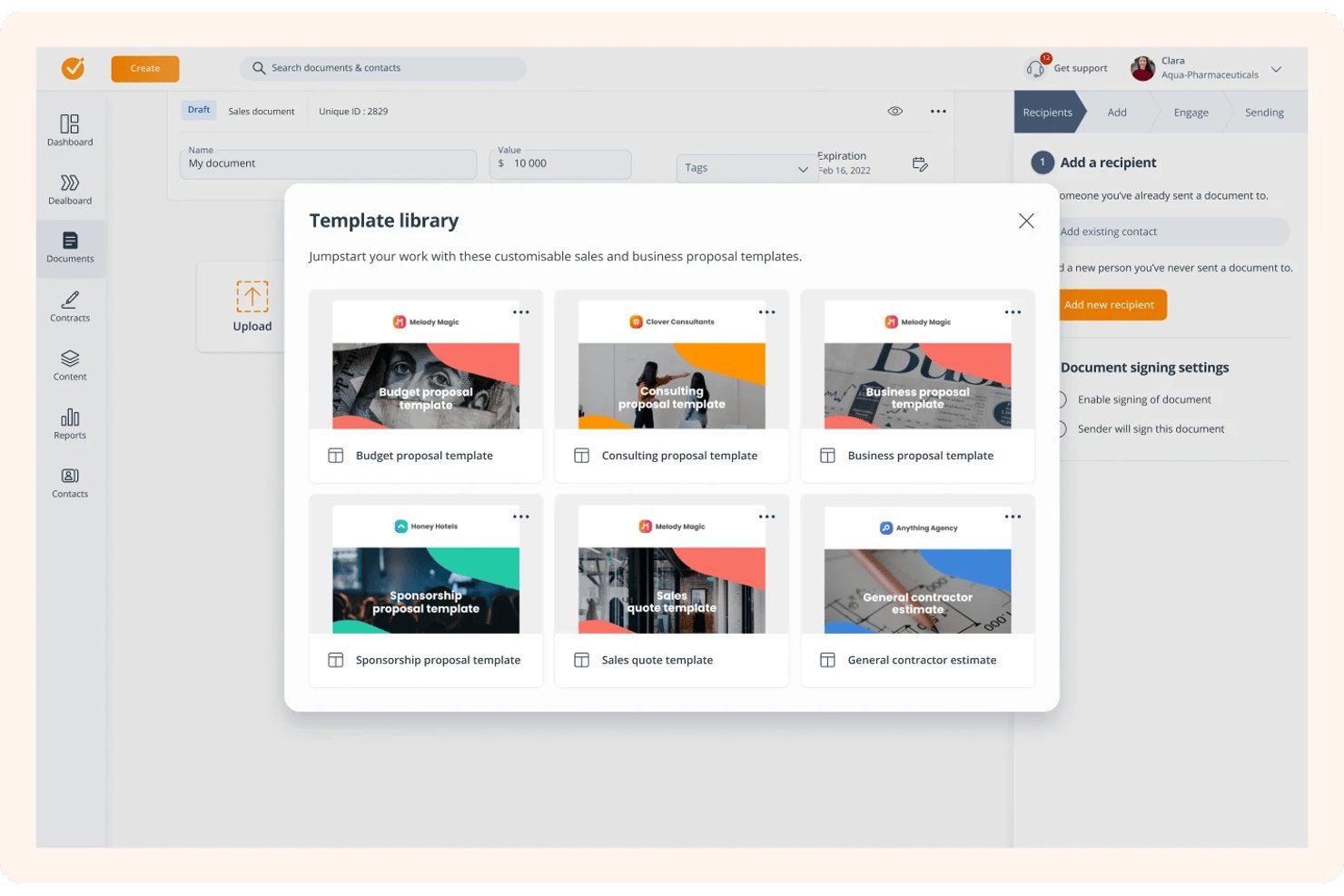
GetAccept combines proposal and contract creation, e-signatures, video introductions, buyer tracking, and digital sales rooms. Mutual action plans, full document editing, pricing tables, and advanced buyer engagement are Professional features, while CPQ, SSO, conditional content, and broader API access require Enterprise or an add-on.
Who Is GetAccept Best For?
It's a strong fit for B2B sales teams at mid-market companies who send high-touch, consultative proposals and need more than a static PDF to engage buyers.
Why I Picked GetAccept
I picked GetAccept because it combines proposal content with video introductions and detailed buyer-engagement data. Sellers can add video to documents or deal rooms, while analytics show page views, section engagement, participant activity, and signing events. Professional users also gain mutual action plans and a deal score for prioritizing follow-up.
GetAccept Key Features
- CPQ quote builder: Enterprise users can configure products and create quotes through GetAccept’s CPQ functionality.
- Mutual action plans: Collaborate on next steps and project timelines directly within the proposal workspace.
- Approval workflows: Route proposals and contracts through multi-step internal approval before client send-out.
- Content library and templates: Access reusable templates for proposals, contracts, and SOWs, including industry-specific formats.
- Contract management: Store signed documents, organize agreements, and set automated renewal reminders.
GetAccept Integrations
GetAccept documents integrations with Salesforce, HubSpot, Pipedrive, Microsoft Dynamics 365, SuperOffice, Lime CRM, Microsoft Teams, Zoom, Gong, Salesloft, Stripe, Chargebee, and Authorize.net. Salesforce is its documented native CRM integration, while many other CRM, payment, and workflow connections are offered as paid add-ons. GetAccept Automation is a separate iPaaS subscription with more than 500 connectors. Read and write API access is plan-dependent or sold as an add-on.
Pros and Cons
Pros:
- Supports mutual action plans and digital sales rooms
- Offers section-level engagement analytics
- Lets you add video walkthroughs to proposals
Cons:
- CPQ, SSO, and conditional content require Enterprise
- Professional requires five users and an annual payment
Other Quote and Proposal Software
Here are some additional quote and proposal software options that didn’t make it onto my shortlist, but are still worth checking out:


How I Evaluate Quote and Proposal Software
I evaluate every tool against baseline requirements—quote generation, approval workflows, and e-signature—then look for differentiators like buyer engagement analytics and CRM sync depth.
Core Functionality (Table Stakes for This List)
When I'm selecting tools for my list, I rank each one on a scale from 0 (does not offer the functionality) to 5 (excels in this area) for each core functionality listed below. Then, I calculate the tool's total score into a percentage. Each tool needs to achieve a minimum total score of 65% to be considered for inclusion.
- Quote Generation: I check whether you can build itemized quotes with line items, discounts, and tax logic—like quoting a multi-phase consulting engagement with different rates per deliverable.
- Proposal Building: Each tool should let you combine narrative sections, pricing tables, and scope of work into a branded document that's ready to send to a client.
- Templates & Content Library: I look for reusable templates and saved content blocks so your team isn't rebuilding the same SOW structure or pricing table from scratch on every deal.
- E-Signature & Acceptance: The platform needs built-in e-signature with an audit trail, so clients can formally accept a proposal without bouncing to a separate signing tool.
- Approval Workflows: Internal routing matters—I evaluate whether the tool supports multi-step review, like requiring a finance lead to sign off on quotes above a certain deal size before they go out.
- Client Tracking & Analytics: I look for visibility into proposal status, view timestamps, and engagement data so you know which sections a prospect spent time on and when to follow up.
Once I have a list of tools that meet the criteria, I consider what sets each platform apart.
Differentiating Factors (What Sets Vendors Apart)
Here's how I compare and contrast different vendors:
Standout Features
Interactive quoting lets buyers toggle add-ons or select packages right inside the proposal—useful when you're offering tiered service levels and want the client to self-configure. I also look at engagement analytics, like whether the tool shows which proposal sections a prospect spent time on, so you know where to focus your follow-up. AI-assisted drafting is another differentiator I evaluate, especially for teams sending high volumes of proposals that share common scope language.
Beyond Features
CRM integration depth matters—I check whether a tool offers bidirectional sync with platforms like Salesforce or HubSpot, or relies on Zapier for basic connections. Payment collection at the point of signature is another factor I evaluate, since tools that let clients pay a deposit when they accept a proposal cut days off your sales cycle and cash cycle. I also look at how pricing scales as your team grows, especially whether key features like approval workflows or API access are gated behind higher tiers.
How to Choose Quote and Proposal Software
As you compare software tools, focus on how each platform supports your actual sales process. A user-friendly quoting tool should help your team create quotes quickly while still giving administrators control over pricing rules, approval workflows, and branded quotes.
Match the Tool to Your Sales Process
First, consider whether the platform can support both your current sales cycle and future needs. For example, a simple proposal tool may work well for small businesses. However, CPQ software may be a better fit if you sell complex product packages, use dynamic pricing, or need structured product configurations.
Next, think about how the software will fit into your existing workflow. In particular, check whether its integrations support your CRM, payment provider, project management tools, and customer support systems.
Here’s a checklist to guide your comparison:
| Factor | What to Consider |
|---|---|
| Scalability | Will the platform support your team and deal volume if you double headcount or project load? Watch for extra costs that surface as you grow. |
| Integrations | Does it connect directly with your CRM, ERP, or billing systems—or will you need API work or third-party connectors like Zapier for your processes? |
| Customizability | Can you easily tailor templates, workflows, and branding to match your firm’s process, or will you hit walls and workarounds? |
| Ease of use | How quickly can team members build, send, and track proposals without constant support or extensive training? Try to demo with typical users, not just admins. |
| Implementation and onboarding | What onboarding is offered—templates, migration, training? Will you need dedicated support to get live, or can you handle setup in-house? |
| Cost | How does pricing evolve for users, documents, and premium features? Look for unexpected charges on integrations or e-signatures as you scale. |
| Security safeguards | Are permissions, audit logs, and certifications like SOC 2 or GDPR compliance in place—especially if client data or contracts are involved? |
| Support availability | Is support live and responsive during the hours your team works, or will technical issues delay your sales and project launches? |
What Is Quote and Proposal Software?
Quoting software—sometimes called sales quote software or quotation software—is a cloud-based software solution for creating, sending, and managing price quotes, sales proposals, and contracts. It helps teams create customized quotes with itemized pricing, scope, terms, and optional services, then route them through an approval process before requesting electronic signatures.
Unlike a basic document editor, quoting software can support quote templates, pricing rules, product configurations, and approval workflows. This makes it easier to create on-brand sales documents, reduce manual errors, and move accepted work into your sales pipeline, billing workflow, or project management system.
Features
Here are the core features any great quote and proposal software should have:
- Quote creation and quote templates: Create professional quotes from reusable layouts, service libraries, and branded quote templates.
- Product configurations and pricing rules: Configure complex product options, bundles, quantities, discounts, and dynamic pricing without rebuilding each price quote manually.
- Approval workflows: Set up an approval process for discounts, margin thresholds, complex product configurations, or non-standard terms.
- Interactive pricing: Let buyers select optional services, add-ons, or an upsell inside the proposal to create more accurate quotes.
- E-signature functionality: Collect electronic signatures and keep an auditable record of acceptance.
- Sales pipeline visibility: Connect proposal activity to your CRM so salespeople can follow up at the right time.
- Customer experience and branding: Deliver customized quotes, polished layouts, and on-brand sales documents that make the buying process feel more professional.
Common Quote and Proposal Software AI Features
Beyond the standard quote and proposal software features listed above, many of these solutions are incorporating AI with features like:
- AI-assisted drafting: Automatically generate proposal content, scope descriptions, or pricing explanations based on past winning proposals and client data.
- Smart content recommendations: Suggest relevant case studies, legal clauses, or pricing tables to include in your proposal based on deal type or client industry.
- Predictive deal scoring: Analyze proposal data and client engagement to forecast the likelihood of winning a deal, helping prioritize follow-up efforts.
- Automated response to RFPs: Use AI to match requirements from RFP documents with your content library, auto-filling answers and highlighting gaps for review.
- Dynamic personalization: Tailor proposal language, visuals, and pricing suggestions in real time based on client profile, preferences, or previous interactions.
Benefits
Implementing quote and proposal software provides several benefits for your team and your business. Here are a few you can look forward to:
- Faster proposal turnaround: Built-in templates and content libraries let you generate branded proposals quickly, even for complex projects.
- Improved quote accuracy: Itemized quoting, approval workflows, and guided pricing reduce errors and ensure consistent scope and rate structures.
- Streamlined sign-off process: Integrated e-signature and digital acceptance workflows eliminate delays from manual signatures and scattered approvals.
- Greater visibility into deals: Engagement tracking and analytics help you monitor proposal status, client interest, and bottlenecks at every stage.
- Professional client experience: Custom branding, interactive quote features, and digital delivery make your proposals stand out and support modern buying journeys.
- Simplified project handoff: Automatic status updates and integrations with CRM or billing tools ensure accepted proposals move directly into delivery or invoicing.
- Enhanced security and compliance: User permissions, audit trails, and built-in safeguards protect sensitive client and contract data throughout your workflow.
Costs and Pricing
Selecting quote and proposal software requires an understanding of the various pricing models and plans available. Costs vary based on features, team size, add-ons, and more. The table below summarizes common plans, their average prices, and typical features included in quote and proposal software solutions:
Plan Comparison Table for Quote and Proposal Software
| Plan Type | Average Price | Common Features |
|---|---|---|
| Free Plan | $0 | Basic quote and proposal creation, limited templates, single user access, and basic e-signature. |
| Personal Plan | $10-$25/user/month | All free features, more templates, limited content library, simple analytics, and basic integrations. |
| Business Plan | $30-$65/user/month | Team collaboration, advanced templates, approval workflows, CRM integrations, engagement analytics, and custom branding. |
| Enterprise Plan | $75-$150/user/month | SSO/SAML, advanced security, API access, custom onboarding, dedicated support, and custom contract or compliance features. |
FAQs
Here are some answers to common questions about quote and proposal software:
Can quote and proposal software integrate with my CRM?
Yes, most solutions offer direct integrations with popular CRMs like Salesforce, HubSpot, or Pipedrive. This helps you pull contact and deal data directly into your proposals and automatically update your pipeline as deals progress.
How secure is quote and proposal software for sensitive contracts?
Leading platforms offer features like SOC 2 certification, granular user permissions, audit trails, and data encryption. This makes them suitable for handling confidential client information and supporting compliance requirements.
Is it possible to automate follow-ups or reminders after sending a proposal?
Yes, many tools let you set up automatic reminders and notifications to prompt clients to review, sign, or accept proposals, helping you keep deals moving without manual tracking.
What happens if we need to manage complex approvals for proposals?
Most business and enterprise plans support multi-step approval workflows. You can assign approvers based on deal value, product type, or role, ensuring every proposal gets the right sign-off before it reaches the client.
Will my team need special training to use this software?
No, most modern quote and proposal platforms emphasize ease of use, with onboarding tutorials, template libraries, and in-app guides, so your team can get started with minimal ramp-up time.