

18 Best Project Planning Courses to Upskill in 2026


Finding the right project planning courses means looking past the syllabus to what actually sharpens your execution. I sifted through the options so you can identify training that fits your role, your gaps, and how you work—whether you're tightening scope management or building stronger delivery habits across cross-functional teams.
DPM School Spotlights
Mastering Digital Project Management & AI - DPM School
Best for: Project managers building practical timelines
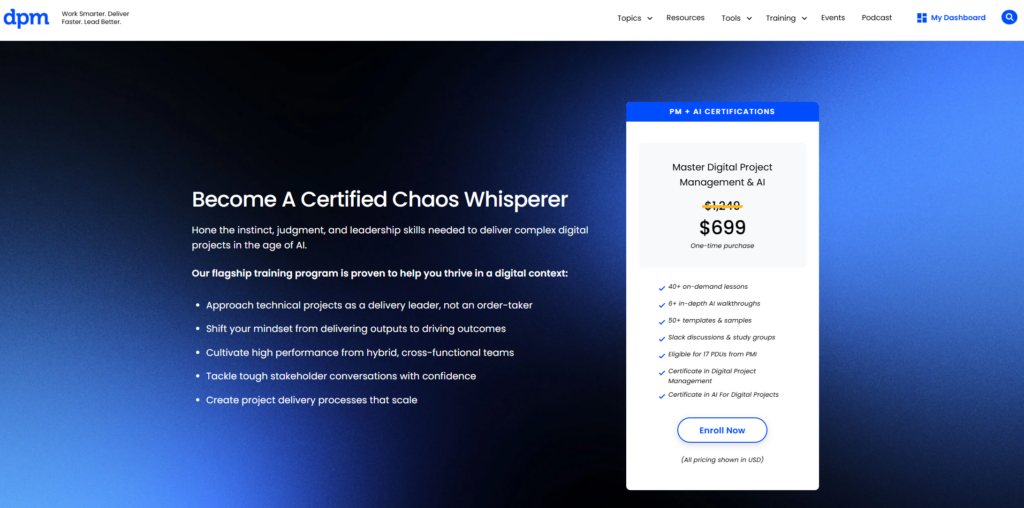
Our DPM School combined program is built for professionals who want structured training in planning and AI-augmented delivery. The bundled AI companion course and 50+ templates give it a practical, applied edge.
What you’ll learn: Build realistic project schedules, apply resourcing and estimation techniques, manage risk and stakeholder communication, and use prompt engineering and AI tools to support digital project delivery.
Course details:
- Format: 100% online, self-paced; optional live study sessions and Slack community included
- Duration: 40+ on-demand lessons plus 6+ AI walkthroughs; one-year access from enrollment
- Level/prerequisites: Intermediate; designed for working professionals in digital project roles
- Price: $699 USD, one-time per learner
- Assessment: Graded assignments with passing thresholds required throughout
- Certificate/credits: Two Accredible certificates (Digital Project Management and AI for Digital Projects); 17 PMI PDUs (12 core, 5 AI companion)
Other DPM School Courses
Our mini courses cover focused skills that support project planning, from building plans to estimating work and costs. Each includes an on-demand video lesson and downloadable resources. They’re available individually or with paid DPM membership, and an optional quiz-based DPM microcredential is available after completing a course.
| Mini course | Best for | Learning outcomes | Price |
|---|---|---|---|
| Master Project Plans | Project managers building practical timelines | When to use a project plan, create detailed timelines, optimize plans, and how to address common planning challenges. | $49 USD |
| Master Project Estimates | Digital project budgeting and estimates | Choose estimation methods; create estimates and budgets; optimize costs; compare pricing models | $49 USD |
The 18 Best Project Planning Courses
Below are my summaries of the best project planning courses. My reviews offer a look at each course's learning objectives, best fits, cost, and more.
1. Project Planning: Putting It All Together - Google
Best for: Beginners learning end-to-end project planning for free


Project Planning: Putting It All Together is the third course in the Google Project Management Professional Certificate on Coursera. It covers the full planning phase in one place—schedules, budgets, risk, and communication—making it a strong starting point if you're new to structured project delivery.
What you'll learn: Build project schedules and set milestones; create and track budgets; manage procurement; identify risks; and develop communication plans.
Course details:
- Format: Self-paced online; video lessons, readings, and assignments
- Duration: Approximately 21 hours of content; 5 modules
- Level/prerequisites: Beginner; no prerequisites required
- Price: Free to audit; certificate requires a Coursera subscription (approximately $49–$59/month) or one-time purchase; financial aid available
- Certificate/credits: Shareable Coursera completion certificate with paid enrollment; part of the Google Project Management Professional Certificate; education hours applicable toward PMI credentials, including CAPM®
Considerations: The certificate is only available with a paid Coursera enrollment, so if you audit the course for free, you won't receive a credential or access to graded assignments.
For more specific PM courses, try this list of training courses in digital project management.
2. Fundamentals of Project Planning and Management - University of Virginia
Best for: Beginners learning planning fundamentals from a university

The University of Virginia's Darden School of Business delivers this beginner course on Coursera. It blends academic grounding with real-world case studies and tool tutorials, covering scheduling, risk, and execution tracking in roughly nine hours.
What you'll learn: Define project scope and dependencies, build schedules using critical-path analysis, manage schedule and cost risk, track execution with earned value management, and apply Agile and Kanban approaches.
Course details:
- Format: Self-paced online; video lessons, readings, assignments, and discussion prompts
- Duration: Approximately 9 hours of content across 4 modules; flexible schedule
- Level/prerequisites: Beginner; no prerequisites required
- Price: Free to audit; certificate requires a Coursera subscription (approximately $49–$59/month) or one-time purchase; financial aid available
- Certificate/credits: Shareable Coursera completion certificate with paid enrollment; no PDUs or professional credits advertised for this standalone course
Considerations: No professional development credits such as PDUs are advertised for this course, so if you need documented credit hours for a certification renewal, you'll want to verify eligibility before enrolling.
3. Initiating and Planning Projects - University of California, Irvine
Best for: Beginners earning PMI contact hours in planning basics

"Initiating and Planning Projects" is a short, beginner course from UC Irvine's Division of Continuing Education, taught by a PMP-certified instructor. It focuses on the foundational planning artifacts every project starts with: stakeholder analysis, project charters, scope statements, and work breakdown structures.
What you'll learn: Identify stakeholders and their information needs, develop a project charter, write scope statements, build a work breakdown structure, and recognize common sources of project conflict.
Course details:
- Format: Self-paced online; video lessons, readings, and graded assignments
- Duration: Approximately 5 hours across 6 modules; flexible schedule
- Level/prerequisites: Beginner; no prerequisites required
- Price: Free to audit; certificate requires a Coursera subscription (approximately $49–$59/month) or one-time purchase; financial aid available
- Assessment: Graded assignments, including AI-graded assignments
- Certificate/credits: Shareable Coursera completion certificate with paid enrollment; part of a four-course specialization qualifying for 35 PMI contact hours and 35 PDUs upon full completion
Considerations: The 35 PMI contact hours and PDUs apply only when you complete the full four-course specialization, so if PMI credential eligibility is your goal, factor in the time and cost of all four courses before enrolling.

4. Project Management and Planning Specialization - Johns Hopkins University
Best for: Experienced team leads transitioning into PM roles

Johns Hopkins University's three-course specialization on Coursera covers the full project lifecycle, from WBS creation and critical-path scheduling through execution control and leadership. It goes deeper than most beginner offerings, with real-world case studies and Microsoft Project tutorials built into the curriculum.
What you'll learn: Build a WBS and SOW, apply critical-path scheduling and Earned Value Management, manage risk and quality, plan communications, and lead Agile and multi-project environments.
Course details:
- Format: Self-paced online; video lessons, readings, case studies, and graded assignments
- Duration: Approximately 48 hours across 3 courses; Coursera estimates roughly 3 months at 5 hours per week
- Level/prerequisites: Intermediate; no formal prerequisites stated, but some work experience is recommended
- Price: Price not published; included with Coursera Plus; individual course audit may be available; financial aid may apply
- Certificate/credits: Shareable Coursera specialization certificate upon completing all three courses; no PDUs or PMI contact hours advertised
Considerations: No PDUs or PMI contact hours are advertised for this specialization, so if you need documented professional credits toward a certification, verify eligibility before committing to all three courses.
5. Planning & Scheduling: Be the Professional from Scratch - Udemy
Best for: Engineers pursuing PSP or PMI-SP certification
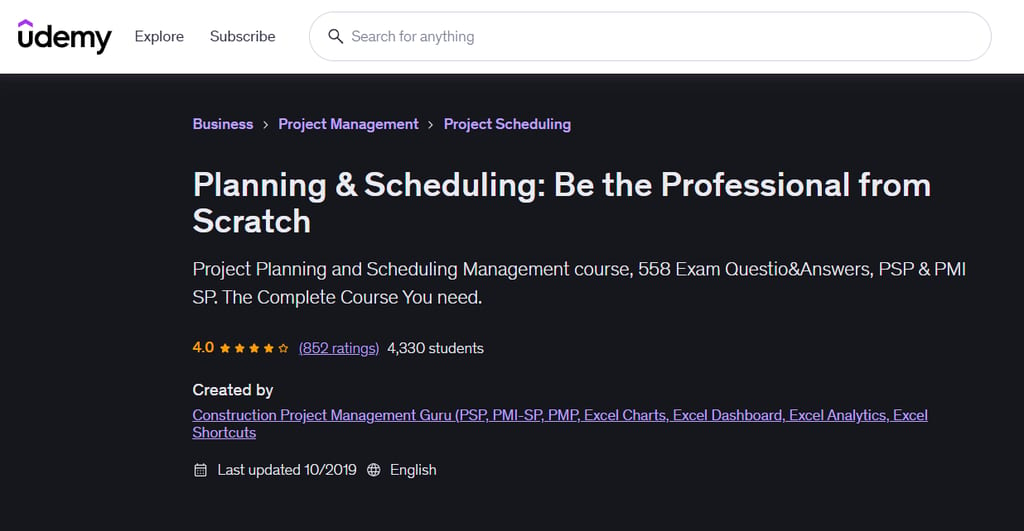
"Planning & Scheduling: Be the Professional from Scratch" is a Udemy course taught by a PSP-, PMI-SP-, and PMP-credentialed instructor. It focuses on scheduling theory and mechanics—CPM, float analysis, resource leveling, and schedule compression—not just software demos, and includes 558 practice exam questions for AACE PSP and PMI-SP prep.
What you'll learn: Build activity sequences using CPM and PDM, calculate float types, apply resource leveling and schedule compression techniques, and practice 558 exam-style questions targeting the AACE PSP and PMI-SP certifications.
Course details:
- Format: Self-paced online (Udemy); on-demand video, practice tests, assignments, and downloadable resources
- Duration: Approximately 16 hours of video across 204 lectures; lifetime access
- Level/prerequisites: Beginner to intermediate; no formal prerequisites stated
- Price: $27.99 USD for lifetime access; 30-day money-back guarantee
- Assessment: Two practice tests and graded assignments
- Certificate/credits: Udemy certificate of completion; no PDUs or CEUs awarded by the platform; course prepares learners for the external AACE PSP and PMI-SP exams, which must be pursued separately
Considerations: Most examples draw from construction and engineering projects, so if you work in tech or digital environments, you'll need to translate some of the practical context yourself.
Find more project scheduling courses here, and more certifications on project scheduling here.
6. Project Planning and Controlling - Simon Fraser University
Best for: Project managers earning PDUs toward PMP or CAPM

Simon Fraser University's PMC210 is an instructor-led course from a PMI Authorized Training Partner. It blends weekly live virtual sessions with self-paced work, giving you the structure of a classroom course alongside scheduling flexibility—and it awards 20 PDUs you can apply directly toward CAPM or PMP requirements.
What you'll learn: Build a WBS with activity dependencies, apply CPM to identify critical paths, develop an integrated project management plan, allocate resources, create a project budget, and use Earned Value Analysis to monitor and control project performance.
Course details:
- Format: Online; hybrid of self-paced coursework and three live virtual evening sessions (3 hours each)
- Duration: 3 weeks at 6–10 hours per week; final assignment due one week after the course ends
- Level/prerequisites: Prerequisites not specified; PMBOK® Guide, 8th edition required as textbook
- Price: CAD $865 per learner; required textbook sold separately
- Assessment: Assignments, quizzes, self-assessments, and participation in live virtual classes; evaluated Pass/Fail
- Certificate/credits: 20 PMI PDUs applicable toward CAPM® or PMP® designation; course counts toward SFU's Project Management certificate program
Considerations: The live sessions run weekday evenings on Pacific time, so if you're outside that time zone, check the schedule before enrolling to confirm the hours work for you.
7. Certificate of Project Planning and Scheduling - Australian Online Courses
Best for: Beginners building scheduling skills without prerequisites

Australian Online Courses' Certificate of Project Planning and Scheduling is a self-paced course with no prerequisites and no exams. It walks you through planning and scheduling fundamentals—WBS, CPM, schedule compression, agile scheduling—with tutor support included and 12 months to finish at your own pace.
What you'll learn: Build a WBS and network diagrams, apply CPM and the Critical Chain Method, use schedule compression techniques, and monitor progress using variance analysis tools.
Course details:
- Format: Self-paced online; written assessments evaluated by tutors
- Duration: Approximately 30 study hours; 12 months' access from enrolment
- Level/prerequisites: Beginner; no prerequisites stated
- Price: AUD $299 per learner; payment plans available for Australian residents
- Assessment: Written assessments including short answers, reflective tasks, and reports or projects
- Certificate/credits: Certificate of Attainment and Statement of Results upon completion; no PDUs or professional credits awarded
Considerations: The provider is not accredited by PMI, AACE, or other professional bodies, so this course won't count toward certification requirements like PMP or PSP—it's a standalone credential only.
For more courses on managing your time, try this list of training courses on time management or this list of productivity courses.
8. Project Planning and Control - University of Aberdeen
Best for: Practitioners earning credit toward an APM-accredited MSc

University of Aberdeen's Project Planning and Control runs at Masters level (SCQF Level 11) and earns 15 credits toward the university's APM-accredited MSc in Project Management. Assessments are tied to your own professional context, so the coursework connects directly to the projects you're already managing.
What you'll learn: Develop project schedules, budgets, and resource plans; apply CPM, resource levelling, and fast-tracking; monitor cost, schedule, and performance during execution; and report progress to stakeholders.
Course details:
- Format: Fully online via MyAberdeen; self-paced with tutor contact and discussion boards
- Duration: Approximately 150 study hours; roughly 10–15 hours per week; cohort-based with fixed start dates
- Level/prerequisites: Masters level (SCQF Level 11); no formal qualifications required to enrol
- Price: £1,395 per learner (GBP); a 20% alumni discount is available
- Assessment: Continual online assessment throughout the course; no final exam
- Certificate/credits: 15 credits at SCQF Level 11, applicable toward the University of Aberdeen's APM-accredited MSc in Project Management
Considerations: This course runs in scheduled cohorts rather than on-demand—the next listed start date is January 2027, so check current availability before planning your enrolment.
9. Project Planning and Control - Robert Gordon University
Best for: Built-environment professionals earning SCQF credits toward an MSc
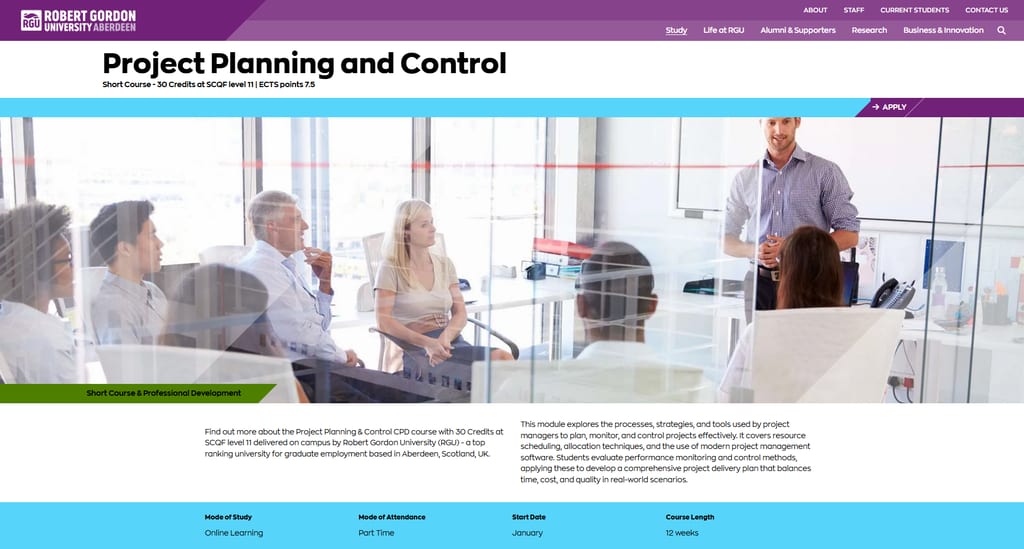
Robert Gordon University's Project Planning and Control is a Masters-level course built for construction and built-environment professionals. It earns 30 SCQF Level 11 credits toward RGU's RICS- and CIOB-accredited MSc in Construction Project Management, making it one of the heavier-credit short courses in this list.
What you'll learn: Define project scope and create a WBS, estimate time and cost, develop schedules and resource plans, apply earned value analysis, and manage change control throughout delivery.
Course details:
- Format: Fully online via RGU's Moodle platform; part-time; includes lectures, workshops, software demonstrations, and case studies
- Duration: 12 weeks; January intake; applications close one week before the module starts
- Level/prerequisites: Masters level (SCQF Level 11); relevant industry experience and/or a good honours degree required; IELTS 6.5 for non-native English speakers
- Price: £1,010 GBP per learner (2025/26 rate); 2026/27 fees to be confirmed
- Assessment: Portfolio assessment
- Certificate/credits: 30 credits at SCQF Level 11 (7.5 ECTS), applicable toward RGU's RICS- and CIOB-accredited MSc in Construction Project Management
Considerations: The course is oriented toward construction and built-environment project delivery—including 4D BIM concepts—so it's a strong fit for that sector but less directly applicable if you work outside it.
10. Google Project Management Professional Certificate - Google
Best for: Beginners logging hours toward CAPM® eligibility

Google's Project Management Professional Certificate is a 7-course program hosted on Coursera. It's built for career changers with no prior experience, and its PMI partnership means every hour you log counts toward CAPM® eligibility—a practical reason to start here if certification is on your roadmap.
What you'll learn: Build project plans, schedules, budgets, and risk registers; manage stakeholder communications; apply Agile and Scrum; and use AI tools for project documentation and risk identification.
Course details:
- Format: Fully online, self-paced; video lectures, practice assessments, and a capstone project
- Duration: Approximately 6 months at 10 hours per week; 140+ hours total
- Level/prerequisites: Beginner; no degree or prior experience required
- Price: $49/month USD after a 7-day free trial; most learners finish for under $300; financial aid available
- Assessment: Practice-based assessments and a capstone project throughout
- Certificate/credits: Google professional certificate with Credly badge; qualifies for 100+ PMI education hours toward CAPM®; up to 9 ACE-recommended college credits or 6 ECTS credits
Considerations: Your certificate access is tied to an active Coursera subscription—if you pause payments before completing the program, you'll lose access to course materials.
For more on managing documentation, try these document management courses.
11. Project Planning and Control - Zoe Talent Solutions
Best for: Corporate teams needing in-person, global delivery options

Zoe Talent Solutions' Project Planning and Control is an instructor-led course available live online or in person at 47+ classroom venues across five continents. Content is customized before each session to suit the audience, which makes it a strong fit for corporate teams that need coordinated, location-flexible delivery.
What you'll learn: Build a project plan using WBS, PERT charts, Gantt charts, and critical path analysis; apply scope, schedule, budget, and risk planning; and manage change control, cost control, and performance reporting.
Course details:
- Format: Instructor-led; live online or in-person at 47+ global venues; customized in-house training available
- Duration: 5 or 10 days; classroom sessions run ~7 hours/day; live online sessions run ~3 hours/day
- Level/prerequisites: Prerequisites not specified; suitable for project coordinators through senior management
- Price: Live online 5-day from $3,785 USD per learner; classroom 5-day from ~$5,775–$6,305 USD depending on venue; fee includes materials, meals, and certificate
- Certificate/credits: Certificate of completion from Zoe Talent Solutions; provider is KHDA-approved; courses are aligned with PMI and CPD standards; no specific PDUs are advertised for this course
Considerations: No specific PDUs are advertised for this course, so if you're tracking hours toward a PMI certification, verify eligibility with the provider before enrolling.
12. Improving Your Project Management Skills: The Basics for Success - AMA
Best for: Project managers earning PDUs across multiple credentials

AMA's best-selling project management seminar earns 18 PMI PDUs alongside credits from NASBA, SHRM, HRCI, and IACET in a single 3-day program. That breadth of accreditation is rare, and it makes this course worth considering if you're tracking renewal hours across multiple credentials at once.
What you'll learn: Build a WBS, calculate critical path and float, develop Gantt schedules, create risk response plans, and establish project baselines using PERT estimates and network diagrams.
Course details:
- Format: Instructor-led; in person at 8+ U.S. cities or live online; in-house delivery available
- Duration: 3 days / 21 hours; a 4-day live online option spreads sessions across shorter daily blocks
- Level/prerequisites: Beginner; no prerequisites or advance preparation required
- Price: $2,895 USD per learner (non-members); $2,595 USD (AMA members)
- Certificate/credits: 18 PMI PDUs, 1.8 IACET CEUs, 21 NASBA CPE hours, 18 SHRM PDCs, and 18 HRCI credits (PHR/SPHR pre-approved)
Considerations: The curriculum covers only a predictive (Waterfall) methodology, so if your team uses Agile or hybrid delivery, the approach won't reflect how you work.
13. Project Management Foundations - LinkedIn Learning
Best for: Beginners learning PM fundamentals while earning PDUs

Project Management Foundations is a self-paced LinkedIn Learning course taught by Bonnie Biafore. Over 1.4 million learners have taken it, and its 4.8/5 rating reflects how well it delivers PM fundamentals. It also covers PMBOK® Guide Seventh Edition content and qualifies for PMI PDUs.
What you'll learn: Build a WBS, sequence tasks using network diagrams, calculate critical path and float, develop a project schedule and budget, and create risk and communication plans.
Course details:
- Format: Self-paced online; video lectures with exercise files, quizzes, and downloadable resources
- Duration: ~4 hours of video content; accessible while subscription is active
- Level/prerequisites: Beginner; no prerequisites required
- Price: Included with LinkedIn Learning subscription from $39.99/month or $239.88/year USD
- Assessment: 10 chapter quizzes
- Certificate/credits: LinkedIn Learning certificate of completion (shareable to LinkedIn profile); qualifies for PMI PDUs as a PMI Authorized Training Partner (PDU count not published on the course page); part of the Career Essentials in Project Management Professional Certificate by Microsoft
Considerations: Course access is tied to an active LinkedIn Learning subscription, so if you cancel before completing it, you'll lose access to both the content and your progress.
14. Kickoff - PMI
Best for: Accidental PMs who need a free, no-risk PM intro

Kickoff is a free, self-paced course built by PMI. It covers both Waterfall and Agile project management in under an hour, with downloadable planning templates you can apply to a real project right away. If you're not sure where to start, this is a genuinely low-risk first step.
What you'll learn: Define project objectives and stakeholder needs, plan scope and schedule using the predictive track, and apply Agile concepts including user stories, story points, and burn-down charts.
Course details:
- Format: Self-paced online; interactive lessons, drag-and-drop activities, and downloadable templates
- Duration: ~45 minutes per track; both Agile and Predictive tracks take roughly 1.5 hours total
- Level/prerequisites: Beginner; no prerequisites required
- Price: Free; requires a free PMI account
- Certificate/credits: Shareable PMI digital badge per completed track; no PDUs or continuing education credits awarded
Considerations: The badges don't carry PDUs or formal continuing education credits, so if you need documented hours for a credential renewal, this course won't count toward that requirement.
15. Introduction to Project Management - Adelaide University via edX
Best for: Beginners wanting free university-level PM foundations

Introduction to Project Management is a beginner course from Adelaide University, delivered on edX. Over 530,000 learners have taken it, and you can audit the full content for free—making it one of the most accessible university-backed PM courses available.
What you'll learn: Initiate a project and plan its scope, schedule, and cost; identify and respond to risks; build stakeholder communication plans; and measure project success against defined objectives.
Course details:
- Format: Self-paced online; video lectures, scenario-based activities, and discussion questions
- Duration: 6 weeks; 2–3 hours per week (~12–18 hours total)
- Level/prerequisites: Beginner; no prior experience required
- Price: Free to audit; $149 USD for a verified certificate
- Assessment: End-of-week quizzes each module
- Certificate/credits: edX Verified Certificate from Adelaide University; counts toward the "Fundamentals of Project Management" Professional Certificate on edX when paired with the companion risk management course
Considerations: The course doesn't award PDUs or continuing education credits, so it won't count toward PMP renewal or similar credential maintenance requirements.
16. Project Management Masterclass: Beginner to Project Manager - Udemy
Best for: New PMs who need depth in both Waterfall and Agile planning

Project Management Masterclass, created by Mind Stack on Udemy, covers both Waterfall and Agile planning across 20+ hours of content. Each section closes with a mini-lab where you apply the concepts to a practice project, building real planning artifacts from scope through risk.
What you'll learn: Build a work breakdown structure, develop schedule and cost baselines using critical path and earned value methods, create risk registers with response strategies, and apply Agile/Scrum sprint planning.
Course details:
- Format: Self-paced online; on-demand video lectures, mini-labs, and 48 downloadable resources
- Duration: 20.5 hours of on-demand video; 186 lectures across 17 sections
- Level/prerequisites: Beginner; no prior project management experience required
- Price: $19.99 USD for lifetime access; Udemy courses are subject to frequent site-wide promotions; also available via Udemy Personal Plan subscription
- Certificate/credits: Udemy certificate of completion; no PDUs or continuing education credits awarded
Considerations: Udemy doesn't publish a fixed price for this course—the amount you pay depends on when you enroll, as the cost varies with frequent site-wide promotions.
17. Introduction to Project Management Training - Learning Tree
Best for: Professionals who need PDUs from instructor-led PM training

Learning Tree's Introduction to Project Management Training is an instructor-led course that walks you through the full project lifecycle using a simulated case study. It earns 11 PMI PDUs and 11 NASBA CPE credits, which makes it one of the few beginner-level options that directly supports credential maintenance.
What you'll learn: Develop a WBS and network diagram, build a risk register with response strategies, create stakeholder communication plans, and establish a project baseline with change control processes.
Course details:
- Format: Live instructor-led; in-person at multiple U.S. and Canadian cities, or virtual attendance for every scheduled session
- Duration: 2 days; an on-demand self-paced version (Course 7296) offers 4+ hours of content with 12-month access
- Level/prerequisites: Foundation/Beginner; no prior project management experience required
- Price: $2,050 USD per learner for the live course; $495 USD for the on-demand version
- Assessment: End-of-course exam included with the live course
- Certificate/credits: 11 PMI PDUs (Ways of Working: 8, Power Skills: 2, Business Acumen: 1); 11 NASBA CPE credits (live, in-class only); post-course one-on-one instructor coaching included
Considerations: The NASBA CPE credits apply only to the live in-person format, so virtual attendees won't earn them—worth confirming before you register if CPE credits factor into your decision.
18. Getting Started as a Project Manager - LinkedIn Learning
Best for: Aspiring PMs who want LinkedIn-visible planning credentials

Getting Started as a Project Manager is a LinkedIn Learning path made up of 8 courses totaling about 11 hours. Rather than covering everything in one sitting, it breaks project management into focused modules—schedules, budgets, requirements, communication—so you can work through the full path or zero in on the planning areas where you need the most development.
What you'll learn: Build and manage a project schedule using critical path concepts, develop a WBS-based budget, write a communication plan, and apply a structured requirements management process.
Course details:
- Format: Self-paced online; on-demand video across 8 sequential courses
- Duration: Approximately 11 hours of total content; individual courses range from 28 minutes to 4 hours
- Level/prerequisites: Beginner; no prior project management experience required
- Price: Requires a LinkedIn Learning subscription; $39.99/month or $239.88/year; one-month free trial available for new subscribers
- Certificate/credits: LinkedIn Learning certificate of completion, displayable as a badge on your LinkedIn profile; individual courses may qualify for PMI PDUs
Considerations: Access to the path depends on maintaining an active LinkedIn Learning subscription, so your certificate and course access lapse if you cancel.
How to Choose a Project Planning Course
Start by identifying the specific planning gap you need to close. Whether that's scheduling, risk management, stakeholder communication, or cost baselining, the right course is one that directly addresses that gap rather than covering it briefly as part of a broader survey.
- Match the curriculum to your actual job tasks. Scan the module list for the artifacts you need to build: WBS, risk register, network diagram, project baseline. A course that names those outputs explicitly will serve you better than one that describes them in general terms.
- Check the format against your schedule. A 2-day instructor-led course demands two consecutive focused days; a 20-hour self-paced course may take weeks depending on your availability. Neither is inherently better—the right one fits how you actually work.
- Verify whether you need professional credits. Completion certificates and professional credentials are different things. If you need PMI PDUs for credential renewal, confirm the course lists a specific PDU count and a PMI claim code before enrolling.
- Look at the practice component. Courses vary significantly here. Some include hands-on labs where you build real artifacts; others are lecture-only. If you're preparing for a planning role rather than refreshing existing knowledge, prioritize courses with applied exercises.
- Factor in the full cost. Some courses are priced per enrollment; others require an ongoing subscription. If you only need one course, a subscription may cost more than it's worth—run the math before you commit.
Project Planning FAQ
Should you learn a project management tool or planning principles first?
Learn planning principles first. Skills like defining scope, sequencing work, estimating costs, and managing risks transfer across every tool and team. Once those fundamentals are solid, tool training becomes much easier—you’re learning where to click, not what to think. The exception is if your role requires a specific tool immediately; in that case, pick it up in parallel, but don’t let tool familiarity substitute for understanding why you’re building a plan in the first place.
How do you choose between a course focused on Waterfall and one focused on Agile?
Choose based on how projects are actually planned and delivered in the roles or organizations you’re targeting. If you’re working in a product or engineering environment, Agile is probably the more relevant starting point. If you’re in construction, finance, or regulated industries, a Waterfall or hybrid approach is more common. When you’re not sure, look for a course that covers both and explains when each makes sense—that context is genuinely useful early in your career.
Will a project planning course prepare you to plan projects in any industry?
It will give you broadly useful methods, but it won’t cover every industry’s regulations, constraints, or terminology. Most courses use generic examples, so you’ll need to adapt what you learn to your organization’s reality. I’d suggest checking whether the course uses examples from your field before enrolling. If it doesn’t, that’s not a dealbreaker—just go in knowing you’ll spend some time translating the concepts to your specific context.
How can you tell whether a course's material is up to date?
Check the syllabus for a last-updated date and scan the module list for references to current tools, frameworks, or standards. If the course references a specific framework like PMBOK, confirm it aligns with the version your workplace uses. Outdated courses often show their age through the tools they recommend or the processes they describe as standard. Reading a few recent student reviews can also surface whether the content still reflects how projects are actually managed today.
What's Next?
Want to share resources and best practices with other digital project managers? Join our membership community for access to 100+ templates, samples, and examples, plus a Slack community of hundreds of digital project managers.


