


Make.com Review: Pros, Cons, Features & Pricing



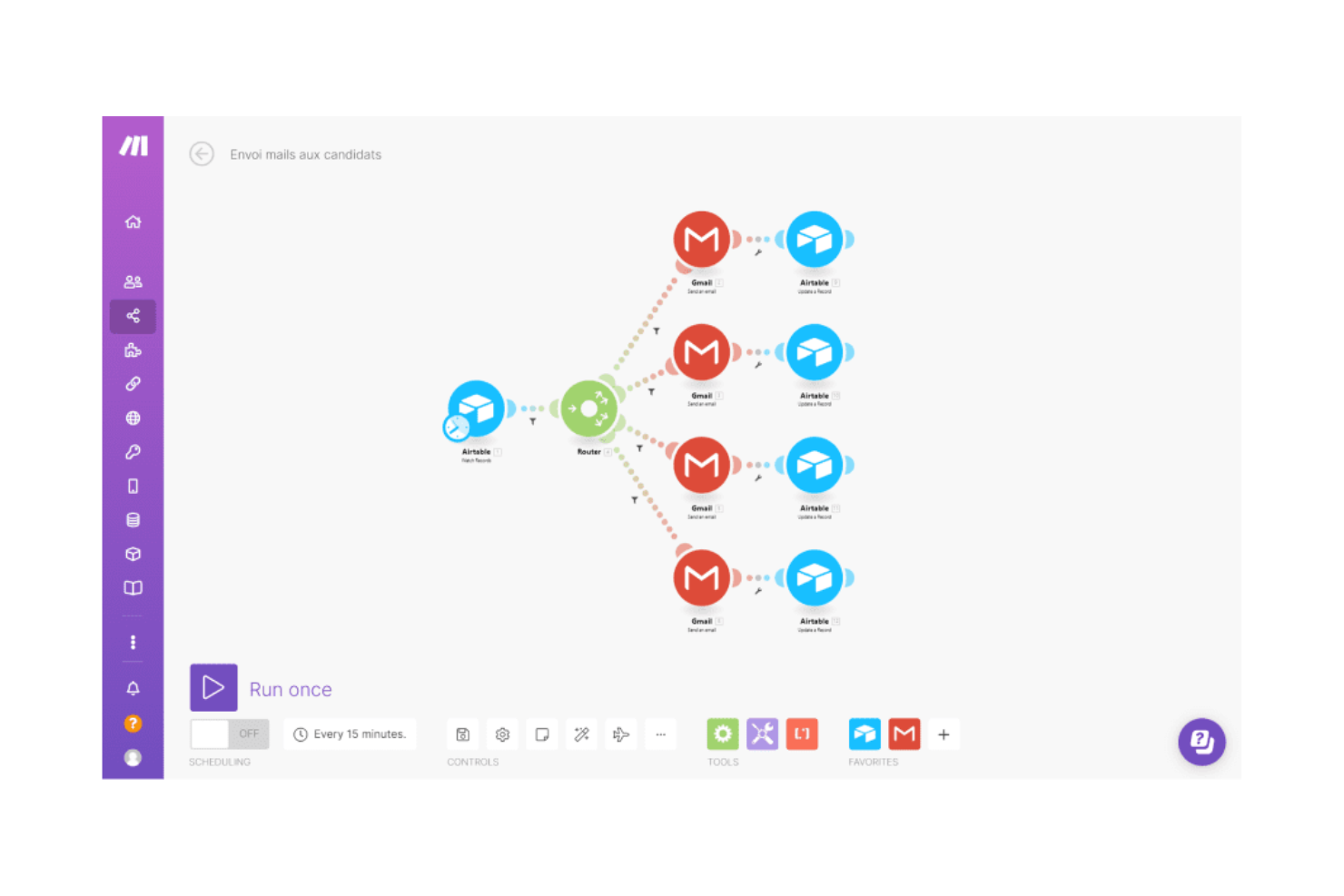
Make is a workflow automation software built around a visual, drag-and-drop scenario builder. It lets you connect apps and automate multi-step processes without writing code. It's worth considering if your team runs complex, multi-branch workflows across a large app stack. I'd recommend it over Zapier if you need more control over your automation logic, as Make gives you that depth without the enterprise pricing.
Make Evaluation Summary
- From $9/month (billed annually)
- Free plan + free demo available
Why Trust Our Software Recommendations
Our team has been testing and reviewing software since 2012. As project managers ourselves, we know how difficult—and important—it is to choose the right software.
For this guide, we evaluated tools using hands-on testing and independent research, scoring tools using our selection criteria. We also draw on insights from industry thought leaders and practicing project management experts.
Our reviews reflect our human editorial judgment, not a sales pitch.
Expert reviewers:
Make Overview
Make.com is a flexible low-code workflow automation tool that connects a wide range of applications. Its user interface is intuitive and simplifies complex tasks, though new users may face a learning curve. It offers strong features at a reasonable price, with both a free plan and paid plans available, which makes it especially suitable for small to mid-sized teams. However, the platform's support team may be less responsive than some alternatives. Overall, it's a practical choice for teams looking to automate workflows efficiently.

pros
-
User-friendly interface allows you to easily automate complex workflows
-
Customizable features allow your team to tailor solutions to fit your business needs
-
Extensive app connections enhance team productivity
cons
-
The onboarding process can be challenging
-
Occasional delays in support team response times
-
The initial learning curve can be steep for those new to no-code automation.
-

Celoxis
Visit WebsiteThis rating combines scores from multiple user review sites to reflect overall customer sentiment about the product.4.5 -
Smartsheet
Visit WebsiteThis rating combines scores from multiple user review sites to reflect overall customer sentiment about the product.4.5 -
Accelo
Visit WebsiteThis rating combines scores from multiple user review sites to reflect overall customer sentiment about the product.4.4




Our Review Methodology
How We Test & Score Tools
We’ve spent years building, refining, and improving our software testing and scoring system. The rubric is designed to capture the nuances of software selection and what makes a tool effective, focusing on critical aspects of the decision-making process.
Below, you can see exactly how our testing and scoring works across seven criteria. It allows us to provide an unbiased evaluation of the software based on core functionality, standout features, ease of use, onboarding, customer support, integrations, customer reviews, and value for money.
Core Functionality (25% of final scoring)
The starting point of our evaluation is always the core functionality of the tool. Does it have the basic features and functions that a user would expect to see? Are any of those core features locked to higher-tiered pricing plans? At its core, we expect a tool to stand up against the baseline capabilities of its competitors.
Standout Features (25% of final scoring)
Next, we evaluate uncommon standout features that go above and beyond the core functionality typically found in tools of its kind. A high score reflects specialized or unique features that make the product faster, more efficient, or offer additional value to the user.
We also evaluate how easy it is to integrate with other tools typically found in the tech stack to expand the functionality and utility of the software. Tools offering plentiful native integrations, 3rd party connections, and API access to build custom integrations score best.
Ease of Use (10% of final scoring)
We consider how quick and easy it is to execute the tasks defined in the core functionality using the tool. High scoring software is well designed, intuitive to use, offers mobile apps, provides templates, and makes relatively complex tasks seem simple.
Onboarding (10% of final scoring)
We know how important rapid team adoption is for a new platform, so we evaluate how easy it is to learn and use a tool with minimal training. We evaluate how quickly a team member can get set up and start using the tool with no experience. High scoring solutions indicate little or no support is required.
Customer Support (10% of final scoring)
We review how quick and easy it is to get unstuck and find help by phone, live chat, or knowledge base. Tools and companies that provide real-time support score best, while chatbots score worst.
Customer Reviews (10% of final scoring)
Beyond our own testing and evaluation, we consider the net promoter score from current and past customers. We review their likelihood, given the option, to choose the tool again for the core functionality. A high scoring software reflects a high net promoter score from current or past customers.
Value for Money (10% of final scoring)
Lastly, in consideration of all the other criteria, we review the average price of entry level plans against the core features and consider the value of the other evaluation criteria. Software that delivers more, for less, will score higher.
Core Features
Visual workflow builder: Make offers an intuitive drag-and-drop interface that allows users of all skill levels to create and manage workflows. This visual approach enables teams to see the entire process at a glance, making it accessible for beginners and efficient for experienced users.
Conditional logic: You can set up workflows that adapt based on specific triggers and conditions, allowing your team to automate complex decision-making processes. Make supports conditional logic through "if-then" scenarios and branching paths that enable dynamic and personalized automations.
AI assistant: Make provides AI-powered assistance to help build workflows faster. The AI Assistant can generate workflow suggestions, assist in creating scenarios, and offer guidance on module configurations, streamlining the automation process.
Error handling: Make allows the use of error handlers to define specific actions when errors occur, such as sending customized alerts or retrying operations, which keeps teams informed and addresses issues without disrupting workflows.
Array aggregator module: You can combine multiple items into a single array for batch processing or grouped data output. The Array Aggregator module is useful when collecting data from repeated steps and passing it as a single bundle to the next module, especially when working with formats like JSON.
Advanced customization: You can fine-tune workflows with dynamic mapping, precise controls, and custom behavior for tailored automation solutions and more powerful scenario execution.

Ease of Use
Make is easy to use, with a drag-and-drop interface and visual workflow builder that requires no technical expertise. While complex automations may have a learning curve, the clear layout and ready-made templates help simplify setup. Beginners typically find it straightforward to build and manage workflows.

Make Specs
- API
- Approval Workflows
- Batch Permissions & Access
- Compliance Tracking
- Contact Management
- Custom Reports
- Dashboard
- Data Export
- Data Import
- Data Visualization
- Document Management
- External Integrations
- Inventory Tracking
- Marketing Automation
- Notifications
- Process Modeling
- Process Reporting
- Project Management
- Roadmapping
- Sales Automation
- Supplier Management
- Third-Party Plugins/Add-Ons
- Workflow Management


- 10 Best Gantt Chart Makers For Project Planning In 2026Opens new window
- 10 ProcessMaker Alternative Tools for Automation in 2026Opens new window
- 7 Steps To Make Your DAM Implementation A SuccessOpens new window
- How Much Does an Enterprise Project Manager Make in 2026?Opens new window
- How To Make A FlowchartOpens new window
- How To Make A Gantt Chart In Excel In 12 Easy StepsOpens new window
- How to Make a Gantt Chart: A Step-By-Step GuideOpens new window
- Make Agile Contracts Work For Your Teams & ClientsOpens new window
- Make Pricing Tiers & CostsOpens new window
- ProcessMaker Pricing Tiers & CostsOpens new window
Make FAQs
How easy is it to customize workflows in Make?
Can Make handle high-volume tasks?
What kind of support does Make offer?
How does Make ensure data security and compliance?
Is Make suitable for non-technical users?
How does Make handle errors within workflows?
Can Make integrate with legacy systems?
Does Make offer collaboration features?
What's Next?
Want to connect with other digital project managers to share resources and best practices? Join our membership community and get access to 100+ templates, samples, and examples and connect with 100s of other digital project managers in Slack.