16 Agile Project Management Courses to Upskill in 2026


Finding agile project management courses that match your skill level and schedule takes time you probably don't have. I sifted through available options to help you compare formats, depth, and focus areas—so you can pick training that fits where you are now and where you're trying to go.
DPM School Spotlights
Customizing Your Project Approach - DPM School
Best for: Advanced PMs tailoring delivery approaches
Our DPM School mini course explores how to adapt project methods to fit different delivery needs. Its practical toolkit and templates help you shape an approach for your project rather than follow one method by default.
What you’ll learn: Decide when to tailor a project approach, apply tailoring steps and rules, handle resistance, and build a methodology playbook.
Course details:
- Format: Prerecorded, on-demand online lesson with downloadable resources
- Duration: 1 to 1.5 hours; 12 months’ access for individual purchases
- Level/prerequisites: Advanced; no prerequisites required
- Price: $89 USD per course
- Assessment: Optional brief quiz available by email after course completion
- Certificate/credits: Optional DPM microcredential upon quiz completion; no course-specific PDU count verified
Considerations: The microcredential does not confer PRINCE2, Scrum, or Agile professional certification.
The 16 Best Agile Project Management Courses
Below are my summaries of the best agile project management courses. My reviews offer a look at each course's learning objectives, best fits, cost, and more.
1. Agile Project Management - Google (via Coursera)
Best for: Beginners breaking into agile project management roles


Google's Agile Project Management course on Coursera is a beginner-friendly option that covers Scrum, Kanban, and Lean through structured video lessons and graded assignments—with Google's brand backing the credential.
What you'll learn: How to apply the Agile Manifesto, run Scrum events, manage a product backlog, plan sprints, and coach agile teams toward value-driven delivery.
Course details:
- Format: Self-paced online; includes videos, readings, and interactive assignments
- Duration: Approximately 20 hours across 4 modules (estimated 2 weeks at 10 hours/week)
- Level/prerequisites: Beginner; no prior project management or agile experience required
- Price: Included with Coursera Plus at $239/year; free audit available without graded assignments or certificate
- Assessment: 20 graded assignments
- Certificate/credits: Shareable certificate of completion; full Google Project Management Professional Certificate counts toward 100+ hours of PMI-recognized education applicable to the CAPM
Considerations: Enrolling in this course also enrolls you in the full Google Project Management Professional Certificate, so it's not a standalone course—factor that in if you only want agile training.
For general project management knowledge, try these project management training courses.
2. Agile Project Management Professional Certificate - University of Maryland (via edX)
Best for: Working professionals earning PMI PDUs at the advanced level

The University of Maryland's Agile Project Management Professional Certificate on edX is a five-course program that goes beyond Scrum basics to cover scaled frameworks and agile leadership—earning up to 50 PMI PDUs.
What you'll learn: How to run sprints, apply Lean Kanban, lead agile teams, scale delivery using SAFe, Disciplined Agile, and LeSS, and implement results-based program controls.
Course details:
- Format: Self-paced online; includes videos, discussion forums, homework, and exams
- Duration: Approximately 5 months; estimated 2–3 hours per week across 5 courses
- Level/prerequisites: Advanced (as listed on edX); no prerequisites specified
- Price: $1,245 USD for the full program; individual courses available for free audit for the first 4 weeks
- Assessment: Graded homework and exams per course
- Certificate/credits: Professional Certificate from the University of Maryland, College Park; earns up to 50 PMI PDUs (10 per course)
Considerations: Free auditing is limited to the first 4 weeks per course, so you'll need the paid track to access graded work and earn the certificate.
3. PMI Agile Certified Practitioner (PMI-ACP) Exam Prep Course - PMI
Best for: Experienced practitioners pursuing the PMI-ACP certification

PMI's official PMI-ACP® Exam Prep Course is built directly around the ACP Exam Content Outline. At 21 hours, it satisfies the training hour requirement for the PMI-ACP application—a practical choice if you're preparing to sit for the exam.
What you'll learn: Cultivate an agile mindset, apply agile leadership techniques to team dynamics, manage and prioritize a product backlog, optimize delivery workflows, and align work with organizational priorities.
Course details:
- Format: Self-paced online; directed multimedia content, guided ECO reference review, and structured independent study activities
- Duration: 21 hours; access period not specified
- Level/prerequisites: Prerequisites not specified on the course page; designed for those preparing to sit for the PMI-ACP® exam
- Price: $320 USD per course; $280 USD for PMI members
- Certificate/credits: 21 PMI PDUs (10 Ways of Working, 7 Power Skills, 4 Business Acumen); satisfies the 21 training hours required to apply for the PMI-ACP® exam
Considerations: This course covers the training hours required for PMI-ACP eligibility, but the exam also requires verified general and agile project work experience before you can submit your application.
Find more options on this list of digital project management training courses.

4. Certified ScrumMaster® (CSM®) - Scrum Alliance
Best for: New to Scrum and pursuing live, instructor-led certification

If you're new to Scrum, the Certified ScrumMaster® (CSM®) from Scrum Alliance is the most employer-cited Scrum credential available. It requires live training with an approved Certified Scrum Trainer—not a self-paced video course.
What you'll learn: How to apply Scrum events, artifacts, and team accountabilities, facilitate productive team dynamics, manage impediments, and coach your team toward continuous improvement.
Course details:
- Format: Live instructor-led; available in person or live online through Scrum Alliance–approved Certified Scrum Trainers (CSTs)
- Duration: 16+ hours of live training, typically over 2–3 days; followed by an independent online exam
- Level/prerequisites: Beginner; no prerequisites required
- Price: USD $250–$2,495 per learner, set by individual trainers; includes two exam attempts and a two-year Scrum Alliance membership
- Assessment: 50-question online exam taken independently after the course; 60 minutes; two attempts included in the course fee
- Certificate/credits: Certified ScrumMaster® (CSM®) certification and digital badge from Scrum Alliance; includes a two-year membership; earns 16 SEUs
Considerations: Because individual Certified Scrum Trainers set their own prices, the same credential can cost anywhere from $250 to $2,495—compare a few approved trainers before you commit.
For more on Scrum, check out this list of Scrum certifications.
5. Agile Project Management (AgilePM®) Certification - APMG International
Best for: Project managers who need structured agile governance

AgilePM® from APMG International is a two-level certification covering agile project management across the full project lifecycle—governance, risk, and delivery included. It's the most widely held agile PM qualification globally, with over 250,000 certified professionals.
What you'll learn: How to apply AgilePM principles and project lifecycle phases, plan and prioritize requirements using MoSCoW, manage governance and risk, and integrate Scrum into project delivery.
Course details:
- Format: In-person classroom, live virtual, or self-paced e-learning through APMG-accredited training organizations; formats vary by provider
- Duration: Foundation: ~21 hours (3 days) classroom or ~10 hours e-learning with 6 months' access; Practitioner: 2 days or ~15 hours e-learning
- Level/prerequisites: Foundation: beginner, no prerequisites; Practitioner: requires an AgilePM v3 Foundation certificate
- Price: Set by individual accredited training organizations
- Assessment: Separate exams at Foundation and Practitioner levels, administered by APMG International
- Certificate/credits: AgilePM® Foundation (no expiry) and Practitioner (valid 5 years) certifications from APMG International; earns up to 21 PMI PDUs
Considerations: This is a two-stage certification—you must pass Foundation before pursuing Practitioner, which means budgeting for two separate courses and exams.
6. Agile Project Management Training (ICP-APM Certification) - Learning Tree International
Best for: Project managers who need a framework-neutral agile PM certification

Learning Tree's instructor-led course leads to ICAgile's ICP-APM certification. It's one of the few options that pairs structured agile delivery training with one-on-one after-course instructor coaching, which adds practical follow-through beyond the classroom.
What you'll learn: Justify an agile approach, coordinate self-organizing teams, plan and monitor agile projects, and use agile tools to align team decisions with organizational goals.
Course details:
- Format: Live instructor-led; available in person or live online; private team training also available
- Duration: 2 days (approximately 16 hours)
- Level/prerequisites: Intermediate; foundational project management knowledge and basic agile familiarity required
- Price: USD $1,795 per learner; includes end-of-course exam and after-course instructor coaching
- Assessment: End-of-course exam required for ICAgile certification; administered by Learning Tree
- Certificate/credits: ICAgile ICP-APM lifetime certification (no renewal fees) with a shareable digital badge; earns 11 PMI PDUs and 11 NASBA CPE credits (in-person only)
Considerations: The 11 NASBA CPE credits apply exclusively to live, in-class attendance, so if you attend virtually, you won't earn them.
7. PMI-ACP® Certification Training - Project Management Academy
Best for: Project managers who want PMI's agile credential with a money-back guarantee

Project Management Academy's PMI-ACP® prep is a 3-day course from a PMI Authorized Training Partner. The tuition refund guarantee—if you fail after three attempts—makes it a lower-risk investment than most exam-prep options.
What you'll learn: How to apply an agile mindset across Scrum, Kanban, and Lean; lead and empower teams; manage backlogs and value delivery; and handle risk and impediments.
Course details:
- Format: Live in-person classroom, live virtual classroom, or video-on-demand (self-paced); in-house available for groups of 10+
- Duration: 3 days instructor-led (live); 21 hours self-paced (video-on-demand); 6 months of portal access included
- Level/prerequisites: Intermediate to advanced; PMI requires agile project experience and a secondary diploma to sit the exam
- Price: $1,995 USD (live virtual) or $2,295 USD (live classroom); PMI exam fee paid separately: $435 (members) or $495 (non-members)
- Assessment: PMI-ACP® exam administered by PMI; not included in course tuition
- Certificate/credits: PMI-ACP® certification from PMI (valid 3 years; 30 PDUs required for renewal); course completion records 28 contact hours
Considerations: The course tuition covers exam prep only—you'll pay PMI's exam fee separately on top of course costs, so factor both into your budget before enrolling.
8. Atlassian Agile Project Management Professional Certificate - LinkedIn Learning
Best for: Project managers new to agile who want Jira Cloud skills

LinkedIn Learning's six-course path pairs agile PM theory with hands-on Jira Cloud skills, endorsed by Atlassian. It covers Scrum and Kanban alongside the tooling most agile teams actually use.
What you'll learn: Agile and Scrum foundations, Kanban principles, Jira Cloud board and sprint setup, JQL queries and dashboards, and common agile PM pitfalls to avoid.
Course details:
- Format: Self-paced, on-demand video courses on LinkedIn Learning
- Duration: Approximately 8 hours of video content across six courses; access tied to active subscription
- Level/prerequisites: Beginner; no prerequisites listed
- Price: Included with a LinkedIn Learning subscription: $39.99/month or $239.88/year; 1-month free trial available
- Assessment: Final exam required to earn the professional certificate
- Certificate/credits: Atlassian Agile Project Management Professional Certificate with a shareable digital badge; no PDUs or CEUs associated
Considerations: Both course access and your certificate depend on an active subscription—there's no one-time purchase option, so ongoing access requires a recurring payment.
9. Agile with Atlassian Jira - Atlassian (via Coursera)
Best for: Agile beginners who want hands-on Jira Cloud practice

Atlassian's own course on Coursera pairs agile and lean principles with hands-on Jira Software Cloud labs. Because it's taught directly by Atlassian, the Jira configuration instruction reflects how the tool is actually designed to work.
What you'll learn: Apply Scrum and Kanban practices in Jira, configure agile boards and custom issue types, use Jira Query Language (JQL) to search and filter work, and manage epics, versions, and user permissions.
Course details:
- Format: Self-paced online; video lessons plus hands-on labs using a free Jira Software Cloud site
- Duration: Approximately 12 hours; flexible schedule
- Level/prerequisites: Beginner; no prior experience required
- Price: Included with Coursera Plus ($239 USD/year); individual certificate purchase price not published on course page
- Assessment: 4 graded module assignments
- Certificate/credits: Coursera shareable completion certificate; prepares learners for the Atlassian APB-330 Jira Cloud Essentials with Agile Mindset Pro Skills Badge (issued by Atlassian University)
Considerations: The Atlassian credential is a Pro Skills Badge rather than a professional certification, so it's best treated as a tool-proficiency credential rather than a formal agile qualification.
10. Google Agile Essentials - Grow with Google (via Coursera)
Best for: Beginners who want a quick Google-branded agile credential

Google Agile Essentials is a short, entry-level course from Grow with Google, delivered on Coursera. It covers agile fundamentals and Scrum in depth through hands-on activities like building backlogs, running sprint retrospectives, and writing sprint recaps.
What you'll learn: Understand agile and Scrum principles, build product and sprint backlogs, create sprint plans, run Scrum events, and use estimation tools to track and measure project progress.
Course details:
- Format: Self-paced online; video lessons, readings, and hands-on activities
- Duration: Approximately 6 hours; flexible schedule
- Level/prerequisites: All skill levels; no prior experience required
- Price: $49 USD/month subscription via Coursera (7-day free trial available); pricing may vary outside the US and Canada
- Assessment: Final graded assessment required to earn the certificate
- Certificate/credits: Google Agile Essentials Certificate issued by Google upon passing the final assessment; no PDUs verified
Considerations: The certificate is a Google-issued completion credential rather than a recognized professional certification, so it won't satisfy job postings or continuing education requirements that ask for a formal agile qualification.
11. Agile Foundations - LinkedIn Learning
Best for: Agile beginners who want hands-on Jira Cloud practice

Doug Rose's LinkedIn Learning course covers agile foundations in about two hours. The latest version adds a dedicated section on AI and agile teams—one of the few introductory courses to address that intersection directly.
What you'll learn: Apply the Agile Manifesto's values and principles, work with Scrum, Kanban, and XP frameworks, write user stories, and understand how AI tools intersect with agile team practices.
Course details:
- Format: Self-paced online; video lessons, quizzes, an exercise file, and AI-powered role-play simulations on LinkedIn Learning
- Duration: Approximately 2 hours of video content; downloadable for offline viewing via the LinkedIn Learning app
- Level/prerequisites: General/beginner; no prerequisites required
- Price: Included with LinkedIn Learning at $39.99/month or $239.88/year (~$19.99/month); 1-month free trial available for new subscribers
- Assessment: 7 quizzes across the course
- Certificate/credits: LinkedIn Learning Certificate of Completion, shareable directly to your LinkedIn profile; CEUs listed as an included resource
Considerations: There's no option to purchase this course individually—you need an active LinkedIn Learning subscription to access it.
For more help with improving the team's ability to get things done, try these courses on productivity.
12. Managing an Agile Team - University of Virginia (via Coursera)
Best for: Team leads who want a business-school take on agile management

Managing an Agile Team is a Coursera course from the University of Virginia's Darden School of Business. It frames agile around four jobs—learning, deciding, building, and managing—giving you a strategy lens most framework-focused courses skip.
What you'll learn: Create agile team charters, facilitate retrospectives, manage stakeholders, and apply Scrum, XP, and Kanban frameworks as your team moves away from traditional project management.
Course details:
- Format: Self-paced online on Coursera; video lessons, readings, quizzes, discussion prompts, and a peer-reviewed final assignment
- Duration: Approximately 10–12 hours; Coursera recommends completing in about 1 week at your own pace
- Level/prerequisites: Beginner; no prerequisites required
- Price: Free to audit; paid certificate enrollment available. Included with Coursera Plus at $239/year or $59/month
- Assessment: Quizzes per module plus a peer-reviewed final assignment
- Certificate/credits: Coursera shareable certificate; may qualify for PMI PDUs, which you self-report through your PMI account
Considerations: Auditing the course is free, but you won't earn the certificate without paid enrollment or a Coursera Plus subscription.
For more on Kanban, try this list of certifications programs on Kanban.
13. PRINCE2 Agile® Foundation - Learning Tree International
Best for: Project managers blending agile delivery with PRINCE2 governance
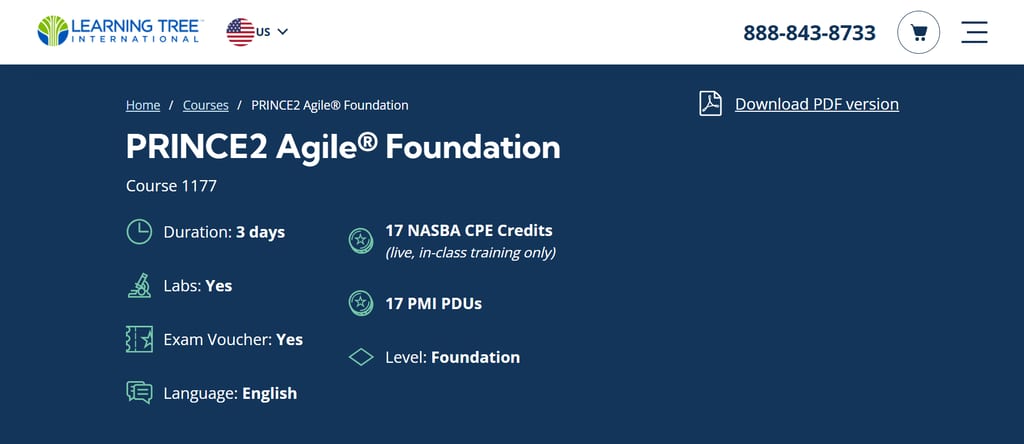
PRINCE2 Agile® Foundation from Learning Tree teaches you to combine agile delivery with PRINCE2's governance structure—a pairing that's genuinely useful in enterprise and government environments where structured oversight isn't optional.
What you'll learn: Apply agile principles within a PRINCE2 governance framework, work with Scrum and Kanban practices, manage stakeholder engagement, and prepare for the PeopleCert PRINCE2 Agile Foundation exam.
Course details:
- Format: Instructor-led; available in-person or live virtual; private team training also available
- Duration: 3 days of instructor-led training; allows up to 2 hours of self-study per evening for exam prep
- Level/prerequisites: Foundation level; no mandatory prerequisites per PeopleCert; working knowledge of project management concepts recommended by Learning Tree
- Price: Contact Learning Tree for pricing; includes official PeopleCert materials and exam voucher
- Assessment: PeopleCert PRINCE2 Agile Foundation exam; 40 multiple-choice questions; 60 minutes; closed book; 60% pass mark
- Certificate/credits: PRINCE2 Agile (Version 2) Foundation certification issued by PeopleCert; 17 PMI PDUs; 17 NASBA CPE credits (live, in-class only); certification requires renewal every 3 years
Considerations: Pricing isn't listed publicly, so you'll need to contact Learning Tree directly to compare costs with other certification options.
14. PRINCE2 Agile® Practitioner - Learning Tree International
Best for: Foundation-certified PMs applying PRINCE2 Agile in practice

Learning Tree's 2-day Practitioner course moves beyond PRINCE2 Agile concepts into applied tailoring—how to adapt practices, roles, and artifacts for your actual project context—making it a natural follow-on from the Foundation.
What you'll learn: Tailor PRINCE2 Agile practices, roles, and artifacts to real projects; apply agile principles within a formal governance structure; and assess stakeholder engagement and team dynamics at Practitioner level.
Course details:
- Format: Instructor-led; in-person or live virtual; private team training available
- Duration: 2 days of instructor-led training; allow up to 2 hours of self-study per evening for exam prep
- Level/prerequisites: Advanced (Practitioner); must hold a valid PRINCE2 Agile Foundation (Version 1 or 2) or PRINCE2 Agile Practitioner (Version 1) certification before sitting the exam
- Price: $2,650 per learner (commercial); $2,355 (government); includes official PeopleCert materials, exam voucher, and Take2 re-sit for public events
- Assessment: PeopleCert PRINCE2 Agile Practitioner exam; 50 multiple-choice questions; 2 hours 30 minutes; open book; 60% pass mark
- Certificate/credits: PRINCE2 Agile (Version 2) Practitioner certification from PeopleCert; 11 PMI PDUs; certification requires renewal every 3 years
Considerations: You must hold a qualifying PRINCE2 Agile Foundation certification before PeopleCert will release your exam results—so if you don't already have it, you'll need to complete the Foundation course first.
15. Certificate in Agile Project Management - AMA (via MindEdge)
Best for: Marketers earning agile skills and PCM® CEUs

The AMA's Certificate in Agile Project Management is a three-course, self-paced program built on MindEdge's platform. It's worth considering if you want a practical introduction to agile without committing to a certification exam.
What you'll learn: Compare agile methodologies with Waterfall, integrate agile into existing project environments, diagnose team issues, and engage stakeholders for feedback.
Course details:
- Format: Self-paced online; mobile-friendly; hosted on MindEdge's platform
- Duration: 19 hours total across 3 courses; self-paced
- Level/prerequisites: Beginner to intermediate; no prerequisites listed
- Price: $309 per learner
- Certificate/credits: AMA certificate of completion; 19 CEUs applicable toward the AMA Professional Certified Marketer® (PCM®) credential
Considerations: This program awards an AMA-branded completion certificate, not a third-party professional certification. If you need a recognized credential like PMI-ACP or PRINCE2, this won't satisfy that requirement.
16. KICKOFF™: Fundamentals of Agile Project Management - PMI
Best for: Beginners who want a free intro from PMI

PMI's free KICKOFF™ course covers agile fundamentals in roughly 45 minutes. It's a no-risk starting point if you're new to Scrum-based delivery and want a PMI-backed credential before committing to a paid course.
What you'll learn: Set up a Scrum board, create a backlog with user stories, run sprint planning and daily scrums, conduct sprint reviews and retrospectives, and track sprint progress with burndown charts.
Course details:
- Format: Self-paced online; interactive lessons, activities, and downloadable templates; requires a free PMI account
- Duration: Approximately 45 minutes for the Agile track; self-paced with progress saved between sessions
- Level/prerequisites: Beginner/foundational; no prerequisites; designed for people with no prior project management experience
- Price: Free; requires a free PMI account (no paid membership needed)
- Assessment: Module assessments included as part of the interactive course activities
- Certificate/credits: Credly digital badge "Fundamentals of Agile Project Management" issued by PMI; no PDUs or contact hours awarded
Considerations: The badge doesn't earn PDUs or contact hours, so completing KICKOFF™ won't count toward PMI-ACP, PMP, or CAPM exam prerequisites.
How to Choose an Agile Project Management Course
Start by naming the specific problem you're trying to solve. Whether that's earning a credential for a job requirement, getting your team running Scrum sprints, or understanding how agile fits into a governance-heavy environment—your answer should drive every other decision.
- Match the course level to where you actually are. A course pitched at Practitioners will frustrate you if you don't have the Foundation prerequisite. Equally, a 45-minute intro won't help you if you're already running sprints and need exam-level depth.
- Check whether a credential is required—or just useful. PMI-ACP, PMP, and PRINCE2 Agile Practitioner are formal certifications with exam prerequisites and renewal requirements. Completion certificates from AMA or LinkedIn Learning aren't equivalent, and they won't satisfy a job posting that asks for a recognized credential.
- Calculate the real time commitment. A "2-day course" often means evening self-study on top of class time. A "19-hour program" spreads across however long you give it. Be honest about what your schedule actually supports.
- Look at how the course teaches, not just what it covers. Case studies, scenario-based exercises, and hands-on sprint simulations build skills you can apply immediately. Video-only content is easier to consume but harder to transfer to real work.
- Factor in total cost, including the exam. Some courses bundle the exam voucher and a re-sit; others don't. If you're pursuing a certification, calculate course fee plus exam fee before comparing options.
- Consider your professional context. Agile in a marketing function looks different from agile in software delivery. A course framed around your actual work environment will click faster than one that treats agile as purely a development practice.
Agile Project Management FAQ
Is Scrum the same as agile project management?
No. Agile is a broad approach to managing work in short cycles and adapting to change; Scrum is one framework for putting that approach into practice. Scrum gives you specific roles, ceremonies, and artifacts—sprints, standups, retrospectives—but agile project management covers more ground than that, including planning, governance, and tailoring your process to fit different team and stakeholder contexts.
A Scrum-focused course can be a great starting point, but check whether it also covers broader agile principles if your role involves more than running sprints.
Are online agile courses as effective as instructor-led ones?
They can be, depending on what you’re trying to get out of the course. Self-paced courses give you flexibility and let you move at your own speed, while live instruction offers real-time feedback and the chance to work through scenarios with other people. For practical skill-building, the format matters less than the course design—look for activities, case studies, or scenario-based exercises rather than passive video-only content.
If you’re preparing for a certification exam, structured practice with assessments tends to be more important than the delivery mode.
Do I need a technical background to study agile project management?
No. Many agile project management skills—prioritizing a backlog, coordinating a team, running retrospectives, and keeping stakeholders aligned—apply just as much outside software development as within it. Where a technical background helps is in understanding the work your team is estimating and scoping, but it’s not a prerequisite for learning or applying agile.
I’d suggest checking the course examples and exercises before enrolling: if they’re built around software sprints and your team ships marketing campaigns, a course with broader framing will click faster.
How can I put what I learn into practice after a course?
Pick one small, low-risk piece of work and apply one or two techniques—make your work visible on a board, or run a brief retrospective at the end of a project phase. Don’t try to overhaul your whole workflow at once. Use what you observe to adjust your approach; agile practices almost always need tailoring to your team’s context, rhythm, and stakeholder expectations.
The techniques you learn in a course are starting points, not prescriptions, and the real learning happens when you see how your team actually responds.
Additional Resources
Check out this list of project management courses to help you manage your projects more efficiently in this fast-paced, AI-driven world.
What's Next?
Want to connect with other digital project managers and share resources and best practices? Join our membership community for access to 100+ templates, samples, and examples. You can also connect with hundreds of digital project managers in Slack.