

Managing Tasks As A Project Manager: 3 Key Strategies 2026


Managing tasks as a project manager often feels like chasing the tail of a dragon—thrilling, unpredictable, and slightly exhausting. At the core of great project management is one constant: change. Goals shift. Tools evolve. Priorities get flipped overnight. And in the midst of it all, it’s the project manager’s job to keep everything moving forward to ensure project success.
But with so much in flux, many project managers are reevaluating how they structure work, delegate tasks, and deliver outcomes. It’s not just about juggling to-do lists anymore—it’s about seeing the bigger picture.
One surprising insight? Many project managers still don’t use systems thinking in their day-to-day workflows, despite current research suggesting they could significantly benefit. Yet it’s one of the most effective ways to manage complexity, align stakeholders, and solve problems that span across teams and timelines. As projects grow more interconnected, this mindset shift isn’t just helpful—it’s essential.

So let’s zoom out. How do you view your team? Your organization? And more importantly, how can you better manage tasks not just reactively, but strategically?
What is Task Management?
Task management is the process of organizing, prioritizing, assigning, tracking, and completing tasks to meet project goals. For project managers, it’s not just about ticking boxes—it’s about creating clarity, maintaining momentum, and making sure every moving part of the project contributes to a defined outcome.
Whether you’re juggling a handful of deliverables or coordinating across multiple teams and stakeholders, using project management and task management (and project and task management software) together makes sure that nothing falls through the cracks. Techniques like task batching can also help you stay focused and reduce the chaos of constant context switching. It helps answer essential questions like:
- What needs to be done?
- Who’s responsible?
- When is it due?
- How does this task connect to the bigger picture?
You can learn more about what tasks project managers do on a day-to-day basis in our article on what tasks project managers do on a daily basis.
Why Systems Thinking for Task Management?
Most project managers are trained to think in straight lines—deterministic workflows, rigid timelines, and linear task management tools like task lists and Gantt charts. But increasingly, that approach doesn’t reflect the reality of our work. According to the APM, this kind of thinking still dominates task management, even as the projects we manage grow more complex and interconnected.
And the shift is already happening. Searches for new project management methodologies have surged in recent years—Google searches for Agile methodologies alone are up 28% since 2017. It’s clear that teams are hungry for new frameworks that can handle a higher degree of complexity, uncertainty, and collaboration.
That’s where systems thinking comes in. Many digital project managers are dealing with projects that involve both high complexity and high interaction. To manage them effectively, we need to think beyond checklists and timelines—we need a framework that helps us understand the bigger picture, spot hidden dependencies, and solve problems from multiple angles.
Here’s a way to think about it:
Project managers are the prefrontal cortex of an organization.
Just like the brain’s executive function system, we’re responsible for planning, prioritizing, organizing, problem-solving, and keeping everything aligned.
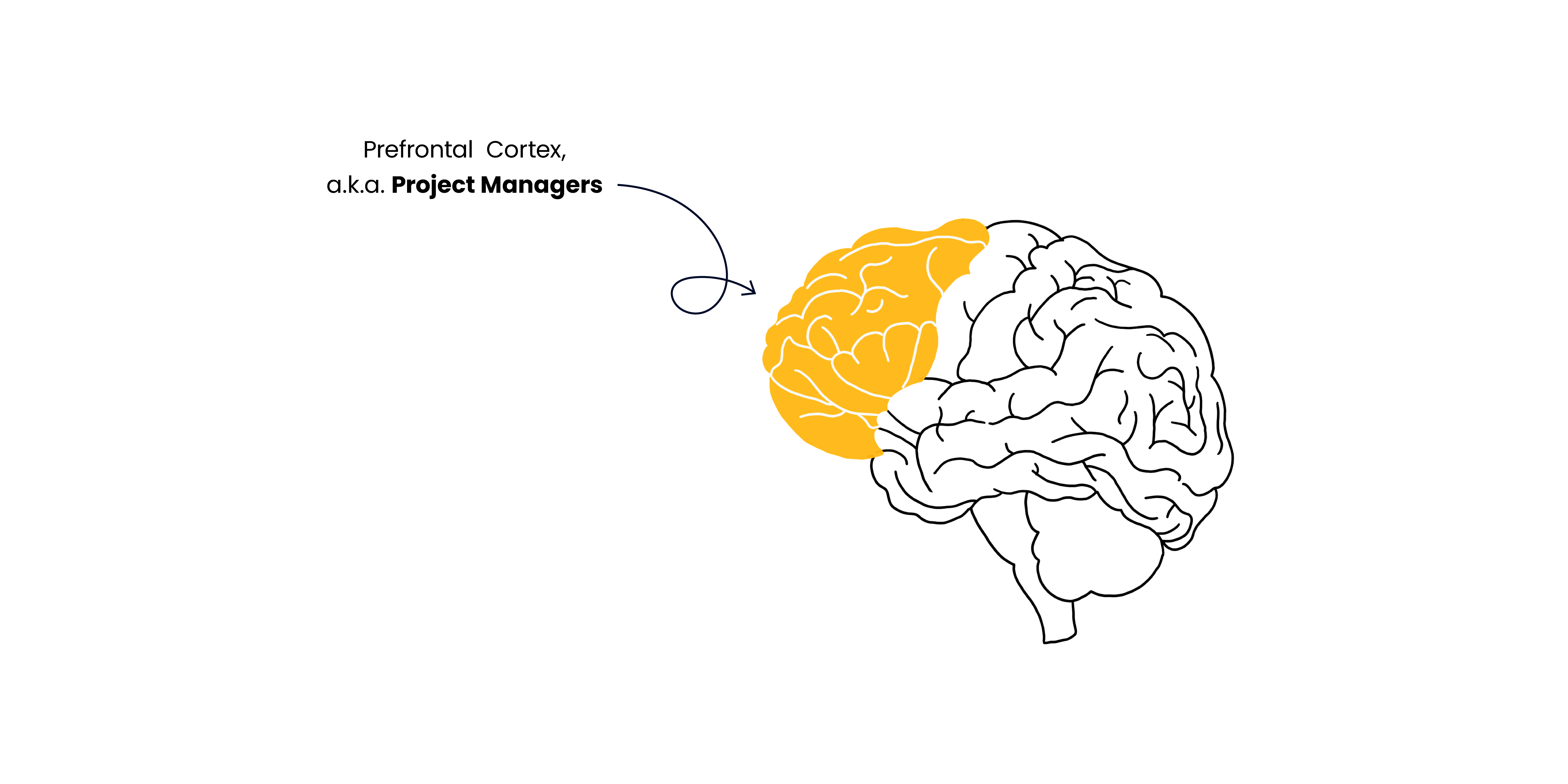
Projects, too, behave like systems. They have inputs, outputs, and processes that operate within (and react to) their environment. As scope shifts and teams grow, your task management approach needs to account for a higher degree of complexity—and the interactions that come with it.
This is where the axis of interaction and complexity becomes useful. It maps how different types of projects require different management systems based on how many parts are involved and how often they interact. For example:
- Low complexity + low interaction? A waterfall-style approach might be enough.
- High complexity + high interaction? You need something more adaptive—like Agile, Lean, Scrum or systems thinking.
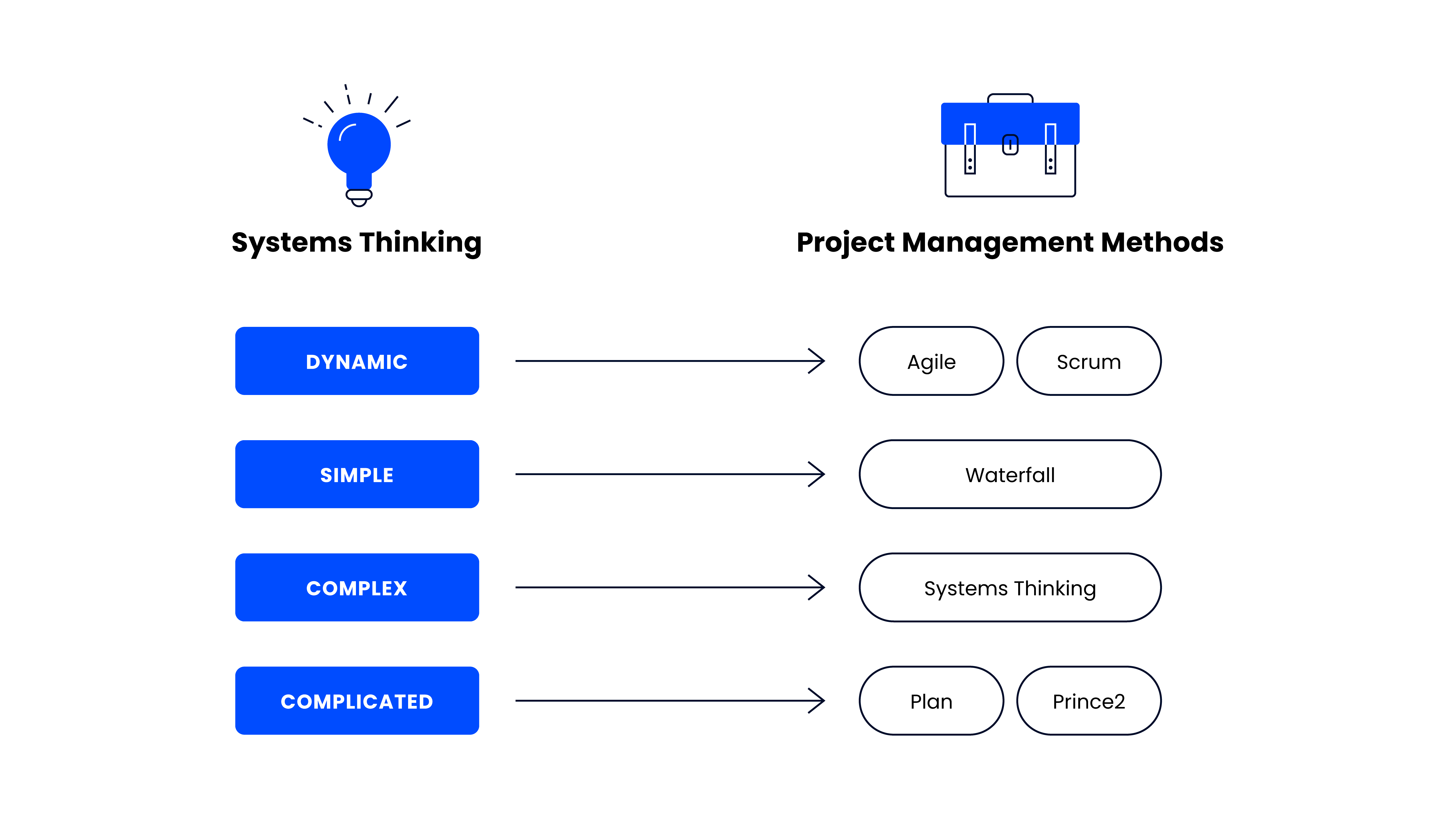
In short, systems thinking equips project managers to navigate complexity. It helps you shift from reactionary task juggling to strategic orchestration—managing not just what gets done, but how everything fits together. Through the lens of systems thinking, we can also compare how projects as systems pair with an equivalent project management system.

3 Key Task Management Strategies
Without further ado, let’s deep dive into what managing tasks as a project manager in 2026 could look like, how to make systems thinking work for you as a DPM, and three key task management strategies to hang on to into the next year. We’ll cover:
- Why you should consider redefining roles
- Why project planning is still important in 2026
- How to build a proactive communication plan
1. Defining Roles
Role definition (and redefinition) is a crucial first step to developing your task management (and stakeholder management) strategy. Each of your project team members should have a defined role and responsibility. It’s up to project managers to keep the vision clear. Without clear role definition and efficient task allocation, all task management strategies fall apart.
There’s a reason the word “think tank” describes a precise, coordinated (however controversial it may be) project effort. Successful, structured organizations on some level, mirror the brain.
Think about it for a moment—organizations are well-defined information systems, communication systems, decision-making systems, and more. All these complex systems interconnect their disparate functions to collaborate, forming a constant free-flow of ideas and operations.
A philosopher by the name of Daniel Dennett, explains it better than me: “competing parallel activities can make complementary and competing contributions into a coherent pattern.” Say that three times fast.
To put it simply: multiple ideas working at once can come together into a clear, focused project. Organizations are like brains in that brains are a highly attuned output process of hundreds of systems. The key, however, is to ensure each role is performing a single or focused function. Multitasking tanks productivity by 40%.
2. Developing Project Plans
The second step in managing projects? Get serious about developing project plans.
Yes, even in an Agile world, project plans aren’t outdated. They’re essential. Think of them less as rigid roadmaps and more as flexible frameworks—structures that allow you to adapt without losing direction.
A strong plan doesn’t restrict your project; it anchors it. It gives your team clarity on goals, timelines, resources, and responsibilities—even as things inevitably shift.
As Christopher Bolick, faculty lead in Northeastern University’s project management program, puts it:
“You wouldn’t start to build a house without having a detailed blueprint showing the contractor how to begin.”
Exactly. Good task management starts with breaking down larger project deliverables into smaller, actionable pieces. That’s your blueprint. Without it, prioritization becomes guesswork and execution slows to a crawl.
One of the most overlooked parts of a project plan is evaluating your resource load. What do you actually have—time, people, tools, budget—and how should it be allocated? Time, especially, is your only non-renewable resource. Protect it.
3. Good Communication
We use systems thinking in everyday language without (ironically) thinking about it. “Domino effect,” “circular logic,” and “a downward spiral” all express the main concepts behind systems thinking.
The majority of what we do as DPMs is communicating—it’s 90% of a project manager’s job. We can’t properly delegate roles, plan, or build a good resource breakdown structure (RBS) without excellent communication at every level. The first step to drafting your next communication plan should be determining what kind of communication your stakeholders need.
Here’s where systems thinking comes in: just like any system, your project relies on constant input, feedback, and interaction between its parts. If communication breaks down, so does the system. That’s why your communication plan isn’t just a nice-to-have—it’s a task management strategy.
Start by asking:
- What kind of communication does each stakeholder actually need?
- How often? Through which channels?
- Are we communicating for visibility, decision-making, alignment—or all of the above?
- Do I need a decision log to track impactful agreements?
- Is each stakeholder fully available to perform their role within the project’s time frame?
And don’t forget—information only becomes communication once it’s interpreted. You might be sharing updates, but if no one understands what it means for their work, the message didn’t land.
One of the biggest opportunities for managing tasks as a project manager in 2026 is shaping a proactive communication environment. That might mean embracing async updates, building better rituals for collaboration, or encouraging your team to contribute content—like sharing expertise, process improvements, or culture insights. Communication is strongest when it flows in every direction.
Building a focus-friendly communication culture also means helping your team protect their time. Techniques like the Pomodoro technique can reinforce async work and reduce unnecessary pings by encouraging heads-down time in short bursts.
Systems Thinking Tools for Task Management
Systems Thinking Tool: Decision Matrix
Defining what tasks require delegation to achieve goals within the project’s timeline begins with decision making and creating priority levels. Dwight Eisenhower’s infamous impact effort matrix is, in fact, none other than an application of systems thinking.
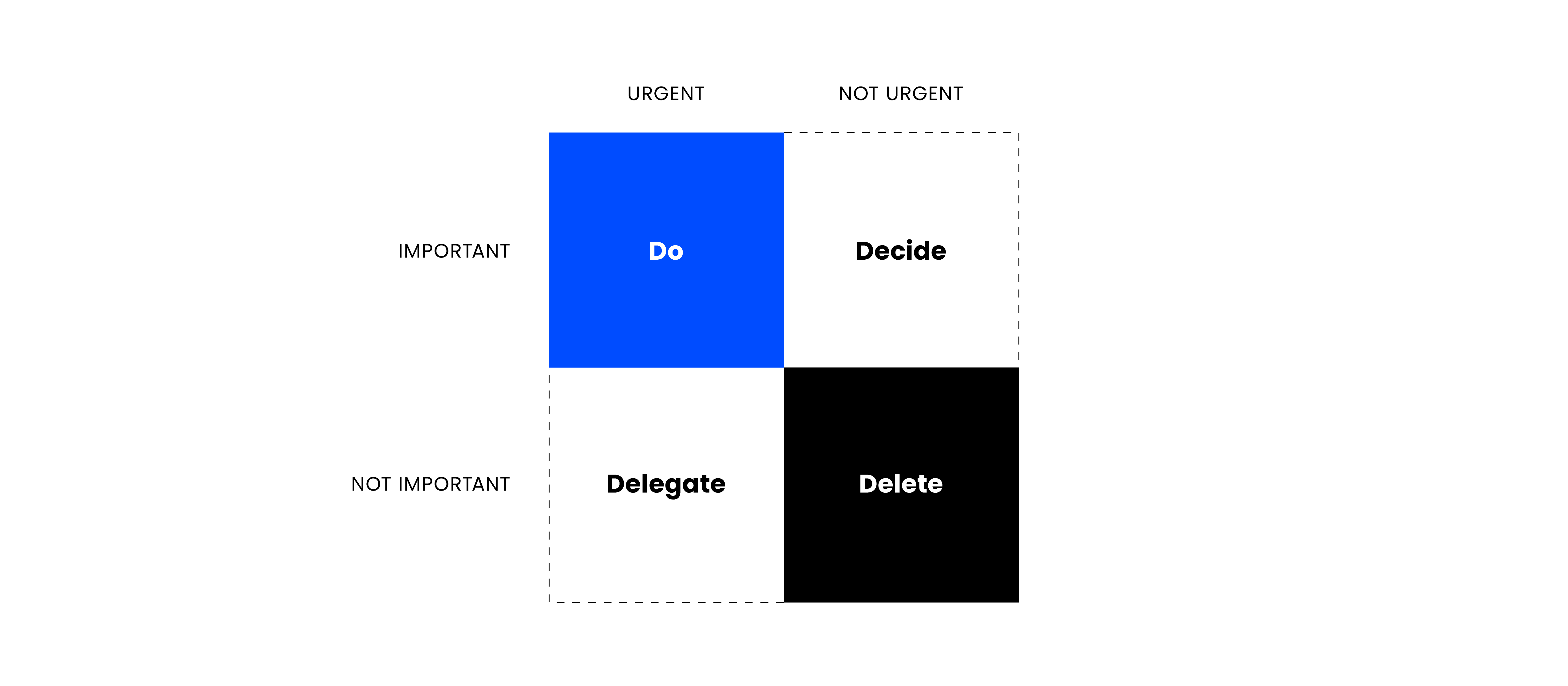
The classic decision matrix is a simple four quadrant chart designed to take guesswork out of prioritizing. It follows a handy alliteration: do, decide, delegate, delete. These boxes further intersect with a label of either urgent or important and their negative counterparts. “Do” being urgent and important, “delete” being not urgent and not important, and so on.
Chronic stress biases human decision-making towards habits instead of goals. Adjacent to being adaptable with roles is mitigating workplace stress, which affects decision making.
Key task management strategies going forward into 2026 are those that assist us with decision making and prioritization while keeping the system and environment in mind—and a decision matrix (or other type of prioritization matrix) is a great place to start.
Systems Thinking Tool: Resource Breakdown Structure (RBS)
You can’t build your literal or figurative house without knowing what you have and what you need. Using an RBS for resource management is more than a list, it employs systems thinking by examining how resource costs are interrelated.
A good RBS will help you with managing tasks as a project manager by looking at all variables affecting your plan towards each step as they connect. The power of functional perspective granted by RBS is also an excellent complement to an existing work breakdown structure (WBS). RBS also requires team collaboration to delegate tasks, streamline workflows, identify project scope and prevent potential risks like bottlenecks and scope creep.
Systems Thinking Tool: Rich Picture Diagram
When developing your communication plans for complex projects, consider how using rich pictures can improve the way you see them as systems. Rich picture diagrams are free-flowing drawings that illustrate the relationship between multiple elements and factors. Rich pictures help create a mental model that opens communication, opens relations of stakeholders to each other, and provides additional context you may have been missing.
A scenario: the DPM delivers a project for a web launch built according to well-defined requirements—the system satisfies them. On launch, it’s condemned by users. How’d we get here? Likely, by not seeing how the requirements were unrelated to (or are interfering with) what the users actually perform. It’s a breakdown in communication.
Looking visually at dynamics such as communication and processes, as well as structures like resources and framework, helps us see new dependencies and how they all fit together, something that will prove essential for the coming year.
The Role of Software Tools in Task Management
Use tools to support your system—not become it.
In 2026, project managers have more tools than ever at their disposal—but more isn’t always better. From endless personal task management software like to-do list apps to fully automated dashboards, it’s easy to fall into the trap of relying on productivity software to solve deeper workflow problems. But the truth is, tools are only as effective as the system behind them.
That’s why systems thinking is so useful when choosing the right task management software. Instead of looking for the platform with the most features and integrations, ask yourself:
- What tasks actually need automation or visibility?
- How complex is the system I’m managing?
- What helps my team collaborate, prioritize, and adapt?
Modern project management software should support—not dictate—your workflow. Whether you're using Kanban boards, Gantt charts, or collaborative workspaces, your tools should reflect the level of complexity and interaction in your project. For low-complexity projects, a simple tool may be enough. For high-complexity, fast-moving work, flexibility and visibility are critical.
Still, only 22% of organizations use project management software—while 77% of high-performing projects do. That’s not just a stat, it’s a reflection of alignment. When your tools are thoughtfully chosen, they don’t just help you manage tasks—they help you manage systems.
Start with your project plan. Understand what your team truly needs. Then, select software that supports the way your people think, plan, and deliver.
FAQs When Managing Tasks as a PM
How can you organize yourself as a project manager?
Organizing yourself as a project manager begins with mastering time and information flow. Use a centralized system—whether a digital workspace or project management tool—to track deadlines, meetings, and deliverables. Set daily and weekly planning rituals, prioritize tasks, and delegate whenever possible. Systems thinking can help you stay focused on how each task fits into the bigger picture, reducing busywork and increasing strategic clarity.
How can you be a good project manager?
To be a good project manager, you need strong leadership, communication, and organizational skills. Focus on setting clear goals, building trust with your team, and staying adaptable in the face of change. Great PMs don’t just manage timelines—they empower their teams, solve problems proactively, and align work with broader business objectives. Practicing systems thinking, staying curious, and investing in continuous learning can help you stand out as a modern digital project manager.
How do project managers prioritize tasks?
Whether you’re juggling a handful of deliverables or coordinating across multiple teams and stakeholders, using project management and task management (and project and task management software) together makes sure that nothing falls through the cracks. Techniques like task batching can also help you stay focused and reduce the chaos of constant context switching.Project managers often prioritize tasks using frameworks like the Ivy Lee method, Eisenhower Matrix, MoSCoW method, or weighted scoring models. These help distinguish between urgent vs. important work and tie tasks back to project goals. A strong prioritization process considers deadlines, dependencies, available resources, and stakeholder impact. Regularly revisiting priorities during sprint planning or status meetings helps keep teams focused and responsive to changes.
Final Thoughts
Regardless of whether you’re a DPM veteran or just starting out, having solid strategies for figuring out the best way to manage tasks is essential to effective project management. Companies using task management techniques that work spend 28 times less compared to those delivering without any at all.



