

10 Best Deel Alternatives in 2026

Best Deel Alternatives Shortlist


Strong Deel alternatives give you reliable global payroll, local compliance, and smooth hiring—no matter where your team works. If you’re looking for options that can handle everything Deel does (and maybe a few things it can’t), you’re in the right place.
Choosing the wrong global workforce management software can mean payroll delays, legal risks, or admin chaos that holds back your projects. Below, you’ll find the standout alternatives that tech and digital teams trust to keep things running smoothly. I’ll break down what each platform does best, so you can quickly spot which one is right for your hiring and HR goals.
What Is Deel?
Deel is a global workforce management platform for handling payroll, hiring, onboarding, and compliance across multiple countries. You can use Deel to hire employees or contractors internationally without needing local legal entities. The platform automates contracts, taxes, and payments based on local laws, which helps reduce risk for distributed teams. Deel is popular with tech, digital, and remote-first companies scaling teams worldwide.
Deel Alternatives Comparison Table
This comparison table summarizes pricing details for my top Deel alternative selections:
| Tool | Best For | Trial Info | Price | ||
|---|---|---|---|---|---|
| 1 | Best for unified HR and payroll automation | Free demo available | Pricing upon request | Website | |
| 2 | Best for local benefits administration at scale | Free demo available | From $459/user/month (billed annually) | Website | |
| 3 | Best for APAC markets | Free demo available | From $399/employee/month | Website | |
| 4 | Best for in-house entity coverage across regions | Free demo available | From $599/month | Website | |
| 5 | Best for advanced multi-currency payroll analytics | Free demo available | From $29/employee/month | Website | |
| 6 | Best for direct global employment in 75+ countries | Free demo available | From $699/employee/month | Website | |
| 7 | Best for flexible contractor payments worldwide | Free plan available | From $19/user/month | Website | |
| 8 | Best for local expertise with global footprint | Free demo available | From $599/employee/month | Website | |
| 9 | Best for customizable payout methods | Free demo available | From €499/employee/month | Website | |
| 10 | Best for compliance in international hiring | Free demo available | From $699/employee/month | Website |


Why Trust Our Software Recommendations
Our team has been testing and reviewing software since 2012. As project managers ourselves, we know how difficult—and important—it is to choose the right software.
For this guide, we evaluated tools using hands-on testing and independent research, scoring tools using our selection criteria. We also draw on insights from industry thought leaders and practicing project management experts.
Our reviews reflect our human editorial judgment, not a sales pitch.
Best Deel Alternatives Reviews
Below are my detailed summaries of the best Deel alternatives that made it onto my shortlist. My reviews offer a detailed look at the features, best use cases, and pricing of each platform to help you find the best one for you.
Rippling
Best for unified HR and payroll automation
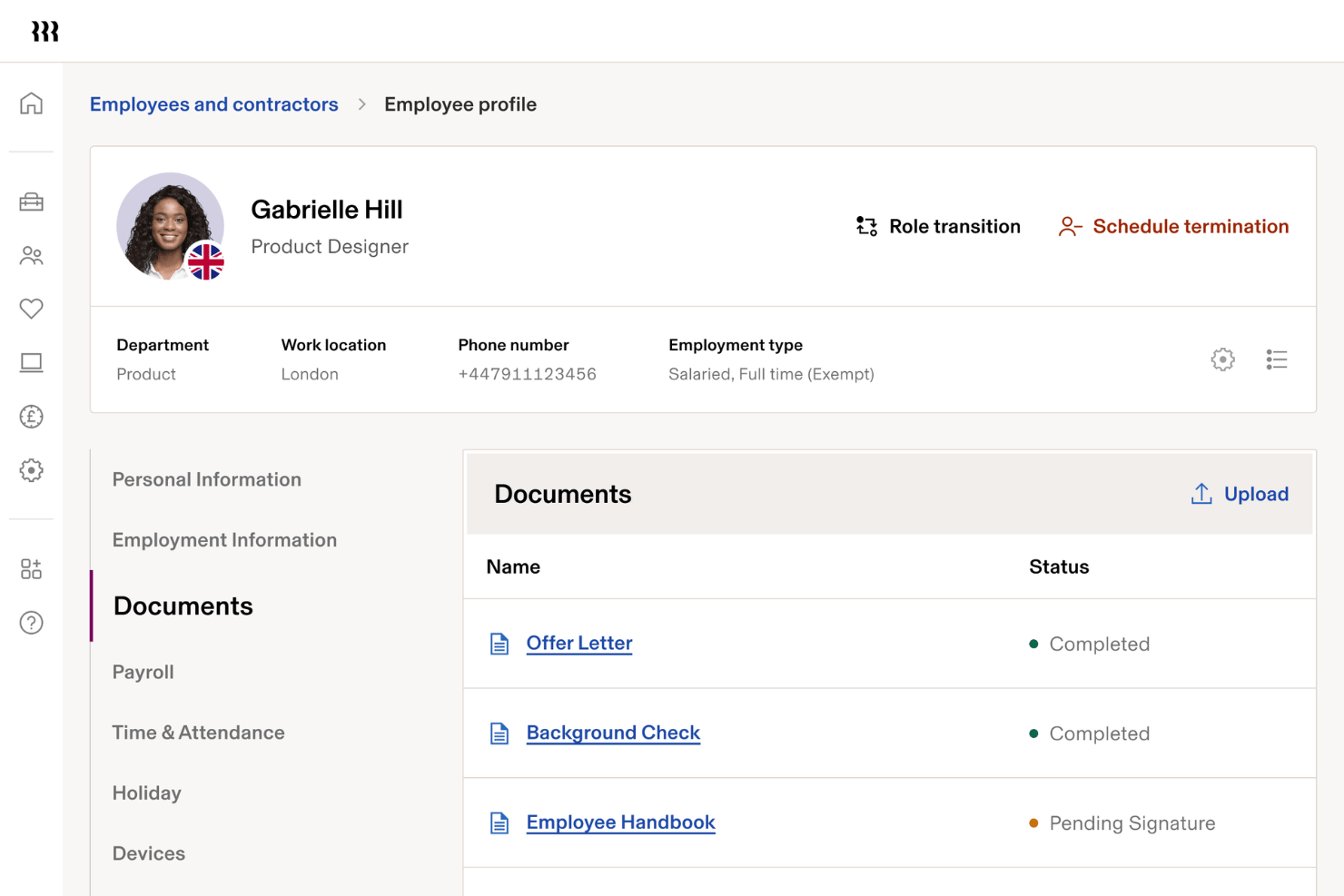
Rippling is a unified HR, payroll, and IT platform built for companies managing distributed teams across multiple countries, consolidating global payroll, EOR, contractor management, and compliance into a single system of record.
Who Is Rippling Best For?
Rippling is a strong fit for mid-market companies that need HR, payroll, IT, and compliance managed in one place across multiple countries.
Why Rippling Is a Good Deel Alternative
I picked Rippling as one of the best because it runs global payroll natively through its own tax engine, letting me process pay for U.S. and international employees in a single pay run. What I appreciate most is the single employee graph: onboarding one person automatically updates payroll, IT access, and benefits from one record. Automated compliance enforcement for minimum wage, overtime, and leave rules then runs in the background across every supported country.
Rippling Key Features
- Unified global HRIS: Maintain a single platform of record with localized fields, documents, and currencies for employees in different countries.
- Automated compliance enforcement: Enforce minimum wage, overtime, and statutory leave rules based on local employment laws.
- Expense management integration: Sync expenses and payroll data directly with general ledger systems for accurate financial reporting.
- Workflow automation studio: Build and customize cross-functional workflows that handle onboarding, offboarding, and multi-country HR approvals.
Rippling Integrations
Rippling offers 650+ integrations, including Slack, Google Workspace, Microsoft 365, QuickBooks Online, Xero, NetSuite, Sage Intacct, Salesforce, GitHub, and Zoom.
Pros and Cons
Pros:
- Single employee record updates all departments
- IT provisioning syncs directly with HR onboarding
- Native payroll engine across 50+ countries
Cons:
- Setup complexity is high for lean HR teams
- EOR country coverage narrower than Deel's
New Product Updates from Rippling

Rippling AI Adds Plugins, Skills, and Automations
Rippling AI now supports plugins, skills, and automations so employees can connect approved third-party tools, package repeatable work into reusable AI instructions, and run recurring workflows under existing Rippling policies and permissions. For more information, visit Rippling's official site.
Best for local benefits administration at scale
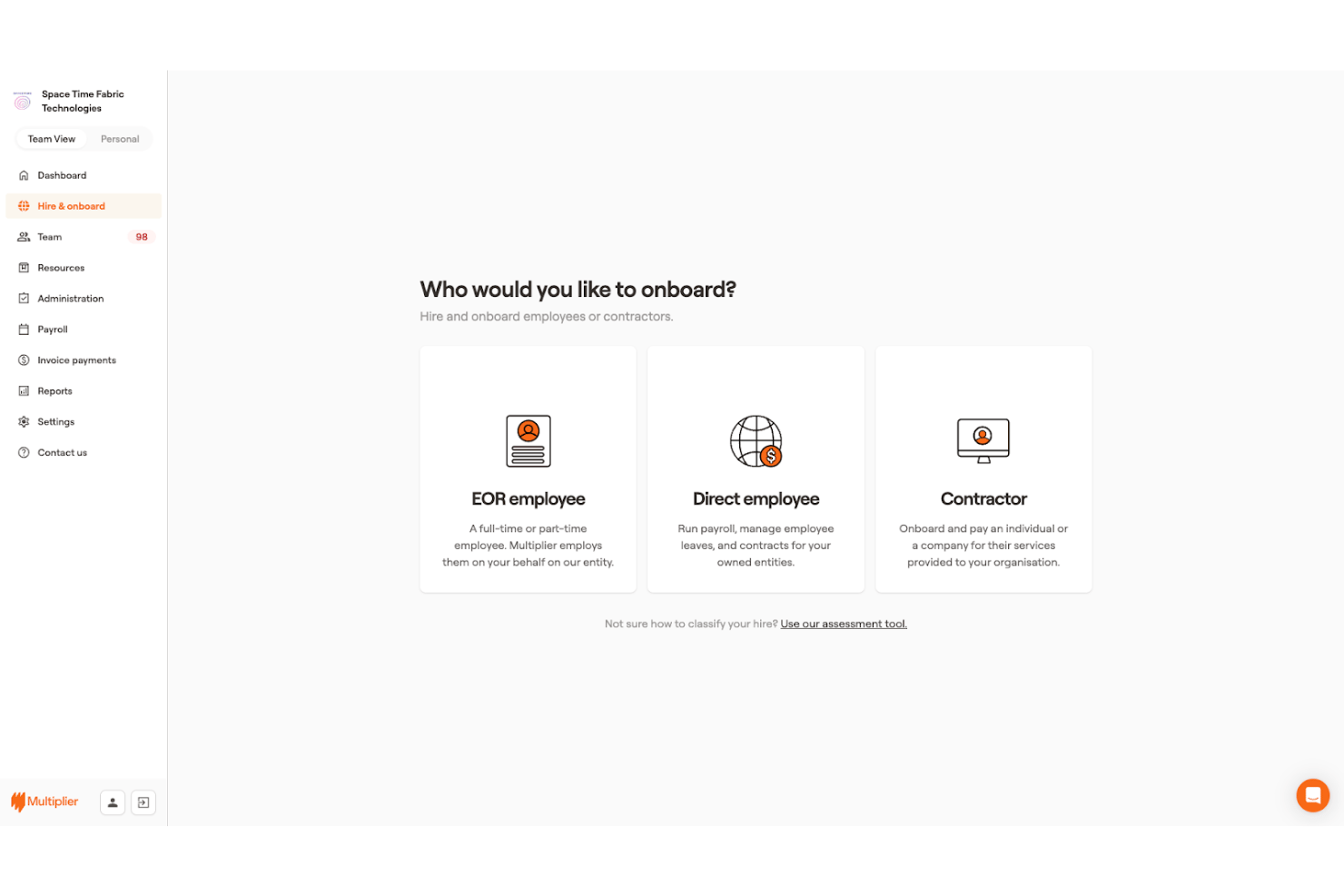
Multiplier is a global employment platform built for HR and people ops teams that need to hire, pay, and manage full-time employees and contractors across 150+ countries without setting up local entities.
Who Is Multiplier Best For?
Multiplier is a strong fit for fast-growing companies scaling internationally across APAC and beyond, where in-country compliance depth and localized benefits matter more than a broad integration ecosystem.
Why Multiplier Is a Good Deel Alternative
I picked Multiplier as one of the best because its local benefits administration goes deeper than most EOR platforms. Instead of applying a standardized global benefits package, Multiplier sources and prices benefits by country, so a hire in Singapore gets locally relevant coverage, not a one-size-fits-all policy. The 24/5 in-country HR and legal expert support backs this up, handling country-specific tax withholding, IP protection, and employment contracts with real precision.
Multiplier Key Features
- Multi-country payroll automation: Run payroll and generate reports for employees and contractors in 150+ countries directly from one dashboard.
- Immigration and visa support: Secure work permits and manage visa processes in over 140 countries with in-house experts.
- Contractor-to-employee conversion workflow: Move global contractors to full-time employee status under EOR without breaking continuity or compliance.
- Employee document management: Centrally store, share, and manage compliance, HR, and identification documents for global teams.
Multiplier Integrations
Integrations include HiBob, BambooHR, Workday, Deel, and more.
Pros and Cons
Pros:
- 24/5 in-country HR and legal support
- Country-specific benefits sourced per local market
- Deep local compliance expertise across APAC
Cons:
- Platform reporting tools lack finance-grade depth
- Fewer owned legal entities than Deel

Pebl
Best for APAC markets
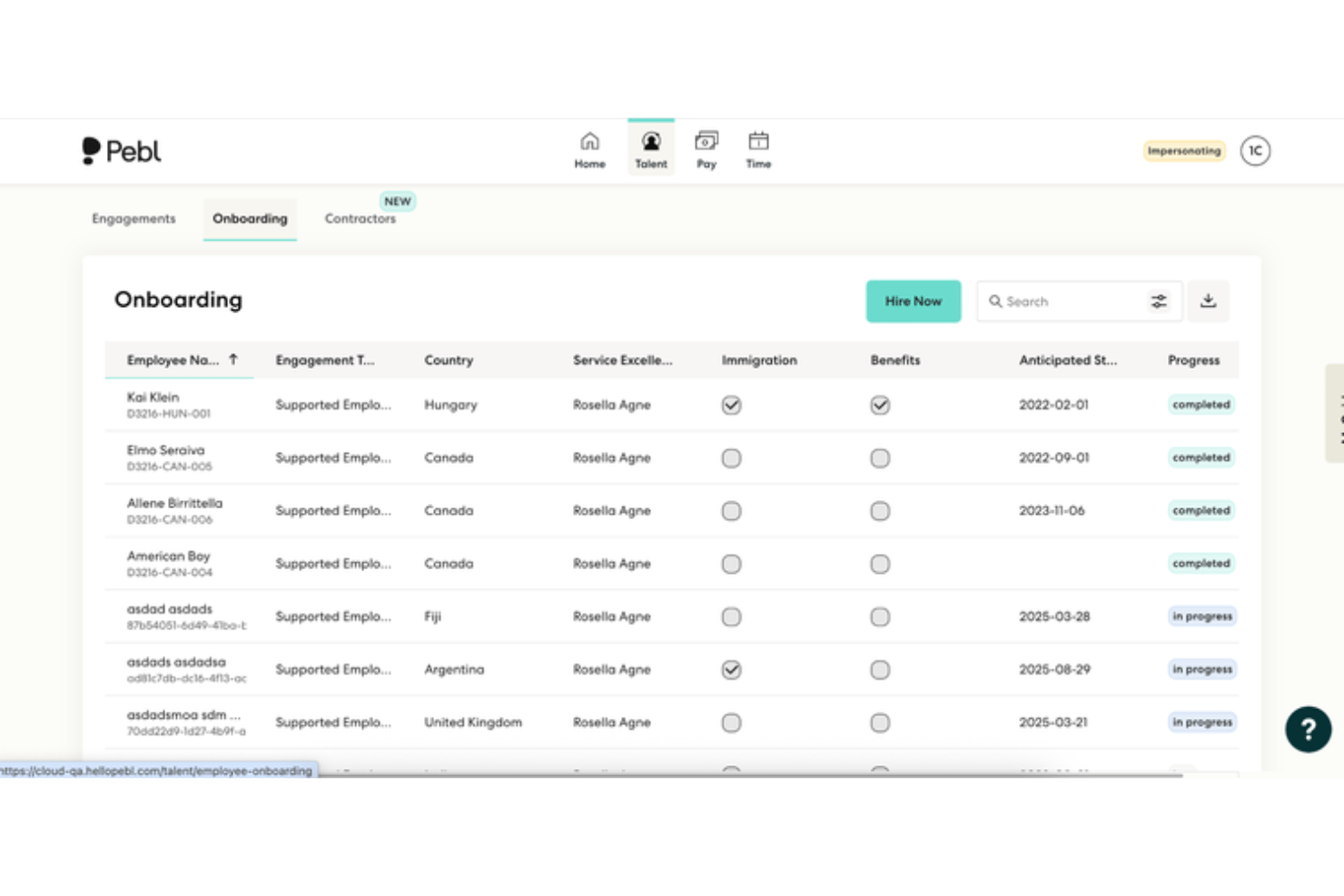
Pebl (formerly Velocity Global) is an AI-driven EOR platform for companies that need to hire, pay, and stay compliant across 185+ countries — including hard-to-reach markets where most global workforce tools don't have the licensing depth to operate.
Who Is Pebl Best For?
Pebl is a strong fit for HR and people ops teams at growing companies that need entity-free hiring across APAC or other markets with complex local labor requirements.
Why Pebl Is a Good Deel Alternative
Pebl earns its spot on my shortlist because of how deep its APAC compliance coverage actually goes. Unlike Deel, Pebl holds more employment licenses across Pacific Islands, Central Asia, and Southeast Asia, which matters when you're hiring in markets where most EORs hand you off to a third-party partner. I also appreciate the in-house immigration support via Vialto Partners, which makes visa and relocation cases in APAC far less painful to manage.
Pebl Key Features
- Global Work Platform dashboard: Manage hiring, payroll, benefits, and compliance across 185+ countries from a single AI-powered interface.
- Alfie AI assistant: Get instant answers to compliance and onboarding questions in 50+ languages through a built-in chat assistant.
- Expense and leave management: Track, approve, and record global employee expenses and leave within the same platform.
- ATS and HRIS integrations: Sync new hires, payroll data, and employee documents with popular applicant tracking and HR systems.
Pebl Integrations
Pebl offers native integrations with applicant tracking systems like Greenhouse, Lever, Workable, and Ashby, plus HRIS platforms including BambooHR, HiBob, Namely, ADP Workforce Now, and Oracle. An API is available for custom integrations.
Pros and Cons
Pros:
- AI assistant covers compliance in 50+ languages
- Built-in immigration support via Vialto Partners
- Deep owned-entity coverage across APAC markets
Cons:
- Less established than legacy EOR providers
- Smaller global footprint outside APAC
G-P
Best for in-house entity coverage across regions
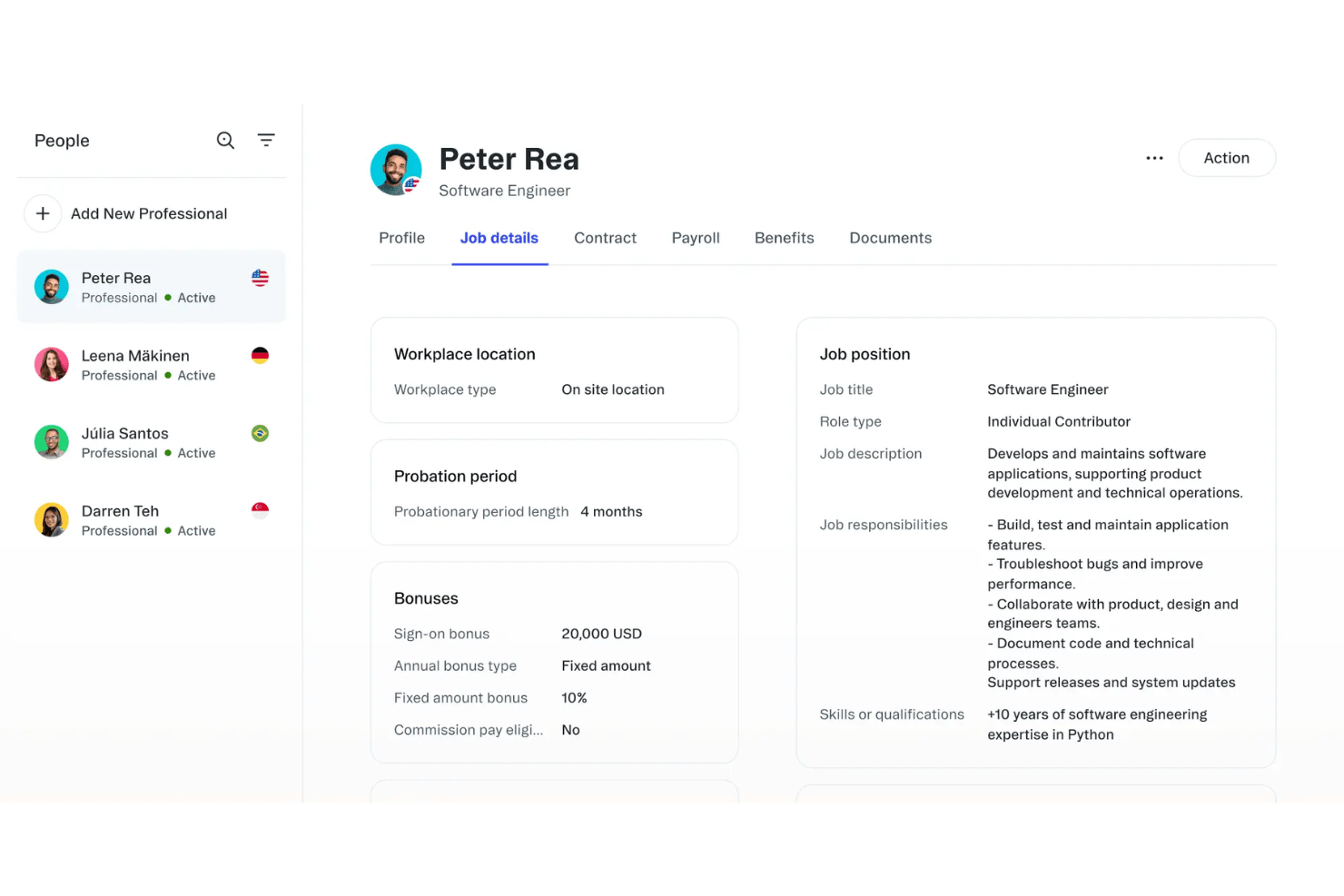
G-P is an employer of record platform built for enterprises that need to hire, pay, and manage employees in 180+ countries without establishing local legal entities, covering end-to-end payroll, onboarding, and compliance through its own in-country infrastructure.
Who Is G-P Best For?
G-P is a strong fit for mid-market and enterprise teams hiring across multiple regions who need legally sound employment in complex jurisdictions.
Why G-P Is a Good Deel Alternative
I've included G-P in my top picks because it owns its employing entity in every one of the 180+ countries it covers, which Deel can't match (it relies on partners in roughly half its markets). That distinction matters most when hiring in high-risk jurisdictions like India or Brazil, where compliance errors carry real legal exposure. G-P's Global Compliance Engine and in-house legal teams handle local labor law directly, with no intermediary layer between your team and the entity managing your employees.
G-P Key Features
- AI-guided onboarding: G-P Gia uses artificial intelligence to generate compliant HR documents and offer letters based on country-specific requirements.
- Locally competitive benefits administration: Manage health, pension, and equity packages tailored to each region’s legal and market norms.
- Bulk contract issuance: Instantly generate and distribute custom contracts for contractors in multiple countries in one workflow.
- Visa and global mobility support: Access in-house experts for employment visa processing and relocation assistance in over 40 countries.
G-P Integrations
Integrations include ADP Workforce Now, Paylocity, BambooHR, UKG Pro, Workday, and more.
Pros and Cons
Pros:
- Faster onboarding in complex hiring markets
- In-house compliance team handles local law
- Owns legal entities in 180+ countries
Cons:
- Platform reporting lacks depth for finance teams
- Contractor tools lag behind Deel's offering
Best for advanced multi-currency payroll analytics
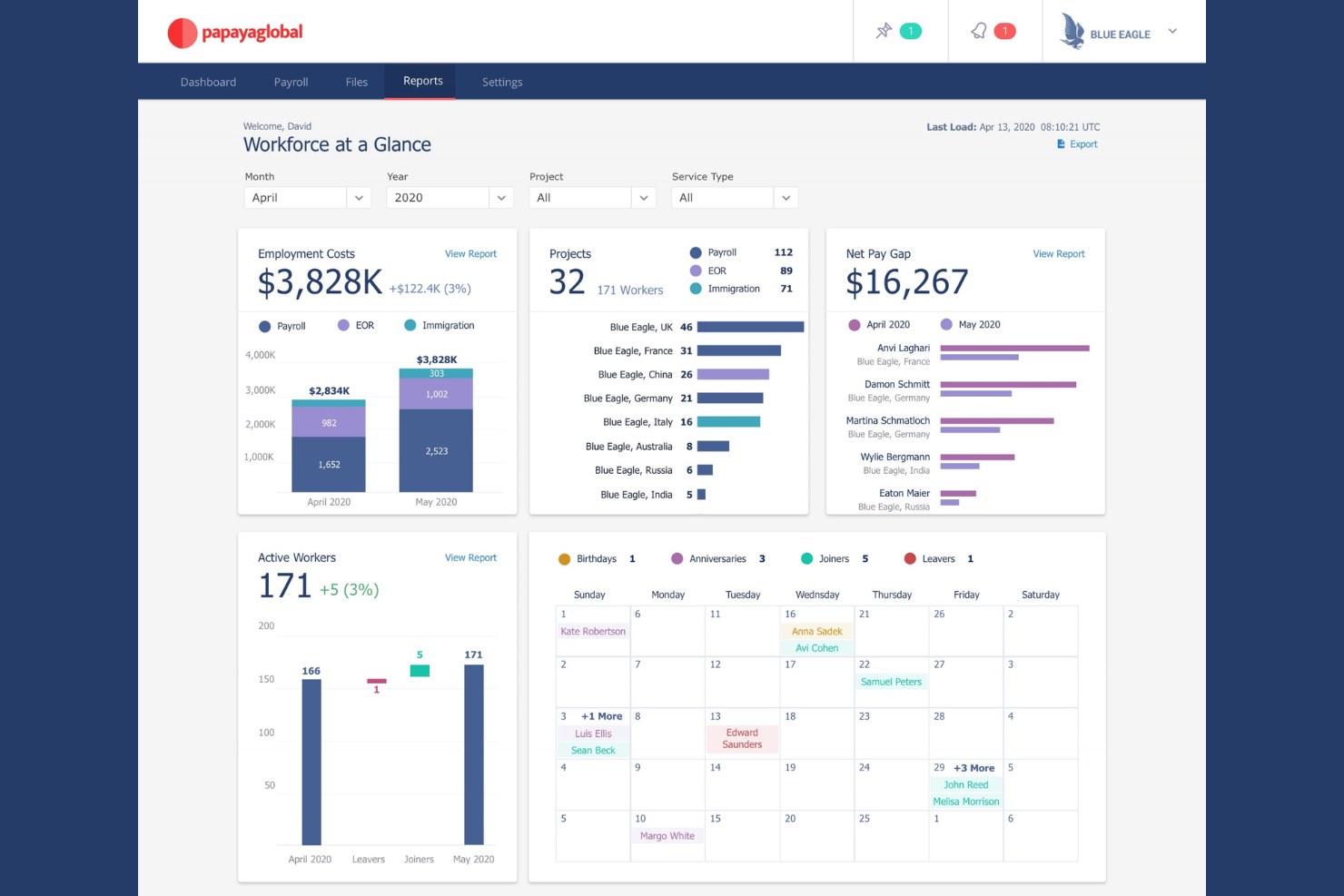
Papaya Global is an enterprise-grade global payroll and workforce management platform built for finance and HR teams that need to pay, hire, and stay compliant across 180+ countries without routing everything through third-party payment rails.
Who Is Papaya Global Best For?
Papaya Global suits mid-market to enterprise companies running multi-country payroll who need deep finance system integrations and same-day payment capabilities at scale.
Why Papaya Global Is a Good Deel Alternative
Papaya Global earns its spot on my shortlist because of how it handles multi-currency payroll analytics at a depth Deel simply doesn't match. I'm particularly impressed by the BI reporting layer inside Payroll Plus, which breaks down payroll spend by geography across 130+ currencies in standardized G2N reports. Pair that with AI-powered payroll validation and you've got financial visibility that actually holds up when reconciling multi-country payrolls at month-end.
Papaya Global Key Features
- OnePay payment process: Enables same-day, multi-currency payments to workers in over 130 currencies using direct global payment rails.
- HCM and ERP integrations: Syncs bidirectionally with platforms like Workday, SAP SuccessFactors, Oracle, BambooHR, and NetSuite for unified data flow.
- Workforce OS roles and permissions: Lets you assign granular access controls and custom workflows for HR, payroll, and finance teams.
- Contingent OS contractor management: Supports end-to-end onboarding, compliance checks, and payment for contractors, freelancers, and consultants in 160+ countries.
Papaya Global Integrations
Papaya Global offers native integrations with Workday, NetSuite, BambooHR, and HiBob, and provides an API for custom integrations.
Pros and Cons
Pros:
- AI-powered payroll validation catches errors pre-run
- Same-day multi-currency payment capabilities
- Built-in payroll engines in 160+ countries
Cons:
- Customer support response times can be slow
- EOR coverage relies on third-party partners
Remote
Best for direct global employment in 75+ countries
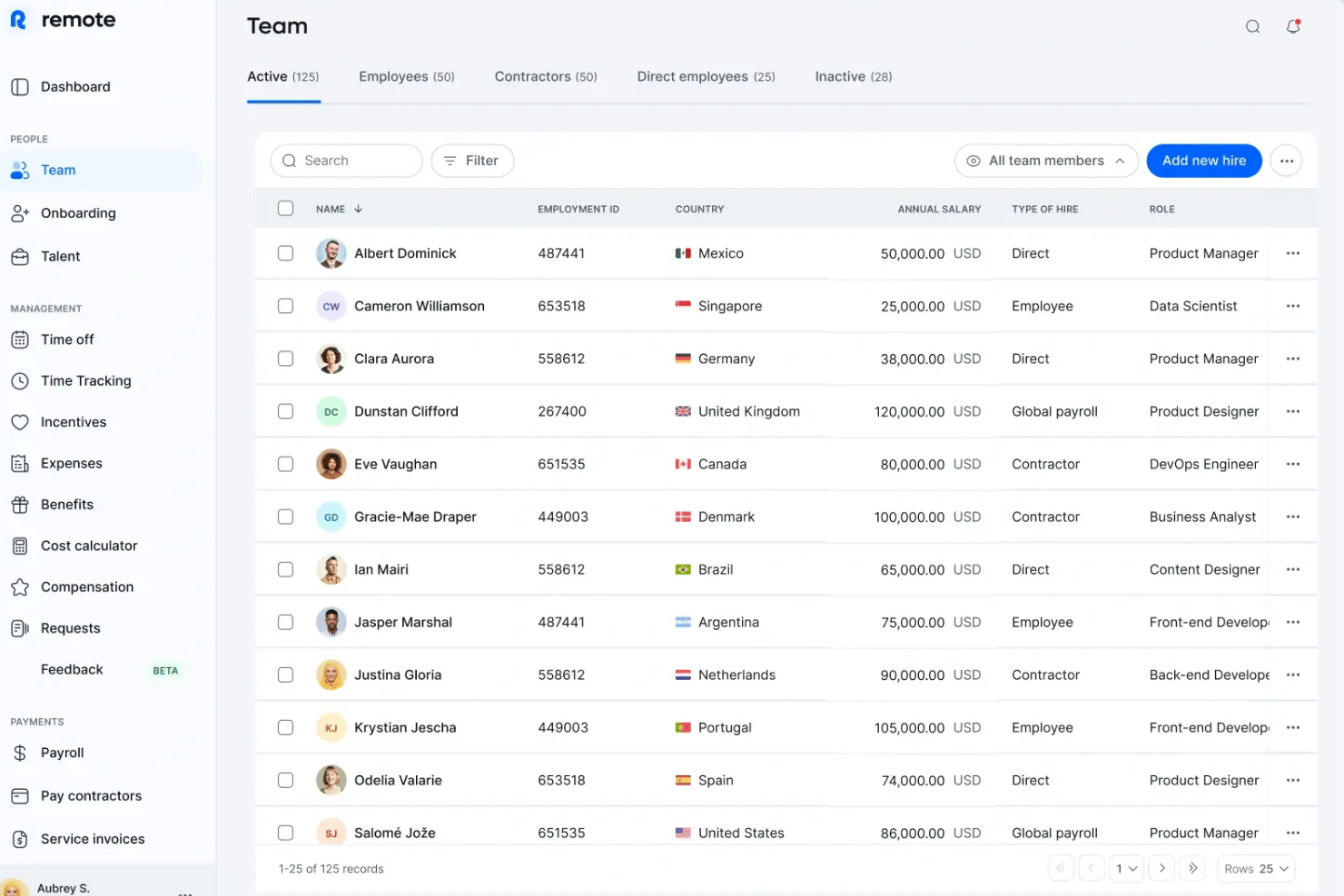
Remote is a global HR and EOR platform built for companies that want to hire, pay, and manage full-time employees and contractors internationally without relying on third-party partners or opening local entities.
Who Is Remote Best For?
Remote is a strong fit for scaling tech companies that need compliant cross-border hiring with owned-entity EOR coverage and built-in IP protection.
Why Remote Is a Good Deel Alternative
I've included Remote in my top picks because it operates through 100% owned legal entities, with no third-party partners sitting between your company and compliance. The feature I find most compelling is Remote IP Guard, which is built into every EOR contract and legally anchors your code and product to your company regardless of where the engineer is based. The Contractor of Record product also takes on full legal responsibility for classification and provides uncapped indemnity against misclassification penalties.
Remote Key Features
- Equity management: Issue and manage global stock options and equity grants directly from the platform.
- Localized benefits administration: Offer curated, country-specific health, pension, and perks packages tailored to local market norms.
- Contractor-to-employee conversion: Transition contractors to full-time EOR employees while maintaining continuity in tenure and payments.
- Multi-country payroll engine: Run automated payroll with in-country payroll engines handling local tax filings and statutory deductions.
Remote Integrations
Remote offers native integrations with BambooHR, HiBob, Greenhouse, Slack, and Personio. An API is available for custom integrations.
Pros and Cons
Pros:
- Uncapped misclassification indemnity for contractors
- Built-in IP protection on all contracts
- Owned entities in every supported country
Cons:
- Customer success response times can be slow
- Country coverage narrower than some EOR competitors

Plane
Best for flexible contractor payments worldwide
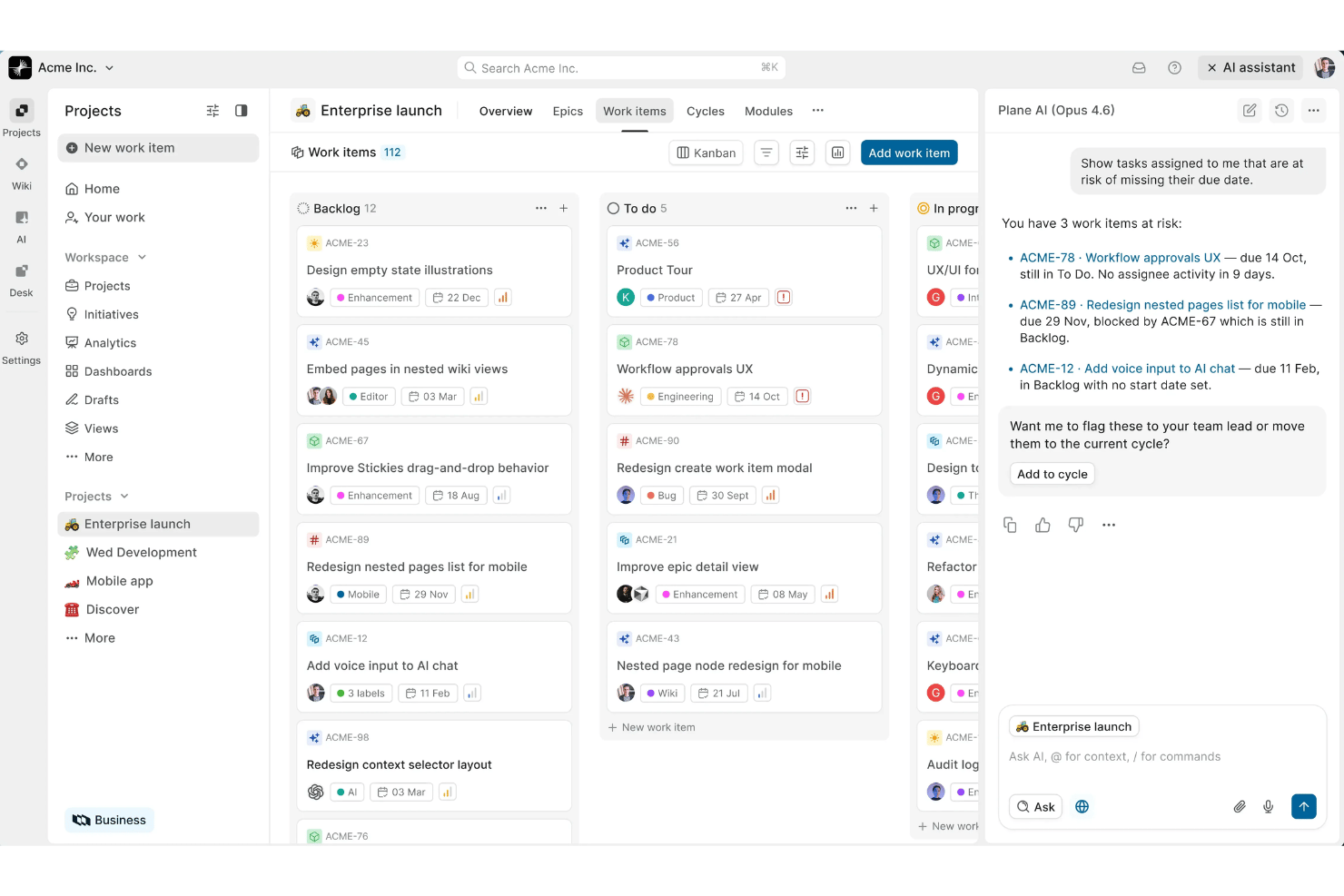
Plane is a global payroll and EOR platform for US-based companies that need to pay contractors across 240+ countries and hire full-time employees without local entity setup, e-wallet friction, or hidden FX markups.
Who Is Plane Best For?
Plane fits small businesses and mid-market companies managing a mix of US employees and international contractors who prioritize transparent pricing and direct-to-bank payments.
Why Plane Is a Good Deel Alternative
I picked Plane as one of the best because it pays contractors in 240+ countries directly to their bank accounts, with no e-wallet required and no withdrawal fees eating into what contractors actually receive. When a payment fails, Plane's AI works through the error automatically and follows up with the contractor directly to resolve it, rather than routing the problem back to my team. Near-mid-market FX rates across 70+ local currencies mean contractors aren't losing money on conversion with every payout.
Plane Key Features
- QuickBooks Online integration: Sync payroll and contractor payment data automatically with your accounting records.
- Unified HR dashboard: Manage US employees, international EOR hires, and global contractors from a single screen.
- Automated tax compliance: Handle US state registrations, IRS 1099 filings, and country-specific payroll taxes without manual processes.
- Open REST API and CLI: Enable developers to automate workforce management tasks and connect external systems programmatically.
Plane Integrations
Plane offers native integrations with QuickBooks Online and Slack. An open REST API and CLI are available for custom integrations.
Pros and Cons
Pros:
- Native MCP server for AI agent payroll automation
- Contractors inactive months bill at $0
- No deposit or annual lock-in requirements
Cons:
- Only serves US-headquartered companies
- EOR onboarding takes one to four weeks
Best for local expertise with global footprint
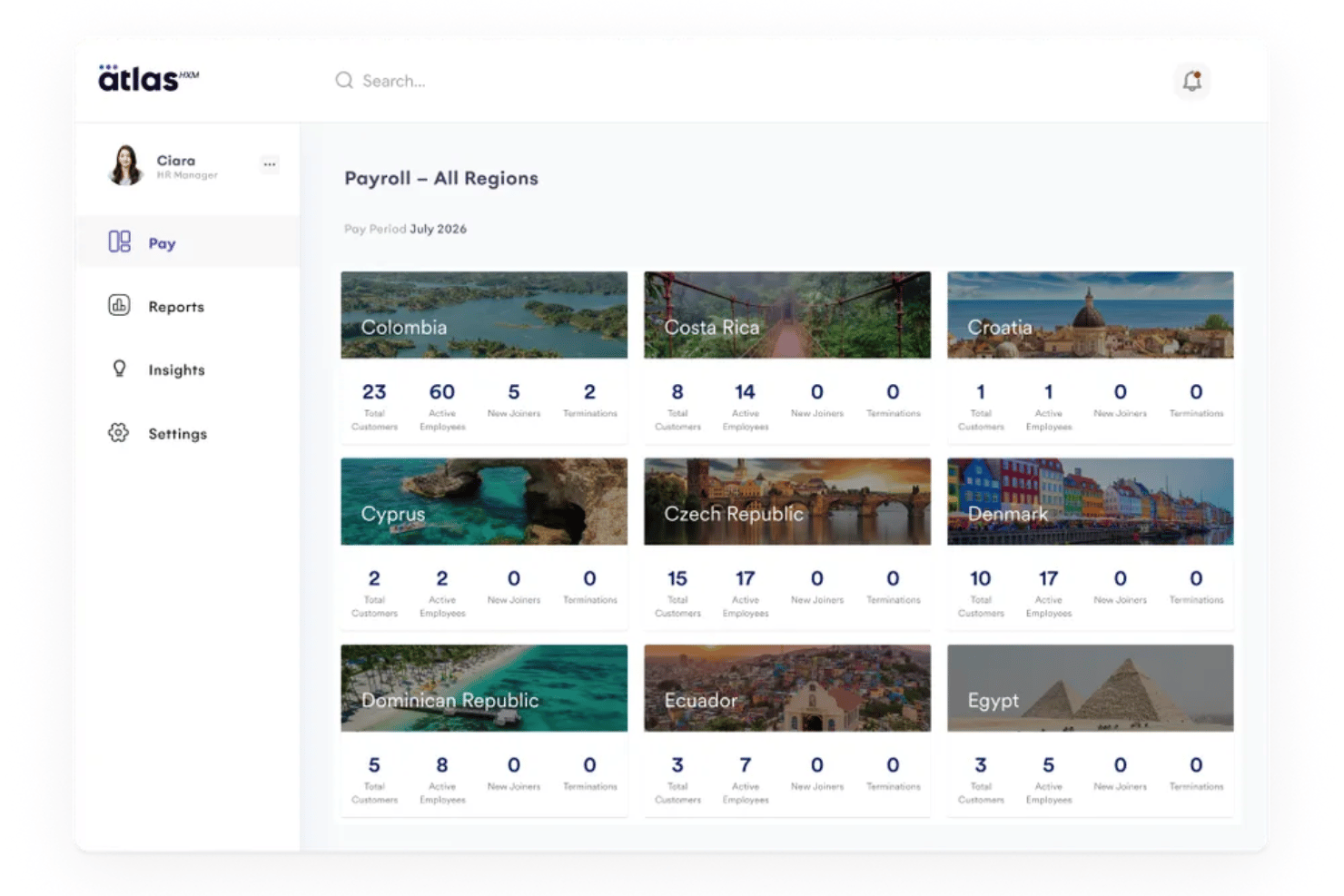
Atlas HXM is a direct Employer of Record platform for companies that need to hire, onboard, and pay full-time employees across 160+ countries without depending on third-party partners to manage local compliance, payroll, or legal entities.
Who Is Atlas HXM Best For?
Atlas HXM suits mid-market and enterprise teams managing global expansion where direct legal entity ownership is a priority for payroll accuracy and compliance control.
Why Atlas HXM Is a Good Deel Alternative
I picked Atlas HXM because its direct entity ownership model is a genuine alternative to Deel's partner-reliant approach. Every employee gets a dedicated account manager, supported in 90+ languages with local time zone coverage. Add visa sponsorship across 75+ countries, and you have a provider that's actually embedded in local markets rather than coordinating through intermediaries.
Atlas HXM Key Features
- Expense card integration: Manage and track global business expenses with an integrated card system linked to payroll and reporting.
- Localized benefits administration: Offer country-specific benefits packages tailored to meet local statutory requirements and market expectations.
- Atlas HXM Learning platform: Provide employees with access to over 9,000 courses, professional certificates, and degree programs for ongoing development.
- Mobile app support: Enable remote teams to access HR tools, submit expenses, and view payroll data from iOS and Android devices.
Atlas HXM Integrations
Atlas HXM offers an API for custom integrations. Native integrations are not clearly documented.
Pros and Cons
Pros:
- Direct payroll processing with consistently high accuracy
- APAC operations are deeply embedded and locally staffed
- Owns legal entities across 160+ countries
Cons:
- Platform has a steep learning curve for new users
- Internal coordination gaps have caused delayed or incorrect pay

Lano
Best for customizable payout methods
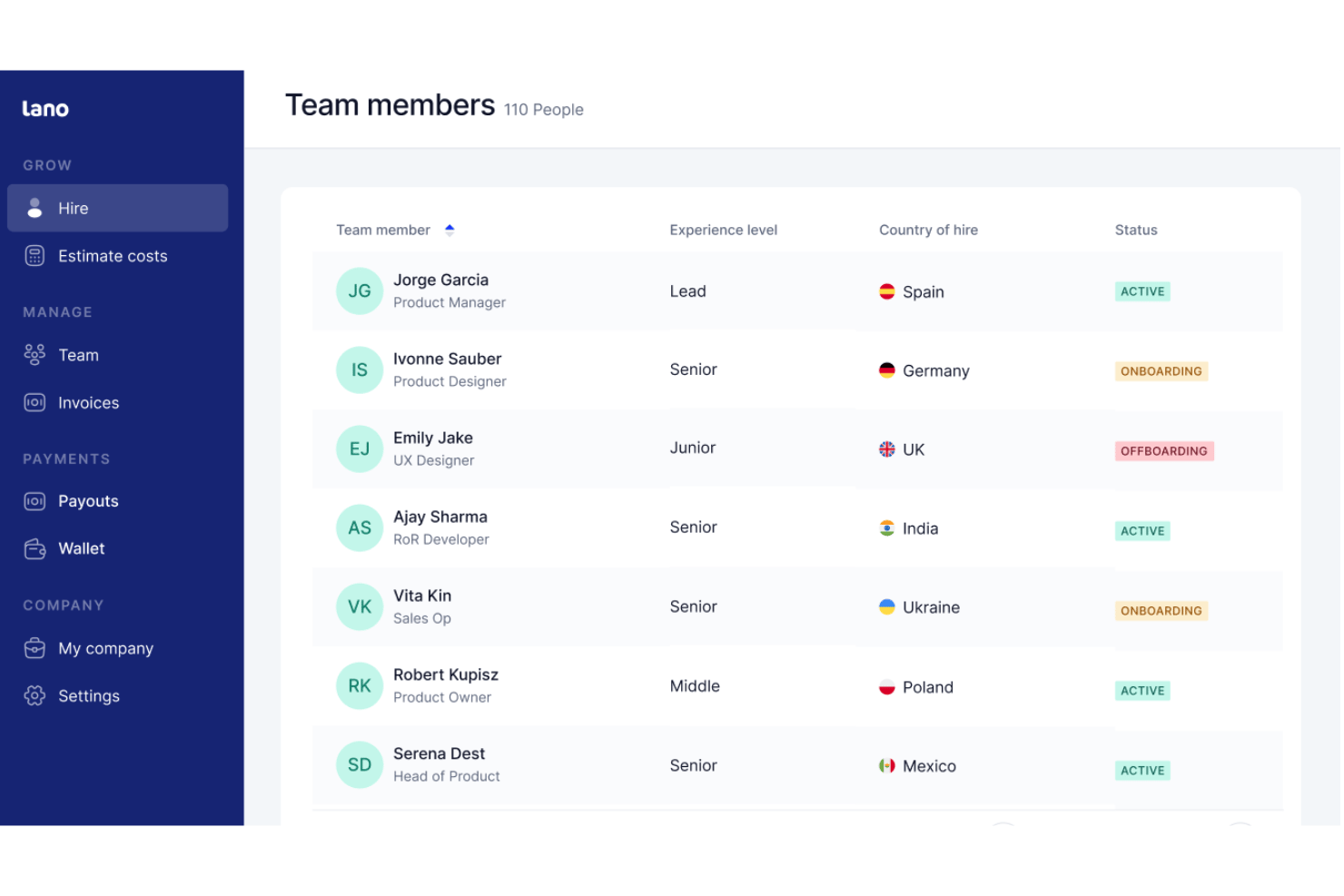
Lano is a global employment and payroll platform that lets finance and HR teams run EOR, contractor management, and multi-country payroll from a single dashboard—without replacing the local payroll providers they already use.
Who Is Lano Best For?
Lano suits mid-market companies expanding across multiple countries that already have local payroll providers and want one consolidated view without rebuilding their setup from scratch.
Why Lano Is a Good Deel Alternative
I've included Lano in my top picks because of how its Lano Wallet handles international payouts. Local payment rails are free, SWIFT costs €25 per transaction, and I can run bulk payouts across 170+ countries in 70+ currencies without leaving the same dashboard where payroll runs. That flexibility means I can pay a contractor in Brazil via local transfer and a full-time hire in Germany via SWIFT in the same batch.
Lano Key Features
- Payroll consolidation dashboard: Centralizes payroll data from multiple local providers across all countries into a single unified view.
- HRIS and ERP integrations: Connects with platforms like HiBob, Workday, and SAP for simplified HR and payroll processes.
- Automated compliance workflows: Delivers local contract generation, document management, and automation for region-specific payroll compliance.
- Contractor management lifecycle: Supports onboarding, classification, invoicing, payments, and transitions from contractor to employee status.
Lano Integrations
Integrations include HiBob, Workday, Sage, Zoho People, and Personio.
Pros and Cons
Pros:
- Covers both EOR and contractor management globally
- Connects existing local payroll providers to one dashboard
- Flexible payout methods including crypto and wallets
Cons:
- Customer support response times reported as inconsistent
- EOR country coverage narrower than top competitors

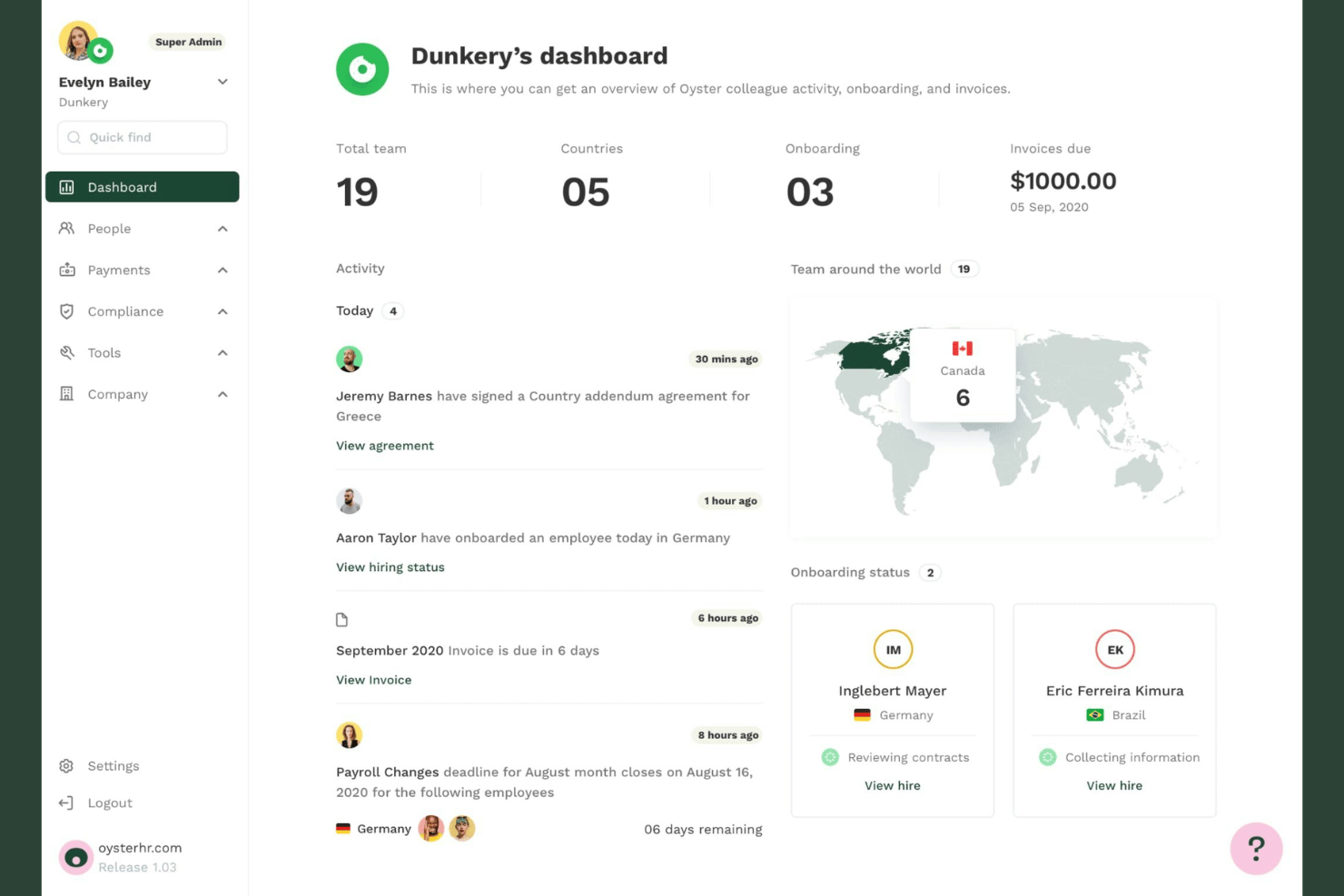
Oyster is an Employer of Record platform for companies hiring full-time employees and contractors across 180+ countries, combining automated compliance, in-house legal expertise, and a human support model that sets it apart from more transactional global hiring tools.
Who Is Oyster Best For?
Oyster is a strong fit for mid-market companies and mission-driven organizations that prioritize compliance depth and hands-on support over the lowest possible price.
Why Oyster Is a Good Deel Alternative
I've included Oyster in my top picks because it backs its compliance promise with features that go beyond automated contracts. Oyster Shell provides misclassification liability coverage up to $500,000, which is something I haven't seen matched elsewhere in this category. When something complex comes up, like a termination in France or a cross-border relocation from Germany to Portugal, Oyster's in-house legal experts handle it directly rather than routing you through third-party partners.
Oyster Key Features
- Localized benefits administration: Tailor benefits like health insurance and pension to meet market norms and legal requirements in each country.
- Contractor-to-employee conversion: Reclassify team members from contractor to employee status without interruption in tenure or pay.
- Salary insights tool: Access compensation benchmarks for 130+ countries directly within the platform.
- Native payroll processing: Run in-country payroll engines that automate tax filings and statutory deductions for compliant global pay runs.
Oyster Integrations
Oyster offers native integrations with BambooHR, HiBob, Personio, Greenhouse, Xero, QuickBooks, NetSuite, Carta, and Slack, and connects with Zapier. An API is available for custom integrations.
Pros and Cons
Pros:
- Contractor-to-employee conversion
- In-house legal experts handle complex terminations
- Misclassification liability coverage up to $500,000
Cons:
- Limited self-serve tools for lean HR teams
- Onboarding slower in partner-dependent markets
Other Deel Alternatives
Here are some additional Deel alternative options that didn’t make it onto my shortlist, but are still worth checking out:
- RemoFirst
For onboarding in emerging markets
- Payoneer Workforce Management
For contractor management
- RemotePeople
For employer-led onboarding controls
- Worksuite
For large-scale freelancer management
- Borderless AI
For AI-powered global workforce compliance
- Worksome
For direct sourcing of expert contractors
- Native Teams
For local tax registrations
- Playroll
For high-growth team expansion needs
- Justworks
For all-in-one benefits administration
- WorkMotion
For fast global hiring automation


How I Evaluate Deel Alternatives
I split my evaluation into two layers: core functionality every Deel alternative needs, and differentiating factors that separate the best. The core layer covers Deel's own capabilities—global payroll, EOR, contractor management, and compliance.
Core Functionality (Table Stakes For This List)
When I'm selecting tools for my list, I rank each one on a scale from 0 (does not offer the functionality) to 5 (excels in this area) for each core functionality listed below. Then, I calculate the tool's total score into a percentage. Each tool needs to achieve a minimum total score of 75% to be considered for inclusion.
- Global payroll processing: I check how many countries a platform supports and whether it handles local tax filings and deductions automatically.
- EOR services: The breadth of countries covered matters, but so does whether the vendor owns its entities or relies on third-party partners.
- Contractor management: I evaluate the full lifecycle—onboarding, contracts, invoicing, payments, and worker classification tools all factor in.
- Compliance support and tax handling: Localized contracts and auto-generated tax forms based on the worker's country are what I look for here.
- Multi-currency payments: Supported currencies and payout flexibility both count, from bank transfers and digital wallets to crypto options.
- Integrations and HRIS functions: I check for connections to accounting and PM tools, plus built-in HR features like time tracking and expenses.
Once I have a list of tools that meet the criteria, I consider what sets each platform apart.
Differentiating Factors (What Sets Vendors Apart)
Here's how I compare and contrast different vendors:
Standout Features
Contractor-to-employee conversion is a big one. When a project hire becomes a permanent team member, I look for platforms that handle that shift without resetting payment history or tenure records. Localized benefits administration also matters because generic stipends rarely compete with curated, country-specific packages for health, pension, or equity. Native payroll engines are worth evaluating too, since platforms that run payroll directly tend to process faster than those relying on third-party aggregators.
Beyond Features
Entity ownership is something I always check. Vendors that own their legal entities in-country tend to offer faster onboarding and more predictable support than those relying on third-party partners. Pricing transparency matters just as much—I look at the full cost picture, including FX markups, deposit requirements, and off-cycle payment fees. Compliance risk coverage is another factor I evaluate closely, especially how a vendor handles termination liability and whether they offer misclassification indemnification.
Why Look For A Deel Alternative?
While Deel is a good choice of global workforce management software, there are a number of reasons why some users seek out alternative solutions. You might be looking for a Deel alternative because…
- Needing faster payroll processing in certain regions
- Wanting more transparent or flexible pricing
- Requiring deeper local benefits packages for employees
- Expanding into a country where Deel lacks owned entities
- Seeking better support for contractor-to-employee conversion
- Preferring more customizable integration for scalability
If any of these sound like you, you’ve come to the right place. My list contains several global workforce management software options that are better suited for teams facing these challenges with Deel and looking for alternative solutions.Key Features
Deel Key Features
Here are some of the key features of Deel, to help you contrast and compare what alternative solutions offer:
- Global payroll processing: Run payroll for employees and contractors in multiple countries, with automated local tax calculations and statutory deductions to ensure compliance.
- Employer of record (EOR) services: Legally hire full-time employees in countries where you don’t have an entity, so you can enter new markets quickly while outsourcing HR and payroll risk.
- Contractor onboarding and management: Automate onboarding, classification, contracts, and payments for international contractors, providing a unified workflow across global teams.
- Multi-currency payments: Send payments in dozens of currencies and access various payout methods, from bank transfers and wallets to alternative rails like crypto, for flexibility and speed.
- Compliance automation: Generate locally compliant contracts, handle required tax forms, and track regulatory updates to reduce legal risk in new countries or regions.
- Benefits administration: Offer country-specific benefits packages such as health, pension, stock options, and meal vouchers that match or exceed local market norms and statutory minimums.
- Time tracking and expense management: Track billable hours, record absences, and manage cross-border expense reimbursements, centralizing records and approvals for distributed teams.
- Integrations with HR and accounting tools: Connect to popular HRIS, ERP, and accounting platforms to sync data, avoid duplicate entry, and keep financials up to date automatically.
- Contractor-to-employee conversion: Move contractors onto full-time employment contracts as your hiring needs evolve, without disrupting payroll history or tenure.
- Data security and certifications: Protect sensitive personal and payment data with leading industry security standards and certifications, providing peace of mind for HR and finance teams.