

monday dev Review: Pros, Cons, Features & Pricing



monday dev is an agile project management software that streamlines workflows, collaboration, and task tracking. It’s ideal for tech startups, software development teams, and IT departments that need adaptable tools to enhance project efficiency. monday dev's value lies in its ability to boost team productivity through seamless integration, customizable workflows, and no-code configurations that support a wide range of agile methodologies like scrum and Kanban.
In this article, you’ll learn about monday dev's features, pros and cons, pricing, and more. Whether you're aiming to improve project delivery or enhance team collaboration, this review will guide you in making an informed choice.
monday dev Evaluation Summary
- From $9/month (billed annually)
- Free trial available
Why You Can Trust Us
We’ve been testing and reviewing project management software since 2012. As project managers ourselves, we know how critical and difficult it is to make the right decision when selecting software.
We invest in deep research to help our audience make better software purchasing decisions. We’ve tested more than 2,000 tools for different project management use cases and written over 1,000 comprehensive software reviews. Learn how we stay transparent & our software review methodology.
monday dev Overview
In my opinion, monday dev is a strong agile project management tool that offers high levels of customization and integration suited for tech-savvy teams in fast-paced environments. Its strengths lie in connectivity and automation, which makes it ideal for teams that rely on integrated workflows. However, its Gantt view and some training materials could be improved. Compared to other tools, monday dev delivers solid value through flexible pricing and features that support both work management and product development.

pros
-
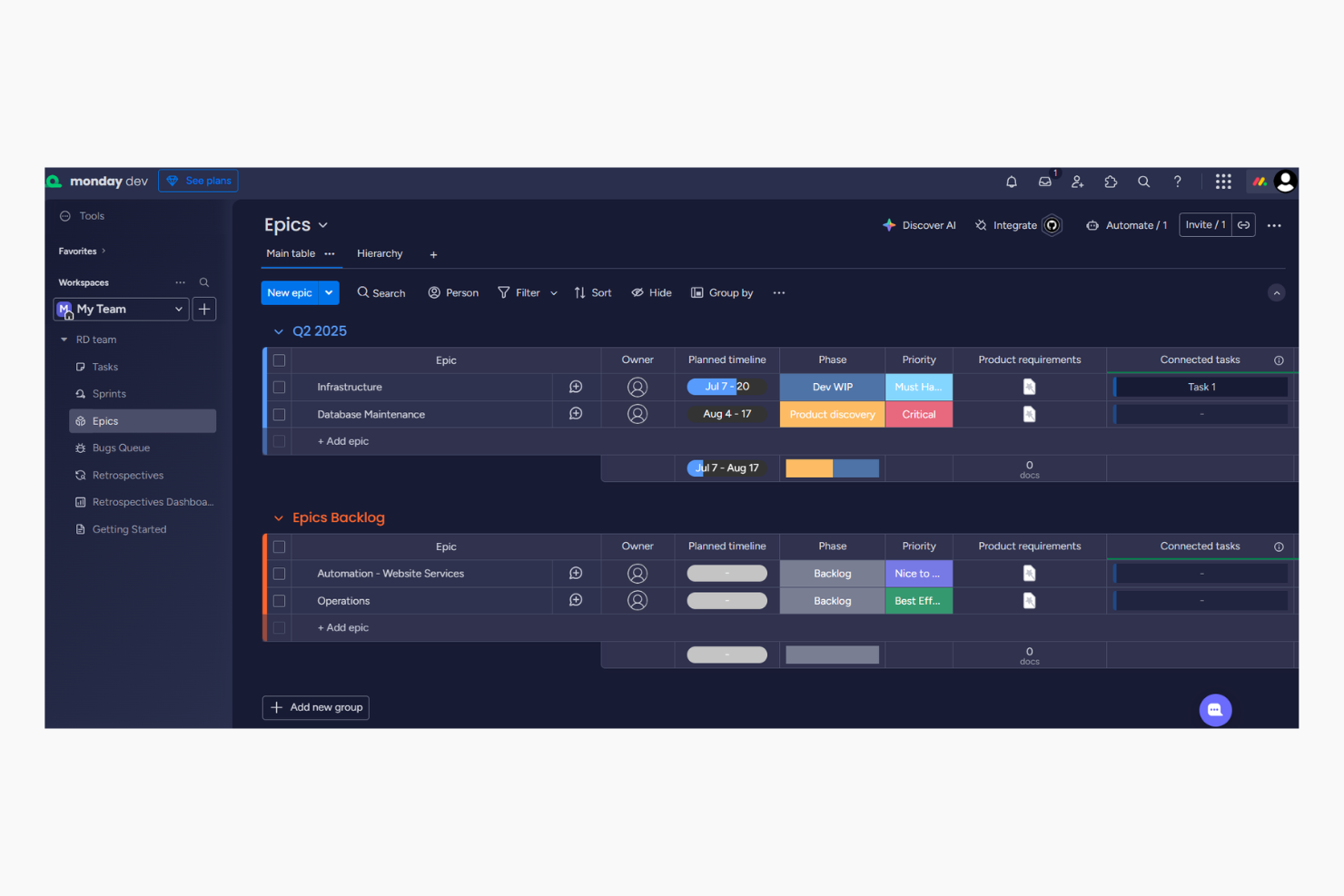
Easily customize workflows, including sprint planning and Kanban board configurations
-
Visual project tracking keeps your team aligned and focused
-
Automation features save time on repetitive tasks
cons
-
Gantt chart view is less intuitive than other tools
-
Mobile app lacks full functionality for managing product roadmap tasks.
-
Initial setup might be overwhelming for teams new to agile tools
-

Celoxis
Visit WebsiteThis rating combines scores from multiple user review sites to reflect overall customer sentiment about the product.4.5 -
Smartsheet
Visit WebsiteThis rating combines scores from multiple user review sites to reflect overall customer sentiment about the product.4.5 -
Accelo
Visit WebsiteThis rating combines scores from multiple user review sites to reflect overall customer sentiment about the product.4.4




Our Review Methodology
How We Test & Score Tools
We’ve spent years building, refining, and improving our software testing and scoring system. The rubric is designed to capture the nuances of software selection and what makes a tool effective, focusing on critical aspects of the decision-making process.
Below, you can see exactly how our testing and scoring works across seven criteria. It allows us to provide an unbiased evaluation of the software based on core functionality, standout features, ease of use, onboarding, customer support, integrations, customer reviews, and value for money.
Core Functionality (25% of final scoring)
The starting point of our evaluation is always the core functionality of the tool. Does it have the basic features and functions that a user would expect to see? Are any of those core features locked to higher-tiered pricing plans? At its core, we expect a tool to stand up against the baseline capabilities of its competitors.
Standout Features (25% of final scoring)
Next, we evaluate uncommon standout features that go above and beyond the core functionality typically found in tools of its kind. A high score reflects specialized or unique features that make the product faster, more efficient, or offer additional value to the user.
We also evaluate how easy it is to integrate with other tools typically found in the tech stack to expand the functionality and utility of the software. Tools offering plentiful native integrations, 3rd party connections, and API access to build custom integrations score best.
Ease of Use (10% of final scoring)
We consider how quick and easy it is to execute the tasks defined in the core functionality using the tool. High scoring software is well designed, intuitive to use, offers mobile apps, provides templates, and makes relatively complex tasks seem simple.
Onboarding (10% of final scoring)
We know how important rapid team adoption is for a new platform, so we evaluate how easy it is to learn and use a tool with minimal training. We evaluate how quickly a team member can get set up and start using the tool with no experience. High scoring solutions indicate little or no support is required.
Customer Support (10% of final scoring)
We review how quick and easy it is to get unstuck and find help by phone, live chat, or knowledge base. Tools and companies that provide real-time support score best, while chatbots score worst.
Customer Reviews (10% of final scoring)
Beyond our own testing and evaluation, we consider the net promoter score from current and past customers. We review their likelihood, given the option, to choose the tool again for the core functionality. A high scoring software reflects a high net promoter score from current or past customers.
Value for Money (10% of final scoring)
Lastly, in consideration of all the other criteria, we review the average price of entry level plans against the core features and consider the value of the other evaluation criteria. Software that delivers more, for less, will score higher.
Core Features
Bug and issue tracking: You can log, assign, and manage bugs and issues in real time to support faster resolution.
Task automation: You can automate repetitive tasks like status updates, due date reminders, and notifications to save time and reduce errors.
Sprint management: You can plan, run, and track sprints with customizable boards that support agile workflows like planning, standups, and retrospectives.
Kanban and scrum views: You can switch between Kanban and scrum boards to match your team’s workflow and visually manage progress with drag-and-drop actions.
Integration with AI: You can use built-in AI tools to generate task summaries, automate updates, and categorize work, which helps your team save time and reduce manual effort.
Third-party integrations: monday dev integrates natively with Slack, Google Drive, Zoom, Microsoft Teams, Jira, Trello, GitHub, Figma, Basecamp, and Asana. monday dev also offers an API and connects with third-party integration tools like Zapier and various CRM platforms.

Ease of Use
monday dev features a user-friendly interface that is easy to navigate, even for those new to agile tools. Its visual project tracking and drag-and-drop functionality simplify task management. While some users may encounter a learning curve initially, the intuitive layout and customizable features quickly become familiar.
Compared to other tools, monday dev strikes a strong balance between simplicity and depth, enabling teams to adapt and perform efficiently.

monday dev Specs
- A/B Testing
- Access Management
- API
- Bug Tracking
- Cloud Deployment
- Code Transformation
- Collaboration Support
- Data Export
- Data Import
- Data Visualization
- Document Management
- External Integrations
- Form Builder
- History/Version Control
- Migration to Cloud
- Multi-User
- Notifications
- Process Modeling
- Re-Platforming
- Software Integration
- Status Notifications
- Template Designer
- Third-Party Plugins/Add-Ons
- Workflow Management
Alternatives to monday dev


monday dev FAQs
How does monday dev handle data security and compliance?
Can monday dev support large teams?
Is monday dev suitable for remote teams?
How customizable are the workflows in monday dev?
What kind of customer support does monday dev offer?
Can I use monday dev on mobile devices?
Does monday dev offer reporting and analytics?
Are there training resources available for new users?
What's Next?
Want to connect with other digital project managers to share resources and best practices? Join our membership community and get access to 100+ templates, samples, and examples, and connect with 100s of other digital project managers in Slack.