Project Charter Guide: Template, Examples, & How to Create It

Project charters outline the scope and objectives of your project. Without one, your project can't officially start, and there's no guarantee that your stakeholders will be aligned on the project purpose and deliverables. This sets you up for scope creep, miscommunications, and ultimately, project failure.
I’ll describe what a project charter is and how a well-crafted one stored in your project management software tool keeps you on track throughout the project. You’ll also find project charter samples and a template to help get started quickly.
What Is a Project Charter?
A project charter is a formal document that outlines the shared understanding of project scope, development, and project objectives, while also defining the roles and responsibilities of each party involved. It’s generally a fairly short document.

Project charters give the green light for a project to begin. It authorizes a project to exist and empowers the project manager to execute the work and spend the project budget. If the charter is approved, the project moves into the planning phase. You might also see a charter referred to as a brief or project initiation document (PID).
Project Charter Template & Sample
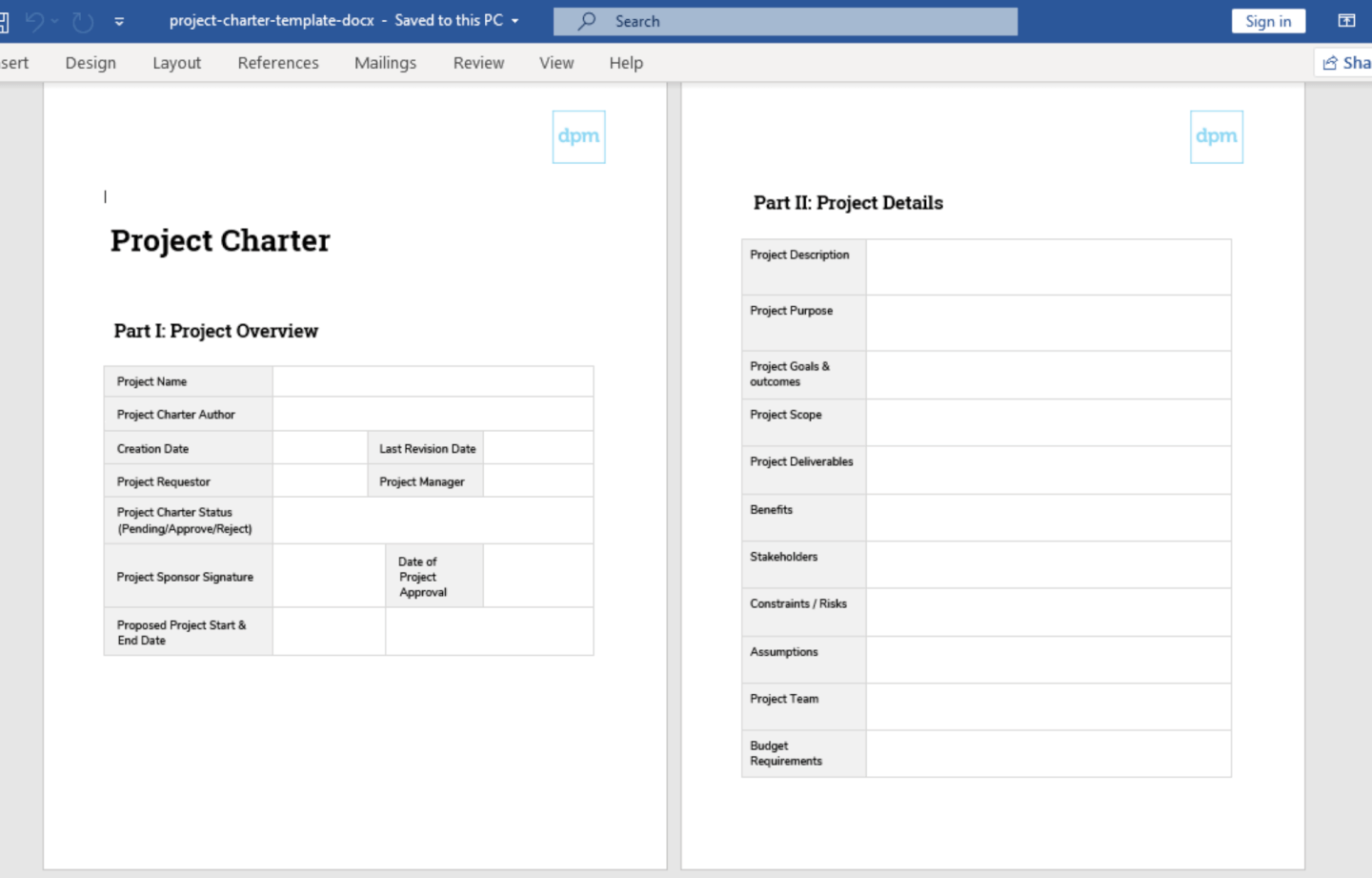
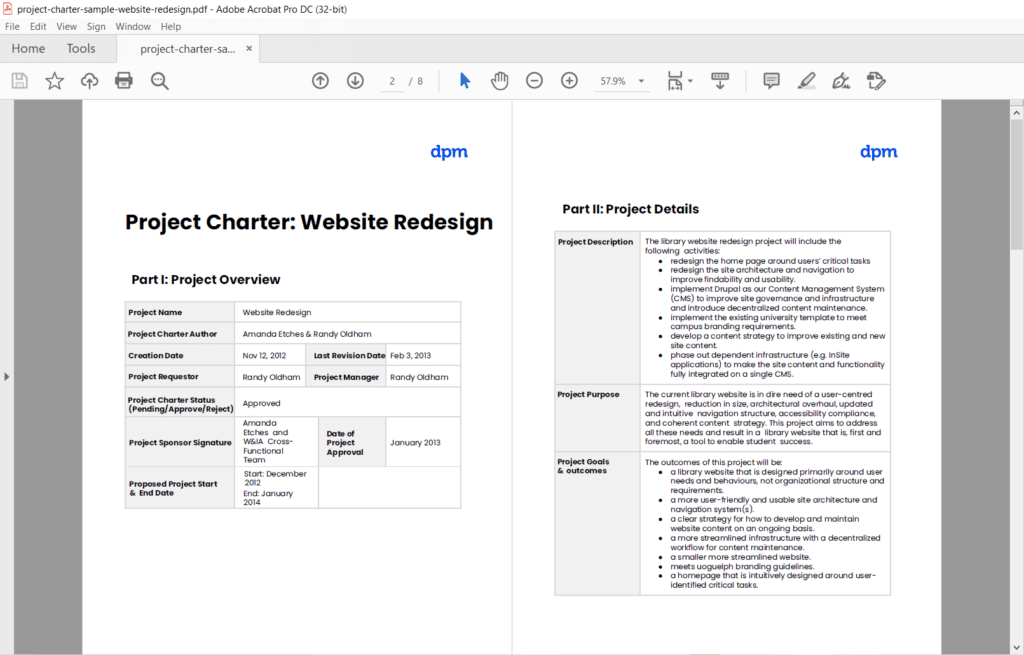
Download your template here and use this guide as you are completing it—the insights in this article will help you create a rock-solid project charter. We’ve also included a filled-in sample to give you an idea of what yours should look like.
Project Charter vs Statement of Work (SoW) vs Project Plan
A statement of work, project charter, and project plan serve different purposes but work together to define, authorize, and guide a project. The SoW establishes the scope and expected deliverables, the project charter formally authorizes the project, and the project plan outlines how the work will be executed and managed.
| Statement of Work | Project Charter | Project Plan | |
|---|---|---|---|
| Purpose | Defines the work to be performed, its boundaries, and expected outcomes | Formally authorizes the project and gives the project manager authority to lead it | Explains how the project will be executed, monitored, and controlled |
| Primary focus | What work is included, what isn't, and what must be delivered | Why the project exists, what it aims to achieve, and who is responsible | How and when the work will be completed |
| Key contents | Business needs, project scope, deliverables, assumptions, exclusions, and acceptance criteria | Business case, objectives, high-level scope, stakeholders, roles, budget, timeline, and success criteria | Schedule, project phases, deliverables, task dependencies, milestones, resources, risks, and communication plans |
| Level of detail | Detailed description of the agreed work and deliverables | High-level overview of the project and its requirements | Detailed breakdown of project activities and management processes |
| When it's created | During project initiation or contracting, often before the charter | During project initiation, before detailed planning begins | During project planning, after the charter is approved |
| Who uses it | Clients, vendors, project managers, and stakeholders | Project sponsors, project managers, and key stakeholders | Project managers, project teams, and stakeholders |
| Approval and authority | Establishes agreed work obligations when incorporated into an approved agreement | Provides formal authorization to proceed and lets the project manager use organizational resources | Establishes an approved approach and baseline for managing project delivery |
| Relationship to other documents | Often serves as an input to the project charter | Builds on the SoW or business case and guides development of the project plan | Builds on the charter and translates its objectives into actionable work |
Why is the Project Charter Important?
The project charter document is important because it gets your stakeholders to agree on why you’re doing the project, what’s in scope (at a high level), and who’s doing what. Some organizations require a signed project charter before allocating resources, including funding, to your project.
Let’s consider the benefits more in-depth, from the perspectives of each party involved.
Benefits for Project Managers & Teams
- Articulates project value proposition: It helps you determine if it’s worthwhile to carry out the project.
- Saves time down the road: The time you take to clarify objectives at the beginning of a project is time you won’t need to spend troubleshooting and negotiating later in the project life cycle.
- Clarifies the budget: A project charter ensures that funding is available and will be released on time. Settling your spending authority and budgets saves time prior to starting the project.
- Sets clear guidelines for your project team: Defining success criteria is invaluable for guiding the team as you begin to brief out the project.
- Boosts team morale: A team working under a sloppy charter will repeatedly find themselves confused, with their hard work wasted or headed in the wrong direction. A well-written charter gives metrics for a successful project that your team can feel motivated and confident to work toward.
The project charter has become automatic, right? People forget what this is all about. It’s a great document; this is your sales document to get people excited about what we’re doing. It also indicates who the project manager is. When you don’t have that formalization, you’re walking in rooms and people are like, ‘who made you project management god or goddess?’ You have this piece of paper to say, right here. It has the executive signing off on it. So it’s also that backup document.


Benefits for Clients & Other Stakeholders
- Creates a shared understanding: The project charter lets stakeholders know what to expect and what resource constraints the project faces.
- Serves as a marketing tool: The project charter can function as a sales document to justify new or existing investments.
What to Include in a Project Charter
Here's what to include in your project charter:
- Introduction: This section explains the purpose of the charter and provides the project name.
- Business case and scope statement: This section explains the purpose of the project (including business drivers and any related projects), defines high-level activities that are part of the scope of the project (to avoid scope creep later), and covers the expected return on investment.
- Success criteria: This section defines what success looks like and how the team will measure success.
- Major requirements or deliverables: This section summarizes high-level requirements and/or key deliverables.
- Budget: This section estimates project costs, ideally by project phase, and defines sources of project funding.
- Milestone schedule: This section estimates project duration and summarizes each major part of the project and all milestones.
- Assumptions and constraints: This section identifies known and unknown parameters upon project initiation.
- Project risks: This section summarizes major known threats or opportunities that may affect project success.
- Team and organization: This section 0defines project roles and responsibilities.
- Approvals: This section includes a space for stakeholders to record their approval (or disapproval) of the charter.
In addition to these project charter sections, you may also include an appendix with documents such as:
- List of deliverables: If deliverables are already defined, this list contains details about each deliverable: what it is and the associated acceptance criteria (such as given-when-then acceptance criteria).
- Scheduling documents: This can include the project timeline, calendar, or other documents that sequence project activities and include details about each project milestone or phase.
- Communication plan: This includes details about how each person involved will be kept informed about progress, scope changes, etc.
When Should I Create the Project Charter?
The project manager should create the project charter during the project initiation phase. Documenting the purpose of the project, what activities will be part of execution, and who is responsible for performing which activities is critical for aligning key stakeholders before the project kickoff.
How to Create a Project Charter
Here is a basic process to follow when you're creating a project charter:
1. Discuss With Stakeholders & Team
Gather information about the project by meeting with key stakeholders, including the project manager, project sponsors, clients, and representative project team members.
Don’t forget that stakeholders may also include other teams that provide specialized support, such as network capacity and security experts.
2. Take & Organize Notes
In your discussions, ask questions and take notes that help you to fill out each of the sections of your charter. Use your time wisely to collect the most salient information; you can always fill in the supporting details later on.
3. Use A Template
Take advantage of the myriad project charter templates available online to create the format that best serves your project needs.
DPM Members can use our pre-made charter template, along with a bunch of other time-saving resources. Alternatively, you could use one of the sample project charters in this post as a starting point.
4. Include Specific Information
Let’s start with a bad example. For a banking client, a project manager writes the project goal statement in the charter as “improve communication channels.” Yes, good communication is a worthy goal, but the way this is written leaves a lot to the imagination:
- Whose communication channels will be improved? Customers? Internal staff?
- How many users’ needs are we trying to address?
- Will we be updating an existing system or building a completely new system?
- When will it be completed?
- Does the scope extend to training on the new communication tool?
- Will the contract include any ongoing support for the system?
A complete charter provides clear, specific information on these questions so that the reader can understand the project purpose. Here’s a better example of a project scope statement (a key part of your charter):
“Create a new communication system to replace ABC system by December 2026, so that customers can chat with their product managers via XYZ bank’s proprietary mobile apps. Train 400 employees to maintain and support the system in-house.”
Apply similar logic to craft other sections of the charter. The goal of this exercise is for the project sponsor to have sufficient information to be able to approve the project.
5. Review With Team Representatives
After drafting a project charter but before reviewing it with a client, set aside time to review the charter with key members of your team to assess accuracy and completeness.
6. Present For Approval
Notice that this step is not “send for approval.” The project charter is the key to getting approval to undertake the project, and it’s important that it’s presented properly. Avoid simply attaching your charter as a PDF in an email, only to be ignored or dismissed out of hand.
Instead, present your charter to your sponsors, stakeholders, or clients. Do this in a meeting or through a slide presentation that includes supporting media. Make sure you leave sufficient time for questions and answers.
Project Charter Examples
Here are three different examples of project charters to consider:
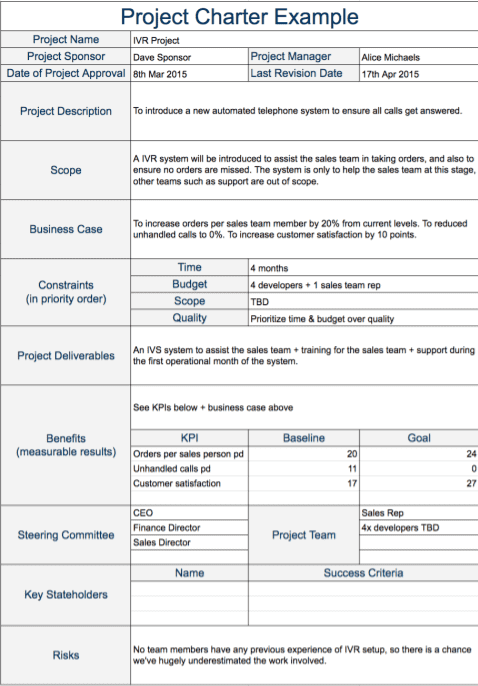
In this example project charter for an interactive voice response system, the project manager has included some notes on the business case, in addition to a project description and the scope.
They've also listed the constraints in priority order, which is useful for providing quick context to whoever is reading this document.
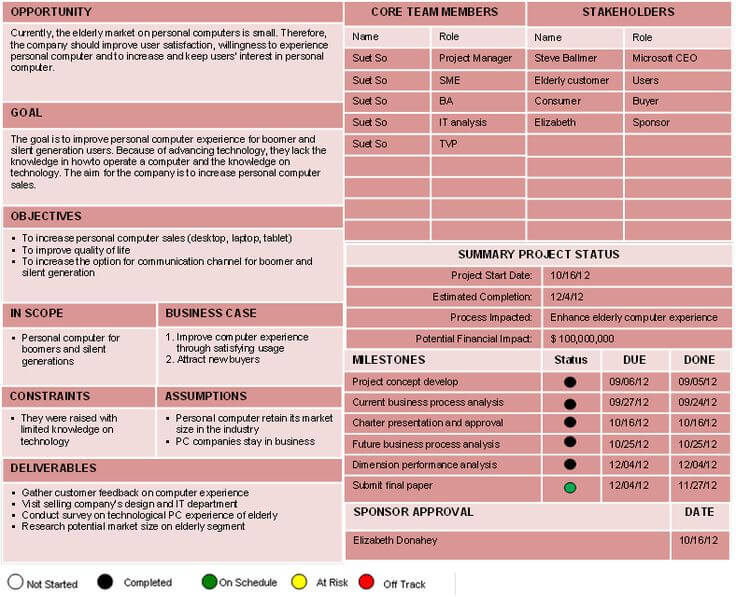
This project charter example clearly lists the project objectives, as well as the milestones and an accompanying timeline.
While you don't necessarily need a complete timeline yet (this will be defined in the project plan), this is a good item to include and then update for project status reports, as the team is completing the work in the execution phase.
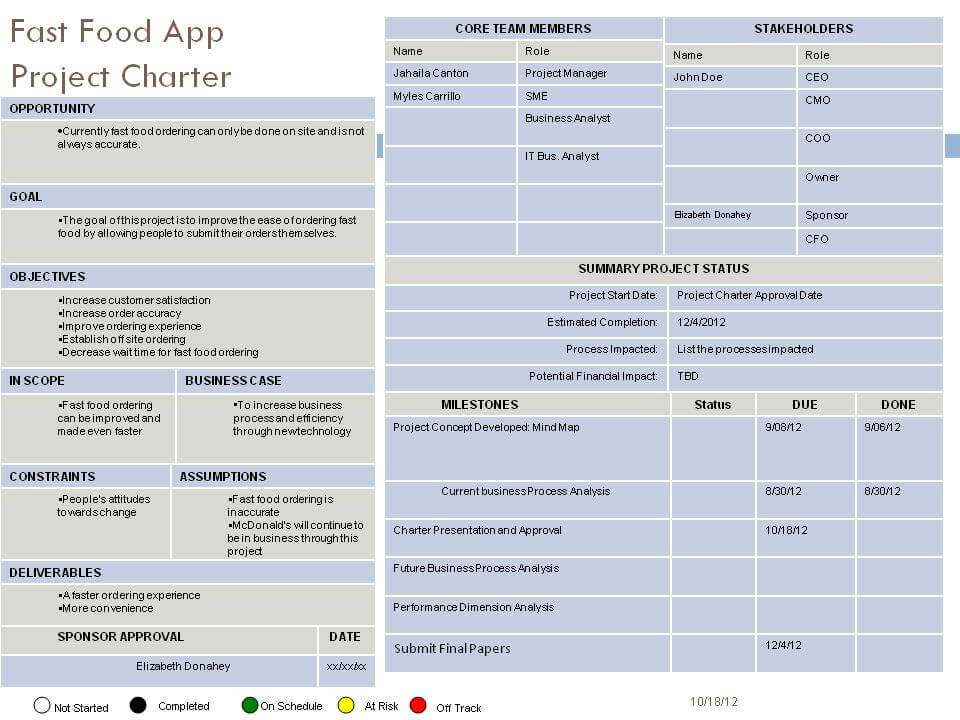
This one is similar to the above example in that it includes milestones and a timeline.
It has also clearly laid out the objectives and what's in scope, and includes some notes on the processes that the project will impact, which is useful as this relates to the constraint of attitude towards change (which is listed in the constraints section).
Expert Tips for Creating a Project Charter
When creating a project charter, follow these best practices to establish clear expectations, secure stakeholder buy-in, and set your project up for success:
- Keep it simple: Write your charter so someone unfamiliar with the project can understand its purpose, scope, and expected outcomes. Avoid jargon and vague statements. If stakeholders need you to explain what a section means, it's probably worth rewriting.
- Focus on the big picture: Stick to high-level objectives, scope, deliverables, and constraints rather than detailed tasks or schedules. I recommend keeping implementation details in your project plan, where they can evolve without requiring changes to the charter.
- Build stakeholder consensus: Involve your project sponsor and key stakeholders before finalizing the charter. Pay particular attention to conflicting expectations around scope, priorities, and success criteria. It's much easier to resolve disagreements during initiation than after work has started.
- Define measurable success criteria: Don't settle for broad goals like "improve customer experience." Specify what success looks like (e.g. reducing customer onboarding time by 20%). This gives your team a shared target and helps stakeholders evaluate whether the project delivered its intended value.
- Document assumptions and constraints: Be explicit about the conditions your project depends on, including budget limits, resource availability, and external dependencies. For example, if delivery depends on a third-party integration, document that assumption before committing to a launch date.
- Clarify decision-making authority: Identify the project sponsor, project manager, and stakeholders responsible for major approvals. In my experience, unclear decision-making authority creates unnecessary delays, especially when scope changes or competing priorities require escalation.
- Get formal approval before execution: Have the project sponsor approve the charter before committing significant resources. Approval confirms agreement on the project's objectives, scope, and authority. Keep the approved charter accessible so you can reference it when new requests or disagreements arise.
Common Project Charter Challenges and How to Overcome Them
Creating a project charter can be challenging when requirements are unclear, stakeholders disagree, or key decisions haven't been made. Here are six common challenges and practical ways to overcome them:
- Unclear project objectives: Vague goals make it difficult to define success and get stakeholders working toward the same outcome. Work with your project sponsor to establish specific, measurable objectives tied to business needs.
- Disagreements over project scope: Stakeholders may have conflicting expectations about what's included, leading to delays or scope creep. Document what's in and out of scope, then resolve disagreements with key stakeholders before seeking approval.
- Unrealistic budget or timeline expectations: Leadership may propose deadlines or budgets without fully understanding the work involved. Validate high-level estimates with your delivery team and present the trade-offs between scope, cost, and schedule.
- Limited stakeholder engagement: Busy stakeholders may delay feedback or approve the charter without reviewing its contents. Identify key decision-makers early and schedule a focused review to resolve outstanding questions before sign-off.
- Undefined roles and decision-making authority: Without clear ownership, approvals can stall and important decisions may fall between teams. Specify the project sponsor, project manager, and key decision-makers, including who can authorize scope or budget changes.
- Incomplete information or untested assumptions: Early project estimates often depend on unknown technical requirements, resource availability, or external dependencies. Document assumptions and constraints explicitly, assign owners to validate them, and flag uncertainties that could affect project feasibility.
Turn Your Project Charter Into a Successful Project
A clear project charter sets the foundation, but successful delivery takes the right tools and guidance. Sign up for our free newsletter and membership to access exclusive resources, practical templates, and expert insights to help you plan and deliver better projects.