
Meta PM Shares How AI Is Changing Delivery And Where It’s Found Wanting
Meta PM Tom Leung explains how AI speeds prototyping and delivery, where it falls short, and why human judgment, alignment, and strategy remain critical in product management.

AI Features: Building effective AI features requires extensive testing, feedback loops, and continuous refinement to succeed.
Project Management Evolution: AI is transforming project management by enabling faster prototyping and iterative validation processes.
Autonomous Teams: Successful delivery now relies on flexible goal-setting and empowered teams with clear decision-making frameworks.
AI Toolstack: A diverse AI toolstack enhances product management efficiency, with tools tailored for specific tasks and workflows.
Strategic Focus: The future of project management requires strategic thinking alongside AI fluency, splitting roles into orchestration and automation.
Tom Leung leads a product management team at Meta, where he's responsible for both product and project success. He's also the creator of the Fireside PM newsletter.
We sat down with him to get a sense of what's changing in product and project delivery. He broke down where AI has changed the game — and where humans are more important than ever.
Product management at Meta
I've been working in software product management for over two decades.
Today, I lead a product management team at Meta. My role is mostly on the why and what of a project, but I'm accountable for the overall success and impact of our projects.
I'm also the creator of the Fireside PM newsletter.
Why building a winning AI feature is harder than it looks

I recently did a consulting project for a pre-IPO company that was launching an AI-powered feature. What was interesting was how the magic was mostly zero to one — from concept to working demo.
However, improving the initial demo to something we felt high confidence in was much harder than expected. We went through multiple iterations, testing different foundational models (GPT-4, Claude, Gemini) to see which performed best for our specific use case, and experimenting extensively with prompt engineering: testing different instruction formats, adding more context about user intent, and refining the output structure.
The biggest improvement came from incorporating user feedback loops and personalization data, which helped the model understand individual user preferences and context.

The biggest improvement came from incorporating user feedback loops and personalization data, which helped the model understand individual user preferences and context. We set up A/B tests to measure accuracy improvements and user satisfaction at each iteration.
All this resulted in a lot of fits and starts. The process took about three months of continuous refinement to get from "impressive demo" to "production-ready feature."
The TL;DR is that it's pretty easy to build an AI feature, but building a winning AI feature into your product is much harder than it looks.
Why AI's biggest risk is how amazing it feels
We're still not at a point where AI is fully autonomous. As amazing as it is, I still regularly find flaws in the reasoning and need to double-check everything.
Here's another example. I did a consulting project a few months ago where Claude and Gamma did a lot of the work after I fed them piles of background info and meeting notes. It did an incredible job. But then, when I was prepping for a client meeting, I realized there were a number of errors that looked fine until you pressure-tested the assumptions. I had to scramble and update all the figures.
So that's the challenge with AI. It's amazing, and it gets better every day — such that you feel like you can check it less. But until it's 99–100% accurate, you still need to stay on top of it because when it does make a mistake or have a hallucination, it can really blow up in your face.
AI is amazing, and it gets better every day. But until it’s 99-100% accurate, you still need to stay on top of it because when it does make a mistake or have a hallucination, it can really blow up in your face.
How AI is changing project planning, prototyping, and roadmaps
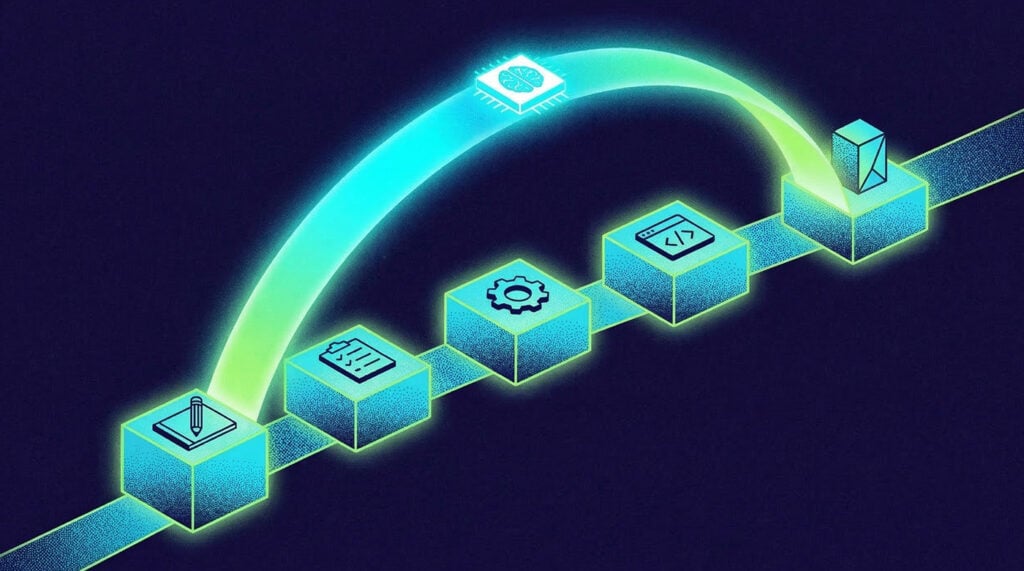
With that said, it's changing how we work. I've noticed that we sometimes start prototyping in parallel with product planning now. In the old days, you couldn't afford to build things before all the planning work was done. But now, you can build a new project in weeks — or even days.
I've also noticed shorter planning cycles and more iterative validation. Instead of spending months on detailed specs, we now create lightweight briefs and validate assumptions through rapid experimentation.
We're moving away from rigid roadmaps, toward more adaptive planning — adjusting priorities quarterly, or even monthly, based on what we learn.
We’re moving away from rigid roadmaps, toward more adaptive planning — adjusting priorities quarterly, or even monthly, based on what we learn.
And we've reduced the number of formal status meetings in favor of async updates and AI-generated summaries of progress. This frees up time for deeper strategic discussions rather than just reporting what's already documented.
The risk is that you end up becoming a feature or product factory!
How core delivery rituals are evolving with AI
Our core delivery rituals are changing too.
For defining scope, we now start with outcome-based goals rather than feature lists. This gives teams more flexibility to adapt as they learn.
For validation, we're doing more continuous testing with smaller user groups rather than big bang releases. AI tools help us analyze feedback patterns quickly.
For managing execution, we've moved toward more autonomous teams with clear decision-making frameworks, rather than centralized approval processes. The key is trusting teams to make good decisions, while using AI to surface risks or blockers early.
And then there's alignment. I think alignment is more important than ever. Since we can do so many things now, we need to have a unified POV on what to build and why.
To get that unified POV, we invest heavily in shared context: regular strategy reviews, clear documentation of our "why," and explicit decision-making principles that everyone can reference. I also use AI tools to create consistent summaries of key decisions and distribute them widely so everyone has access to the same information. And we run quarterly alignment sessions where we revisit our priorities and make sure everyone understands how their work connects to the bigger picture.
The goal is to create a shared mental model so teams can make independent decisions that still ladder up to our overall strategy.
I think alignment is more important than ever. Since we can do so many things now, we need to have a unified POV on what to build and why.
What an AI tool stack looks like for modern product managers
Here's my current AI tool stack:
- ChatGPT: General purpose reasoning, brainstorming, and quick research
- Claude: Complex analysis and writing tasks where I need nuanced reasoning
- Gemini: Multimodal tasks and when I need to analyze documents with images
- Manus: Automating tedious workflows like generating weekly team updates, processing data, and handling repetitive project management tasks
- NotebookLM: Synthesizing insights across large document sets and creating audio summaries
- NanoBanana: Creating visual presentations and slide decks quickly
- FigmaMake: Rapid prototyping and design iteration
I rotate between ChatGPT, Claude, and Gemini depending on the task. Each has strengths in different areas.
Why Claude outperformed other LLMs with product requirements
I recently tested five AI chatbots to help with writing product requirements documents.
Claude came out on top for writing product requirements documents. It excels at maintaining context over long documents, following complex instructions, and producing well-structured output that reads naturally. It's particularly good at understanding nuance and avoiding the overly formal or generic tone that some other models fall into.
That said, I still use different models for different tasks: ChatGPT for quick iterations, Gemini when I need to process visual information, and Claude for anything requiring deep reasoning or long-form writing.
How agentic workflows on Manus save hours each week
I've been using Manus as my primary orchestration platform for agentic workflows. It's particularly useful for automating multi-step tasks like generating weekly team updates, processing meeting notes into action items, and synthesizing research across multiple sources.
I’ve been using Manus as my primary orchestration platform for agentic workflows. It’s particularly useful for automating multi-step tasks.
The experience has been positive — it handles the tedious coordination work that used to eat up hours each week. That said, I still need to review outputs carefully since AI isn't quite 100% reliable yet.
I've also experimented with using ChatGPT's custom GPTs and Claude's Projects for specific workflows. But Manus has been the most effective for complex, multi-step orchestration where I need different tools to work together.
Why NotebookLM transforms how PMs synthesize context and decisions
What I've noticed most, lately, is that the ability to understand the internal context of a customer segment, project, or previous decision by using AI to look across dozens of sources is pretty mind-boggling.
Pre-AI, you'd have had to spend weeks reading piles of documents and doing scores of 1:1s. But now, I use tools like NotebookLM to ingest dozens of documents — meeting notes, strategy docs, customer research — and quickly synthesize insights across them.
For example, when evaluating a new product direction, I can ask it to summarize all previous customer feedback on a specific pain point and get a coherent answer in seconds rather than spending days reading through scattered documents. I also use ChatGPT and Claude for similar synthesis work, especially when I need to understand the context behind past decisions or identify patterns across multiple projects.
Why strategy will matter more than ever in an AI-accelerated world
Within five years, the role of project manager will split into two distinct tracks.
One track will focus on strategic orchestration: understanding business context, aligning stakeholders, and making high-level tradeoffs.
The other will be more like "AI workflow engineer," designing and optimizing the automated systems that handle execution, reporting, and coordination.
The tactical, administrative side of PM work will be almost entirely automated.
Teams will move faster, but the human judgment required to decide what to build and why will become even more critical. The winners will be PMs who can think strategically while also being fluent in how to leverage AI systems effectively.
Follow Along
You can follow along as Tom Leung continues to change the AI game on LinkedIn. And, of course, check out tomleungcoaching.com!
More expert interviews to come on The Digital Project Manager!