

The AI-Powered PM: How Dr. Nancy Li Launches AI Products in Weeks
Learn Dr. Nancy Li’s framework for AI-driven product delivery, showing how to automate PM work, validate ideas fast, and launch AI products in weeks with measurable value.

Nancy Li
Director of Product, Youtuber, and LinkedIn Top Voice
Industry Leadership: Dr. Nancy Li is a renowned product director, YouTuber, and LinkedIn Top Voice in AI product management.
AI Project Management: AI is transforming project delivery by focusing more on decision-making rather than mere documentation.
Automating Tasks: Automating core product management tasks saves significant time, enhancing efficiency and productivity.
AI Product Lifecycle: A structured AI product framework accelerates launch while ensuring AI applications provide true value.
Future of Roles: AI may replace some roles, but it emphasizes the need for skilled AI-powered product managers.
Dr. Nancy Li is an acclaimed Director of Product, YouTuber, and LinkedIn Top Voice. She founded the Product Manager Accelerator, two AI products, and the AI Product Management Bootcamp — the latter of which is responsible for the launch of 40+ real-world AI products.
We caught up with her to understand how she does it. She gave us her framework for fast, effective project delivery.
Educating product managers
I founded Product Manager Accelerator, which has helped 1,500+ product managers land their dream PM jobs in FAANG companies and unicorn startups — and get promoted as product leaders. And I founded AI Product Management Bootcamp, which has helped launch 40 real-life AI products.

Most recently, we developed two AI products for our students: AI Study Companion and AI Interviewer Copilot. They're currently used by PM Accelerator students, and we will launch the product to external users in 2026.
I was also one of the youngest engineering PhDs from BU and I'm an alumna of the MIT Sloan School of Business. I'm an award-winning Director of Product and a YouTuber. I've been featured in Forbes, and I'm a LinkedIn Top Voice.
How AI is reshaping project delivery from artifacts to decisions
Because of AI, project delivery is changing from producing artifacts to making decisions. We spend less time on documentation and coordination, and more time on framing the right problems, validating assumptions, and designing AI-enabled workflows.
Because of AI, project delivery is changing from producing artifacts to making decisions.

It's faster, more iterative, and increasingly about orchestrating humans and AI together — not managing handoffs.
As a CEO and CPO, I was able to cut my team in half and double my output by leveraging the power of AI.
Which core PM tasks can be automated
I save at least eight hours per week on product management tasks by automating my work. The following tasks should be automated:
- Requirement generation
- Prototyping
- Market research
- Debugging
- Customer interviews — we use Dovetail to summarize meeting notes and turn them into requirements.
- Ramping up on new projects
- Getting up to speed on any topic, like industry news
- Summarizing existing tech stacks
- Creating system architecture diagrams based on existing code base
But it's important to note that a human touch is still required in some areas, like going from prototype to production-level products and creating product strategy that actually helps you stand out.
A human touch is still required in some areas, like going from prototype to production-level products and creating product strategy that actually helps you stand out.
How AI is changing core delivery rituals for product teams
All of this impacts delivery rituals.
AI cuts the time of defining project scope by 50%. You can collect customer feedback and conduct market research so easily these days.
And, while aligning teams still needs a human touch, AI can help summarize team meetings and save time that way.
A framework for creating AI products
As I said, my bootcamp has helped launch over 40 AI products. To do this, we created an AI hypothesis framework. It's a simple, repeatable system we use to validate AI ideas before building them.
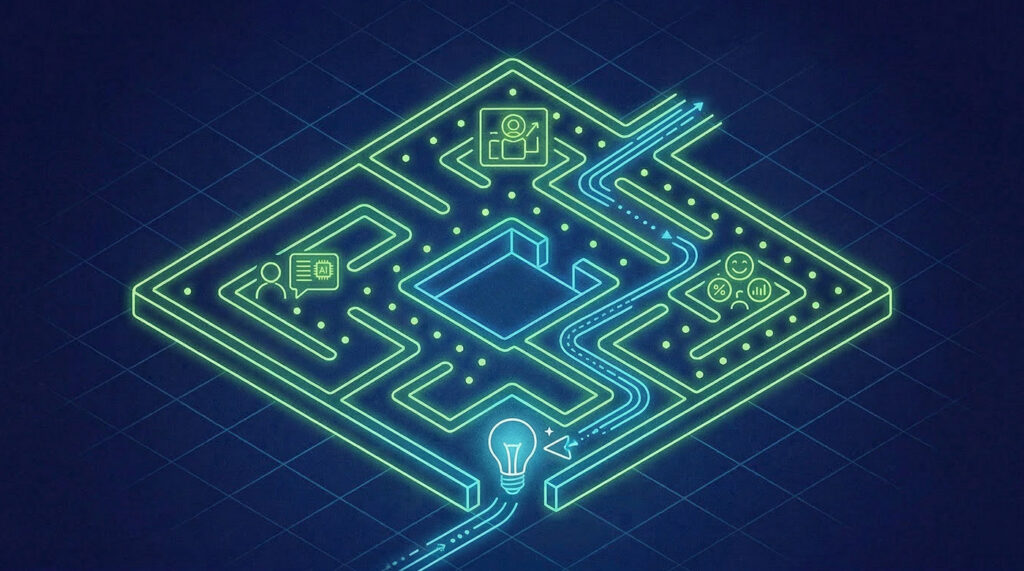
It starts with Problem Definition using our GUCCI (Goals and Mission, Unmet Needs, Customer Segmentation, Competition, and Integrated Ecosystem) framework, where we clarify the user goal, pain point, constraints, and the impact we want to create.
From there, we form an AI Hypothesis — a clear statement of what inputs the AI needs, what outputs it should generate, and how it will improve the workflow. This drives our Data Strategy and a quick AI Proof of Concept to test technical feasibility.
We then validate the AI inputs and outputs directly with customers to confirm whether the feature actually solves a real problem. Only validated ideas move into the Product MVP, where we design the full AI-enabled user journey.
Once the MVP is live, we measure whether we’ve reached AI Product–Market Fit. If yes, we scale through a generalization strategy, expand use cases, and leverage real user data to strengthen our data and product advantage.
This lifecycle — GUCCI → AI Hypothesis → PoC → MVP → PMF → Scale — allows us to consistently launch AI products in about three months while ensuring AI is only used where it truly creates measurable value. You can read more about the process here.
How spec-driven product management speeds up AI product delivery
Another big part of this is that we've moved away from traditional project management methods — writing requirements, waiting for designers to create mockups, and waiting for engineers to create the first prototype. Now, we use a "spec-driven" product management process, meaning that we use AI tools to write requirements and generate prototypes fast.
Now, we use a “spec-driven” product management process, meaning that we use AI tools to write requirements and generate prototypes fast.
We're able to turn product requirements into prototypes in one hour with zero code, and experiment with ideas — fast. Removing the dependencies on designers and developers collapses timelines and easily saves PMs hours every week.
Here's how to do it:
- Prompt ChatGPT to help with the product requirements for your ideas
- Enter our product ideas
- ChatGPT will then ask clarifying questions and design the detailed user journey map
- Ask ChatGPT to generate requirements.
- Put those requirements into Google AI Studio to generate the prototype.
Why a scenario-first philosophy creates measurable value
We're big on agents. In fact, our core product direction relies heavily on agentic workflows — both in our business and our products. That means giving AI ownership of outcomes, not just prompts.
Internally, agents help us transform complex workflows into scalable, high-quality, repeatable processes. Combined with our end-to-end evaluation loop, agentic systems have become a reliable engine behind our delivery quality.
For example, we use agents that ingest customer data, generate insights, draft PRDs, generate design variance, and prototype design. And we've created an "AI second brain" that can brainstorm ideas with me as a junior product manager.
In our products, we focus on workflows that bring real value to our learning community: learning assistants, document intelligence, and multi-step reasoning.
Our philosophy is simple: AI must serve the scenario, and the scenario must create measurable value.
In our view, AI is not about chasing the newest model — it’s about disciplined engineering, scenario-driven design, and the craftsmanship to refine every component until it truly serves the user.
In our view, AI is not about chasing the newest model — it’s about disciplined engineering, scenario-driven design, and the craftsmanship to refine every component until it truly serves the user.
How agents can become more sophisticated with LangGraph
Let's take a look at an agentic workflow. This particular use case may not apply broadly, but I think the specifics of how we implemented it may help with advanced PM-based workflows.
In the early phase of our AI Interviewer Copilot, our system was primarily a RAG-centric assistant built on LangChain. It served well for fast iteration and helped us establish strong foundations in document processing and retrieval quality, but as the assistant grew in functionality and complexity — supporting multi-step reasoning, new task types, personalization, and collaboration between different reasoning modules — a pure RAG pipeline was no longer sufficient.
The early challenge was not just complexity, but how to ensure reliable, repeatable, high-quality delivery when the content sources were heterogeneous and constantly evolving. We needed a framework that could support agentic RAG, where multiple specialized agents work together in a controlled and interpretable way.
That led to the adoption of LangGraph. It provides determinism, transparency, and explicit state management, which are essential when building a conversational assistant whose reasoning steps must be auditable, explainable, and repeatable. The shift to LangGraph also aligned well with our long-term direction: building an intelligent assistant rather than a single-turn Q&A system.
So, we rebuilt the delivery workflow using modern AI orchestration:
- LangGraph for deterministic multi-agent state transitions
- Embedding + retrieval evaluation loops to stabilize the RAG Agent
- Metadata-preserving document processing to prevent semantic drift
Now, it's a multi-agent system consisting of a RAG Agent, a Resume-Review Agent, and a Context-Orchestration Agent. We implemented a full, end-to-end evaluation framework — covering component-level accuracy (chunking, embedding, retrieval) and system-level accuracy (final answer relevance, hallucination rate).
And by continuously tuning each component and integrating automated regression tests, we ensured that the system achieved 90%+ accuracy before every major release.
Ultimately, we believe that a modern AI system is not defined by any single model. It is defined by a well-orchestrated ecosystem of components: document intelligence, retrieval stability, multi-agent collaboration, memory structures, and continuous evaluation.
We believe that a modern AI system is not defined by any single model. It is defined by a well-orchestrated ecosystem of components: document intelligence, retrieval stability, multi-agent collaboration, memory structures, and continuous evaluation.
How AI-assisted debugging accelerates delivery
AI-assisted debugging was an important part of that successful implementation — we relied heavily on it.
Tools like Claude Code and Cursor help us quickly diagnose integration issues, generate unit tests, and reason through tricky edge cases in prompt behavior. This significantly increased our development speed, especially when fixing logic flaws or unexpected model outputs.
What an AI-first product management tool stack looks like in practice
Here's our PM tech stack:
- Google AI studio for prototyping
- Claude Code for identifying issues, reasoning through edge cases, and generating targeted unit tests
- Cursor for debugging
- ChatGPT for PRD
- ChatPRD for product management
- Dovetail for getting requirements from customer insights
- Miro for collaboration
My favorite might be Claude Code. It consistently helps us spot integration problems or logical gaps much earlier than traditional debugging alone. And it's significantly better than Lovable. Even if there's a lot of hype about Lovable, it's not for production-level, advanced AI engineering.
Will AI replace project managers and product roles?

Ultimately, I think AI will replace project managers. We just don't need project managers to manage processes anymore! In fact, many entry-level jobs will be replaced by AI — that includes software engineers, designers, and data analysts.
However, we need more AI-powered product managers who can make decisions leveraging AI, lead cross-functional teams to execute on product visions and effective stakeholder management, and get results fast.
My advice? You need to quickly upskill yourself on how to leverage existing AI tools and reinvent product delivery. And consider focusing on AI products, specifically. The way I see it, you can either create AI products and lead the innovation, or get replaced.
Follow along
You can follow along with Dr. Nancy Li as she ships AI products and teaches others how to do the same on YouTube, LinkedIn, X, her podcast, and the PM Accelerator website. You can also check out her new AI Product Management Bootcamp.
More expert interviews to come on The Digital Project Manager!

