Project Manager Salary Guide 2025: Data from 600+ PMs
Project managers are driving real impact, but that value isn’t always reflected in their paychecks. This year’s salary report shows stalled wages and a profession under pressure from economic shifts, slow hiring, and emerging tech. Despite these challenges, PMs are finding ways to adapt and advocate for the compensation they deserve.

When you think about your project management career, there’s probably a moment that stands out as a turning point. A moment when you realized you were underpaid, undervalued, or just not in the right place.
For Mackenzie Dysart, a Delivery Principal at Thoughtworks, that moment came when she quit one of her first jobs as a project coordinator.
“I was giving my notice to my manager, and he asked me ‘Well, what's your hourly rate going to be?’ It was a very uncomfortable question, but I told him,” Mackenzie said.

His response: “You're worth more than that. You undersold yourself.”
This is a common challenge for project managers. It’s a role that is consistently undervalued inside organizations. And that can make it difficult to know just how much you're worth as a PM.
“Project managers are sometimes taken for granted,” shares Rhonda Riegel, Senior Creative Project Manager at Extend. “You get to be so good at what you do that it's almost seamless. People don't notice how much is getting done unless there's a problem.”
That seamlessness is what keeps organizations moving forward. You're the one holding the team together, managing the project management software, and making sure the work actually gets done (on time and on budget, of course). New products don’t launch without project managers. Internal processes don’t improve. And that kind of value should be showing up in paychecks.
“Project managers are the backbone of execution in any organization,” says Yonelly Gutierrez, a Senior Project Manager and the Founder of Velvet Vision, a coaching program dedicated to helping women land $100K+ project management roles. “When you’re in a leadership role driving impactful outcomes, you need to be compensated well for that.”
But that impact isn’t translating into higher compensation. Around 65% of respondents to our 2025 salary survey said they don’t feel like they’re paid what they’re worth as project managers. And the path forward isn’t getting any easier. Economic challenges, shifts in hiring, and the rise of AI are all making growth in this field harder to navigate.
It’s been a very difficult economic time for everybody. Because of that, there haven’t been a lot of promotions or salary increases. Businesses have to pick and choose where their money’s going. And that’s where you’ll see project managers being stretched a little too thin. It’s one of the first roles that gets cut every single time—and that speaks to not everybody seeing the value of it. It’s kind of the nature of the industry, unfortunately.
As we dig into the results from this year’s survey, you’ll see some concerning trends. Salaries have stalled despite inflation. Freelance rates are low. And there’s uncertainty about where the role is headed next.
But let’s be clear: this report isn’t meant to discourage you. It’s not about doom and gloom. It’s here to remind you that you bring real value to the table, and you deserve to be paid accordingly.
So, where do project management salaries stand today? What can you do to increase your earning potential, even in a tough market? And what should we expect for the future of compensation in this field? Let’s get into it.
About the Survey
From November 2024 through March 2025, we surveyed more than 600 project managers worldwide for this report. We asked about their salaries, roles, industries, and day-to-day work in an effort to better understand what project management really looks like today.
Most of the survey’s respondents, around 86.5%, work as permanent project managers, while 13.5% identified as freelancers/contractors. While responses came in from a variety of sectors, the majority came from digital industries, like Software & IT (30.6%) and Media, Marketing, and Advertising (22.1%).
Geographically, our survey reached a wide audience, but we’ve focused this year’s report on the regions with the strongest response rates: the United States (51.5%), the United Kingdom (11.4%), and Canada (5.8%).
How Much Do Project Managers Get Paid?
If you’ve been researching your market value as a project manager, you know there’s no cut and dry answer here. Every website, every salary guide, and every person you talk to will give you a different response.
That’s because variables matter significantly in this field. Your location, title, industry, years of experience, certifications, and more come together to form your number. Below, you will find salaries broken down by those variables to give you the best possible view of project manager salaries in 2025.
Average Project Manager Salaries Haven’t Kept Up
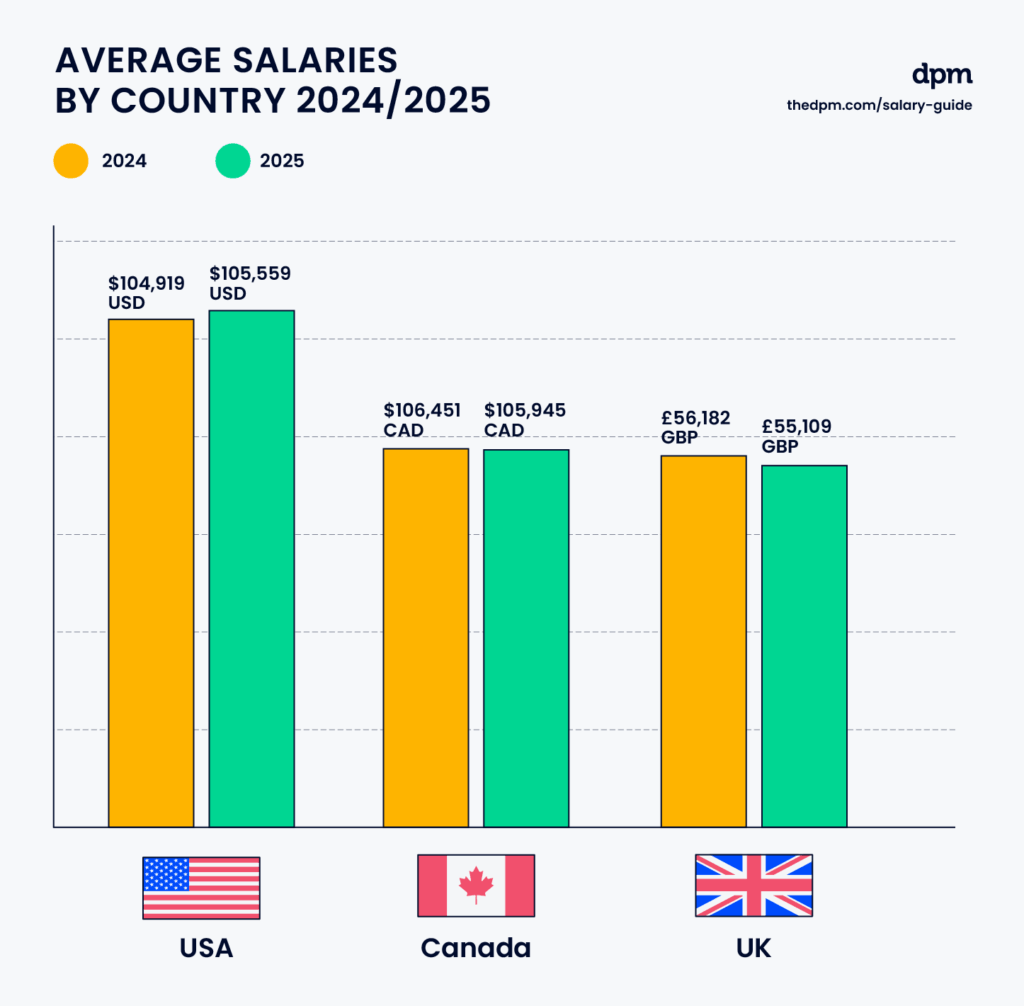
Full-time project managers in the United States reported an average salary of $105,559 USD. Compared to our 2024 salary report, not much has changed for project managers in the U.S. The average salary for a project manager last year was reported at $104,919 USD. That accounts for just a .61% increase, while the inflation rate in the United States in 2024 was 2.9%.
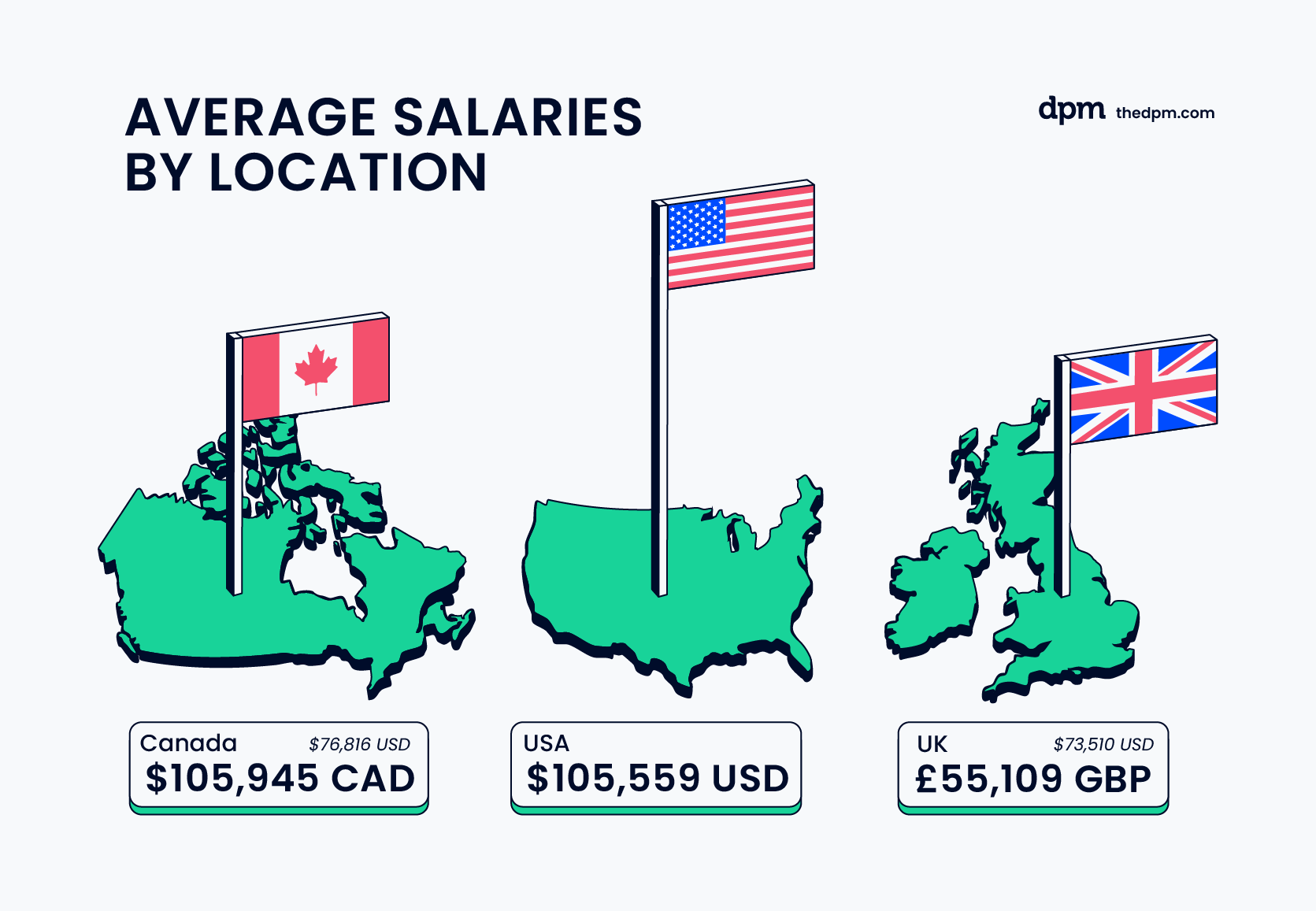
The case was similar for Canada and the United Kingdom when looking at average salaries year over year. This year, project managers in Canada reported an average salary of $105,945 CAD, while the average salary in our 2024 report was $106,451 CAD. Project managers in the United Kingdom reported an average salary of £55,109 GBP, which was also lower than last year’s average of £56,182 GBP.
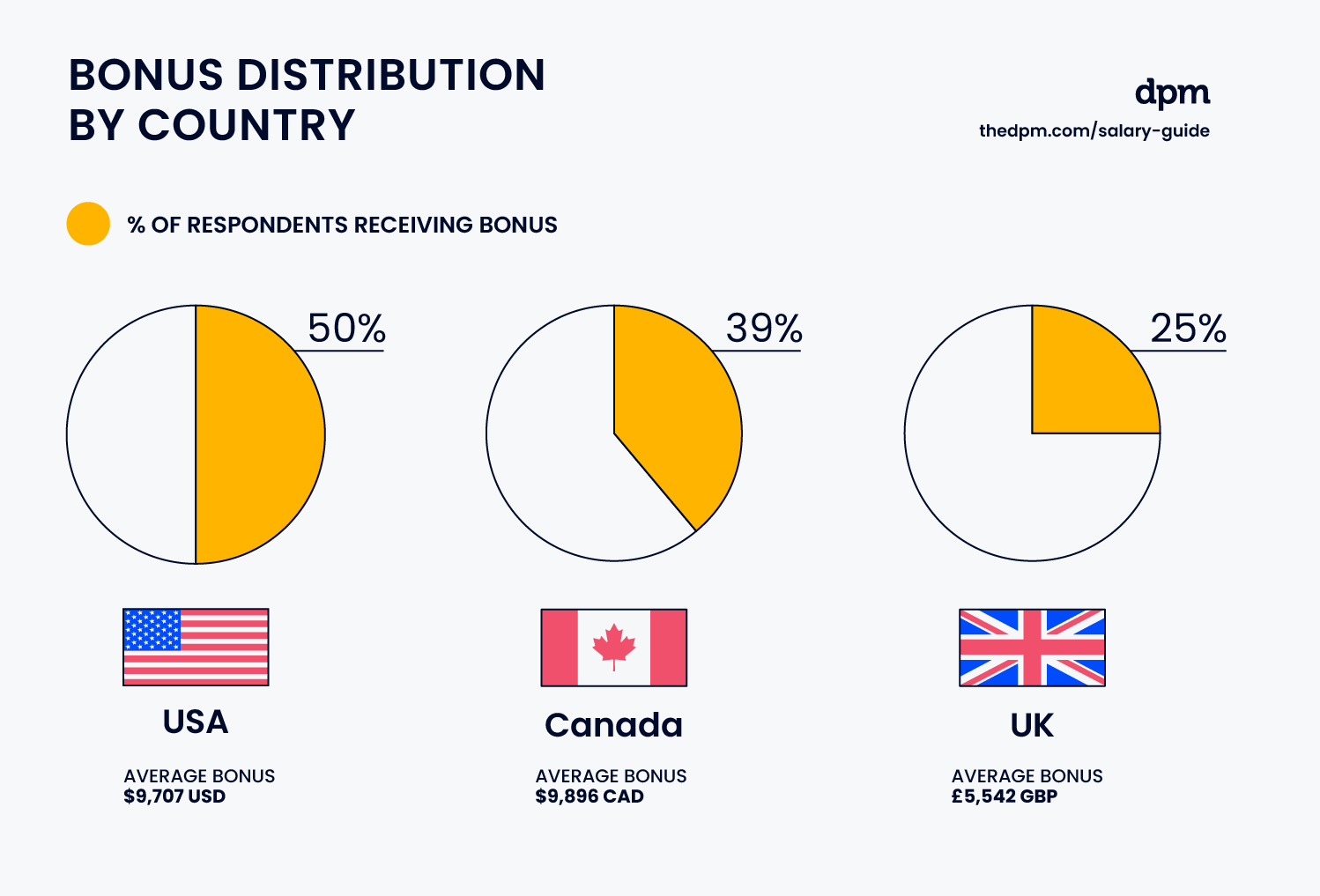
Half of our U.S. respondents also reported receiving a bonus in the last year, ranging from as little as $200 USD to as high as $60,000 USD, with the average additional cash compensation of $9,707 USD. Bonuses were much less prevalent in Canada and the U.K. Only 39% of Canadian respondents to our survey received a bonus in the last year, ranging from $400 CAD to $40,000 CAD, averaging out at around $9,896 CAD. In the U.K. only a quarter of project managers said they received a bonus, and the additional payout was much smaller. Bonuses ranged from £200 GBP to £14,000 GBP, with the average additional cash compensation being £5,542 GBP.
Bigger Title = Bigger Pay
Titles do play a significant role in the salary you can expect as a project manager. Unsurprisingly, PM titles associated with seniority and more years of experience typically earn the highest salaries (like project coordinators vs project managers).
Project Coordinators in both the U.S. and Canada expectedly reported the lowest salaries, averaging at $70,608 USD in the U.S. and $61,000 CAD in Canada. The title reporting the highest pay was Project Director in both the U.S. ($146,629 USD) and Canada ($195,000 CAD). We did not receive any data on project coordinators in the U.K., so the Project Manager title had the lowest average salary at £46,425 GBP, and the Head of Project Management title came out on top with an average salary of £73,750 GBP.
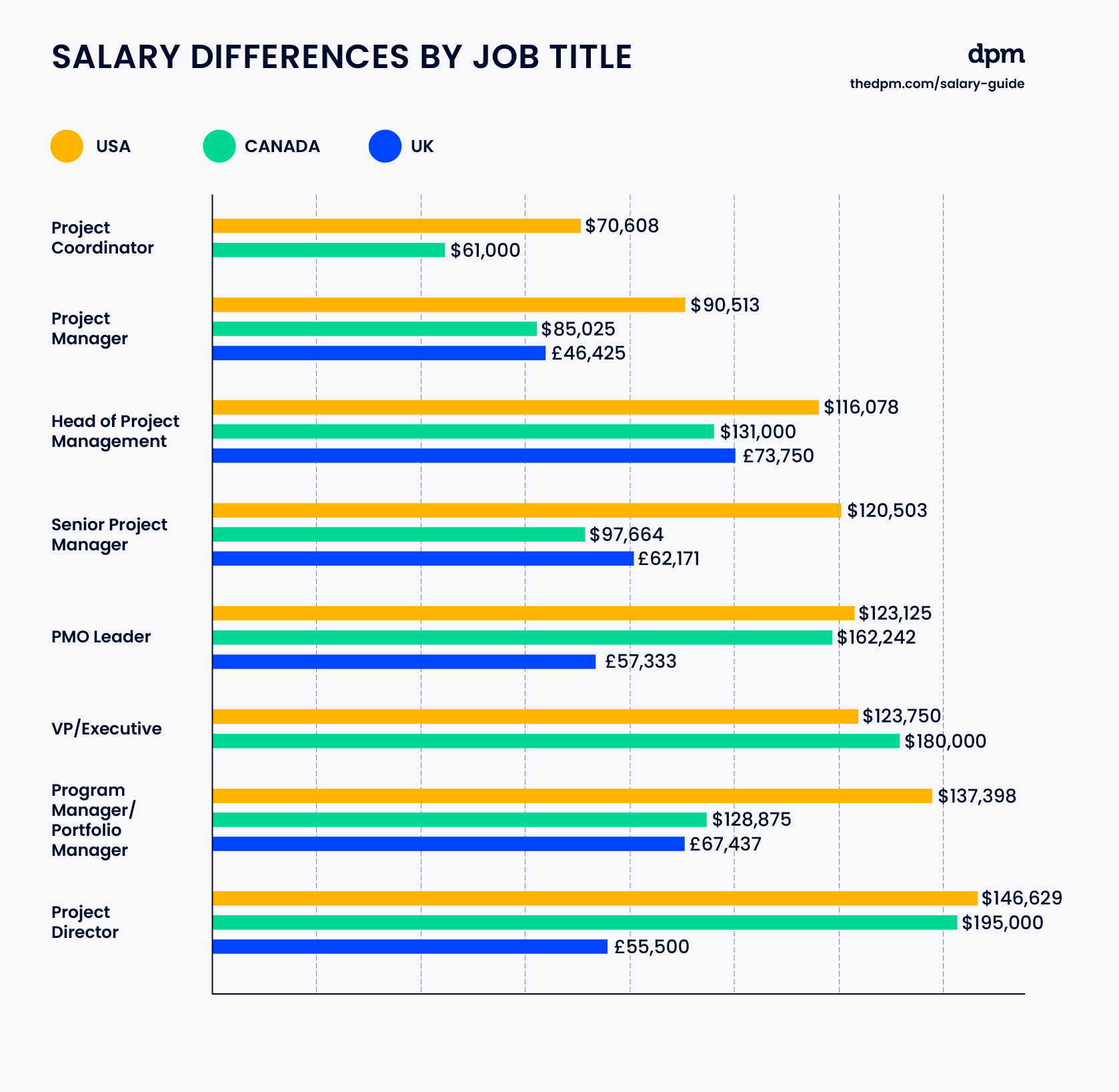
For all three geographies, we received the most responses from Project Managers and Senior Project Managers—so those titles offer the most realistic look at average salaries for the role. We received a much lower response rate from higher-level roles, such as Project Director and PMO Leader, so keep that in mind when considering this data. In the U.K. especially, we were surprised by the low salary rates reported by respondents in senior roles. For example, people with the title Director of Project Management/PMO reported much higher salaries in the Project Management Institute's 2023 salary survey, with a median salary of £95,154 GBP.
While this difference may be related to a smaller sample size, it's also important to keep in mind that project management titles can vary widely from country to country, and even organization to organization. While there are general trend lines, a project manager at one company can mean different responsibilities, seniority, and salary at another. Industry and size of organization matter, too.
Experience Still Pays—Getting It Is the Hard Part
It’s no surprise that project manager salaries also increase with years of experience. In the U.S., U.K., and Canada, folks with less than three years of experience reported the lowest salaries, and those with over a decade in the field are earning significantly more.
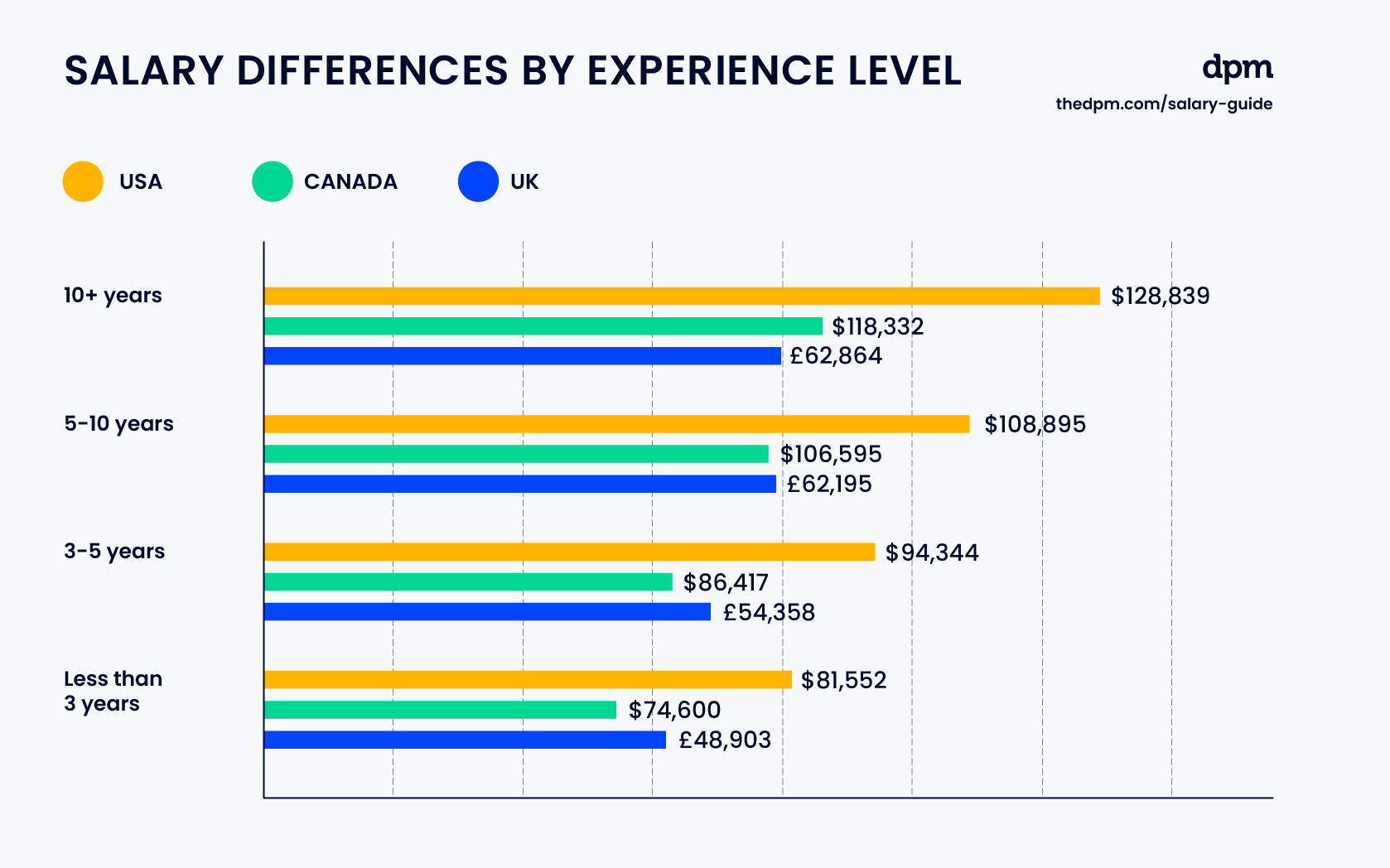
The challenge arising for project managers is that entry-level roles are becoming more difficult to land. It’s something happening across industries, not just in project management. AI and automation are shifting responsibilities, and the kinds of “starter” tasks that used to be perfect for new PMs are now often handled by tools or absorbed into other roles. That means fewer formal entry points for new PMs.
“Entry-level roles just don't exist, or they're very, very hard to find," says Mackenzie. "For folks looking to get into the profession, it's going to be a lot harder… And that's unfortunate because you need to start somewhere.”
That's not to say there are no entry-level PM roles out there. While the traditional ladder might be getting harder to climb, people are still making their way into the profession. A lot of PMs don’t start with the title. They fall into it from adjacent roles and gain that valuable project management experience along the way. So even if formal entry-level roles are getting harder to find, there are still plenty of ways to become a project manager.
Switching Industries Could Boost Your Salary
Industry also plays a role in the level of compensation you can expect as a project manager.
Most of our respondents were in the Software & IT, and Media, Marketing, & Advertising industries. Across the board, there is a significant gap between the compensation of these two industries.
In the U.S., for example, those in the Software & IT reported an average $120,184 USD salary, and those in the Media, Marketing, & Advertising industry reported an average salary of $96,768 USD. This gap was present in our 2024 survey as well, although both industries saw salary growth year over year, with Software & IT having an average salary of $96,583 USD in 2024, and Media, Marketing, & Advertising reporting an average of $73,488 USD in 2024. These were also the most common industries among our respondents from the U.K. and Canada, and the compensation gap was present there as well.
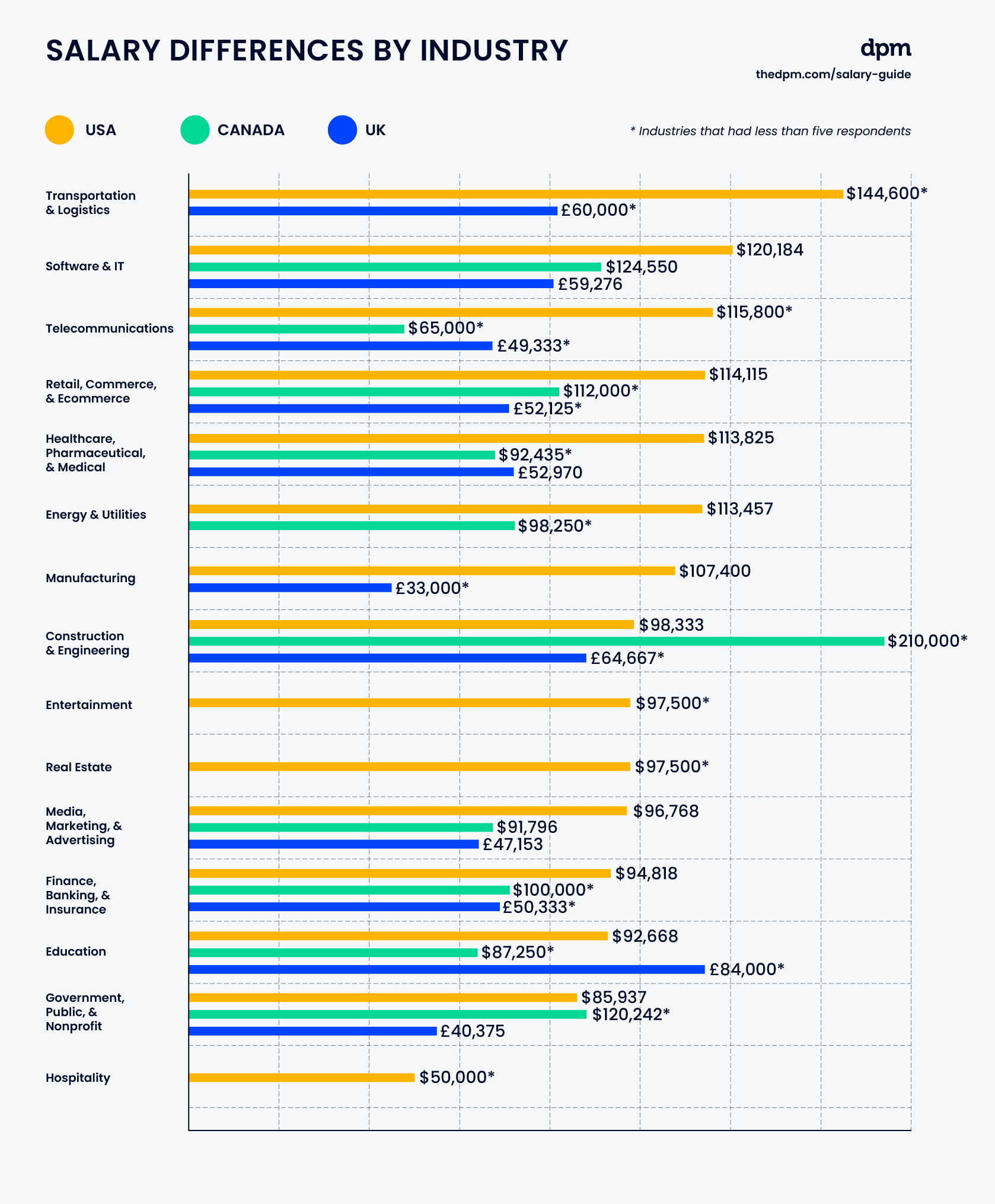
Remember: your skills are transferable. If you’ve built a strong foundation as a PM, there’s no rule saying you have to stay in one sector forever. If you're unhappy with your compensation, consider a move to a higher-paying industry. But keep in mind that some of the salary differences noted here may also come down to organization and budget size.
Certifications Pay Off
According to our data, having a project management certification does make a difference when it comes to salary. About half of all respondents said they hold a certification or professional designation in project management. And among those who do, 78% said it’s benefited their career or compensation in some way.
The numbers back that up. Respondents with at least one certification reported earning up to $14,000 USD more on average than those without.
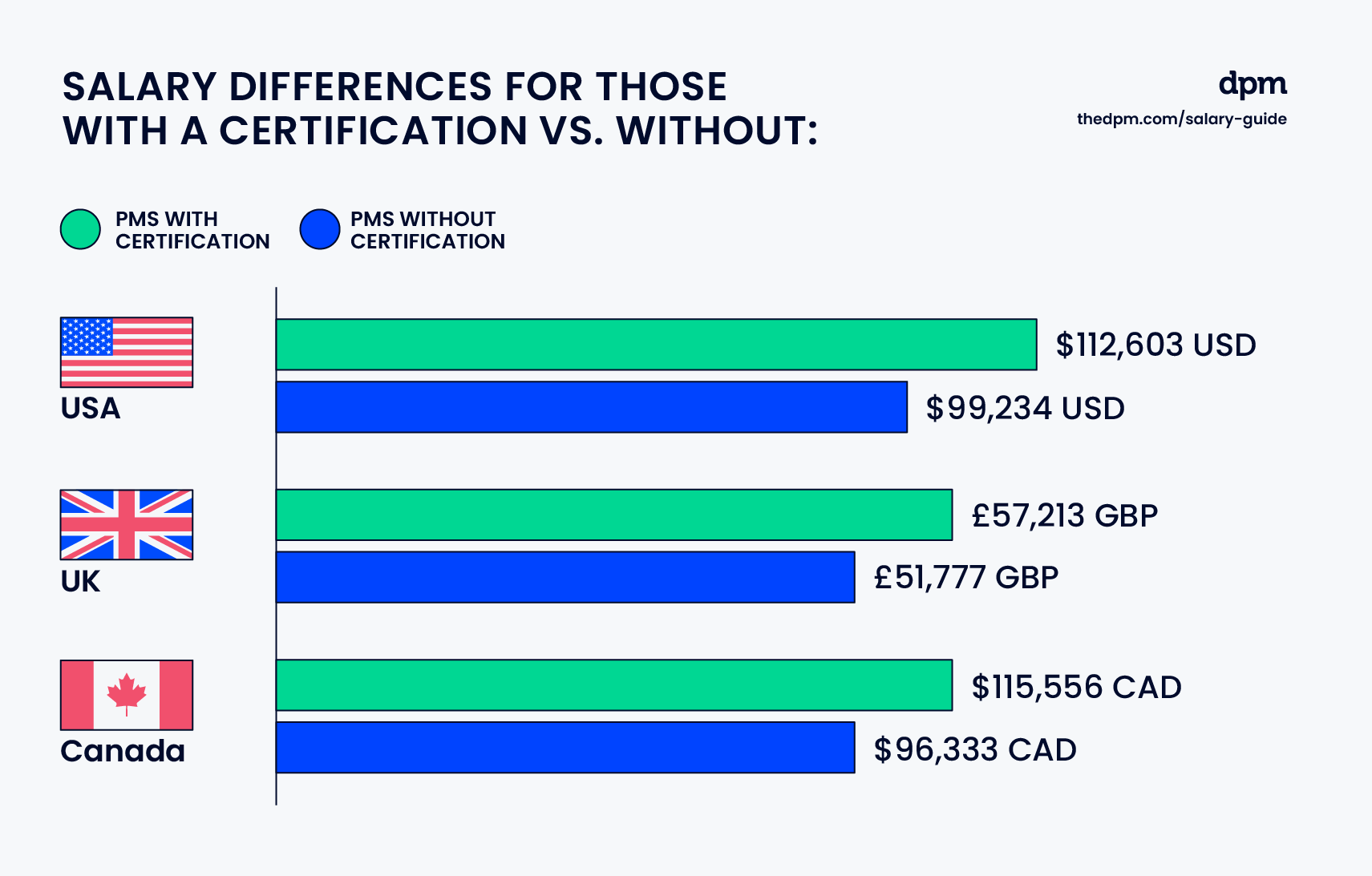
But does that mean you absolutely need a certification to be successful as a project manager? Not necessarily.
“I don't have any certifications, and I haven't needed them in my particular role,” says Rhonda. “It doesn't mean that they wouldn't be a benefit, but I have the data to show that I can do what I do. I have a portfolio that shows that I know my stuff. That's what matters."
Still, having those extra letters after your name can definitely help, especially when you’re applying for new roles or trying to stand out in a crowded PM job market.
"Certifications strengthen your application," says Sally Shaughnessy, Vice President Program Management at AZDS Interactive Group. "Do I think they're mandatory for career advancement? No. Do I think they help with setting you apart from other candidates? Yes."
Mackenzie agrees. While certifications might not define your ability to do the job, they can influence whether you’re seen as a match by recruiters or applicant tracking systems (ATS).
“In an industry where there's not a lot of jobs available and a lot of people are competing for very few jobs, it can't hurt,” Mackenzie says. “Even when I didn't have my PMP yet, I always made a point of saying ‘Working towards PMP’ on my resume. That way, I wouldn't automatically get removed from [an applicant] search.”
There’s no doubt that certifications can open doors, but more isn’t always better. Our data showed that having more than one certification didn’t lead to a significantly higher salary.
So instead of trying to collect them all, focus on attaining the certifications that align with your goals and the types of roles you’re interested in. For example, if you’re targeting digital project management roles, the DPM School is your best bet.
For a more general PM certification, consider the PMP, CSM, or PRINCE2. These are the certifications our respondents said have had the biggest impact on their compensation and career growth.
Benefits Matter More Than You Think
Compensation isn’t just about your salary, especially if you’re in the U.S. where things like health insurance and retirement savings aren’t guaranteed. A solid benefits package is what can make or break a job offer.
In our survey, nearly all U.S.-based project managers said their company offers health insurance, and almost 90% reported having access to a savings or retirement plan match. But other benefits were split. Just under half of U.S. respondents said they get a personal development budget, around 59% said they receive support for earning certifications or continuing education, and about the same number said they get extra vacation time. So while core benefits like healthcare and retirement are fairly standard, those growth-oriented or quality-of-life perks weren’t as consistent.
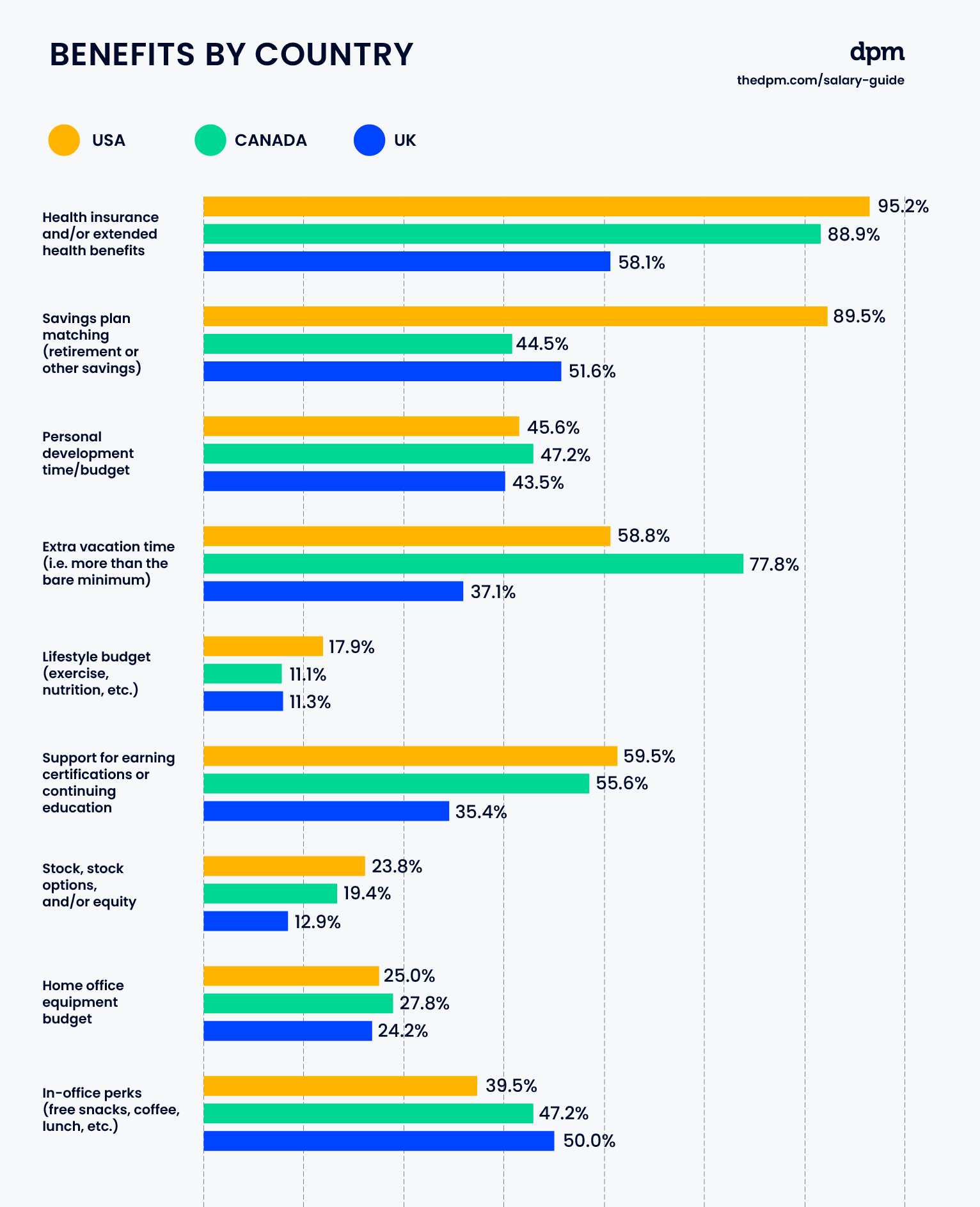
For project managers in Canada and the U.K., the benefits picture looks a little different. In Canada, extended health benefits and additional time off were among the most commonly reported perks. In fact, nearly 78% of Canadian respondents said they receive more than the minimum vacation time. But in the U.K., where things like healthcare and vacation are often handled outside of the employer, fewer respondents reported receiving those benefits directly through their job. Only 58% of U.K. respondents said they had employer-provided health benefits, and just 37% said they received extra vacation time.
This is where understanding the full picture of compensation really matters. If a company offers you a higher salary but doesn’t provide retirement matching, or sticks you with expensive monthly premiums for health insurance, a bigger paycheck won’t get you as far. It’s a detail that can be easy to overlook during the excitement of an offer, but it can have a huge impact on the money you actually take home.
Rhonda Riegel knows this all too well. After receiving what looked like a strong offer for a new role, she took a closer look at the benefits. She realized she’d be on the hook for far more than she expected when it came to health insurance, and that discovery led her to renegotiate.
People forget that they can negotiate for other things. It could be a title, more vacation days, or a guaranteed review and salary discussion after six months.
So if you’re evaluating an offer, or just trying to understand your total compensation, it’s worth looking beyond the salary. Benefits matter, and in today’s market, they’re absolutely something you can and should negotiate.
Remote PMs Earn More
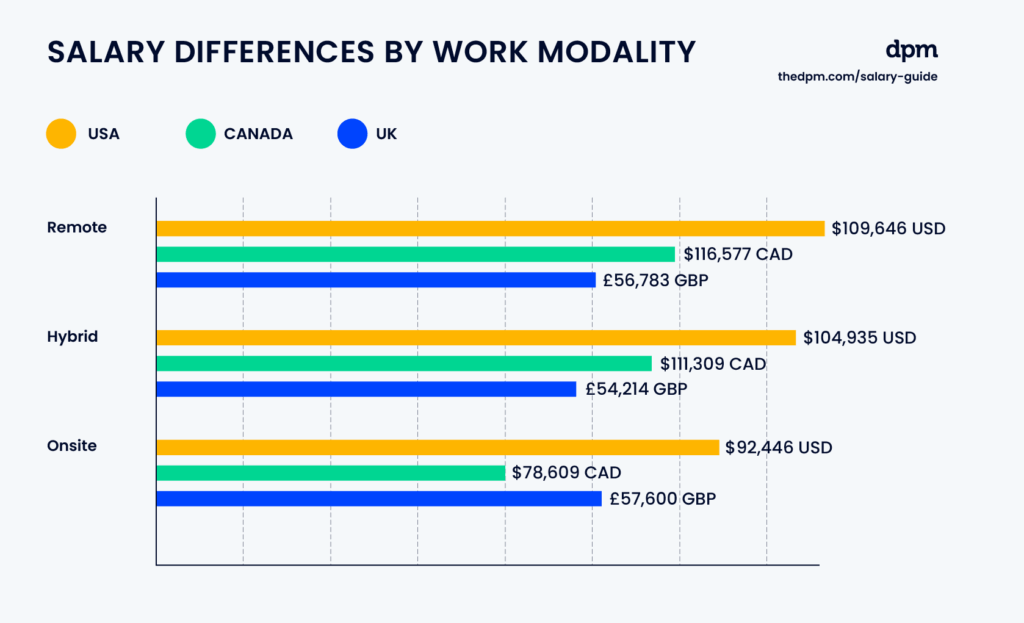
Remote and hybrid work has been the norm for project managers for years now, and our data shows that’s not changing anytime soon. The vast majority of respondents said they work in either fully remote or hybrid environments. Only 15.6% reported working onsite full-time.
In the U.S., fully remote project managers earned the most at an average of $109,646 USD, compared to $104,935 USD for hybrid workers and $92,446 USD for onsite roles. Respondents from Canada showed a similar trend, with remote PMs reporting an average salary of $116,577 CAD, which is nearly $38,000 CAD more than their onsite counterparts.
The U.K. was the only exception to this trend. There, onsite employees reported slightly higher salaries than their remote peers—£57,600 GBP compared to £56,783 GBP for remote and £54,214 GBP for hybrid.
It’s also worth noting that these salary differences might have less to do with where people work and more to do with what kind of work they’re doing. Many of the highest-paying industries, like Software & IT, are also the ones most likely to support fully remote teams.
The Best-Paying U.S. States for PMs (And Why)
In the U.S., it’s important to remember that PM salaries can also vary a lot depending on where you live. Cost of living plays a big role, and so does the local job market. While we didn’t ask respondents to share their state of residence in this year’s survey, our research team recently looked into the best (and worst) states in the U.S. for project management jobs based on available salary data from 2021 to 2023.
The states offering the highest average salaries included New Jersey at $131,413 USD, Washington at $118,143 USD, New York at $115,903 USD, and California at $115,177 USD. These are all home to major tech hubs or are close to large metro areas, which typically come with higher costs of living and higher demand for PMs. Higher state income taxes also likely contribute to those bigger salaries.

Equal Work, Unequal Pay for Women
“I think that women especially need to be more open with talking about their salary journeys,” Sally says.
Mackenzie agrees: “I know it's an uncomfortable thing, but especially as women in the workforce, you need to talk about it to understand where you are in terms of the benchmark.”
There’s a reason these conversations matter so much: the gender pay gap is still very real in project management. Across the board, women in our survey reported lower salaries than men in the same roles.
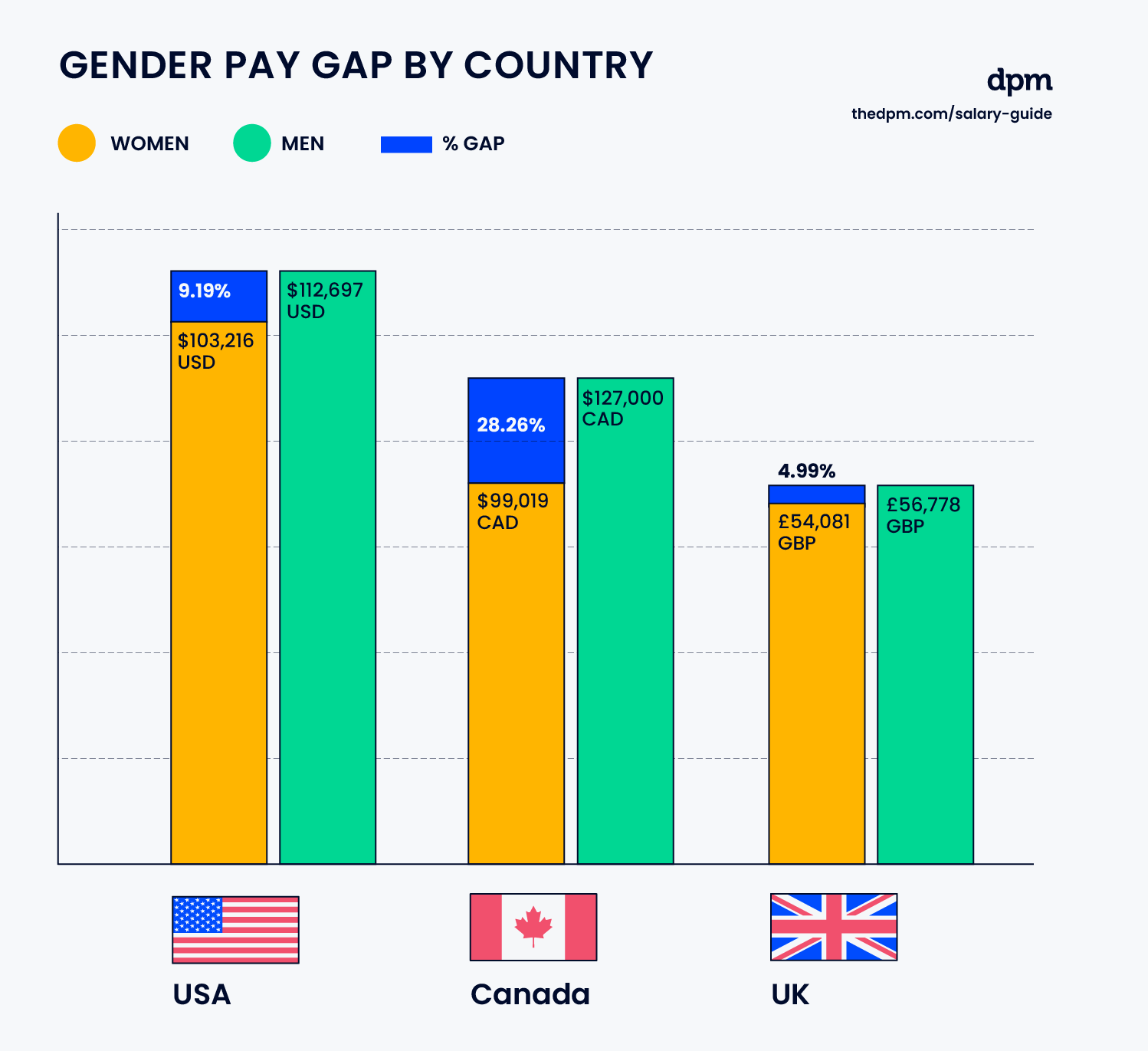
The numbers speak for themselves. In the U.S., women reported an average salary of $103,216 USD, while men reported $112,697 USD. In the U.K., the gap was a bit narrower, but still present. And in Canada, the pay gap was the most significant, with women earning $99,019 CAD and men earning $127,000 CAD.
While the narrowing gap in some regions is encouraging, it doesn’t mean the problem is solved. And that’s exactly why these salary conversations matter.
Negotiating is not rude or aggressive. You bring value in advocating for fair pay. And the more that you do this over the span of your career, the better that you’ll get. It is going to feel a little bit icky. It is going to feel a little bit scary, especially for women. Because we’re not really raised to go for what we want and demand our worth as much as our male counterparts… We really just need to push for what we want.
The only way to keep closing this gap is to keep pushing through those uncomfortable conversations. And if you’re in a position to lift someone else up, it’s your responsibility to take action.
Fractional Work Is Growing—Pay Hasn’t Caught Up
People often talk about freelance work like it’s a safety net: “If your full-time gig doesn’t work out, you can always go freelance!”
For some, that’s true. Freelance or fractional project work can be a way to bridge the gap between roles or bring in extra income during a career transition.
But for others, choosing to leave the stability of a 9-to-5 and step into freelance work isn’t a backup plan. It’s a big, intentional decision. And right now, our data shows that not many project managers are eager to make that leap. Only 4% of our respondents said they were interested in pursuing freelance project management in 2025.
That’s a stark contrast to the market. Demand for freelance and fractional talent has only grown, especially since the pandemic. In 2020, economic uncertainty pushed companies to lean on more flexible talent, and that trend hasn’t gone away. In fact, by 2027, freelancers are expected to make up over half (50.9%) of the U.S. workforce.
You'd think freelance and fractional project managers would be seeing strong compensation in response to that demand. But according to our data, that's not happening.
In the U.S., the average hourly rate reported by freelance PMs was just $68 USD.
“That’s very low—too low,” says Thako Harris, a freelance project manager. “As a freelancer, you have to pay for all of your own things… You don't know when you're going to have to work again. Considering all the fluctuations and variations that you have to navigate over the course of an entire year—it’s wild.”
And those fluctuations are exactly why your full-time salary shouldn’t be your benchmark when setting your freelance rate. On paper, $68 USD per hour works out to about $141,440 USD per year if you bill 40 hours a week, 52 weeks a year. But in reality, you’ll likely take unpaid time off, pay out of pocket for benefits, cover your own business expenses, and absorb dry spells between clients. That money goes fast.
Based on his experience, both as a freelance PM and someone who’s hired them, Thako recommends charging at least $100–$125 USD per hour. This will help you account for those extra costs, and be paid appropriately for the value your bring to the table.
In terms of how PMs structure their freelance work, the approaches were fairly split. About half of our respondents said they charge hourly, while another third charge per project. A smaller group said they use daily, monthly, or yearly contract rates.
Rethinking the Path to More Money as a PM
If you’re unhappy with your compensation as a project manager, you’re not alone. As we highlighted at the beginning of this report, you’re in good company with 65% of our respondents.
And while there are ways to increase your pay as a project manager, the path forward looks a little different in today’s market than it used to.
We’ve all heard the classic advice: “If you want a substantial raise, switch jobs.” And for a long time, that was true. But in today’s market, the financial benefit of job hopping has basically disappeared. In 2023, the median pay bump for job switchers was 7.7%, compared to 5.6% for those who stayed put. Now, it’s 4.8% for switchers and 4.6% for stayers—just a 0.2% difference.
“It’s a really challenging market," says Sally. "But there's no harm in passive exploration—just know that the market is saturated, and the screening processes are just that much harder right now.”
The salary boost that used to come with a new job isn’t guaranteed anymore. And if you’re like most of our respondents, you’re not exactly rushing to update your resume. About 62% said they’re planning to stay in their current role or try to advance with their current employer this year.
But it’s not just the market that is having an impact on employee retention. There was naturally a trend in our data between satisfaction and whether or not individuals were planning to stay in their roles this year. Around 66% of respondents said they were somewhat, mostly, or totally satisfied with their jobs. And it wasn’t just the highest-paid folks who fell into this majority. People across salary levels reported feeling content at work, suggesting that fulfillment isn’t always tied to the number on your paycheck.
That doesn’t mean that leaving your current role wouldn’t offer any benefits. Moving to a new industry, joining a larger organization, or stepping into a more senior or specialized role could still come with a significant salary bump.
“I found that my salary grew when I went to larger organizations or when I moved into management,” said Sally. “But I know that my salary deliberately contracted at other points in my career based on a personal life choice or a desire to work with different types of clients.”
In other words, the decision to leave your current role isn’t just about compensation anymore—it’s about fit. If you’re still feeling challenged, excited, and aligned with your organization’s mission, it might make more sense to focus on internal growth. That's not to say, however, that asking for and getting a raise or promotion in this current market is going to be any easier.
You have to demonstrate your worth. You’re not gonna get a raise on meeting expectations. As a people manager, I make it very clear to the people on my team that I don’t give raises based on years of experience. I give raises based on results… So if you don’t have a job description, if you don’t have core competencies, if there aren’t agency targets for you to attach yourself to—work on getting those.
And if you ask for a raise and don’t get it?
Mackenzie reminds us: “The worst case of you asking and pushing for a little bit more money is they say no. That just gives you some rationale to ask again next year… Or it tells you it might be time to look for something new.”
How to Negotiate a Raise (Or a Job Offer)
So if you do find yourself pushing for a raise or weighing a new offer, how can you best advocate for yourself?
1. Own your impact
One of the biggest challenges for project managers is that if you're good at it, you make the work look easy. That's a problem if you're trying to prove your value. Seamless execution is often invisible, and increasing your compensation is going to take showing off a little.
“All those little befores and afters are important stories to tell," says Rhonda. "Don’t downplay how seamless you made something… Whatever your story is, own it and tell it.”
Whether you've introduced better workflows, implemented dashboards, or helped a chaotic team get aligned, those changes matter. They're tangible proof of your value.
But these examples are only useful if you're tracking them. Create a running doc (even a simple Notion or Google Doc) where you log project milestones, KPIs, and team wins. Build a mini portfolio or deck to show off your growth. Use storytelling too, like before-and-after screenshots and feedback from your team and clients.
2. Bring the data
Numbers are your best friend in a negotiation.
“It's important to have data points,” says Mackenzie. “Come into a negotiation and say, ‘I'm making X. Based on my research, I should be making somewhere between Y and Z. How are we going to get me there?”
When searching for this data, use multiple sources, like Glassdoor, LinkedIn, PMI’s salary calculator, and (of course) DPM’s salary report. This will help you establish the most credible range.
Yonelly Gutierrez also recommends using informational interviews: “As you're networking with others, you can simply ask them, ‘Hey, what's the market rate for a PM with this much experience?’ People would be happy to share that information."
3. Practice what you’ll say
To be successful in a negotiation, it's also important to be clear and prepared.
“The best thing you can do is practice,” says Yonelly. “You literally need to rehearse your responses out loud and remind yourself that negotiation is expected… The more that you do this over the span of your career, the better that you'll get.”
It can feel silly, but even just saying a few prepared lines out loud in front of a mirror can help. Yonelly offered this script for when you receive an offer that's lower than you want:
“Thanks so much. I’m really excited about this opportunity. Based on my experience and research, I was expecting something closer to [$X]. Is there flexibility in the budget to get closer to that?”
If they counter, you can say:
“I appreciate you working with me. If we can meet at [$Y], I’d be ready to move forward today.”
4. Negotiate beyond salary
If they can’t meet your number, you have a few options. You can either walk away, take the lower offer, or negotiate for something else.
“It's a matter of understanding all the things that matter to you," says Mackenzie. "Maybe a little bit less pay, but more vacation is important. Maybe negotiating benefits as of day one. Maybe other perks like cell phone or internet coverage.”
Before any conversation, list out a few non-salary items that would make a difference for you. Maybe you want more PTO, work-from-home flexibility, stock options, a signing bonus, or a title upgrade. Knowing exactly what you want, and exactly what you’re not willing to negotiate, will help you move forward with confidence.
5. Move on from a “no”
Don’t let fear of rejection hold you back in a negotiation. If your request gets turned down for a raise or higher offer, ask for clear feedback and a timeline to revisit the conversation.
“The worst they can say is no,” Yonelly reminds us. “But the best case scenario could change your financial future.”
Remember: You’ve spent your career advocating for your team and your projects. You can absolutely advocate for yourself. So know your value, ask for what you're worth, and keep the conversation going even when it feels uncomfortable.
AI, Burnout, and Balance: What’s Next for PM Salaries?
There are a lot of pressures shaping the project management profession right now, and they’re not easy to ignore.
We’ve talked about many of them throughout this report: economic instability, shifting organizational priorities, the impact of remote and hybrid work, and a compensation landscape that hasn’t kept up with inflation or job complexity.
But one major pressure point we haven’t talked about yet is AI.
We know AI is going to change the way we work, but what we don’t know yet is how it will shape project management roles in the long run.
I don’t think that AI is going to replace project management. I think that AI can replace some of the functions that project managers do, which means that it’s going to be imperative that we lean on the facets of our job and the characteristics of our job that can’t be replaced by AI… It is not going to replace the human connection.
Sally’s advice for project managers is to double down on your soft skills—stakeholder management, communication, and collaboration. But also be the expert on how to use AI to make you more effective in your role.
Mackenzie adds: “Our roles will just get more complex in the fact that we’ll have to consider all the different tech. With more technology, there is more data. And with more data, there are more security requirements. It’s going to get a little bit more robust… There's going to be more people at the table.”
In a perfect world, as the role becomes more complex, compensation will increase in turn. But based on what we’ve seen in this year's data, that’s not a guarantee.
“I think we will see people leaving the profession,” says Mackenzie. “You're going to have a bunch of folks who stick it out at companies that they’re checked out of. We need to find non-monetary ways to make people feel appreciated so that they will stick around and care… You need folks who aren't burned out, who aren't disenfranchised, and give them the opportunity to keep caring.”
When salaries are flat, growth opportunities are limited, and workloads are heavy, people will hit their limit. That’s especially true in a field that has historically been undervalued and under-appreciated, like project management.
So, should you throw in the towel? Walk away from project management entirely?
Absolutely not.
Everything is shifting, and fast. And that's true in every profession. It’s easy to feel like you’re falling behind, or that there’s no clear path forward. But in moments like this, it’s worth pausing and remembering what brought you here in the first place.
“People are really refocusing on what brings them joy, what is worth their time,” says Mackenzie. “It’s a moment where we're all kind of reflecting—and it's come out of the pandemic. It's come out of us being at home a little bit more. It's come out of a bunch of companies now requiring folks to go back to the office. People are revisiting what matters to them and what they need to get by.”
You might not know what your role will look like a few years from now, or even six months from now. But you can get clear on the kind of work that energizes you. You can predict the balance you’ll want. You can know the values you won’t compromise on.
You can use those personal benchmarks to guide your path forward as a PM. Not just for a higher salary. Not just for a bigger title. But for a career that actually works for you.