


WeTransfer Review: Key Features, Pros, Cons, and Pricing 2026



WeTransfer is a file sharing software built for sending large files quickly, without requiring recipients to create an account or navigate a shared folder. It's worth considering if your team regularly transfers large creative assets—video files, design packages, or photography—to clients or external collaborators. I'd pick WeTransfer over Dropbox when the goal is a clean, one-off file delivery rather than ongoing shared storage. Recipients don't need to sign up or install anything to download what you send.
WeTransfer Evaluation Summary

- From $23/month.
- Free version available
Why Trust Our Software Recommendations
Our team has been testing and reviewing software since 2012. As project managers ourselves, we know how difficult—and important—it is to choose the right software.
For this guide, we evaluated tools using hands-on testing and independent research, scoring tools using our selection criteria. We also draw on insights from industry thought leaders and practicing project management experts.
Our reviews reflect our human editorial judgment, not a sales pitch.
Expert reviewers:
WeTransfer Overview
When judging WeTransfer against other file sharing software, its user-friendly design and clean interface set it apart for quick, one-off transfers. Pricing is straightforward, and onboarding is nearly instant—just upload and send. However, it underperforms for teams needing granular permissions, deep integrations, or advanced collaboration features.
Support is responsive but basic. If you're selecting a tool for fast, ad-hoc sharing—like sending design files to clients or large videos to stakeholders—WeTransfer is a top pick. For ongoing project collaboration or regulated environments, you may find its simplicity limiting. If you've ever wondered whether WeTransfer is a legitimate service or have seen concerns raised online, it's worth noting that WeTransfer.com is a well-established platform serving over 80 million monthly active users globally, with a broadly positive reputation and strong Trustpilot ratings.
pros
-
Allows sending files up to 3GB for free
-
No account required for recipients to download files
-
Simple, ad-free interface for quick transfers
cons
-
Free plan limits users to 10 transfers per month
-
Lacks granular access controls and advanced permissions
-
Files are deleted after a short retention period
-

Smartsheet
Visit WebsiteThis rating combines scores from multiple user review sites to reflect overall customer sentiment about the product.4.5 -
Celoxis
Visit WebsiteThis rating combines scores from multiple user review sites to reflect overall customer sentiment about the product.4.5 -
Accelo
Visit WebsiteThis rating combines scores from multiple user review sites to reflect overall customer sentiment about the product.4.4





Our Review Methodology
How We Test & Score Tools
We’ve spent years building, refining, and improving our software testing and scoring system. The rubric is designed to capture the nuances of software selection and what makes a tool effective, focusing on critical aspects of the decision-making process.
Below, you can see exactly how our testing and scoring works across seven criteria. It allows us to provide an unbiased evaluation of the software based on core functionality, standout features, ease of use, onboarding, customer support, integrations, customer reviews, and value for money.
Core Functionality (25% of final scoring)
The starting point of our evaluation is always the core functionality of the tool. Does it have the basic features and functions that a user would expect to see? Are any of those core features locked to higher-tiered pricing plans? At its core, we expect a tool to stand up against the baseline capabilities of its competitors.
Standout Features (25% of final scoring)
Next, we evaluate uncommon standout features that go above and beyond the core functionality typically found in tools of its kind. A high score reflects specialized or unique features that make the product faster, more efficient, or offer additional value to the user.
We also evaluate how easy it is to integrate with other tools typically found in the tech stack to expand the functionality and utility of the software. Tools offering plentiful native integrations, 3rd party connections, and API access to build custom integrations score best.
Ease of Use (10% of final scoring)
We consider how quick and easy it is to execute the tasks defined in the core functionality using the tool. High scoring software is well designed, intuitive to use, offers mobile apps, provides templates, and makes relatively complex tasks seem simple.
Onboarding (10% of final scoring)
We know how important rapid team adoption is for a new platform, so we evaluate how easy it is to learn and use a tool with minimal training. We evaluate how quickly a team member can get set up and start using the tool with no experience. High scoring solutions indicate little or no support is required.
Customer Support (10% of final scoring)
We review how quick and easy it is to get unstuck and find help by phone, live chat, or knowledge base. Tools and companies that provide real-time support score best, while chatbots score worst.
Customer Reviews (10% of final scoring)
Beyond our own testing and evaluation, we consider the net promoter score from current and past customers. We review their likelihood, given the option, to choose the tool again for the core functionality. A high scoring software reflects a high net promoter score from current or past customers.
Value for Money (10% of final scoring)
Lastly, in consideration of all the other criteria, we review the average price of entry level plans against the core features and consider the value of the other evaluation criteria. Software that delivers more, for less, will score higher.
Core Features
Large File Transfers
Send files up to 3GB on the free plan and up to 200GB with paid plans. This supports sharing big files—high-resolution videos, design files, or large documents—without compression.
No Recipient Account Needed
Recipients can download files directly from a download link without creating an account. This removes barriers for clients or partners outside your organization.
Customizable Download Pages
Paid users can brand download pages with their own logos and backgrounds. This helps reinforce your company's identity during client interactions.
Password Protection
Add passwords to file transfers for an extra layer of security. Only users with the password can access the shared files.
Transfer Tracking
Paid plans let you see when files are downloaded and by whom. Email notification alerts keep you informed the moment a recipient accesses your files.
File Expiry Controls
Set custom expiration dates for file availability on paid plans. This lets you control how long files remain accessible to recipients.

Ease of Use
WeTransfer is widely recognized for its minimal learning curve and intuitive, user-friendly interface, making file transfers quick even for first-time users. Uploading and sending files requires just a few clicks, and recipients don't need to register or navigate complex menus. Many users appreciate the lack of clutter and advertising, which keeps the process focused and hassle-free. However, the simplicity means advanced controls are limited, so it's best for straightforward, one-off transfers rather than ongoing collaboration.
Integrations
WeTransfer integrates with Dropbox, Adobe Creative Cloud, and Keepeek.
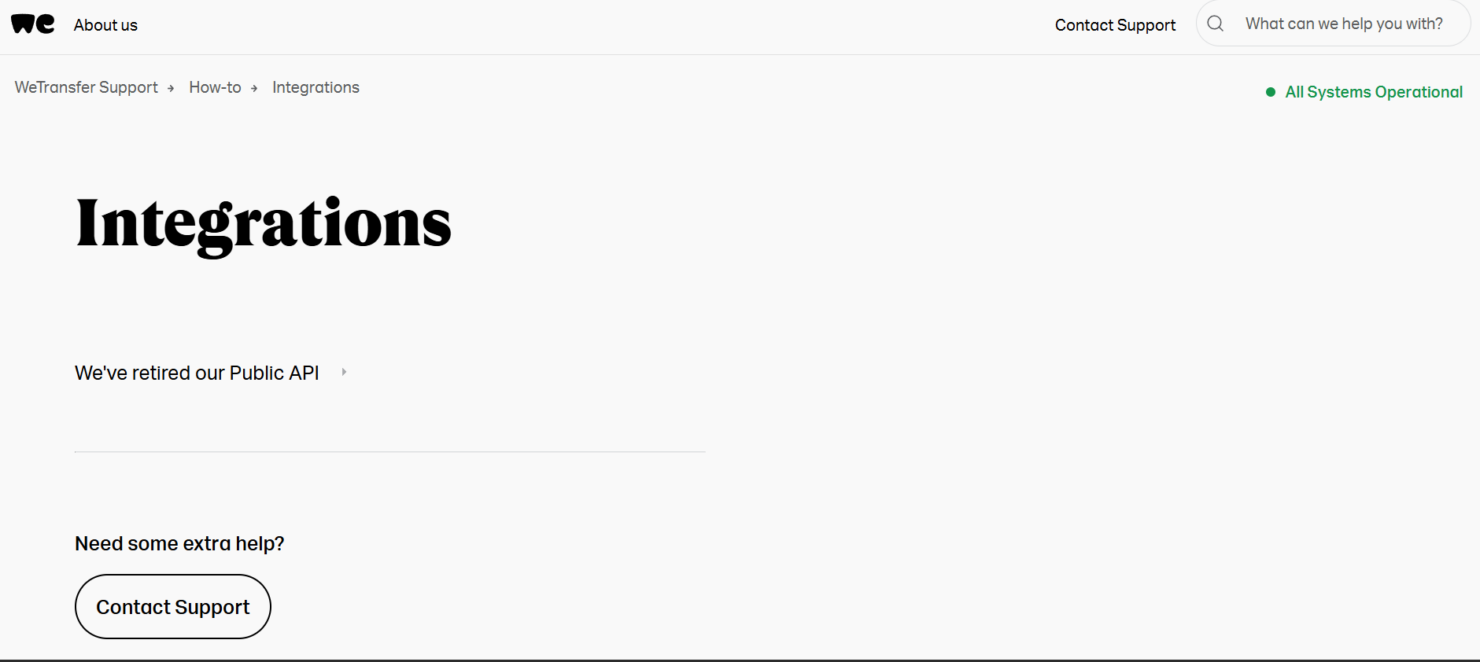
Since 2023, WeTransfer no longer provides a public API. That means you can’t develop custom integrations for extended workflows.
WeTransfer Specs
- 2-Factor Authentication
- API
- Batch Permissions & Access
- Calendar Management
- Contact Management
- Contact Sharing
- Email Integration
- External Integrations
- Google Apps Integration
- Multi-User
- Notifications
- Project Management
- Scheduling


