
How 5 Project Management Consultants Assess a Team’s Readiness for AI Change


Leadership Focus: AI readiness starts with leadership behavior rather than just team tools or skills.
Cultural Shift: Successful AI adoption relies on a cultural mindset supporting change rather than an emotional state of readiness.
Process Importance: Operational maturity is crucial; teams need documented workflows before integrating AI technologies.
Clear Objectives: Teams must articulate specific problems to solve with AI to avoid automating confusion and chaos.
Risk of Burnout: Automating poorly structured processes can lead to increased stress and burnout rather than efficiency.
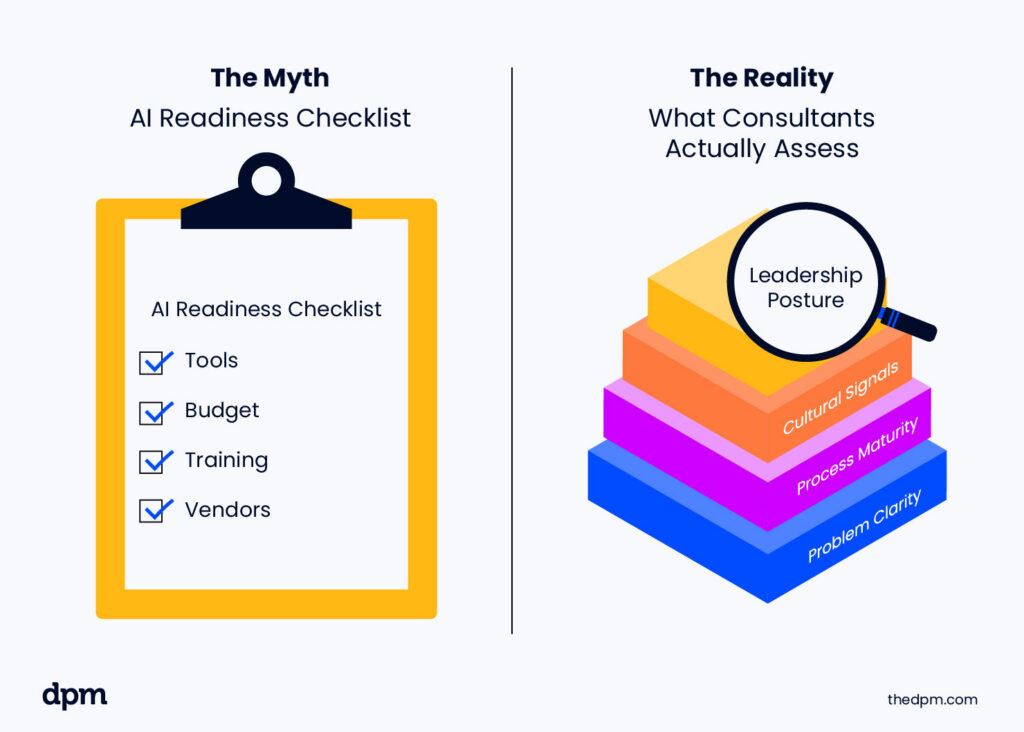
AI readiness is often treated like a technical checklist. Do teams have the right tools? The right skills? The right budget?
But consultants who work closely with organizations see a different reality. AI readiness has far less to do with software and far more to do with leadership behavior, cultural signals, and operational discipline. In fact, many teams that believe they are “ready” are often the least prepared to use AI effectively.
Across industries, consultants consistently point to the same truth: AI does not fix the risk of broken systems. It exposes them.
AI Readiness Starts With Leadership, Not the Team
The first place consultants look when assessing AI readiness is not the team at all. It is leadership.
Anthony E. Tuggle, CEO and Founder of consultancy TAG US Worldwide, puts it bluntly: “My assessment of AI readiness usually starts with leaders, not the team. Transformative change begins at the top, and leaders who are stuck in the past often resist AI because they fear job replacement, worry about a tool outsmarting them, or simply resist change.”
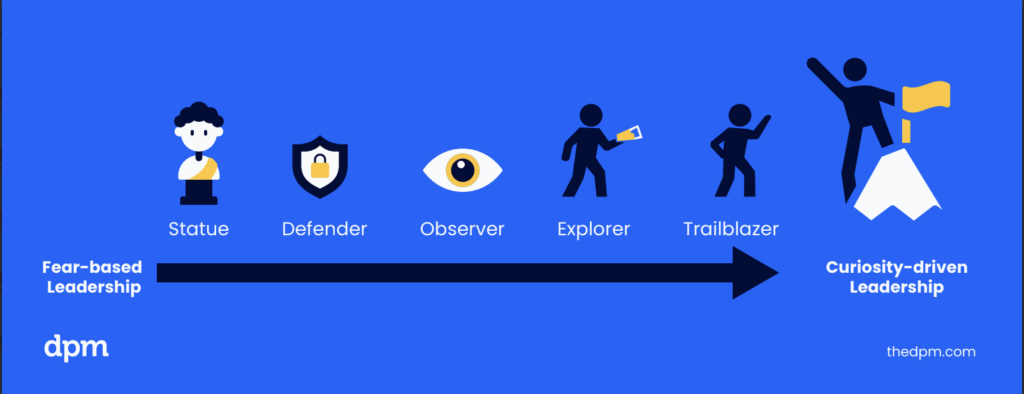
That fear shows up in subtle but damaging ways. Leaders delay decisions. They block experimentation. They frame AI as a threat rather than a lever. According to Tuggle, the difference is visible in how leaders position themselves. “Good leaders are mavericks or trailblazers; bad leaders are statues.”
When leadership is defensive or risk-averse, AI initiatives and adoption stall before they begin. When leaders are curious, open, and willing to model experimentation, teams follow quickly. Readiness is not about knowing all the answers. It is about being willing to move forward without them.

No Team Is Ever Truly “Ready” for Change
One of the biggest misconceptions around AI is the idea that teams need to feel ready before adoption begins. In reality, readiness is not an emotional state.
James Lloyd, an AI and Digital Strategy Consultant, argues that waiting for readiness is a losing strategy. “No one is ever ready for change. People generally do not like change. So, no team will ever be ‘ready’ for AI.”
What matters more than readiness is how change is introduced and supported. Lloyd emphasizes that success depends on “how it is implemented and again, down to culture.” That includes “having the right messaging from the top down about why it's important and why now,” as well as “having the right training and guidance” and “choosing the right AI tools and initiatives.”
Teams do not need to feel confident on day one. They need clarity, context, and permission to learn. When leaders clearly articulate why AI matters now, resistance drops and momentum builds.
Process Maturity Matters More Than Technical Curiosity
Many organizations rush toward AI because they are excited by its capabilities. Consultants, however, look first at something far less glamorous: process maturity.
Kyle Rankert, MBA and Small Business Operations and Project Management Consultant, explains that “AI readiness is rarely technical, it’s operational maturity.” He warns that “if a team doesn’t have documented workflows, consistent intake, or clear ownership, AI just accelerates chaos.”
In practice, this means AI tools amplify whatever already exists. Strong processes become faster. Weak processes become more painful. Rankert’s approach is to slow teams down before speeding them up. “I first implement simple process discipline, then layer AI onto repeatable steps.”
Teams that cannot describe how work flows today are not ready to automate it tomorrow. AI rewards clarity and punishes ambiguity.
If You Cannot Name the Problem, AI Will Not Help
Another key signal consultants look for is whether teams can clearly articulate what they are trying to improve. AI initiatives often fail when the goal is vague, such as wanting to “use AI” or “be more innovative.”
Dana Zellers, Leadership Coach and Consultant, frames readiness around intent. “I assess AI readiness by looking at process maturity before capability. If a team doesn’t have clear workflows, ownership, or decision paths, AI will just automate confusion and accelerate burnout.”
Zellers points out that readiness shows up when teams can explain their objective in concrete terms. “Readiness shows up when teams can clearly articulate what problem they are trying to reduce or speed up, not when leadership just wants to ‘use AI.’”
AI works best when it is applied to specific friction points. Without that clarity, teams risk investing time and energy into tools that create more noise, not less.
Automating Chaos Leads to Burnout, Not Efficiency
One of the most consistent warnings consultants share is that AI can make bad situations worse. Speed without structure increases pressure, not productivity.
Sidharth Ramsinghaney, Business Consultant, looks for discipline before enthusiasm. “I look for ‘process maturity’ over ‘technical curiosity.’ A team is ready for AI when they have a disciplined understanding of their manual workflows; if you automate chaos, you simply accelerate exhaustion.”
When AI is layered onto unclear roles, broken handoffs, or undocumented work, it does not reduce workload. It increases cognitive load and contributes to burnout. Teams feel faster but less in control.
True readiness means teams understand their work end to end. Only then does automation become a relief instead of a burden.
What AI Readiness Actually Looks Like
Across these perspectives, a clear pattern emerges. AI readiness is not about tools, pilots, or technical skills. It is about foundations.
Consultants assess readiness by looking for leadership that models curiosity instead of fear, cultures that support learning instead of perfection, and operations that are documented, owned, and understood. They listen for clarity around what problems teams are trying to solve and watch for discipline in how work moves through the organization.
AI does not transform teams on its own. It reveals how teams already work. Organizations that understand this are the ones that succeed.
Explore AI Use Cases and More
Ready to take the next step and start exploring how AI can accelerate your business' process? When you sign up to a free DPM membership, not only do you get access to countless templates, articles, and resources, you also get access to our AI Transformation Explorer. The AI Transformation Explorer gives you 100s of AI ideas for ways to use AI with examples of how to implement each use case.

