

18 Best Project Risk Management Courses: Upskill 2026


When unmanaged risks derail timelines, the gap usually traces back to process, not bad luck. I sifted through the available project risk management courses to help you find training matched to your role, delivery context, and the specific gaps you need to close—whether that's risk identification, quantitative analysis, or stakeholder communication.
The 18 Best Project Risk Management Courses
Below are my summaries of the best project risk management courses. My reviews offer a look at each course's learning objectives, best fits, cost, and more.
1. Managing Project Risks and Changes - University of California, Irvine (via Coursera)
Best for: Beginners learning risk identification and change control

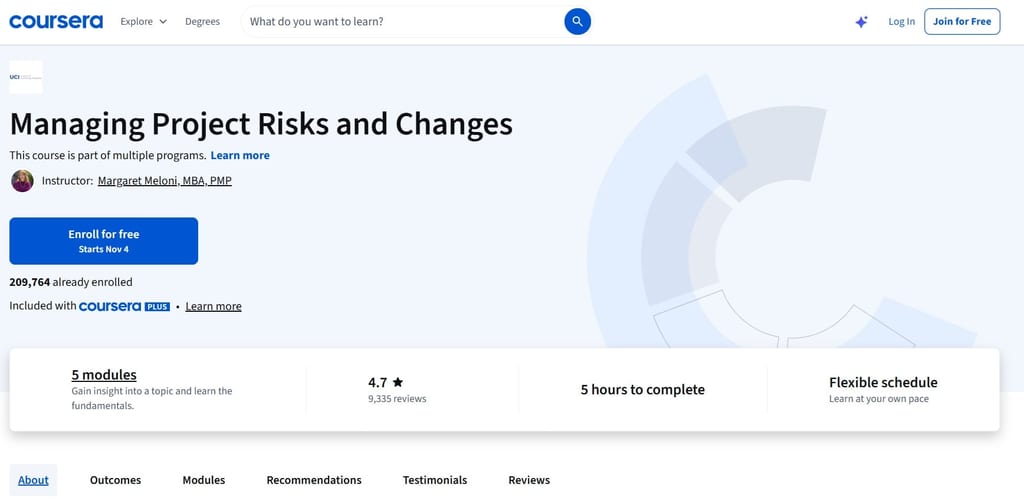
This University of California, Irvine course pairs risk management with change control in a single, focused package. Taught by PMP-certified instructor Margaret Meloni—rated 4.8/5 by learners—it covers both the analytical side of risk and the communication skills that make risk responses actually land with stakeholders.
What you'll learn: Identify and prioritize project risks, develop risk responses, manage scope changes, create a communications management plan, and facilitate lessons-learned sessions.
Course details:
- Format: Online, self-paced with video lectures, readings, and quizzes
- Duration: Approximately 5 hours
- Level/prerequisites: Beginner; no prerequisites stated
- Price: Free to audit; included with Coursera Plus ($239/year); financial aid available
- Assessment: Quizzes per module plus a final exam
- Certificate/credits: Shareable completion certificate; counts toward UCI's Project Management Principles and Practices or Project Management & Other Tools for Career Development specializations on Coursera
Considerations: The course bundles risk management with communications and change control, so if you're looking for depth on quantitative risk analysis specifically, this course won't go far enough.
2. Risk Management Training for Projects, Programs, and Operations - Learning Tree International
Best for: PMs who need live instruction and quantitative methods
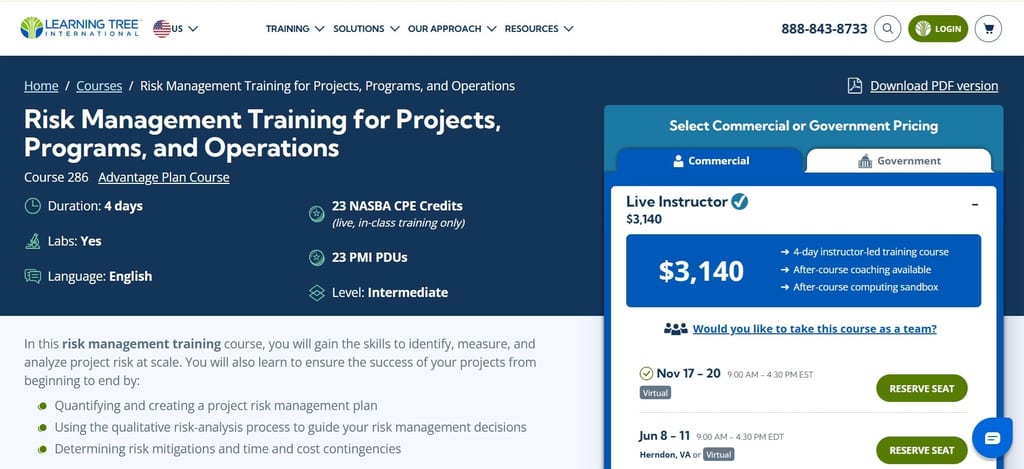
Learning Tree's four-day instructor-led course covers the full risk management lifecycle with real depth. It's one of the few options that pairs qualitative and quantitative analysis methods—including EMV and three-point estimates—with hands-on labs, scalable templates, and after-course one-on-one coaching.
What you'll learn: Build risk registers and risk plans, apply qualitative and quantitative analysis methods, develop response strategies, monitor emerging risks, and run lessons-learned processes.
Course details:
- Format: Instructor-led; available in-person or live virtual
- Duration: 4 days (9:00 AM–4:30 PM per day)
- Level/prerequisites: Intermediate; prior project management experience required
- Price: $3,140 USD per learner; government pricing available at $2,792 USD
- Assessment: End-of-course exam
- Certificate/credits: 23 PMI PDUs, 23 NASBA CPE credits (in-person only), 15 PRINCE2 CPDs; after-course one-on-one instructor coaching included
Considerations: At $3,140 per learner, this is one of the more expensive options on this list—it makes the most sense if you need verifiable PDUs or CPE credits alongside the training.
3. Strategic Project Risk Management - LinkedIn Learning
Best for: Intermediate PMs seeking a strategic risk framework

Dr. Prasad Kodukula, a PMI Fellow with 40+ years of practitioner experience, teaches this LinkedIn Learning course. What sets it apart is its four-type risk framework—variability, event, ambiguity, and emergent—which gives you a more structured lens than most introductory or mid-level courses offer.
What you'll learn: Categorize project risks by type, build and maintain a risk register, perform qualitative and quantitative analysis, select treatment strategies, and manage risks at the program and portfolio level.
Course details:
- Format: Online, self-paced; downloadable for offline viewing via iOS/Android app
- Duration: 1 hour 42 minutes
- Level/prerequisites: Intermediate; foundational project management knowledge assumed
- Price: Included with LinkedIn Learning subscription ($39.99/month or $239.88/year); free trial available
- Assessment: 5 quizzes included
- Certificate/credits: LinkedIn Learning Certificate of Completion; shareable to LinkedIn profile or downloadable as PDF; continuing education units available
Considerations: Access to this course depends on an active LinkedIn Learning subscription—there's no standalone purchase option, so it only makes sense if you're already subscribed or plan to use the platform for other courses too.
4. Project Risk Management: Effective Decision Making Strategies - University of Maryland, College Park (via edX)
Best for: PMs who need a quantitative, decision-science approach

This three-course professional certificate from the University of Maryland, College Park goes deeper into quantitative risk methods than most PM-focused programs. It applies decision science—including Monte Carlo simulation, Bayesian thinking, and utility theory—to real project risk challenges, taught by a professor with an engineering and reliability background.
What you'll learn: Build a risk management plan and risk register, model budget and schedule risk using Monte Carlo simulation, apply Bayesian thinking and utility theory, and evaluate risk response strategies including risk transfer.
Course details:
- Format: Online, self-paced via edX; three sequential courses
- Duration: Approximately 4 months at 1–3 hours per week (15 weeks total)
- Level/prerequisites: Intermediate; some project management familiarity assumed
- Price: $747 USD for the full program (individual courses $249 each)
- Assessment: Assessments included across all three courses
- Certificate/credits: edX Professional Certificate from the University of Maryland, College Park; 30 PMI PDUs (10 per course)
Considerations: The program is structured as three sequential courses, so you're committing to a multi-month investment—it's worth the time if you want genuine depth in quantitative methods, but it's not the right fit if you need a quick skills refresh.

5. Project Risk Management - Coursera
Best for: Beginners who want PMBOK, PRINCE2, and ISO 31000 in one place
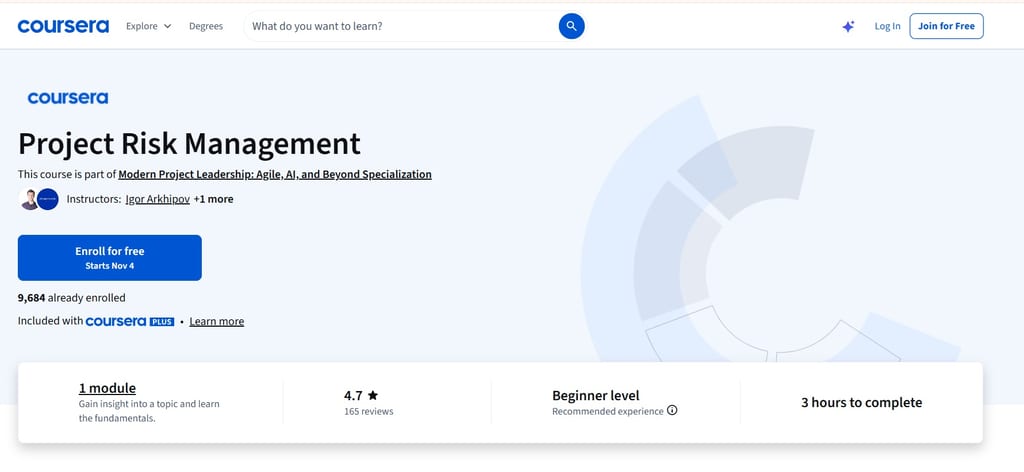
This three-hour Coursera course draws on PMBOK, PRINCE2, and ISO 31000 to walk beginners through the complete project risk lifecycle. Taught by Igor Arkhipov, a CBAP with 15+ years of experience, it includes a live risk register demo that helps translate the concepts into practice.
What you'll learn: Establish a risk management framework, identify and analyze project risks, develop mitigation strategies, monitor risk indicators, and build a working risk register.
Course details:
- Format: Online, self-paced via Coursera; video lectures, readings, and assessments
- Duration: 3 hours
- Level/prerequisites: Beginner; basic project management knowledge assumed
- Price: Included with Coursera Plus ($239/year); financial aid available; individual enrollment pricing not published
- Assessment: 1 assignment and 2 discussion prompts included
- Certificate/credits: Shareable Coursera certificate of completion; part of the "Modern Project Leadership: Agile, AI, and Beyond" Specialization
Considerations: There's no published standalone purchase price, so if you're not already on Coursera Plus, you'll need to check current individual enrollment fees before signing up.
6. Risk Management Professional Certification Prep Specialization - LearnKartS (via Coursera)

Best for: PMs who want PMI-RMP exam prep with case studies
LearnKartS structures this six-course Coursera specialization around the PMI-RMP exam content outline, walking you through all five exam domains with mapped case studies. It's focused exam prep, not a general survey—which makes it worth considering if the PMI-RMP credential is on your roadmap.
What you'll learn: Apply risk identification techniques including mind mapping and root cause analysis, perform qualitative and quantitative analysis using Monte Carlo simulation and decision trees, and develop response strategies for both threats and opportunities.
Course details:
- Format: Online, self-paced via Coursera; video lectures, quizzes, practical exercises, and case studies across 6 sequential courses
- Duration: Approximately 34 hours total; about 4 weeks at 10 hours per week
- Level/prerequisites: Intermediate; familiarity with project management basics and Waterfall/Agile methodologies recommended
- Price: Included with Coursera Plus ($239/year); individual course enrollment available; no standalone one-time price published; financial aid available
- Assessment: Quizzes and practical exercises included across all six courses
- Certificate/credits: Completion certificate from LearnKartS upon finishing the full specialization; shareable to LinkedIn, resume, or CV
Considerations: The specialization is not affiliated with or endorsed by PMI, and completing it does not award the PMI-RMP credential—you'll still need to pass the PMI-administered exam separately to earn that designation.
7. Strategic Risk Management - Project Management Academy (PMA)
Best for: PMs connecting project risks to organizational strategy
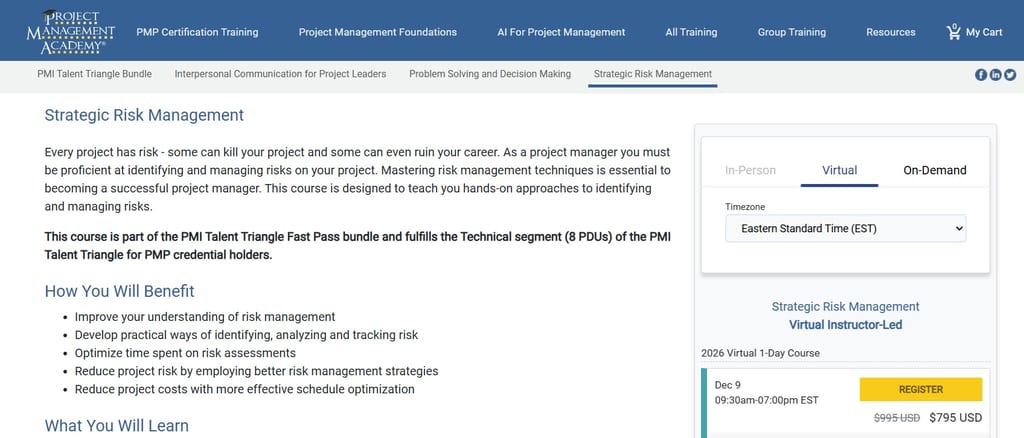
Project Management Academy's Strategic Risk Management is a one-day workshop from a PMI Authorized Training Partner. It goes deeper into risk than standard PMP training covers, connecting project-level risk decisions to broader organizational goals through a mix of individual and team exercises built around real project scenarios.
What you'll learn: Write three-part risk statements, build risk matrices, calculate contingencies using expected monetary value and Monte Carlo simulation, and develop response strategies for residual and secondary risks.
Course details:
- Format: Live virtual instructor-led (1 day) or self-paced video on demand; individual and team exercises included
- Duration: 1 day (virtual instructor-led) or 8 hours of content with 6 months' access (video on demand)
- Level/prerequisites: Intermediate; prior project management experience assumed; no PMP required
- Price: $995 USD (virtual instructor-led); $295 USD (video on demand); group in-house pricing available on request
- Certificate/credits: 8 PMI PDUs (all Ways of Working), pre-approved by PMI toward PMP credential maintenance
Considerations: The course is practical training, not PMI-RMP exam prep—if you're targeting that certification specifically, you'll want to pair it with a dedicated exam prep resource.
8. PMI-RMP Certification Training - Project Management Academy (PMA)
Best for: PMs who want live PMI-RMP prep and a pass guarantee

PMA's PMI-RMP Certification Training is a 30-hour boot camp from a PMI Authorized Training Partner built specifically to prepare you for the PMI-RMP exam. It satisfies the 30 contact-hour education requirement to apply for the exam and backs your enrollment with a money-back pass guarantee.
What you'll learn: Apply the five PMI-RMP risk management domains by performing qualitative and quantitative risk analysis, building risk registers, planning risk responses, and developing contingency plans.
Course details:
- Format: Live virtual instructor-led or self-paced video on demand; in-house available for groups of 10+
- Duration: 3 days / 30 hours (virtual instructor-led); 30 hours of content with 6 months' access (video on demand)
- Level/prerequisites: Intermediate to advanced; builds on PMP knowledge; no PMP required to enroll
- Price: $1,695 USD (virtual instructor-led, discounted from $1,995 USD)
- Certificate/credits: 30 PMI PDUs (24 Ways of Working, 3 Business Acumen, 3 Power Skills); satisfies the PMI-RMP exam's 30 contact-hour education requirement
Considerations: The course explicitly builds on PMP-level knowledge, so if you're enrolling without that foundation, expect to work harder to keep pace.
9. Project Management Foundations: Risk - LinkedIn Learning
Best for: PMs who want a quick, PMBOK-aligned risk refresher

Project Management Foundations: Risk is a 90-minute self-paced course on LinkedIn Learning, taught by Bob McGannon, PMP, and updated for the PMBOK seventh edition. At under two hours, it covers the full risk management lifecycle in a fraction of the time most dedicated risk courses require.
What you'll learn: Build and tailor risk plans, identify threats and opportunities, assess risk appetite and tolerance, and develop responses for staffing and technology uncertainty.
Course details:
- Format: Self-paced online via LinkedIn Learning; video lessons and 2 exercise files; mobile app access included
- Duration: 1 hour 26 minutes of content; access continues with active subscription
- Level/prerequisites: Intermediate; no prerequisites needed
- Price: Included with LinkedIn Learning subscription ($39.99/month or $239.88/year); individual course purchase not available
- Assessment: 5 inline quizzes
- Certificate/credits: LinkedIn Learning Certificate of Completion, shareable to LinkedIn profile; CEUs awarded; part of a Microsoft Professional Certificate
Considerations: The course isn't available as a standalone purchase—you'll need an active LinkedIn Learning subscription, so check whether your employer already provides access before paying out of pocket.
10. Project Risk Management - Management Concepts
Best for: Government PMs earning CLP and CPE risk management credits

Management Concepts' Project Risk Management (Course 6103) is a 3-day instructor-led course built specifically for public-sector PMs, taught by instructors with federal agency backgrounds. It's worth considering if your organization procures training through GSA contract vehicles or requires CLP and CPE credits for professional development.
What you'll learn: Build risk management plans, perform qualitative and quantitative risk analysis including Monte Carlo simulation, develop response strategies, and monitor risks throughout project execution.
Course details:
- Format: In-person (Washington, DC) or live virtual instructor-led; private group delivery available
- Duration: 3 days (approximately 8 hours per day)
- Level/prerequisites: Intermediate
- Price: $2,589.00 USD per learner; ACH, EFT, or check payments avoid a 3% credit card surcharge; government contract vehicles available
- Assessment: Hands-on exercises and team activities (60% of grade); final exam (40% of grade); minimum score of 70% required to earn credit
- Certificate/credits: 24 CLP, 24 CPE (NASBA-registered), 1.9 CEU, 21 PMI PDUs; FM MyLearn Number F7394
Considerations: At $2,589 per learner, this is the highest-priced course in this roundup—though government agencies can procure it through GSA schedules and other contract vehicles, which often makes budget approval more straightforward than a direct purchase.
11. Risk Management for Project Professionals - Udemy
Best for: PMs preparing for the PMI-RMP exam on a budget

Risk Management for Project Professionals is a self-paced Udemy course by Sorin Dumitrascu covering the full PMBOK risk lifecycle across nearly 42 hours of video. If you're preparing for the PMI-RMP and want that depth without the cost of an instructor-led program, this is worth considering.
What you'll learn: Build risk management plans, run qualitative and quantitative analysis including Monte Carlo simulation and expected monetary value, develop threat and opportunity responses, and monitor risks using PMBOK sixth and seventh edition frameworks.
Course details:
- Format: Self-paced, on-demand video via Udemy; desktop, mobile, and TV access
- Duration: 41 hours 43 minutes of video plus 15+ hours of exercises; lifetime access
- Level/prerequisites: Intermediate; prior familiarity with project management fundamentals including scope, schedule, and cost expected
- Price: $64.99 USD per course (frequently discounted); also available via Udemy subscription from $12.99/month
- Assessment: Section quizzes and assignments throughout the course
- Certificate/credits: Udemy Certificate of Completion; instructor claims 40 PDUs toward PMI credentials (no PMI Authorized Training Partner designation verified)
Considerations: The 40 PDU claim comes from the instructor, not a PMI Authorized Training Partner designation, so confirm PDU eligibility directly with PMI before counting these hours toward certification requirements.
12. Project Risk Management & Compliance - Oxford Management Centre
Best for: Global teams wanting a week-long in-person risk intensive

Oxford Management Centre's Project Risk Management & Compliance is a five-day instructor-led course delivered across locations in Europe, the Middle East, Africa, and North America. It's worth considering if your team is distributed globally and in-person training outside the US is a real requirement.
What you'll learn: Plan risk management using PMBOK processes, perform qualitative and quantitative analysis including Monte Carlo simulation and expected monetary value, apply Bow-Tie analysis, and develop and control response strategies for both threats and opportunities.
Course details:
- Format: In-person classroom (London, Dubai, Pretoria, Amsterdam, Houston) or live virtual instructor-led; private group delivery available
- Duration: 5 days (full-day sessions)
- Level/prerequisites: Curriculum targets project managers, risk managers, and engineers
- Price: $4,950 USD per learner (online); $5,950 USD per learner (most classroom locations); $7,950 USD per learner (Houston classroom); accommodation and transport excluded
- Certificate/credits: Oxford Management Centre Certificate of Completion; PMI PDUs (PMI Registered Training); CPE credits (NASBA-registered sponsor); Guided Learning Hours for online participants
Considerations: Classroom fees cover materials and refreshments but exclude accommodation and transport, so total cost per learner is meaningfully higher than the listed price—factor that in before comparing it against other options.
13. Project Risk Management - UC San Diego Extended Studies
Best for: PMs in healthcare or pharma needing university credit

UC San Diego Extended Studies' Project Risk Management is a six-week course from a WASC-accredited university, awarding 2.00 extension units. If you work in healthcare or pharmaceuticals and want academic credentials that carry more weight than a platform certificate, this is worth considering.
What you'll learn: Evaluate probability and impact of project risks, build and prioritize a risk register, apply a qualitative response-planning process, plan cost and time contingencies, and monitor risks through project execution.
Course details:
- Format: Online asynchronous via Canvas, or in-person weekly evening sessions (San Diego only)
- Duration: ~6 weeks; 30 education hours total
- Level/prerequisites: Intermediate; UC San Diego's Project Management Essentials or Boot Camp required, though concurrent enrollment is allowed
- Price: $595 USD per learner; required textbook purchased separately
- Assessment: Graded assignments throughout; 70% or higher required to earn the certificate
- Certificate/credits: UC San Diego Certificate of Completion; 2.00 WASC-accredited extension units; 30 PDU-applicable education hours; counts toward UC San Diego's Professional Certificate in Project Management
Considerations: The required textbook is an additional out-of-pocket cost not included in tuition, and in-person sessions are only available in San Diego.
14. Project Management Fundamentals: Risk Management - Georgia Tech (via edX)
Best for: New PMs wanting a free Georgia Tech introduction
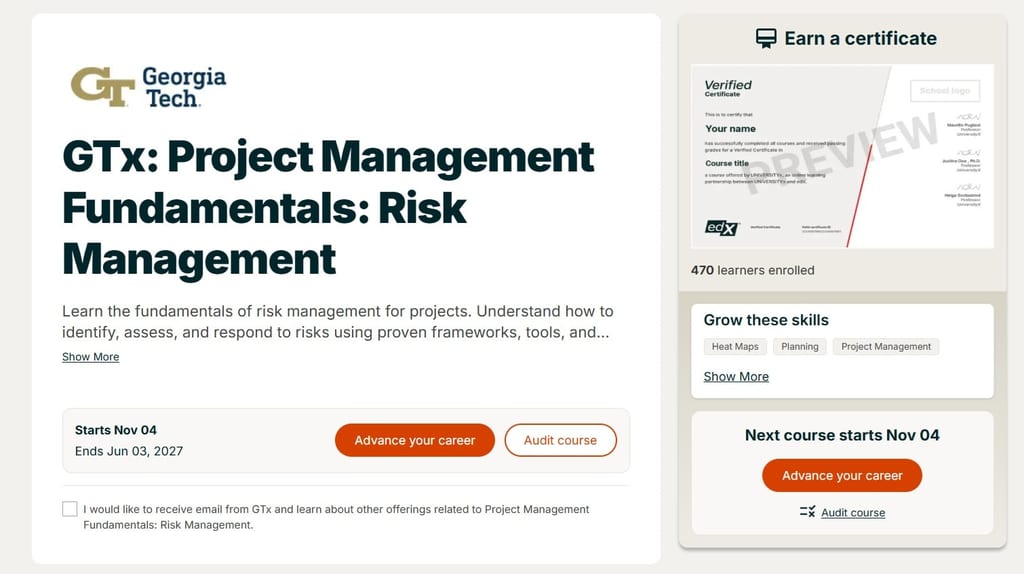
Georgia Tech's self-paced edX course covers project risk management from identification through monitoring. At roughly two weeks and free to audit, it's the most accessible entry point on this list for beginners with no prior project management experience.
What you'll learn: Identify and categorize project risks, apply Expected Monetary Value to prioritize them, develop tailored response strategies including avoidance and mitigation, and monitor risks through project execution.
Course details:
- Format: Self-paced online via edX; lectures, interactive simulations, and real-world case analyses
- Duration: 2 weeks; 2–4 hours per week (~4–8 hours total)
- Level/prerequisites: Introductory; no prior experience required
- Price: Free (audit track); $149 USD for a verified certificate; full 4-course Professional Certificate is $596 USD
- Assessment: Required assessment included; a passing score is needed to earn CEU credit
- Certificate/credits: edX Verified Certificate from Georgia Tech (paid track); counts toward the GTx Project Management Fundamentals Professional Certificate
Considerations: The audit track gives you full content access but no certificate—if credentials matter to you, budget for the $149 verified track.
15. Project Risk & Opportunity Management - PPI
Best for: Engineers managing risk and opportunity on complex projects

PPI's three-day instructor-led course is one of the few in this roundup that treats opportunity management as a discipline equal to risk. It's built for technical environments like defense, aerospace, and infrastructure, and covers a wider toolkit of analysis methods than most PM-focused courses.
What you'll learn: Identify and categorize project risks and opportunities, apply quantitative techniques including Monte Carlo simulation and EMV, evaluate risks against acceptability criteria, and develop handling plans integrated with project schedules and management documents.
Course details:
- Format: In-person or online; corporate delivery to organizations worldwide
- Duration: 3 days (24 instructor hours)
- Level/prerequisites: Intermediate to advanced; familiarity with project management or systems engineering assumed
- Price: Contact PPI directly for a quote
- Certificate/credits: PPI certificate of completion; 24 PMI PDUs; 24 INCOSE PDUs (creditable toward CSEP maintenance); 24 CPD hours for Engineers Australia and Engineering New Zealand
Considerations: Because PPI delivers this course primarily through corporate engagements, individual learners may have limited access to public sessions—it's best suited for teams booking in-house training rather than solo enrollment.
16. PME4: Project Risk Management - Algonquin College Corporate Training
Best for: New PMs learning Agile and traditional risk methods

Algonquin College's PME4 is a three-day virtual course covering traditional and Agile risk management. As a PMI Authorized Training Partner, it awards 21 PDUs toward PMP certification—and can stand alone or count toward their seven-course Project Management Essentials certificate.
What you'll learn: Identify and assess project risks, plan proactive and reactive responses, build and manage a risk register, monitor risks through trigger and symptom tracking, and apply Agile risk management practices.
Course details:
- Format: Live virtual instructor-led via Microsoft Teams; 8:30 AM–4:30 PM EST each day
- Duration: 3 consecutive days
- Level/prerequisites: Beginner; no prior experience required
- Price: $1,780 CAD per participant; PMBOK® Guide (7th ed.) recommended but sold separately
- Assessment: In-class quizzes, assignments, and homework throughout the course
- Certificate/credits: 21 PMI PDUs; counts toward Algonquin College's Project Management Essentials certificate (80% attendance required)
Considerations: Sessions are scheduled infrequently—the next listed session runs January 2027—so if you're working toward a certification deadline, check availability early.
17. Project Risk Management - IRM
Best for: Practitioners wanting a risk body's one-day course

IRM's one-day course approaches project risk from the perspective of a dedicated risk management professional body. That distinction matters if you want a risk-discipline lens rather than a methodology-driven one. The trainer brings a background in government security advisory and crisis management, which shapes how the course frames threat identification and response.
What you'll learn: Identify and prioritize project risks, build and manage a risk register, develop risk response plans, and align risk management with project and programme strategy.
Course details:
- Format: Live virtual instructor-led via Zoom; in-house delivery available for groups of six or more
- Duration: 1 day (6 hours)
- Level/prerequisites: Practitioner level; some project experience assumed
- Price: £440–£550 + VAT per participant (member and non-member rates); up to 25% savings when bundled with other IRM courses
- Certificate/credits: IRM certificate of attendance; CPD hours applicable per IRM's training framework
Considerations: No PMI PDUs or other widely recognized PM certification credits are mentioned, so if you're working toward PMP maintenance hours, this course won't help with that.
18. Project Risk Management Training - 4PMTI
Best for: PMPs needing 24 renewal PDUs in risk management
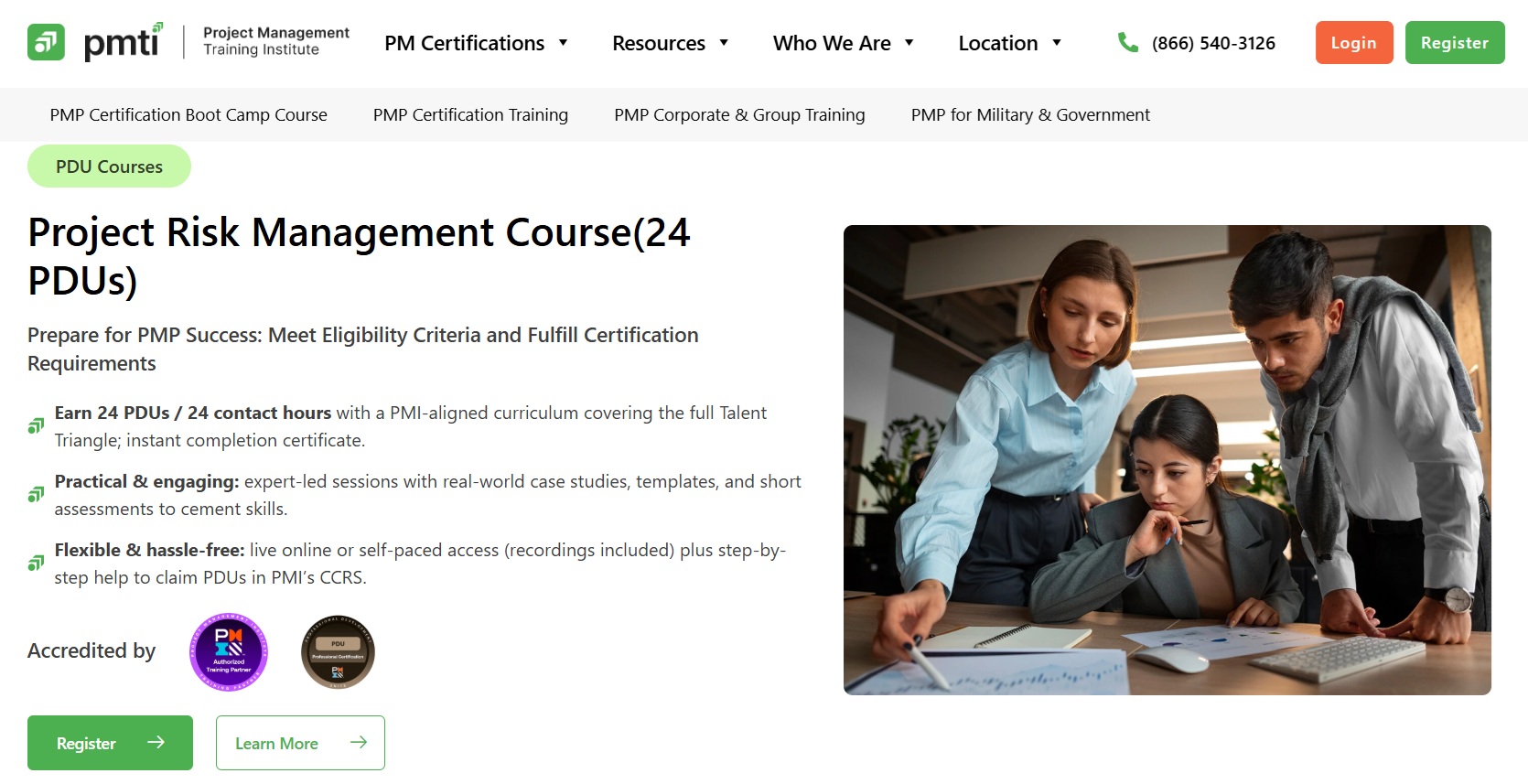
4PMTI's self-paced course was developed by Max Wideman, a Fellow PMI who helped write the original PMBOK Guide. That content lineage gives the material real authority. It also uses accelerated-learning techniques—multi-sensory delivery, mnemonics, and practice tests—rather than a straight lecture format.
What you'll learn: Identify and analyze project risks using qualitative and quantitative techniques, develop risk response and mitigation strategies, understand insurable risks, and apply PRM concepts through case studies.
Course details:
- Format: Self-paced online e-learning; live online and private in-person team workshops available on request
- Duration: 24 hours of content; 30-day access window
- Level/prerequisites: No prerequisites required; project experience is helpful
- Price: $495 USD per participant; group pricing available on request
- Assessment: Multiple-choice knowledge checks throughout the course
- Certificate/credits: Completion certificate; 24 PMI PDUs aligned with the PMI Talent Triangle, verified through PMTI's PMI Authorized Training Partner status
Considerations: The 24 PDUs apply to PMP renewal only—they don't count toward the 35 contact hours required to sit the PMP exam for the first time, so this isn't the right course if you're still working toward initial certification.
How to Choose a Project Risk Management Course
Start by identifying the specific gap you're trying to close. Whether that's building your first risk register, running Monte Carlo simulations, or leading organization-wide risk governance will determine which course actually moves the needle for you.
- Match curriculum depth to your role. A course covering risk identification and response planning is enough if you're new to formal risk management. If you're running complex schedules or cost models, look for quantitative analysis content—EMV, sensitivity analysis, and simulation tools.
- Check whether PDUs are part of your decision. If you hold a PMP or other PMI credential, some courses in this space offer pre-verified PDUs you can apply directly to renewal. Others offer only a certificate of completion, which carries no weight toward certification maintenance.
- Consider the experience level the course assumes. Some courses assume you've managed projects before; others are designed for practitioners with established risk management responsibilities. Starting a course pitched above your current experience level tends to produce surface learning, not durable skills.
- Be honest about format and time commitment. A 2.5-hour on-demand course and a 24-hour self-paced program are fundamentally different investments—even if both are "self-paced." Live virtual formats add accountability but require schedule flexibility. Factor in your actual availability, not your ideal availability.
- Ask whether the tools match your workplace. Some courses teach risk concepts through Excel or Primavera; others focus on frameworks and process. If your team uses specific software, a course with hands-on tool demos will transfer more directly to your day-to-day work.
Project Risk Management FAQ
Are project risk management skills transferable across industries?
Yes. Core practices—identifying risks, assessing likelihood and impact, assigning owners, and planning responses—apply across sectors, though examples and risk categories vary. A course built around construction scheduling will teach the same underlying logic as one built around software delivery.
Check whether a course’s case studies reflect your industry, or whether the principles are framed broadly enough that you can adapt them to your own context.
How can you judge a course's quality beyond its ratings?
Look for a detailed syllabus, clear learning outcomes, instructor credentials, and exercises that ask you to apply the techniques—not just watch them. Ratings give you a rough signal, but they don’t tell you whether the content is current or relevant to your work.
A high rating on a course last updated in 2018 is worth less than a moderate rating on something that reflects current frameworks and tools.
Is completing a course enough to manage project risk effectively?
No. A course gives you methods and tools, but applying them on a real project is where the learning actually sticks. Risk management also depends on stakeholder input, organizational context, and judgment calls that no course can fully replicate.
Think of a course as building your foundation—you’ll sharpen the rest through practice, iteration, and feedback on live projects.
Does a course certificate mean you hold a risk management certification?
No. A certificate of completion confirms you finished a course; it’s not the same as a professional certification. Credentials like the PMI-RMP or IRM’s risk qualifications involve separate eligibility requirements, examinations, and ongoing maintenance.
Before listing a certificate on your profile or resume, check what it actually represents—some carry real professional weight, and others are simply proof of attendance.
What's Next?
Want to connect with other digital project managers and share resources and best practices? Join our membership community to access 100+ templates, samples, and examples, and connect with hundreds of peers in Slack.


