7 Leaders Tell Us the Practices PMs Should Stop Following

Ritual Critique: Project management rituals often outlive usefulness, focusing on appearance rather than real delivery.
Planning Approach: Alignment with stakeholders is crucial, outperforming isolated planning with documentation artifacts.
Status Reporting: Effective delivery health is tied to stakeholder confidence, not just activity-focused status reports.
Decision Impact: Status reports should drive decisions or significant insights, not routine updates.
Plan Flexibility: Project success requires adaptability to changing environments, not rigid adherence to original plans.
Every profession has rituals that outlive their usefulness. In project management, some of the most entrenched habits—meticulous status reports, rigid adherence to the plan, an eagerness to say yes—started as genuine best practices. They were responses to real problems: lack of visibility, scope chaos, stakeholder distrust.
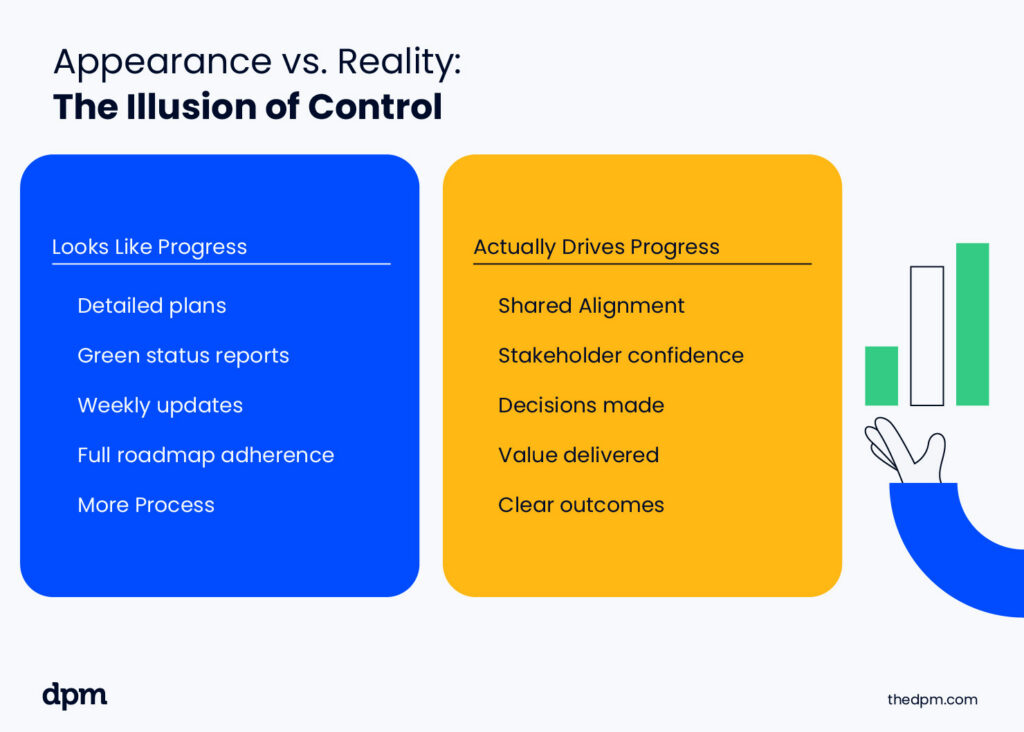
But somewhere along the way, the rituals became the point. Teams started optimizing for the appearance of control rather than the reality of delivery. Status reports got longer. Plans got more detailed. And project managers got better at performing progress while the actual work quietly stalled.
We asked seven delivery leaders a pointed question: if you could tell every project manager you oversee to stop doing one thing, what would it be? Their answers span different industries, different methodologies, and different levels of seniority. But they share a common thread—the practices most worth killing are the ones that make project managers feel productive while keeping them furthest from the work that matters.

Stop Planning in a Vacuum
Alignment is not a phase. It is the entire point.
Paul Kirschbaum, Project Director at FreemanGroup, targets the habit at the root of most delivery failures. "Stop designing programs in isolation from the people who have to execute them," he says. "If frontline teams, managers, and senior leaders aren't aligned around the same few priorities, the initiative stalls no matter how polished the plan looks. Alignment beats documentation every time."
Stop designing programs in isolation from the people who have to execute them.
It is a deceptively simple observation, and one that cuts against deep instincts in the profession. Project managers are trained to plan, and planning feels like progress. A detailed work breakdown structure, a color-coded Gantt chart, a risk register with seventeen rows—these artifacts create the sensation of rigor. But rigor in isolation is just decoration. A beautifully documented plan that the engineering lead has never seen and the operations team cannot execute is not a plan. It is a fantasy with formatting that lacks proper workflow optimization.
The fix is not to stop planning. It is to stop treating planning as a solo activity. The best project managers Kirschbaum describes are the ones who pull stakeholders into the room before the plan is written, not after. They know that a rough plan built with the people who will execute it will outperform a polished plan built without them every single time. This collaborative approach forms the foundation of any effective process improvement plan.

Stop Confusing Status Reports with Delivery Health
What you measure signals what you value.
Aleksa Baburska, Director of Solution Acceleration at Devox Software, draws a line between the metrics project managers track and the outcomes that actually matter. "I tell my project managers to stop treating status reports as the main measure of success," she says, "as soon as real delivery health is seen in stakeholder confidence and team compound velocity."
The distinction is important. Status reports measure activity. They tell you what happened. Stakeholder confidence and team velocity measure trajectory. They tell you whether the project is building momentum or quietly losing it. A project can produce flawless weekly updates while the team burns out, the sponsor disengages, and the delivery date drifts. The report says green. The project is red.
This does not mean reporting has no value. It means that the report should serve the delivery, not the other way around. When project managers spend more time crafting updates than understanding the health of the team and the trust of their stakeholders, the reporting has become the product—and the actual product has lost its advocate.
Stop Writing Status Reports Nobody Needs
If it doesn't drive a decision, it doesn't deserve an audience.
Cosmina Buiga, Founder and Principal of Delivery Is the Strategy™, takes the reporting critique further—and sharper. "Stop sending status updates that read like diary entries," she says. "Your executives do not care that the infrastructure team completed 47 tickets last week. They care that the payment gateway is still offline and costing the business $18K per day in abandoned checkouts."
Her test for whether a status report should exist at all is ruthless in its clarity: "Every status report should answer one question: what decision do you need from me right now to unblock revenue? If the answer is nothing, do not send the report."
Every status report should answer one question: what decision do you need from me right now to unblock revenue?

It is a standard that would eliminate the majority of status updates in most organizations overnight. And that is precisely the point. The weekly update has become a default, not a decision. Project managers send it because it is Thursday, not because something has changed. Executives skim it because it arrived, not because it contains information they can act on. The ritual persists because stopping it feels riskier than continuing it—even though continuing it costs everyone time and delivers no one value.
Buiga's reframe forces project managers to think like business owners. Every communication should either request a decision or deliver information that changes one. Everything else is noise dressed up as diligence.
Stop Saying Yes to Plans You Haven't Pressure-Tested
Unchallenged assumptions always come due.
Dana Zellers, a Leadership Coach, shifts the focus from outputs to a more personal habit—the instinct to agree. "Stop accepting scope and schedule at face value," she says. "Many PMs feel pressure to say yes and figure it out later, but unchallenged assumptions almost always resurface as missed deadlines or strained relationships."
The pattern is familiar to anyone who has managed projects in fast-moving organizations. A stakeholder names a deadline. A sponsor defines scope. The project manager nods, opens a spreadsheet, and starts working backward from a date that was never interrogated. The pressure to accommodate is real—nobody wants to be the person who slows things down in the kickoff meeting. But the cost of compliance without scrutiny is almost always higher than the cost of early pushback.
Zellers describes what stronger project managers do differently: "The strongest PMs dig in early, pressure-test the plan, and clarify what is truly required versus what is assumed." That distinction—required versus assumed—is where most project failures originate. Assumptions about capacity, dependencies, technical complexity, and stakeholder availability rarely survive contact with reality. The project managers who surface those gaps in week one are not being difficult. They are being responsible.
Stop Leading with Tools When the Problem Is Purpose
Templates do not fix misalignment.
Apriel Biggs, Chief Transformation Officer at Blagile, Inc., sees a pattern among project managers under pressure: they reach for process when they should be reaching for understanding. "When things are broken, pushing tools and templates is not the first remedy," she says. "Stop talking about the 'what' and begin to discuss the 'why.'"
It is a natural reflex. When a project starts to wobble, the instinct is to add structure—a new tracking tool, a tighter change control process, another layer of reporting. These interventions feel productive. They are visible, implementable, and within the project manager's control. But they address symptoms, not causes. A project that is failing because stakeholders disagree on what success looks like will not be saved by a better RACI chart.

Biggs frames project managers not as administrators but as strategic partners: "Project managers are partners in the strategy delivery lifecycle. Delivery leaders must get curious about what is broken and understand value as defined by stakeholders." The shift she is describing is from compliance to curiosity. Instead of asking "are we following the process?" the better question is "does anyone in this room agree on what we are actually trying to achieve?" If the answer is no, no template will help.
Stop Worshipping the Original Plan
Static plans in dynamic environments are liabilities.
Suzy Jackson, Chief Commercial Officer, brings a commercial lens to a delivery problem. "I would tell project managers to stop the obsession with 100% adherence to rigid, pre-planned roadmaps," she says. "Organizations that adhere too closely to static plans see a drop in overall value when market conditions change."
The observation has teeth because it connects plan rigidity directly to business outcomes. Adherence to the original timeline is not a virtue if the market moved while the team was heads-down executing. A product delivered on time to a spec that no longer reflects customer needs is not a success. It is an expensive exercise in following instructions.
Jackson's alternative is pragmatic: "The most successful delivery occurs when teams are able to pivot based on real-time data versus original assumptions." This does not mean abandoning structure. It means treating the plan as a hypothesis rather than a contract—something to be tested against emerging information, not defended against it. The best project managers hold the plan loosely enough to respond to reality and tightly enough to maintain coherence. That balance is the skill. Rigid adherence is just the absence of it.
Stop Clinging to the Old Playbook
The profession is evolving. The toolbox should too.
Anthony E. Tuggle, CEO and Founder of TAG US Worldwide, zooms out from any single practice to challenge the default posture of the profession itself. "Project managers should stop solely subscribing to traditional project management methods, frameworks, and experiences," he says. "They should embrace the evolution of technology and tools, many of which are automated, AI-powered, and scaling every day."
Project managers should stop solely subscribing to traditional project management methods and embrace the evolution of technology and tools.
Tuggle is not arguing against methodology. He is arguing against methodological loyalty—the tendency to treat a framework learned five or ten years ago as permanent infrastructure rather than as a tool that may have a shelf life.
The project management profession has always evolved in waves—from waterfall to agile, from agile to hybrid, from hybrid to whatever comes next. Each wave brought new tools and retired old assumptions. The project managers who thrive through these transitions are not the ones who mastered one framework and defended it. They are the ones who stayed curious enough to learn the next one and honest enough to admit when the old one stopped working, making career-defining decisions to adapt and grow.
The Common Thread
The practices these leaders want killed range from specific (stop sending diary-entry status reports) to philosophical (stop clinging to static plans in a changing world). But every answer orbits the same core problem: project managers optimizing for the artifacts of control rather than the conditions of delivery.
Status reports that no one reads. Plans built without the people who execute them. Scope accepted without scrutiny. Tools deployed before the problem is understood. Roadmaps followed after the destination has moved. These are not failures of competence. They are failures of orientation. The project manager is pointed at the process instead of the outcome.
The leaders in this piece are not asking for less rigor. They are asking for better-directed rigor—toward alignment, toward stakeholder trust, toward business outcomes, toward the honest and sometimes uncomfortable work of understanding what is actually going on before deciding what to do about it.
The strongest project managers already know this. They are the ones who send fewer reports but surface harder truths, who push back on timelines early instead of apologizing for them late, and who treat every framework as a tool to be used rather than a doctrine to be followed. The practice worth stopping is whichever one has become a substitute for thinking.
Want to connect with and learn more from experts like the ones featured in this article? Sign up for a free DPM membership.