

16 Best Collaboration Courses to Upskill in 2026


Finding collaboration courses that sharpen cross-functional alignment and distributed teamwork is harder than it looks. I sifted through options across communication, async workflows, and stakeholder coordination to help you find training that fits where you work and what you need to improve.
DPM School Spotlights
Master Cross-Functional Team Cohesion - DPM School
Best for: Project leads aligning goals across functional teams
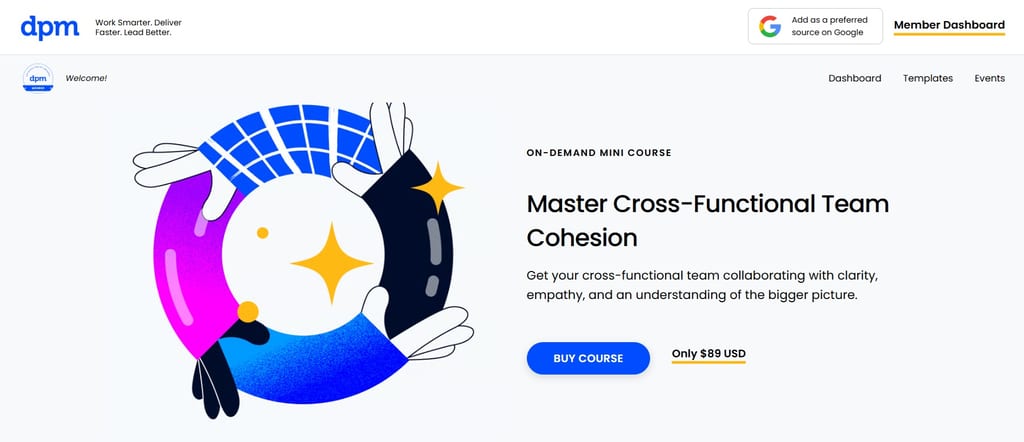
Our DPM School mini course uses practical tools to help teams build cohesion around shared goals. It gives you ways to address collaboration challenges across a project team.
What you’ll learn: Assess team dynamics, align shared goals, build accountability, encourage collaboration, and address cohesion challenges.
Course details:
- Format: Self-paced, on-demand online video lesson with downloadable resources
- Duration: About 1 hour of instruction; 12 months’ access with individual purchase
- Level/prerequisites: Advanced; no prerequisites required
- Price: $89 USD per course
- Assessment: Optional brief quiz by email, required only for the DPM microcredential
- Certificate/credits: Optional DPM microcredential; no course-specific pre-approved PDU count supplied
Considerations: The course is listed at an advanced level, though it has no prerequisites.
The 16 Best Collaboration Courses
Below are my summaries of the best collaboration courses. My reviews offer a look at each course's learning objectives, best fits, cost, and more.
1. High Performance Collaboration: Leadership, Teamwork, and Negotiation - Northwestern University (via Coursera)
Best for: Managers building leadership, teamwork, and negotiation skills

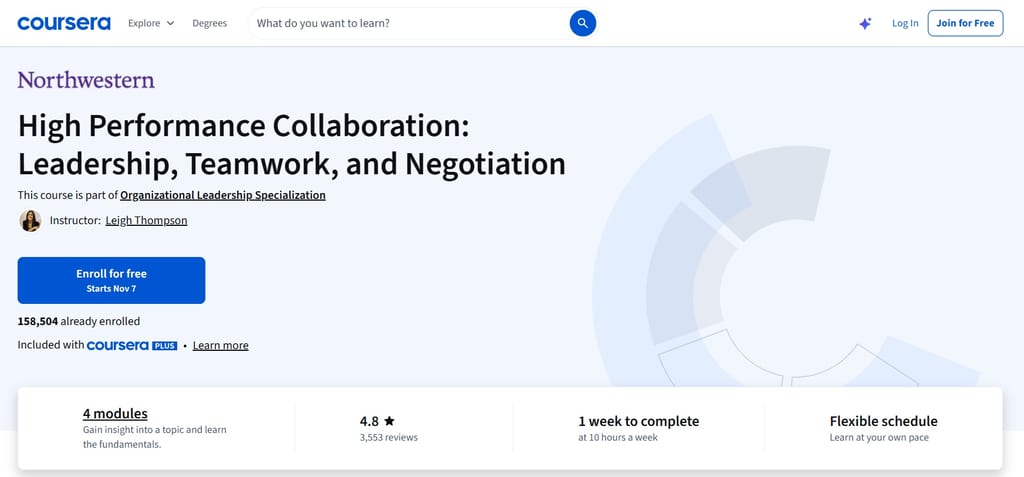
Northwestern University's Kellogg School offers this Coursera course covering three pillars of collaboration: leading teams, designing them well, and negotiating outcomes. It's backed by strong peer reviews and a 4.8/5 rating from over 3,500 learners.
What you'll learn: Apply leadership self-assessments, build effective team structures, manage conflict, navigate virtual team dynamics, and use BATNA and win-win negotiation frameworks.
Course details:
- Format: Self-paced, on-demand online course with video lectures, readings, assignments, and peer reviews
- Duration: Approximately 13 hours of content across 4 modules; flexible schedule
- Level/prerequisites: Beginner to intermediate; no prerequisites required
- Price: Free to audit; certificate requires purchase, included with Coursera Plus at $239/year
- Certificate/credits: Shareable Coursera completion certificate; counts toward the Northwestern Organizational Leadership Specialization Certificate
Considerations: The certificate is only available through a paid plan or purchase, so if you need a credential, factor in the Coursera Plus subscription cost before enrolling on the free audit track.
2. Collaborative Leadership Skills - AMA
Best for: Mid-level managers breaking down silos across departments

AMA's Collaborative Leadership Skills is a two-day, instructor-led seminar built around practical scenario work. Its unusually broad continuing-education credit coverage — spanning PMI, SHRM, HR, and association bodies — makes it a strong pick if you need to satisfy multiple credentialing requirements in one course.
What you'll learn: Foster an inclusive team climate, gain stakeholder buy-in, remove collaboration barriers, adapt your leadership style to the situation, and resolve conflict constructively.
Course details:
- Format: Instructor-led, live-online seminar with scheduled sessions; also available as on-site delivery at your location
- Duration: 2 days (approximately 15.5 hours of instruction)
- Level/prerequisites: Intermediate; a foundation in leadership is noted as a CPE prerequisite; no advance preparation required
- Price: $2,795 USD per learner (non-members); $2,545 (AMA members); $2,478 (GSA) — live online format
- Certificate/credits: 1.2 CEU, 14 CPE, 12 PDUs (PMI — Power Skills), 12 PDCs (SHRM), 12 PHR/SPHR, 12 CAE; IACET-accredited provider
Considerations: Because this is a scheduled live seminar, you'll need to block two full consecutive days — it's not something you can fit in around a packed project schedule.

3. Collaboration Principles and Process - LinkedIn Learning
Best for: Leaders wanting an end-to-end collaboration system

LinkedIn Learning's Collaboration Principles and Process, taught by corporate trainer Tiana Sanchez, covers the full collaboration lifecycle from deciding when to collaborate through measuring team outcomes — including AI-powered role-play for hands-on practice.
What you'll learn: Identify when collaboration is appropriate, foster psychological safety, align your team on a shared goal, run better meetings, and measure success with checklists and a visual roadmap.
Course details:
- Format: Self-paced, on-demand video course with an exercise file, quizzes, and AI-powered role-play simulations
- Duration: 1 hour 22 minutes of video content; self-paced with no set schedule
- Level/prerequisites: All levels; basic understanding of team dynamics and some team or project management experience
- Price: Included with a LinkedIn Learning subscription at $39.99/month or $239.88/year (approx. $19.99/month); one-month free trial available for new subscribers
- Assessment: 3 quizzes built into the course
- Certificate/credits: Shareable LinkedIn Learning certificate of completion; CEUs awarded (specific number not published on the course page)
Considerations: The course is only available through a LinkedIn Learning subscription and can't be purchased individually, so your access ends if your subscription lapses.
4. Teamwork Skills: Communicating Effectively in Groups - University of Colorado Boulder (via Coursera)
Best for: Beginners seeking a theory-grounded approach to teamwork

Teamwork Skills: Communicating Effectively in Groups is a University of Colorado Boulder course on Coursera. It focuses on the hidden forces shaping group behavior—context, systems, and interaction design—then builds practical skills in conflict resolution and decision-making.
What you'll learn: Recognize how context and systems shape group dynamics, resolve team conflict, strengthen group decision-making, navigate diversity and identity in teams, and select the right technology for virtual work.
Course details:
- Format: Self-paced, on-demand online course with video lectures, readings, and assignments; available in English with 26 subtitle languages
- Duration: Approximately 10 hours across 4 modules; self-paced with no set schedule
- Level/prerequisites: Beginner level; no prerequisites required
- Price: Free to audit with no certificate; certificate requires individual purchase or Coursera Plus at $239/year; financial aid available
- Assessment: Assignments included across modules; some are AI-graded
- Certificate/credits: Shareable Coursera certificate of completion; counts toward the University of Colorado Boulder Business Communication Specialization
Considerations: Auditing gives you access to lectures and readings, but graded assignments and the certificate are locked behind a paid plan — so if the credential matters, factor that cost in upfront.
5. Effective Collaboration across Teams - LinkedIn Learning
Best for: Leaders managing cross-functional team dynamics

Ron Carucci brings 30 years of executive advisory experience to this LinkedIn Learning course on cross-functional collaboration, covering shared identity, decision clarity, and trust-building across teams in just 45 minutes.
What you'll learn: Identify cross-team collaboration challenges, create a shared team identity, clarify decision-making roles, resolve conflict constructively, and build empathy to collaborate in hybrid environments.
Course details:
- Format: Self-paced, on-demand video course with exercise files, quizzes, and AI-powered role-play simulations
- Duration: 45 minutes of video content; self-paced with no set schedule
- Level/prerequisites: All levels; no prerequisites required
- Price: Included with a LinkedIn Learning subscription at $39.99/month or $239.88/year (approx. $19.99/month); one-month free trial available for new subscribers
- Assessment: 4 quizzes built into the course
- Certificate/credits: Shareable LinkedIn Learning certificate of completion; CEUs awarded (specific number not published on the course page)
Considerations: This course is only available through a LinkedIn Learning subscription and can't be purchased individually, so access ends if your subscription lapses.
6. Product x Project Management: The Collaboration Playbook - PMI
Best for: Project managers who partner with product managers

PMI built this course around the specific friction between project and product management teams. It uses scenario-based learning and a reciprocal cross-training model, so both roles gain fluency in each other's discipline.
What you'll learn: Identify where project and product management roles intersect, apply shared frameworks to navigate ambiguity, clarify decision-making, and use scalable operating models like pods and dual leadership to align teams.
Course details:
- Format: Self-paced, on-demand e-learning with scenario-based modules and expert insights
- Duration: 3 hours; self-paced with no set schedule
- Level/prerequisites: Prerequisites not required; content assumes familiarity with project or product management roles
- Price: Free for PMI members; USD $39 for non-members
- Certificate/credits: Completion badge awarded; earns 3 PDUs applicable toward PMI certification maintenance (PMP, PMI-ACP, etc.)
Considerations: Non-members pay $39 per course — if you hold a PMI certification, your membership already covers access at no additional cost, so check your membership status before purchasing.
7. Cross Functional Collaboration - Starweaver (via Coursera)
Best for: Managers with experience tackling cross-team friction

Starweaver's course on Coursera targets managers who already have field experience and need practical tools for cross-team work. Six hands-on assignments make up most of the runtime, so you spend more time practicing than listening.
What you'll learn: Identify and overcome cross-functional collaboration barriers, improve communication and active listening across teams, resolve conflict, build consensus, and foster trust through shared goals.
Course details:
- Format: Self-paced, on-demand course with 26 video lectures, 2 readings, and 6 practical assignments
- Duration: 4 hours total; self-paced with no set schedule
- Level/prerequisites: Intermediate; provider recommends 3–5 years of experience in leadership, supervision, or project management
- Price: Included with Coursera Plus at $239/year; free to audit without a certificate
- Assessment: 6 assignments totaling approximately 3 hours of applied practice
- Certificate/credits: Shareable Coursera certificate of completion, suitable for display on LinkedIn; no PDUs or external credits noted
Considerations: Auditing the course is free, but you'll need a paid Coursera Plus subscription or a separate certificate purchase to earn the shareable credential.
8. Collaborate Effectively for Professional Success - IBM (via Coursera)
Best for: Beginners building foundational teamwork skills fast

IBM's beginner-level course on Coursera covers workplace and virtual collaboration in about two hours. It's backed by nearly 100,000 enrollees and a 4.6/5 rating, making it a low-risk starting point for anyone new to structured teamwork practices.
What you'll learn: Apply collaborative behaviors across the four stages of team development, identify collaboration barriers, facilitate virtual meetings, and use the right communication tools for distributed teams.
Course details:
- Format: Self-paced, on-demand online course with 19 video lectures, 13 readings, and 2 assignments
- Duration: Approximately 2 hours total; self-paced with no set schedule
- Level/prerequisites: Beginner; no prerequisites required
- Price: Included with Coursera Plus at $239/year; free to audit without a certificate
- Assessment: 2 graded assignments totaling approximately 40 minutes
- Certificate/credits: Shareable Coursera certificate of completion, suitable for display on LinkedIn; part of IBM's People & Soft Skills for Professional and Personal Success Specialization
Considerations: Auditing is free, but earning the shareable certificate requires a paid Coursera Plus subscription or a separate certificate purchase.
9. Facilitating and Leading Cross-Functional Collaboration - University of Colorado System (via Coursera)
Best for: Team leads learning to run cross-functional workshops

The University of Colorado System's course on Coursera trains both the leader and facilitator roles in cross-functional work. With 27 assignments across 5 modules, it's built around practice—giving you frameworks you can apply, not just understand.
What you'll learn: Distinguish leader and facilitator roles, run collaboration workshops, apply the DACI decision-making framework, build shared roadmaps and working agreements, and structure teams for co-located, distributed, and hybrid settings.
Course details:
- Format: Self-paced, on-demand online course with 5 modules, video lectures, 8 readings, and 27 assignments
- Duration: 9 hours total; self-paced with no set schedule
- Level/prerequisites: Beginner; no specific prerequisites required
- Price: Included with Coursera Plus at $239/year; free to audit without a certificate
- Assessment: 27 assignments across 5 modules, including a mix of graded and practice quizzes
- Certificate/credits: Shareable Coursera certificate of completion; part of the Cross-Functional Collaboration Specialization from the University of Colorado System
Considerations: Auditing is free, but earning the shareable certificate requires a paid Coursera Plus subscription or a separate certificate purchase.
10. Collaboration and Self Management in Agile Environments - Pluralsight
Best for: Agile team members bridging Agile and non-Agile workflows

Pluralsight's course ties collaboration directly to Agile workflows—Scrum, Kanban, retrospectives—rather than treating teamwork in the abstract. Its module on bridging Agile and non-Agile teams makes it practical for mixed-methodology organizations.
What you'll learn: Apply active listening, negotiation, and conflict resolution within Agile teams; run effective retrospectives and reviews; and collaborate across Agile and non-Agile environments.
Course details:
- Format: Self-paced, on-demand online course with video lectures across 4 modules
- Duration: 1 hour 19 minutes total; self-paced with no set schedule
- Level/prerequisites: Beginner; no prerequisites required
- Price: Requires a Pluralsight subscription; individual plans start at $29/month or $299/year; a 10-day free trial is available
- Certificate/credits: Pluralsight does not issue certificates of completion for individual courses; completion is tracked in your Pluralsight profile
Considerations: Without a shareable certificate, this course won't give you a credential to display on LinkedIn or a resume—it's better suited to skill-building than credentialing.
11. Creating a Collaborative Culture - LinkedIn Learning
Best for: Managers shifting team culture toward collaboration

Lisa Bodell's 30-minute LinkedIn Learning course teaches the cultural side of collaboration. You'll get concrete techniques for motivating teams to collaborate and embedding it into your organization's everyday ways of working.
What you'll learn: Identify collaboration role models, overcome team barriers, apply "yes/if" thinking to keep ideas moving, share work in progress to build trust, and find unexpected collaborators across your organization.
Course details:
- Format: Self-paced, on-demand online course with video lectures, 1 exercise file, and AI-powered Role Play simulations
- Duration: 30 minutes total; self-paced with no set schedule
- Level/prerequisites: Intermediate; no specific prerequisites required
- Price: LinkedIn Learning subscription required; $39.99/month or $239.88/year; a 1-month free trial is available for new subscribers
- Assessment: 2 quizzes
- Certificate/credits: Shareable LinkedIn Learning Certificate of Completion; includes Continuing Education Units (CEUs)
Considerations: There's no option to purchase this course individually—you need a LinkedIn Learning subscription to access it, though the one-month free trial covers the full 30-minute runtime.
12. Team Building and Collaboration Skills for Managers - Udemy
Best for: Managers building collaboration skills across remote and in-person teams

This Udemy course from Human and Emotion: CHRMI gives managers a broad toolkit for team collaboration—covering Belbin's team roles, trust-building, conflict resolution, and remote collaboration using tools like Slack and Microsoft Teams.
What you'll learn: Build trust among team members, apply Belbin's nine team roles, resolve conflict constructively, motivate teams using established theories, and lead remote collaboration using tools like Slack, Microsoft Teams, and Zoom.
Course details:
- Format: Self-paced, on-demand online course with video lectures and articles; 12 sections and 42 lectures
- Duration: 2 hours 47 minutes of on-demand video; lifetime access once purchased
- Level/prerequisites: Beginner; basic understanding of corporate work and an interest in management skills required
- Price: $49.99 one-time purchase per learner with lifetime access; also included with Udemy subscription from $12.99/month
- Certificate/credits: Udemy Certificate of Completion, shareable and downloadable
Considerations: With its rating and reviews, this online collaboration and productivity course has a much smaller feedback pool than others in this roundup—worth factoring in if social proof matters to your decision.
13. How to Collaborate with Your Colleagues to Build Psychological Safety Together - LinkedIn Learning
Best for: Teams building psychological safety together

Erin Shrimpton, a Chartered Organizational Psychologist, teaches this 25-minute LinkedIn Learning course that reframes psychological safety as a shared team responsibility—not just a leadership task—giving every team member concrete strategies to build it together.
What you'll learn: Practice vulnerability loops to build reciprocal trust, prepare for meetings to ensure inclusive participation, recognize what teammates do right, and adopt a coaching mindset to support colleagues' growth.
Course details:
- Format: Self-paced, on-demand online course with video lectures; accessible on tablet and phone
- Duration: 25 minutes total; self-paced with no set schedule
- Level/prerequisites: General level; no prerequisites required
- Price: LinkedIn Learning subscription required; $39.99/month or $239.88/year; 1-month free trial available for new subscribers
- Assessment: 4 quizzes
- Certificate/credits: Shareable LinkedIn Learning Certificate of Completion
Considerations: There's no individual purchase option—access requires a LinkedIn Learning subscription, though the entire 25-minute course fits comfortably within the one-month free trial period.
14. Teamwork and Creativity - University of Illinois Urbana-Champaign (via Coursera)
Best for: Beginners building creative collaboration skills for free

This Coursera course from the University of Illinois Urbana-Champaign's Gies College of Business treats creativity as a team discipline—examining how groups ideate together and what psychological dynamics undermine that process.
What you'll learn: Generate ideas using techniques like analogy and re-categorization, pitch them persuasively, evaluate ideas without bias, and identify team creativity barriers like conformity and group polarization.
Course details:
- Format: Self-paced, on-demand; 44 video lectures, 13 readings, 24 assignments, 3 peer reviews, and 1 discussion prompt across 5 modules
- Duration: ~24 hours of content; self-paced with no set schedule
- Level/prerequisites: Beginner; no prerequisites required
- Price: Free to audit; certificate requires Coursera Plus at $239/year; financial aid available
- Assessment: 24 assignments (some AI-graded) and 3 peer-review assignments
- Certificate/credits: Shareable Coursera Certificate of Completion, addable to your LinkedIn profile
Considerations: Auditing is free, but earning the certificate requires a Coursera Plus subscription—no standalone course purchase option is listed on the course page.
15. Collaboration with Emotional Intelligence - Udemy
Best for: Teams applying emotional intelligence to real collaboration challenges

Robin Hills, a Business Psychologist with 40+ years of experience, teaches this Udemy course using emotional intelligence as the framework for building stronger collaborative relationships—seven practical activities push you to apply the skills with your actual team.
What you'll learn: Apply DISC behavioral styles to adapt to teammates, build trust using the trust equation, manage conflict dynamics, run meetings with mindfulness, and work across multi-disciplinary teams.
Course details:
- Format: Self-paced, on-demand; video lectures, articles, downloadable resources, 1 role play, and 7 practical activities; mobile and TV accessible
- Duration: 3 hours 30 minutes of video content; self-paced with no set schedule; additional time required for practical activities
- Level/prerequisites: No level specified; no prerequisites required
- Price: Included with Udemy Personal Plan from $12.99/month; individual course purchase also available
- Certificate/credits: Udemy Certificate of Completion
Considerations: The seven practical activities require active engagement with a real collaborative team outside the course, so you'll get significantly less value if you're not currently working with a team.
16. RITx: Teamwork & Collaboration - Rochester Institute of Technology
Best for: Professionals linking teamwork skills to a leadership certificate
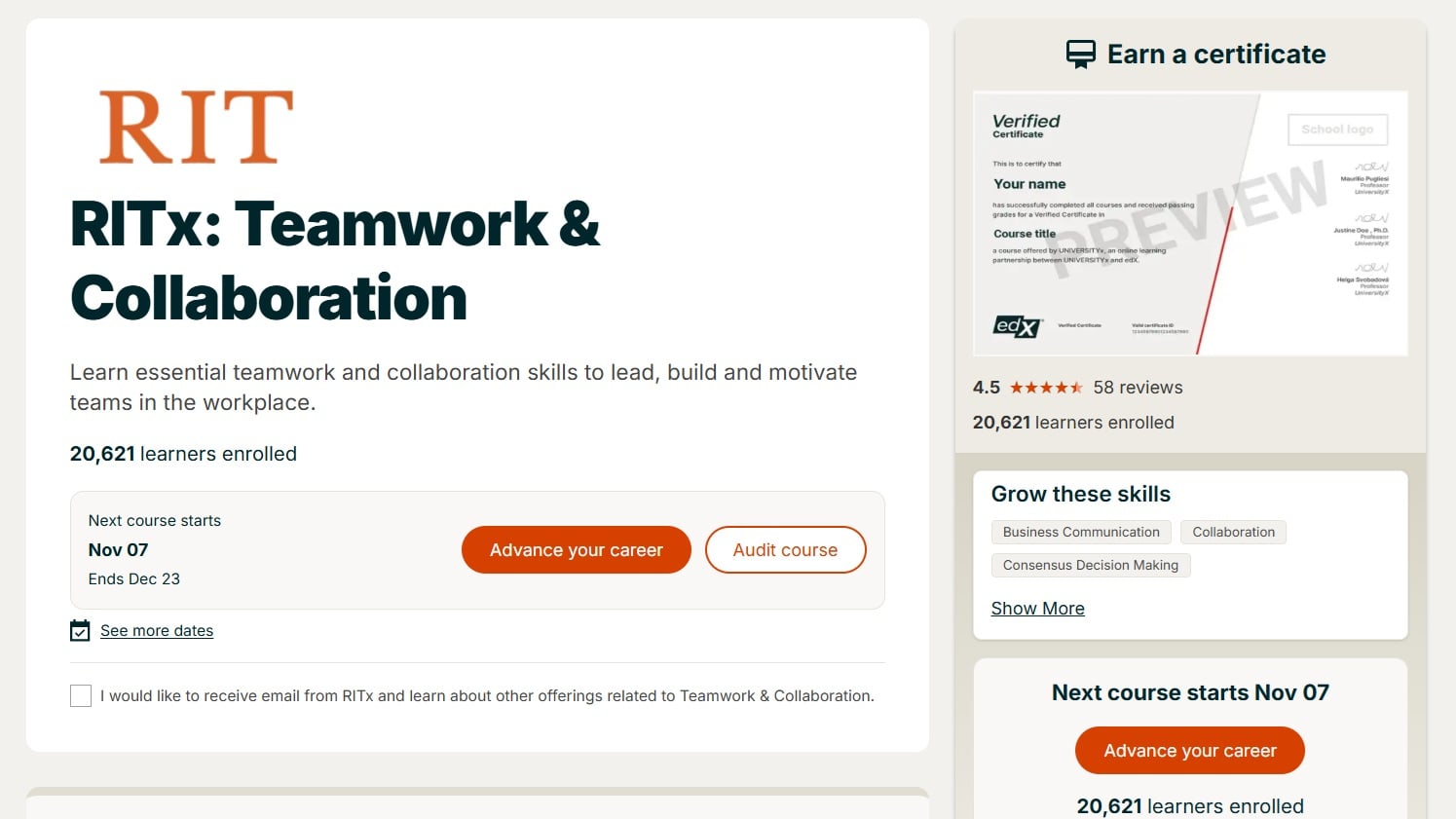
RIT's edX course treats teamwork as a leadership competency within its three-course Leadership Essentials Professional Certificate. You analyze your own team experiences alongside industry examples—a self-reflective approach that makes the content genuinely applicable.
What you'll learn: Motivate teams by improving group cohesion, manage conflict to build productive working relationships, collaborate across cross-functional teams, and assess team performance using group dynamics principles.
Course details:
- Format: Self-paced, on-demand; video lectures, readings, and discussion boards; instructor-paced sessions also run periodically on edX
- Duration: 3 weeks at 4–6 hours per week (approx. 12–18 hours total); self-paced with flexible scheduling
- Level/prerequisites: Introductory; no prerequisites required
- Price: Free to audit; verified certificate $199 USD; full 3-course Leadership Essentials Professional Certificate $537.30 USD
- Certificate/credits: Verified edX Certificate of Completion from RIT; completing all 3 courses in the series earns the Leadership Essentials Professional Certificate
Considerations: Auditing gives you access to lectures and readings, but graded assignments and the certificate require the $199 paid enrollment.
How to Choose a Collaboration Course
Start by naming the specific problem you're trying to solve. Whether that's managing conflict in cross-functional teams, running better meetings, or building a team that generates stronger ideas—your answer should drive the decision.
- Match the curriculum to your actual gap. Courses in this list cover very different ground. Some focus on psychological dynamics and ideation; others teach behavioral frameworks like DISC or ground collaboration in emotional intelligence. If your team struggles with trust and communication, a course built around EI is a better fit than one focused on creative techniques.
- Be honest about your time constraints. Commitments here range from roughly 3.5 hours to 24+ hours. A shorter course won't always be a shortcut—check whether the format includes practical activities that extend beyond video time, since those add real hours to your schedule.
- Think about where you'll apply the learning. Some courses are built for solo reflection; others explicitly require you to work with a live team outside the course. If you're not currently embedded in a team, you'll get less from activity-driven formats.
- Factor in the real cost. "Free to audit" doesn't mean free to complete. Several courses require a paid subscription or enrollment to access graded work and certificates. If a credential matters for your role, verify the full cost before you commit.
- Consider the credential's purpose. Completion certificates are useful for demonstrating initiative on a resume or LinkedIn. If you need something that maps to a formal professional certification pathway, check whether the course contributes to a recognized credential program.
Collaboration Courses FAQ
Can you benefit from a collaboration course if you work remotely?
Yes—most collaboration skills translate directly to remote work, and some are even more valuable when your team isn’t in the same room. Look for courses that cover async communication, virtual meeting facilitation, and coordinating across time zones. If a course leans heavily on in-person activities, you’ll need to adapt those exercises to a digital format.
I’d also check whether the course addresses tools and norms your team already uses—that makes it easier to apply what you learn right away.
Do you need to take a collaboration course with your team?
No, you can go through a course on your own and start applying new approaches immediately. That said, taking a course together gives your whole team a shared language for how you work—agreed-on norms around decision-making, conflict, and communication are much easier to establish when everyone’s starting from the same place.
If your team has a specific friction point, like recurring conflict or unclear ownership, learning together can accelerate the fix more than solo study will.
How can you put what you learn into practice?
Pick one or two specific behaviors to try in your next meeting or project—don’t try to change everything at once. For example, you might start explicitly naming how a decision will be made before the discussion begins, or invite a quieter teammate to share their view before the loudest voices dominate. Then ask for feedback and adjust based on what you observe.
Small, deliberate changes applied consistently tend to stick better than broad attempts to overhaul how your team works.
How can you tell whether your collaboration skills are improving?
Watch for changes in team behavior and outcomes, not just how you felt about the course. Ask yourself: are disagreements getting resolved faster? Are quieter team members contributing more? Is your team reaching decisions with less back-and-forth confusion? These are concrete signals.
If you’re not seeing shifts in team dynamics after applying what you learned, that’s useful information too—it may mean the course addressed the wrong gap, or that the real issue is structural rather than behavioral.
What's Next?
Want to connect with other digital project managers and share resources and best practices? Join our membership community and get access to 100+ templates, samples, and examples, and connect with hundreds of digital project managers in Slack.


