
6 Leaders Tell Us: The Mistake That Reshaped How They Run Delivery Teams


Reporting Mistake: Leaders often confuse structured reporting with true visibility, leading to misinformed decisions.
Control Confusion: Being overly involved can create dependency; effective leadership requires clarity on outcomes and trust.
Proximity Fallacy: Reliance on co-location for collaboration is outdated; technology now enables effective remote teamwork.
Calm Consequences: Prioritizing stakeholder comfort can hide risks; proactive discussion of issues leads to better outcomes.
Values Over Skills: Hiring for cultural fit is crucial; misaligned values during growth can severely impact team performance.
Most delivery leaders can point to a moment where something broke. A project that looked fine on paper suddenly collapsed. A team that seemed aligned quietly disengaged. A decision that felt reasonable at the time created long-term damage.
These moments rarely come from incompetence. They come from leadership assumptions that go unchallenged until pressure exposes them. For many experienced leaders, one mistake fundamentally reshaped how they run delivery teams and changed what they now value most to avoid project failure.
When Reporting Is Mistaken for Visibility
One of the most common leadership mistakes in delivery is assuming that structured reporting reflects reality.
Ken Herron, Principal at Merit2Hire, describes the moment that changed his leadership approach clearly. “The leadership mistake that reshaped how I run delivery teams was assuming reporting equals visibility.” Over time, he saw how misleading that assumption could be. “Status updates often hide the real signals until it’s too late.”
The leadership mistake I made was assuming reporting equals visibility. Status updates often hide the real signals until it’s too late.

Dashboards, weekly updates, and traffic-light reports can create a sense of control, but they often sanitize risk. Teams learn how to report progress without exposing uncertainty. Leaders see motion instead of truth.
Herron’s experience highlights a shift many leaders make after failure. Real visibility comes from surfacing weak signals early, not from cleaner reporting or tighter templates.

When Control Is Confused With Support
Another leadership mistake often comes from good intentions. Many leaders believe that staying deeply involved is the best way to support delivery teams, especially under pressure.
Dana Zellers, Executive and Leadership Coach, reflects on this early-career belief: “Earlier in my career, I believed staying deeply involved and shouldering all the responsibility was the best way to support teams.”
What followed was not stronger execution but the opposite. “What I now see, and experienced firsthand, is that this creates dependency and slows execution and removes buy in.” Zellers notes that leaders today still fall into this trap, especially when outcomes feel at risk.
Her leadership philosophy shifted toward structure instead of control. “The shift that matters most is moving from oversight to clarity on outcomes, decision rights, and trust.” That realization led to a complete restructuring of how she manages PM teams.
Under pressure, Zellers learned that "what counts is not a supposedly perfect plan, but clear ownership and straightforward paths for decision-making." The mistake was preventable, but the lesson reshaped everything that followed.
When Proximity Is Treated as a Requirement
For years, many delivery leaders relied on physical proximity as a primary driver of collaboration. When teams struggled, the solution was often co-location.
Anthony E. Tuggle, CEO and Founder of consultancy TAG US Worldwide, once took that approach. “Before the pandemic, I relied extensively on co-locating project managers and resources to boost collaboration.”
That assumption did not survive the rapid evolution of work. “But the technology has evolved rapidly since then, and now advances in collaboration platforms, virtual conferencing, and new work practices have changed my perspective.”
Before the pandemic, I relied extensively on co-locating project managers and resources to boost collaboration. But the technology has evolved rapidly since then and new work practices have changed my perspective.

Tuggle’s leadership shifted from where people sit to how teams are structured. Today, he can “connect teams globally and explore creative PM resource models I wouldn’t have considered before.” The mistake was not believing in collaboration. It was tying collaboration to proximity instead of systems.
When Calm Is Rewarded Over Candor
Some leadership mistakes are subtle and culturally reinforced. One of the most damaging is rewarding teams for keeping stakeholders comfortable.
Ian Skjervem, CEO and Founder of Smart Investors Daily, admits this was once his metric for strong PM leadership. “I used to reward project managers for keeping stakeholders calm, but that was a mistake.”
I used to reward project managers for keeping stakeholders calm, but that was a mistake.

Over time, he realized what calm often signaled. “Calm often meant risks were being hidden instead of addressed.” Issues were delayed, tradeoffs avoided, and assumptions left unchallenged until the cost was far higher.
Skjervem changed how he evaluates delivery leadership. Now, he looks at "how early they bring up uncomfortable issues like missed assumptions, tradeoffs, and constraints before those risks grow." The shift moved the organization from reactive firefighting to proactive decision-making.
When Skill Is Prioritized Over Values
Hiring decisions are another area where leadership mistakes quietly compound over time, especially during periods of growth.
Rocky Chai, Chief Executive Officer of Ultra Cleaning, learned this lesson while scaling rapidly. “Early on, I hired for technical skills over cultural fit.” At smaller scale, the impact was manageable. As growth accelerated, the consequences became impossible to ignore.
Early on, I hired for technical skills over cultural fit. When we scaled from 200 to 800 specialists, technical excellence couldn’t compensate for misaligned values

“When we scaled from 200 to 800 specialists, technical excellence couldn't compensate for misaligned values.” The result was organizational strain. “Teams fractured under pressure, turnover spiked, and delivery quality suffered.”
Chai redefined what strong hiring meant for delivery. “I learned that hiring people who embody our service standards and can grow into technical competence beats hiring experts who resist our systems.” That shift produced measurable results. “Now cultural alignment is our first filter, and our retention improved 40%.”
The Mistakes That Change How Leaders Lead
Across these experiences, a clear pattern emerges. Leadership mistakes that reshape delivery teams are rarely about ignorance or negligence. They are logical assumptions that stop holding up under scale, pressure, or change.
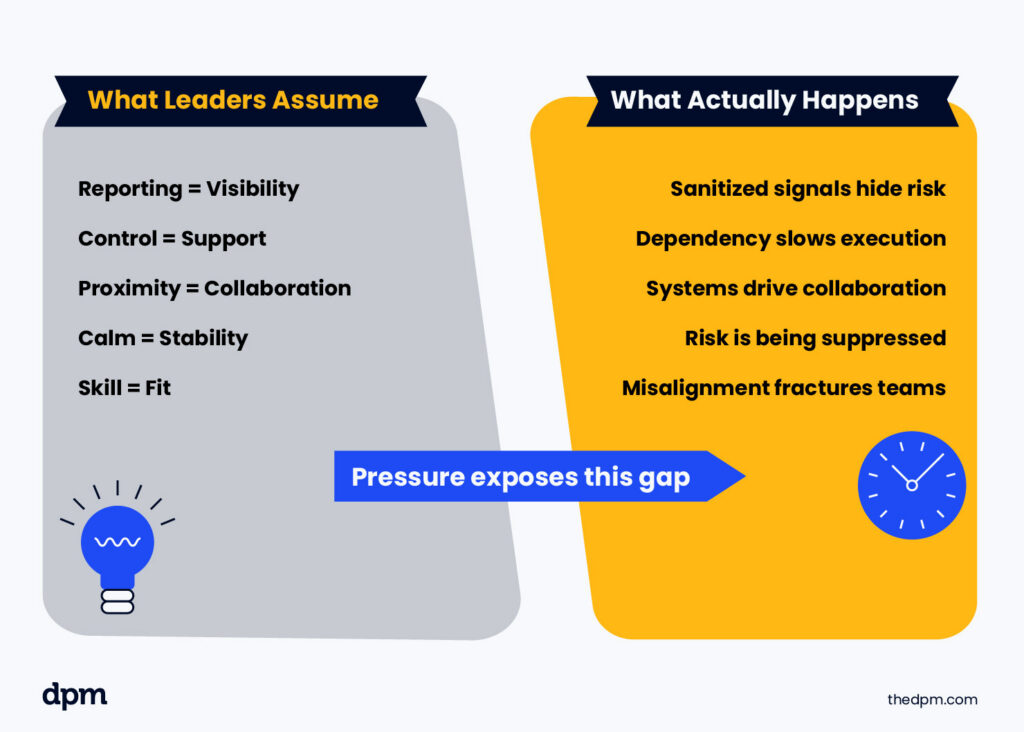
Reporting is mistaken for insight. Control is mistaken for support. Calm is mistaken for stability. Skill is mistaken for fit.
The leaders who grow from these mistakes do not simply adjust tactics. They restructure how delivery works. They change what they reward, how they decide, and what they prioritize.
Strong delivery teams are not built by avoiding mistakes. They are built by learning from them.
Want more insights like this? Sign up for a free DPM membership to get full access to all of our articles, templates, and other resources.