
How Project Managers are Forecasting Capacity and Managing Project Risks in 2026


Project managers don’t just manage tasks. They manage capacity, expectations, deadlines, and the very human reality that people don’t scale on command. For many professional service teams, capacity planning still relies on gut instinct, best guesses, and spreadsheets that are already out of date by the time they’re shared.
That approach works—until it doesn’t. You’ve likely felt the symptoms:
- Projects start feeling perpetually behind
- Senior team members are overloaded and not always accessible
- Delivery risks show up too late to fix without financial or rework repercussions
And as a result, you, the project manager, end up bearing the stress of it all.
That’s why more PMs are placing a higher focus on capacity forecasting as a way to move beyond guesswork and manage project risks earlier and more proactively.
Improving capacity and demand planning capabilities can have a significant positive impact on project and portfolio results, even without changes to staffing or funding levels.
In this article, we’ll look at why capacity forecasts matter, how they support better project risk management, and how PMs can build a practical capacity forecast that scales with increasing delivery complexity.
Forecasting vs. Scheduling vs. Resourcing: What’s the Difference?
“Forecasting,” “scheduling,” and “resourcing” are often used interchangeably, but each addresses a different problem.
- Scheduling is assigning tasks and deadlines.
- Resourcing is the process of matching people to work based on their skills and availability.
- Capacity forecasting is the prediction of future workload, availability, and delivery risk using current and historical data.
Forecasting capacity sits above scheduling and resourcing. It adds a forward-looking planning layer that helps PMs understand what’s coming next and where project risks are likely to surface.
What are Capacity Forecasting and Project Risk Management Best Practices?
Capacity forecasting and project risk management aren’t about predicting the future perfectly. They’re about creating enough visibility to make better decisions sooner.
Only about 31% of projects meet the classic definition of success: on time, on budget, and on scope. So how do you improve your odds of success?
Predictability beats heroics
A solid capacity forecast helps you spot problems before they turn into emergencies. When risks are visible early, it’s easier to adjust plans calmly, with fewer late nights and less last-minute reshuffles.
Identify project risks before they snowball
Project risks rarely appear overnight. Delivery issues usually build through small overloads, minor delays, and unclear availability. Forecasting capacity brings those slow-building risks into view while there’s still time to respond.
Protect capacity to protect delivery
When teams operate at or near full capacity for too long, quality drops and burnout rises, both of which directly threaten delivery. Capacity forecasting helps PMs balance workloads so projects stay sustainable, not just on schedule. This is especially important as 66% of U.S. employees report feeling burned out, and nearly one in four cite excessive workload as the primary cause.
Align delivery plans with revenue reality
Revenue depends on realistic delivery planning. Under-forecasting leads to over-promising, while over-forecasting can mean turning away work you could have delivered. A reliable capacity forecast helps teams commit confidently and deliver profitably.
What Are the Early Signs Your Team Needs Better Capacity Forecasting?
These are classic project risk signals tied directly to unclear capacity:
- Projects constantly feel “one week behind.”
- PMs regularly ask, “Who can take this on?”
- Senior consultants are overloaded without realizing it.
- Work falls through the cracks between teams.
- Onboarding new hires feels disorganized or chaotic.
- You can’t confidently accept—or decline—new client work.
How Forecasting Capacity Matures in Professional Services
Capacity forecasting and more advanced project risk management typically evolve as delivery complexity increases, client demand grows, and project risk becomes harder to manage reactively.
Here’s what that progression often looks like:
Level 1: Reactive
Work is assigned as it arrives. PMs scramble to fill gaps, and risks surface late, usually when deadlines are already at risk.
Level 2: Managed
Schedules exist, but capacity decisions are still made in isolation. Resourcing conflicts and overload are common, and forecasting is mostly short-term.
Level 3: Forecast-aware
Teams can see capacity trends and upcoming constraints, but adjustments happen inconsistently. Forecasting informs conversations, not decisions.
Level 4: Predictive
Capacity forecasts are actively used to guide delivery planning, staffing decisions, and project risk management. PMs spot issues earlier and adjust with confidence.
Level 5: Optimized
Teams model scenarios, anticipate demand, and align delivery plans with revenue goals. Forecasting becomes a core input to strategic planning, not just day-to-day scheduling.
You don’t need to reach the final stage to see results. Moving even one level up reduces delivery risk, improves utilization, and gives you more control over outcomes.
Where Accelo Fits Into Modern Capacity Forecasting
As service teams mature, forecasting capacity across disconnected tools becomes harder to manage. When project plans, time tracking, resourcing, and financials live in separate systems, PMs are forced to piece together forecasts manually, often after risks have already materialized.
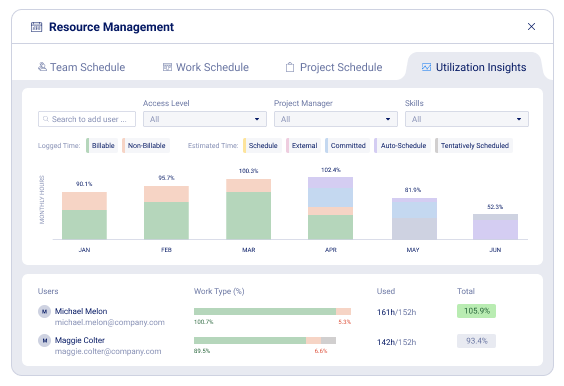
This is where a unified professional services platform can make a huge impact. Accelo connects project delivery, resource availability, time tracking, and financial data in one place, giving project and financial leaders a clearer view of future capacity and emerging project risks. With the addition of Forecast PSA's AI-driven scheduling and forecasting capabilities, Accelo helps teams move beyond reactive planning toward more predictive, risk-aware delivery.
 connects project delivery, resource availability, time tracking, and financial data in one place, giving project and financial leaders a clearer view of future capacity and emerging project risks. With the addition of
If you’re exploring how to strengthen capacity forecasting as your organization grows, a personalized Accelo demo can help you see what this looks like using your own projects, teams, and delivery patterns. Book a demo now.
Forecasting Capacity and Project Risk Management Are About Clarity, Not Control
Capacity forecasting transforms delivery from a guessing game into a more predictable, sustainable practice. For project managers, it’s not about adding complexity; it’s about gaining clarity into capacity constraints and emerging project risks.
With the right tooling in place, PMs can manage project risks earlier, protect their teams from burnout, and deliver work more reliably—without constantly firefighting issues that could have been anticipated and addressed.