
Safran Review 2026: Pros, Cons, Features and Pricing



Safran Project is a critical path software for complex projects, especially capital-intensive programs that need visibility into schedule status, resource demands, and finances. I’d choose it over Microsoft Project when quantitative schedule-risk analysis matters, since Safran Risk adds Monte Carlo simulation to Safran’s project-control tools.
Safran Evaluation Summary
- Pricing upon request
- Free consultation available
Why Trust Our Software Recommendations
Our team has been testing and reviewing software since 2012. As project managers ourselves, we know how difficult—and important—it is to choose the right software.
For this guide, we evaluated tools using hands-on testing and independent research, scoring tools using our selection criteria. We also draw on insights from industry thought leaders and practicing project management experts.
Our reviews reflect our human editorial judgment, not a sales pitch.
Expert reviewers:
Safran Overview
Safran Project suits complex programs where you need schedule, resource, and financial control in one environment. I’d choose it when comparing tools for large, resource-loaded plans: it supports unlimited activities, baseline comparisons, capacity views, and configurable reports, while Safran Risk adds Monte Carlo schedule and cost analysis. Its API and third-party schedule exchange offer flexibility, though pricing isn’t published, so request a quote. The customizable interface and reported direct support are positives, but I’d budget time for onboarding because advanced risk modeling takes know-how. It’s a stronger fit for capital projects than fast-moving digital teams needing lightweight task tracking.
pros
-
Reviewers describe its project-control toolkit as practical and broadly useful.
-
Real-time CPM recalculation and unlimited activities suit large schedules.
-
Portfolio resource-capacity views expose demand, conflicts, and gaps.
cons
-
Reviewers say the interface looks dated.
-
Safran publishes no pricing, complicating upfront budget comparisons.
-
Its portfolio-control depth may overwhelm teams running lightweight digital projects.
-

Smartsheet
Visit WebsiteThis rating combines scores from multiple user review sites to reflect overall customer sentiment about the product.4.4 -
Celoxis
Visit WebsiteThis rating combines scores from multiple user review sites to reflect overall customer sentiment about the product.4.5 -
Accelo
Visit WebsiteThis rating combines scores from multiple user review sites to reflect overall customer sentiment about the product.4.4





Our Review Methodology
How We Test & Score Tools
We’ve spent years building, refining, and improving our software testing and scoring system. The rubric is designed to capture the nuances of software selection and what makes a tool effective, focusing on critical aspects of the decision-making process.
Below, you can see exactly how our testing and scoring works across seven criteria. It allows us to provide an unbiased evaluation of the software based on core functionality, standout features, ease of use, onboarding, customer support, integrations, customer reviews, and value for money.
Core Functionality (25% of final scoring)
The starting point of our evaluation is always the core functionality of the tool. Does it have the basic features and functions that a user would expect to see? Are any of those core features locked to higher-tiered pricing plans? At its core, we expect a tool to stand up against the baseline capabilities of its competitors.
Standout Features (25% of final scoring)
Next, we evaluate uncommon standout features that go above and beyond the core functionality typically found in tools of its kind. A high score reflects specialized or unique features that make the product faster, more efficient, or offer additional value to the user.
We also evaluate how easy it is to integrate with other tools typically found in the tech stack to expand the functionality and utility of the software. Tools offering plentiful native integrations, 3rd party connections, and API access to build custom integrations score best.
Ease of Use (10% of final scoring)
We consider how quick and easy it is to execute the tasks defined in the core functionality using the tool. High scoring software is well designed, intuitive to use, offers mobile apps, provides templates, and makes relatively complex tasks seem simple.
Onboarding (10% of final scoring)
We know how important rapid team adoption is for a new platform, so we evaluate how easy it is to learn and use a tool with minimal training. We evaluate how quickly a team member can get set up and start using the tool with no experience. High scoring solutions indicate little or no support is required.
Customer Support (10% of final scoring)
We review how quick and easy it is to get unstuck and find help by phone, live chat, or knowledge base. Tools and companies that provide real-time support score best, while chatbots score worst.
Customer Reviews (10% of final scoring)
Beyond our own testing and evaluation, we consider the net promoter score from current and past customers. We review their likelihood, given the option, to choose the tool again for the core functionality. A high scoring software reflects a high net promoter score from current or past customers.
Value for Money (10% of final scoring)
Lastly, in consideration of all the other criteria, we review the average price of entry level plans against the core features and consider the value of the other evaluation criteria. Software that delivers more, for less, will score higher.
Core Features
CPM Schedule Calculation
Safran Project recalculates activity dates when you change schedule logic, using the Critical Path Method. Its unlimited activity capacity suits large plans where dependency changes must flow through the schedule.
Baselines and Change Control
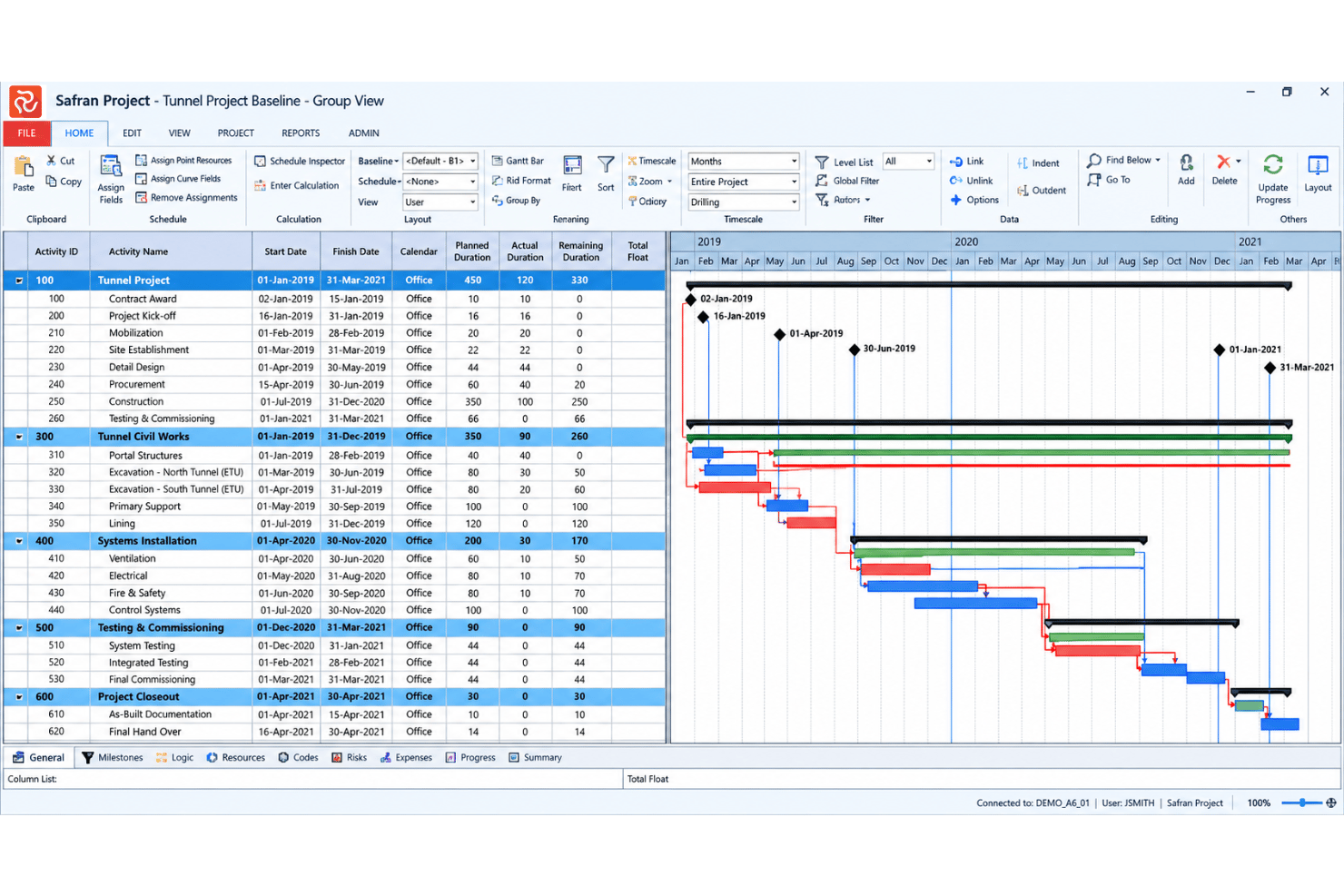
Save an approved plan as a baseline, then compare later updates against it without overwriting the original. Multiple baseline versions and tracked changes help you see how approved scope changes affect schedule and budget.
Progress and Performance Tracking
Enter activity or resource progress and expenditure, then compare actuals with the stored baseline at reporting cutoffs. Safran recalculates the schedule as progress and project dates change, helping you identify delays and work that needs attention.
Resource Planning and Leveling
Resource views show demand against availability across projects, while histograms reveal capacity gaps and conflicts. Resource leveling can delay activities to fit availability while preserving schedule logic.
Schedule and Cost Risk Analysis
Safran Risk uses Monte Carlo simulation to model schedule and cost uncertainty, with joint confidence levels and probabilistic cashflow analysis. You can compare mitigation scenarios to assess their potential effect on completion dates and costs.
Configurable Project Reporting
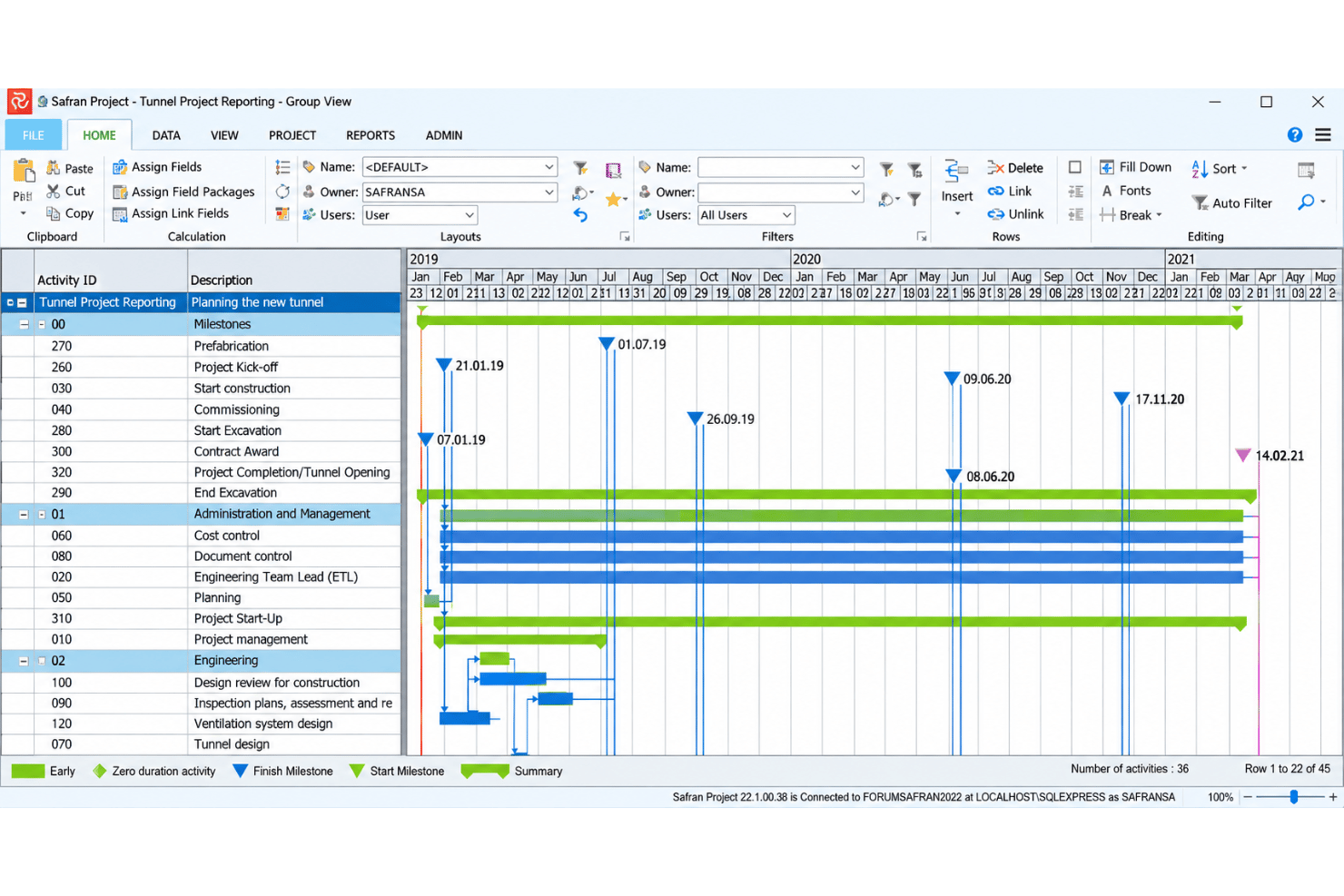
Build reports and charts from current project data, including S-curves, histograms, progress summaries, and performance charts. Package reports for printing or schedule them regularly, so stakeholders can review consistent project updates.
Ease of Use
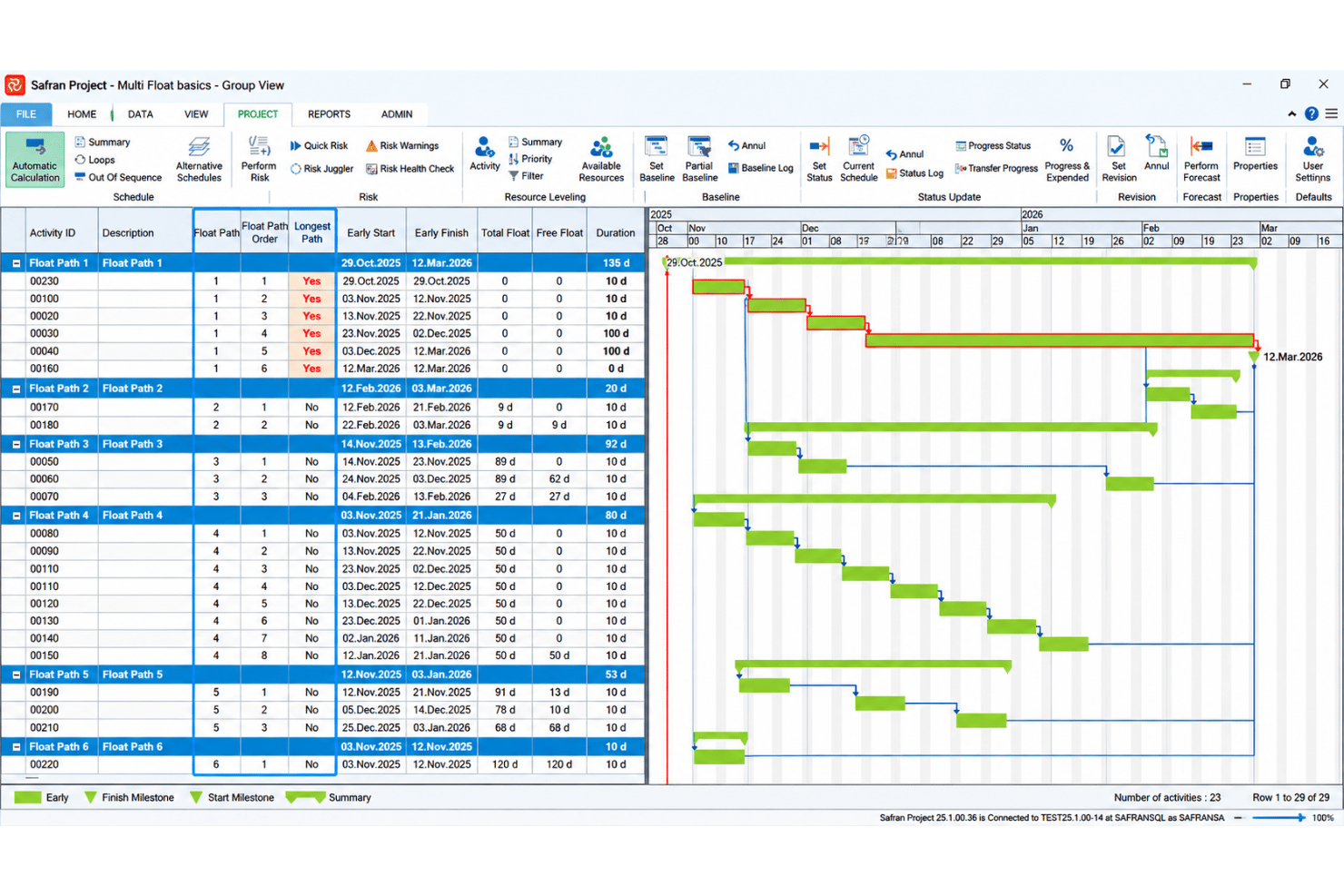
Safran is capable but not especially easy to learn: reviewers describe its interface as dated, and advanced risk modeling takes specialist know-how. Its configurable screens, baseline comparisons, resource-capacity views, and custom reports give project controls teams plenty to work with, but that depth can feel heavy for simple schedules. Reviewers also describe the toolkit as practical and report direct support, which can help teams through setup and unfamiliar workflows.
Integrations
Safran supports integrations with Microsoft Project, Oracle Primavera P6, Microsoft Power BI, and Marine Manager, among others.
It also provides a license-controlled REST Integration API for custom connections and data synchronization with external systems.
Safran Specs
- API
- Batch Permissions & Access
- Budgeting
- Calendar Management
- Collaboration Support
- Contact Management
- Contact Sharing
- Customer Management
- Dashboard
- Dashboards
- Data Export
- Data Import
- Data Visualization
- Dependency Tracking
- Document Sharing
- Expense Tracking
- External Integrations
- File Sharing
- Gantt Charts
- Kanban Boards
- Multi-User
- Notifications
- Project Management
- Resource Management
- Scheduling
- Task Scheduling/Tracking
- Third-Party Plugins/Add-Ons
- Time Management
- Travel Management
- Workflow Management