

Creatio AI Studio vs. Microsoft Copilot Studio: Comparison & Reviews for 2026



As AI agents take on more routine and process-driven work, teams need tools that make it easier to build automation without adding another layer of complexity. The challenge is finding the right balance between accessibility, integration depth, and control.
Creatio AI Studio and Microsoft Copilot Studio are AI productivity tools for building and managing AI agents and workflows. Creatio combines AI Twin’s conversational agent creation with no-code and coded development, open model support, human-led and agentic workflows, and centralized lifecycle governance, while Copilot Studio focuses on low-code building within the Microsoft ecosystem.
In this comparison, I assess which tool is the better fit for your team, workflows, and automation needs.
Creatio AI Studio vs. Microsoft Copilot Studio: An Overview
Creatio AI Studio


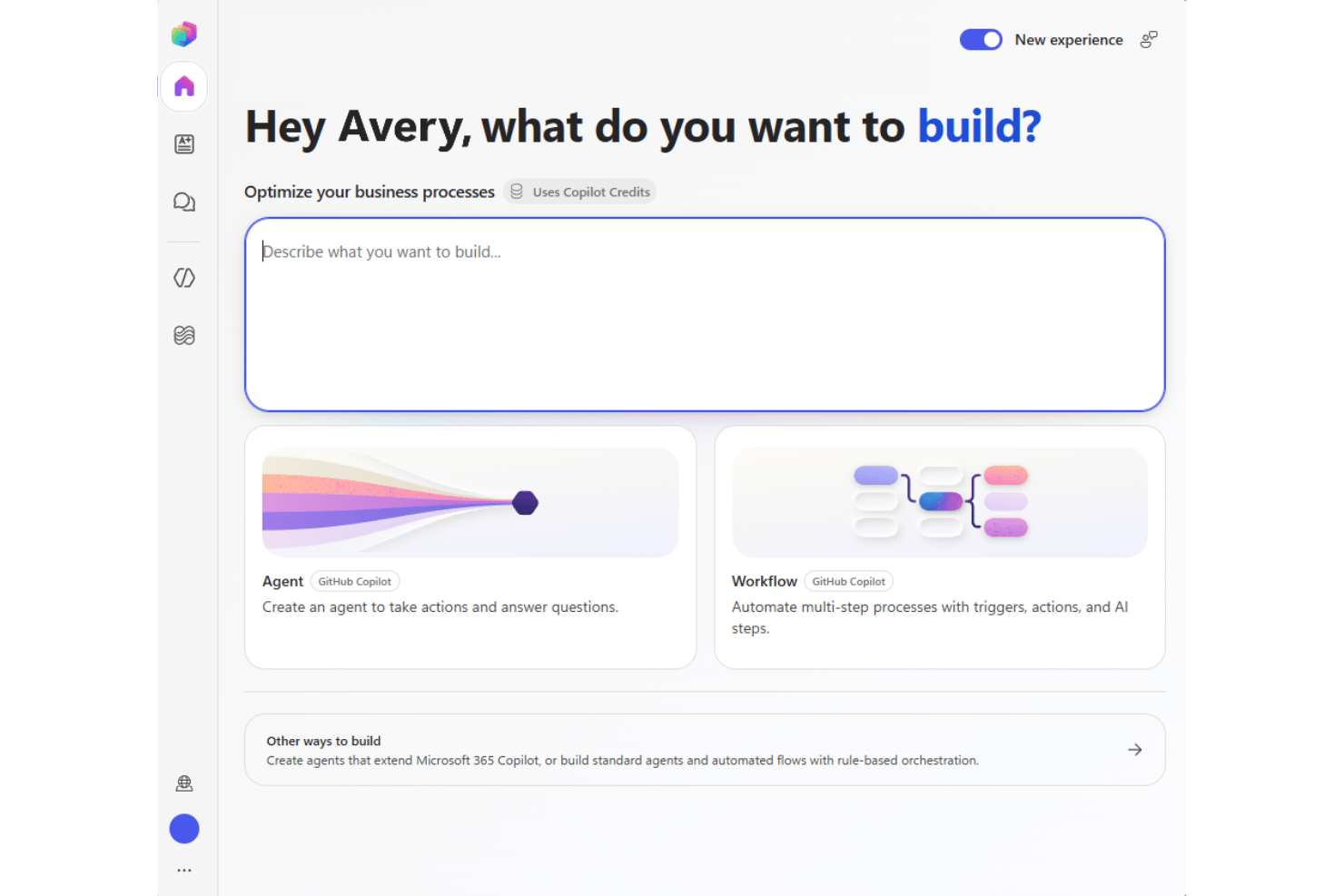
Microsoft Copilot Studio
Why Trust Our Software Recommendations
Our team has been testing and reviewing software since 2012. As project managers ourselves, we know how difficult—and important—it is to choose the right software.
For this guide, we evaluated tools using hands-on testing and independent research, scoring tools using our selection criteria. We also draw on insights from industry thought leaders and practicing project management experts.
Our reviews reflect our human editorial judgment, not a sales pitch.
Expert reviewers:
Creatio AI Studio vs. Microsoft Copilot Studio Pricing Comparison
| Creatio AI Studio | Microsoft Copilot Studio | |
|---|---|---|
| Free Trial | Free demo available | Not available |
| Pricing | $40/user/month | From $30/user/month (billed annually) |
Creatio AI Studio vs. Microsoft Copilot Studio Pricing & Hidden Costs
Creatio AI Studio combines per-user platform pricing with separate AI packages based on AI Credits and optional support tiers, while its Unlimited model supports broader organization-wide scaling. Meanwhile, Microsoft Copilot Studio uses Copilot Credits through prepaid or pay-as-you-go billing, so costs can vary based on agent activity and task complexity.
To pick the right vendor, consider how predictable you need costs to be and how heavily your agents will be used. I’d lean toward Creatio if you prefer a defined platform and AI package structure, while Copilot Studio offers more usage-based flexibility for organizations already working within the Microsoft ecosystem.
Creatio AI Studio vs. Microsoft Copilot Studio Feature Comparison
| Creatio AI Studio | Microsoft Copilot Studio | |
|---|---|---|
| API | ||
| Access Management | ||
| Data Export | ||
| Data Import | ||
| Document Management | ||
| External Integrations | ||
| Form Builder | ||
| Multi-User | ||
| Notifications | ||
| Process Modeling | ||
| Workflow Management |
Creatio AI Studio vs. Microsoft Copilot Studio Integrations
| Integration | Creatio AI Studio | Microsoft Copilot Studio |
|---|---|---|
| Microsoft 365 | ✅ | ✅ |
| Sage | ✅ | ❌ |
| Google Workspace | ✅ | ✅ |
| Slack | ✅ | ✅ |
| Microsoft Teams | ✅ | ✅ |
| SAP | ✅ | ✅ |
| ✅ | ✅ | |
| Hootsuite | ✅ | ❌ |
| API | ✅ | ✅ |
| Zapier | ✅ | ✅ |
Both Creatio AI Studio and Microsoft Copilot Studio offer broad integration ecosystems for connecting agents to business systems and workflows. Creatio emphasizes open, cross-platform connectivity through its Marketplace, APIs, webhooks, and MCP, while Copilot Studio benefits from Microsoft’s extensive connector ecosystem and close ties to Microsoft services. Overall, Creatio is a strong fit for teams working across a mixed tech stack, while Copilot Studio fits naturally into Microsoft-centered environments.
Creatio AI Studio vs. Microsoft Copilot Studio Security, Compliance & Reliability
| Factor | Creatio AI Studio | Microsoft Copilot Studio |
|---|---|---|
| Data Privacy | Supports AWS and Azure regions, data residency options, on-premises deployment, full customer data ownership, and separation from shared model training. | Supports geographic data residency and privacy controls across Microsoft’s cloud infrastructure. |
| Encryption & Auditing | Uses encryption and audit logging across administrative activity, data operations, and agent execution to support traceability. | Encrypts data at rest and in transit and provides logging through Microsoft’s cloud security framework. |
| Reliability | Provides enterprise cloud SLAs, AI observability, execution history, policy monitoring, approvals, escalation controls, and lifecycle governance. | Uses Microsoft Azure infrastructure and regional redundancy to support availability and resilience. |
| Regulatory Compliance | Maintains SOC 2 Type II and ISO/IEC 27001 certifications, with controls that support GDPR requirements and regulated workflows. | Supports a broad compliance portfolio, including SOC, ISO, GDPR, HIPAA, and FedRAMP frameworks. |
| Access & AI Governance | Supports SAML 2.0 SSO, MFA, granular RBAC, organization- and agent-level policies, tool approvals, data masking, confirmations, and human-in-the-loop controls. | Uses Microsoft Entra ID, RBAC, authentication controls, and Power Platform governance for managing agent access and activity. |
Overall, Creatio AI Studio emphasizes granular access controls, auditability, flexible deployment, and an AI Trust and Governance framework that extends security controls into agent activity. Microsoft Copilot Studio draws on Microsoft’s broader cloud security and compliance ecosystem. Both provide strong enterprise foundations, but they approach governance through different platform architectures.
Creatio AI Studio vs. Microsoft Copilot Studio Ease of Use
| Factor | Creatio AI Studio | Microsoft Copilot Studio |
|---|---|---|
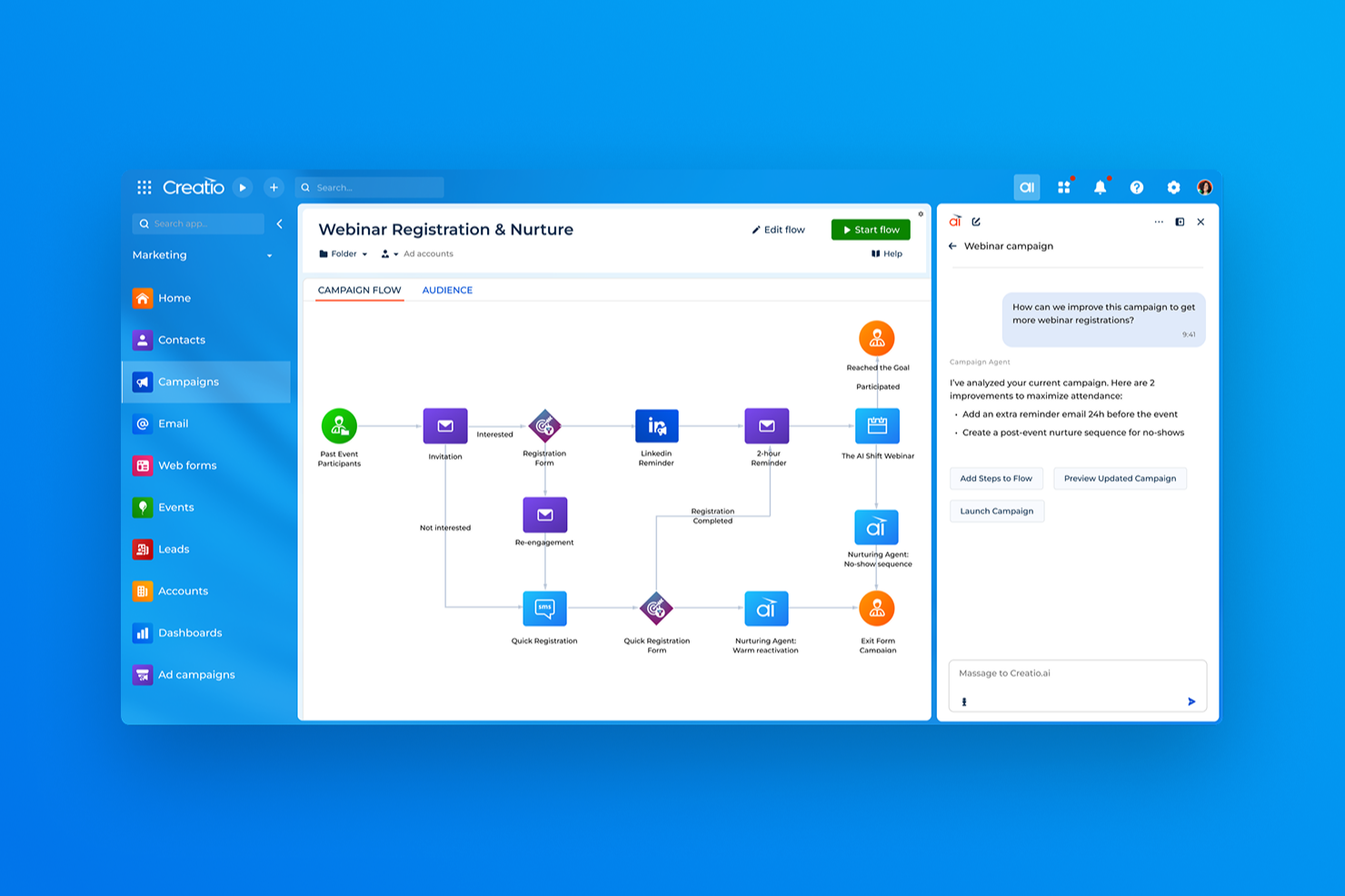
| User Interface | Combines AI Twin’s conversational agent creation with visual no-code tools for building and managing agents, while coding SDKs support more advanced requirements. | Uses a familiar Microsoft interface with guided tools for building and managing agents. |
| Onboarding | Typically follows a guided implementation based on workflows, integrations, data, and deployment scope. | Provides guided setup, templates, documentation, and Microsoft learning resources. |
| Setup Process | Supports flexible configuration, but more complex deployments can involve integrations, migration, testing, and rollout planning. | Connects closely with Microsoft services and business data, though broader setups can still require configuration. |
| Learning Curve | No-code tools lower the barrier to agent building, while advanced implementations may benefit from specialists or certified partners. | Low-code tools are approachable, especially for Microsoft users, but more advanced automation can require Power Platform knowledge. |
| Support | Provides email and regional phone support, plus Creatio Academy, self-service resources, and a global partner ecosystem. | Provides Microsoft documentation, training resources, community support, and plan-based support options. |
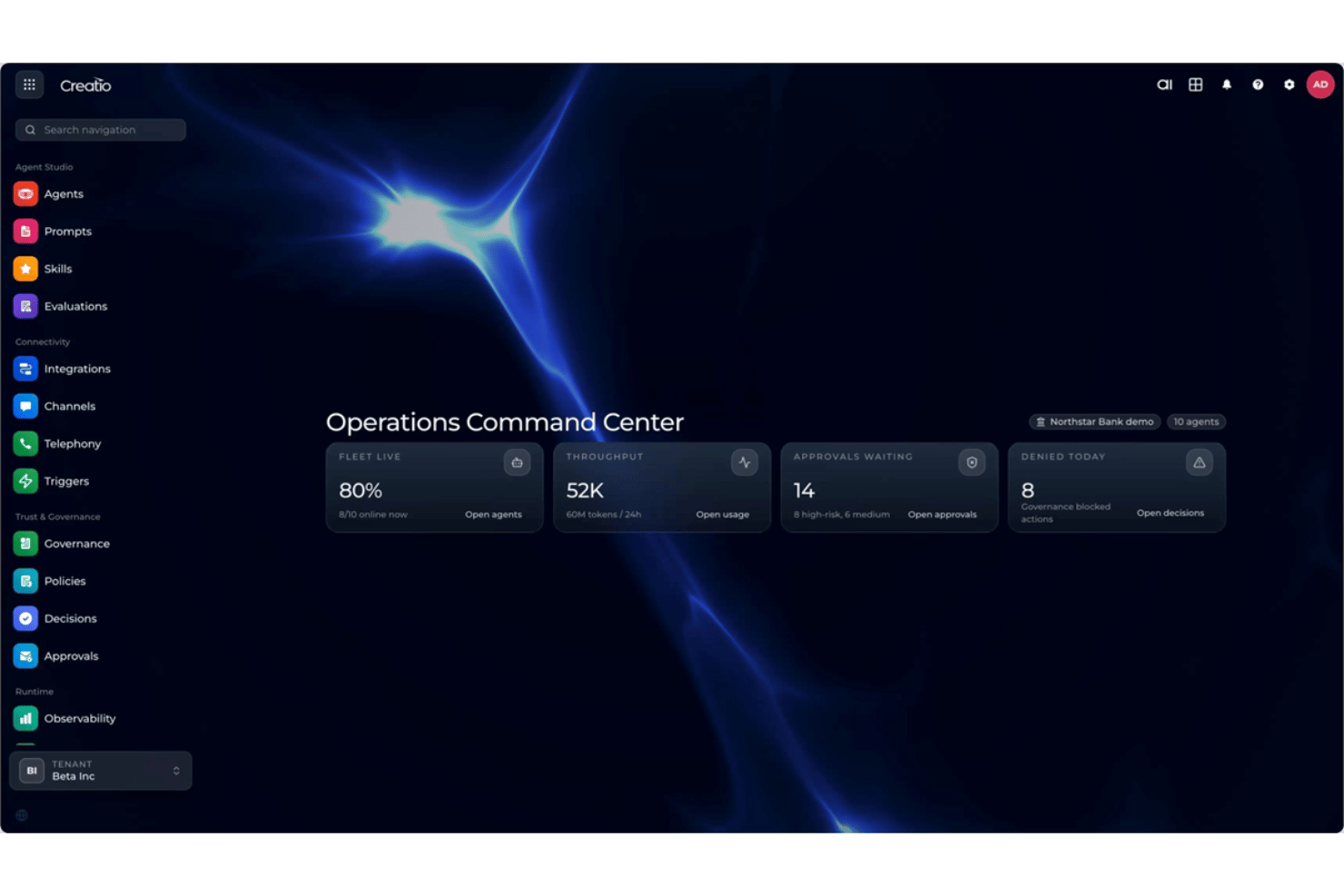
From an ease-of-use perspective, Creatio AI Studio gives business and technical teams several paths into agent creation, from AI Twin’s conversational experience and visual no-code tools to coding SDKs. Microsoft Copilot Studio benefits from a familiar environment for teams already using Microsoft 365 and Power Platform. Creatio may suit teams that want more flexibility in how agents are built and configured, while Copilot Studio can feel more natural in a Microsoft-centered stack.
Creatio AI Studio vs Microsoft Copilot Studio: Pros & Cons
Creatio AI Studio
- No-code agent designer lets teams build and deploy AI agents with less developer support
- Supports no-code and coding-based agents, giving technical and business teams more flexibility
- Built-in governance covers policies, approvals, audit trails, and human review of agent actions
- Advanced implementations may require significant configuration and integration work
- Administrators may need time to learn its broader no-code and agent management capabilities
- Its enterprise-focused feature set may be excessive for teams that only need simple AI automation
Microsoft Copilot Studio
- Connects securely to Microsoft 365 and business data.
- Built-in governance and access controls for enterprise compliance.
- Visual builder simplifies creating conversational AI agents.
- Limited customization outside Microsoft tools and connectors.
- Lacks advanced model fine-tuning options found elsewhere.
- Some features require higher-tier Microsoft 365 licenses.
Best Use Cases for Creatio AI Studio and Microsoft Copilot Studio
Creatio AI Studio
- Banking and Financial Services Creatio supports banking, credit union, insurance, and mortgage organizations with configurable AI and workflow automation for complex, regulated processes.
- Manufacturing and Distribution Manufacturing and distribution teams can use AI agents and automated workflows across operational, service, and customer-facing processes.
- Healthcare and Life Sciences Healthcare, pharma, and life sciences organizations can use configurable workflows, integrations, and governance controls across data-intensive processes.
- Telecommunications and Utilities Telecom, energy, and utility companies can automate high-volume operational and service workflows while maintaining centralized control over AI agents.
- Retail and CPG Retail and consumer goods teams can use AI-driven workflows to automate processes across customer operations, sales, and other cross-functional activities.
- High Tech and Business Services High-tech and business services organizations with complex, changing processes can use Creatio’s no-code tools and integrations to build and adapt AI-driven workflows.
Microsoft Copilot Studio
- Large Enterprises Integrated security, compliance, and scalability features suit organizations with complex oversight needs.
- IT Departments Tight links to Microsoft Azure and Power Platform simplify workflow automation and bot management for in-house IT teams.
- Human Resources HR teams benefit from ready-to-deploy chatbots for onboarding, policy guidance, and employee support with ties to Microsoft 365.
- Healthcare Providers Built-in security and compliance controls help healthcare organizations automate patient communication while protecting sensitive data.
- Education Institutions Easy deployment inside Microsoft Teams streamlines faculty and student interactions for schools already running on Microsoft platforms.
- Customer Service Ability to build AI agents for support and integrate directly with Dynamics 365 makes it attractive for service teams.
Who Should Use Creatio AI Studio, and Who Should Use Microsoft Copilot Studio?
If you’re looking for an AI productivity tool that brings business users, technical teams, and AI agents into the same workflow environment, Creatio AI Studio is likely a good fit. It suits midsize and large organizations that need AI Twin and no-code agent creation, coded agents, multiple AI models, open integrations, omnichannel engagement, centralized governance, and human oversight across complex business processes.
If, instead, your organization already relies heavily on Microsoft 365, Dynamics 365, Azure, or Power Platform, Microsoft Copilot Studio may suit your needs. It suits large enterprises, IT teams, HR, healthcare, education, and customer service teams that want to automate workflows, support self-service, and deploy agents across familiar Microsoft channels and business systems.
Differences Between Creatio AI Studio and Microsoft Copilot Studio
| Creatio AI Studio | Microsoft Copilot Studio | |
|---|---|---|
| AI Model Flexibility | Supports OpenAI, Google, Anthropic, and other model strategies through an open architecture without tying teams to one provider. | Supports selectable AI models within Microsoft’s governed Copilot Studio framework, with availability varying by region and model status. |
| Deployment Options | Supports multiple AWS and Azure regions as well as on-premises deployment for organizations needing more hosting flexibility. | Runs as a cloud service within Microsoft’s Azure and Power Platform infrastructure. |
| Ecosystem Orientation | Designed to orchestrate agents and workflows across varied enterprise systems without requiring a Creatio-first stack. | Fits most naturally into organizations centered on Microsoft 365, Power Platform, Dynamics 365, and Azure. |
| Platform Scope | Combines AI Twin, AI Studio, workflow automation, no-code application development, CRM, and human-led business processes in one platform. | Centers on agent and workflow development within Microsoft Copilot, Power Platform, and related Microsoft services. |
| Pricing and Scaling | Combines platform access with separate AI packages and AI Credits, with Unlimited supporting broader organization-wide scaling. | Uses Copilot Credits through prepaid or pay-as-you-go billing, so costs scale with agent activity and task complexity. |
| Visit Creatio AI StudioOpens new window | Read Microsoft Copilot Studio ReviewOpens new window |
Similarities Between Creatio AI Studio and Microsoft Copilot Studio
| Business Data Grounding | Both allow agents to use organizational data and business context so responses and actions are tied to real operational information. |
|---|---|
| Governance Controls | Both provide policies, permissions, and administrative controls for managing how agents access data and execute business actions. |
| Monitoring and Evaluation | Both give teams tools to test, monitor, and evaluate agent activity so they can identify issues and improve performance over time. |
| No-Code Agent Building | Both provide visual and natural-language tools that make agent creation accessible without requiring users to code every workflow from scratch. |
| Workflow Automation | Both let teams create AI-driven workflows that handle routine tasks, trigger actions, and execute multi-step business processes. |
| Visit Creatio AI StudioOpens new window Read Microsoft Copilot Studio ReviewOpens new window | |