

7 Project Management Consultants: How They Would Address Team Burnout


Diagnosis: Understanding burnout requires diagnosing root causes, not just applying temporary solutions like time off.
Workload: Addressing workload imbalance and unrealistic targets is critical to prevent overburdening key team members.
Meetings: Reducing unnecessary meetings can lower cognitive load and improve team effectiveness dramatically.
Expectations: Unrealistic expectations, unchecked, lead to burnout; pressure-test promises against real capabilities.
Culture: Culture influences burnout significantly; leaders must measure and drive change from the top down.
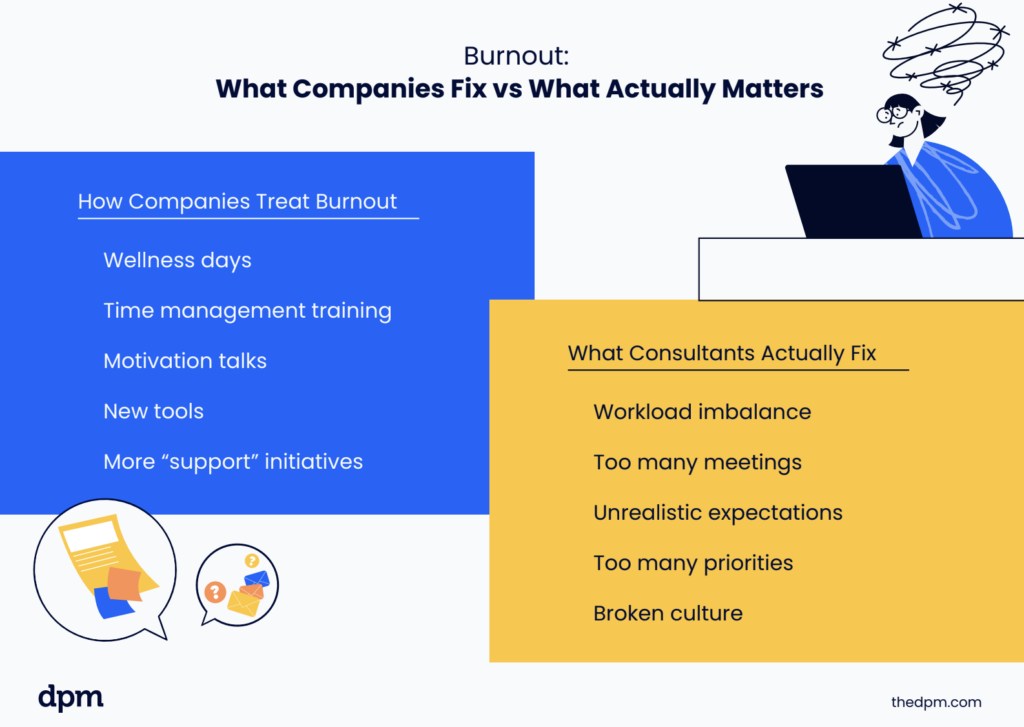
When a team is burnt out, the instinct is to fix the people. Give them a day off. Bring in a wellness speaker. Suggest they manage their time better. These gestures are well-intentioned, and they are almost always insufficient, because they treat burnout as an individual failing rather than a systemic signal.
Consultants who walk into burnt-out teams for a living tend to see it differently. They do not look at the people first. They look at the environment those people are operating in—the workload, the meetings, the expectations, the priorities, the culture that created the conditions for exhaustion in the first place. Burnout, in their experience, is rarely about too little resilience. It is almost always about too much of something that should have been questioned a long time ago.
We asked seven consultants and delivery leaders what they would change first if they saw a team they were advising was burnt out. Their answers vary in focus, but they share a conviction: the fix almost never involves adding something new. It involves removing something that should never have been there.

Diagnose Before You Prescribe
The root cause matters more than the remedy.
Greg Madhere, Founder and CEO of Lowgic Partners, resists the urge to jump to solutions. "There's no silver bullet for burnout," he says. "First, you need to find the root cause of what's leading your team to experiencing feelings of burnout before solving for it. Otherwise, you might be applying a band-aid to a gaping wound."
There's no silver bullet for burnout. First, you need to find the root cause of what's leading your team to experiencing feelings of burnout before solving for it.
It sounds obvious, but the diagnostic step is the one organizations skip most often. A team reports exhaustion, and leadership responds with a half-day Friday or a new project management tool—interventions that feel responsive but address nothing specific. Madhere's instinct is to look at the machinery of the work itself. "Often it can be too many meetings, too much tedious reporting, too much context switching, or being overwhelmed with too many manual, menial tasks with short turnaround times," he explains. "These days there's an AI solution for each of these, but it's important to mix and match the right ones before prescribing a change."
The nuance matters. AI can automate meeting notes, generate reports, reduce context switching, and handle repetitive tasks. But deploying the wrong solution against the wrong cause adds a tool to the pile without removing the weight. Madhere's point is that the diagnosis has to be specific. A team drowning in meetings needs a different intervention than a team drowning in manual data entry, even though both will describe the experience as burnout.

Rebalance the Load
Uneven distribution breaks the strongest teams.
Murli Pawar, Vice President of the Digital Engineering Division at consultancy SunTec India, starts with the most fundamental variable: who is carrying what. "I would start by helping them address workload distribution," he says. "It is crucial to identify whether tasks are unevenly allocated and make sure that all team members have the right support. I would also suggest them to revisit their targets and set more realistic, achievable goals."
It’s crucial to identify whether tasks are unevenly allocated and make sure that all team members have the right support.

Workload imbalance is one of the most common and least visible drivers of burnout. In most teams, a small number of people carry a disproportionate share of the critical work—not because the distribution was designed that way, but because competence gets rewarded with more responsibility until the most capable people are also the most overloaded. The rest of the team may have manageable workloads. The median does not tell the story. The outliers do.
Pawar's second point—revisiting targets—is equally important and equally neglected. Goals set during a planning cycle often reflect ambition rather than capacity. Three months into execution, the team is behind, the targets have not moved, and the gap between expectation and reality becomes a daily source of stress. Resetting goals is not a concession. It is an acknowledgment that the original assumptions were wrong, and that continuing to chase them is more expensive than correcting them.
Subtract Before You Add
The most effective intervention is often removal.
Suzy Jackson, Chief Commercial Officer, identifies a specific, measurable target. "In reality, the first thing to audit is the 60% of meeting time that is often spent on redundant status updates that could be dealt with via asynchronous communication," she says. "A study shows that removing unnecessary sync points leads to a reduction of cognitive load of at least 20%, which is what's needed when people are hitting a wall."
Twenty percent is not trivial. For a team already running at capacity, a twenty-percent reduction in cognitive load is the difference between surviving the week and falling behind. And the source Jackson identifies—synchronous meetings spent on information that could be shared asynchronously—is present in almost every organization. The weekly standup that became a daily standup. The project review that became a status recitation. The cross-functional sync that no one can explain the purpose of but everyone attends because it is on the calendar.
Her broader principle is the one that distinguishes experienced consultants from well-meaning ones: "If anything the fix is usually the subtraction of a layer of process rather than a new tool added to the pile." Burnt-out teams do not need more. They need less. Less reporting, less synchronization, less performative collaboration. The instinct to solve burnout by introducing something—a new workflow, a new tool, a new initiative—often compounds the problem it aims to fix.
Pressure-Test the Promises
Unrealistic expectations are the quietest cause of exhaustion.
Joe Sagrilla, CEO and Principal Consultant at Horizon Business Consulting LLC, looks upstream of the team to the commitments that were made on their behalf. "Even great teams burn out trying to deliver the impossible," he says. "The first thing I do is pressure-test whether expectations are realistic — usually by mapping what's been promised against actual funding, skills available, and whether anyone defined success criteria."
Even great teams burnout trying to deliver the impossible.
This framing shifts the accountability. Burnout in Sagrilla's view is not a team problem—it is a planning problem. Someone promised a deliverable without confirming that the resources, skills, and definitions of success were in place to support it. The team inherited the gap and has been running flat out to close it ever since. "A lot of the burnout I see stems from this mismatch," he says.
The mismatch is endemic in project-driven organizations. Sales teams make commitments that delivery teams have to honor. Leadership sets timelines based on market pressure rather than team capacity. Success criteria stay vague because specificity would force uncomfortable trade-offs. The result is a team that cannot win—not because they lack talent or effort, but because the conditions for success were never established. Pressure-testing those conditions is not a morale exercise. It is a structural correction.
Start with Culture, Measure the Change
Burnout is a cultural output.
James Lloyd, a Digital Strategy and AI Transformation Consultant, names the deepest and most difficult variable. "Burn out kills progress," he says. "The single biggest cause of burn out is culture, which just so happens to be the most difficult thing to change in an organisation and also the single biggest driver in success of transformation initiatives."
It is the answer that no one wants to hear, because culture is slow to change and impossible to fix with a single intervention. But Lloyd's approach is pragmatic rather than philosophical: "The first course of action would be to have a conversation with the team, identify their pain points and issues, create KPIs and implement change using a top-down approach. Then, measure the outcomes based on the original KPIs and repeat until improvement."
The discipline in that sequence is worth noting. It starts with listening—not surveying, not workshopping, but talking to the people doing the work and hearing what they say. It moves to measurement, because cultural problems that are not quantified are cultural problems that never get prioritized. And it insists on top-down ownership, because culture does not change from the middle. It changes when leadership decides it will change and then commits to the unglamorous cycle of measuring, adjusting, and measuring again.
Create Space for Connection
Isolation compounds exhaustion.
Anthony E. Tuggle, CEO and Founder of TAG US Worldwide, focuses on something the other consultants imply but do not name directly: the human fabric of the team. "I would prioritize team building and create space, such as a forum where meaningful connections can form and become the positive fabric for rebuilding culture," he says. "The value of a change of scenery where people can relate, decompress, and build community cannot be overstated."
It is easy to dismiss team building as a soft intervention, especially alongside the structural recommendations in this piece. But Tuggle is not describing trust falls and icebreakers. He is describing something more fundamental—the connective tissue that allows a team to absorb pressure without fragmenting. Burnt-out teams do not just suffer from overwork. They suffer from isolation. People stop collaborating and start merely coexisting. Communication shrinks to the transactional. The informal relationships that once made hard weeks survivable erode under sustained pressure.
Creating space—physical, temporal, or emotional—for those connections to rebuild is not a substitute for fixing workload or clarifying expectations. But without it, the structural fixes have nothing to land on. A team that has lost its sense of community will not recover just because the meeting load dropped by twenty percent. They need a reason to believe the team is worth investing in again.
Redefine What "Important" Means
When everything is a priority, nothing is.
Kory Kogan, Vice President of Content Development at FranklinCovey, locates the source of burnout in a word that every team uses and almost no team defines. "When I see burnout, I immediately look at how we/team are defining 'important,'" she says. "In knowledge work, that word means something different to everyone, which quickly turns into everything being important, translating to competing priorities and overload for all the wrong reasons."
The observation is precise. In the absence of a shared definition of importance, every stakeholder's request carries equal weight. Every initiative is urgent. Every deadline is real. The team does not burn out because the work is hard. They burn out because they are trying to do all of it simultaneously, with no mechanism for deciding what to defer, delay, or drop.
Kogan's intervention is direct: "My first intervention is to narrow the focus to a few measurable outcomes and align the team around what actually is most important—and make sure we have the language and safety to always determine and verify that which is most important, less important, and not important so we stay focused, avoid burnout, and get some amazing things done."

The phrase "language and safety" is doing critical work in that sentence. Narrowing focus requires the ability to say no—or at least not now—to stakeholders who believe their priority should be the team's priority. That ability does not exist unless leadership creates the conditions for it. Teams need explicit permission to deprioritize, and they need a shared framework for making those decisions without relitigating them every week.
The Pattern Behind Every Answer
The seven responses in this piece cover different ground—diagnosis, workload distribution, meeting reduction, expectation management, culture change, community building, and priority alignment. But they share a structural logic that is worth naming.
Not one of these consultants recommends adding something to a burnt-out team's plate. Not a new tool. Not a new process. Not a new initiative. Every recommendation is either a subtraction—fewer meetings, fewer priorities, fewer unrealistic commitments—or a correction: redistributing work, redefining importance, rebuilding connections that have frayed.
This is the insight that organizations miss most often. Burnout is not solved by giving people more resources to do the same unsustainable work. It is solved by changing the conditions that made the work unsustainable in the first place. That means fewer priorities, not better prioritization tools. Fewer meetings, not better meeting agendas. Clearer expectations, not more motivational messaging.
The consultants in this piece agree on one more thing, even if they express it differently: burnout is always a leadership problem before it is a team problem. The team is the surface where burnout becomes visible. The conditions that created it were set long before anyone started feeling exhausted. The first change, in every case, is for someone with authority to look at those conditions honestly and decide that something has to give.
Want more insights from experts like those featured in this article? Sign up for a free DPM account to get access to countless templates, articles, and other resources curated by experts.


