
Best-Selling Author and PMO Leader Peter Taylor on AI’s Communication Revolution
Peter Taylor, Global Head of PMO at Dayforce, explains how AI is turning project management into a more strategic role by automating routine work. His biggest focus area? Using AI to radically improve communication, coordination, and decision-making across global teams.

Career Focus: Peter Taylor emphasizes communication as a key area for AI implementation in project management.
AI Transformation: Artificial intelligence is shifting project management from execution to strategic leadership roles.
Automation Principles: Ten principles are guiding the integration of AI, including self-managed projects and stakeholder visibility.
Efficiency Gains: AI is enhancing project management by automating tasks and improving decision-making processes.
Prepare for Change: Project managers are encouraged to embrace education and experimentation for an AI-driven future.
Peter Taylor is a best-selling author, veteran speaker, and the Global Head of PMO at Dayforce. He literally wrote the book on how to be a "lazy" — but winning — project manager. And there's no better way to do that than with AI.
We sat down with him to see where he's focusing AI efforts within his global organization. The short answer: communication. Here's what he told us.
A career in productive laziness

I've led some of the largest PMOs in the world. I'm currently the Global Head of PMO, Transformation and Customer Office at Dayforce, where I oversee the delivery of hundreds of client-facing projects across the world. I also oversee and enable many internal transformation projects.
I'm an international speaker on all things "project" and "productive laziness." I've done over 500 lectures in 28 countries, and I've been described as, "Perhaps the most entertaining and inspiring speaker in the project management world today."
Back in 2021, I was concerned that no project managers seemed to be talking about artificial intelligence and what it might do for the profession. So, I wrote a book called "AI and the Project Manager: How the Rise of Artificial Intelligence Will Change Your World".
Now, in 2026, that future is already here.
How AI is transforming project and product management roles
Fully automated project management is now possible. We have:
- The computation capability
- The AI to interpret and act on information without prewritten code
- The systems to monitor and coordinate work automatically
- The cultural readiness to trust automation in project management
As a result, AI is transforming both project and product management from execution-heavy roles into strategic, insight-driven leadership positions.
AI is transforming both project and product management from execution-heavy roles into strategic, insight-driven leadership positions.
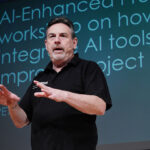
While there will always be a place for human judgment and relationships, routine tasks such as reporting, scheduling, tracking, risk analysis, and customer feedback can be done without a human project manager in the loop. And AI will provide valuable predictive insights and decision support that help managers anticipate issues and prioritize effectively.
Ten principles are defining this shift:
- Projects can and should manage themselves. AI manages, humans think. And the necessary thinking should be minimal.
- Control is out; visibility is in. Stakeholders should have continuous visibility into project health via dashboards.
- Governance must be embedded rather than enforced. It should live within automation rather than reviews and signoffs.
- Teams should lead themselves. Distributed leadership is possible with the right structure, clarity, and tools.
- Meetings should be viewed as a symptom of failure. They compensate for poor workflows and unclear ownership.
- Outcomes are more important than activity. There should be less micromanaging and more impact.
- Human effort is needed, but should focus on innovation. Admin is for algorithms.
- Stakeholder-centric engagement is more important than ever. Communication should be proactive. It should also be automatically personalized and adjusted for impact.
- Progress is driven by dynamic, adaptive planning. Plans must be updated constantly by AI according to project conditions.
- PMOs and AI must always learn and evolve. PMOs evolve into centers of learning instead of control towers. AI learns from every project's performance.
With regard to communication, AI offers a significant time-saving opportunity in the production of meeting minutes, actions, and recommendations for all project team members. And I personally see the language translation capabilities as a huge gain in shared understanding and reduction of project communication issues, thanks to live translation of audio and/or local language transcripts — especially as we have a worldwide community of project personnel.
AI offers a significant time-saving opportunity in the production of meeting minutes, actions, and recommendations for all project team members.
Where AI delivers the highest-leverage automation gains in project management
Where I work, the GPMO is one of many teams seeking ways to adopt and drive value from the investment in AI. We are in a people business — Human Capital Management — and therefore, it is always "people-first." But we have a clear focus on AI opportunities that allow us to improve and progress at speed.
Our primary areas of focus are in:
- Communication gains through automation, reporting analytics, team meetings, and language support
- Coordinating the many channels of discussion regarding customer needs and expectations into a single truth of need
- Project requirements gathering
- Knowledge sharing and insights through a common platform of intelligence from our thousands of projects and retrospectives
- Training content for internal use
Communication and requirements gathering are the big ones.
And scope definition is a key ritual where gains are possible. AI allows us to assimilate hundreds of hours of conversations, discussions, notes, scoping sessions and more into a single cohesive output.
How AI is improving project management efficiency and decision-making

We recently completed an investigation into project management efficiency. AI was used to assist in data analysis and identification of key points of the project management lifecycle where gains could be made through process automation, technology support, and better process design and education of our project teams.
It wasn't all AI. There were manual components, like gathering tracking stats from many projects to identify resource-heavy "hotspots," and interviews with PMs to identify points of change that could deliver productivity benefits.
Once compiled, we used an in-house ChatGPT deployment to run assessments of process variables to validate proposed improvements and rank investment activities.
This was a very recent investigation, so I don't have results to share, but it looks promising.
How AI is reshaping core delivery rituals for modern PMOs
We’re redesigning our core delivery rituals around AI as a full team participant:
- AI now drafts initial scopes, surfaces risks, and aligns inputs before humans ever meet.
- During execution, it synthesizes updates, flags misalignment, and forecasts issues so our conversations focus on decisions — not data-gathering
- For validation, AI models scenarios and tests assumptions early, giving us faster confidence to pivot or proceed.
We’re redesigning our core delivery rituals around AI as a full team participant.
Ultimately, AI removes noise from the system so our teams can focus on value, outcomes, and smart leadership. And the result is that the projects of the future will be able to start delivering much faster.
What a simple AI-ready project management tech stack looks like

Most organizations run projects where the technology adds little value to the PMs. The tech doesn't operate as a digital partner. An AI world should be different.
PMs work at their peak when the systems they use are simple, aligned, and offer them guidance, rather than just being reporting-out systems.
Here's our simple project management tech stack:
- Certinia (PSA) with Smartsheet
- EnterpriseGPT — an in-house ChatGPT deployment
- MS Teams Premium
Most organizations run projects where the technology adds little value to the PMs. The tech doesn’t operate as a digital partner. An AI world should be different.
How PMOs can coordinate AI experiments across global organizations
I've been pleasantly surprised by the general enthusiasm from many people about the potential opportunity of gain through AI. Resistance to this change has been minimal, which was not the immediate expectation.
Key to this has been a significant investment by the business into AI education. And what it has led to is a need to coordinate the AI experiments of many individuals across the organization so that we can identify where and when the investments in time and effort will be most beneficial.
To do this, the GPMO has set up a log of all AI ideas across our domain of ownership. We sanction and invest in small experiments. And then we run comparative analyses of historical project data against new processes and automations.
How to prepare for an AI-first future in project management
Here's my advice to PMs: Be open minded and prepare yourself through education. Read, listen, discuss, experiment, and generally get involved!
Here’s my advice to PMs: Be open minded and prepare yourself through education. Read, listen, discuss, experiment, and generally get involved!
Follow along
You can follow Peter Taylor's work as he continues educating PMs on how to work in global, AI-enhanced environments on LinkedIn, X, and his website, thelazyprojectmanager.com. And don't miss his book, The Lazy Project Manager: How to be twice as productive and still leave the office early.
More expert interviews to come in The Digital Project Manager!
