

How to unify your AI tech stack with Zapier



AI has officially crossed the line from "interesting experiment" to business expectation. Leaders are investing in it, roadmaps depend on it, and teams are being asked to deliver real outcomes, not just proofs of concept.
But turning that expectation into day-to-day impact is harder than it sounds.
The key problem is integration. According to a Zapier survey, 78% of enterprises struggle to integrate AI with their existing systems. Organizations have an abundance of tools and leadership buy-in but no clear way to connect systems, data, and intelligence.
Zapier is an AI orchestration platform that changes that. It allows you to build AI-powered systems at scale, so you can turn AI from isolated tools into an integrated part of how work gets done.
 is an AI orchestration platform that changes that. It allows you to build AI-powered systems at scale, so you can turn AI from isolated tools into an integrated part of how work gets done.
The real problems created by a disconnected AI tech stack
Most enterprise work crosses systems, roles, and approvals. But when those systems aren't connected, work breaks at every handoff. Here's what that looks like:
- Teams operate in silos. Each tool supports its own workflow, so there's no shared view of work across teams. Marketing automates handoffs one way, sales another, and operations a third. This leads to misalignment, inconsistent processes, and automation that optimizes individual teams instead of the business as a whole.
- Information doesn't reach the teams that need it. When data is locked inside individual tools, teams either operate without context or rely on manual work to fill the gaps. This delays decisions and increases the risk of overlooking critical issues or opportunities.
- AI outputs stop at insights instead of actions. AI can generate summaries, classifications, and recommendations. But without orchestration, those outputs go nowhere. Work stalls, manual effort creeps back in, and the value of AI is capped at information instead of impact.
Zapier: AI orchestration for real work that scales
Solving broken handoffs requires more than adding another AI tool. You need a way to coordinate systems, data, and intelligence across end-to-end workflows. Zapier is that solution.
With Zapier, AI isn't used in isolation. It's embedded directly into workflows that span tools, teams, and approvals from the moment work starts to the moment it's completed. AI analyzes, decides, and routes work automatically, while Zapier handles the coordination behind the scenes. This means you can orchestrate:
- Systems designed to scale, supporting growth and evolving processes without constant rework
- End-to-end workflows, where work flows seamlessly across tools and teams
- AI-driven actions, where insights automatically guide what happens next
Why enterprises use Zapier to orchestrate AI
The key to successfully orchestrating AI is making sure it fits into the way work already happens across your organization, without adding friction or complexity. Here's how Zapier enables teams to do exactly that.
1. Built to scale with your organization
Enterprise workflows rarely stay small or simple. As your team grows and processes evolve, automation needs to expand without becoming brittle or fragmented.
Zapier enables organizations to design AI-powered systems that scale. Shared workflows and logic can be reused and extended, so you can start with a focused use case and gradually roll it out across the organization without rebuilding processes or creating parallel solutions.
2. Broad, deep integrations across the enterprise stack
Most enterprise work spans a wide range of applications, from CRM and marketing tools to finance, support, and HR systems. Zapier connects with over 8,000 apps and AI tools, making it possible to orchestrate AI across the full lifecycle of work. It's the connective layer between systems that allows data, decisions, and actions to move seamlessly across your existing stack.
3. Enterprise-grade security and governance
Zapier is designed to meet enterprise security and governance requirements, supporting standards like GDPR and SOC 2 Type II while offering capabilities such as enterprise-grade single sign-on and detailed audit histories.
With role-based permissions, comprehensive activity tracking, and centralized administration, IT teams maintain clear visibility and control. At the same time, teams can move quickly, build and adapt workflows responsibly, and evolve processes without constant back-and-forth or bottlenecks.
4. Accessible to non-technical teams
AI orchestration shouldn't be limited to engineers. Zapier's no-code approach lets everyone, regardless of technical expertise, build and manage sophisticated, end-to-end workflows.
By lowering the barrier to entry, organizations see faster adoption, more experimentation, and broader ownership of automation initiatives.
5. Faster implementation and time to value
Zapier works alongside your existing tools, which means you don't have to worry about long implementation cycles, custom integrations, or major infrastructure changes.
You can move from idea to live workflow quickly, test AI-powered processes in real conditions, and refine them over time, helping you turn AI strategy into tangible results sooner.
When existing tools aren't enough: building solutions with Zapier
Sometimes, existing tech stacks aren't enough to support your team's workflows. With Zapier, you can build custom solutions to support end-to-end processes without introducing new complexity.
- Zapier Tables lets you store, manage, and structure data that doesn't belong neatly in a single app. Tables can act as a lightweight database for AI-powered workflows, giving you a central place to track records, enrich data, and trigger automations.
- Zapier Forms allows you to design flexible, custom forms—for example, contact forms, customer feedback forms, surveys—that serve as the starting point for automated workflows. Each submission can instantly trigger actions across your tech stack, making it easy to collect data and put it to work without managing the systems behind the scenes.
- Zapier Agents enables AI-driven decision-making inside workflows. Agents can analyze inputs, apply logic, and determine next steps automatically, reducing the need for manual judgment in repetitive processes.
- Zapier Chatbots lets you build and embed AI-powered chatbots to share with your customers or team. These chatbots can answer questions, surface insights, and trigger actions using real-time data from connected systems.
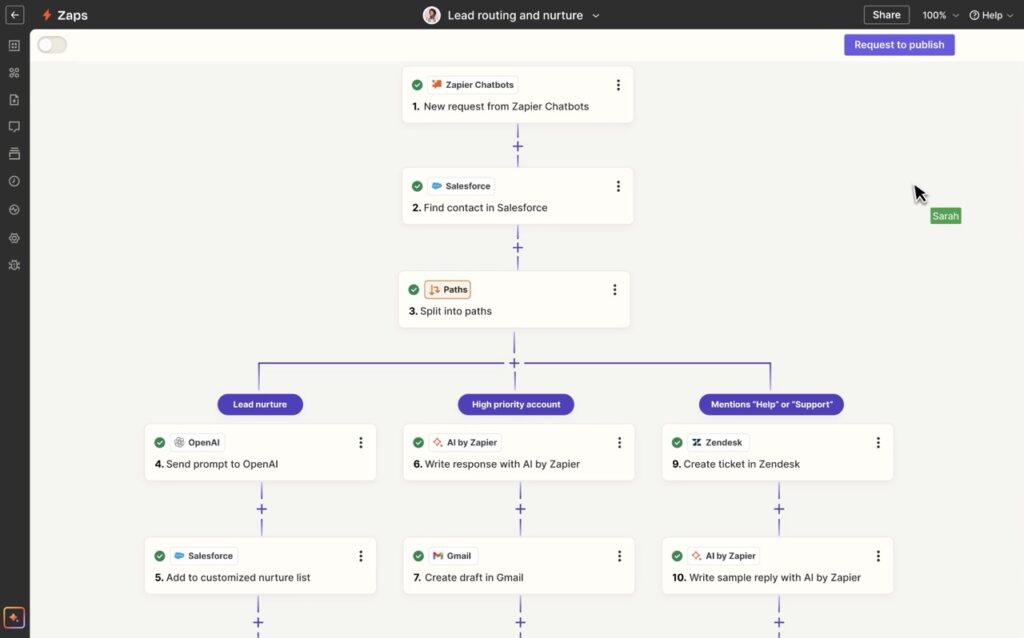
Together, these products allow you to extend your tech stack with purpose-built solutions, all while keeping orchestration, governance, and scalability centralized in Zapier.
From AI tools to AI-powered systems
Unifying your AI tech stack isn't about adopting more tools. It's about building systems where intelligence, data, and workflows move together.
When AI is orchestrated across your existing stack, insights lead directly to action. Teams spend less time managing handoffs and more time delivering outcomes. And AI becomes a durable capability, not a series of disconnected experiments.
Zapier provides the orchestration layer that makes this possible. By connecting your tools, embedding AI into workflows, and supporting enterprise-scale governance, Zapier helps organizations turn AI from a promise into a practical part of how work gets done.
Want to learn more about how Zapier can support your enterprise automation Get started for free.


