


ALICE is AI-powered construction planning and scheduling software in the BIM project management software category, built to model and compare project schedules, sequences, and resource plans. I’d consider it for a large, complex construction project where you need to test alternatives or recover from delays; compared with relying on Primavera P6 alone, ALICE adds AI-driven scenario generation and comparison while working with existing P6 schedules.
ALICE Evaluation Summary
- Pricing upon request
- Free demo available
Why Trust Our Software Recommendations
Our team has been testing and reviewing software since 2012. As project managers ourselves, we know how difficult—and important—it is to choose the right software.
For this guide, we evaluated tools using hands-on testing and independent research, scoring tools using our selection criteria. We also draw on insights from industry thought leaders and practicing project management experts.
Our reviews reflect our human editorial judgment, not a sales pitch.
Expert reviewers:
ALICE Overview
I’d choose ALICE when a large capital project needs schedule optimization more than everyday BIM coordination. Its AI simulations compare sequencing, resource, time, and cost scenarios, with results shown on a time-versus-cost graph; for example, teams can test recovery plans after delays. Compared with conventional scheduling tools, that scenario analysis is its clearest advantage, while its focused planning scope makes it less suited to broad project management. Pricing is quote-based, typically for projects valued at $75 million or more, and includes expert support, workshops, and implementation help. Schedule imports support established formats, but expect a guided setup rather than instant onboarding.
pros
-
AI simulations compare sequencing, duration, cost, and resource tradeoffs.
-
A practitioner praised its optioneering for exploring construction alternatives.
-
Imports P6 and Microsoft Project schedules for scenario analysis.
cons
-
It focuses on scheduling, not BIM coordination or field management.
-
2D schedule views don’t provide 3D model coordination.
-
Quote-based pricing and project focus can deter smaller teams.
-

Smartsheet
Visit WebsiteThis rating combines scores from multiple user review sites to reflect overall customer sentiment about the product.4.4 -
Celoxis
Visit WebsiteThis rating combines scores from multiple user review sites to reflect overall customer sentiment about the product.4.5 -
Accelo
Visit WebsiteThis rating combines scores from multiple user review sites to reflect overall customer sentiment about the product.4.4





Our Review Methodology
How We Test & Score Tools
We’ve spent years building, refining, and improving our software testing and scoring system. The rubric is designed to capture the nuances of software selection and what makes a tool effective, focusing on critical aspects of the decision-making process.
Below, you can see exactly how our testing and scoring works across seven criteria. It allows us to provide an unbiased evaluation of the software based on core functionality, standout features, ease of use, onboarding, customer support, integrations, customer reviews, and value for money.
Core Functionality (25% of final scoring)
The starting point of our evaluation is always the core functionality of the tool. Does it have the basic features and functions that a user would expect to see? Are any of those core features locked to higher-tiered pricing plans? At its core, we expect a tool to stand up against the baseline capabilities of its competitors.
Standout Features (25% of final scoring)
Next, we evaluate uncommon standout features that go above and beyond the core functionality typically found in tools of its kind. A high score reflects specialized or unique features that make the product faster, more efficient, or offer additional value to the user.
We also evaluate how easy it is to integrate with other tools typically found in the tech stack to expand the functionality and utility of the software. Tools offering plentiful native integrations, 3rd party connections, and API access to build custom integrations score best.
Ease of Use (10% of final scoring)
We consider how quick and easy it is to execute the tasks defined in the core functionality using the tool. High scoring software is well designed, intuitive to use, offers mobile apps, provides templates, and makes relatively complex tasks seem simple.
Onboarding (10% of final scoring)
We know how important rapid team adoption is for a new platform, so we evaluate how easy it is to learn and use a tool with minimal training. We evaluate how quickly a team member can get set up and start using the tool with no experience. High scoring solutions indicate little or no support is required.
Customer Support (10% of final scoring)
We review how quick and easy it is to get unstuck and find help by phone, live chat, or knowledge base. Tools and companies that provide real-time support score best, while chatbots score worst.
Customer Reviews (10% of final scoring)
Beyond our own testing and evaluation, we consider the net promoter score from current and past customers. We review their likelihood, given the option, to choose the tool again for the core functionality. A high scoring software reflects a high net promoter score from current or past customers.
Value for Money (10% of final scoring)
Lastly, in consideration of all the other criteria, we review the average price of entry level plans against the core features and consider the value of the other evaluation criteria. Software that delivers more, for less, will score higher.
Core Features
Generative Schedule Creation
ALICE uses AI to generate construction schedules from project scope and sequencing logic. You can explore schedule options early, before committing to a baseline plan.
Construction Sequencing
You can test different ways to arrange and stack project activities. This helps your team compare execution strategies, such as changing the order of work across project phases.
What-If Construction Simulation
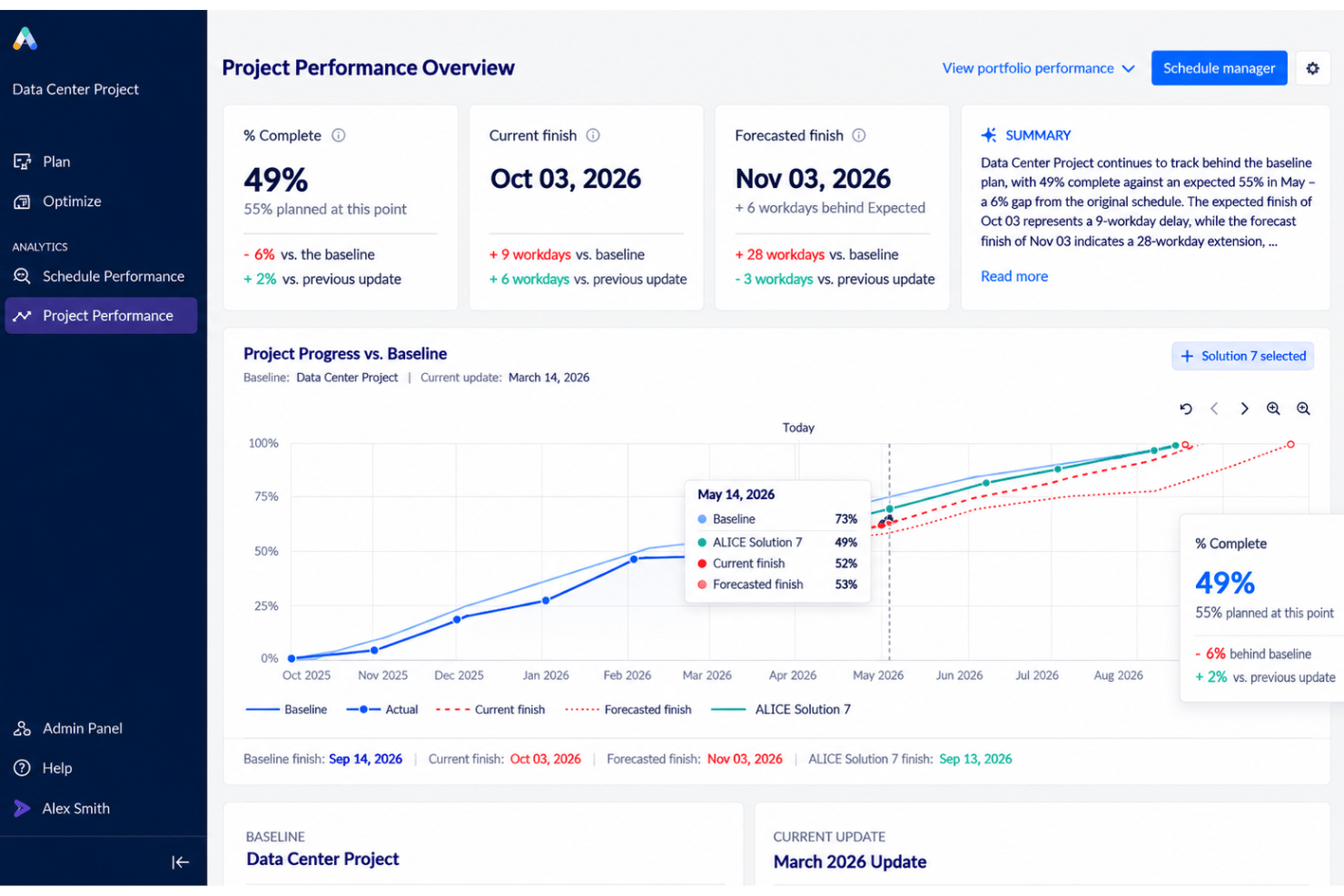
Run simulations to compare schedule scenarios and see their time, cost, and resource implications. For example, you can test recovery options after a delay before choosing a revised plan.
Objective-Based Schedule Optimization
Set and rank priorities such as project duration, milestone dates, or crew and equipment use. This lets you weigh trade-offs, such as protecting a key milestone even when it doesn’t produce the shortest overall schedule.
Analytics and Reporting
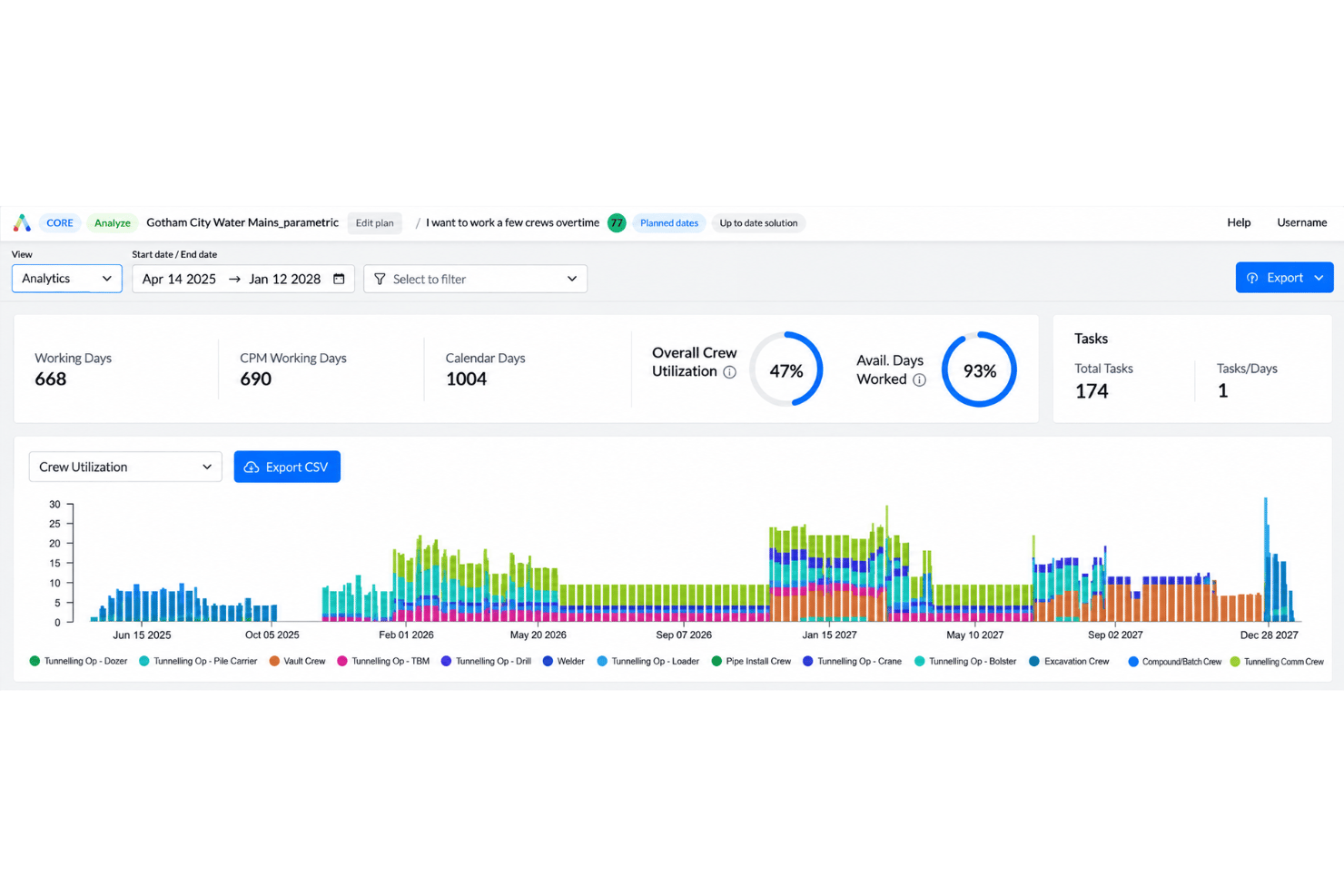
ALICE reports crew, equipment, and resource utilization, along with cost breakdowns and time-phased costs. These views help you identify idle resources or compare the cost profile of schedule alternatives.
Schedule Insights Agent
You can chat with a schedule to get insights and recommendations. This gives project teams a way to investigate schedule questions without relying only on manual review.
Ease of Use
ALICE is usable for specialist schedulers, but I wouldn’t call it plug-and-play. Its focused interface supports schedule modeling, scenario comparisons, and resource trade-offs, while guided implementation helps teams prepare their plans. Practitioner feedback praises its optioneering, and AEC Hub describes the learning curve as gentle to moderate. That fits a planning tool, though teams new to simulation-led scheduling should expect to learn its approach before getting full value.
Integrations
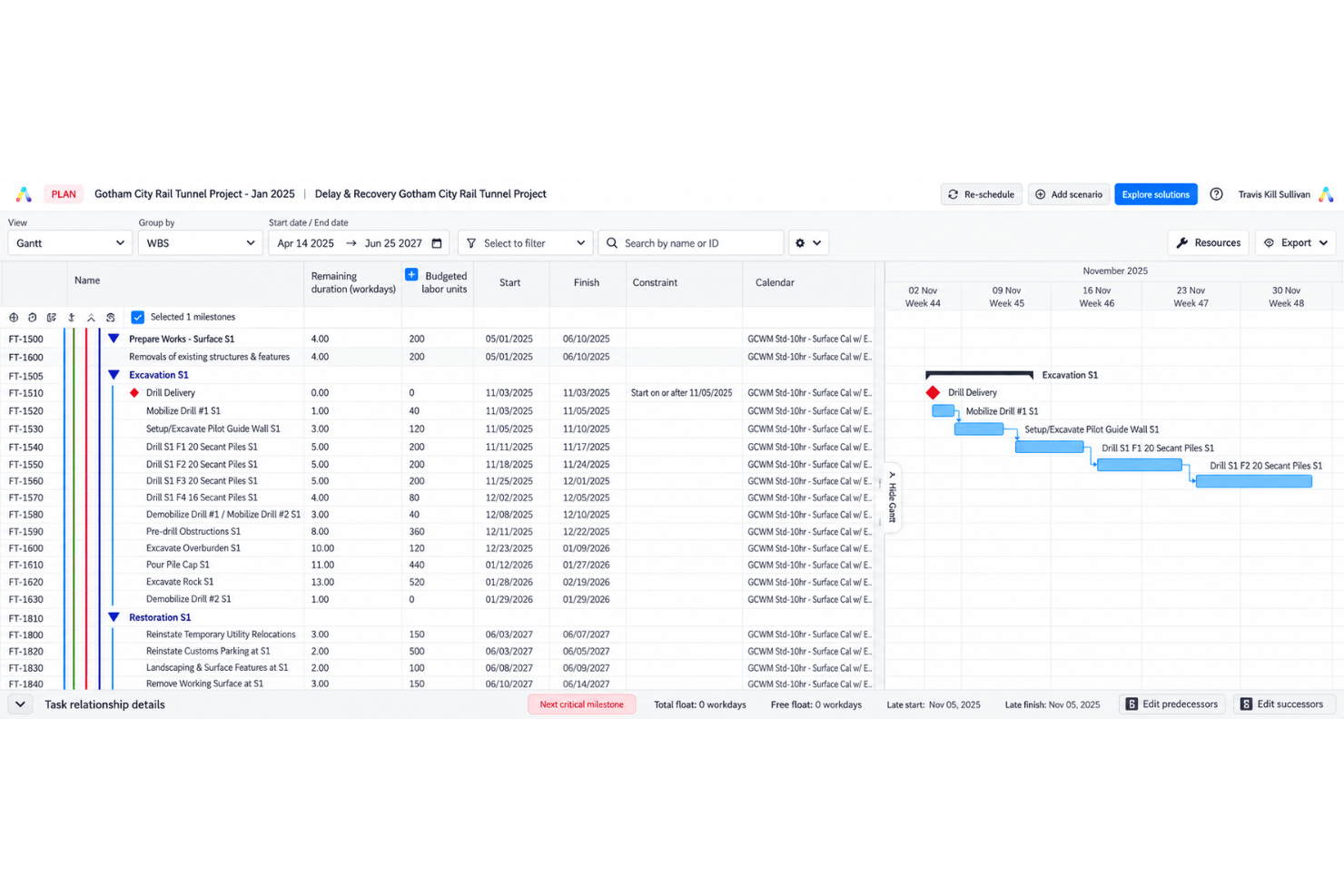
ALICE integrates with Oracle Primavera P6, Oracle Primavera Cloud, and Microsoft Project through schedule import and export capabilities. It supports Primavera XER and XML files, Microsoft Project MPP imports, and schedule exports in compatible formats.
ALICE's public documentation does not confirm a general-purpose API or integrations with third-party automation platforms.
ALICE Specs
- API
- Batch Permissions & Access
- Budgeting
- Calendar Management
- Collaboration Support
- Contact Management
- Contact Sharing
- Customer Management
- Dashboard
- Dashboards
- Data Export
- Data Import
- Data Visualization
- Dependency Tracking
- Document Sharing
- Expense Tracking
- External Integrations
- File Sharing
- Gantt Charts
- Kanban Boards
- Multi-User
- Notifications
- Project Management
- Resource Management
- Scheduling
- Task Scheduling/Tracking
- Third-Party Plugins/Add-Ons
- Time Management
- Travel Management
- Workflow Management