

How to Give Leaders Visibility Into Strategic Initiatives Without More Reporting


Strategic initiatives rarely stall because teams aren’t working hard enough. More often, the information leaders need to make timely decisions is scattered across Jira, Asana, Slack, spreadsheets, meetings, and everything in between. By the time a risk becomes visible at the executive level, the opportunity to address it early may already be gone.
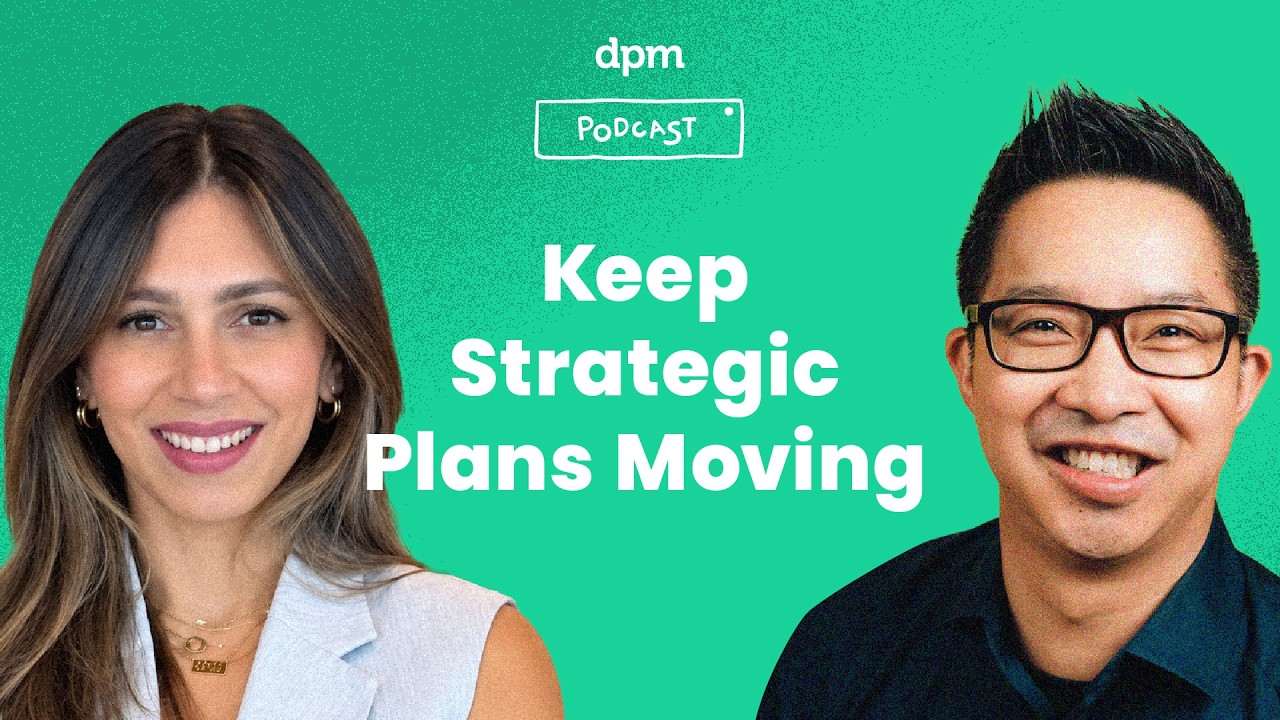
Galen Low sits down with Maria Delgado Oliveros, founder of glidiffy and former program management leader at Uber, Hexagon PPM, and Chime, to unpack what makes strategic initiatives different from ordinary projects—and why better visibility can transform the relationship between program managers and executive sponsors. They explore how PMs can spend less time chasing updates and more time understanding dependencies, surfacing risks, making trade-offs, and becoming trusted operational partners.

What You’ll Learn
- Why strategic initiatives require a different approach than standalone projects
- How disconnected tools can hide risks, dependencies, and execution drift
- What executives actually need to know to make timely decisions
- Why understanding business strategy and commitments matters for program managers
- How better visibility can shift PMs from information gatherers to strategic partners
- Where AI and connected tools can support—not replace—the judgment of project and program managers
Key Takeaways
- Visibility matters more than standardization. Getting every team onto one platform might sound tidy, but it can take significant time and effort. The more immediate challenge is connecting the information that already exists so risks and dependencies become visible without forcing teams to abandon the tools they use.
- Surface risks while there’s still time to act. A risk report isn’t particularly useful once the consequence has already arrived. Program managers should communicate what’s happening, what it could affect, what mitigation is underway, and who needs to make a decision.
- Translate execution into business impact. Leadership doesn’t need a brain dump from every project board. They need to understand where an initiative stands, its wins and risks, and how the work connects to organizational objectives, OKRs, or KPIs.
- Treat new work as a trade-off. When unexpected work appears, the question isn’t simply whether the team can do it. Ask what gets deprioritized if they do. That keeps day-to-day execution connected to the commitments the organization has already made.
- Think like a “mini COO.” Maria frames program management as an operational role: designing operating models, understanding how teams work, spotting dependencies, mitigating risk, and keeping execution aligned with strategy. The value isn’t collecting updates—it’s understanding the whole system well enough to help it operate.
- Use automation to create space for judgment. When PMs spend less time hunting through tools and manually assembling status reports, they can spend more time solving problems and advising leaders. The technology handles more of the information gathering; the PM brings context, judgment, and action.
- Build a partnership with executive sponsors. Better visibility changes the conversation from “Why didn’t I know about this?” to “Here’s the issue, its impact, and the decision we need.” That makes the PM less of an information conduit and more of a trusted advisor.
Chapters
- 00:00 — Why Initiatives Stall
- 02:41 — Projects vs. Initiatives
- 07:12 — Strategy & Execution
- 08:58 — Why Initiatives Matter
- 12:04 — The Visibility Problem
- 13:38 — Connecting Disconnected Tools
- 18:04 — Surfacing What Matters
- 21:38 — The “Mini COO” Mindset
- 27:50 — What Executives Need
- 31:25 — Risks & Trade-Offs
- 35:15 — Building Strategic Partnerships
- 37:32 — AI as a PM Partner
- 40:30 — What’s Next for glidiffy
Meet Our Guest

Maria Delgado Oliveros is the Founder of glidiffy, bringing more than 12 years of experience in operations strategy, program management, and process optimization within the technology sector. She specializes in helping organizations streamline operations, scale effectively, and bring greater clarity to complex workflows. Drawing on her experience across technical and non-technical program management, Maria takes a practical, multicultural approach to solving operational challenges and building more efficient, scalable organizations.
Resources from this episode:
- Join the Digital Project Manager Community
- Subscribe to the newsletter to get our latest articles and podcasts
- Check out this episode’s sponsor: Fingerprint
- Connect with Maria on LinkedIn
- Check out glidiffy
Related articles and podcasts:
Galen Low: Strategic initiatives are the main vehicle for how organizations rally departments together to create change that moves the business forward. But for some reason, they always seem to stall out. Sometimes it's because of competing priorities or because leadership teams tend to bite off more than their people can handle.
But a lot of the time it's because the right information wasn't surfaced at the right time in a way that would give teams, department heads, and executive sponsors enough time to react. And to make matters worse, often the right information actually was available, but it was buried in one of the 27 tools that the various teams were using.
What's the answer? How can program managers and initiative leads create better visibility for executive sponsors without feeling the need to commit every team conversation to memory? To answer that, I've brought in a former program manager with Uber who is now building a platform that could solve the visibility equation without disrupting the way teams work.
We'll be talking about why communication breaks down as information travels up the chain, what information is important to what stakeholder groups, and how understanding the bigger picture can change the relationship between program managers and executive sponsors from an adversarial rivalry to a trusted partnership. Hope you enjoy the episode.
Welcome to the Digital Project Manager Podcast—the show that helps delivery leaders work smarter, deliver smoother, and lead their teams with confidence in the age of AI. I'm Galen, and every week we dive into real-world strategies, emerging trends, proven frameworks, and the occasional war story from the project front lines.
Whether you're steering massive transformation projects, wrangling AI workflows, or just trying to keep the chaos under control, you're in the right place. And if you've been liking what you've been hearing from us lately, please consider following us wherever you're finding us, and maybe even leaving us a review. All right. Let's get into it.
With me today is Maria Delgado Oliveros, founder of glidiffy and a program management leader who has worked at organizations including Uber, Hexagon PPM, and Chime. Maria has spent most of her career helping organizations connect strategy to execution, figuring out how goals become roadmaps, how work gets coordinated across teams, and importantly, how leaders get enough visibility to make good decisions before something has already gone wrong.
With glidiffy, Maria is tackling the age-old problem of getting visibility into otherwise opaque cross-departmental initiatives without forcing multiple departments and teams to switch tools.
Maria, thanks for joining me today.
Maria Delgado Oliveros: Thank you so much, Galen, for inviting me today. I'm very happy to be here.
Galen Low: Here's the little roadmap that I've sketched out for us today.
First, I just wanted to hit you with a bit of a spicy question that my listeners would love to hear your take on. But then I wanted to use that as a lens to talk about why strategic initiatives are so challenging, whether tools are the answer, and how teams can support sound decision-making that help their initiatives actually, you know, come to fruition instead of getting stuck in progress purgatory.
How does that sound to you?
Maria Delgado Oliveros: That sounds amazing. Let's go into it.
Galen Low: Awesome. Let's dive in. I'm gonna set the scene, you know, with a bit of tang, a bit of spice but let me take a running start at it, because my listeners are a mix of project professionals and senior business leaders, and in both cases, projects and initiatives are seen as key parts of transformation, like they're like the engine room.
But in a lot of cases, projects and initiatives are not treated the same way, not by leadership teams, not by executional teams, not by executive coaches, and, and, and, et cetera, et cetera. So my question is this: Are strategic initiatives just projects masquerading under a fancy name? What makes them the same, and what sets them apart?
Maria Delgado Oliveros: No, actually, they are not the same. They could be slightly similar and sound slightly s- the same, but they are not. So for a strategic initiatives, that's a little more related to leadership, where the business wants to go, what is the outcome or priority for the company. So they are definitely related and connected to that.
When it comes to project it can be operational, it can be just a bit of execution. It has a deliverable you know, obviously initiatives also have, but they can span within one team. While the scope for a strategic initiative goes across. So it's a much broader type of initiative that goes across multiple different functions.
So for instance, for a company to be able to accomplish one strategic initiative, all these different teams have to be participat- participating into it, and be able to be online with the priority of the company.
Galen Low: I love the way you put that because, yeah, you're right, a project could be sort of localized within the department.
It's not necessarily business as usual, but it's pretty close to business as usual. People who are used to working together, people who sort of speak the same language, people who, you know, have the same sensibility and view the business in a certain way. But I, I, I like what you said about it just, it cuts across, right?
And everyone kind of needs to row in the same direction. And these are not necessarily groups of people who are used to rowing in the same direction. And then the other thing that I think you're saying is that it's also a new direction. It's not like the usual thing. Oftentimes, it's the almost a shift in strategy or an amplification of a strategy to change the business as a whole.
Maria Delgado Oliveros: Exactly. So it's connected to h- where the business wants to go as a whole, what the priority of the business really is. Well, now, like a proj- actually, one thing that it's important to mention is that a strategic initiative can have multiple projects underneath that, and even programs as well. So it's, these could be this massive work that can span months, sometimes even years.
It really depends on where the company wants to go and what stage they are in as a company as well. So it's closely related to leadership. They are the one deciding what's important for the company and how we wanna go and take it there. And then in a project, just an independent set of work for one individual team that's gonna be concluded and move on to a different one.
Galen Low: I think you just explained, like, why it's complicated. I was even gonna ask you later. I still might in a different way, but like the idea of almost that like sort of, architecture, I, I guess I should say, right? Yes, it can be like many projects projects working together. We'd typically call it a program or, you know, a portfolio of different things some of which start and stop at different times.
And a- actually, when you're working those projects, you might not even realize necessarily the breadth and the scope of the initiative that it sits within. And when you said the like, oh yeah, multi-year thing, like I've, I've worked in a lot of, you know, boutique, smaller, very fast-paced, very impatient organizations and you know, we'll, we'll plan like max three years ahead, you know?
Everything pa- past that is you know, something that we can be have ambition around, but not necessarily any detail. But that idea, and I, I do wanna get into some, you know, the experience you've had at other organizations you've worked at, where, yeah, these are... They're big pushes. They are not, you know, one quarter.
They are not even, you know, the sort of annual sort of strategic plan, and we're gonna finish it all in 12 months. Some of these things are, you know, transformational and also take time.
Maria Delgado Oliveros: Yeah, and also I think one thing that you just mentioned there, which is the strategic planning, right?
So very important part of it, right? You can make a plan for a year, right? Because you want to have a vision. You know as a company where you're headed to or where you think you're headed to, but you have to revisit this every quarter, right? So that you know, are we still in shape? Are we really executing on the things that we said we were going to execute?
Are we moving the needle forward or we're not? And how is the market behaving at the same time, right? You're considering multiple different things just at the same time, so that's w- the very important part why execution needs to keep being aligned with what the strategy was actually set for.
Galen Low: Yeah.
There's the checkpoints to make sure we're still on the right course. Not even internally do we understand what course we need to be on? Are we following the plan? But also should the plan change based on environmental factors? It's a it may be a good segue. M- I wonder if we can maybe zoom out a little bit because you've kinda hung your hat on delivering strategic initiatives, both professionally and with your sort of current venture.
You know, all the way to the extent that you're building a platform, like glidiffy, around this idea of making strategic initiatives smoother. I thought maybe just let's crack that open about the market and about sort of initiatives. Like, why are strategic initiatives so important right now?
Not even historically, but in this very moment. And also, what's at stake if organizations n- you know, can't get this right, if they can't rally their teams to deliver on initiatives on plan, or if they can't sort of listen to what's happening in the market around them and just kind of, follow things step by step, rote, for multiple years.
Maria Delgado Oliveros: To be honest, in my opinion, the reason why they are so important is because this is where you know you wanna take the company to. So if we don't focus on it, we can't really get there. So we plan
Based on all the different things that we need to be able to accomplish, where... Are we growing? Are we trying to get more, like maybe customers? Are we trying to get more revenue? What are the things that we would really wanna be focusing on during one specific set of time? And so while you have that strategy, then you need to determine how are we going to execute that strategy?
How many teams do need to interact with that? That is important part of it because you are moving the company forward instead of actually saying, "Well, we're just gonna do everything all at the same time." When you do so many things, then you don't move forward. So I think that's the biggest part of it.
What really makes it complicated is execution af- let's say you already have communicated your strategy to the entire company. It's very important that everyone is on board and knows what's going on, right? What are we really working towards as a whole? And then what are the teams are going to be interacting?
So responsibility is a very important part. Who is gonna be accountable? Who is going to be responsible? Who do we need to c- get consulting from, or who is actually going to be informed? We need to know exactly how those things are gonna play out. What are the things that we need to be able to execute?
But- Execution drift very fast, and I'll give you one specific example. In tech companies especially, you have a team of engineers, and then you have the entire you have marketing also interacting, and you have program management and product and all of these different teams to be able to deliver multiple different projects for this big initiative.
Because tools are disconnected, problems become invisible. A engineer may be working on some low-priority work that was never committed to, but no one could see it because they have their own board and some- someone is not checking. So t- tools today are not connected to provide one si- single visibility.
And let's be real, moving everyone towards just one individual one is almost impossible and takes forever in large organizations. So it's not the most efficient way. It can work, but it's not the most efficient way. So 47% of teams actually struggle finding information across multiple different tools.
People are losing about 60% of their time just to coordination. So what tool do I need to actually use? What information do I have there? And then connecting all the dots, and obviously that impacts, at the end of the day, the revenue of the company.
Galen Low: It's actually really interesting that you bring up sort of the, the visibility.
And there's two problems there where, you know, I'm like, "Okay, well, what's the solution then?" Because I agree, right? I think there's a lot of organizations right now that are like, "Okay, well, in order to get the visibility we need and for everyone to move in lockstep and for us to be able to catch, you know, these things that would otherwise be invisible, we need to change to a consolidated platform.
Everyone needs to work the same way. We need to roll out new SOPs. You know, we need to do the whole change management thing and, you know, enforce adoption," and yada, yada, yada. To your point, that could take years. That- Yeah ... could be a strategic initiative, right? To sort of have the business intelligence that helps drive the business forward.
But in a lot of cases that's it's slow, right? You, you mentioned, it's like, it, it's, it's a very slow process to address something that usually comes up because we need speed. And then to your point you know, that I, I can definitely relate. We have a lot of even in a smaller organization, we have so many tools.
We have so many teams and departments using different tools, working different ways you know, different project management software you know, different ways of using that project management software. And, you know, on the one hand, I'm like, okay, well, that is also chaos. Switching to a consolidated platform, you know, might not be the right answer or at least will take longer than we want it to.
But then I think, I guess it just begs the question well, what do we do in the meantime? Is there anything we can do in the meantime to solve the problem of visibility Without necessarily changing the way everyone works all at once.
Maria Delgado Oliveros: Yeah, and that's where I basically started doing a lot of research and focusing on.
Because I lived it myself, right? So I had a team that was using Asana. So I had the marketing team using Asana to actually track their own projects which were associated to the big initiatives that we were driving. I had another team, which was the engineering team, actually using Jira.
And then I had another team using spreadsheets while I was using Notion. You already have four, but let's be real, every single day conversations are happening on Slack. So now you're introducing communication, and then other communication comes through email. So how much are you really connecting across?
And as a program manager, your main goal is to know exactly where everything is at, what are the risks that we are actually facing at the moment, how are we going to solve it so that we are not impacting our deliverables? We have to be able to communicate up and actually roll up all that information and say, "Here's where we are.
Here's how we're doing. This is the risk that we're seeing. And if we don't do this, this is what's gonna happen." I saw it many times, where oh, we commit, we committed to 15 projects that are part of the strategic initiative. And we're like, "Okay, we're gonna go and we're gonna do it." And then we finish five.
And it was like, how are we gonna do this? They ended up doing some- something else, and this is the goals that we have committed to. We're not moving the needle as we thought we were. So I ended up doing initially using Notion, and me being the single human being actually, like, connecting all the dots.
Where are the dependencies? How is this project dependent to another project? Where... if this happen, what's, how is that gonna be impacted? So I consolidated everything into one place to say, analytics team doesn't have the capacity for this, and if we have, then we have to make a trade-off. If we need to make a change, we need to make a trade-off because we kn- we need to know how that's gonna be impacted.
And guess what? I realized that that ended up working very well because we were having, everyone was centralizing everything into one, although I was the one taking the burden to actually connect all the dots. So providing visibility was incredible 'cause it ended up, we went from f- Committing 15 and accomplishing 5, right?
To accomplishing 20 within the same timeframe.
Galen Low: It's, it's it's impressive.
Maria Delgado Oliveros: That's at four times more than initially. There is a way, we just don't have today the systems that can automatically do that, and that was the reason why I decided to start working on glidiffy. I know for a fact that every company has so many tools, and the teams are not gonna let them go just easily.
And also, leadership is not trying to push that because that's gonna take, you know, learn- the learning curve, curve is huge. The the money that you actually have to invest is also huge. It's gonna take so much time. I had a company that I talked to that they took a year and a half to do the implementation only for one team.
And so it, it takes forever, and I was like, there has to be a way where we can connect all the tools that teams are using today to provide the visili- that visibility and create that executive summary in a quick way so executive also know where things are at, what is really important for them to know so that they can actually make the decision on time, rather than waiting and saying, "Guess what?
No one told me, and now we're late on this, and we have to push a huge launch to a month out, two months out," where, well, you had already forecasted in a specific revenue, and now you're just gonna miss that So what we're doing in glidiffy is connecting all these dots so that people can see what are the dependencies, what are the risk, what are the comber- conversations happening in Slack that are impacting those projects that never get back to be written down into a Jira ticket.
So we're providing that visibility so that people have all the information they need to continue to move forward and flag it in time.
Galen Low: I like that. So let me see if I've got this right, because you as you, individual, you know, Mafe the human, are stringing these things together. You're not asking your teams to use the same platform, but you are surfacing the things that needed to be surfaced in a timely manner.
I can, I can go so many places with this, but you know, that, that is valuable and is one of the first things that people are like, "Gosh, can we automate this?" glidiffy actually, instead of sort of like, you know, there's those platforms out there that are kinda like aggregating information, right?
You know, it's you know, using an API, bringing everything together so it all lives in one spot. But arguably, that's the admin side of it, not necessarily the storytelling part of it that is, is valuable when it's you. But glidiffy actually is meant to be the you in this equation, to be like, "Okay, what's important that I can surface from this from all these tools?
We don't need to make our teams switch platforms, as long as we've got the right information feeding in." And then it makes a decision on how to surface it to whoever, to whoever owns that strategic initiative, who may or may not be a trained project manager or project manager at all. In some cases, more like the sponsor, probably, you know, someone who is involved in strategic planning and surfacing stuff to them so that they can make timely decisions instead of, "Gosh, it would've been great to know that a month ago.
Now we need to push out our launch."
Maria Delgado Oliveros: Yeah, so, and, and let's be real, and I s- I saw this too many times, where we're pushing everyone to make the updates on All the tools, so you're duplicating effort so many times, all the tools so that you have the clear vision of what's going on, but you have to do this once a week.
Once a week? What? Something happened probably last week and I just didn't realize a week later, or maybe in the monthly, like, business review, right? That's just not efficient at the end of the day because we're still falling behind, and no one is actually able to fix it right away. And project managers, program managers are literally wasting a lot of valuable time, and very expensive time, by the way, into, let me chase down information across multiple different tools when they can really invest that time into solving the problem.
Galen Low: This segment is brought to you by Fingerprint. Every visitor on your platform looks the same at first. Can you trust them or are they a threat? Fingerprint recognizes bots, AI agents, VPNs, tampering, and over 100 more unique signals to give you durable risk scoring and threat detection in real time. Even as human and agentic activity blends together, you can identify suspicious traffic faster and build safer and more secure sites and apps. Over 6,000 companies rely on Fingerprint every day. Join them now at fingerprint.com.
And now back to the show.
The scenario I'm picturing, right, you're still there. You've got a tool like glidiffy that's sort of bringing information together. You're not hunting for it anymore, which, you know, everyone's breathing a sigh of relief right now because I know a whole bunch of people listening, regardless of whether they're project managers or not probably have to do that and probably hate it, right?
That whole "Go into this platform and copy and paste this number, and do it every week and add it to this sheet." And talk to me a bit more about where the project manager then sits in terms of finding solutions to these problems, 'cause it's like servicing information. I wanna come back into... I wanna come back to what information it's servicing later.
But it's it's bringing this information up and, you know, what, what then becomes the role of the project or program manager to assist in solving the problems?
Maria Delgado Oliveros: To be honest, it's what the p- the role really is. I feel like, and this has happened to me before where people actually say this, and I wanna make sure that people understand that this is not what we are.
We're not glorified secretaries. We are coming to understand the full picture so execution happens smoothly. This is a very operational role. It's like, I, I always s- I always joke around this. It's like, well, first we're influencers 'cause we h- we gotta influ- influence people with our authority. So everyone knows how they have to operate.
You create the operating models, which is really important. You need to understand how the team really behaves so that you're adapting all the time because let's be real, yes, you can have a standard of things, but every team is different. Now you're also taking that very operational role, and I, and I always joke with the fact that I say in a technical team, right, for a tech company, when you have product which is really focused on the vision and how we're gonna do the strategy for this next launch and how this is all gonna work together, and then you have engineering which is really implementing, and then you have marketing, how are you gonna hit the market?
How are you gonna go to market? Analytics, which is really understanding all the the data that's coming in so that we can be very informed. Design to make sure that people have a good way to actually access that tool or anything that you're actually really creating. And then you have project management or program management on that very operational role.
So I s- I call it the mini COO of that organization. Because that's exactly what we are. We're creating the operating model. We're really ta- taking a look into what the risk is, how are we gonna mitigate that risk? How are we gonna escalate the information? And then make sure that everyone has the information that they are required to have, because you said it right.
The m- the management layer that we're working with every single la- e- every single day, and then we have the next layer. Is that a VP or is that the C-level, right? And they all require different information, and now we're adapting all this information all the time. Let's be real, I have been in calls that have been the most expensive calls of my life where I have VPs, dir- directors, project managers, program managers, product managers, engineering teams, like over 40, 50 people just reviewing a document to know where things are at because the VP needs to know so that they can explain it to a C-level.
How much money are we spending there? Because we gotta put everyone together in there in case they have a question. But we have this information across everywhere, the meetings that we're having that we're recording, all of that. If we consolidate all of that and we know how to connect it, then we know the information.
But tools today, we do have AI tools, right? A ton of them that connects to other tools, but that's a summarization. This is specialized into how are we really driving this strategic initiative across functions and across tools so that we know where things are at at all times.
Galen Low: That's what I really like about what you're saying.
I like the mini COO thing. It resonates more with me than the, oh, project managers are CEOs of their own projects. I only quasi believe that. There's a lot of flaws in that metaphor. The COO thing, you know, building the operating model for these project teams and these programs to sort of come together, I think is the, is the main goal, and it changes that thing because, you know, in the grand scheme of things, and the you know, I'm, I'm, I'm thinking from my listeners' point of view, it's yeah, you know, we are not glorified, you know, secretaries.
Our value is not note-taking or gathering information together. It can be problem-solving, but not just problem-solving at a project level. When we're talking about strategic initiatives, you said it right off the bat with your response we need to understand the big picture. Not w- the project, but, like, where this sits within the strategy, and then how this is...
what the impact is. What is really at stake here? And it's so easy to get lost in the day-to-day, and so you're solving individual little problems, and you're like, "Yeah, I can, I can help fix this. I'll go find the solution." But I think the difference here when we're talking about strategic initiatives is understanding the even bigger picture beyond the, the day-to-day work that's happening.
And sometimes the decisions that need to be made, the problems that need to be solved won't get solved in the same way if you're looking at it through the, the bigger picture lens. When you zoomed all the way out and you're like, "Well, okay, in the grand scheme of things, you know, yes, we could fix this bug.
It could take us two weeks. It could delay launch. But, like, where does it impact everything else? What could we have been doing instead to sort of push this organization forward in its strategy, and how can I sort of, facilitate those decisions to be made?" But then I think it comes back to, and I, this is great because this is exactly where I wanted to go anyways.
It comes back to okay, well, well, you know, there is a lot of information, and you can't just surface. And to your point, we can't just summarize the notes from every meeting and you know, put it in front of a VP and then expect them to just understand where everything's at. And equally, I would say that sometimes the dashboards that we're putting together every week by copying and pasting numbers don't even tell the story of what's happening.
So, what are some of the things that you know, metrics or data or information that you think, you know, delivery leads, program managers, project managers even department heads who need to report up, you know, so that their leader can go into the monthly business review or, you know, quarterly planning with the right information.
What are some of the things that are maybe less obvious or less standard that, you know, we need to be surfacing to our higher-ups to manage up well, to ensure the success of the strategic initiative, not just my little, you know, area of this project is going fine, thank you very much?
Maria Delgado Oliveros: I see in the way I visualize it, right?
So, one is we need a quick summary. What is this, right? What is all of this initiative about? So that we have this constant reminder. Then we need to know where we are at that point, right? Because it's not gonna be the same as last week, or I would hope not. So where are we at at this current moment?
And then we need to understand what have we... what are the wins? What are the risks? And the risks are more importance-- are more important than even the wins. Yes, the wins, we have to celebrate them, but the risks are what can prevent us from actually moving forward. What are these risks? What are the problems that we're seeing?
Are we doing anything to solve it? What are the mitigating steps that we're taking? And if we ca- don't have the solution, who needs to make a call to make sure that the decision gets made and so we can continue to move forward? And the last part of it is how is this work correlated to the OKRs or the KPIs, right?
In every organization, some may use OK- OK- OKRs, some may not use OKRs, but at the end of the day, s- the objective, everything is kind of correlated, however we wanna call it. Because that is the impact. So we need to know how much we have moved forward, how much we have left, and what are the problems that we're facing today so that we can solve it.
That is the part that the decision-making comes in, and that's what matters to the VP, and then that's what matters to the C-level. And why does it matter? Because at the end of the day, this goes back to the board, because there is a clear commitment from them that they need to be able to deliver on. And if they are not going to be able to deliver on, they need to start communicating that, communicating that early on, and that is the reason why we have to keep on providing that information to these levels.
Galen Low: I love that, and what I love about it is that it's this understanding. It's like people will say managing up. I, I don't disagree, but also having a clear understanding of what happens to the information as it goes up to, you know, VP layer, executive layer, to the board. You know, what does that mean and what's at stake for everyone above?
You know, we're sometimes guilty a- as program managers of you know, protecting the team, defending the work, you know, storytelling in a, in a, in a, in a, in a sort of positive light. Flagging risks, but you know, often with delivery for our project or program. And sometimes we're, we're guilty of not being able to see it from the perspective of someone who needs to go and stand in front of their peers and say, "Listen, here are some risks."
"Here's what might hold us back. Here's what we need," to go up to bat for it or to be able to ans- answer questions about it. I think it, it requires a certain sensibility of like what happens to the information, you know, rather than just like brain dump and like word vomit onto, you know, the, your, your sponsor to be like, "Good luck, bye."
Right? It's like you need to understand, you know, how to m- make them successful and sort of w- how that impacts the overall plan. It's not just a project, it's not just a program, it's not just a portfolio of projects. It is a strategy that we're all in that boat together, and it behooves us.
It's very important for us to know how that information gets used instead of just "Not my problem anymore," in order for that strategy to manifest and for us all to be successful.
Maria Delgado Oliveros: And honestly, like you, you brought up like a great point with all of that 'cause this... Let's compare, you know, what could be a bad way to do it and a good way to do it, right?
A bad way to do it is I show up and I tell you, "Oh yeah, we have this problem," right? This is what's going on and this is what's gonna happen. And then your VP comes and says, "Well, how didn't we see that a week ago?" "Oh, well, no one told me." So things happen, projects are always get delay. Not because we have seen it many times m- means that it is the right thing to do because then we're not actually really doing our job We need to make sure that we understand the full picture so that we know the impact of that problem that is really happening today.
It's not "Well, I already told you, then let me move on." And then a good way to actually do it is I understand the full picture. I know what we're committed to. I know what we're impacting in the company. So this is very important so that I can make a call to say, "Hey, this thing should have never been taken on because it's a low priority," or, "This other thing, let me protect the team so that they are not working on it."
And I can actually escalate and say, "Are we going to take this work or not? And if we are, what are we deprioritizing?" And so understanding, having that business acumen is very important at the end of the day. That is the reason why I go and do the same thing and say, "We're not glorified note-takers or secretaries.
We're people that need to understand the full picture so that we can continue to operate, operate, and actually deliver on the things that we have committed to."
Galen Low: I love that, and I love the sort of emphasis on commitment. It's sometimes a throwaway word, but as you go up the ladder in an organization it is the currency, right?
What have we committed to? Did we deliver? That is the language. That is the currency at that level. Not just "Okay, yeah, we said we would, but we changed our minds," or, "Oops," you know? It's like a... It, it's, it, it has a, a lot more gravity there. Maybe this is actually a, a good spot to look into the future.
In my head, I'm, I'm, I'm thinking this. I'm like, okay, well, you know, a portion of the folks listening or watching, they're like, "Yeah, yeah, yeah, yeah. Well, I, I do that." A portion of them are like, "Yeah, I don't really know. Y- no one's trained me to do that. They've trained me to deliver projects and I do that well but I'm never at the table.
I'm never in the room. I don't know what happens at a board meeting." And then there's folks listening who are like, "Yeah, I am that VP," you know? And it's now, you know, I, I wish I could go to, to my team and be like, "Listen help me help you help me," right? It's like, how can I get this to, you know, not stand on the floor and be like, "I don't know the answer to this question.
I don't know how we saw this coming. See you next quarter when hopefully I'll have better news." Not a good feeling for anybody. And then we've got this like this notion of okay, well, you know, a, a, a platform like yours, glidiffy can save us time as program managers or even just teams, like assembling information that's usually probably not even the right information to be surfacing.
And that's freeing up time for program managers to Do more. Help problem solve with their understanding of the bigger picture. Maybe my question is, how do you see the relationship changing between folks who are, you know, program managers, you know, at SaaS companies, at, you know, other organizations and enterprises similar to the places that you've worked you know, Uber and Chime?
How does the relationship change between those groups and how they work with the leadership layer, you know, director levels and VPs and up, and how do we get there? Maybe that's a, a big question.
Maria Delgado Oliveros: I actually, I actually think it creates a better relationship with them. One of the problems when we're program managers, we're humans.
We cannot have eyes everywhere. And so maybe there was something I missed today that should have never been missed. And so therefore, I can't sc- actually communicate it up to see, to tell them, "Here is a problem, and here's how we can actually address it." So I think it makes the com- the, the relationship better because now there is visibly- visibility across in areas that I probably didn't even have time to actually even go into.
So now I can, if I see it, I can actually act on. So when I have that conversation with the VP or whatever that next level really is, now I have a better answer for them. Instead of actually saying, "I'll be back. Let me just go and try to see what's going on," I have now the time to really focus on actually executing and really then making strategic moves.
And if internally in the company, like, how can we really get better instead of actually just wasting time going across multiple different tools? I think it improves that communication, that relationship between them, and You can now address the problems on time rather than too late.
Galen Low: Entirely. And you know what, as you're saying that, I'm like, it sounds more like a, a partnership or, you know, at the very least you become an advisor, not necessarily just somebody in the chain feeding information up.
And I also like what you said, like it's not usually our competency. It's like, "Oh, we had all the information available, but I just forgot to tell you." It's that the information is available, it's just not always visible. There's so much going on, there's so much complexity in what we do that, yeah, it's easy to miss something.
But if we have the support to not miss the important things, then that triggers us to be able to be a better advisor, a better partner for, you know, the people that we are supporting, our, you know, our, our program sponsors, our executive sponsors and that's sort of like the glue that actually keeps strategic initiatives moving forward instead of, you know, stalling out because of these weird surprises.
Maria Delgado Oliveros: Yeah. And it doesn't take away, you know, the fact of like we are the ones creating the operating model. We are the ones interacting every single day with the team. We're the ones that sometimes we are not the experts in one topic, because let's be real, we have to hear a ton of different things. And so if I'm not the expert, then this tool can actually help me understand it better than me having to sit down and ask 200 questions because I just didn't really know, which is always great to do, but sometimes we're afraid of actually really doing that.
And so now you have the ability to have a tool to help you out, and you are focusing on the real things that you need to be focusing on. So I just see as a partner rather than a competition, because right now we just cannot continue to waste time and waste hours that is costing a company so much money, and at the end of the day is really impacting directly the revenue of the company because every time you delay any launch, you are impacting the revenue of that company.
That's the real, the reality. So I see as a, that partner, and now we can really focus on the real work.
Galen Low: Honestly, it's a really like it's a really crisp and, and, and attractive picture, right? To say, "Listen, we don't need to get everyone switching tools. That's gonna be disruptive. People are gonna use their tools.
They love them. We do need to provide visibility, not just of the, the usual suspects, but of the things that matter to the bigger picture." And w- we do have the technology now, right? To be able to bring this all together so that we don't miss as many things, so that we can service the right information at the right time, so that we can be better advisor and partners for our sponsors and also, you know, for the folks who are sponsors of a strategic initiative so that they can expect their team to, to work with them and have this relationship where they're kind of partnering, not just this adversarial relationship where they're just gonna, you know, defend themselves and push back and vice versa.
Maria Delgado Oliveros: That's the right way to see it. That's the way I see it. As a program manager too, right? Even as a program manager, does that, does that mean I wanna lose my job? I really don't, but I wanna become better at it.
Galen Low: This is, yeah. This is the promise of the AI, you know, this is the AI promise actually in, in reality without the sort of cynicism that we're experiencing where it's yes, this is like giving us a stool to stand on so that we can actually do more in our role and deliver more value in our role.
Maria Delgado Oliveros: Correct. That's what I, what we're striving for, helping becoming those partners to those project managers, program managers that are really driving these work along. I, I gotta say also, like chief of staff. Chief of staff, depending on the size of the company, can be doing a lot of this work, really connecting how is the, the execution going against the strategy of the company.
So becoming that partner It's, to me, more important than actually becoming the competition.
Galen Low: Maria, thanks so much for this. This has been a lot of fun. Glidiffy, it's super compelling. I, I feel like it's, it's pretty early days for you, but where can people learn more about you and what you're doing with glidiffy?
Maria Delgado Oliveros: You can learn more about glidiffy on glidiffy.com. We are right now, yes, like you said, we're still pretty early on. We have developed our first tool right now and it's available. Right now we're actually really looking for partners to test it out, to pilot it because like you said, we're very early days, and we just wanna become better and better, and you can only do that with others that are really looking to solve the same problem.
Galen Low: I love that. Love that you're sort of like, you know, building out in the open and involving folks, and I agree. It's just you know, in order to build something for this audience to solve this problem, you know, you need to build it with them as well. I just wanna say thank you again for being on the show.
Maria Delgado Oliveros: Thank you so much for inviting me, Galen. This has been amazing.
Galen Low: All right, folks. That's it for this episode of Digital Project Manager Podcast. If you enjoyed this conversation, make sure to subscribe wherever you're listening. And if you want even more tactical insights, case studies, and playbooks, create a free account with us at thedigitalprojectmanager.com.
Until next time, thanks for listening.

