

Creatio’s AI Studio: A Project Leader’s Guide to Managing AI Agents at Scale


As AI agents move from pilots into everyday use, organizations are running into a new operational challenge: scaling them. A single agent that drafts status updates or triages incoming requests is straightforward to deploy.
The difficulty arises when agents multiply across project teams, the PMO, and the wider business — built by different teams, accessing client and company data, and making decisions — without a shared way to build, govern, and monitor them. That challenge often lands with project leaders: PMOs and delivery teams are frequently the ones asked to roll agents out across the business, and to answer for how those agents behave once they are live.
Managing AI agents at scale is therefore less a question of model capability than of operations: how agents are built, what they are permitted to access and do, how their activity and cost are tracked, and how humans stay in control. This guide examines those requirements and describes how Creatio AI Studio, an AI-native platform for managing the end-to-end agent lifecycle, approaches each of them.
The Problem: Agents Are Easy to Launch and Hard to Govern
The gap between a successful pilot and a managed fleet is where most AI programs stall. It is rarely the model that fails; it is the absence of an operational layer around it. As agent numbers grow, five problems tend to surface at once.
- Sprawl. Agents are built independently across teams with no shared standards. Within a quarter, no one can say how many exist or what they can access.
- Shadow AI. Employees build and adopt agents whether or not IT has sanctioned them, because the work rewards it. Without a managed platform, that activity is invisible — and prohibition only drives it further out of view.
- Governance gaps and compliance risks. When it is unclear what data an agent can access and what actions it may take, every new agent becomes a potential exposure. As agents make decisions and take actions autonomously, organizations need to understand and explain what they do.
- No observability. Most teams have no fleet-level view of agent activity, decisions, errors, or cost. An organization cannot manage what it cannot see.
- Uncontrolled AI costs. Agents consume tokens and AI actions as they work, making costs harder to predict as adoption scales. Without visibility into consumption, AI spend can grow unnoticed.
These five problems define what a management layer needs to address. The sections below describe how AI Studio maps to each.
How Creatio AI Studio Approaches the Management Problem
One Environment for the Entire Agent Lifecycle
Creatio AI Studio brings the entire agent lifecycle into a single environment, helping organizations avoid the fragmentation that can emerge as they build and deploy more agents across the business. AI Studio provides one place to build and equip agents with the right skills and knowledge, connect them to business systems and communication channels, deploy and monitor them across environments, and govern their actions through policies, approvals, and observability.
 brings the entire agent lifecycle into a single environment, helping organizations avoid the fragmentation that can emerge as they build and deploy more agents across the business. AI Studio provides one place to build and equip agents with the right skills and knowledge, connect them to business systems and communication channels, deploy and monitor them across environments, and govern their actions through policies, approvals, and observability.
Because every agent is built using the same governed library of approved skills, APIs, integrations, enterprise knowledge, and connected systems, teams can reuse trusted components instead of creating isolated, one-off agents that are difficult to manage and maintain.
Two Ways to Build, on One Governed Foundation
Creatio AI supports two ways to build agents, addressing another common source of agent sprawl: different teams and employees creating agents outside a shared governance framework.
- AI Studio enables organizations to build business-critical, customer-facing agents with natural language, visual no-code tools, and coding agents. They can connect them to enterprise data, knowledge, and systems, deploy them across channels, and manage their performance with built-in observability and governance.
- AI Twin extends agent building to individual employees. Users simply describe what they want an agent to accomplish, and AI Twin assembles the required workflows and skills in a sandbox, where employees can refine the agent through conversation before deploying it under IT governance. Both tools draw from the same governed catalog, so nothing is built outside vetted boundaries. This helps organizations bring shadow AI under control without limiting innovation: employees can still build agents for their needs, but within IT-defined guardrails rather than outside them.

Fleet-Level Observability Through the Operations Command Center
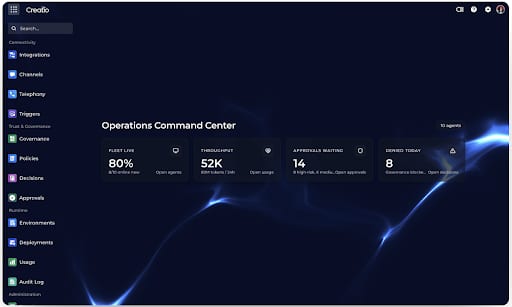
Creatio AI Studio's Operations Command Center provides a single view that addresses the observability problem. It enables organizations to monitor agent activity, execution history, triggers, and outcomes. The Command Center also shows how many agents are online, throughput and token consumption, approvals awaiting review, and the actions the governance layer blocked that day.
For agents built with Coding Agent, the platform also tracks run-completion rates, latency percentiles, AI-action consumption, and tool-call volume, giving teams visibility into both agent performance and costs.
Governance and Trust Built into the Platform

Creatio AI Studio uses four types of guardrails under the Creatio AI Trust Framework, designed to help organizations scale AI agents while maintaining security, governance, transparency, and control.
- Data privacy and security. LLM requests are processed within the organization’s cloud environment alongside its data, rather than being routed through public AI services. Data is encrypted in transit and at rest, used only as context for the interaction, and never incorporated into model training or shared across tenants. Role-based access controls ensure that agents can access only the data and resources they are authorized to use.
- Clear governance and accountability. Creatio manages safeguards at the platform level, including approved models, pre-deployment testing, and system-wide usage controls. Organizations remain in control of how AI is used within their business: they can select or bring their own models, define access and usage policies, set budgets and approval workflows, and approve agents before they enter production.
- Transparency and human oversight. The Command Center records who used what, when, and why; an "Explain" function surfaces an agent's reasoning and source context, and human-in-the-loop approvals keep humans in control for high-stakes decisions.
- Retrieval and grounding. Agents formulate answers grounded in approved knowledge bases rather than model’s general knowledge, providing a specific source of information.
The framework supports enterprise compliance requirements, including GDPR, HIPAA, and SOC 2. And because every agent — including a personal AI Twin — inherits the exact role-based access of the person or team it acts for and logs every decision, scaling the number of agents does not introduce new gaps in the security model.
A Practical Governance Checklist for Scaling AI Agents
Before expanding an agent program, project and PMO leaders can use the following checklist to confirm the fundamentals to scale AI agents responsibly are in place.
- Inventory. Do you have a current list of every agent in operation, including those built informally?
- Access. Does each agent operate under defined, least-privilege permissions rather than broad access?
- Ownership. Is it clear who owns each agent and who signs off before it reaches production?
- Approvals. Are high-impact actions gated by human-in-the-loop review, whether selective or mandatory?
- Grounding. Do agent answers draw from an approved knowledge base and cite their sources?
- Observability. Can you see agent activity, performance, and cost at the fleet level in real time?
- Audit. Is every agent’s decision logged and traceable to a user?
- Budget. Are usage budgets and rate limits set, with alerts before thresholds are reached?
- Data residency. Do you know where your data and models run, and that they are not routed to public services?
Any item without a confident answer is a gap worth closing before adding more agents, not after.
How to Roll Out Agents at Scale: A Staged Framework
Scaling agents is best treated as an operational discipline, with a staged sequence that keeps control ahead of growth.
- Set governance standards first. Define access rules, approval workflows, budgets, and oversight while the number of agents is still manageable. Retrofitting governance onto a sprawling fleet is far harder.
- Consolidate onto one platform. Building, running, and monitoring agents in a single governed environment is what converts a set of experiments into a managed system. This is the function Creatio AI Studio is designed for — its managed-agents, runtime, and governance areas cover each of these stages in one place.
- Begin with assistive use cases. Start where the agent recommends, and a person decides — status reporting, risk flagging, intake triage — on high-visibility project workflows. Establish reliability before granting autonomy. AI Studio's human-in-the-loop approvals support this assistive-first mode.
- Graduate autonomy as trust is proven. Expand each agent's latitude deliberately, keeping human checkpoints on high-impact actions. In AI Studio, permission inheritance and full decision logs make this safe to do incrementally.
- Measure from the outset. Stand up fleet-level observability of performance and cost immediately. Creatio AI Studio's Operations Command Center provides this view — agents online, throughput, approvals, and cost — from day one.
Knowing When Your Organization is Ready
A useful signal that it is time to move from ad hoc agents to a management platform is when any of the following becomes true: agents exist in more than one or two teams, agents are beginning to touch regulated or sensitive data, no single person can account for what all of them do, or AI costs have started to appear without a clear owner. At that point, the question is no longer whether to adopt a platform but how quickly the existing sprawl can be brought under management.
Creatio AI Studio is structured around this transition, combining a governed foundation, end-to-end lifecycle management, and fleet-level visibility in a single environment. For organizations moving from a handful of agents to a managed fleet, that combination is what brings the control, transparency, and accountability that operating at scale requires.

