



Moxo vs. Process Street: Vergleich & Expertenbewertungen im Jahr 2026



A workflow can look perfectly organized in a document and still fall apart in practice. Tasks get skipped, approvals arrive late, and teams discover during an audit that the documented process and the one people actually followed were two different things.
Moxo and Process Street are workflow automation platforms, but they approach automation differently. Moxo orchestrates work across employees, external stakeholders, AI agents, and connected systems. Process Street operates as a compliance operations platform, connecting policies and SOPs to controlled execution, monitoring, and audit-ready evidence.
In this detailed comparison, I’ve evaluated Moxo and Process Street to help you decide which tool better fits your workflow automation needs.
Moxo vs. Process Street: An Overview
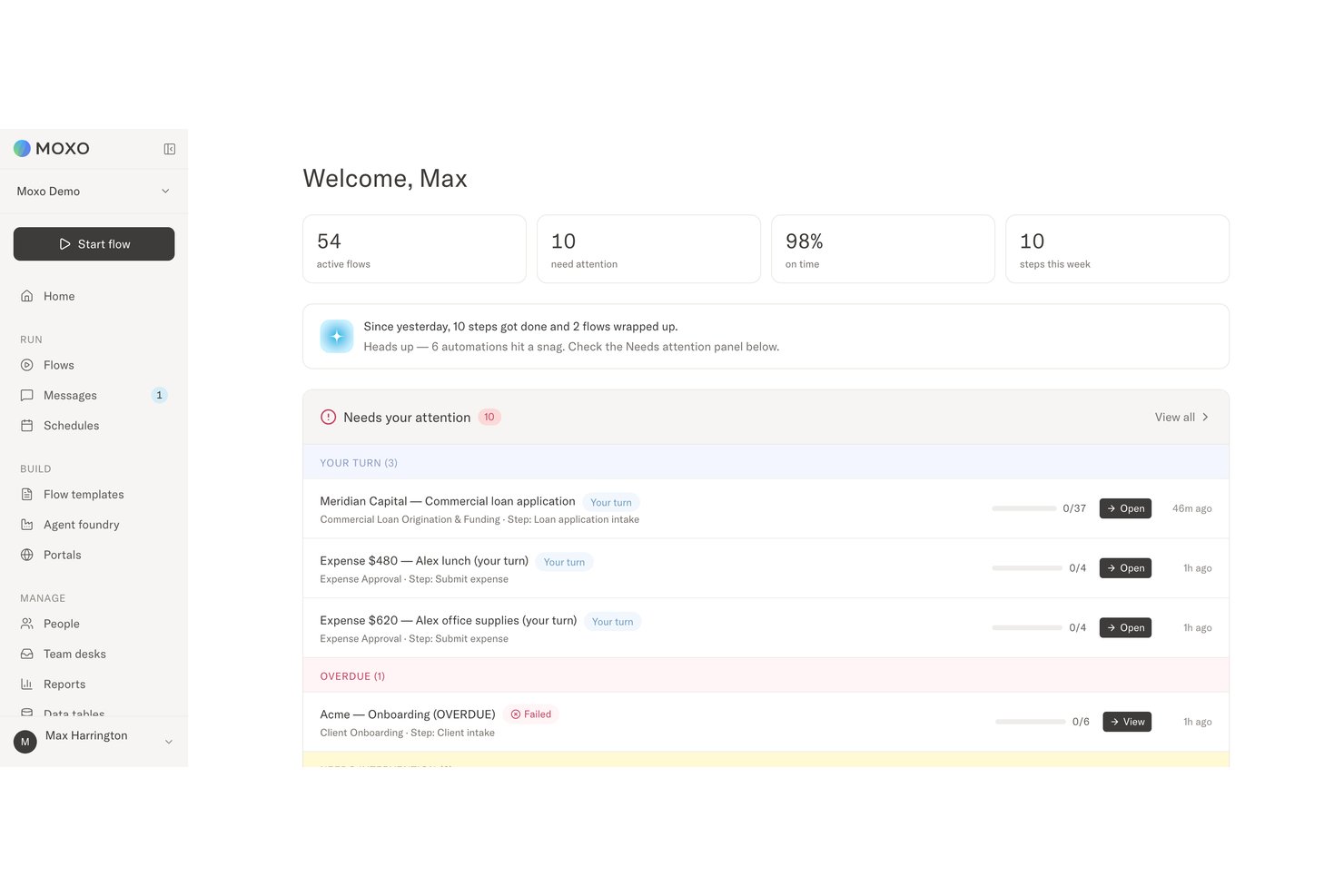
Moxo
Process Street

Warum Sie unseren Software-Empfehlungen vertrauen können
Unser Team testet und bewertet Software seit 2012. Als Projektmanager wissen wir selbst, wie schwierig – und wichtig – es ist, die richtige Software auszuwählen.
Für diesen Leitfaden haben wir Tools mithilfe von praktischen Tests und unabhängiger Recherche bewertet und dabei unsere Bewertungskriterien angewendet. Zudem greifen wir auf Erkenntnisse von Branchenvordenkern und praktizierenden Projektmanagement-Experten zurück.
Unsere Bewertungen spiegeln unser menschliches redaktionelles Urteilsvermögen wider, keine Verkaufsstrategie.
Expertenprüfer:
Moxo vs. Process Street Pricing Comparison
| Moxo | Process Street | |
|---|---|---|
| Free Trial | Free demo available | Free demo available |
| Pricing | From $5,000/year (billed annually) | Pricing upon request |
Moxo vs. Process Street Preise & Versteckte Kosten
Moxo veröffentlicht Preise für Free, Business und Pro, während für Enterprise ein individuelles Angebot erstellt wird. Die Kosten steigen, wenn Teams mehr Flows und KI-Kredite benötigen oder für eigene Portale, Supervisor-Agents, APIs, SSO und Prüfprotokolle in höhere Stufen wechseln. Process Street setzt auf angebotsbasierte Tarife für Startup, Pro und Enterprise, wobei Nutzeranzahl, Gäste, Automatisierungsvolumen, API-Nutzung, Speicherplatz, Berichterstattung, Sicherheit und Support Einfluss auf die Kosten haben.
Moxo ist bei der Kostenschätzung im Voraus einfacher, obwohl die erweiterten Orchestrierungs- und Governance-Funktionen in höheren Tarifstufen liegen. Process Street bietet möglicherweise mehr Flexibilität für größere Implementierungen, jedoch ist der endgültige Preis durch das Angebotsmodell schwerer vorherzusagen. Beide Systeme können zudem Zusatzkosten für Implementierung, Integrationen, Schulung, Managed Workflows oder erhöhten Nutzungsumfang verursachen.
Moxo vs. Process Street Feature Comparison
<div class="slate-p slate-selectable" data-slate-node="element" data-block-id="PqIaQgfEDU" data-slate-fragment="JTVCJTdCJTIyY2hpbGRyZW4lMjIlM0ElNUIlN0IlMjJ0ZXh0JTIyJTNBJTIyTW94byUyMGFuZCUyMFByb2Nlc3MlMjBTdHJlZXQlMjBib3RoJTIwY292ZXIlMjB3b3JrZmxvdyUyMGF1dG9tYXRpb24lMjBlc3NlbnRpYWxzJTJDJTIwaW5jbHVkaW5nJTIwdGFza3MlMkMlMjBhcHByb3ZhbHMlMkMlMjB0ZW1wbGF0ZXMlMkMlMjBmb3JtcyUyQyUyMGNvbmRpdGlvbmFsJTIwcm91dGluZyUyQyUyMHJlbWluZGVycyUyQyUyMGRvY3VtZW50JTIwaGFuZGxpbmclMkMlMjBhbmQlMjBwcm9jZXNzJTIwdHJhY2tpbmcuJTIwQm90aCUyMGhlbHAlMjBzdGFuZGFyZGl6ZSUyMHJlcGVhdGFibGUlMjB3b3JrJTIwYW5kJTIwcmVkdWNlJTIwbWFudWFsJTIwZm9sbG93LXVwcy4lMjIlN0QlNUQlMkMlMjJ0eXBlJTIyJTNBJTIycCUyMiUyQyUyMmlkJTIyJTNBJTIyZmJUakJJbTlzMiUyMiU3RCUyQyU3QiUyMmNoaWxkcmVuJTIyJTNBJTVCJTdCJTIydGV4dCUyMiUzQSUyIlRoZSUyMGRpZmZlcmVuY2UlMjBpcyUyMHRoZSUyMHR5cGUlMjBvZiUyMGNvbXBsZXhpdHklMjBlYWNoJTIwaGFuZGxlcyUyMGJlc3QuJTIwTW94byUyMGNvbWJpbmVzJTIwYSUyMG5vLWNvZGUlMjB3b3JrZmxvdyUyMGJ1aWxkZXIlMkMlMjBBZ2VudCUyMEZvdW5kcnklMkMlMjBjdXN0b20lMjBjbGllbnQlMjB3b3Jrc3BhY2VzJTJDJTIwU0xBJTIwZXNjYWxhdGlvbnMlMkMlMjBodW1hbi1pbi10aGUtbG9vcCUyMGNvbnRyb2xzJTJDJTIwYW5kJTIwaW1tdXRhYmxlJTIwYXVkaXQlMjB0cmFpbHMlMjBmb3IlMjBtdWx0aS1wYXJ0eSUyMHByb2Nlc3Nlcy4lMjBQcm9jZXNzJTIwU3RyZWV0JTIwY29tYmluZXMlMjBuby1jb2RlJTIwd29ya2Zsb3dzJTJDJTIwZ292ZXJuZWQlMjBwb2xpY2llcyUyMGFuZCUyMFNPUHMlMkMlMjBDb3JhJTIwQUklMjBtb25pdG9yaW5nJTJDJTIwZW5mb3JjZWQlMjB0YXNrJTIwb3JkZXIlMkMlMjBjb25kaXRpb25hbCUyMGxvZ2ljJTJDJTIwYW5kJTIwYXVkaXQtcmVhZHklMjByZWNvcmRzJTIwZm9yJTIwY29tcGxpYW5jZSUyMG9wZXJhdGlvbnMuJTIyJTdEJTVE
| Moxo | Process Street | |
|---|---|---|
| API | ||
| Access Management | ||
| Analytics | ||
| Approval Workflows | ||
| Audit Trail | ||
| Batch Permissions & Access | ||
| Business Rules Mining | ||
| Compliance Tracking | ||
| Custom Reports | ||
| Customer Management | ||
| Data Export | ||
| Data Import | ||
| Document Management | ||
| External Integrations | ||
| Form Builder | ||
| Multi-User | ||
| Notifications | ||
| Process Modeling | ||
| Process Reporting | ||
| Project Management | ||
| Reports | ||
| Risk Assessment | ||
| Roadmapping | ||
| White-label | ||
| Workflow Management |
Moxo vs. Process Street Integrationen
| Integration | Moxo | Process Street |
|---|---|---|
| Slack | ✅ | ✅ |
| Microsoft Teams | ✅ | ✅ |
| Google Sheets | ✅ | ✅ |
| Salesforce | ✅ | ✅ |
| Dropbox | ✅ | ✅ |
| DocuSign | ✅ | ✅ |
| HubSpot | ✅ | ✅ |
| Jira | ✅ | ✅ |
| API | ✅ | ✅ |
| Zapier | ✅ | ✅ |
Beide Plattformen unterstützen verbreitete Geschäftsanwendungen über eingebaute Verbindungen, Zapier, Webhooks und APIs. Moxo nutzt Integrationen, um Daten und Aktionen in mehrstufigen Workflows zu koordinieren. Process Street verbindet eigene Abläufe mit Systemen zur Verwaltung von Richtlinien, Nachweisen und Compliance. Verbindungsarten und Tarifvoraussetzungen können variieren; Teams sollten daher bestätigen, welche Aktionen für jede App verfügbar sind.
Moxo vs. Process Street Sicherheit, Konformität & Zuverlässigkeit
| Faktor | Moxo | Process Street |
|---|---|---|
| Datenschutz | Nutzt eine mandantenfähige Architektur mit KMS-verschlüsseltem Speicher sowie Verschlüsselung bei der Übertragung und Speicherung. Private Cloud- und On-Premises-Bereitstellungen sind für Organisationen mit strengeren Anforderungen an die Datensouveränität ebenfalls verfügbar. | Verschlüsselt Web-Datenverkehr mit TLS 1.2 oder höher und speichert Daten mittels AWS RDS und S3. Die Infrastruktur umfasst Datenbankreplikation, Backups und Optionen für regionale Datenspeicherung. |
| Konformität & Datenschutz | Besitzt SOC 2 Typ II- und SOC 3-Zertifizierungen, wird regelmäßig von Dritten auditiert und verfügt über Kontrollen zur Unterstützung der DSGVO-Anforderungen. | Verfügt über SOC 2 Typ II- und ISO 27001-Zertifizierungen und unterstützt GDPR, CCPA, HIPAA mit BAA sowie AWS CIS-Anforderungen. |
| Identität & Zugriff | Unterstützt SAML 2.0 SSO und granulare, rollenbasierte Berechtigungen für Mitarbeitende, externe Stakeholder und KI-Agenten, damit Teams steuern können, wer Informationen einsehen, Aktionen durchführen oder Entscheidungen in jedem Schritt des Workflows treffen kann. | Bietet SSO, SCIM-Provisionierung, rollenbasierte Berechtigungen, Gastzugänge sowie Freigabekontrollen für Workflows, Ordner, Vorlagen und Prozessdaten. |
| Nachvollziehbarkeit | Erstellt unveränderliche Audit-Logs für Workflow-Aktionen, Freigaben, Ausnahmen, Zeitstempel und Verantwortliche mit Protokollen, die auf einen Aufbewahrungszeitraum von sieben Jahren oder mehr ausgelegt sind. | Zeichnet Aufgabenabschlüsse, Zuweisungen, Freigaben, Kommentare und Workflow-Aktivitäten auf und bietet so Compliance-Teams den Nachweis, dass vorgeschriebene Verfahren eingehalten wurden. |
| Zuverlässigkeit | Setzt auf geschichtete Netzwerk-, System- und physische Sicherheitskontrollen, regelmäßige Backups, externe Tests und flexible Bereitstellungsoptionen, um Workflow-Verfügbarkeit und Datenintegrität zu schützen. | Nutzt integrierte Redundanz, synchrone Datenbankreplikation, getrennte Backups, kontinuierliches Monitoring und Wiederherstellungsmaßnahmen, um Infrastrukturausfällen zu widerstehen. |
Beide Plattformen bieten starke Sicherheits- und Governance-Maßnahmen für die Workflow-Automatisierung in Unternehmen. Moxo wendet Berechtigungen und Verantwortlichkeiten auf Mitarbeitende, externe Teilnehmende und KI-Agenten an, mit unveränderlichen Protokollen für Entscheidungen und Eskalationen. Im Vergleich dazu bietet Process Street ein breiter dokumentiertes Konformitätsportfolio und legt den Schwerpunkt darauf, dass Richtlinien, Kontrollen und erforderliche Verfahren nachweislich eingehalten werden.
Moxo vs. Process Street Benutzerfreundlichkeit
| Faktor | Moxo | Process Street |
|---|---|---|
| Benutzeroberfläche | Bietet geführte Abläufe und individuelle Portale, sodass Mitarbeitende, Kundschaft, Liefernde und andere Teilnehmende nur die für sie relevanten Nachrichten, Dateien, Entscheidungen und Aktionen sehen. | Stellt Prozesse als strukturierte Aufgaben, Formulare, Freigaben und Checklisten dar, wodurch jeder erforderliche Schritt leicht nachvollzogen und abgeschlossen werden kann. |
| Onboarding | Ermöglicht die eigenständige Einrichtung mit Vorlagen, einem No-Code-Workflow-Builder oder mit hochgeladenen Dokumenten und Diagrammen; für größere Implementierungen steht eine geführte Einführung zur Verfügung. | Bietet Vorlagen, Tutorials und einen No-Code-Builder, der Teams hilft, einfache SOP- und Compliance-Workflows ohne großen technischen Aufwand zu starten. |
| Workflow-Erstellung | Der No-Code-Workflow-Builder generiert Rollen, Verzweigungslogik, Datenverweise, Fristen und Eskalationsregeln aus Prozessbeschreibungen, Dokumenten oder Diagrammen. Fortgeschrittene, mehrteilige und agentenbasierte Workflows erfordern dennoch sorgfältige Planung. | Teams können Prozesse mit Aufgabenverteilung, bedingter Logik, Freigaben, erzwungener Reihenfolge und dynamischen Fälligkeitsdaten über eine vertraute visuelle Oberfläche erstellen. |
| Laufende Unterstützung | Bietet In-App-Hilfe und eine Wissensdatenbank; Kundenerfolgs- und Entwicklungsunterstützung ist in höheren Tarifstufen verfügbar. | Stellt E-Mail- und Chat-Support bereit; höhere Pläne umfassen zusätzlich dediziertes Erfolgsteam, Schulungen, Prozessberatung und individuelle Integration. |
Aus Perspektive der Benutzerfreundlichkeit bietet Moxo eine geführte Erfahrung bei komplexen, mehrteiligen Workflows, mit individuellen Portalen und rollenspezifischen Aktionen, die Mitarbeitende sowie externe Stakeholder auf die nötigen Aufgaben fokussieren. Process Street ist schneller zu verstehen für Teams, die SOPs, Richtlinien und Compliance-Anforderungen in kontrollierte, schrittweise Workflows übertragen wollen. Für Organisationen mit verzweigter Logik, KI-Agenten und mehreren Teilnehmendengruppen kann der Funktionsumfang von Moxo den Mehraufwand wert sein, während Teams, die eine unkomplizierte Umsetzung von Compliance wünschen, mit Process Street einfacher durchstarten.
Moxo vs Process Street: Pros & Cons
Moxo
- Agentic AI handles preparation, validation, routing, and monitoring
- Custom portals keep external participants aligned
- Human-in-the-loop controls, SLA rules, and audit trails reinforce accountability
- Advanced workflow design requires an adjustment period
- Less common integrations may require Zapier, Composio, or APIs
- Reporting focuses on process operations rather than customizable BI
Process Street
- You can create workflows with its intuitive no-code builder, making setup a breeze.
- It offers customizable templates, helping your team standardize processes quickly.
- The checklist feature keeps your team organized and ensures nothing gets missed.
- Advanced users might find it lacks some complex automation options compared to other tools.
- It may require more customization for industry-specific needs.
- Some users feel the mobile app lacks the full functionality of the desktop version.
Best Use Cases for Moxo and Process Street
Moxo
- Professional Services Firms Accounting, legal, consulting, and marketing firms can manage client onboarding, document collection, approvals, and recurring service delivery.
- Financial Services and Insurance Banks, lenders, wealth managers, and insurers can coordinate applications, compliance checks, exception reviews, signatures, and client decisions.
- Healthcare Administration Healthcare organizations can manage provider credentialing, intake, document verification, acknowledgements, and approval-heavy processes.
- B2B SaaS Customer Operations Customer success and implementation teams can coordinate onboarding, account reviews, renewals, and service requests across customers and internal specialists.
- Real Estate and Construction Firms Moxo helps organize contracts, approvals, vendor requirements, project documentation, and communication between clients, brokers, contractors, and internal staff.
- Manufacturing and Logistics Operations Operations teams can use Moxo for vendor onboarding, order fulfillment, compliance checks, document requests, and other multi-party workflows.
Process Street
- Human Resources Streamline onboarding and training processes with customizable templates that ensure consistency.
- Finance Teams Maintain compliance and accuracy in routine tasks with easy-to-use checklists.
- IT Departments Implement and manage standard operating procedures without needing complex coding skills.
- Small Businesses Quickly set up workflows using the intuitive no-code builder, perfect for teams without IT support.
- Customer Support Ensure consistent responses and follow-ups with organized checklist features.
- Marketing Teams Manage campaign workflows efficiently with customizable templates and process tracking.
Wer sollte Moxo und wer sollte Process Street verwenden?
Wenn Sie eine Workflow-Automatisierung für komplexe Prozesse mit Mitarbeitenden, Kundschaft, Lieferanten, KI-Agenten und vernetzten Systemen benötigen, ist Moxo wahrscheinlich die bessere Wahl. Es eignet sich besonders für professionelle Dienstleistungen, Finanzdienstleistungen, das Gesundheitswesen und andere regulierte Branchen, die individuelle Kundenportale, nachvollziehbare Freigaben, Audit-Trails und menschliche Kontrolle benötigen.
Wenn Sie stattdessen eine Compliance-Operations-Plattform benötigen, um Richtlinien, Arbeitsanweisungen (SOPs) und wiederkehrende Aufgaben in gesteuerte Arbeitsabläufe zu verwandeln, könnte Process Street die stärkere Wahl sein. Sie eignet sich gut für HR-, Finanz-, IT-, Kundenservice- und Betriebsteams, die wiederverwendbare Vorlagen, eine festgelegte Aufgabenreihenfolge, bedingte Logik, das Sammeln von Nachweisen und den Beleg, dass erforderliche Verfahren tatsächlich durchgeführt wurden, benötigen.
Differences Between Moxo and Process Street
| Moxo | Process Street | |
|---|---|---|
| AI Agent Architecture | Uses Agent Foundry to create agents for preparation, validation, review, routing, and monitoring, with supervisor agents able to review outputs and escalate exceptions to humans. | Uses Cora to generate workflows, monitor execution, enforce controls, flag risks, and identify missing or delayed compliance steps. |
| Decision Governance | Keeps people accountable for approvals, exceptions, compliance sign-offs, and other judgment calls, while recording decisions, participants, context, and timestamps in immutable audit trails. | Connects policies to operational workflows, requiring evidence, tracking control completion, flagging risks, and maintaining audit histories to demonstrate that required procedures were followed. |
| External Participant Experience | Provides custom portals configured for clients, vendors, partners, and other participants, with access to relevant messages, files, resources, and assigned actions through accounts or magic links. | Supports external participation through guests, shared forms and pages, task assignments, and workflow run links, but offers a less specialized workspace experience. |
| Primary Workflow Scope | Orchestrates complex processes across employees, external stakeholders, AI agents, and connected systems, while keeping people accountable for critical decisions. | Connects policies, SOPs, approvals, and recurring operations to controlled workflows that enforce required steps and preserve audit evidence. |
| Workflow Design Model | Its no-code workflow builder generates structured flows from plain-language descriptions, documents, or diagrams, including roles, branching, data references, deadlines, human actions, AI agents, and escalation rules. | Generates workflows from process descriptions or documents, then lets users refine tasks, forms, approvals, assignments, conditional logic, enforced order, and dynamic due dates. |
| Visit MoxoOpens new window | Read Process Street ReviewOpens new window |
Similarities Between Moxo and Process Street
| Automation and Notifications | Both route work based on conditions, trigger follow-up actions, enforce deadlines, and notify participants when tasks, submissions, or decisions need attention. |
|---|---|
| Forms and Data Collection | Both collect structured information, questionnaires, files, and supporting evidence at specific workflow stages rather than relying on scattered emails. |
| Integrations and Extensibility | Both connect with third-party business systems and support Zapier and APIs for transferring data and triggering actions across a broader software stack. |
| Reusable Workflow Templates | Both let teams create and reuse standardized templates for recurring processes such as onboarding, service delivery, reviews, and compliance checks. |
| Task and Approval Management | Both support assigned tasks, due dates, approval steps, role-based ownership, and structured handoffs to keep workflows moving with clear accountability. |
| Visit MoxoOpens new window Read Process Street ReviewOpens new window | |