

10 bedste projektstyringssoftwareløsninger til professionelle servicevirksomheder udvalgt til 2026

Projektstyringssoftware til professionelle servicevirksomheder – kortliste


Projektstyringssoftware til professionelle servicevirksomheder hjælper dit team med at planlægge, følge og levere kundeprojekter, samtidig med at I administrerer ressourcer, budgetter og tidsplaner ét sted. Hvis du leder efter den rigtige platform, balancerer du sandsynligvis skiftende kundekrav, kompleks fakturering og behovet for indsigt i realtid på tværs af flere projekter.
Den rigtige software kan hjælpe dig med at koordinere arbejdet på tværs af teams, holde interessenter afstemt og sikre, at intet falder mellem to stole. På denne liste finder du et udvalgt sortiment af værktøjer, der er udviklet specifikt til professionelle servicevirksomheder, så du kan sammenligne funktioner og vælge den løsning, der passer bedst til din virksomhed.
Why Trust Our Software Recommendations
Our team has been testing and reviewing software since 2012. As project managers ourselves, we know how difficult—and important—it is to choose the right software.
For this guide, we evaluated tools using hands-on testing and independent research, scoring tools using our selection criteria. We also draw on insights from industry thought leaders and practicing project management experts.
Our reviews reflect our human editorial judgment, not a sales pitch.
Expert reviewers:
Sammenligningstabel for projektstyringssoftware til professionelle servicevirksomheder
Denne sammenligningstabel opsummerer prisoplysninger for mine bedste udvalg af projektstyringssoftware til professionelle servicevirksomheder:
| Tool | Best For | Trial Info | Price | ||
|---|---|---|---|---|---|
| 1 | Best for multi-project visibility | 14-day free trial + free demo available | From $8/user/month (billed annually) | Website | |
| 2 | Best for professional services analytics | 21-day free trial + free demo available | From $17.10/user/month (billed annually) | Website | |
| 3 | Best for client collaboration features | 14-day free trial + free demo available | From $9.99/user/month (billed annually) | Website | |
| 4 | Best for real-time project tracking | 30-day free trial | From $15/user/month (billed annually) | Website | |
| 5 | Best for government contracting compliance | Free demo available | Pricing upon request | Website | |
| 6 | Best with software development integrations | Free plan available | From $7.91/user/month | Website | |
| 7 | Best for all-in-one business management | 14-day free trial + free demo available | From $19.90/user/month (billed annually) | Website | |
| 8 | Best for resource forecasting accuracy | Free demo available | Pricing upon request | Website | |
| 9 | Best for agency resource planning | 14-day free trial + free demo available | From $10/user/month (billed annually) | Website | |
| 10 | Best for time and billing management | Free demo available | From $20/user/month | Website |

Anmeldelser af projektstyringssoftware til professionelle servicevirksomheder
Nedenfor finder du mine detaljerede opsummeringer af den projektstyringssoftware til professionelle servicevirksomheder, der kom med på min kortliste. Mine anmeldelser giver et detaljeret indblik i funktionerne, de bedste anvendelsesområder og integrationerne for hver platform, så du kan finde den bedste løsning til dit team.

Workzone
Best for multi-project visibility

Workzone is designed for teams that need to manage multiple projects at once without losing sight of deadlines or priorities. It’s especially useful for professional services firms juggling client work across departments or business units. With its project dashboards and cross-project reporting, Workzone helps you keep every project visible and on track.
Why I Picked Workzone
Unlike many project management tools, Workzone is built to give you a clear, real-time view across all your projects at once. I picked Workzone because its multi-project dashboards let professional services teams monitor progress, deadlines, and workloads without toggling between separate project spaces.
The platform’s portfolio-level reporting and workload views help you spot bottlenecks and balance resources across clients or departments. For teams managing several projects in parallel, Workzone’s visibility features make it easier to keep everything organized and moving forward.
Workzone Key Features
Some other features that make Workzone useful for professional services teams include:
- Task Dependencies: Set up task relationships to manage project sequencing and handoffs.
- Document Sharing and Versioning: Store, share, and track changes to project files within the platform.
- Automated Project Templates: Create and reuse templates for recurring client projects or deliverables.
- Time Tracking: Log hours directly on tasks to monitor project effort and support client billing.
Workzone Integrations
Integrations include Slack, Google Drive, Dropbox, Box, Microsoft Outlook, Microsoft Excel, Microsoft Word, Microsoft PowerPoint, SharePoint, and many more.
Pros and Cons
Pros:
- Automated templates standardize recurring client projects
- Task dependencies support structured project workflows
- Multi-project dashboards show portfolio-wide project progress
Cons:
- No built-in resource forecasting tools
- Limited integrations with financial systems
New Product Updates from Workzone

Workzone Enterprise Adds Multi-Stage Approval Workflows
Workzone Enterprise now includes Approval Workflows, enabling multi-stage document approvals to standardize complex processes and reduce manual effort. For more information, visit Workzone's official site.
 .
.
Best for professional services analytics

ProjectWorks is designed for professional services firms that need deep analytics across projects, people, and financials. It’s especially useful for consultancies and agencies that want to connect project delivery with business performance in real time. With its unified analytics and forecasting tools, ProjectWorks helps you spot trends, manage resources, and make data-driven decisions across your portfolio.
Why I Picked ProjectWorks
Analytics is where ProjectWorks really sets itself apart for professional services teams. I picked ProjectWorks because it brings together project, resource, and financial data into a single analytics dashboard, making it easier to track performance and profitability.
Real-time reporting and forecasting tools let you drill into utilization, revenue, and pipeline metrics without exporting data to spreadsheets. For firms that need to connect delivery metrics with business outcomes, ProjectWorks offers the analytics depth and flexibility that’s often missing from other project management tools.
ProjectWorks Key Features
Some other features that make ProjectWorks useful for professional services teams include:
- Resource Scheduling Board: Visualize and assign resources to projects using a drag-and-drop interface.
- Leave and Time Off Management: Track staff availability and manage leave requests directly within the platform.
- Invoice Generation: Create, send, and track invoices linked to project milestones and deliverables.
- Customizable Project Templates: Standardize project setup with reusable templates tailored to your workflows.
ProjectWorks Integrations
Integrations include Xero, QuickBooks, MYOB, HubSpot, Salesforce, 12d Synergy, Jira, Azure DevOps, Employment Hero, and Data Connection.
Pros and Cons
Pros:
- Invoice creation links directly to project milestones
- Resource planning includes future pipeline visibility
- Analytics dashboards combine project and financial performance data
Cons:
- Integration setup can require vendor assistance
- Gantt chart functionality is limited

Teamwork
Best for client collaboration features

Agencies and client-facing teams often turn to Teamwork for its advanced client collaboration features. The platform is designed for professional services firms that need to manage projects while keeping clients in the loop. With built-in client access controls and communication tools, Teamwork helps you centralize feedback and approvals without losing project momentum.
Why I Picked Teamwork
For professional services teams that need to keep clients engaged throughout a project, Teamwork stands out for its client collaboration features. I picked Teamwork because it lets you grant clients controlled access to project spaces, so they can review progress, leave feedback, and approve deliverables without seeing sensitive internal details.
The platform’s built-in client communication tools, like project-specific messaging and file sharing, help centralize all client interactions in one place. This setup makes it easier to manage expectations and maintain transparency with clients from kickoff to project close.
Teamwork Key Features
Some other features that make Teamwork useful for professional services teams include:
- Task Dependencies: Set up and manage task relationships to control project flow.
- Time Tracking: Track billable and non-billable hours directly within each project.
- Invoice Generation: Create and send invoices based on tracked time and project milestones.
- Portfolio Management: View and manage multiple projects across your organization from a single dashboard.
Teamwork Integrations
Integrations include Slack, Google Drive, Dropbox, HubSpot, QuickBooks, Xero, Zapier, Microsoft Teams, Outlook, and Trello.
Pros and Cons
Pros:
- Task templates simplify repeatable service project processes
- Built-in time tracking connects directly to invoicing workflows
- Client access permissions support transparent collaboration
Cons:
- Mobile notifications can be inconsistent
- Resource scheduling lacks advanced forecasting features

Best for real-time project tracking

ProjectManager gives teams live visibility into project progress, making it a strong fit for organizations that need up-to-the-minute updates. It’s especially useful for project managers overseeing distributed teams or juggling multiple deadlines. With real-time dashboards and automated status updates, ProjectManager helps you spot issues and adjust plans quickly.
Why I Picked ProjectManager
What sets ProjectManager apart is its focus on real-time project tracking, which is essential for professional services teams managing fast-moving projects. I picked ProjectManager because its live dashboards and instant status updates let you monitor progress and spot bottlenecks as they happen.
The platform’s automated alerts and activity feeds keep everyone aligned, even when teams are distributed or working across time zones. This level of visibility helps project managers make quick, informed decisions and keep projects moving forward.
ProjectManager Key Features
Some other features that make ProjectManager useful for professional services teams include:
- Gantt Chart Planning: Build and adjust project timelines with drag-and-drop Gantt charts.
- Resource Management: Allocate team members and track their workload across multiple projects.
- Document Sharing: Store, organize, and share project files directly within the platform.
- Timesheet Tracking: Log and approve time entries for accurate project billing and reporting.
ProjectManager Integrations
Integrations include Microsoft Teams, Slack, Jira, MS Project, Power BI, Acumatica, Excel, Azure DevOps, Google, and OneDrive.
Pros and Cons
Pros:
- Resource management tools track team workload across projects
- Drag-and-drop Gantt charts simplify schedule adjustments
- Real-time dashboards provide instant project status visibility
Cons:
- Reporting customization options are limited
- No built-in client portal for external collaboration

Deltek
Best for government contracting compliance
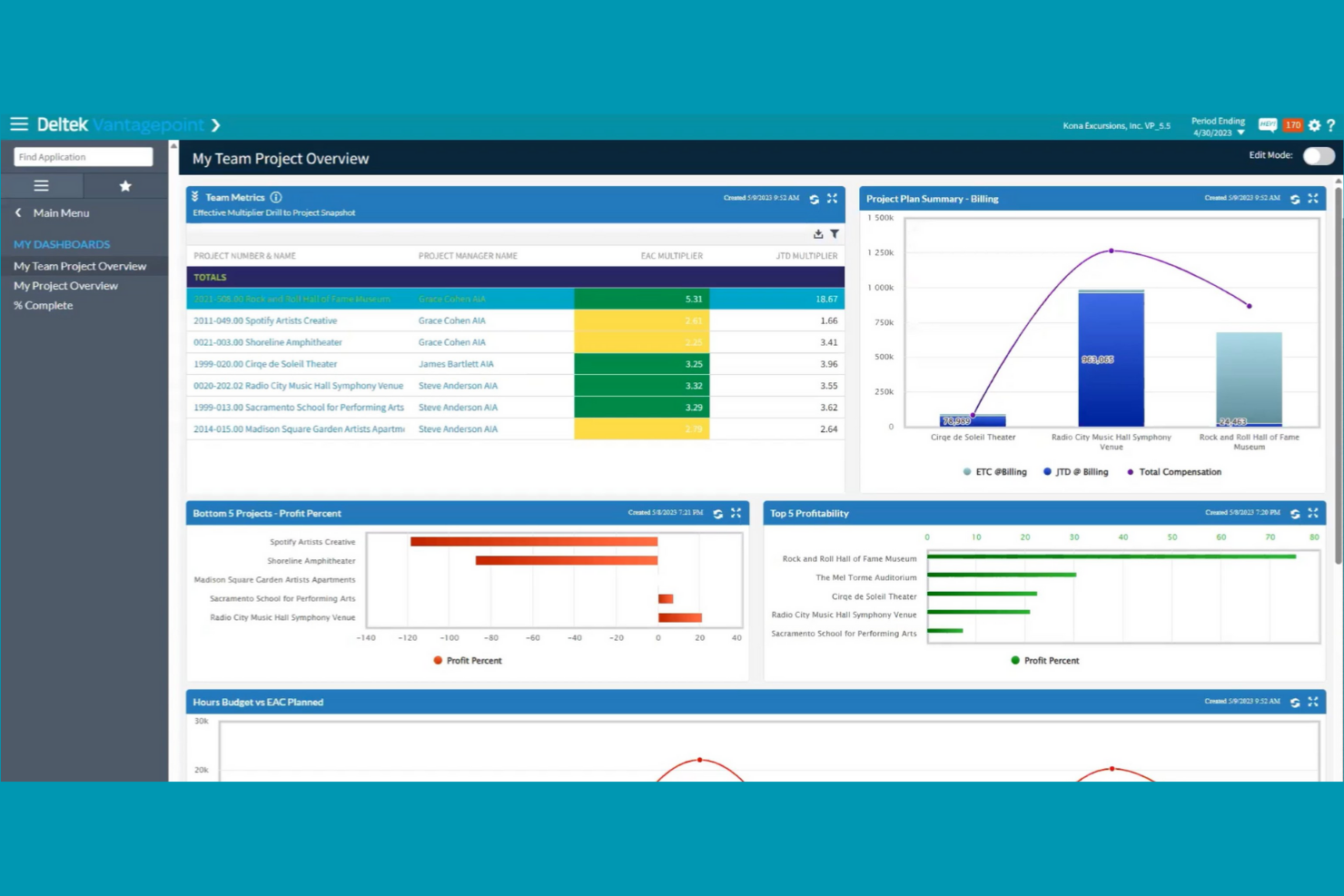
Deltek is purpose-built for firms that need to manage projects while meeting strict government contracting requirements. It’s especially relevant for professional services organizations working with federal, state, or local agencies that must follow compliance standards like DCAA or FAR. Deltek helps you handle project accounting, timekeeping, and reporting with features designed to support audit readiness and contract oversight.
Why I Picked Deltek
Unlike most project management platforms, Deltek is designed specifically to address the compliance needs of government contractors. I picked Deltek because it offers built-in support for DCAA audits, FAR regulations, and other government standards that professional services firms must follow when working with public sector clients.
Features like automated cost allocation and contract-specific reporting help teams stay audit-ready and avoid compliance pitfalls. For organizations that can’t afford to risk non-compliance, Deltek’s focus on regulatory requirements makes it a strong fit.
Deltek Key Features
In addition to its compliance-focused capabilities, Deltek offers several other features for professional services teams:
- Resource Planning: Allocate staff and track utilization across multiple projects.
- Integrated CRM: Manage client relationships and capture project opportunities within the same platform.
- Document Management: Store, organize, and control access to project files and contracts.
- Mobile Time and Expense Entry: Submit timesheets and expenses from any device.
Deltek Integrations
Integrations include tools such as Microsoft Project, QuickBooks, Salesforce, SAP, Oracle, IBM, Adobe, Google Workspace, Slack, and Trello.
Pros and Cons
Pros:
- Resource planning tools manage staffing across projects
- Automated cost allocation supports compliant project billing
- DCAA-compliant timekeeping supports government contract requirements
Cons:
- Customization often requires vendor support
- Reporting tools require specialized training

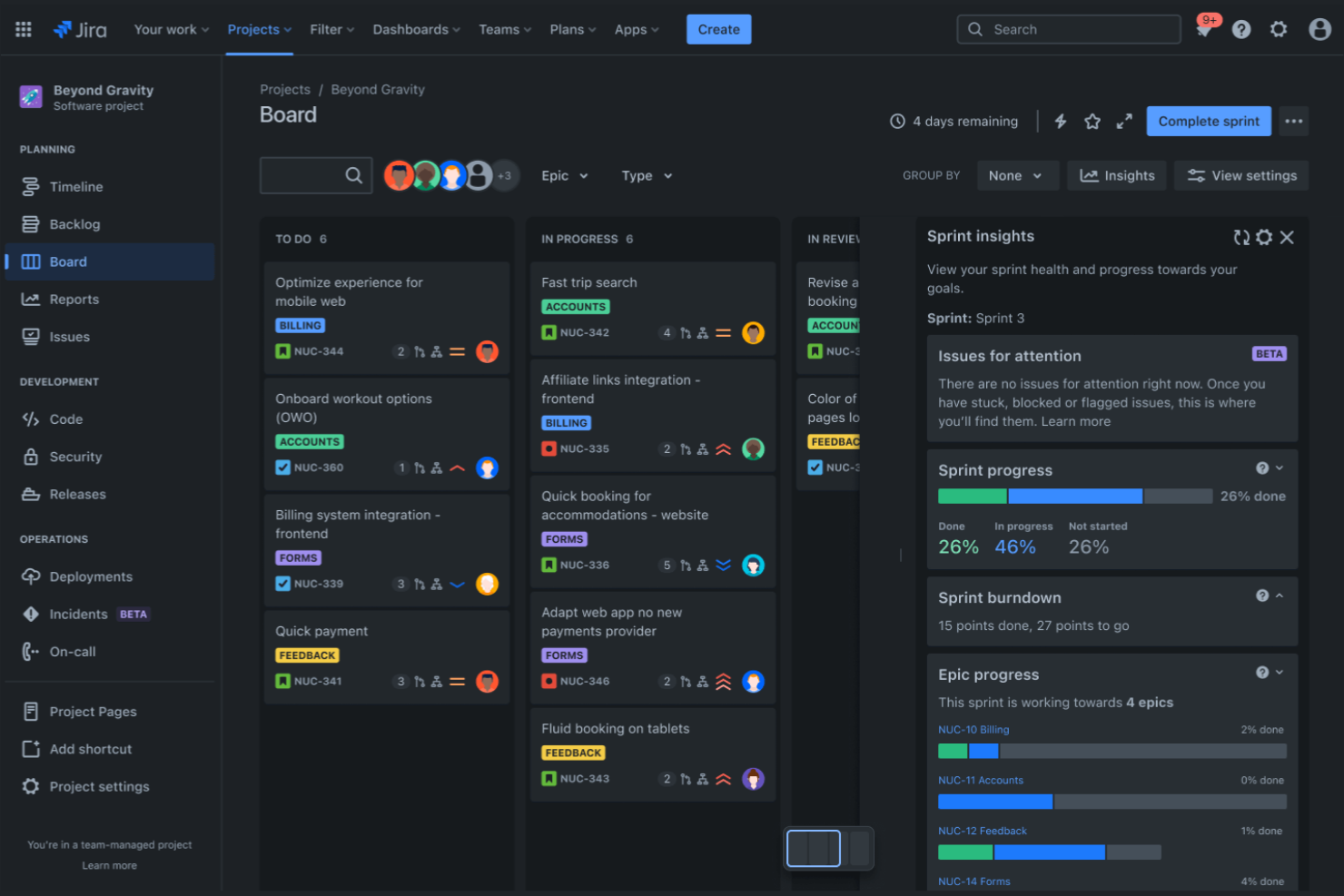
Jira brings together a suite of tools designed for teams that need deep integration with software development workflows. It’s a strong fit for IT consultancies, digital agencies, and professional services firms that manage technical projects alongside client deliverables. With features that connect project tracking, code repositories, and deployment pipelines, Jira helps you coordinate work across technical and non-technical teams.
Why I Picked Jira
What sets Jira apart is its ability to connect project management directly with software development tools. I picked Jira because it lets you link issues, tasks, and project milestones with code repositories and deployment pipelines.
Features like Jira’s Agile boards and Bitbucket’s code management help professional services teams keep technical and client-facing work in sync. For firms that deliver software or technical solutions, Jira’s ecosystem supports collaboration between project managers, developers, and stakeholders in one place.
Jira Key Features
Some other features that make Jira useful for professional services teams include:
- Advanced Permissions: Control access to projects, issues, and documentation at a granular level.
- Custom Workflows: Design and automate unique approval and task processes for each team or project.
- Knowledge Base Integration: Link project work to Confluence pages for easy documentation and reference.
- Time Tracking: Log and report on time spent across tasks and projects.
Jira Integrations
Integrations include Slack, GitHub, Microsoft Teams, Google Drive, Dropbox, Salesforce, Zoom, Trello, Asana, and GitLab.
Pros and Cons
Pros:
- Marketplace offers extensive add-ons for specialized workflows
- Issue linking connects development tasks to project milestones
- Agile boards support Scrum and Kanban project workflows
Cons:
- Email notifications can become overwhelming
- Reporting dashboards require manual setup


Scoro brings project management, billing, CRM, and reporting together in one platform for professional services teams. It’s a strong fit for agencies and consultancies that want to manage projects, finances, and client work without juggling multiple tools. Scoro helps you connect project delivery with business operations, so you can track everything from sales to invoicing in a single workspace.
Why I Picked Scoro
What sets Scoro apart is its ability to unify project management, billing, and CRM in one platform, making it a true all-in-one business management solution. I picked Scoro because it lets professional services teams handle project planning, time tracking, and invoicing without switching between different tools.
Features like built-in quoting and budgeting help you manage the entire client lifecycle, from sales to project delivery to billing. For teams that want to connect project work with business operations, Scoro’s integrated approach is especially valuable.
Scoro Key Features
Some other features that make Scoro useful for professional services teams include:
- Task Board View: Visualize and manage tasks using a drag-and-drop board layout.
- Calendar Integration: Sync project schedules and deadlines with Google Calendar and Outlook.
- Custom Dashboards: Build dashboards to track KPIs, project progress, and financial metrics.
- Automated Recurring Invoices: Set up and manage recurring billing for ongoing client work.
Scoro Integrations
Integrations include Google Calendar, Microsoft Exchange, QuickBooks, Xero, Stripe, Jira, HubSpot, Salesforce, Dropbox, and Zapier.
Pros and Cons
Pros:
- Custom dashboards track project and business performance metrics
- Built-in quoting and budgeting support project planning
- All-in-one platform connects project delivery and financial management
Cons:
- API access requires higher-tier plans
- Task dependency controls are limited for complex projects

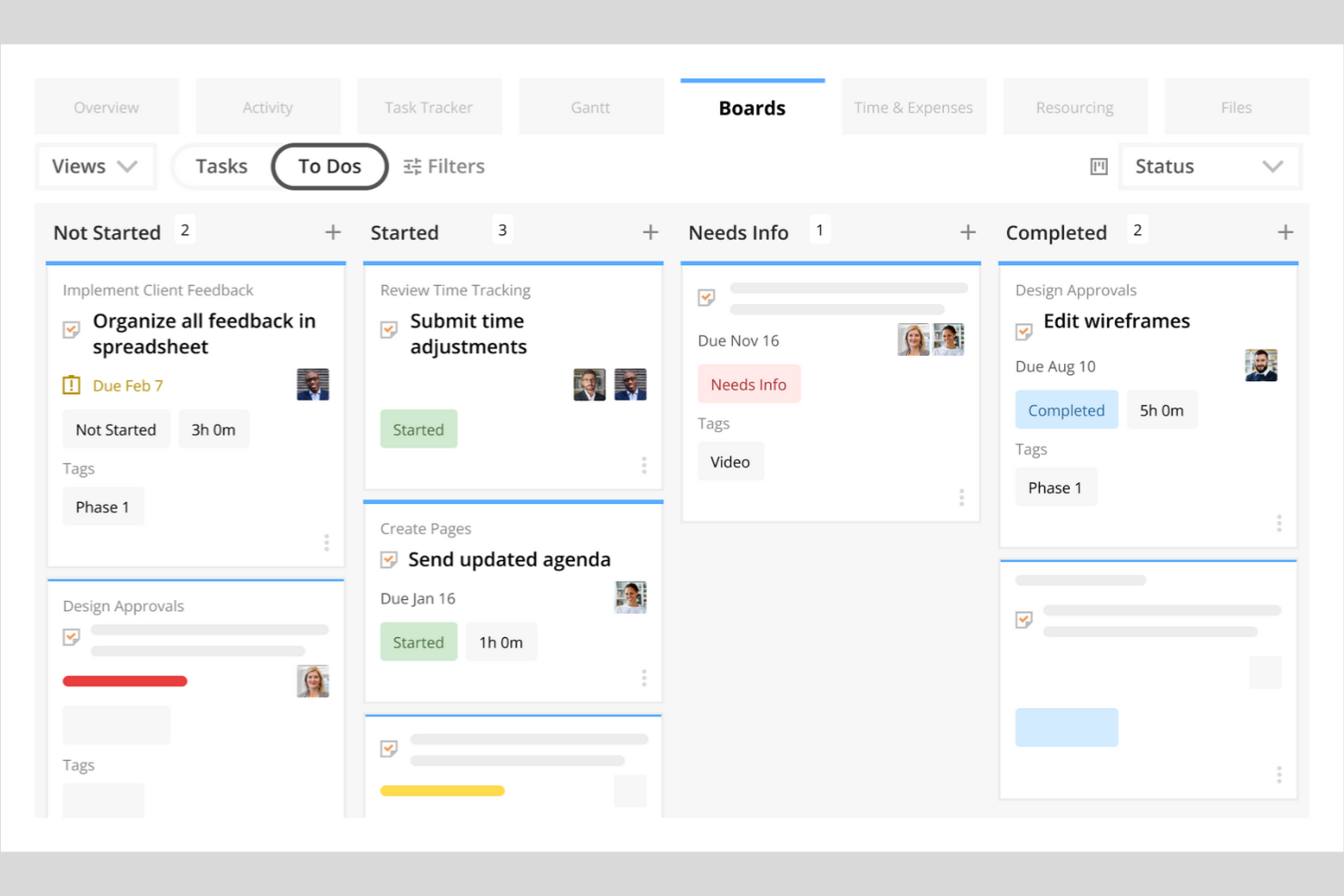
Kantata stands out for professional services organizations that need precise control over resource allocation and project staffing. It’s built for teams managing billable hours, shifting client demands, and complex project portfolios. With its advanced forecasting and utilization tools, Kantata helps you match the right people to the right projects and anticipate resourcing gaps before they impact delivery.
Why I Picked Kantata
Resource forecasting is a constant challenge for professional services teams, and Kantata addresses this with a level of accuracy that’s hard to match. I picked Kantata because its resource management engine lets you forecast demand, model different staffing scenarios, and visualize utilization rates across your entire portfolio.
The platform’s skills matching and capacity planning features help you assign the right people to the right projects, reducing both under- and over-allocation. For organizations where billable utilization and project staffing are business-critical, Kantata’s forecasting tools provide the visibility and control you need.
Kantata Key Features
Some other features that make Kantata valuable for professional services teams include:
- Project Accounting: Track budgets, expenses, and margins directly within each project workspace.
- Custom Reporting: Build and schedule tailored reports on project health, financials, and team performance.
- Client Collaboration Portal: Share project updates, files, and timelines with clients in a secure environment.
- Time and Expense Tracking: Capture billable hours and expenses at the task or project level for accurate invoicing.
Kantata Integrations
Integrations include Salesforce, Slack, Jira, HubSpot, Xero, QuickBooks, Expensify, Sage Intacct, Microsoft Teams, and Google Drive.
Pros and Cons
Pros:
- Project accounting tracks margins and project profitability
- Skills matching supports precise project staffing decisions
- Resource forecasting models future staffing demand
Cons:
- Interface changes can disrupt existing workflows
- Mobile app functionality is limited

Best for agency resource planning
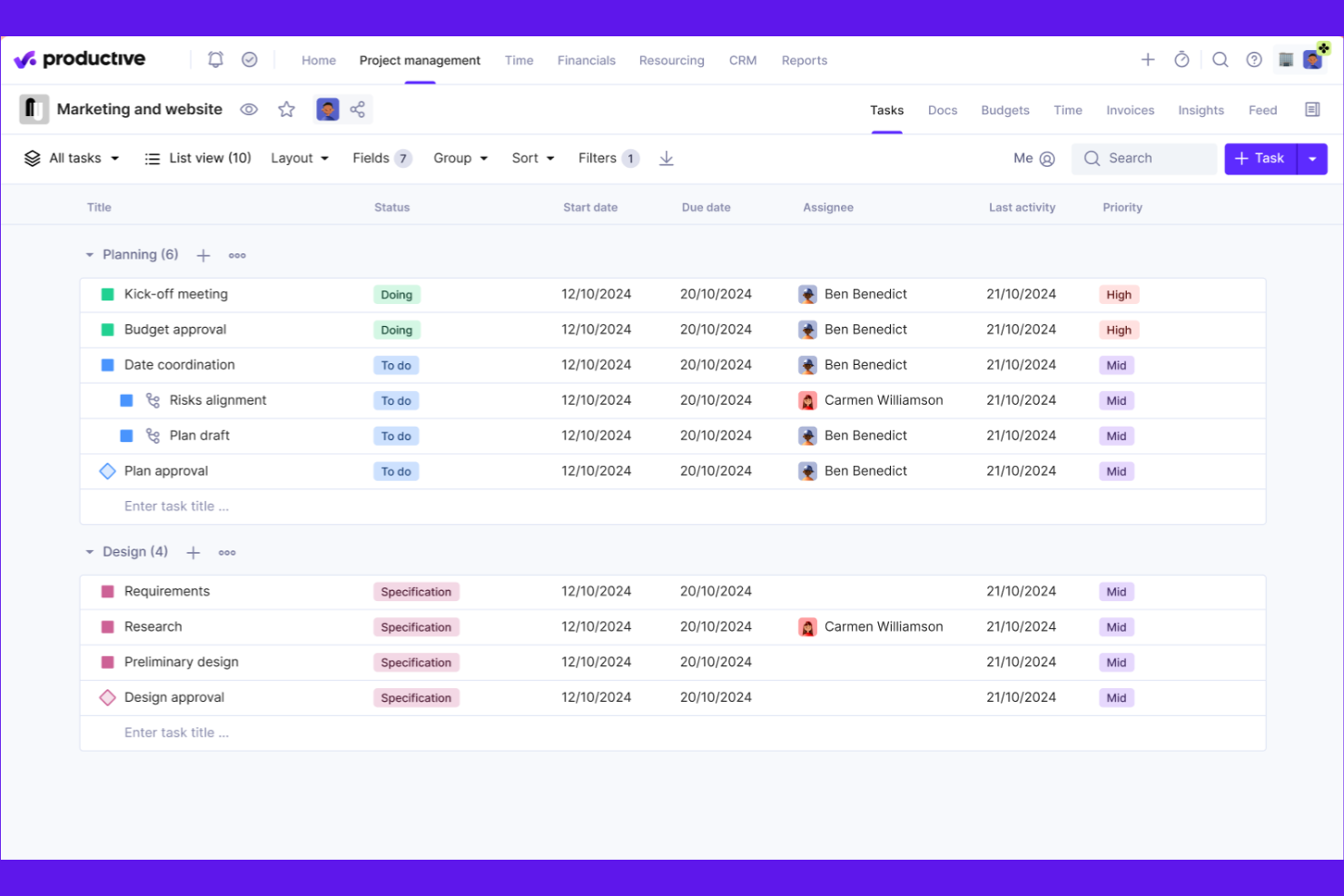
Productive is designed for agencies that need to manage resources, projects, and budgets in one place. It’s especially useful for teams balancing multiple client accounts and shifting workloads. With built-in forecasting and utilization tracking, Productive helps agencies optimize staffing and project delivery.
Why I Picked Productive
When it comes to agency resource planning, Productive offers a level of visibility and control that’s hard to match. I picked Productive because it combines resource scheduling, capacity planning, and real-time utilization tracking in one platform. The tool lets you forecast workloads, assign team members based on availability, and monitor billable hours across projects. This makes it easier for agencies to balance client demands, avoid overbooking, and keep projects on track.
Productive Key Features
In addition to its resource planning strengths, Productive offers several other features that support agency operations:
- Budget Management: Track project budgets, expenses, and profitability in real time.
- Client Portal: Share project updates, files, and invoices directly with clients.
- Custom Reporting: Build and schedule detailed reports on project and financial metrics.
- Task Collaboration: Assign tasks, set deadlines, and communicate with team members within each project.
Productive Integrations
Integrations include Jira, HubSpot, Xero, Google Calendar, Sage, Gmail, Microsoft Outlook, Slack, BugHerd, and QuickBooks.
Pros and Cons
Pros:
- Profitability tracking connects time, budgets, and expenses
- Forecasting tools improve resource planning accuracy
- Utilization dashboards visualize team workload in real time
Cons:
- Custom fields are limited on lower-tier plans
- No built-in Gantt chart for timeline planning
New Product Updates from Productive
Productive Adds Voice Dictation, Slack Connector, Proposals, and Overtime
Productive adds voice dictation, a Slack Connector, proposal controls, and overtime tracking. These updates support faster AI interactions, client proposals, and time management. For more information, visit Productive’s official site.

BigTime
Best for time and billing management

BigTime is built for professional services firms that need precise control over time tracking and billing. It’s especially useful for consultancies, accounting firms, and engineering teams that juggle multiple client projects and complex billing arrangements. With features for detailed timesheet entry, expense capture, and invoicing, BigTime helps you keep billable hours accurate and client billing transparent.
Why I Picked BigTime
When accurate time and billing management is a top priority, BigTime offers a focused solution for professional services teams. I picked BigTime because it lets you capture billable hours with detailed timesheets and automatically link them to client invoices.
The platform’s expense tracking tools help you manage reimbursable costs and keep project budgets on track. For firms that need to handle complex billing scenarios, BigTime’s flexible invoicing options make it easier to bill clients accurately and transparently.
BigTime Key Features
Some other features that make BigTime valuable for professional services teams include:
- Resource Allocation: Assign staff to projects based on availability and skill sets.
- Project Budgeting: Set and monitor project budgets to avoid overruns.
- Custom Reporting: Build tailored reports to analyze project and financial data.
- Workflow Automation: Automate approval processes for timesheets and expenses.
BigTime Integrations
Integrations include QuickBooks, Sage Intacct, Lacerte, Xero, NetSuite, Salesforce, HubSpot, Jira, BambooHR, and Zendesk.
Pros and Cons
Pros:
- Resource allocation dashboard visualizes staff availability
- Expense tracking connects directly to project invoices
- Detailed timesheets support accurate client billing
Cons:
- Project templates offer limited flexibility
- Gantt chart functionality is limited
Anden projektstyringssoftware til professionelle servicevirksomheder
Her er nogle yderligere muligheder inden for projektstyringssoftware til professionelle servicevirksomheder, som ikke kom med på min kortliste, men som stadig er værd at undersøge:
- Wrike
For customizable workflow automation
- Workday
With enterprise HR and finance integration
- SAP
With advanced financial reporting
- Certinia
For Salesforce-native project operations
- Asana
For structured project planning with intuitive task management and workflow automation
- monday.com
For highly visual work management with customizable project workflows
- ClickUp
For consolidating project management, documents, and team collaboration in one platform


How I Evaluate Project Management Software for Professional Services
I evaluate every tool in two layers: the baseline it must clear—billing models, resource capacity, and project financials—and the differentiators that make it the right fit.
Core Functionality (Table Stakes For This List)
When I'm selecting tools for my list, I rank each one on a scale from 0 (does not offer the functionality) to 5 (excels in this area) for each core functionality listed below. Then, I calculate the tool's total score into a percentage. Each tool needs to achieve a minimum total score of 65% to be considered for inclusion.
- Project Accounting & Billing: I check whether a tool supports the billing models services firms actually use—time-and-materials, fixed-fee, retainers—and how invoicing ties to logged work.
- Time & Expense Tracking: Consultants and delivery staff need to log hours against specific clients and tasks, so I look for tracking that maps cleanly to billable engagements.
- Resource Management: Staffing the right people across overlapping client projects is a constant challenge, and I evaluate how each tool handles capacity views and allocation.
- Project Financial Forecasting: I look at how well a platform tracks budgets, margins, and projected revenue per engagement—especially as scope shifts mid-project.
- Client Project Delivery: Whether it's Gantt charts, kanban boards, or milestone tracking, I evaluate the toolset available for managing deliverables from kickoff through sign-off.
- Reporting & Analytics: Services leaders care about utilization rates and project profitability, so I look for reports that surface those KPIs without heavy manual setup.
Once I have a list of tools that meet the criteria, I consider what sets each platform apart.
Differentiating Factors (What Sets Vendors Apart)
Here's how I compare and contrast different vendors:
Standout Features
Skills and competency matching is a big differentiator—when you're staffing a new engagement, filtering by certifications, industry experience, or language skills saves hours of back-and-forth with resource managers. I also look at whether a platform offers client portals, since giving clients real-time visibility into project status cuts down on recurring status meetings. Revenue recognition automation matters too, especially for firms juggling mixed billing models across dozens of active engagements where manual tracking invites errors.
Beyond Features
Integration depth matters a lot here—I check whether a platform connects natively to accounting systems like QuickBooks or NetSuite, because broken financial sync between your PSA and general ledger creates reconciliation headaches at month-end. Firm size fit is another factor I weigh carefully, since a tool built for 20-person agencies often falls apart at 500 users, and enterprise platforms can overwhelm smaller teams. I also evaluate pricing transparency, particularly whether vendors offer role-based licensing so delivery staff aren't paying the same rate as project leads.
Sådan vælger du projektstyringssoftware til professionelle servicevirksomheder
Det er nemt at fare vild i lange funktionslister og komplekse prisstrukturer. For at hjælpe dig med at holde fokus, mens du arbejder dig gennem din unikke proces for valg af software, får du her en tjekliste over faktorer, du bør have i tankerne:
| Faktor | Hvad skal du overveje? |
|---|---|
| Skalerbarhed | Vil softwaren understøtte din teamstørrelse og projektmængde, efterhånden som du vokser? Tjek brugerbegrænsninger, projektlofter og prisstigninger, når dine behov udvides. |
| Integrationer | Opretter den forbindelse direkte til dine centrale systemer (CRM, regnskab, HR, dokumenthåndtering)? Mangler her kan skabe manuelt arbejde og datasiloer. |
| Tilpasningsmuligheder | Kan du tilpasse arbejdsgange, felter og tilladelser, så de matcher din virksomheds processer? Stive værktøjer kan tvinge dig til at ændre den måde, dit team arbejder på. |
| Brugervenlighed | Vil dit team hurtigt tage det i brug? Se efter tydelig navigation, minimale krav til oplæring og en brugergrænseflade, der matcher dit teams tekniske niveau. |
| Implementering og introduktion | Hvor lang tid vil det tage at komme i gang? Overvej support til migrering, værktøjer til dataimport og tilgængeligheden af ressourcer eller tjenester til introduktion. |
| Pris | Er prisniveauerne gennemsigtige og forudsigelige, efterhånden som du skalerer? Vær opmærksom på skjulte gebyrer, påkrævede tilføjelser eller minimumsperioder i kontrakten, som kan påvirke dit investeringsafkast. |
| Sikkerhedsforanstaltninger | Opfylder værktøjet dine standarder for databeskyttelse og sikkerhed? Se efter kryptering, adgangskontroller, revisionslogge og overholdelse af relevante regler. |
| Tilgængelig support | Hvilke supportkanaler tilbydes, og inden for hvilke tidsrum? Overvej, om du har brug for hjælp døgnet rundt, dedikeret kundeadministration eller selvbetjeningsressourcer. |
Hvad er projektstyringssoftware til professionelle servicevirksomheder?
Projektstyringssoftware til professionelle servicevirksomheder er en digital platform, der hjælper servicebaserede organisationer med at planlægge, følge og levere kundeprojekter, samtidig med at de administrerer ressourcer, budgetter og tidsplaner. Disse softwareløsninger samler projektplanlægning, økonomistyring og teamsamarbejde i ét system, så virksomheder kan koordinere arbejdet mere effektivt.
I stedet for at være afhængige af adskilte værktøjer eller manuelle processer kan professionelle serviceteams håndtere projekter fra start til slut, samtidig med at de følger ressourcefordeling, projektindtjening og kundeleverancer. Med bedre overblik over arbejdsbelastning og fremdrift kan organisationer træffe velinformerede beslutninger, understøtte teamsamarbejde og tilpasse arbejdsgange, så de opfylder de specifikke behov i hvert projekt.
Funktioner
Når du vælger projektstyringssoftware til professionelle servicevirksomheder, bør du holde øje med følgende vigtige funktioner:
- Projektplanlægning og tidsplanlægning: Opret tidsplaner, fastlæg milepæle, og kortlæg afhængigheder for at skabe en tydelig køreplan for projektleverancer på tværs af flere teams.
- Ressourcestyring: Fordel teammedlemmer baseret på færdigheder, tilgængelighed og arbejdsbelastning, så projekterne forbliver afbalancerede, og professionelle serviceteams kan overholde deres kundeforpligtelser.
- Tidsregistrering: Registrer fakturerbare og ikke-fakturerbare timer direkte på platformen for at understøtte præcis fakturering og overvåge projektindtjeningen.
- Budgettering og udgiftsregistrering: Følg projektbudgetter, udgifter og økonomiske resultater for at forbinde leverancearbejdet med økonomistyringen og bevare indtjeningen.
- Kundefakturering og fakturering: Generer brugervenlige fakturaer baseret på registreret tid, leverancer eller milepæle, samtidig med at økonomiske data forbliver forbundet med projektaktiviteterne.
- Kanban-tavler: Organiser opgaver visuelt ved hjælp af Kanban-tavler, så teams kan administrere arbejdsprocesser og lettere følge projektets fremdrift.
- AI-drevet automatisering af arbejdsgange: Mange værktøjer automatiserer nu arbejdsgange for opgavegodkendelser, statusopdateringer og meddelelser, så teams kan reducere manuelt arbejde og holde projekterne i gang.
- Rapportering og analyse: Generer rapporter om projektets fremdrift, teamudnyttelse og økonomiske nøgletal for at understøtte bedre beslutningstagning på tværs af professionelle serviceteams.
- Samarbejdsværktøjer: Muliggør teamsamarbejde gennem delte arbejdsområder, opgavekommentarer og fildeling, så interessenter er koordinerede gennem hele projektets livscyklus.
- ERP-integrationer: Forbind projektstyringen med ERP-systemer for at tilpasse projektdata til økonomistyringen og den bredere forretningsdrift.
Fordele
Implementering af projektstyringssoftware til professionelle servicevirksomheder giver flere fordele for dit team og din virksomhed. Her er nogle af de fordele, du kan se frem til:
- Centraliseret projektoverblik: Få adgang til alle projektplaner, budgetter og leverancer ét sted, så det bliver nemmere at overvåge fremskridt og opdage problemer tidligt.
- Forbedret ressourceallokering: Tildel teammedlemmer baseret på tilgængelighed og kompetencer i realtid, så flaskehalse og overbookinger reduceres.
- Nøjagtig tids- og udgiftsregistrering: Registrer fakturerbare timer og projektomkostninger direkte på platformen, hvilket understøtter præcis fakturering og rentabilitetsanalyse.
- Effektiviseret kundefakturering: Automatiser generering af fakturaer og faktureringscyklusser ved hjælp af registreret tid, milepæle eller leverancer, så manuelt arbejde og fejl reduceres.
- Forbedret samarbejde: Del dokumenter, opdateringer og feedback på platformen, så alle er koordinerede og informerede gennem hele projektets livscyklus.
- Tilpasningsbare arbejdsgange: Tilpas godkendelsesprocesser og overdragelser af opgaver, så de matcher virksomhedens unikke metoder til projektlevering, hvilket øger effektiviteten og ansvarligheden.
- Datadrevet beslutningstagning: Brug indbygget rapportering og analyse til at evaluere projektresultater, ressourceudnyttelse og økonomiske resultater, hvilket understøtter bedre forretningsbeslutninger.
Omkostninger og priser
Ved valg af projektstyringssoftware til professionelle serviceydelser er det nødvendigt at forstå de forskellige prismodeller og tilgængelige planer. Omkostningerne varierer afhængigt af funktioner, teamstørrelse, tilføjelser og meget mere. Tabellen nedenfor opsummerer almindelige planer, deres gennemsnitlige priser og typiske funktioner, der er inkluderet i projektstyringssoftwareløsninger til professionelle serviceydelser:
Sammenligningstabel over planer for projektstyringssoftware til professionelle serviceydelser
| Plantype | Gennemsnitlig pris | Almindelige funktioner |
|---|---|---|
| Gratis plan | $0 | Grundlæggende opgavestyring, begrænset antal brugere, enkel projektsporing og grundlæggende rapportering. |
| Personlig plan | $5-$15/bruger/måned | Opgavetildeling, kalenderintegration, begrænset tidsregistrering og grundlæggende dokumentdeling. |
| Virksomhedsplan | $20-$40/bruger/måned | Avanceret projektplanlægning, ressourcestyring, tids- og udgiftsregistrering, kundefakturering og tilpassede arbejdsgange. |
| Enterprise-plan | $50-$100/bruger/måned | Avanceret sikkerhed, tilpassede integrationer, dedikeret support, avanceret analyse og compliance-styring. |
Projektstyringssoftware til professionelle servicevirksomheder – ofte stillede spørgsmål
Her er nogle svar på almindelige spørgsmål om projektstyringssoftware til professionelle servicevirksomheder:
Hvordan adskiller projektstyringssoftware til professionelle servicevirksomheder sig fra generelle projektstyringsværktøjer?
Projektstyringssoftware til professionelle servicevirksomheder omfatter funktioner, der er skræddersyet til kundeopgaver, såsom tidsregistrering, fakturering og ressourcestyring. Disse værktøjer hjælper servicebaserede teams med at administrere kundeprojekter, registrere fakturerbare timer og håndtere fakturering, hvilket ikke altid er inkluderet i generelle projektstyringsværktøjer.
Kan projektstyringssoftware til professionelle servicevirksomheder integreres med regnskabs- eller CRM-systemer?
Ja, de fleste projektstyringssoftwareløsninger til professionelle servicevirksomheder tilbyder integrationer med populære regnskabs- og CRM-systemer. Det giver dig mulighed for at synkronisere kundedata, automatisere fakturering og forbinde projektaktivitet med økonomiske poster, hvilket reducerer manuel dataindtastning og forbedrer nøjagtigheden.
Hvad bør jeg overveje, når jeg migrerer fra regneark til projektstyringssoftware til professionelle servicevirksomheder?
Start med at kortlægge dine nuværende arbejdsgange og datafelter i forhold til det nye system. Se efter importværktøjer, hjælp til opstart og oplæringsressourcer, der kan hjælpe dit team med en problemfri overgang. Planlæg en trinvis implementering, og afsæt tid til brugeroplæring og justeringer af processerne.
Er det muligt at administrere flere kunder og projekter på én gang med disse værktøjer?
Ja, projektstyringssoftware til professionelle servicevirksomheder er udviklet til at håndtere flere kunder og projekter samtidigt. Du kan oprette separate arbejdsområder, tildele teams og følge fremskridt, budgetter og fakturering for hver kunde eller hvert projekt på den samme platform.
Hvordan hjælper disse værktøjer med ressourceallokering og kapacitetsplanlægning?
Disse værktøjer indeholder dashboards og rapporter, der viser teamets tilgængelighed, arbejdsbelastning og projektopgaver. Du kan forudsige ressourcebehov, undgå overbooking og justere tildelinger i realtid for at holde projekterne på sporet og sikre en afbalanceret arbejdsbelastning i teamet.