

10 ferramentas alternativas ao Hubstaff para acompanhamento da força de trabalho em 2026

Melhores alternativas ao Hubstaff — seleção


Se gere uma equipa remota ou híbrida, sabe que controlar o tempo e monitorizar a produtividade pode rapidamente tornar-se um desafio, especialmente quando gere vários projetos. O Hubstaff é uma escolha popular para empresas que procuram simplificar estas tarefas, mas não é a opção certa para todos. Felizmente, existem muitas alternativas que vale a pena considerar.
Neste artigo, reuni as melhores alternativas ao Hubstaff com base nos meus testes práticos de software de controlo de tempo e ferramentas de gestão de equipas. Vou apresentar-lhe opções que oferecem uma monitorização robusta dos colaboradores, um controlo de tempo simples e relatórios avançados, ajudando-o a encontrar a solução certa para a sua equipa.
O que é o Hubstaff?
O Hubstaff é uma ferramenta de controlo de tempo e gestão da produtividade concebida para ajudar equipas remotas, trabalhadores independentes e agências a monitorizar as horas de trabalho e a produtividade. Destina-se a empresas que pretendem controlar com precisão o tempo dedicado aos projetos, gerir tarefas e analisar hábitos de trabalho para melhorar a eficiência. O Hubstaff automatiza tarefas administrativas como o processamento de salários, a faturação e o agendamento, poupando tempo e melhorando a gestão de projetos.
Why Trust Our Software Recommendations
Our team has been testing and reviewing software since 2012. As project managers ourselves, we know how difficult—and important—it is to choose the right software.
For this guide, we evaluated tools using hands-on testing and independent research, scoring tools using our selection criteria. We also draw on insights from industry thought leaders and practicing project management experts.
Our reviews reflect our human editorial judgment, not a sales pitch.
Expert reviewers:
Tabela de comparação de preços
\u003cp data-pm-slice=\u00221 1 []\u0022\u003eUtilize esta tabela de comparação para analisar lado a lado os preços, os períodos de teste gratuitos e a disponibilidade de demonstrações.\u003c/p\u003e
| Tool | Best For | Trial Info | Price | ||
|---|---|---|---|---|---|
| 1 | Best for employee monitoring | Free trial available | From $10/user/month | Website | |
| 2 | Best for screenshot-based monitoring | Free trial available | From $6.49/user/month (billed annually) | Website | |
| 3 | Best for customizable punch-in options | Free trial available | From $5.99/user/month | Website | |
| 4 | Best for productivity management | Free trial available | From $7/user/month | Website | |
| 5 | Best for privacy-first workforce monitoring | 14-day free trial + free demo available | From $3.99/user/month (billed annually) | Website | |
| 6 | Best for PM-focused time tracking without monitoring | Free plan + 30-day trial available | From $9/user/month (billed annually) | Website | |
| 7 | Best for free-tier time tracking at scale | Free plan + 7-day trial + demo available | From $3.99/user/month (billed annually) | Website | |
| 8 | Best for invoicing from tracked project hours | Free plan + free trial + free demo available | From $3.99/user/month (billed annually) | Website | |
| 9 | Best for project-budget time tracking | Free plan + 14-day free trial available | From $8.50/user/month (billed annually) | Website | |
| 10 | Best for AI-backed distributed team monitoring | 14-day free trial | Pricing upon request | Website |
Análises das melhores alternativas ao Hubstaff
Com base na minha vasta experiência, apresentarei uma análise e uma visão geral detalhadas de cada alternativa ao Hubstaff. Ficará a conhecer as respetivas vantagens e desvantagens, funcionalidades principais, integrações e casos de utilização mais adequados.

Best for employee monitoring
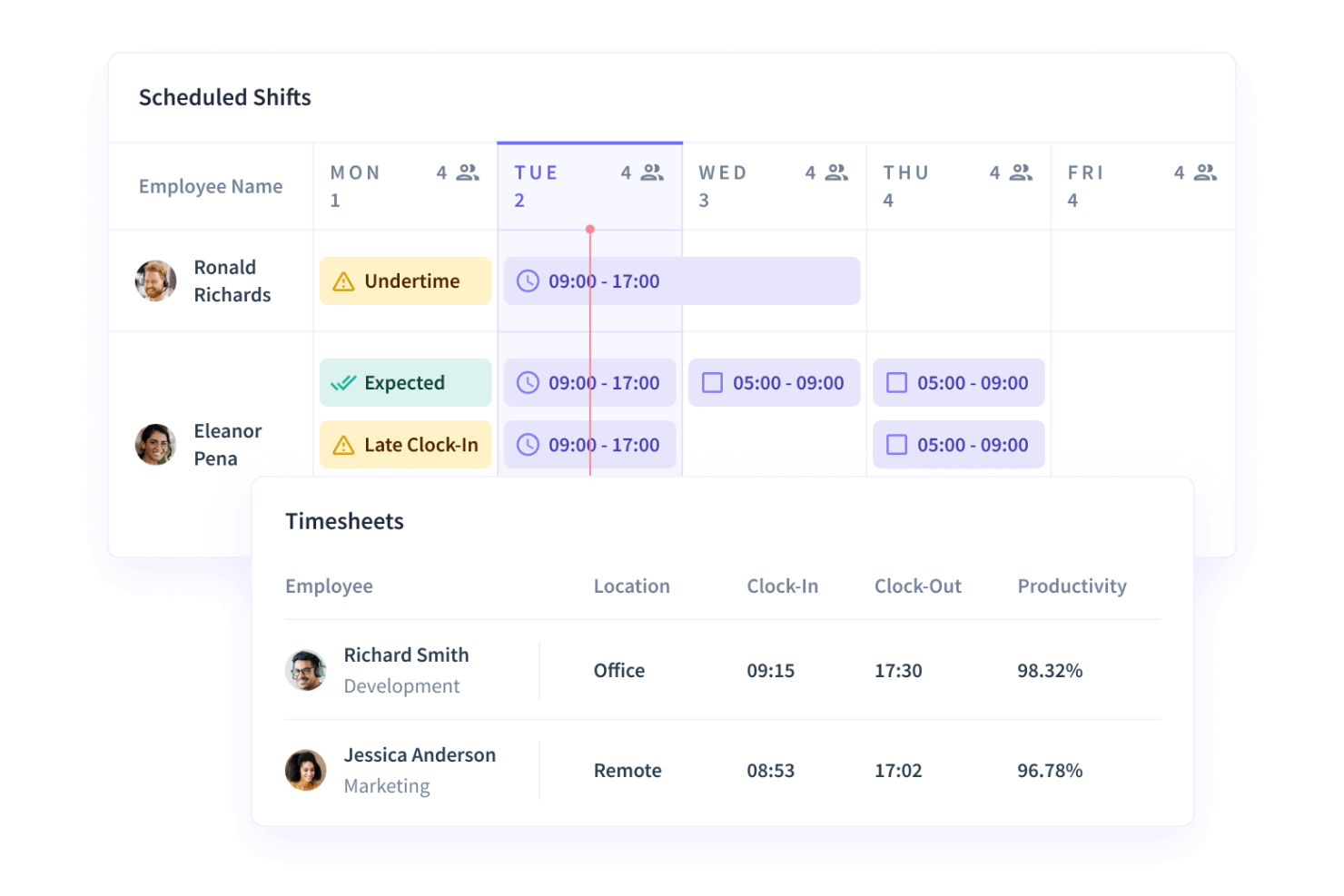
Insightful is a workforce analytics and employee monitoring platform that tracks time and attendance, captures screenshots, analyzes app and website usage, and measures team productivity and capacity across distributed teams.
Who Is Insightful Best For?
Insightful is a strong fit for operations and HR teams that need deep visibility into how distributed or hybrid workforces are actually spending their time.
Why I Picked Insightful
I picked Insightful as one of the best because it goes further than basic time tracking by showing exactly how distributed teams spend their working hours. I find the app and website usage categorization particularly useful: you can label specific tools as productive or unproductive per team, so a Slack notification for a sales team reads differently than it does for a developer. The AI Adoption report is also something I haven't seen done this way elsewhere, tracking daily AI tool usage, active tools, and team-level maturity segments using your own activity data.
Insightful Key Features
- Automatic attendance tracking: Captures clock-ins and clock-outs using Unlimited, Fixed, Network-Based, or VPN-based scenarios on company computers.
- Schedule adherence monitoring: Tracks late clock-ins, absences, overtime, and undertime against configured employee schedules.
- Configurable screenshot capture: Takes randomized-interval screenshots with default blurring of passwords, banking details, and private messages, at up to 30 captures per hour.
- AI Adoption report: Shows daily AI tool usage, adoption rates, team maturity segments, and cross-tool comparisons built from your organization's own activity data.
Insightful Integrations
Insightful offers 50+ native integrations, including Asana, Jira, ClickUp, Trello, Teamwork, Azure DevOps, BambooHR, Gusto, ADP Workforce Now, and Workday. It also provides a REST API with JSON responses for custom integrations.
Pros and Cons
Pros:
- Configurable screenshots include default sensitive-detail blurring
- Project time links to budgets and costs
- Reviewers value real-time activity visibility
Cons:
- App labeling and tracking setup takes time
- Reviewers find reports overwhelming or inflexible
New Product Updates from Insightful
Insightful Expands MCP and HRIS Integrations
Insightful adds OAuth connections for ChatGPT and Microsoft Copilot Studio through its MCP Server, while HRIS integrations gain manager scope syncing in Beta. These updates expand AI access and automate permission management. For more information, visit Insightful’s official site.
 .

Monitask
Best for screenshot-based monitoring

Monitask is an employee monitoring and time tracking tool that captures screenshots, records app and website usage, and tracks keyboard and mouse activity across distributed teams.
Who Is Monitask Best For?
Monitask suits distributed teams and agency managers who need clear visual proof of work through screenshot monitoring without sacrificing employee transparency.
Why I Picked Monitask
I've included Monitask in my top picks because screenshot-based monitoring is genuinely where it shines among Hubstaff alternatives. I like how Smartblur automatically obscures sensitive content before a screenshot ever leaves the employee's machine, which makes it easier to roll out monitoring without friction. Employees can also see exactly what their manager sees, and screenshot frequency scales from 30 up to 120 captures per hour depending on your oversight needs.
Monitask Key Features
- Idle time detection: Monitask automatically separates idle periods and breaks from active work time in logged timesheets.
- Mouse-jiggler detection: Monitask flags unnatural cursor patterns and USB-device signals associated with simulated activity.
- Client login access: Clients can log in directly to review project progress and time data without needing a full team account.
- Employee scorecards: Managers can review individual performance scorecards that summarize productivity and activity metrics by team member.
Monitask Integrations
Monitask offers integrations with Asana, Basecamp, ClickUp, Jira, Slack, Trello, and RemoteTeam, plus a public API for custom connections. It also supports 1,000+ apps through Zapier.
Pros and Cons
Pros:
- Project-level hours help reconcile client billing
- Smartblur obscures sensitive details in captured screens
- Screenshot timelines verify work without repeated check-ins
Cons:
- Team summaries may require manual CSV analysis
- Frequent screenshots can make employees self-conscious

Best for customizable punch-in options
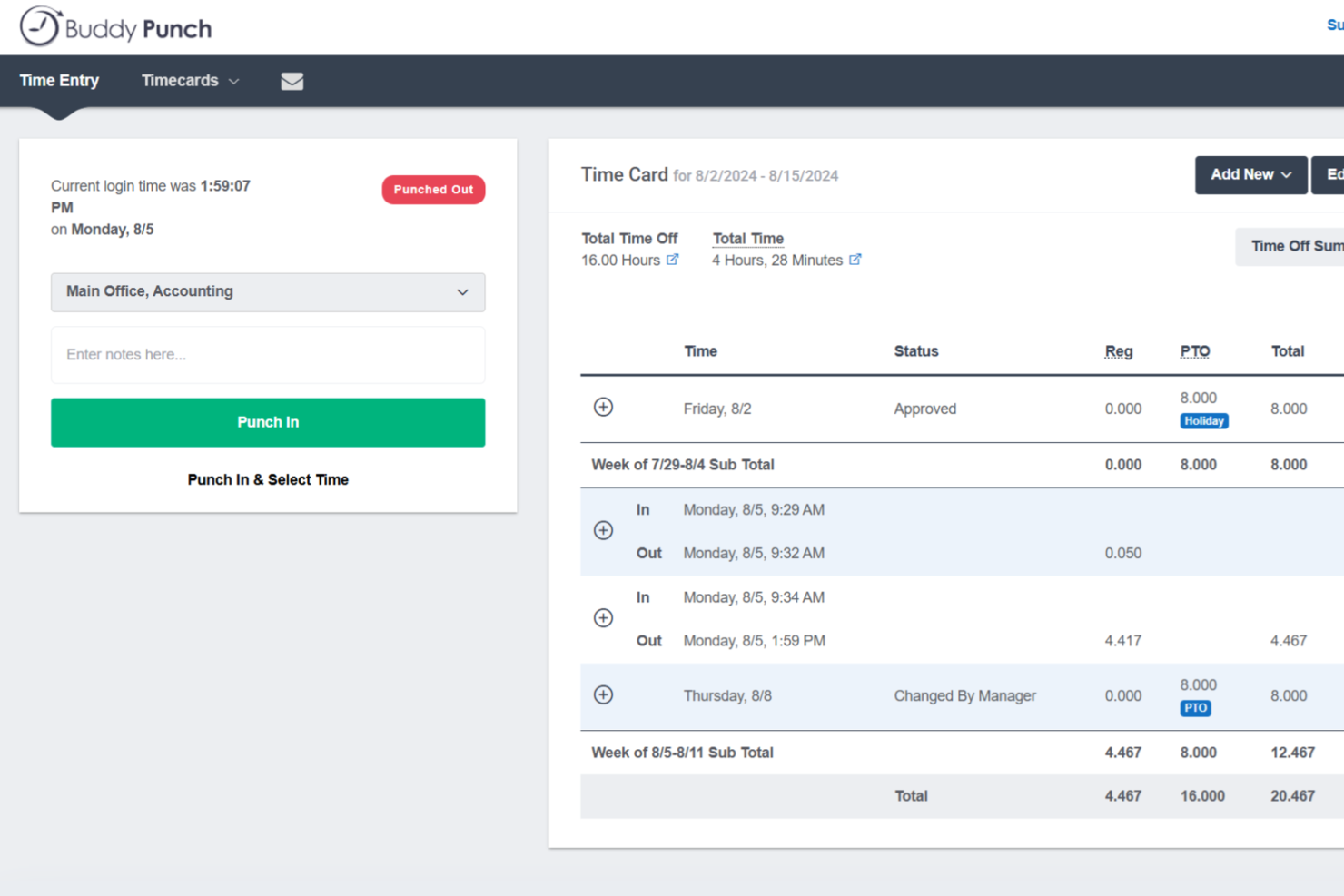
Buddy Punch is a time clock and attendance tracking platform that covers employee scheduling, GPS-based punch verification, PTO management, and payroll-ready timesheet exports.
Who Is Buddy Punch Best For?
Buddy Punch is a strong fit for operations managers and HR teams overseeing hourly or field-based workforces who need flexible clock-in options and payroll-ready timesheets.
Why I Picked Buddy Punch
I picked Buddy Punch as one of the best because of how many ways it lets employees clock in—web, mobile app, shared kiosk with PIN, QR code scan, or even text message. That variety matters when you're managing a field crew where no two workers have the same setup. I also like that GPS coordinates are captured at every punch event, so there's a location record tied to each clock-in without requiring real-time tracking overhead.
Buddy Punch Key Features
- Geofence-based punch blocking: Employers can define worksite boundaries and restrict employees from clocking in or out when outside those zones.
- Automatic timesheet compilation: The system pulls clock-in and clock-out data into timesheets and calculates regular hours, overtime, and configured pay types automatically.
- PTO accrual and request management: Employees can view their time-off balances and submit requests directly in the app, with approved PTO added to timesheets automatically.
- Payroll provider integrations: Buddy Punch connects natively with providers including Gusto, ADP Workforce Now, Paychex, Rippling, and Workday to transfer timesheet data for processing.
Buddy Punch Integrations
Buddy Punch offers nearly 20 native payroll integrations, including QuickBooks Online, QuickBooks Desktop, ADP Workforce Now, Gusto, Paychex, Paycor, Paylocity, Rippling, and Workday. It also supports Zapier, plus a REST API and webhooks for custom integrations.
Pros and Cons
Pros:
- Employees can check hours and PTO
- Location-stamped punches support field accountability
- Multiple punch methods suit varied field setups
Cons:
- Reviewers report missed punches and mobile glitches
- No app or website activity monitoring

Apploye
Best for productivity management
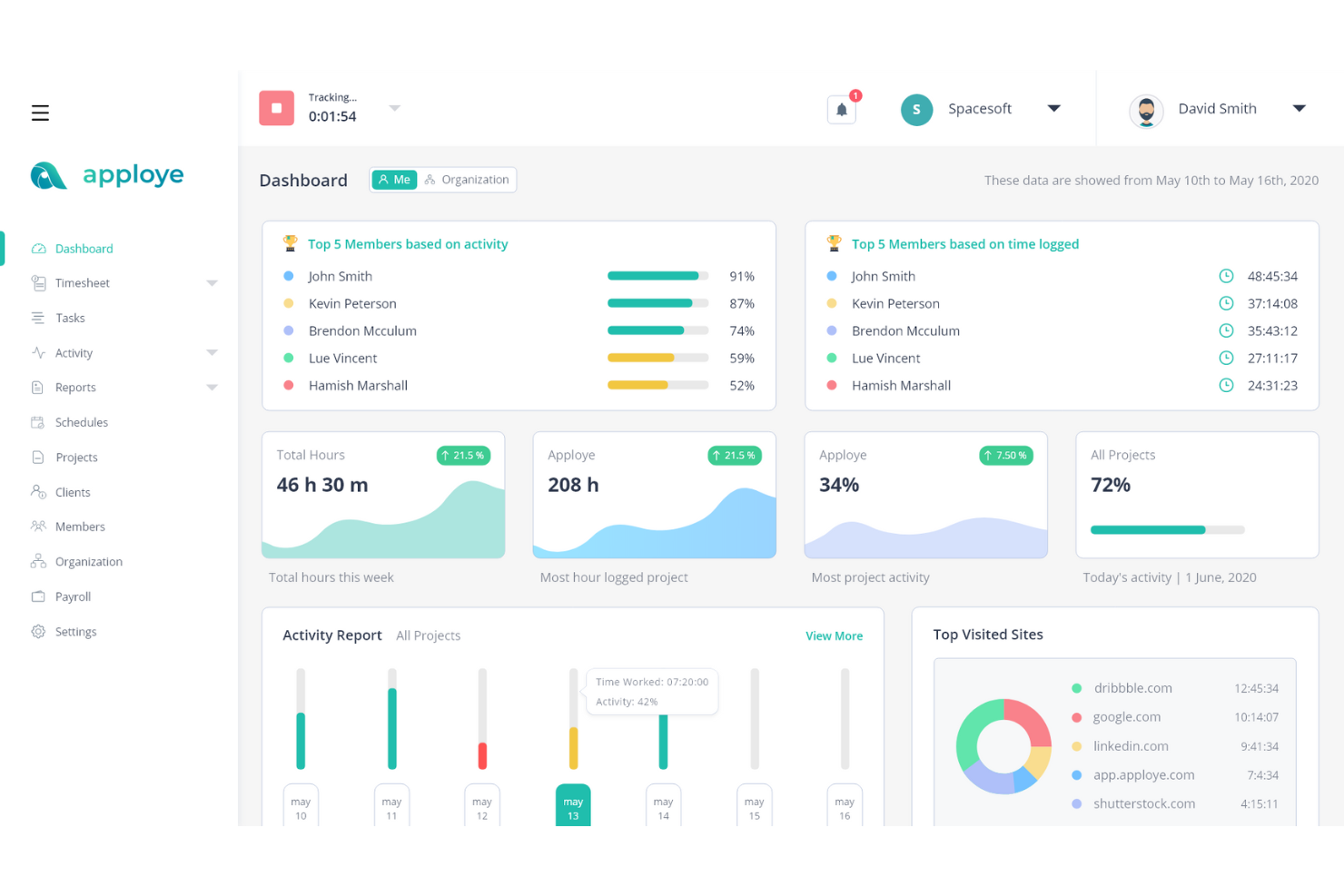
Apploye is a workforce productivity platform that combines time tracking, activity monitoring, screenshot capture, project budgeting, attendance management, and client invoicing.
Who Is Apploye Best For?
Apploye is a strong fit for agencies and freelance business owners who need to tie tracked hours directly to client billing and project budgets.
Why I Picked Apploye
I've included Apploye in my top picks because it goes further than basic time tracking by tying every logged hour directly to project budgets and client billing. I particularly like the budget-alert system, which notifies managers the moment a project hits a set spending threshold, so there's no scrambling after the fact. On top of that, the activity and productivity monitoring, including app and URL usage tracking and configurable screenshot capture, gives distributed teams real visibility without constant check-ins.
Apploye Key Features
- Timesheet approval: Managers can review and approve employee timesheets on a daily, weekly, or custom schedule before hours flow into payroll.
- Attendance and shift management: Administrators can create shifts, track clock-in and clock-out times, and compare required shift hours against actual hours worked.
- Multi-organization support: Users can manage multiple companies under a single account, each with separate settings and data.
- Idle time detection: Apploye flags inactive periods and lets employees or administrators decide whether to keep or discard idle time from timesheets.
Apploye Integrations
Apploye offers seven documented native integrations, including ClickUp, Asana, Jira, Monday.com, Trello Power-Ups, Zoho, and Deel. Its read-only REST API and MCP server support custom integrations.
Pros and Cons
Pros:
- Configurable screenshots add review context
- Project hours clarify client billing
- Activity reports reduce remote check-ins
Cons:
- Monitoring can feel invasive to employees
- Reports offer limited filtering and history

Best for privacy-first workforce monitoring
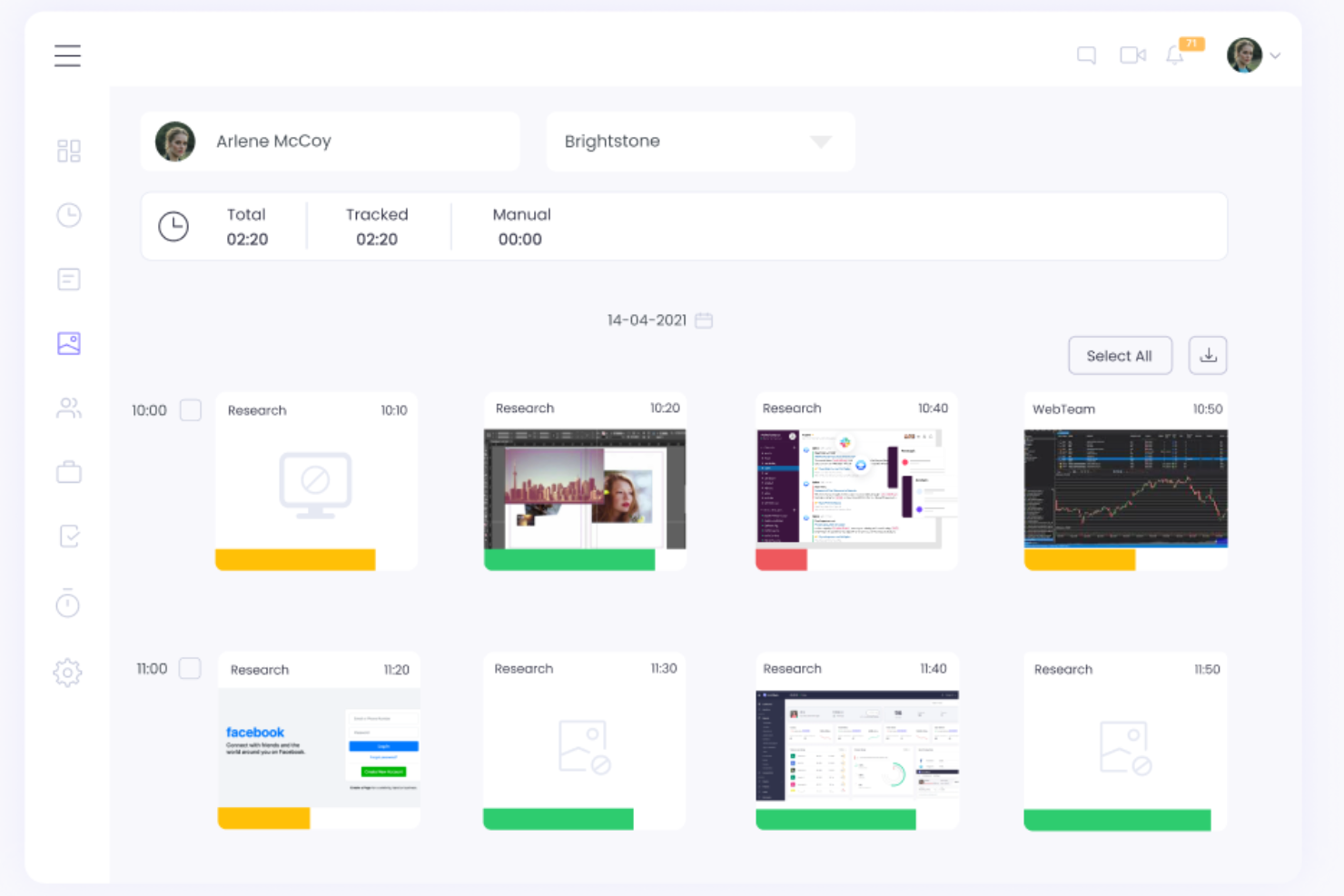
WebWork Time Tracker is a time tracking and employee monitoring tool that combines automatic time capture, activity-level reporting, screenshot monitoring, payroll calculation, and project budgeting across desktop, mobile, and web platforms.
Who Is WebWork Time Tracker Best For?
WebWork Time Tracker is a strong fit for distributed teams and remote-first businesses that need detailed workforce visibility without keylogging or invasive data collection.
Why I Picked WebWork Time Tracker
I've included WebWork Time Tracker in my top picks because it takes a deliberate stance on monitoring that most tools don't: no keylogging, configurable screenshot blur levels, and per-member screenshot overrides so you're not applying a blanket surveillance policy to your whole team. I particularly like that employees can view their own screenshots directly in the desktop app, which removes the "black box" feeling that makes monitoring contentious. The Silent Tracker is also restricted to company-owned devices by policy, which keeps personal privacy boundaries clear.
WebWork Time Tracker Key Features
- Offline time tracking: The desktop tracker records work hours without an internet connection and syncs data automatically once connectivity returns.
- Geofencing: Set job site locations and a defined radius that can trigger mobile tracking when field workers enter the area (Plus and above).
- Timesheet approvals: Managers can review and approve employee timesheets with configurable pay periods, autosubmit, and autoapproval options (Plus and above).
- Project budgeting: Set budgets for projects, track spending against them, and receive AI-generated alerts when time or budget thresholds are at risk of being exceeded (Plus and above).
WebWork Time Tracker Integrations
WebWork Time Tracker offers native integrations with Jira, Asana, ClickUp, Slack, QuickBooks, Xero, Gusto, Deel, GitHub, and Stripe. It supports REST API, webhooks, and marketplace integrations through Zapier, Make, and Zoho Flow.
Pros and Cons
Pros:
- Automatic tracking simplifies routine time capture
- Employees can review their own screenshots
- No keylogging, with adjustable screenshot blur
Cons:
- Some users report missed hours or interruptions
- Frequent screenshots can feel intrusive
New Product Updates from WebWork Time Tracker
WebWork Time Tracker Adds WFH Requests and Flexible Shifts
WebWork Time Tracker adds work-from-home balances, requests, and flexible shifts. These updates simplify remote work scheduling and attendance tracking. For more information, visit WebWork Time Tracker’s official site.
 .
Beebole
Best for PM-focused time tracking without monitoring
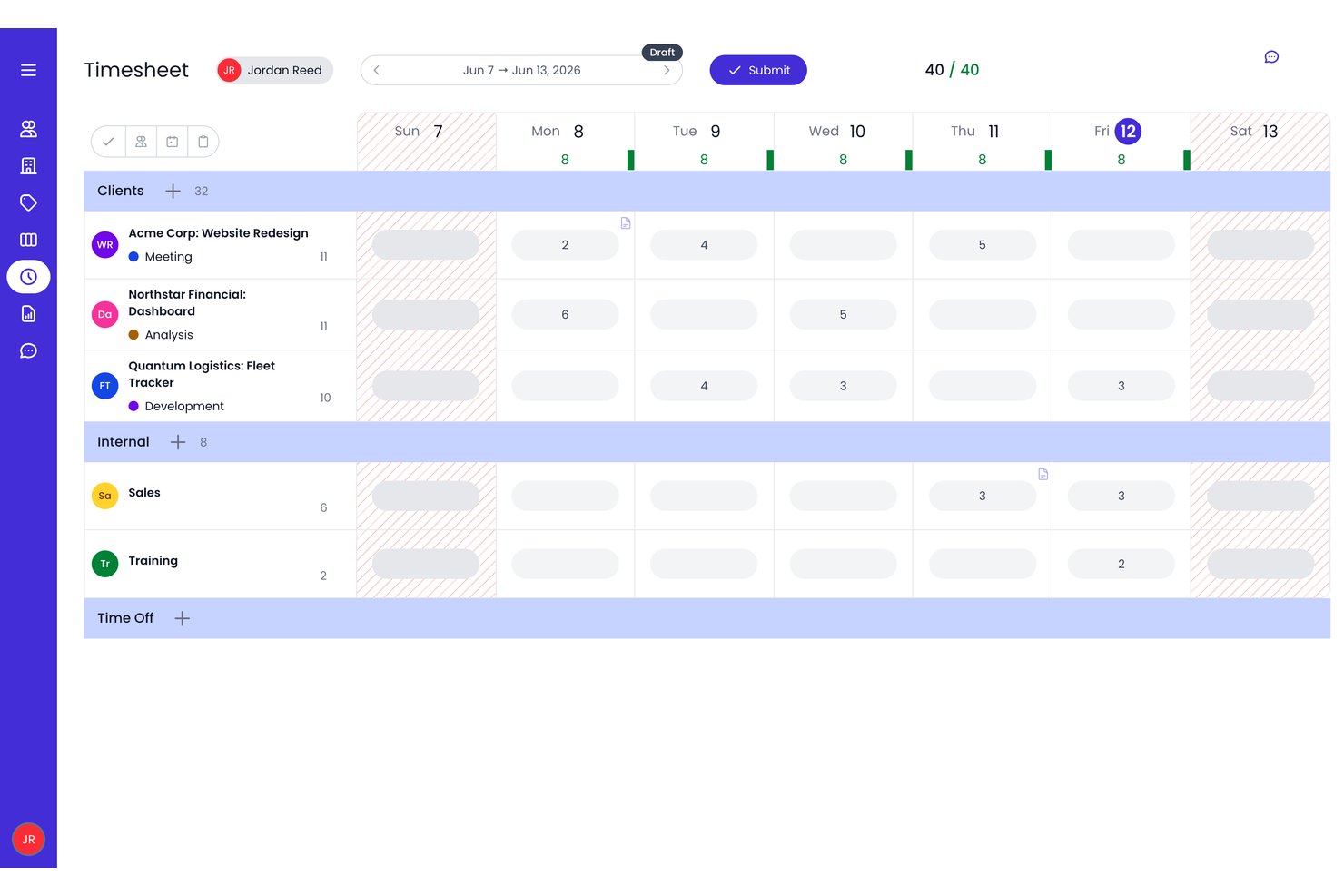
Beebole is a project time tracking and resource planning platform that combines timesheet management, project budgeting, and financial reporting across clients, projects, and tasks.
Who Is Beebole Best For?
Beebole suits project managers and agency leads who need detailed project budget tracking and financial reporting without employee monitoring.
Why I Picked Beebole
I've included Beebole in my top picks because it's built for project managers who need serious budget and financial visibility without any employee surveillance attached. I love that activity tracking is fully opt-in on the desktop app, meaning managers only see entries employees choose to accept, and nothing is recorded covertly. What makes it genuinely useful is the depth of project financials: you can split budgets by person or subproject, track costs against profitability, and report on margins across clients, all without a single screenshot in sight.
Beebole Key Features
- Multi-level timesheet approvals: Route submitted timesheets through configurable approval chains before time is locked or exported.
- Resource planning with Gantt heatmaps: View team availability, flag overbookings, and assign project bookings across Gantt, Kanban, and Staffing views.
- Time-off tracking and accruals: Manage absence requests, accrual policies, allowances, and public holidays, with approved time off reflected in resource planning.
- AI-assisted report creation: Describe a report in plain language and have Beebole generate it, with processing handled on Beebole-operated servers rather than third-party AI providers.
Beebole Integrations
Beebole offers native integrations with Asana, Linear, monday.com, Google Sheets, QuickBooks Online, Xero, BambooHR, Google Calendar, and Outlook Calendar. It also supports GraphQL, webhooks, and an MCP server for custom connections.
Pros and Cons
Pros:
- Simple time logging and timer use
- Custom reports support varied client needs
- Granular client, project, and task allocation
Cons:
- No screenshots, idle reports, or productivity categories
- Report filters and date selection take effort

Clockify
Best for free-tier time tracking at scale
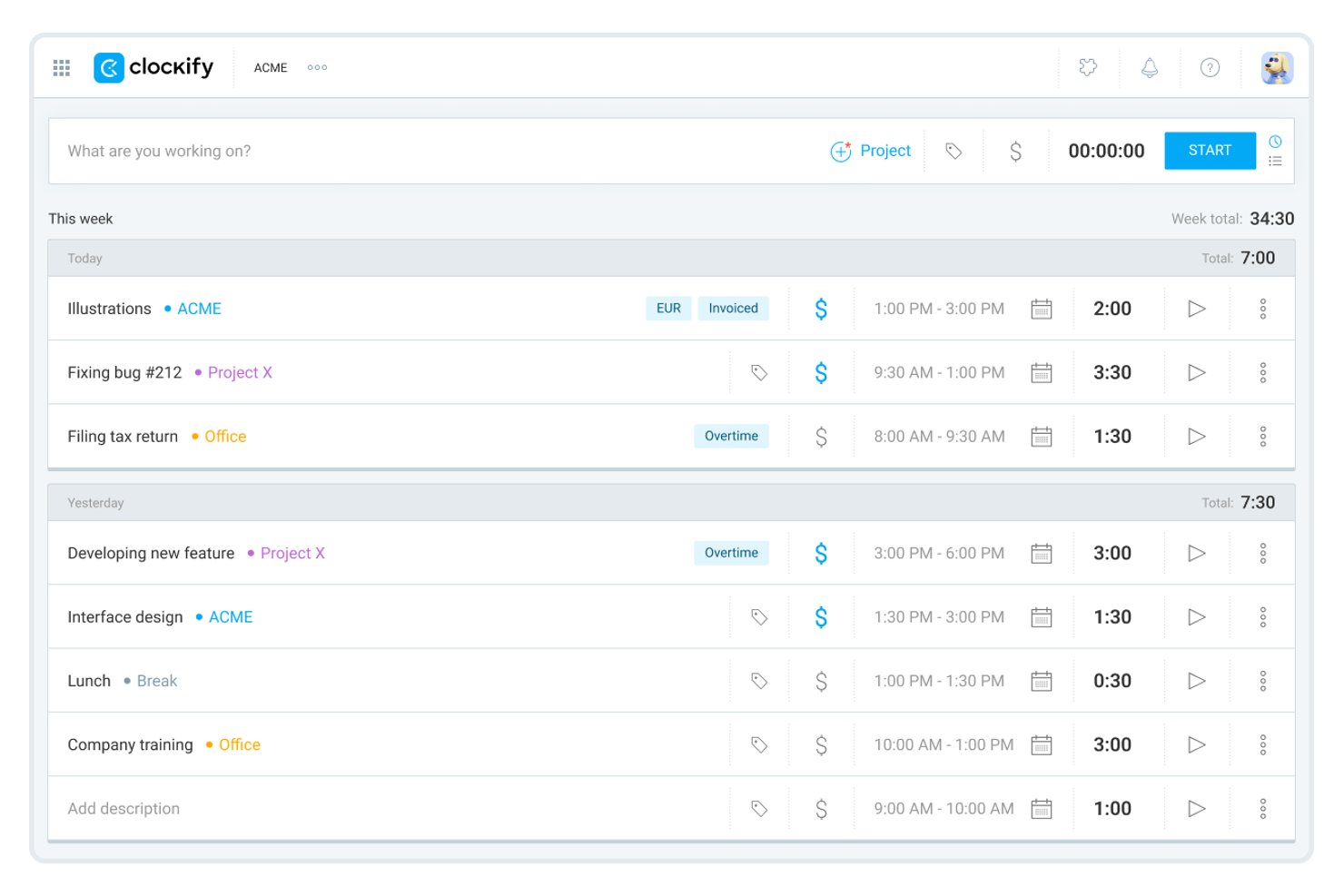
Clockify is a time tracking and timesheet app that covers timer-based and manual time entry, activity monitoring, GPS location tracking, project and task budgeting, invoicing, and timesheet approvals across web, desktop, mobile, and kiosk.
Who Is Clockify Best For?
Clockify is a strong fit for growing teams and agencies that need to track time across many users without immediately committing to a paid plan.
Why I Picked Clockify
I've included Clockify in my top picks because it's the only tool on this list where a large team can track time across unlimited projects without paying a cent. Its free tier covers timer-based and manual entry, Auto Tracker (which records time spent in apps and documents automatically), and team activity views. When you're ready to scale, GPS location tracking and configurable activity monitoring with screenshot capture are available on paid plans.
Clockify Key Features
- Timesheet approval workflows: Submit timesheets for manager review, with pending, approved, rejected, and withdrawn request tracking plus automated email reminders.
- Kiosk clock-in: Let team members clock in and out from a shared device using a PIN or QR code, with optional break tracking and photo capture.
- Time-off management: Create time-off policies and holidays, handle leave requests, and track balances across your team.
- Data region selection: Choose to host your workspace data in the EU, UK, USA, or Australia to meet regional data-residency requirements.
Clockify Integrations
Clockify offers 100+ native web app integrations, including QuickBooks, Xero, Jira, Google Calendar, Outlook, Asana, Trello, ClickUp, GitHub, and GitLab. It also supports REST API, webhooks, and Zapier.
Pros and Cons
Pros:
- Timesheet reports help prepare client billing
- Client and project entries clarify billable hours
- Auto Tracker captures app and document time
Cons:
- Complex reports offer limited flexibility
- Mobile syncing glitches disrupt time records

TimeCamp
Best for invoicing from tracked project hours

TimeCamp is a time tracking tool that combines automatic and manual time capture, project and task-level budgeting, attendance management, productivity monitoring, and built-in invoicing across web, desktop, and mobile apps.
Who Is TimeCamp Best For?
TimeCamp is a strong fit for freelancers and agency teams who need to turn tracked project hours directly into client invoices without juggling separate billing tools.
Why I Picked TimeCamp
I picked TimeCamp as one of the best because it closes the gap between tracking project hours and getting paid without making you jump between tools. I love how you can pull billable time directly from any project or task, generate an invoice inside the same platform, and push it straight to QuickBooks or Xero. Budget alerts at 80% and 100% of a project's estimated hours or fee mean you can catch scope creep before it hits the invoice.
TimeCamp Key Features
- Automatic time tracking: Uses keywords tied to app names, window titles, or URLs to assign tracked time to the correct project or task automatically.
- Attendance and time-off tracking: Records employee start and end times, absences, paid and unpaid leave, and overtime within the same platform.
- Geofencing: Starts and stops a mobile timer automatically when an employee enters or exits an assigned job site using GPS.
- Timesheet approvals: Lets employees submit daily or weekly timesheets to assigned managers for approval or rejection with comments.
TimeCamp Integrations
TimeCamp lists 100+ integrations, including Jira, Asana, ClickUp, Slack, Microsoft Teams, QuickBooks Online, Xero, and BambooHR. It also offers a REST API and Zapier integration.
Pros and Cons
Pros:
- GPS geofencing captures on-site time automatically
- Project budgets flag scope creep early
- Tracked hours translate into client-ready invoices
Cons:
- Mobile timers can feel clunky or glitchy
- Activity reports omit keyboard and mouse levels

Everhour
Best for project-budget time tracking
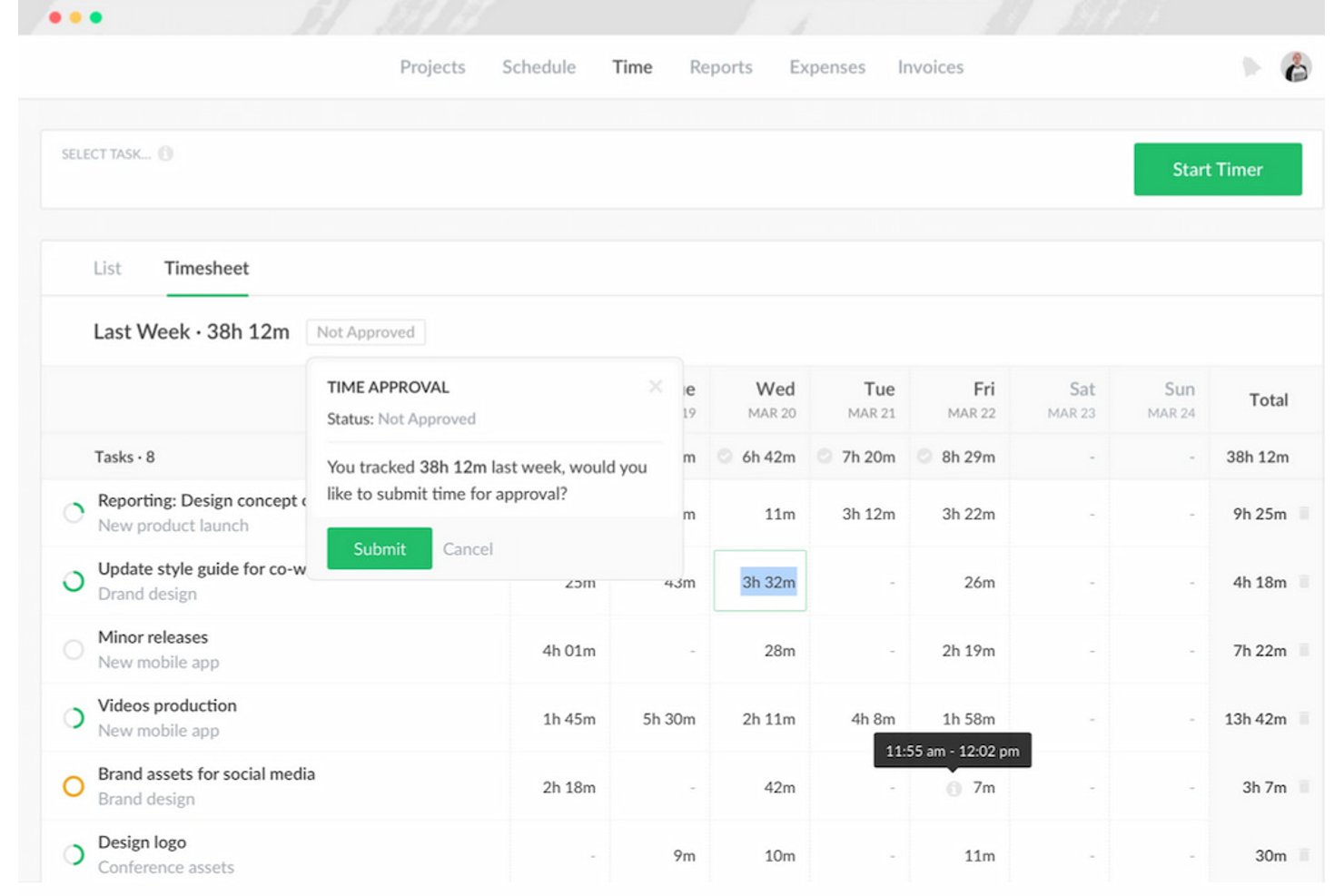
Everhour is a time tracking tool built around project and task structures, offering timers, timesheet approvals, project budgeting, invoicing, and native integrations with tools like Asana, Jira, ClickUp, and QuickBooks.
Who Is Everhour Best For?
Everhour is a strong fit for agencies and client-service teams that need time tracking tied directly to project budgets, billable rates, and invoicing workflows.
Why I Picked Everhour
I picked Everhour as one of the best because it treats time tracking as a budgeting tool, not just a clock. Where Hubstaff focuses on activity monitoring and GPS, Everhour ties every tracked hour to a project budget, so you can see exactly when a client engagement is burning through its allocation and set alerts before you go over. I especially like how teams can group multiple projects under a shared client budget and pull profitability reports that compare estimated versus actual hours.
Everhour Key Features
- Timesheet approvals: Managers can review, approve, or reject submitted timesheets and lock approved periods to prevent further edits.
- Time-off management: Team members can request time off, managers can approve requests, and teams can configure time-off types, balances, and public holidays by country.
- Live team dashboard: Shows active timers and which project or task each team member is currently working on in real time.
- Native integrations with PM tools: Everhour embeds directly into Asana, ClickUp, Jira, Trello, and other project management tools so users can track time without leaving their workflow.
Everhour Integrations
Everhour offers 10+ native integrations, including Asana, ClickUp, Jira, Linear, Trello, QuickBooks, Xero, GitHub, and Slack. It also supports Zapier and an API for custom integrations.
Pros and Cons
Pros:
- Filter reports for billing and project reviews
- Compare client work with project limits
- Track billable hours against task budgets
Cons:
- Mobile tracking offers fewer functions than web
- No documented idle-time or keystroke monitoring

Time Doctor
Best for AI-backed distributed team monitoring
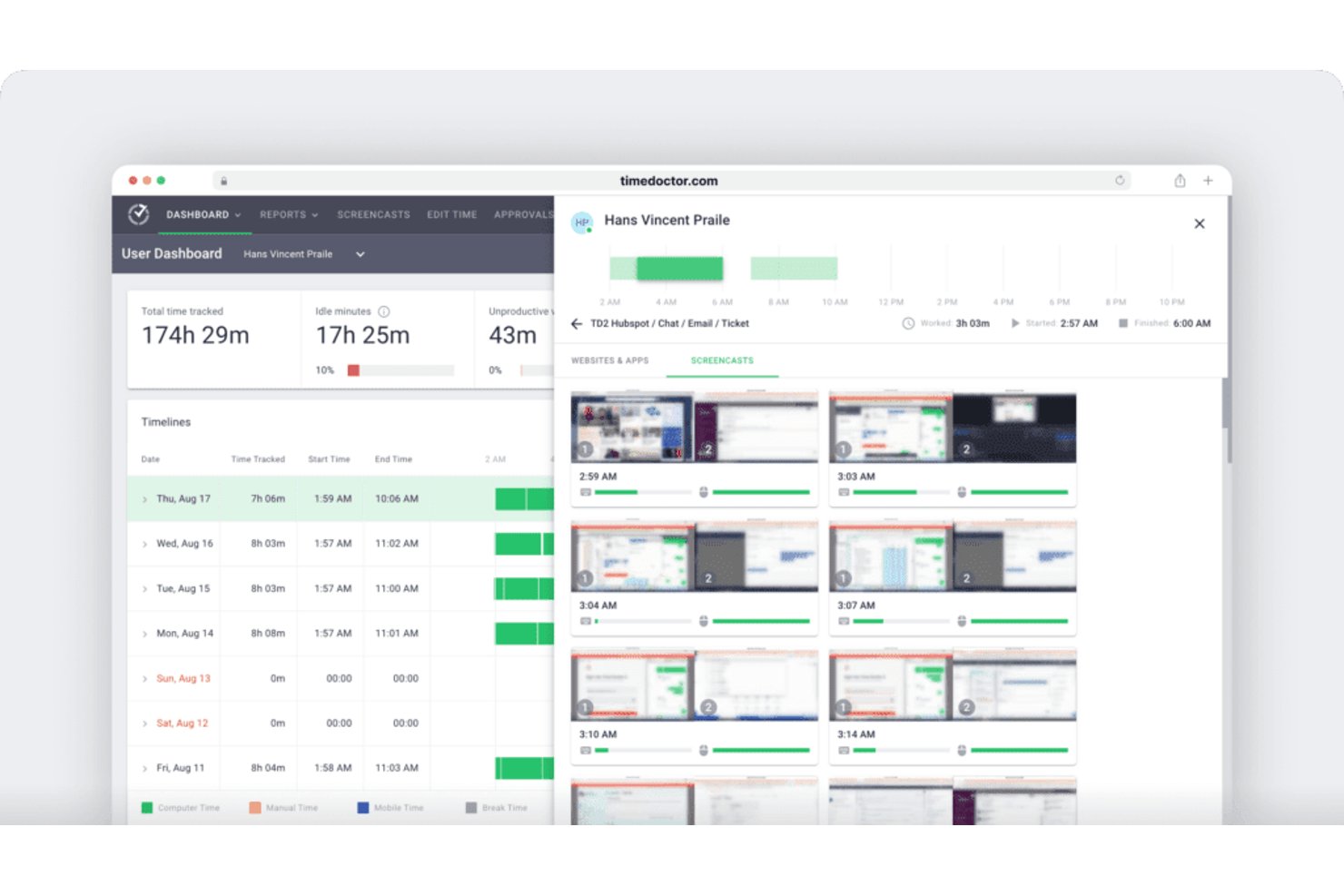
Time Doctor is an employee time tracking and workforce monitoring platform that combines automatic and manual time capture, web and app usage reporting, AI-powered productivity analytics, and attendance management across distributed teams.
Who Is Time Doctor Best For?
Time Doctor suits operations managers and people leaders who need deep visibility into distributed team activity, especially where AI-driven productivity insights and strong compliance credentials matter.
Why I Picked Time Doctor
I picked Time Doctor as one of the best because its AI-backed monitoring goes well beyond basic time capture. Benchmarks AI compares individual work patterns against AI-matched peer groups, so I can spot who's underperforming relative to comparable roles, not just raw hours. The Unusual Activity AI report flags suspicious time-entry patterns automatically, which is exactly the kind of signal a distributed team manager needs without manually auditing every timesheet.
Time Doctor Key Features
- Attendance and schedule tracking: Compares scheduled hours against actual hours worked and records missing hours across your distributed team.
- Web and app usage reporting: Logs time spent on specific websites and applications, with breakdowns by day, week, month, or custom date range.
- Work-life balance metrics: Surfaces patterns of overload or imbalance so you can spot burnout risk before it becomes a retention problem.
- 60+ native integrations: Connects with tools like Jira, ClickUp, Asana, Gusto, and ADP to fit into your existing project and payroll workflows.
Time Doctor Integrations
Time Doctor offers 60+ native integrations, including Jira, Asana, ClickUp, monday.com, ADP, Gusto, Payoneer, PayPal Payouts, Wise, and Xero AU Payroll. It also provides Open API access for custom integrations.
Pros and Cons
Pros:
- AI benchmarks flag unusual work patterns
- Clear attendance and project reports
- Accurate offline time capture
Cons:
- Payroll payments still require CSV uploads
- Close monitoring can feel intrusive
Outras alternativas ao Hubstaff
Segue-se uma lista de alternativas adicionais ao Hubstaff que selecionei, mas que não chegaram à lista principal.
- Workstatus
For workforce intelligence beyond time tracking
- DeskTime
For automatic productivity efficiency analysis
- RescueTime
For automatic time tracking without surveillance
- Toggl
For trust-based project time tracking
- Teramind
For insider risk and DLP monitoring
- Jibble
For GPS-verified attendance tracking
- Timely
For privacy-first automatic timesheets
- Harvest
For billing clients from tracked time
- Controlio
For compliance-focused workforce monitoring
- Polaris PSA
For project financials and time visibility


Análises relacionadas de software de gestão de projetos
Se ainda não encontrou o que procura, consulte estas ferramentas de gestão de projetos relacionadas que testámos e analisámos.
- Software de gestão de projetos
- Software de gestão de recursos
- Software de automatização de fluxos de trabalho
- Criador de gráficos de Gantt
How I Evaluate Hubstaff Alternatives
I split my evaluation into three parts, with the most weight on core needs: track hours, assign them to projects, and show team activity. Next, I consider standout features like GPS geofencing for field teams. Finally, I weigh support, onboarding, and pricing value.
Core Functionality (Table Stakes For This List)
When I'm selecting tools for my list, I score each one on a scale from 0 (does not offer the functionality) to 5 (excels in this area) for each core functionality listed below. I then convert the total into a percentage to help assess each tool's overall fit, with extra weight on any functionalities I’ve deemed essential.
- Time Tracking (Essential): I look for timer and manual entry across devices, plus idle detection or offline support for distributed teams and shifting schedules.
- Activity Monitoring (Essential): I assess whether activity levels, idle time, and app or website usage give managers useful context without overreaching on employee privacy.
- Screenshot Privacy: I check whether teams can configure screenshot frequency, blur sensitive details, or limit capture to suit their monitoring policies.
- Payroll & Invoicing: I look for ways to turn approved hours into payroll data or client invoices, reducing reconciliation work at pay or billing time.
- Project Allocation: I assess how easily teams assign hours to projects and tasks, then compare actual time with estimates and budgets.
- Reports & Timesheets: I check for reviewable timesheets, useful filters, approval workflows, and exports that support client reporting and payroll handoffs.
Once I have a list of tools that meet the criteria, I consider what sets each platform apart.
Differentiating Factors (What Sets Vendors Apart)
Here's how I compare and contrast different vendors:
Standout Features
GPS and geofencing matter when your team includes field workers or mobile staff. I look for auto clock-in/out triggered by job site boundaries, which removes manual entry from the equation entirely. Employee-facing transparency is equally important. Tools like Hubstaff track activity, but some alternatives offer self-monitoring dashboards and consent-based capture that shift the dynamic from surveillance to self-management. I also evaluate AI-powered insights, specifically whether a platform flags workload anomalies or burnout risks before they hit your sprint.
Beyond Features
I evaluate how well each tool connects to existing PM and finance stacks. If tracked hours can't flow into your invoicing or payroll tools without a CSV export, you're adding manual work every billing cycle. Privacy controls also weigh heavily—configurable screenshot blurring or consent prompts directly affect whether a distributed team actually adopts the tool or pushes back. Finally, I check onboarding support, because rolling out a new tracker to a remote team without migration guides or templates can stall adoption for weeks.
Por que procurar uma alternativa ao Hubstaff?
Pode estar à procura de uma alternativa ao Hubstaff se tiver algum dos seguintes problemas.
- Preocupações com os custos: pode considerar que o modelo de preços do Hubstaff está acima do seu orçamento
- Funcionalidades: pode procurar funcionalidades adicionais ou diferentes que o Hubstaff não disponibiliza
- Experiência do utilizador: pode preferir uma interface mais intuitiva ou fácil de utilizar
- Necessidades de integração: pode precisar de melhores opções de integração com outras ferramentas e serviços.
- Suporte e recursos: pode querer mais apoio ao cliente ou recursos educativos
As alternativas ao Hubstaff podem oferecer funcionalidades e benefícios e responder a necessidades específicas que o Hubstaff não consegue satisfazer. Por exemplo, podem adaptar-se melhor a determinadas empresas devido ao custo, aos requisitos funcionais, à experiência do utilizador e ao suporte.
Principais funcionalidades do Hubstaff
Eis algumas das principais funcionalidades do Hubstaff, para ajudar a comparar o que as soluções alternativas oferecem:
- Registo de tempo: Registe com precisão as horas de trabalho, utilizando funcionalidades de GPS e capturas de ecrã para verificar o trabalho, com integração com software de gestão de tarefas para um acompanhamento contínuo dos projetos.
- Informações sobre produtividade: Monitorize a produtividade dos colaboradores com métricas em tempo real e informações sobre a utilização de aplicações.
- Processamento salarial & pagamentos: Processe salários online, crie faturas personalizadas e acompanhe as horas extraordinárias para garantir pagamentos precisos.
- Integrações: Ligue-se a mais de 35 ferramentas populares, como Jira, Slack e Google Calendar, para melhorar o fluxo de trabalho.
- Gestão da força de trabalho: Gira os horários, a assiduidade e as estruturas das equipas, integrando-se com ferramentas de colaboração para melhorar a comunicação.
- Gestão de projetos: Gira os custos dos projetos, acompanhe as horas faturáveis e supervisione eficazmente os orçamentos dos clientes.
- Monitorização dos colaboradores: Obtenha informações sobre a produtividade e mantenha registos de atividade para um melhor acompanhamento do desempenho.
- Foco na privacidade: Utilize opções para ocultar dados sensíveis, mantendo o acompanhamento da produtividade sem comprometer a privacidade.
- Recursos: Aceda a um centro de ajuda, a um blogue e a um centro de recursos para obter suporte e orientação.
- Período experimental gratuito: Experimente o software durante um período experimental gratuito de 14 dias para explorar as suas capacidades.