
Reseña de Quickbase: Ventajas, Desventajas, Características y Precios



Quickbase is a low-code web based project management tool built for teams managing complex, interconnected workflows that standard grid-based tools can't handle well. I'd mainly consider it if your team needs to build custom applications around your project data without leaning on developers. Compared to Smartsheet, Quickbase gives you significantly more control over data relationships and custom app logic—making it the better fit for operations-heavy environments where processes vary widely across teams.
Quickbase Evaluation Summary
- From $35/user/month (billed annually)
- 30-day free trial
Por qué confiar en nuestras recomendaciones de software
Nuestro equipo lleva probando y evaluando software desde 2012. Como gestores de proyectos, sabemos lo difícil —y lo importante— que es elegir el software adecuado.
Para esta guía, evaluamos las herramientas mediante pruebas prácticas e investigación independiente, puntuando las herramientas según nuestros criterios de selección. También nos basamos en la experiencia de líderes de opinión del sector y de profesionales en activo de la gestión de proyectos.
Nuestras reseñas reflejan nuestro criterio editorial humano, no un discurso de ventas.
Revisores expertos:
Quickbase Overview
In my opinion, Quickbase is a strong contender in the project management software market, particularly for industries that demand highly customizable workflows, such as construction and healthcare. The platform stands out for its flexibility and wide integration capabilities, which make it particularly suitable for complex workflows.
Quickbase's no-code/low-code interface enables organizations to build tailored applications that can streamline complex processes. However, because of its broad feature set, there can be a learning curve, especially for non-technical users or teams new to application development.
Compared to other project management tools, Quickbase offers a strong, scalable platform that is ideal for teams willing to invest time in customization and training. It is best suited for environments where integration, adaptability, and visibility into processes are critical for success.

pros
-
Powerful customization options let you tailor workflows to your team's needs
-
Real-time collaboration tools keep your team connected and on the same page
-
Automation features save time on repetitive tasks
cons
-
Some users find the learning curve particularly steep.
-
The interface can feel outdated compared to more modern project management tools.
-
Users may need to invest time in setting up and customizing templates to fit specific workflows.
-

Smartsheet
Visit WebsiteThis rating combines scores from multiple user review sites to reflect overall customer sentiment about the product.4.5 -
Celoxis
Visit WebsiteThis rating combines scores from multiple user review sites to reflect overall customer sentiment about the product.4.5 -
Accelo
Visit WebsiteThis rating combines scores from multiple user review sites to reflect overall customer sentiment about the product.4.4





Nuestra Metodología de Revisión
Cómo probamos y puntuamos las herramientas
Llevamos años construyendo, refinando y mejorando nuestro sistema de prueba y puntuación de software. La rúbrica está diseñada para capturar los matices de la selección de software y los factores que hacen efectivo a un sistema, centrándose en los aspectos críticos del proceso de toma de decisiones.
A continuación, puedes ver exactamente cómo funciona nuestro proceso de prueba y puntuación en base a siete criterios. Esto nos permite proporcionar una evaluación imparcial del software basada en la funcionalidad principal, características destacadas, facilidad de uso, incorporación, soporte al cliente, integraciones, opiniones de clientes y valor por el dinero.
Funcionalidad principal (25% de la puntuación final)
El punto de partida de nuestra evaluación es siempre la funcionalidad principal de la herramienta. ¿Cuenta con las funciones y características básicas que un usuario esperaría ver? ¿Alguna de estas funciones principales está limitada a planes de precios superiores? Esperamos que la herramienta se mantenga a la par de las capacidades básicas de sus competidores.
Características destacadas (25% de la puntuación final)
A continuación, evaluamos las características destacadas poco comunes que van más allá de la funcionalidad principal normalmente encontrada en este tipo de herramientas. Una puntuación alta refleja funciones únicas o especializadas que hacen que el producto sea más rápido, eficiente, o aporte valor extra al usuario.
También evaluamos la facilidad de integración con otras herramientas habitualmente presentes en el ecosistema tecnológico para ampliar la funcionalidad y utilidad del software. Las herramientas que ofrecen muchas integraciones nativas, conexiones de terceros y acceso por API para integrar soluciones personalizadas obtienen la mejor puntuación.
Facilidad de uso (10% de la puntuación final)
Consideramos cuán rápido y fácil es ejecutar las tareas fundamentales usando la herramienta. El software con alta puntuación está bien diseñado, es intuitivo, ofrece aplicaciones móviles, proporciona plantillas y hace que tareas relativamente complejas parezcan sencillas.
Incorporación (10% de la puntuación final)
Sabemos lo importante que es una adopción rápida para un nuevo sistema, así que evaluamos cuán sencillo es aprender a usar la herramienta con una capacitación mínima. Analizamos cuán rápido un miembro del equipo puede configurarse y comenzar a usar la herramienta sin experiencia previa. Las soluciones mejor puntuadas indican que se requiere poco o ningún soporte.
Soporte al cliente (10% de la puntuación final)
Revisamos la rapidez y facilidad para obtener ayuda por teléfono, chat en vivo o base de conocimientos. Las empresas que ofrecen soporte en tiempo real obtienen las mejores puntuaciones, mientras que los chatbots obtienen las peores.
Opiniones de clientes (10% de la puntuación final)
Además de nuestras propias pruebas y valoraciones, consideramos la puntuación neta del promotor de clientes actuales y anteriores. Revisamos la probabilidad de que, ante la opción, quisieran elegir la herramienta de nuevo por su funcionalidad central. Un software con una puntuación alta refleja una gran satisfacción de sus usuarios actuales o pasados.
Valor por el dinero (10% de la puntuación final)
Por último, tomando en cuenta todos los criterios mencionados, comparamos el precio promedio de los planes básicos respecto a las funciones principales y el valor aportado por los otros criterios. El software que entrega más por menos recibirá una puntuación superior.
Core Features
Task management: Quickbase allows teams to create, assign, and track tasks within custom-built applications, which helps teams stay organized and aligned. Users can define task owners, deadlines, statuses, and priorities, and view progress through dashboards and reports. With automation features, teams can also set up alerts and reminders to ensure deadlines are met and tasks don’t fall through the cracks.
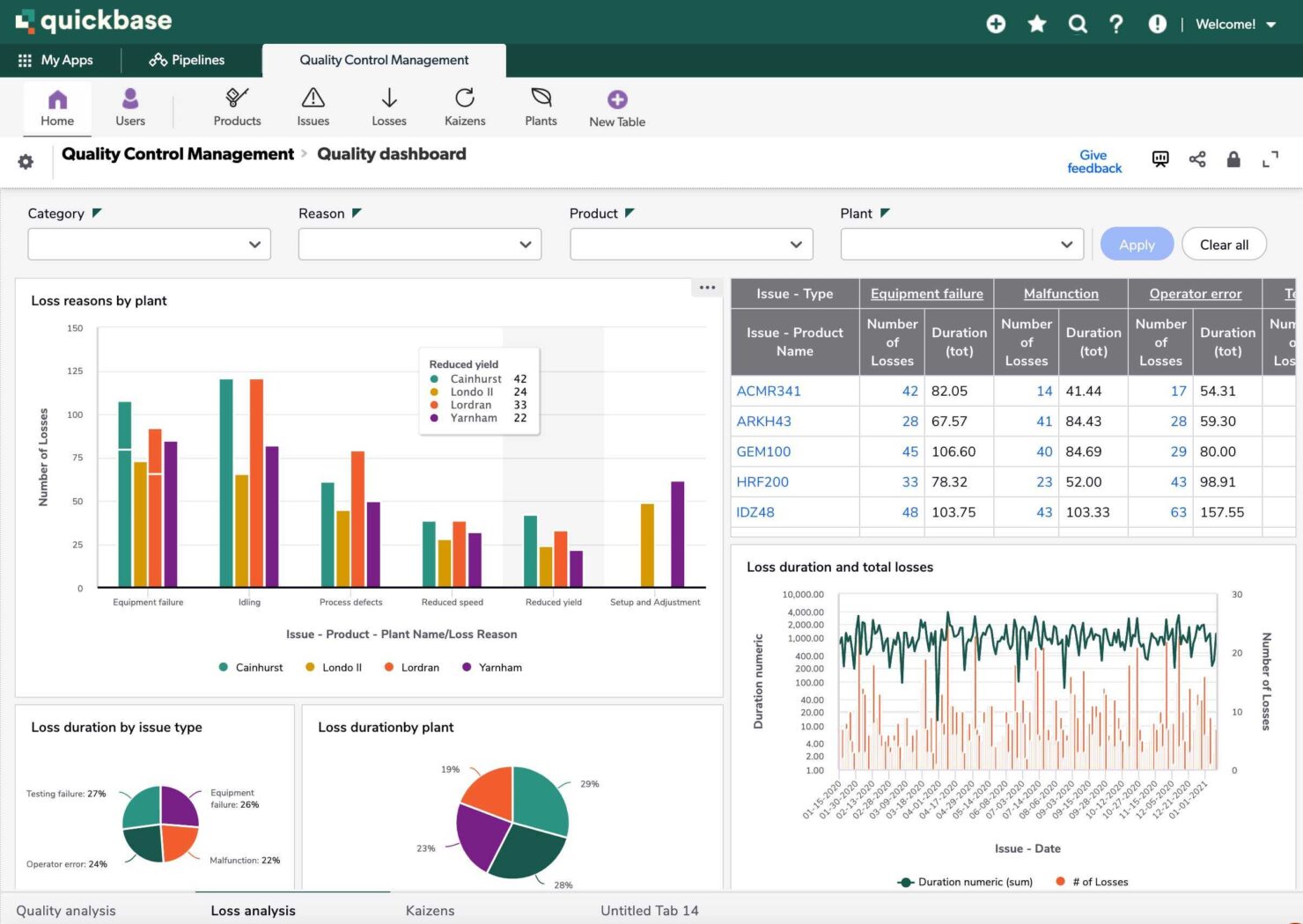
Custom dashboards: Quickbase apps enable you to build personalized dashboards that display the metrics, reports, and data most relevant to your team. You can tailor dashboards by role or user, embedding charts, tables, calendars, and KPIs to match your workflow. These dashboards provide a real-time, visual overview of project progress, resource allocation, and performance trends, which can help teams stay aligned and make informed decisions quickly.
Automated workflows: Quickbase allows you to automate repetitive tasks by setting up triggers, conditions, and actions using its built-in Pipelines feature. This helps teams save time, reduce manual errors, and ensure consistency across processes. Common automations include sending notifications, updating records, generating reports, and integrating with third-party tools without manual intervention.
Reporting tools: Quickbase provides powerful reporting capabilities that let you generate real-time, data-driven reports to monitor project performance, identify trends, and support decision-making. You can create customizable reports using tables, charts, summary views, and filters. Users can also schedule reports, apply permissions, and use pre-built report templates to access insights quickly.
Collaboration features: Quickbase helps teams stay connected through real-time data updates, shared views, and role-based access controls. Users can share files, add notes to records, tag teammates, and subscribe to updates to ensure everyone stays informed as work progresses.
Role-based permissions: Quickbase can help you control access to data and functionality through granular, role-based permissions. You can assign users to roles with specific rights to view, edit, add, or delete records within apps or tables. This ensures that sensitive information remains secure and that team members only access the data relevant to their responsibilities. Permissions can also be customized by user group, form, field, or report level, which allows for highly tailored access control.

Ease of Use
Quickbase's ease of use is decent, but it requires some learning to unlock its full potential. While the platform provides drag-and-drop tools and no-code customization, users often report that it takes time and guidance to become proficient, particularly when building more complex apps.
The user experience is functional but less modern compared to newer project management platforms, which can affect how quickly some teams adapt. However, once users become familiar with the system, Quickbase’s customization and automation capabilities deliver substantial value.
The ability to tailor workflows, integrate systems, and automate processes stands out as one of Quickbase’s core strengths. For teams willing to invest the time in setup and training, the long-term payoff is significant.

Quickbase Specs
- A/B Testing
- API
- External Integrations
- Multi-User
- Third-Party Plugins/Add-Ons