

Reseña de Moxo: Ventajas, Desventajas, Características y Guía de Precios para 2026



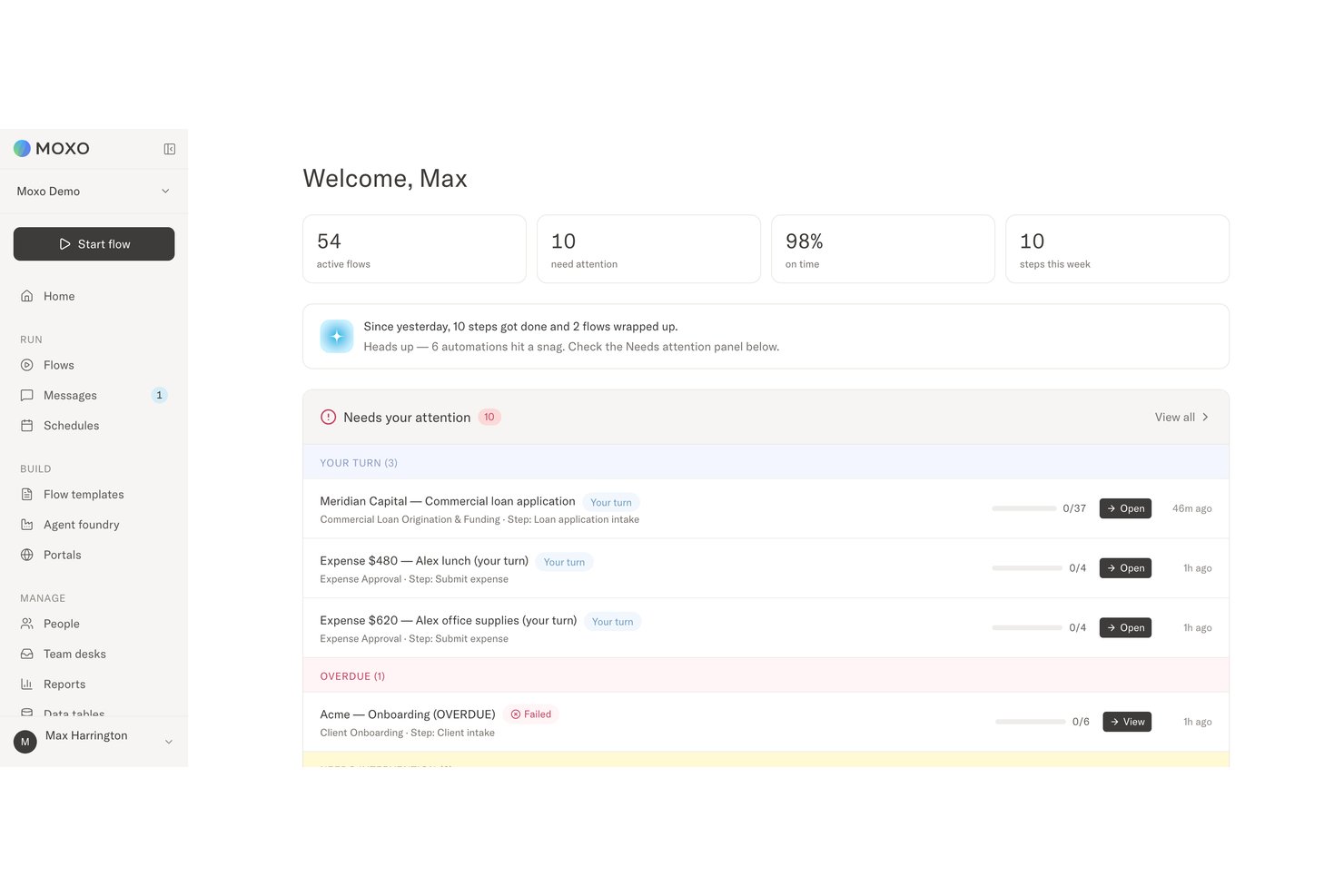
Moxo is a workflow automation software built for client-facing processes like onboarding, document collection, and approval workflows. I'd consider it if your team is coordinating these steps across email chains, shared drives, and scattered chat threads. It's a better fit than something like monday.com if your workflows involve external clients. Moxo gives those clients a dedicated workspace to participate directly, rather than treating them as an afterthought to an internal tool.
Moxo Evaluation Summary
- From $5,000/year (billed annually)
- Free demo available
Por qué confiar en nuestras recomendaciones de software
Nuestro equipo lleva probando y evaluando software desde 2012. Como gestores de proyectos, sabemos lo difícil —y lo importante— que es elegir el software adecuado.
Para esta guía, evaluamos las herramientas mediante pruebas prácticas e investigación independiente, puntuando las herramientas según nuestros criterios de selección. También nos basamos en la experiencia de líderes de opinión del sector y de profesionales en activo de la gestión de proyectos.
Nuestras reseñas reflejan nuestro criterio editorial humano, no un discurso de ventas.
Revisores expertos:
Moxo Overview
In my opinion, Moxo works best when automation needs to cross company boundaries without removing people from critical decisions. Its no-code builder, Agent Foundry, custom portals, SLA controls, and audit trails automate routine coordination while preserving accountability. Advanced flows can take time to configure, but the depth suits service-based and compliance-heavy organizations.
pros
-
Agentic AI handles preparation, validation, routing, and monitoring
-
Custom portals keep external participants aligned
-
Human-in-the-loop controls, SLA rules, and audit trails reinforce accountability
cons
-
Advanced workflow design requires an adjustment period
-
Less common integrations may require Zapier, Composio, or APIs
-
Reporting focuses on process operations rather than customizable BI
Is Moxo Right For Your Needs?
Who Would be a Good Fit for Moxo?
Moxo suits organizations automating repeatable processes across internal teams and external stakeholders. It is particularly useful when workflows involve several handoffs, client or vendor collaboration, compliance requirements, or decisions that need a traceable human owner.
-
Professional Services Firms
Accounting, legal, consulting, and marketing firms can manage client onboarding, document collection, approvals, and recurring service delivery.
-
Financial Services and Insurance
Banks, lenders, wealth managers, and insurers can coordinate applications, compliance checks, exception reviews, signatures, and client decisions.
-
Healthcare Administration
Healthcare organizations can manage provider credentialing, intake, document verification, acknowledgements, and approval-heavy processes.
-
B2B SaaS Customer Operations
Customer success and implementation teams can coordinate onboarding, account reviews, renewals, and service requests across customers and internal specialists.
-
Real Estate and Construction Firms
Moxo helps organize contracts, approvals, vendor requirements, project documentation, and communication between clients, brokers, contractors, and internal staff.
-
Manufacturing and Logistics Operations
Operations teams can use Moxo for vendor onboarding, order fulfillment, compliance checks, document requests, and other multi-party workflows.
Who Would be a Bad Fit for Moxo?
Moxo may be too much platform for simple, fully autonomous, or highly technical workflows. Businesses needing basic data sync, personal task management, developer-led BPMN modeling, or IT ticketing will likely get better value from a specialized tool.
-
Ecommerce and Retail Businesses
Online stores handling quick, one-off customer purchases may not need Moxo’s portals, structured handoffs, or long-running workflows. A commerce or customer support platform will usually be a better fit.
-
IT Service Management Departments
Internal IT teams managing incidents, service requests, and ticket queues will likely need dedicated ITSM features rather than Moxo’s client and stakeholder orchestration tools.
-
Developer-Led BPM Programs
Organizations that want engineers to build and maintain highly technical BPMN workflows may find Moxo too business-user focused. A developer-centric process engine will offer more control over complex process architecture.
-
Solo Consultants and Freelancers
Independent professionals managing personal tasks or a small number of clients may find Moxo more complex than necessary. Its strongest capabilities are designed for processes involving multiple participants, roles, and approvals.
-
Businesses Needing Basic Data Sync
Organizations that only need to move information between a form, CRM, and another application will likely be better served by a lightweight automation platform with more one-click connectors.
-
Fully Automated Back-Office Operations
Businesses aiming to run processes entirely through systems and AI, with no human approvals or exception handling, may not align with Moxo’s human-accountability model.
Nuestra Metodología de Revisión
Cómo probamos y puntuamos las herramientas
Llevamos años construyendo, refinando y mejorando nuestro sistema de prueba y puntuación de software. La rúbrica está diseñada para capturar los matices de la selección de software y los factores que hacen efectivo a un sistema, centrándose en los aspectos críticos del proceso de toma de decisiones.
A continuación, puedes ver exactamente cómo funciona nuestro proceso de prueba y puntuación en base a siete criterios. Esto nos permite proporcionar una evaluación imparcial del software basada en la funcionalidad principal, características destacadas, facilidad de uso, incorporación, soporte al cliente, integraciones, opiniones de clientes y valor por el dinero.
Funcionalidad principal (25% de la puntuación final)
El punto de partida de nuestra evaluación es siempre la funcionalidad principal de la herramienta. ¿Cuenta con las funciones y características básicas que un usuario esperaría ver? ¿Alguna de estas funciones principales está limitada a planes de precios superiores? Esperamos que la herramienta se mantenga a la par de las capacidades básicas de sus competidores.
Características destacadas (25% de la puntuación final)
A continuación, evaluamos las características destacadas poco comunes que van más allá de la funcionalidad principal normalmente encontrada en este tipo de herramientas. Una puntuación alta refleja funciones únicas o especializadas que hacen que el producto sea más rápido, eficiente, o aporte valor extra al usuario.
También evaluamos la facilidad de integración con otras herramientas habitualmente presentes en el ecosistema tecnológico para ampliar la funcionalidad y utilidad del software. Las herramientas que ofrecen muchas integraciones nativas, conexiones de terceros y acceso por API para integrar soluciones personalizadas obtienen la mejor puntuación.
Facilidad de uso (10% de la puntuación final)
Consideramos cuán rápido y fácil es ejecutar las tareas fundamentales usando la herramienta. El software con alta puntuación está bien diseñado, es intuitivo, ofrece aplicaciones móviles, proporciona plantillas y hace que tareas relativamente complejas parezcan sencillas.
Incorporación (10% de la puntuación final)
Sabemos lo importante que es una adopción rápida para un nuevo sistema, así que evaluamos cuán sencillo es aprender a usar la herramienta con una capacitación mínima. Analizamos cuán rápido un miembro del equipo puede configurarse y comenzar a usar la herramienta sin experiencia previa. Las soluciones mejor puntuadas indican que se requiere poco o ningún soporte.
Soporte al cliente (10% de la puntuación final)
Revisamos la rapidez y facilidad para obtener ayuda por teléfono, chat en vivo o base de conocimientos. Las empresas que ofrecen soporte en tiempo real obtienen las mejores puntuaciones, mientras que los chatbots obtienen las peores.
Opiniones de clientes (10% de la puntuación final)
Además de nuestras propias pruebas y valoraciones, consideramos la puntuación neta del promotor de clientes actuales y anteriores. Revisamos la probabilidad de que, ante la opción, quisieran elegir la herramienta de nuevo por su funcionalidad central. Un software con una puntuación alta refleja una gran satisfacción de sus usuarios actuales o pasados.
Valor por el dinero (10% de la puntuación final)
Por último, tomando en cuenta todos los criterios mencionados, comparamos el precio promedio de los planes básicos respecto a las funciones principales y el valor aportado por los otros criterios. El software que entrega más por menos recibirá una puntuación superior.
Core Features
No-Code Workflow Builder
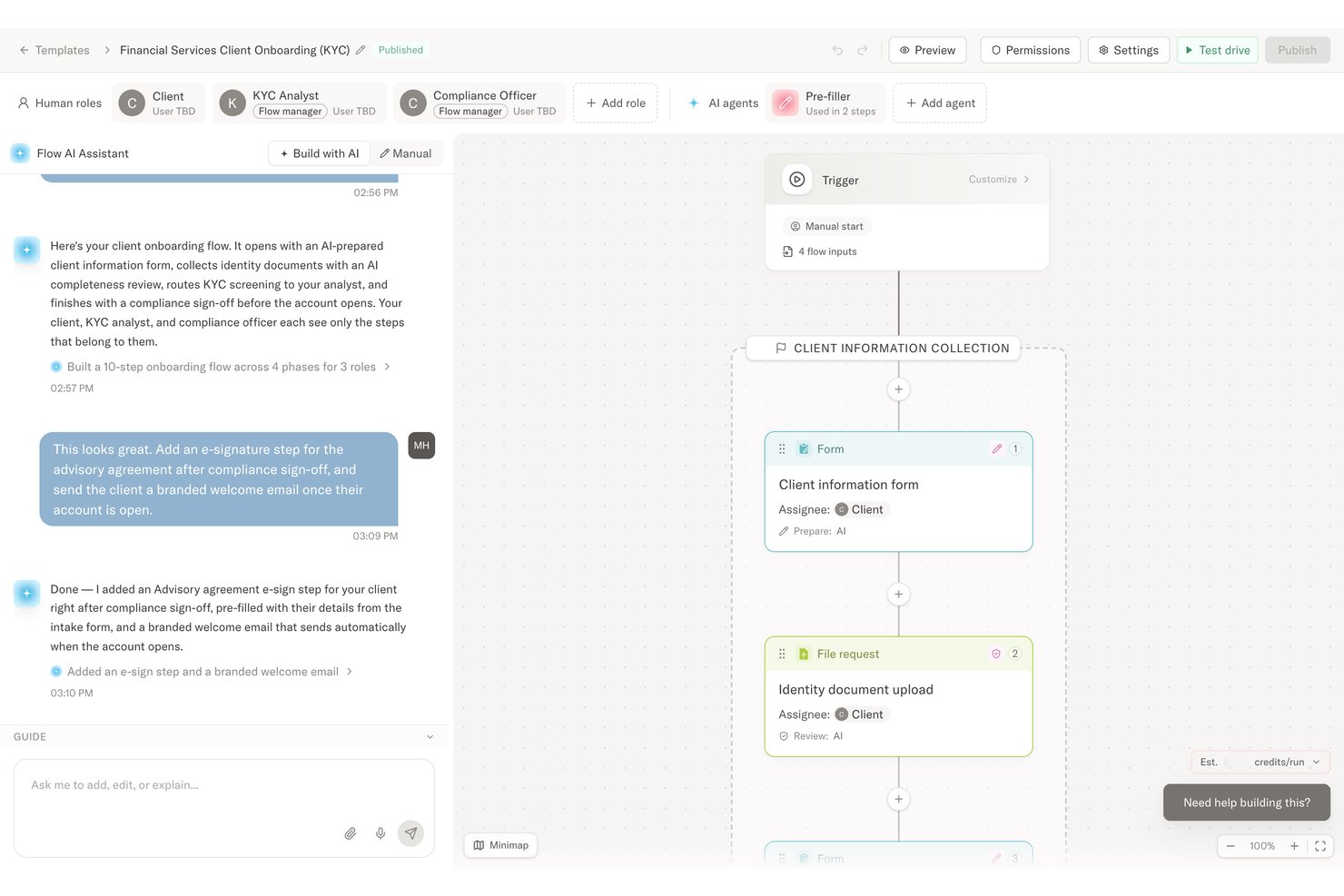
Teams can describe a process in plain language, upload a document or diagram, or start from a template. Moxo generates structured steps, roles, branching logic, data references, deadlines, and escalation rules without requiring code.
Business Process Orchestration
Moxo automates and coordinates workflows across employees, clients, vendors, partners, AI agents, and connected systems. It supports processes such as customer onboarding, implementations, service delivery, account management, order fulfillment, training, and vendor onboarding.
Agent Foundry
Agent Foundry lets teams build AI agents that prepare work, validate information, recommend actions, complete routine steps, and monitor progress. Agents follow workflow permissions and can escalate exceptions when human judgment is needed.
Workflow Actions and Approvals
Teams can add tasks, forms, questionnaires, file requests, acknowledgements, decisions, approvals, payments, and e-signatures. These actions keep submissions, reviews, and sign-offs moving in the correct order.
Custom Portals
Moxo provides branded portals that can also be configured for vendors, partners, franchisees, and other participants. Each person sees the messages, files, resources, and actions relevant to their role, while magic links allow access without an account, password, or app download.
Process Insights and Audit Trails
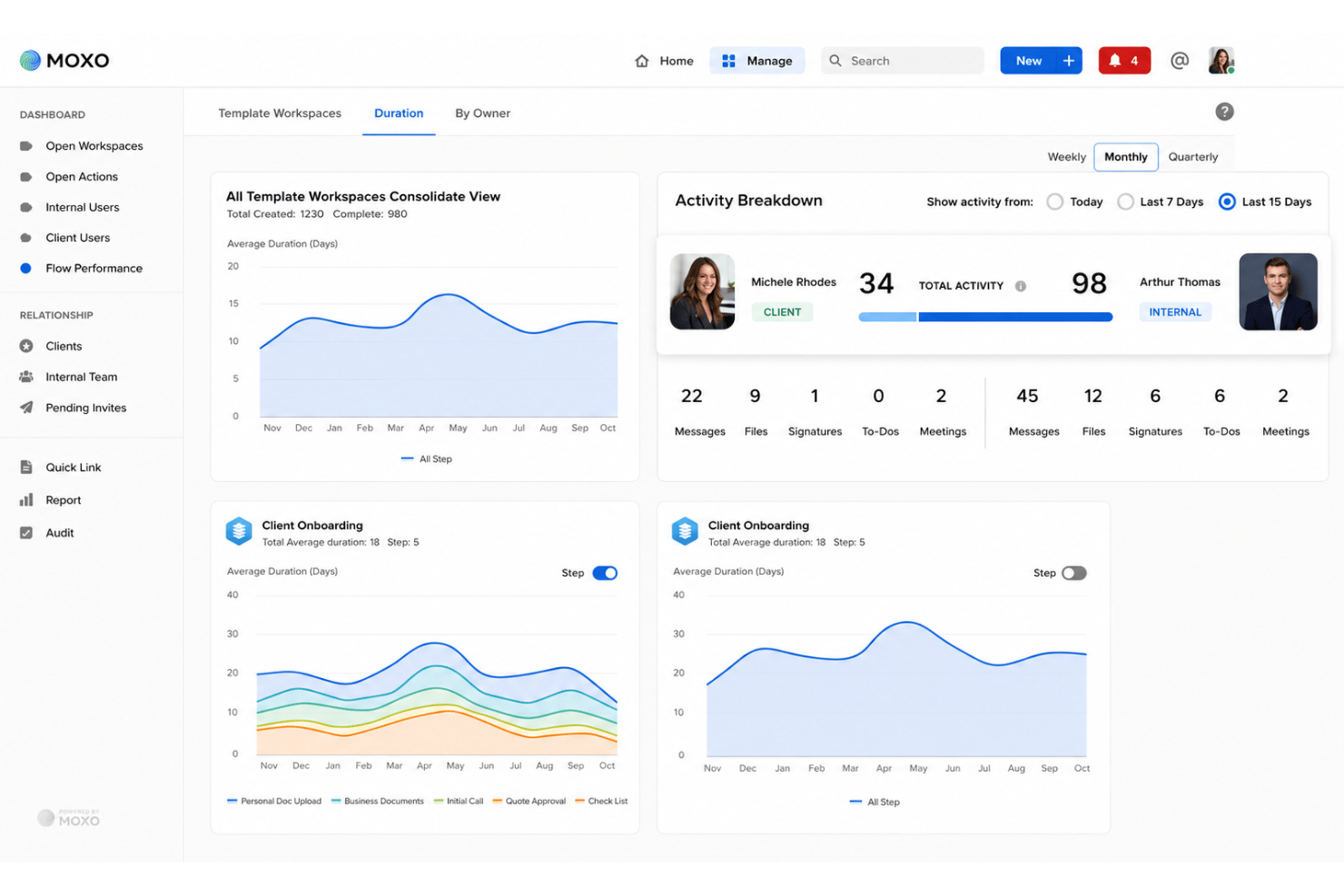
Moxo tracks status, ownership, delays, cycle times, throughput, and SLA performance. Dashboards, a Pulse Score, reports chat, and audit trails help teams identify bottlenecks and trace decisions to the responsible participant.
Standout Features
Human-in-the-Loop Decision Controls
AI agents can prepare, validate, route, and monitor work, while people remain responsible for approvals, exceptions, compliance sign-offs, and other judgment-based decisions.
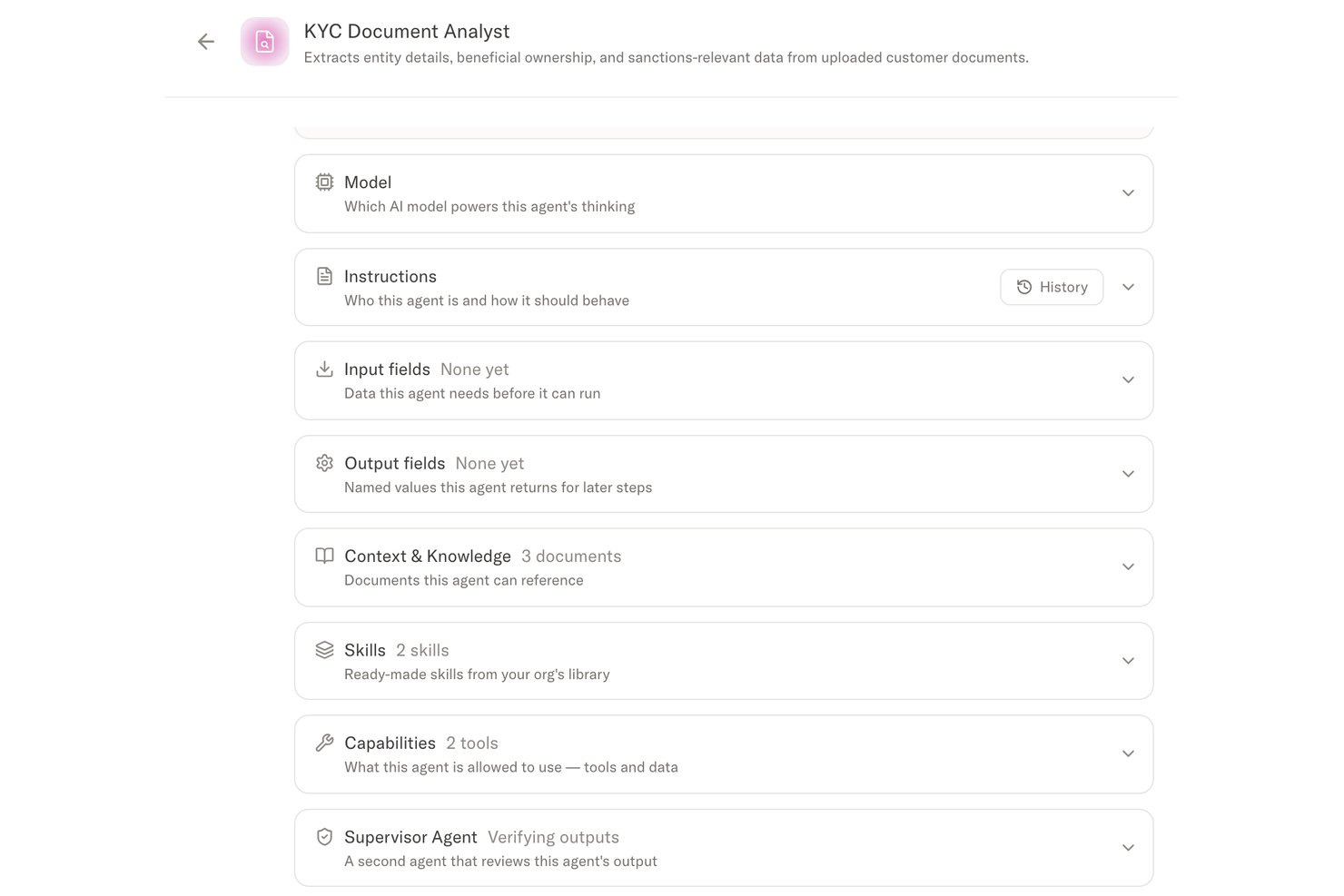
Multi-Agent Supervision
Moxo allows one agent to review another agent’s output, flag anomalies, and escalate work that falls outside its assigned scope. This adds oversight to complex and regulated processes.
Ease of Use
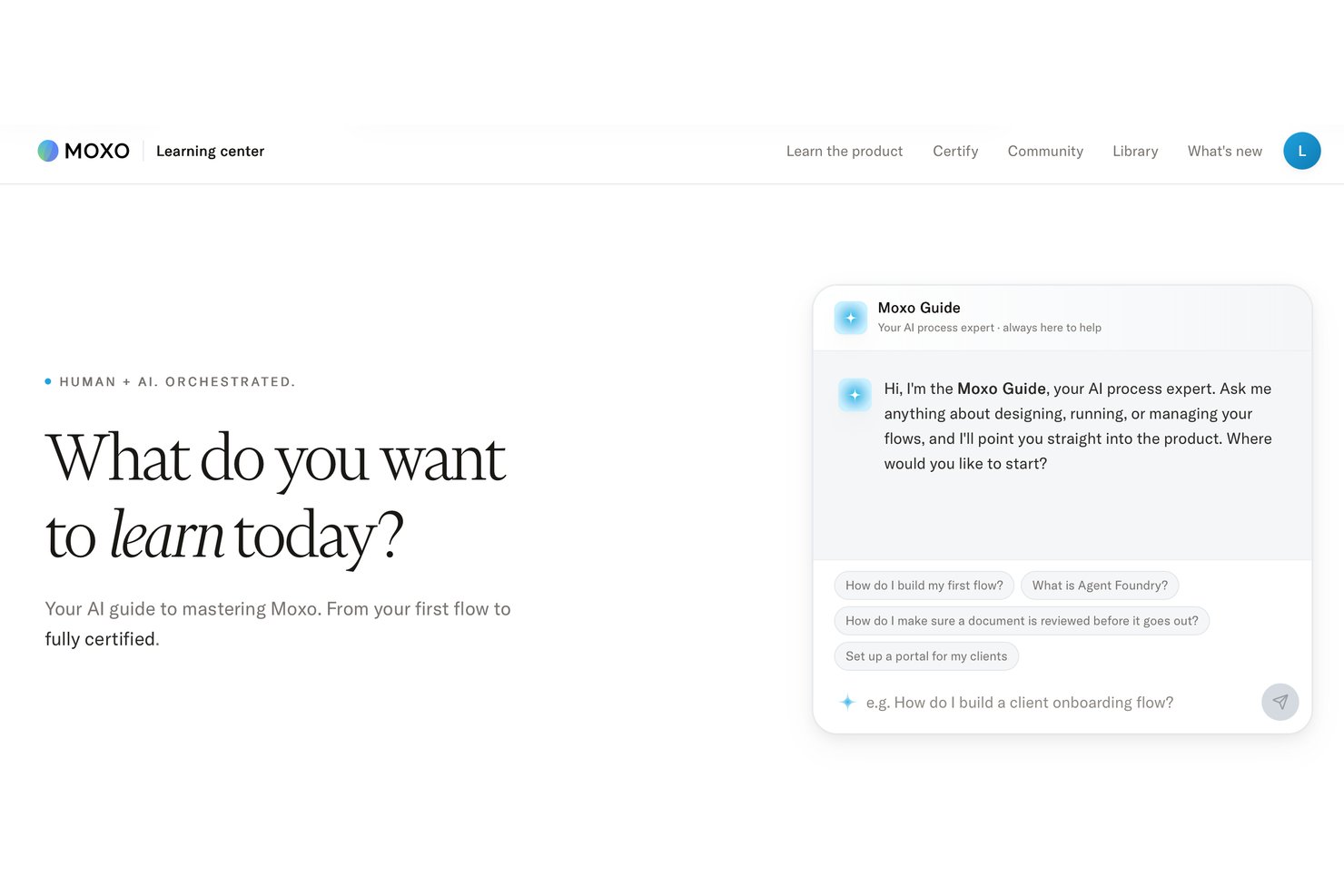
Moxo is easier to learn than its feature set might suggest. The no-code builder, templates, and conversational setup reduce reliance on IT, although advanced flows with branching, multiple roles, and supervised agents still require an adjustment period.
Onboarding
Moxo offers self-serve and guided onboarding. Coordinators can build and launch a flow from a prompt, template, document, or diagram the same day, while larger rollouts involving multiple workspaces and agents may take several weeks. Technical setup is mainly limited to optional APIs, webhooks, and SSO.
Customer Support
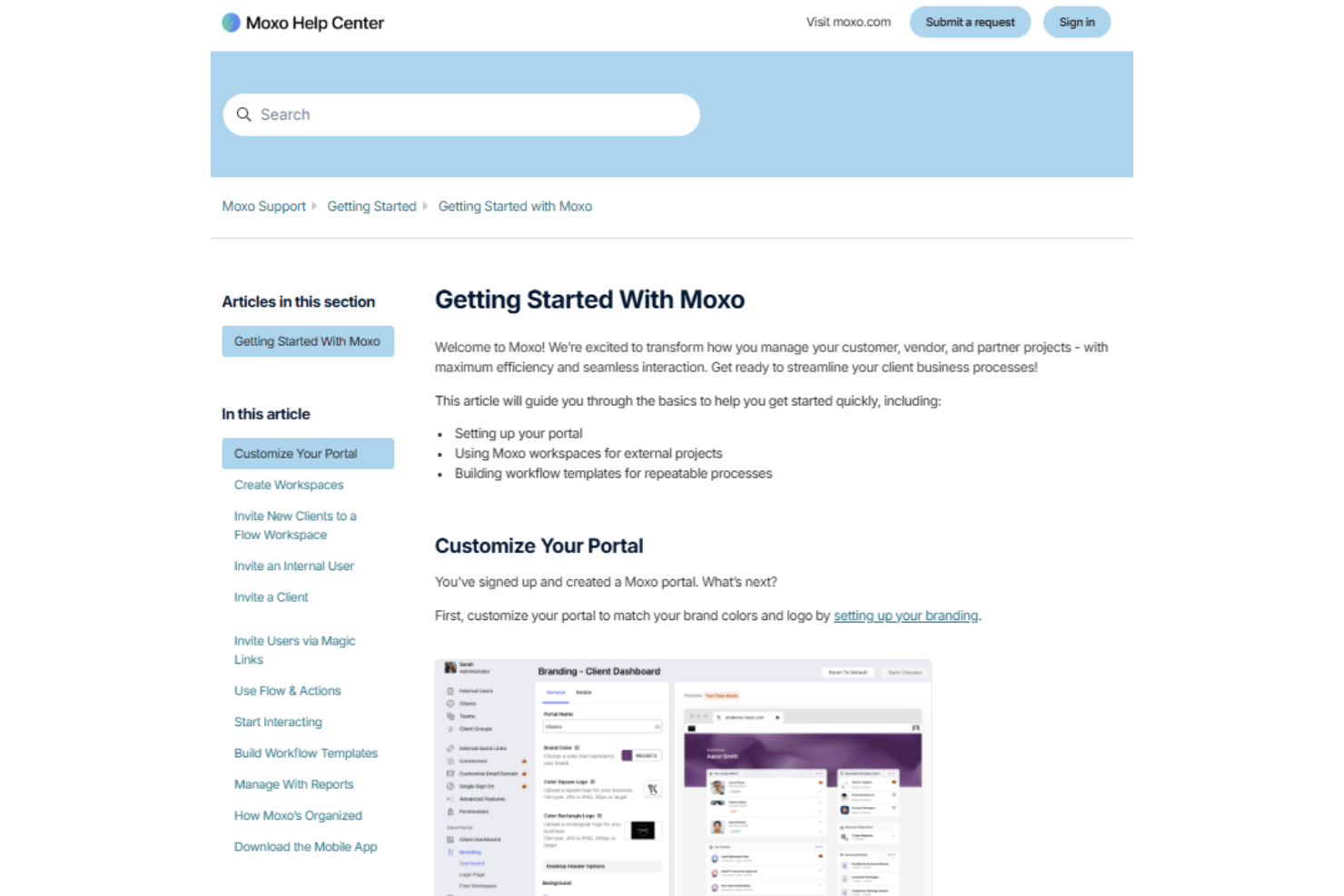
Moxo includes in-app support on Free and Business, a customer success manager on Pro, and a forward-deployed engineer on Enterprise. Users can also access a self-service Help Center with setup guides and documentation covering platform use, administration, Moxo AI, integrations, automations, and the mobile app, as well as a form for submitting technical support requests. Larger deployments can include process consulting and implementation assistance.
Integrations
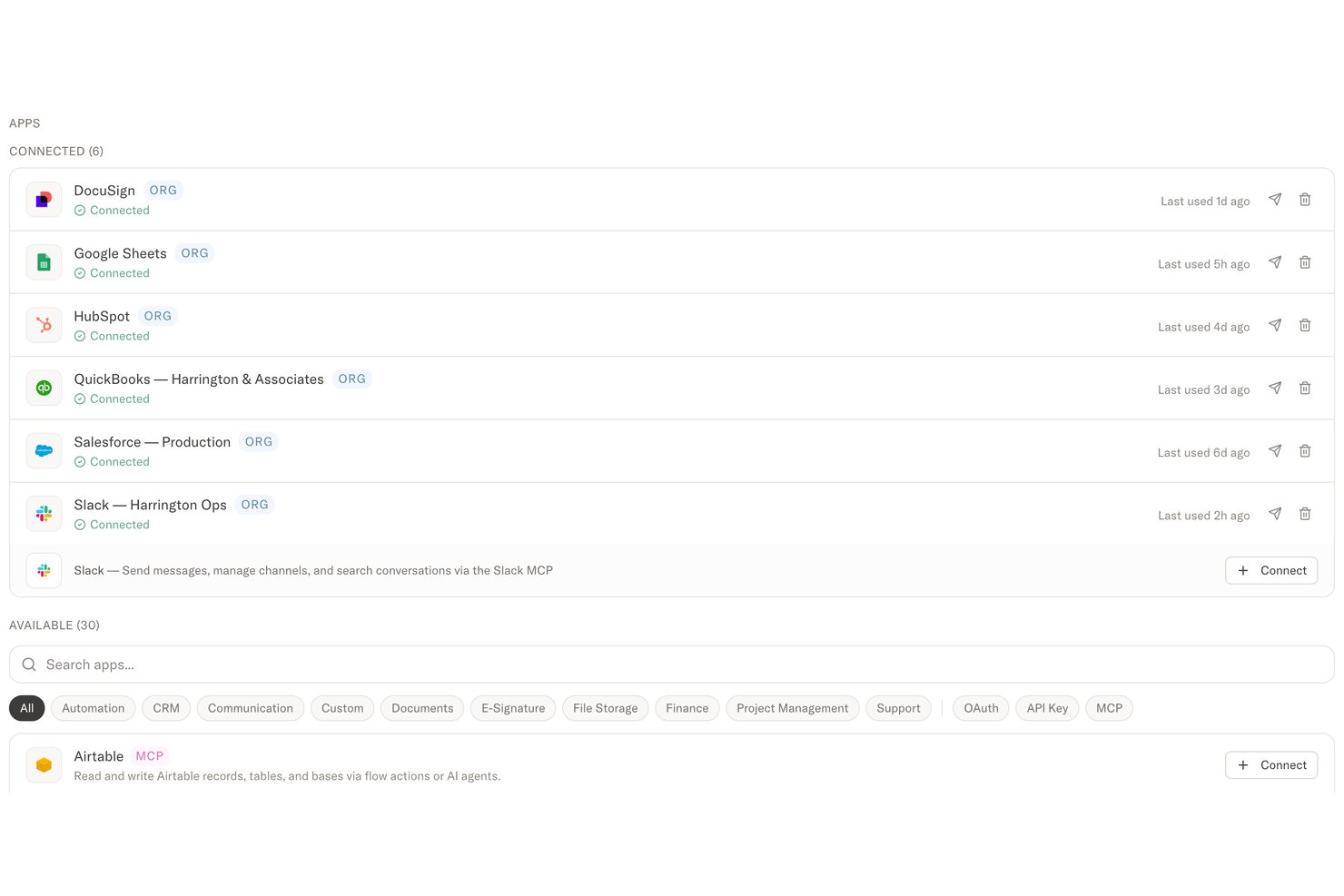
Integrations include DocuSign, Gmail, HubSpot, Slack, Jira, Salesforce, Box, QuickBooks, SAP, Stripe, Jotform, and Microsoft Dynamics 365. An API is available for building custom integrations and pushing or pulling data between Moxo and other systems, with webhooks and Zapier also supported for additional automation.
Value for Money
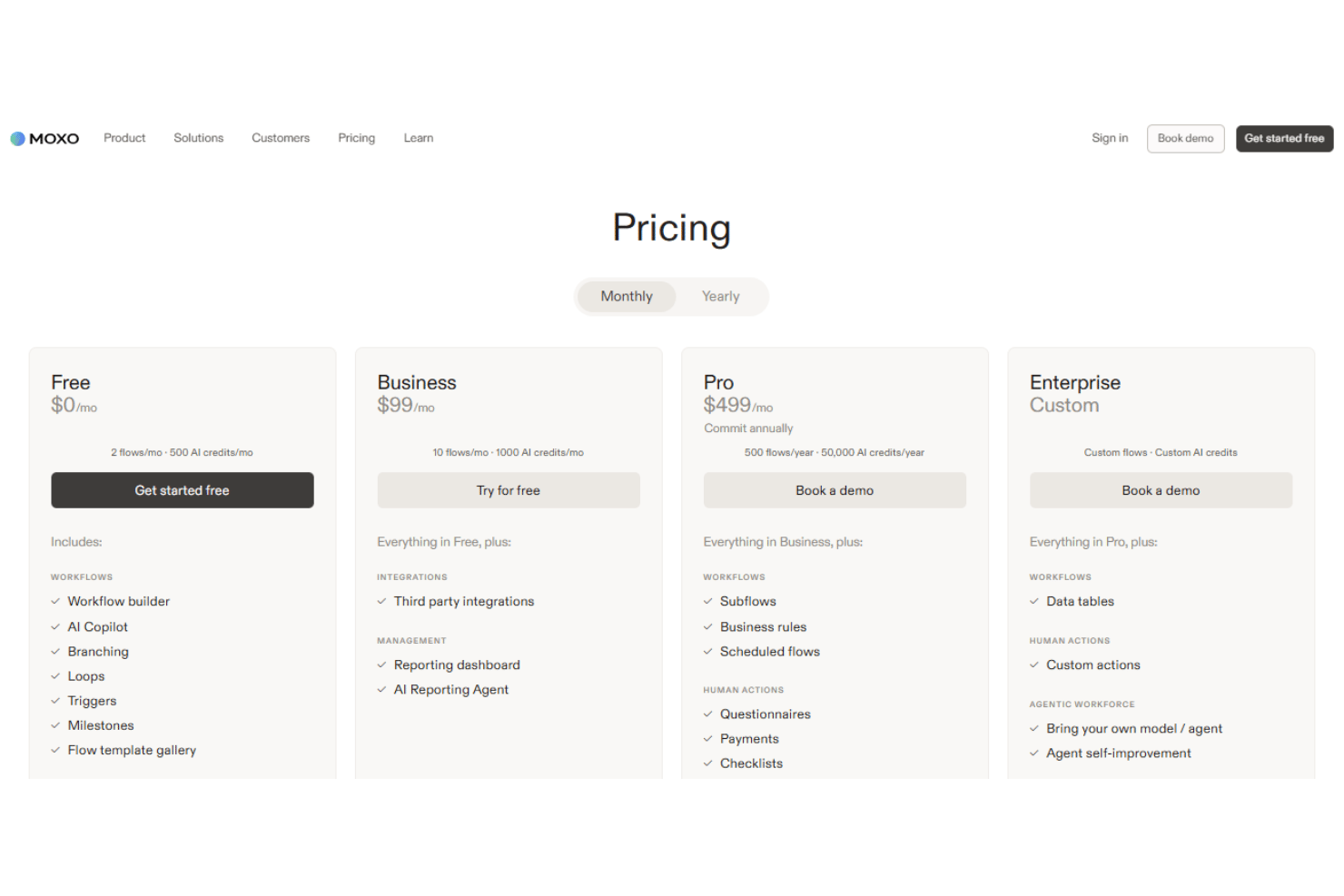
Moxo offers good value when automation involves multiple participants, approvals, AI agents, and connected systems. Free and Business are useful for getting started, but Pro contains many of its main capabilities, including custom portals, advanced agents, APIs, SSO, and audit logs. It is harder to justify for basic automation, but the cost makes more sense when missed handoffs or delayed approvals have real consequences.
- Free: Includes the no-code workflow builder, branching, loops, triggers, templates, approvals, forms, decisions, e-signatures, file requests, basic agents, AI utilities, magic links, and in-app support.
- Business: Adds higher workflow and AI limits, a reporting dashboard, and an AI Reporting Agent.
- Pro: Adds subflows, business rules, scheduled flows, payments, checklists, supervisor agents, advanced agent capabilities, custom portals, SMS notifications, custom domains, APIs, webhooks, MCP connections, SAML SSO, audit logs, and a customer success manager.
- Enterprise: Adds custom limits, data tables, custom actions, bring-your-own models or agents, custom workspace pages, embedded apps, custom code, and a forward-deployed engineer.
Moxo Specs
- Access Management
- Analytics
- API
- Approval Workflows
- Audit Trail
- Batch Permissions & Access
- Business Rules Mining
- Compliance Tracking
- Custom Reports
- Customer Management
- Data Export
- Data Import
- Document Management
- External Integrations
- Form Builder
- Multi-User
- Notifications
- Process Modeling
- Process Reporting
- Project Management
- Reports
- Risk Assessment
- Roadmapping
- White-label
- Workflow Management
Moxo FAQs
How long does it take to deploy Moxo?
Is Moxo only a client portal?
Does Moxo support custom branding?
What security features does Moxo provide?
Can Moxo automate approvals, reminders, and escalations?
Does human-in-the-loop mean a person must complete every step?
Is Moxo similar to Zapier?
Is Moxo easy for non-technical users?
How does Moxo handle e-signatures and document approvals?
Does Moxo require an IT team to manage it?
Moxo Company Overview & History
Moxo is a human-AI workflow automation and business process orchestration platform based in Cupertino, California. Founded in 2012 by Subrah Iyar, co-founder and former CEO of WebEx, and Stanley Huang, former Senior Director of Engineering at WebEx, the company originally operated as Moxtra.
It began as a mobile collaboration product before expanding into workflow automation across employees, external stakeholders, AI agents, and connected systems. Its current offering centers on no-code automation, agentic AI, process visibility, and auditable execution.
Moxo Major Milestones
- 2012: Moxtra was founded by Subrah Iyar and Stanley Huang in Cupertino, California.
- 2013: Moxtra officially launched its initial collaboration product for iPad and the web.
- 2020: Moxtra was named Best Digital Banking Solution Provider at the Banking Tech Awards.
- 2022: The company rebranded from Moxtra to Moxo as its offering expanded from collaboration into end-to-end client interaction workflows.
- 2024: Moxo won Best UX/UI Design in a SaaS Product at the Cloud SaaS Awards.