

Os 10 melhores softwares de SEO para agências analisados em 2026

Melhor seleção de software de SEO para agências


Gerir o SEO da sua agência pode ser difícil. Conciliar o acompanhamento de palavras-chave, os backlinks e os relatórios para clientes pode ser avassalador. É aqui que entra o software de SEO para agências. Este pode ajudá-lo a organizar tarefas, analisar dados e manter os clientes satisfeitos.
Com base na minha experiência, o software certo ajuda a poupar tempo e a melhorar os resultados. Testei e analisei várias opções e estou aqui para partilhar consigo as melhores ferramentas de SEO.
Neste artigo, vou orientá-lo pelas melhores opções de software, destacando aquilo que cada uma faz melhor. Vamos encontrar a solução certa para as necessidades da sua equipa.
Why Trust Our Software Recommendations
Our team has been testing and reviewing software since 2012. As project managers ourselves, we know how difficult—and important—it is to choose the right software.
For this guide, we evaluated tools using hands-on testing and independent research, scoring tools using our selection criteria. We also draw on insights from industry thought leaders and practicing project management experts.
Our reviews reflect our human editorial judgment, not a sales pitch.
Expert reviewers:
Tabela comparativa de software de SEO para agências
Esta tabela comparativa resume os detalhes de preços das minhas principais escolhas de software de SEO para agências.
| Tool | Best For | Trial Info | Price | ||
|---|---|---|---|---|---|
| 1 | Best for content relevance | 14-day free trial | From $129/month | Website | |
| 2 | Best for rank tracking | 14-day free trial + free demo available | From $103.20/month (billed annually) | Website | |
| 3 | Best for SERP tracking | Free plan available | From $37.70/month (billed annually) | Website | |
| 4 | Best for backlink analysis | Free plan available | From $29/month | Website | |
| 5 | Best for client reporting | Free demo + 14-day free trial | From $20/client/month (billed annually) | Website | |
| 6 | Best for competitor analysis | Free trial available | From $125/month | Website | |
| 7 | Best for keyword research | 14-day free trial | From $139/month | Website | |
| 8 | Best for SEO metrics | 7-day free trial + free demo available | From $79/month (billed annually) | Website | |
| 9 | Best for scalable SEO | Free demo available | Pricing upon request | Website | |
| 10 | Best for low-barrier SEO entry | Free plan + 7-day free trial available | From $20/month | Website |
Análises do melhor software de SEO para agências
Abaixo encontram-se os meus resumos detalhados do melhor software de SEO para agências que entrou na minha seleção. As minhas análises apresentam uma visão detalhada das principais funcionalidades, vantagens e desvantagens, integrações e casos de utilização ideais de cada ferramenta, para o ajudar a encontrar a melhor opção para si.

Best for content relevance

Clearscope is a content optimization tool designed for content creators and SEO professionals who want to strategically target their content's relevance and search engine visibility. It provides insights into how to improve content quality and keyword usage to achieve better rankings.
Why I picked Clearscope: It offers detailed analyses and recommendations for improving your content relevance. The tool helps you identify essential terms to include, which can boost your content's SEO performance. With its Content Grade feature, you can identify areas of improvement that you can address to ensure your content meets SEO standards.
Standout features and integrations:
Features include a scoring system that evaluates your content's SEO effectiveness. The term suggestions feature identifies important keywords that you can include to enhance your content's relevance. Additionally, its competitor analysis tool provides data-driven insights into how your content compares against top-ranking pages.
Integrations include Google Docs, WordPress, and Google Search Console.
Pros and Cons
Pros:
- Strong search intent matching
- Clear keyword usage guidance
- Precise content relevance scoring
Cons:
- Requires SEO understanding
- Narrow feature focus

Best for rank tracking

SE Ranking is an all-in-one SEO solution designed for marketers and agencies, focusing on comprehensive SEO task management. It caters to users who need tools for keyword ranking, website auditing, and competitor analysis to improve online visibility.
Why I picked SE Ranking: It focuses on rank tracking, offering detailed insights into keyword positions across search engines. The software provides a keyword suggestion tool that can be used to help you identify new market opportunities. With its in-depth competitor analysis features, you can view your competitors' performance in SEO, PPC, and AI search. Additionally, the website auditing tool can help you ensure that your site is optimized for search engines.
Standout features and integrations:
Features include a grid rank tracker for tracking local rankings and performing bulk data analysis. The customizable lead generator tool can be installed on your website and improve your rates of visitor conversion.
Integrations include Zapier, Bitrix24, SEO Tools for Excel, Reportz, and more.
Pros and Cons
Pros:
- Flexible pricing plans
- Large keyword datasets
- Reliable daily rank tracking
Cons:
- Heavy setup for new users
- The interface may feel dense

Mangools
Best for SERP tracking

Mangools is an SEO toolkit that helps you research keywords, track rankings, and analyze search results in one place. It’s used by marketers and SEO teams to plan content, monitor visibility, and study competitors.
Why I picked Mangools: Mangools provides clear, daily tracking of how keywords move in search results over time. You can monitor desktop and mobile rankings across different locations without the heavy setup. The SERP tracking tool shows position changes, estimated traffic, and overall performance in simple charts, which can make it easier to quickly spot gains and drops and act before rankings shift further.
Standout features and integrations:
Features include the SERPWatcher to view past ranking changes and historical data, an interactive performance index to track overall visibility, and custom automated alerts for major position shifts. You can also review volatility across tracked keywords in one view.
Integrations are not publicly listed.
Pros and Cons
Pros:
- Lightweight tool stack
- Accurate local SERP tracking
- Clean and readable interfaces
Cons:
- Fewer API controls than those of some competitors
- Limited automation features

Ahrefs
Best for backlink analysis

Pros and Cons
Pros:
- Powerful site explorer
- Mobile and desktop tracking features
- Industry-leading backlink database
Cons:
- Steep learning curve
- Limited social tools

Best for client reporting
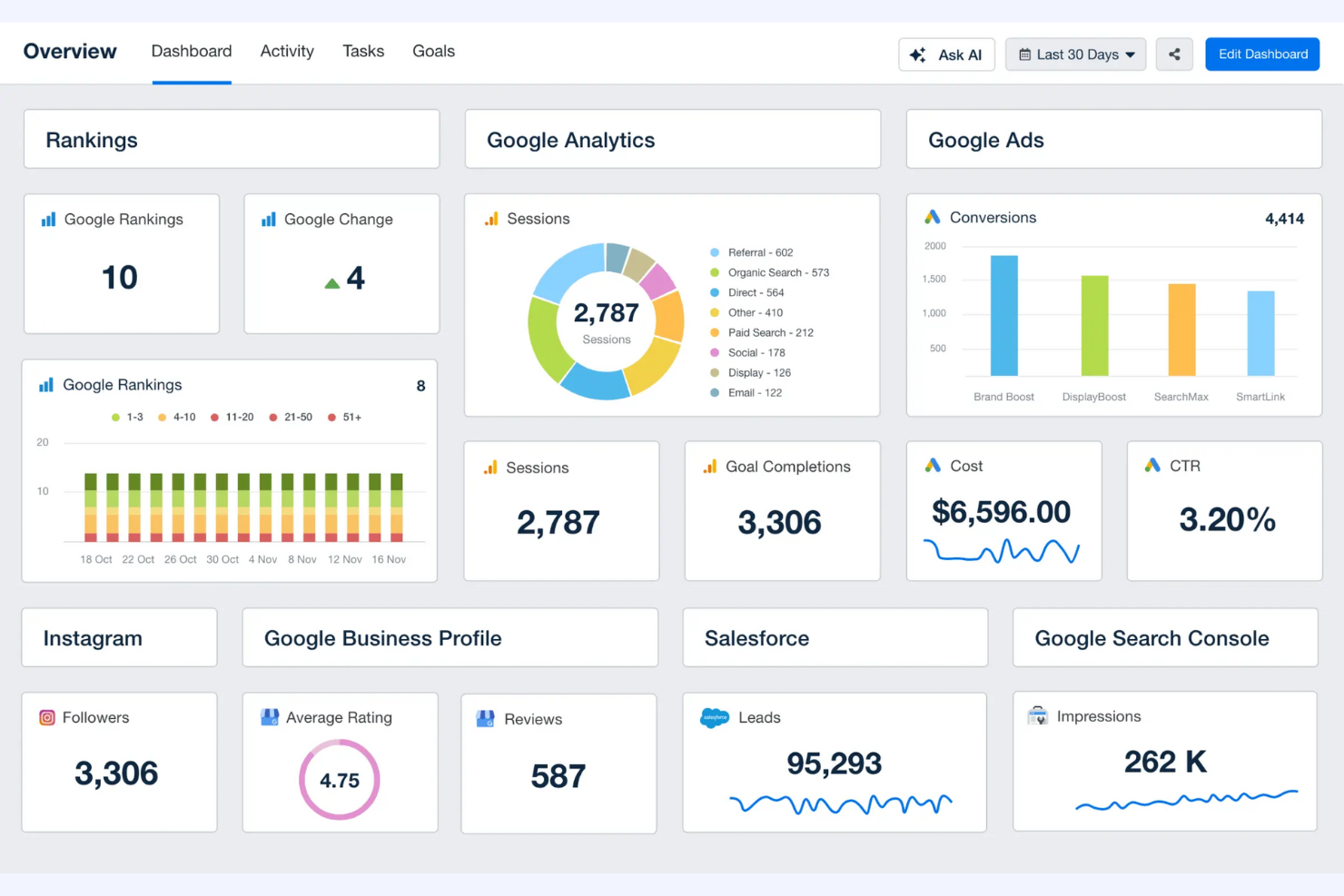
AgencyAnalytics is a reporting platform designed for digital agencies, helping them create detailed marketing reports and dashboards. It's aimed at agencies that need to track and showcase their marketing performance metrics to clients efficiently.
Why I picked AgencyAnalytics: It focuses on client reporting, offering customizable dashboards, automated report scheduling and approval, and pre-built report and dashboard templates that can save you time. You can also automate data collection and integrate data from various sources to create a unified report for your clients.
Standout features and integrations:
Features include a drag-and-drop dashboard builder that lets you customize reports according to client preferences. You can also take advantage of white-label reporting to maintain your agency's branding in all client communications.
Integrations include Google Analytics, Google Ads, Facebook Ads, Instagram, YouTube, LinkedIn Ads, and more.
Pros and Cons
Pros:
- Multi-client dashboard support
- Automated report scheduling
- Strong client reporting tools
Cons:
- Features are tailored for reporting
- Limited deep SEO analysis

Best for competitor analysis

Similarweb is a digital intelligence platform designed for marketers and business analysts looking to gain insights into online market trends and competitor performance. It helps users understand traffic sources, audience behavior, and industry benchmarks.
Why I picked Similarweb: It excels in competitor analysis, providing detailed insights into traffic sources and audience engagement. The platform offers industry benchmarks that can help you understand where your business stands in the market. With its audience behavior tools, you can tailor your strategies to meet the demands of your target audience.
Standout features and integrations:
Features include detailed traffic and market data analysis that can help you understand where your competitors get their traffic and identify areas of consumer demand. The AI SEO Strategy Agent can benchmark specific content and cluster topics to help you prioritize as you refine your SEO strategy.
Integrations include Salesforce, HubSpot, Microsoft Excel, Looker Studio, and more.
Pros and Cons
Pros:
- Useful audience behavior insights
- Strong market benchmarking
- Detailed traffic source modeling
Cons:
- Limited historical accuracy
- Expensive for small agencies

Semrush
Best for keyword research

Semrush is a digital marketing and SEO platform used to research keywords, analyze competitors, and track search performance. It helps you plan content, monitor rankings, and audit sites from one workspace.
Why I picked Semrush: Semrush offers SEO marketing tools for finding and analyzing search terms at scale. You can see keyword volume, difficulty, trends, and intent before committing to content or campaigns. The platform also shows which keywords your competitors rank for and where gaps exist, which can make it easier to plan content that targets real search demand. If your work depends on finding the right terms fast, Semrush supports that from idea development to result tracking.
Standout features and integrations:
Features include site auditing for finding technical issues, position tracking for monitoring search engine rankings over time, and topic research for building content ideas around core terms. You can also run backlink audits to check link quality to connect keyword work with overall site health.
Integrations include Google Analytics, Google Search Console, Looker Studio, WordPress, Trello, Zapier, and more.
Pros and Cons
Pros:
- Scalable for agency workflows
- Strong competitor visibility
- Large keyword dataset
Cons:
- Potential data overload for small teams
- Learning curve for beginners

Moz Pro
Best for SEO metrics

Moz Pro is an SEO software suite tailored for marketers and SEO professionals who need comprehensive tools for keyword research, link building outreach, and site audits. It helps users improve their search engine rankings and online visibility through actionable insights.
Why I picked Moz Pro: It focuses on SEO analysis, providing detailed metrics that give you a clear understanding of your site's performance. The keyword explorer tool helps you discover and prioritize the best keywords to target. With the link explorer, you can analyze your backlink profile and discover link-building opportunities. The Site Crawl feature identifies technical SEO issues so that your site remains optimized.
Standout features and integrations:
Features include rank tracking that monitors your site's local and national search engine rankings over time. The on-page optimization feature provides a prioritized list of specific recommendations for improving your site's performance. Additionally, the custom reports feature lets you create, run, and export detailed PDF or CSV reports tailored to your needs.
Integrations are not publicly listed.
Pros and Cons
Pros:
- Educational SEO ecosystem
- Clear site audit reports
- Solid backlink research
Cons:
- Restrictive free tier
- Expensive for feature depth

Best for scalable SEO

BrightEdge is an SEO platform designed for large SEO operations, helping businesses optimize their digital content and improve search engine rankings. It serves marketing teams and SEO specialists who need data-driven insights to inform their digital strategies.
Why I picked BrightEdge: It supports enterprise-level SEO with a suite of tools for large-scale data analysis and content optimization. The platform's Data Cube provides insights into search trends and opportunities. With its StoryBuilder feature, you can create visual SEO reports that showcase your local and global performance. Additionally, its ContentIQ tool identifies and displays errors in order of severity, helping you prioritize site fixes and make sure your content is optimized.
Standout features and integrations:
Features include the ability to track search performance across multiple devices and locations. The platform offers real-time analytics that can help you make informed decisions quickly. The Content Optimizer feature can be used to create competitive, SEO-friendly content that ranks well.
Integrations include Adobe Analytics, Google Analytics, Google Search Console, WordPress, and more.
Pros and Cons
Pros:
- Cross-channel reporting
- Strong content performance tracking
- Enterprise-scale SEO data
Cons:
- Requires trained specialists
- High pricing tiers

Ubersuggest
Best for low-barrier SEO entry

Ubersuggest is an SEO tool designed for marketers and small businesses that want to enhance their online visibility. It helps users with keyword research, site audits, and competitive analysis to improve their search rankings.
Why I picked Ubersuggest: It focuses on providing keyword suggestions, offering a wide array of terms to enhance your SEO strategy. The tool's site audit feature identifies SEO and code issues that need fixing to help you optimize your website. With its competitor analysis, you can gain insights into your rivals' strategies and adjust accordingly.
Standout features and integrations:
Features include a keyword overview that provides insights into search volume and competition. The content gap analysis feature can help you determine what content to create that resonates with your audience. Additionally, the backlink data feature shows you who’s linking to your competitors.
Integrations are not publicly listed.
Pros and Cons
Pros:
- Browser extension support
- Suitable for beginners
- Affordable SEO entry tool
Cons:
- Basic site audit depth
- No API or webhook support
Outro software de SEO para agências
Eis algumas opções adicionais de software de SEO para agências que não entraram na minha seleção, mas que ainda vale a pena conhecer:
- Google Search Console
For indexing issues
- Surfer SEO
For AI-generated writing
- Rankability
For AI-led content optimization
- Gumloop
For team collaboration
- Search Atlas
For local SEO
- AIOSEO
For WordPress SEO
- Whatagraph
For automated reporting
- TapClicks
For marketing analytics
- Screaming Frog
For technical SEO audits
- SEOTesting
For SEO experiment tracking


How I Evaluate SEO Agency Software
I split my evaluation into baseline criteria—things like multi-client workflow management and automated white-labeled reporting—and differentiators that separate tools worth recommending from the rest.
Core Functionality (Table Stakes For This List)
When I'm selecting tools for my list, I rank each one on a scale from 0 (does not offer the functionality) to 5 (excels in this area) for each core functionality listed below. Then, I calculate the tool's total score into a percentage. Each tool needs to achieve a minimum total score of 65% to be considered for inclusion.
- SEO Project Workflows: I look for templates and workflows designed around common SEO deliverables—like technical audits, keyword research sprints, or monthly on-page optimization cycles—rather than generic task boards.
- Client & Campaign Management: Managing 20+ retainer clients in one workspace gets messy fast, so I evaluate how each tool segments campaigns, organizes client accounts, and surfaces status at a glance.
- SEO Tool Integrations: A platform should connect to the tools agencies already rely on—Google Analytics, Search Console, Ahrefs, Semrush, or Moz—so data flows into project workflows without manual exports.
- Automated SEO Reporting: I check whether the tool can generate scheduled, white-labeled reports that pull in rankings, traffic, and backlink data so your team isn't rebuilding slides every month.
- Team Collaboration & Task Assignment: Agencies juggle writers, link builders, and strategists across accounts, so I evaluate task assignments, due dates, dependencies, and workload visibility across contributors.
- Client Portal & Approvals: I look for a dedicated client-facing view where stakeholders can review deliverables, leave feedback, and approve work—keeping sign-off loops out of scattered email threads.
Once I have a list of tools that meet this criteria, I consider what sets each platform apart.
Differentiating Factors (What Sets Vendors Apart)
Here's how I compare and contrast different vendors:
Standout Features
White-label branding matters when clients interact with your platform directly—I look for tools that let you apply your agency's logo, colors, and custom domain across portals and reports. Time tracking tied to specific clients and campaigns is another differentiator, since it helps you measure retainer profitability rather than just task completion. I also evaluate whether a tool offers AI-driven features like automated keyword clustering or content brief generation, which can cut hours off repetitive SEO workflows.
Beyond Features
Pricing structure is a big one—I evaluate whether a tool charges per user, per client, or at a flat rate, because the wrong model can erode margins as your agency scales. Integration depth also matters beyond just having a connector; I check whether data from tools like Semrush or Search Console syncs bidirectionally or just pulls surface-level metrics. Client confidentiality rounds out my evaluation, especially role-based access controls that keep one client's data isolated from another across your team.
Como escolher software de SEO para agências
É fácil perder-se em listas longas de funcionalidades e estruturas de preços complexas. Para o ajudar a manter-se concentrado enquanto desenvolve o seu processo específico de seleção de software, eis uma lista de fatores a ter em conta:
| Fator | O que considerar |
|---|---|
| Escalabilidade | O software consegue acompanhar o crescimento da sua agência? Considere se este suporta um número crescente de clientes e volumes de dados maiores, ou se precisa de software criado para agências de SEO de grande escala. Procure planos de preços flexíveis à medida que cresce. |
| Integrações | Funciona com as suas ferramentas atuais? Garanta a compatibilidade com plataformas como o Google Analytics, canais de redes sociais e sistemas de CRM. |
| Personalização | Pode adaptar o software aos seus fluxos de trabalho? Avalie a possibilidade de personalizar painéis, relatórios e permissões de utilizadores de acordo com as necessidades da sua agência. |
| Facilidade de utilização | O software é intuitivo para a sua equipa? Avalie a curva de aprendizagem e se a interface é fácil de utilizar para uma adoção rápida. |
| Implementação e integração inicial | Quanto tempo será necessário para começar a utilizar o software? Considere os recursos necessários para a configuração e a formação, incluindo o suporte e a documentação disponíveis. |
| Custo | O preço enquadra-se no seu orçamento? Compare os custos entre fornecedores, incluindo taxas ocultas, e considere o valor a longo prazo em vez das poupanças a curto prazo. |
| Medidas de segurança | Os dados dos clientes e as operações estão seguros? Verifique a conformidade com as normas de proteção de dados e a disponibilidade de encriptação e controlos de acesso. |
O que é software de SEO para agências?
O software de SEO para agências é um conjunto de ferramentas digitais concebidas para ajudar as agências a gerir e melhorar os esforços de otimização para motores de pesquisa dos seus clientes. Os profissionais de marketing, os especialistas em SEO e as agências digitais utilizam geralmente estas ferramentas para melhorar a visibilidade online e acompanhar o desempenho. As funcionalidades de acompanhamento de palavras-chave, análise de ligações de retorno e auditoria do site ajudam a otimizar o conteúdo, melhorar as classificações nas pesquisas e compreender a concorrência. De um modo geral, estas ferramentas fornecem informações valiosas que permitem tomar decisões fundamentadas e melhorar os resultados dos clientes.
Funcionalidades
Ao selecionar software de SEO para agências, procure as seguintes funcionalidades essenciais:
- Acompanhamento de palavras-chave: Monitoriza as classificações das palavras-chave para fornecer informações sobre o desempenho do seu site nos resultados de pesquisa.
- Análise de ligações de retorno: Avalia a qualidade e a quantidade das ligações de retorno para melhorar as estratégias de construção de ligações.
- Auditoria do site: Identifica problemas técnicos de SEO e fornece recomendações para os resolver.
- Análise da concorrência: Fornece informações sobre as estratégias de SEO dos concorrentes para ajudar a manter-se à frente no mercado.
- Relatórios automatizados: Gera relatórios detalhados sobre o desempenho de SEO, poupando tempo na compilação manual de dados.
- Otimização de conteúdo: Analisa o conteúdo para sugerir melhorias que permitam obter melhores classificações nos motores de pesquisa.
- Painéis personalizados: Permitem adaptar a apresentação dos dados às necessidades e preferências dos clientes.
- Ferramentas de SEO local: Melhoram a visibilidade das empresas nas pesquisas locais através da otimização das listagens locais.
- Análise em tempo real: Fornece dados atualizados para ajudar a tomar decisões fundamentadas rapidamente.
- Capacidades de integração: Permitem estabelecer ligação com outras ferramentas e plataformas para simplificar os fluxos de trabalho e a gestão de dados.
Vantagens
A implementação de software de SEO para agências proporciona várias vantagens para a sua equipa e para a sua empresa. Eis algumas das que pode esperar:
- Melhores classificações nas pesquisas: Ao utilizar o acompanhamento de palavras-chave e a otimização de conteúdo, o seu site pode obter uma melhor visibilidade nos resultados de pesquisa.
- Poupança de tempo: Os relatórios automatizados e as auditorias do site reduzem o tempo despendido em tarefas manuais, permitindo que a sua equipa se concentre na estratégia.
- Informações sobre a concorrência: A análise da concorrência fornece dados valiosos sobre as estratégias dos concorrentes, ajudando-o a tomar decisões fundamentadas para se manter à frente.
- Melhores relatórios para clientes: Os painéis personalizados e os relatórios automatizados oferecem informações claras e adaptadas, mantendo os clientes informados e satisfeitos.
- Melhores estratégias de construção de ligações: A análise de ligações de retorno ajuda a identificar e tirar partido de ligações de elevada qualidade para aumentar a autoridade do seu site.
- Maior visibilidade local: As ferramentas de SEO local garantem que a sua empresa aparece em destaque nos resultados de pesquisa locais, atraindo mais clientes da região.
- Decisões baseadas em dados: A análise em tempo real fornece informações atualizadas, permitindo tomar decisões rápidas e fundamentadas.
Custos e preços
A seleção de software de SEO para agências exige uma compreensão dos vários modelos de preços e planos disponíveis. Os custos variam consoante as funcionalidades, a dimensão da equipa, os complementos e outros fatores. A tabela abaixo resume os planos comuns, os respetivos preços médios e as funcionalidades normalmente incluídas nas soluções de software de SEO para agências:
Tabela de comparação de planos de software de SEO para agências
| Tipo de plano | Preço médio | Funcionalidades comuns |
|---|---|---|
| Plano gratuito | $0 | Acompanhamento básico de palavras-chave, auditorias limitadas do site e capacidades de elaboração de relatórios restritas. |
| Plano pessoal | $10-$30/utilizador/mês | Acompanhamento de palavras-chave, análise de ligações de retorno e informações básicas sobre a concorrência. |
| Plano empresarial | $50-$150/utilizador/mês | Auditorias avançadas do site, relatórios abrangentes e ferramentas de SEO local. |
| Plano empresarial de grande dimensão | $200-$500/utilizador/mês | Painéis personalizados, análise em tempo real e capacidades abrangentes de integração. |
Perguntas frequentes sobre software para agências de SEO
Aqui estão algumas respostas a perguntas comuns sobre software para agências de SEO:
É difícil implementar software para agências de SEO?
A maioria das plataformas modernas de SEO para agências foi concebida para uma configuração rápida, com guias de integração e recursos de formação. A dificuldade de implementação depende geralmente do grau de complexidade dos seus fluxos de trabalho atuais.
O software para agências de SEO pode ser integrado com outras ferramentas?
Sim, a maioria das plataformas integra-se com ferramentas de análise, sistemas CRM, plataformas de conteúdos e redes de publicidade. Verificar as integrações nativas antes da compra pode ajudar a evitar trabalho manual mais tarde.
Com que frequência são lançadas atualizações para o software para agências de SEO?
A frequência das atualizações varia consoante o fornecedor, mas a maioria lança melhorias regulares para funcionalidades, precisão dos dados e segurança. As plataformas maiores tendem a ser atualizadas com mais frequência.