

De 20 bedste softwareløsninger til konsulenter i 2026

Kortliste over den bedste konsulentsoftware


Konsulentsoftware giver dig værktøjerne til at administrere projekter, registrere tid, fakturere kunder og analysere resultater – alt sammen fra ét sted. Hvis du leder efter den bedste konsulentsoftware til virksomheder, søger du sandsynligvis efter måder at holde dit team organiseret på, få større indsigt i rentabiliteten af opgaver og reducere tidskrævende manuelt arbejde.
Denne guide gennemgår muligheder, der håndterer alt fra projektlevering til ressourceallokering, så alle moderne virksomhedskonsulenter kan skære igennem støjen og finde løsninger, der faktisk passer til virkeligheden i dagens konsulentarbejde. Du kan se, hvad hvert værktøj er bedst til, så du kan fokusere på det, der får din virksomhed til at bevæge sig fremad.
Why Trust Our Software Recommendations
Our team has been testing and reviewing software since 2012. As project managers ourselves, we know how difficult—and important—it is to choose the right software.
For this guide, we evaluated tools using hands-on testing and independent research, scoring tools using our selection criteria. We also draw on insights from industry thought leaders and practicing project management experts.
Our reviews reflect our human editorial judgment, not a sales pitch.
Expert reviewers:
Sammenligningstabel for konsulentsoftware
Denne sammenligningstabel opsummerer prisoplysninger for udvalgte konsulentsoftwareløsninger:
| Tool | Best For | Trial Info | Price | ||
|---|---|---|---|---|---|
| 1 | Best for tailored workflows for A&E firms | Free demo available | Pricing upon request | Website | |
| 2 | Best for built-in client relationship management | Free demo available | Pricing upon request | Website | |
| 3 | Best for ERP integration for services businesses | Free demo available | Pricing upon request | Website | |
| 4 | Best for connecting sales and delivery data | 14-day free trial | From $19.90/user/month (billed annually) | Website | |
| 5 | Best for real-time margin tracking | Free demo available | From $20/user/month | Website | |
| 6 | Best for extensive third-party integrations | 14-day free trial | From $9.99/user/month (billed annually) | Website | |
| 7 | Best for AI-driven workflows for project delivery | Free demo available | Pricing upon request | Website | |
| 8 | Best for mobile time tracking for teams | 30-day free trial available | From $14/user/month (billed annually) | Website | |
| 9 | Best for Salesforce-native platform integration | Free demo available | Pricing upon request | Website | |
| 10 | Best for agile project staffing | Free demo available | Pricing upon request | Website |

Anmeldelser af den bedste konsulentsoftware
Nedenfor finder du mine detaljerede opsummeringer af den bedste konsulentsoftware, der kom med på min kortliste. Mine anmeldelser giver et detaljeret indblik i funktionerne, de bedste anvendelsesområder og integrationerne for hver platform, så du kan finde den bedste løsning til dig.

BQE Core
Best for tailored workflows for A&E firms
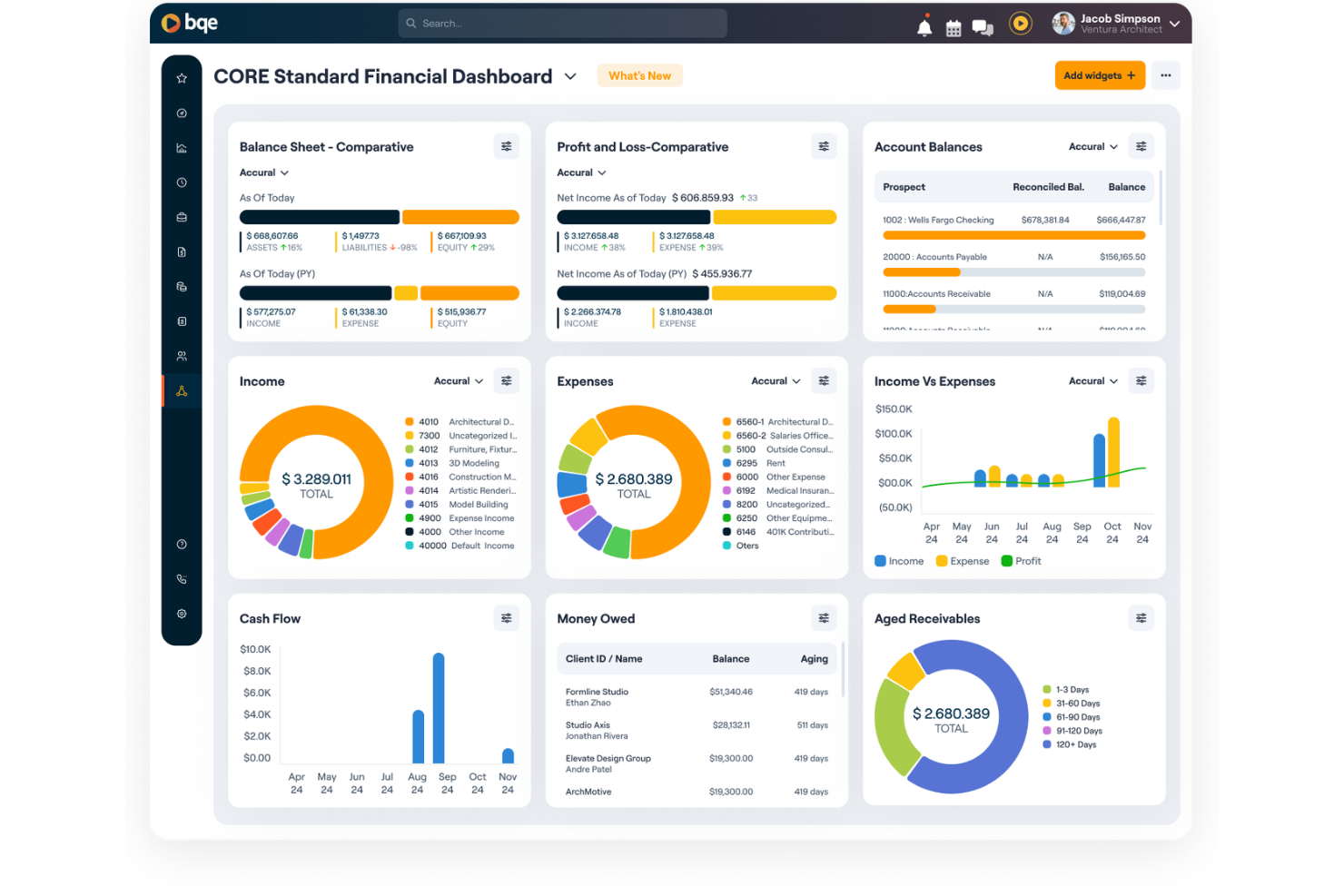
BQE Core is an all-in-one firm management platform built specifically for architecture and engineering firms, covering project management, time and expense tracking, billing, and financial reporting.
Who Is BQE Core Best For?
BQE Core is purpose-built for architecture, engineering, and consulting firms that need project accounting and billing tools designed around their specific delivery models.
Why I Picked BQE Core
I've included BQE Core in my top picks because it's one of the few consulting tools built from the ground up for A&E firms, not adapted from a generic project management platform. I like how it structures projects around fee types like fixed fee, hourly, and unit-based billing, which mirrors how A&E firms actually contract work.
The phase and task-level budget tracking lets my team monitor spend against each project phase in real time, so budget overruns surface before they compound.
BQE Core Key Features
- Resource planning: View team capacity and utilization across all projects using Gantt charts, then adjust allocations against project timelines and budgets.
- Time and expense tracking: Log hours with pause-and-play timers, set automatic timesheet reminders, and attach receipts directly to project expense records.
- Built-in CRM: Manage client relationships and business development activity from within the same platform used for project delivery and billing.
- Integrated accounting: Access profit and loss statements, balance sheets, and general ledger data alongside project financials in one unified view.
BQE Core Integrations
BQE Core offers 100+ native integrations, including QuickBooks, DocuSign, Power BI, Xero, Google, and Microsoft. It also connects with Zapier and provides public APIs for custom integrations.
Pros and Cons
Pros:
- Handles mixed project and retainer work
- AI flags project risks before escalation
- Unified quote-to-cash workflow tracking
Cons:
- Reporting customization options are limited
- Mobile app needs significant improvement
Best for built-in client relationship management

Deltek Vantagepoint is an ERP platform built for professional services firms, functioning as a robust time tracking software while covering project management, resource planning, financials, and client relationship management in one place.
Who Is Deltek Vantagepoint Best For?
Deltek Vantagepoint is a strong fit for architecture, engineering, and consulting firms that run project-based business models and need a single system for finance, projects, and client management.
Why I Picked Deltek Vantagepoint
I picked Deltek Vantagepoint as one of the best because its CRM module is purpose-built for project-based firms, not bolted on from a generic sales tool. Contact records connect directly to project history, pipeline stages, and pursuit tracking, so you can see the full client relationship in one place.
I also like the Dela AI layer, which surfaces client intel and flags relationship gaps based on activity data. That's a level of business development context most ERP platforms don't offer.
Deltek Vantagepoint Key Features
- Resource management: Assign staff to projects based on availability and role fit, then monitor workloads and adjust as project demands shift.
- Project financial tracking: Monitor project costs, budgets, and KPIs from a single dashboard with real-time alerts when metrics fall out of range.
- Time and expense automation: Use AI to simplify timesheet entry and expense reporting, reducing manual input across billable and non-billable work.
- Automated billing and invoicing: Configure billing rules per project and automate invoice generation to reduce the time between work delivered and payment received.
Deltek Vantagepoint Integrations
Deltek Vantagepoint offers native integrations with other Deltek products like GovWin IQ, Deltek PIM, Deltek ArchiSnapper, Microsoft Outlook, and UKG Pro. It also supports pre-built connectors on iPaaS platforms and a RESTful API for custom integrations.
Pros and Cons
Pros:
- Supports complex multi-method billing setups
- Tracks project budgets and margins in real time
- CRM and project data share one database
Cons:
- Interface fields can feel cluttered and dense
- Complex reporting setup slows initial adoption
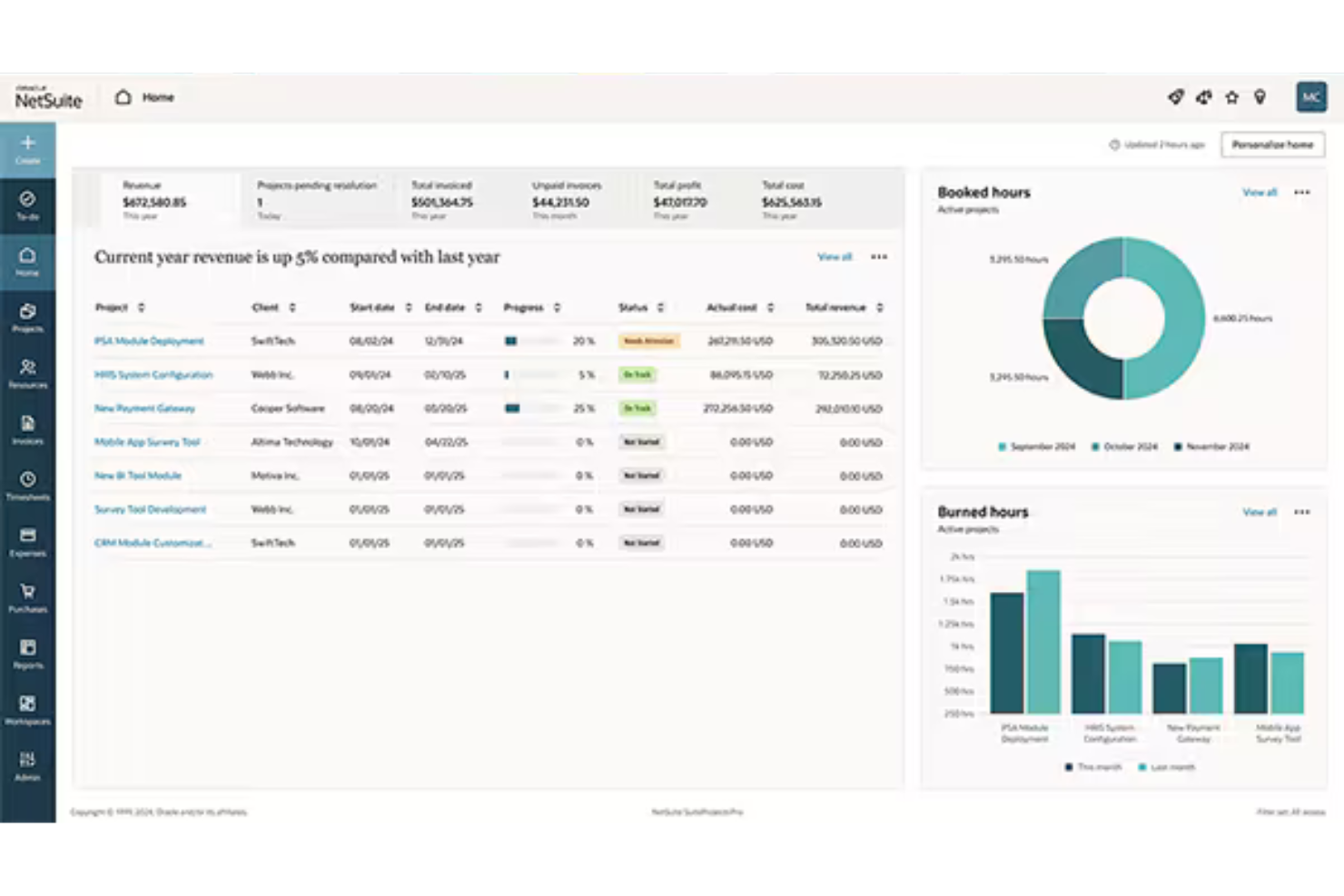
NetSuite SuiteProjects Pro is a cloud-based PSA platform that covers the full project delivery lifecycle for services businesses, including project management, resource planning, time and expense tracking, billing, and ERP-connected financials.
Who Is NetSuite SuiteProjects Pro Best For?
NetSuite SuiteProjects Pro is a natural fit for mid-size to enterprise services firms that run on NetSuite ERP and need project financials tightly connected to their broader business operations.
Why I Picked NetSuite SuiteProjects Pro
I've included NetSuite SuiteProjects Pro in my top picks because its ERP connection is genuinely bidirectional. Project costs, revenue recognition, and invoices flow directly into NetSuite Financials without manual exports or reconciliation. I also like that company executives can view all project metrics alongside sales, financials, and other KPIs from within NetSuite.
For consulting firms that already run on NetSuite, that unified visibility across delivery and finance is something you won't replicate by stitching two separate platforms together.
NetSuite SuiteProjects Pro Key Features
- Project Center: View project status, resource demand, risks, and budgets vs. actuals across all active projects in one place.
- Capacity planning: Allocate resources to projects based on skill set, experience, availability, and planned PTO.
- AI-generated project summaries: Monitor project changes and auto-generate up-to-date status summaries without manual drafting.
- Project template automation: Create new projects from preconfigured templates with built-in budgets, approval workflows, and billing rules.
NetSuite SuiteProjects Pro Integrations
NetSuite SuiteProjects Pro offers native integrations across the Oracle NetSuite ecosystem, including NetSuite ERP and NetSuite CRM. An API is available for custom integrations.
Pros and Cons
Pros:
- Unified time, expenses, and project accounting
- Skills-based resource search across global teams
- Built-in project billing and revenue recognition
Cons:
- Page load speeds lag during peak usage
- Reporting requires workarounds for deeper analysis

Scoro
Best for connecting sales and delivery data
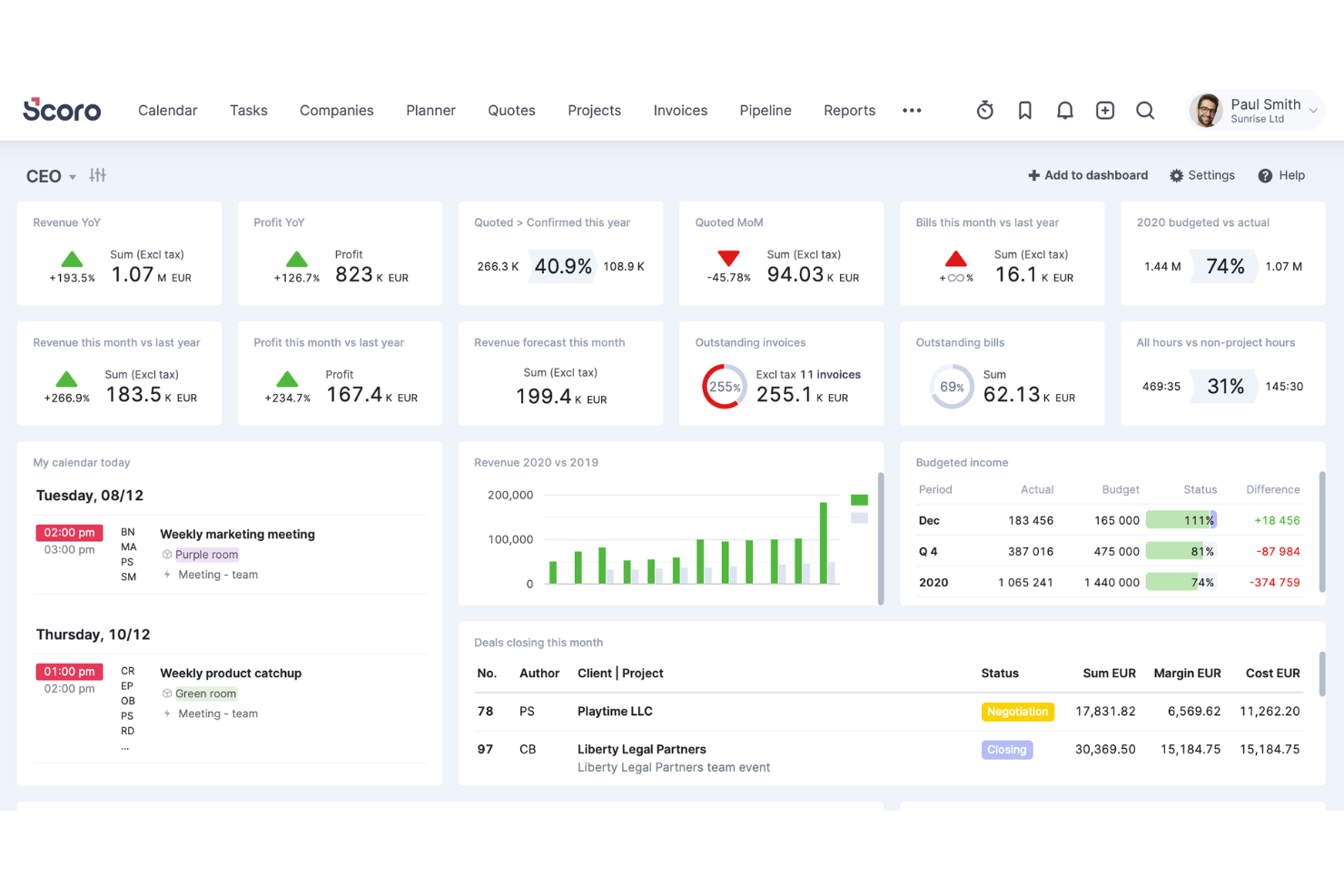
Scoro is an all-in-one business management platform for professional services firms that covers CRM, project management, time tracking, billing, and financial reporting in a single workspace.
Who Is Scoro Best For?
Scoro is a strong fit for growing professional services firms that need one system to manage the full client lifecycle, from first contact through invoicing.
Why I Picked Scoro
I've included Scoro in my top picks because it's one of the few consulting tools that keeps sales and delivery data in the same system rather than forcing you to stitch them together manually. I like that a won deal in the CRM flows directly into a scoped project with budgets, roles, and resource plans already attached. From there, time tracked against delivery feeds back into live profitability views at the project, service, and role level. That's a level of operational continuity I don't see in most competing PSA tools.
Scoro Key Features
- Quote and proposal builder: Create detailed quotes with line items, pricing tiers, and markup directly inside the platform before a project begins.
- Workload planner: View scheduled vs. available hours across your team in a drag-and-drop calendar to manage capacity across multiple active projects.
- Automated invoicing: Generate invoices based on tracked time, fixed fees, or project milestones without manually pulling data from separate systems.
- Customizable dashboards: Build dashboards tracking KPIs like billable ratio, revenue pipeline, and project status across your entire portfolio.
Scoro Integrations
Scoro offers native integrations with Xero, QuickBooks, Avalara, Stripe, Jira, Envoice, Google Calendar, Outlook, Slack, Mailchimp, and Dropbox. Zapier and an API are available for custom integrations.
Pros and Cons
Pros:
- Detailed quoting with role-based estimates
- CRM and billing in one workspace
- Real-time profitability views per project
Cons:
- Steeper onboarding than lighter PM tools
- Report customization can be difficult
New Product Updates from Scoro

Scoro Adds Time Mobile App and ELI Improvements
Scoro adds the Scoro Time mobile app for iOS/Android to track time anywhere and expands ELI with attachments, smarter filtering, and trigger-based actions. For more information, visit Scoro's official site.

BigTime
Best for real-time margin tracking
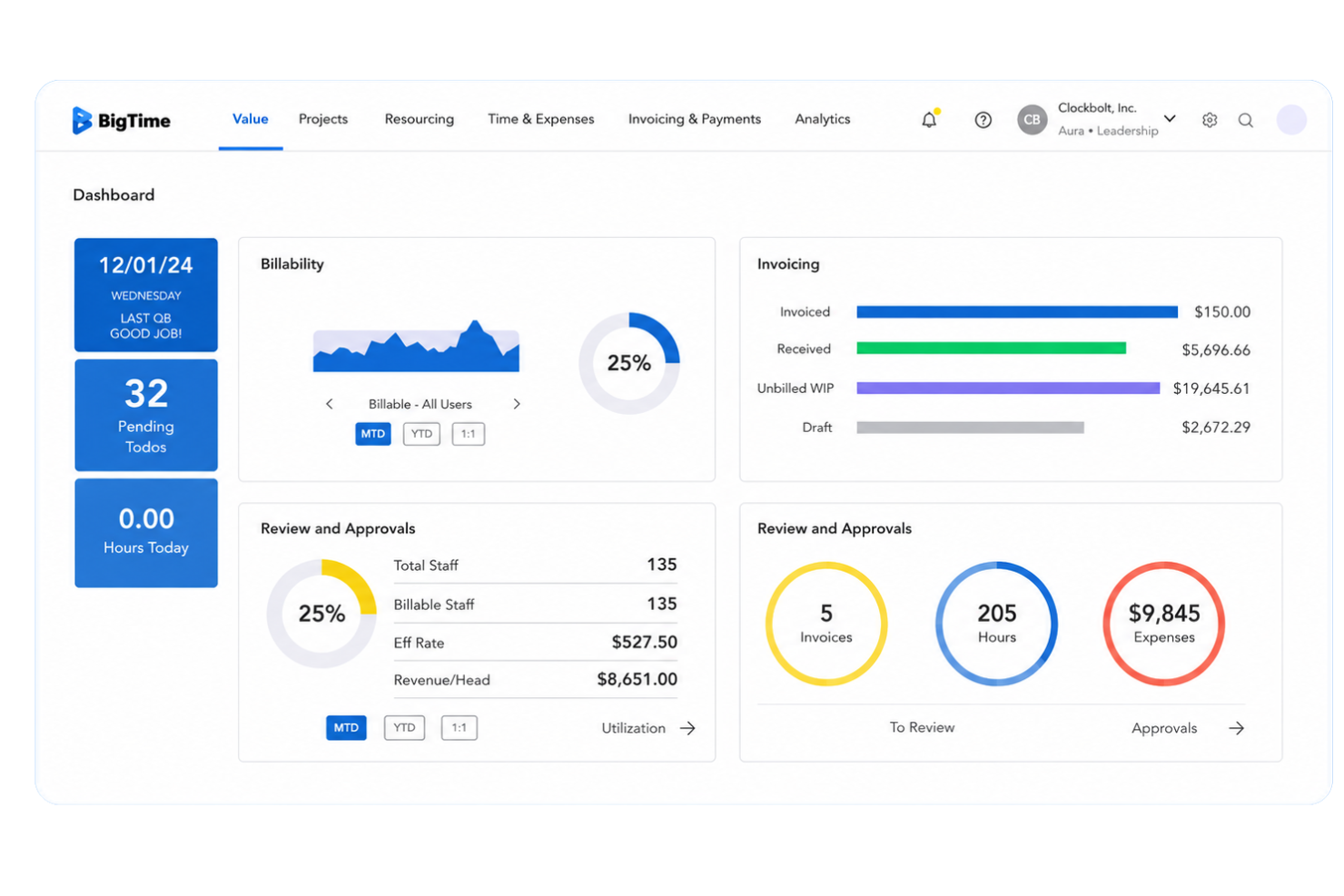
BigTime is a professional services automation (PSA) platform built for consulting, engineering, and IT services firms that need project management, time and expense tracking, resource scheduling, quoting, and billing in one place.
Who Is BigTime Best For?
BigTime is a strong fit for mid-sized professional services firms in consulting, accounting, and engineering that bill by the hour and need tighter control over project margins.
Why I Picked BigTime
BigTime earns its spot on my shortlist because of how it handles margin visibility in real time, not just at month-end. I like that the margin-informed Quote Builder shows live rate card data as you scope work, so you're not guessing at profitability before a project kicks off.
The budget vs. actuals tracking updates continuously throughout delivery, and the Resourcing Agent factors margin impact into every staffing decision before you confirm it. That combination means margin isn't something I'm reconciling after the fact.
BigTime Key Features
- Time and expense tracking: Log billable hours and expenses directly against projects, with that data feeding automatically into budgeting, invoicing, and performance reporting.
- Flexible invoicing and billing automation: Generate invoices based on tracked time, budget status, and billing models, including time-and-materials, fixed fee, and retainer arrangements.
- Real-time dashboards and custom reporting: Monitor KPIs like revenue, utilization, and project status at the project level or rolled up across your entire portfolio.
- Drag-and-drop resource scheduling: Visualize team availability, adjust workloads, and prevent overbooking directly from the resource management view.
BigTime Integrations
BigTime offers native integrations with QuickBooks, Xero, Sage Intacct, Hubspot, Jira, Smartsheet, Zendesk, Okta, Salesforce, Lacerte, Slack, and more, and provides an API for custom integrations.
Pros and Cons
Pros:
- Fast quote-to-project conversion with templates
- AI-assisted resource matching saves staffing time
- Built-in margin tracking during project scoping
Cons:
- Interface feels dated compared to newer competitors
- The mobile app has limited functionality
Best for extensive third-party integrations
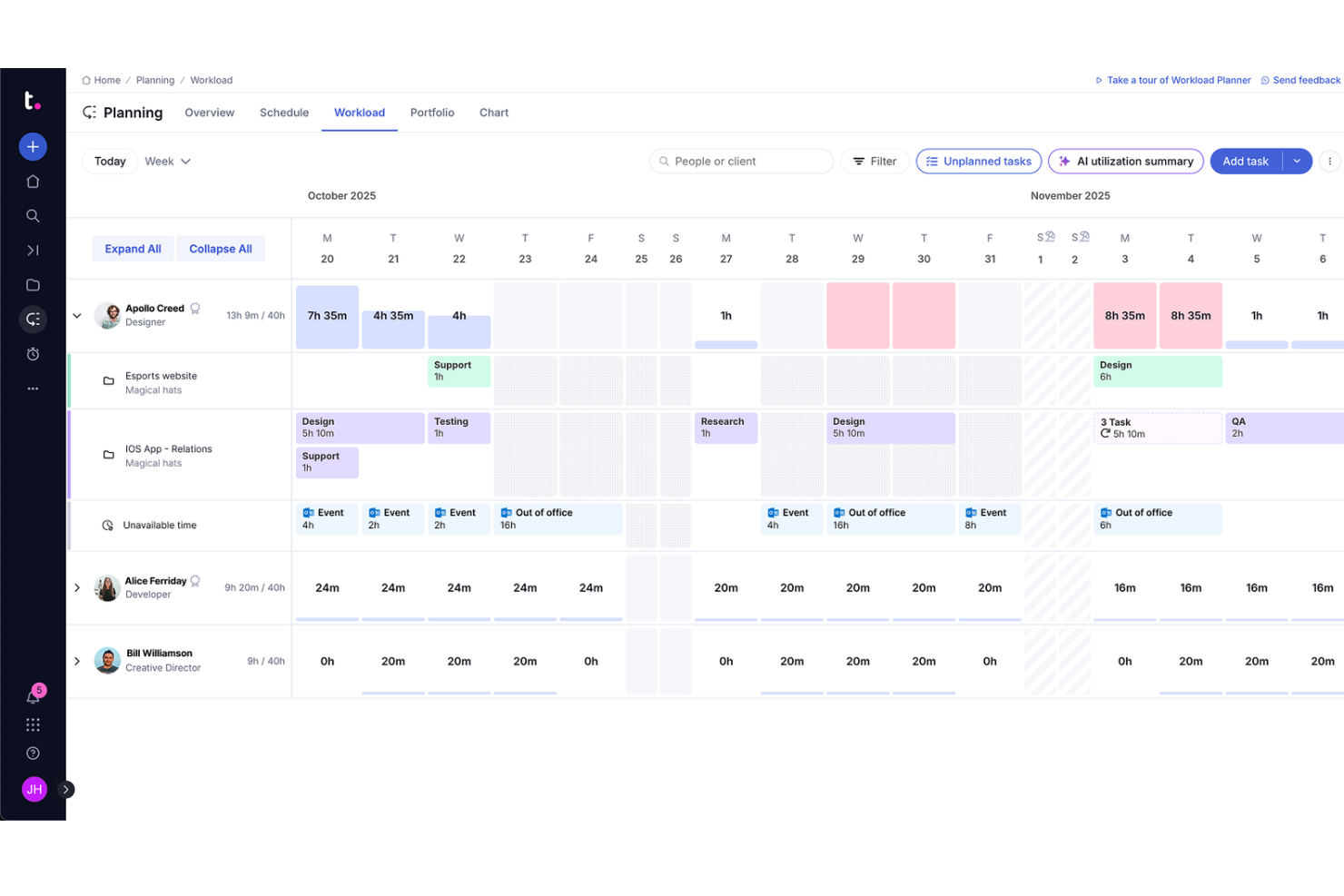
Teamwork.com is a project management and client operations platform built for professional services teams, combining task management, time tracking, resource planning, budgeting, and profitability reporting in one place.
Who Is Teamwork.com Best For?
Teamwork.com is a strong fit for small to mid-sized consulting agencies and client services teams that manage multiple projects and billable work simultaneously.
Why I Picked Teamwork.com
I've included Teamwork.com in my top picks because of how well it connects with the tools consulting teams already use daily. With 150+ integrations spanning CRM, accounting, file storage, time tracking, and reporting, you can pull Xero invoices, sync HubSpot deals, or manage files from Google Drive and Dropbox without leaving the platform.
I especially like the Microsoft Office Add-in, which lets you log time and create tasks directly from Word or Excel—something client-facing teams will use constantly.
Teamwork.com Key Features
- Client portal: A dedicated space where clients can log in to view project progress, files, and updates without needing a full account.
- Budget tracking: Set project budgets and monitor spend against estimates in real time at the task or project level.
- Workload management: View team capacity across all active projects and reassign tasks when someone is over-allocated.
- Retainer management: Track recurring client retainers, log hours against them, and monitor remaining budget per billing period.
Teamwork.com Integrations
Teamwork.com offers 150+ integrations, including native integrations with Slack, HubSpot, Salesforce, QuickBooks, Microsoft Teams, Xero, Harvest, Dropbox, Google Workspace, and NetSuite. It also connects with Zapier and Make, and provides an API for custom integrations.
Pros and Cons
Pros:
- Granular time tracking at the task level
- Client portal for external project visibility
- Built-in retainer tracking for recurring clients
Cons:
- Mobile app lacks full desktop functionality
- Reporting customization options feel limited

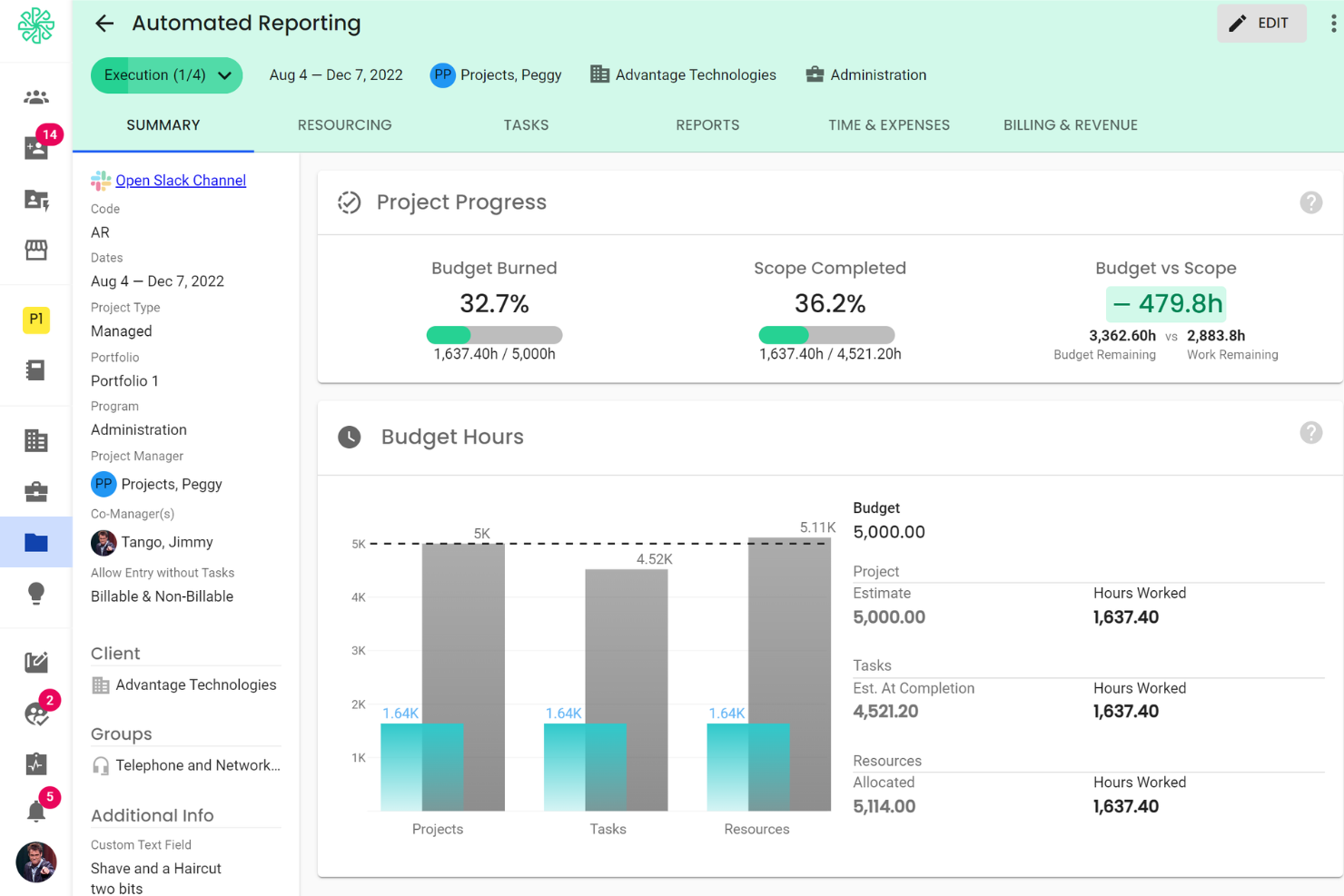
Polaris PSA is a professional services automation (PSA) platform built by Deltek for IT and consulting firms, covering project management, resource planning, time tracking, expense management, and project financials in a single solution.
Who Is Polaris PSA Best For?
Polaris PSA is purpose-built for IT and technology consulting firms that manage complex, multi-phase client engagements with distributed delivery teams.
Why I Picked Polaris PSA
Polaris PSA earns its spot on my shortlist because of how its AI, Dela, actively participates in project delivery rather than just reporting on it. I can ask Dela to flag at-risk projects before they slip, or surface billing gaps my team might miss mid-engagement.
I also like that project health scoring runs continuously in the background, so I'm not waiting on a weekly status call to know something's off. That level of real-time visibility across active engagements is what sets it apart.
Polaris PSA Key Features
- Expense management: Log, categorize, and submit project expenses directly against client engagements for accurate cost tracking.
- Opportunity pipeline tracking: Manage pre-sales opportunities and connect won deals directly to project setup without re-entering data.
- Utilization reporting: Track billable vs. non-billable hours across your team to monitor consultant utilization rates over time.
- Timesheet approval workflows: Route submitted timesheets through configurable approval chains before hours are posted to projects.
Polaris PSA Integrations
Polaris PSA offers native integrations with Deltek ERP systems, Salesforce, QuickBooks, Xero, Jira, and Microsoft 365. An API is available for custom integrations.
Pros and Cons
Pros:
- Real-time revenue recognition across project types
- Skill-based resource matching via Dela AI
- ZeroTime captures hours from 100+ work apps
Cons:
- Reporting lacks advanced calculated fields
- Occasional lag with large project datasets

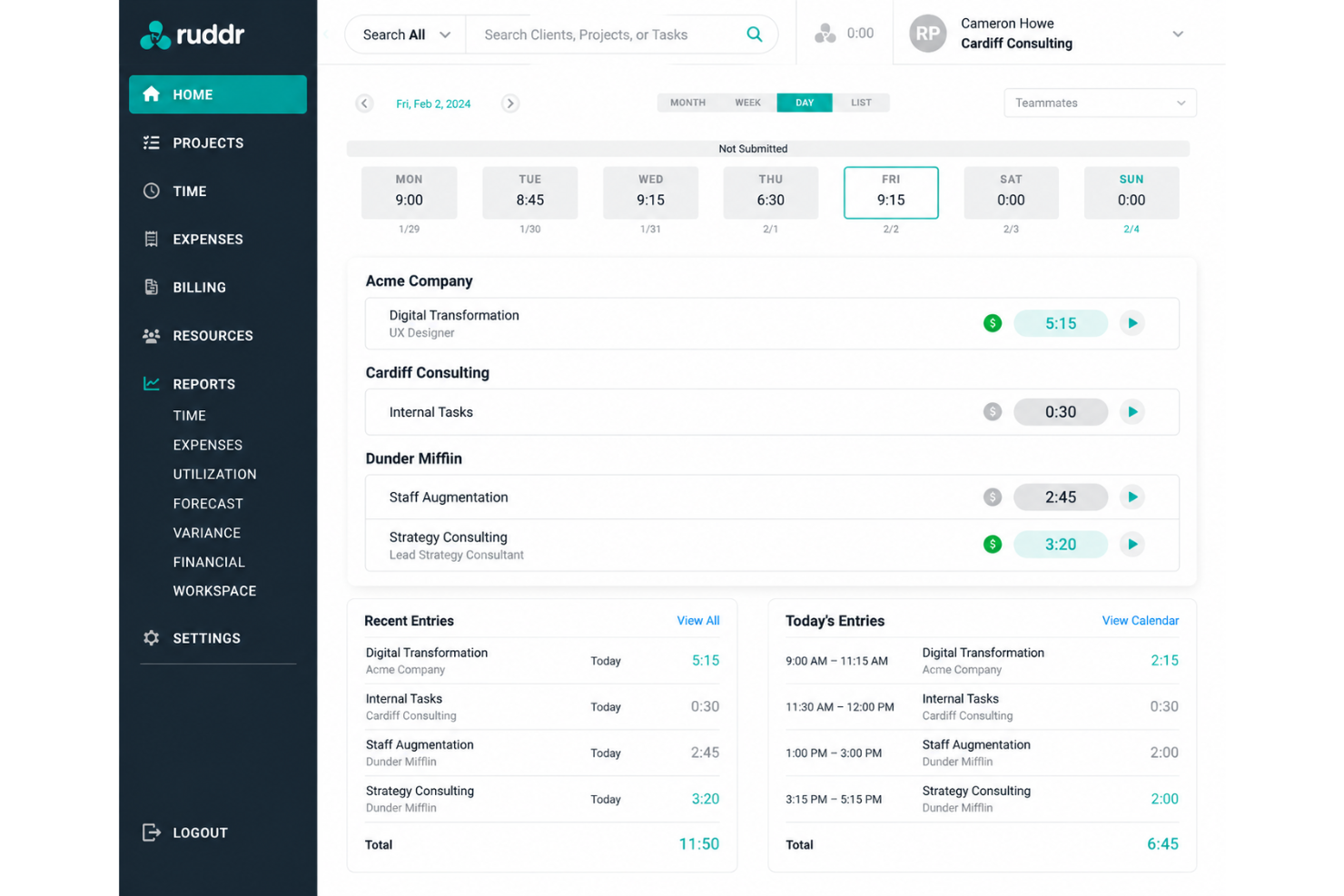
Ruddr is an AI-native PSA platform for professional services firms that covers time tracking, expense tracking, resource management, project management, invoicing, sales pipeline, and financial forecasting.
Who Is Ruddr Best For?
Ruddr is a strong fit for small to mid-sized professional services firms, particularly consulting and digital agencies, that need a full PSA without the complexity of enterprise-grade tools.
Why I Picked Ruddr
I picked Ruddr as one of the best because its mobile time tracking works the way consulting teams actually operate. Consultants log time from their phones right after a client meeting, rather than reconstructing their week every Friday.
I also like that Ruddr surfaces real-time budget performance as hours are entered, so project managers catch overruns before they compound. The configurable, multistep approval workflows, including optional client approval before invoicing, keep billing clean without adding admin overhead.
Ruddr Key Features
- Resource allocation: Allocate work to team members or placeholder roles by day, week, or month, with a click-and-drag interface and split or clone options.
- Sales pipeline tracking: Capture opportunities, associate them to tentative projects, and track weighted pipeline value, average deal size, and full activity history.
- Project health reporting: Project managers score budget, schedule, client satisfaction, and team satisfaction in periodic health reports, with actual-to-budget metrics stamped automatically at each entry.
- Multicurrency support: Run projects and invoices across multiple currencies, which is useful for consulting firms working with international clients.
Ruddr Integrations
Ruddr offers a smaller set of native integrations, including QuickBooks Desktop, QuickBooks Online, Xero, Rippling, BambooHR, Expensify, Slack, HubSpot, Salesforce, and more. An open API is also available for custom integrations.
Pros and Cons
Pros:
- Fast onboarding with minimal setup time
- Built-in invoicing tied to tracked hours
- Copy-forward time entries speed up logging
Cons:
- Fewer advanced features than enterprise PSAs
- Limited branding and white-label options

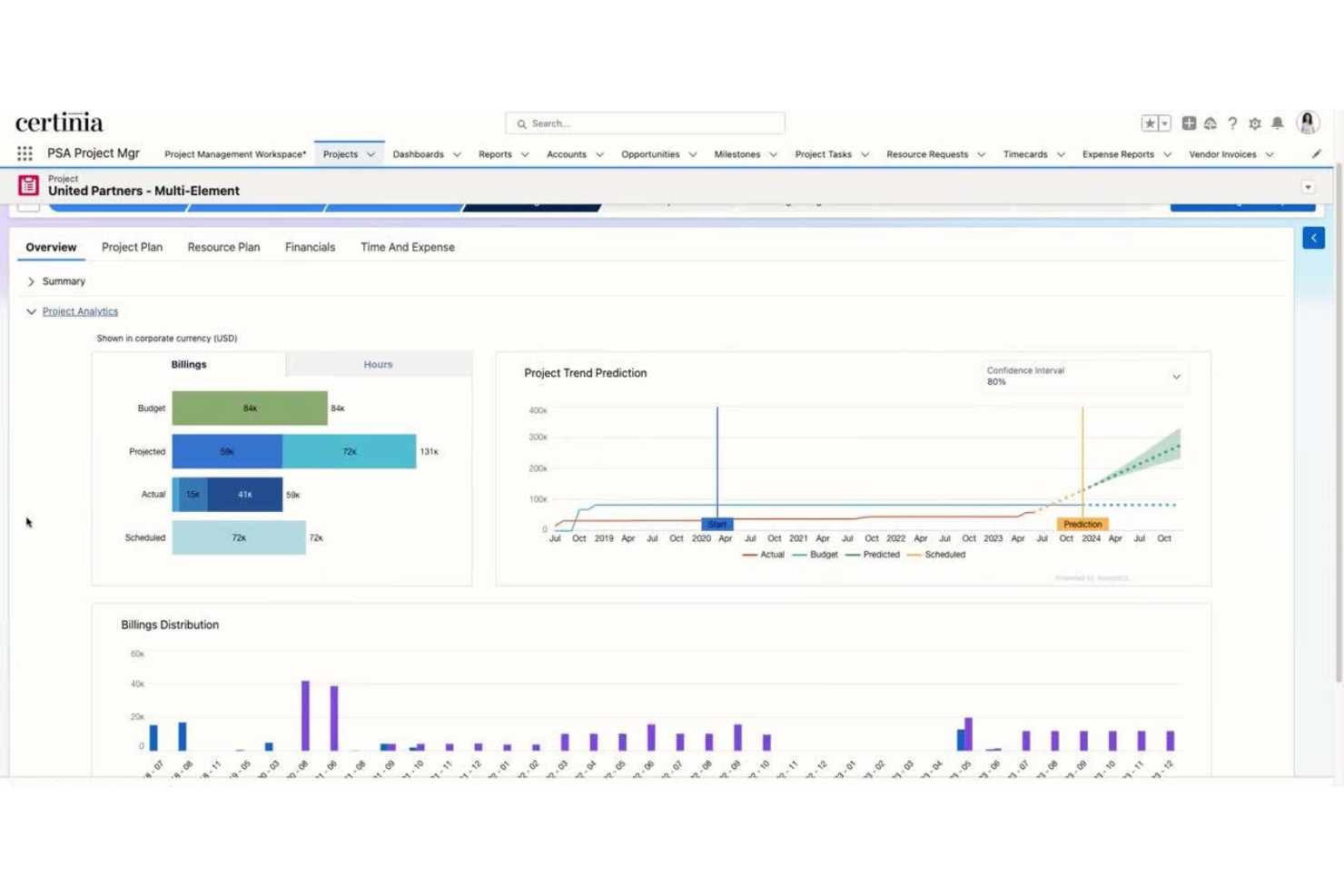
Certinia PS Cloud is a professional services automation (PSA) platform built natively on Salesforce, covering resource planning, project delivery, billing, and financial management for consulting and services organizations.
Who Is Certinia PS Cloud Best For?
Certinia PS Cloud is a natural fit for mid-to-large consulting and professional services firms that are already running Salesforce as their CRM.
Why I Picked Certinia PS Cloud
I've included Certinia PS Cloud in my top picks because it's one of the only PSA platforms that lives entirely inside Salesforce, not just connected to it. That means opportunity data, project records, resource assignments, and billing all share the same customer record.
I also like the Veda AI layer, which uses your own historical project data to generate estimates and match resources to open roles without manual intervention.
Certinia PS Cloud Key Features
- Services estimation: Build project quotes using historical delivery data, then refine scope and pricing before a contract is signed.
- Project management: Track milestones, risks, and delivery status across active engagements directly within the Salesforce platform.
- Services billing: Manage complex billing scenarios, including time-and-materials, fixed-fee, and milestone-based billing, tied directly to project records.
- Services financials: Access real-time financial visibility across projects, including margin tracking and revenue recognition, without leaving the platform.
Certinia PS Cloud Integrations
Certinia PS Cloud offers native integrations with Salesforce, Jitterbit, Expensify, SAP Concur, Avalara, Celigo, Zankraft, Conga, and DocuSign, and provides an API for custom integrations.
Pros and Cons
Pros:
- Skills-based resource matching with AI
- Built-in revenue recognition automation
- Real-time consultant utilization visibility org-wide
Cons:
- Requires deep onboarding to avoid errors
- Page loading times can be slow
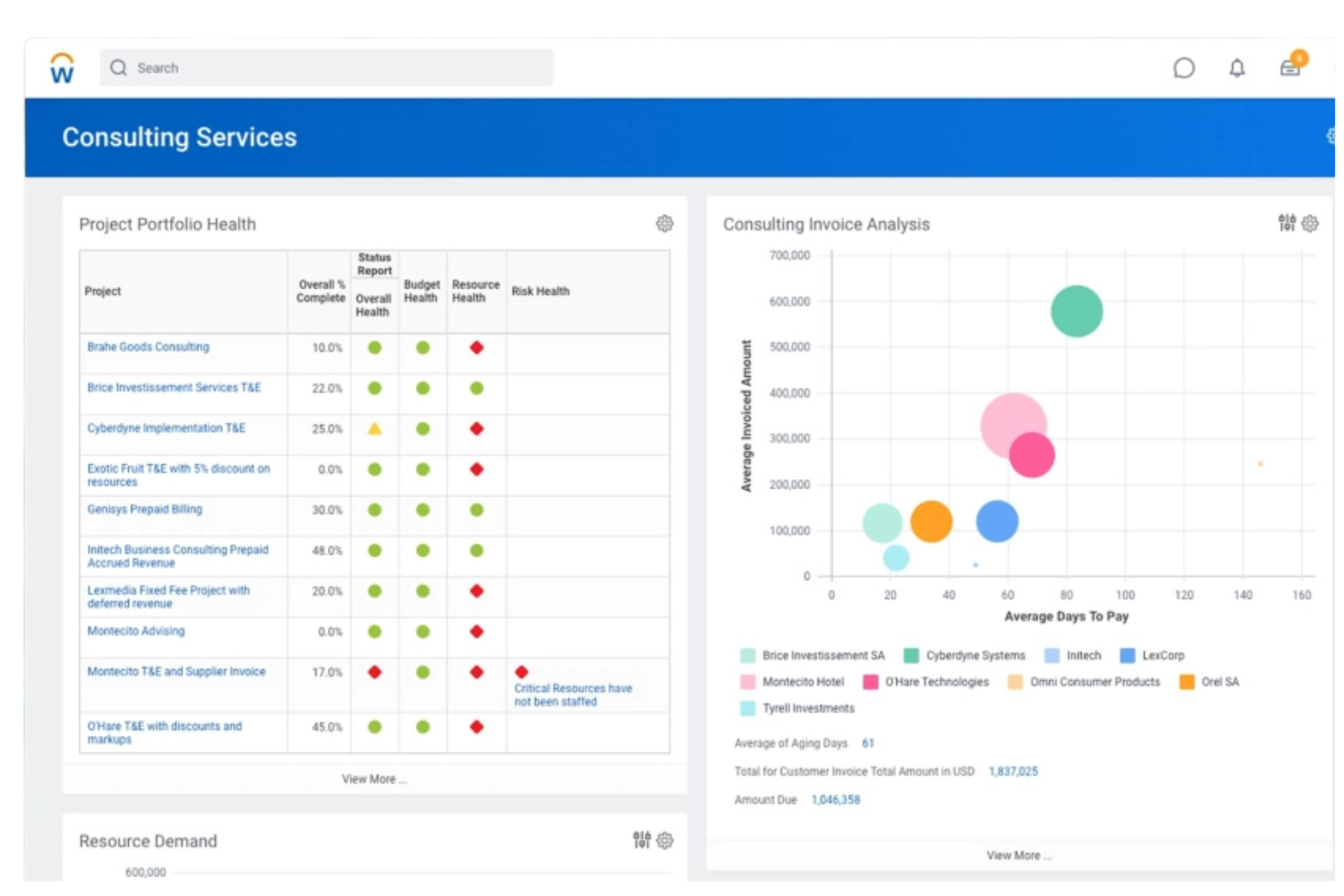
Workday PSA is a professional services automation platform that covers project planning, resource management, time tracking, expense management, project billing, and financial management alongside built-in HCM, Services CPQ, and planning capabilities.
Who Is Workday PSA Best For?
Workday PSA suits enterprise-level IT and management consulting firms that need to manage rapid staff changes across multiple concurrent client engagements.
Why I Picked Workday PSA
Workday PSA earns its spot on my shortlist because of how it handles dynamic resource allocation across fast-moving engagements. I use the staffing pool feature to predefine groups of qualified resources by skill set, so when a new project opens, I can fill roles in hours rather than days.
The real-time capacity visibility also lets me see who's available before I commit to a client delivery timeline.
Workday PSA Key Features
- Project time tracking: Log billable and non-billable hours against specific projects and tasks directly within the platform, with mobile submission support.
- Budget-to-actuals monitoring: Track live project spend against approved budgets, with cost variances surfaced at the project or task level.
- Skills catalog: Maintain a centralized record of worker certifications, skills, and experience levels to support role-based project assignments.
- Project health dashboards: View milestone status, margin, and delivery risk across your entire project portfolio from a single reporting view.
Workday PSA Integrations
Native integrations are not publicly listed. Workday PSA offers an API for custom integrations.
Pros and Cons
Pros:
- Real-time project profitability tracking
- Talent-to-project matching with skills intelligence
- Unified finance, HR, and project data
Cons:
- Third-party integrations require extensive setup
- Complex implementation for smaller firms
Anden konsulentsoftware
Her er nogle yderligere muligheder for konsulentsoftware, som ikke kom med på min kortliste, men som stadig er værd at undersøge:
- Accelo
For risk detection with predictive analytics
- Kantata
For expertise-driven resource matching
- Avaza
For integrated expense and invoicing tools
- Productive
For profit forecasting by project
- HoneyBook
For managing client communications
- Rocketlane
For client onboarding collaboration
- Projectworks
For workforce planning for consultancies
- Bonsai
For automated contract and proposal building
- Moxie
For solo consultant business operations
- Agiled
For white-label client portals


How I Evaluate Consulting Software
I evaluate consulting software in two layers: the baseline must-haves—like billable time tracking and engagement structure—and the differentiators that separate the best tools from the rest.
Core Functionality (Table Stakes For This List)
When I'm selecting tools for my list, I rank each one on a scale from 0 (does not offer the functionality) to 5 (excels in this area) for each core functionality listed below. Then, I calculate the tool's total score into a percentage. Each tool needs to achieve a minimum total score of 65% to be considered for inclusion.
- Client Engagement Management: I look for structured engagement workspaces with phases, milestones, and deliverable tracking—so a firm running parallel discovery and implementation projects can manage each one distinctly.
- Time & Billing Tracking: Consultants bill in different ways, so I evaluate whether tools support multiple rate types tied to roles, clients, or projects and connect tracked time directly to invoices.
- Resource & Capacity Planning: Staffing the right consultant to the right engagement matters. I check for utilization views, availability forecasting, and the ability to plan headcount across overlapping projects.
- Project Financials & Profitability: I look at how each tool tracks budgets, costs, and margins at the engagement level—especially whether you can spot an over-budget project before it erodes the client relationship.
- Client Collaboration Portal: A shared space where clients can review deliverables, approve milestones, and exchange files keeps work moving. I evaluate whether the portal is branded and access-controlled or just a basic file link.
- Proposals & SOW Management: The handoff from proposal to active engagement is where details get lost. I check whether tools let you draft proposals, capture e-signatures, and convert accepted SOWs into projects automatically.
Once I have a list of tools that meet this criteria, I consider what sets each platform apart.
Differentiating Factors (What Sets Vendors Apart)
Here's how I compare and contrast different vendors:
Standout Features
Knowledge and IP management is a major differentiator. Firms that store reusable templates, methodologies, and past deliverables in a central library save hours when spinning up new engagements. I also evaluate project profitability analytics depth—the strongest tools track realization rates and margins per engagement, client, and practice area in real time. That visibility helps firm owners catch margin erosion mid-project rather than in a post-mortem. Resource planning goes a step further when tools offer skills-based matching, so you staff consultants based on expertise rather than just availability.
Beyond Features
Firm size shapes everything about tool fit. A solo consultant juggling five clients has different needs than a 200-person firm with multiple practice areas—I evaluate whether each platform scales without forcing enterprise complexity too early. Integration coverage matters just as much. Consulting firms run on a mix of accounting, CRM, and collaboration tools, so I check for native connections to platforms like QuickBooks, Salesforce, and Slack. Security rounds out my evaluation—consultants handling sensitive client data need SOC 2 compliance, role-based access, and data segregation between engagements.
Sådan vælger du konsulentsoftware
Det er nemt at fare vild i lange funktionslister og komplekse prisstrukturer. For at hjælpe dig med at holde fokus, mens du arbejder dig gennem din unikke proces for valg af software, får du her en tjekliste over faktorer, du bør have i tankerne:
| Faktor | Hvad skal du overveje? |
|---|---|
| Skalerbarhed | Kan værktøjet håndtere flere kunder, brugere eller komplekse projekter, efterhånden som du vokser? Overvej besværet ved en migrering, hvis du får brug for at opgradere senere. |
| Integrationer | Har det indbygget forbindelse til dit CRM-system, dine regnskabs- og kommunikationsværktøjer? Se efter API-adgang, hvis din teknologiske platform er unik eller forventes at ændre sig. |
| Tilpasningsmuligheder | Kan du tilpasse arbejdsgange, datafelter og skabeloner, så de passer til din virksomheds processer og ikke kun generiske konsulentaktiviteter? |
| Brugervenlighed | Vil dine konsulenter og kunder rent faktisk tage det i brug? Prøv demonstrationer med virkelige scenarier for at vurdere, hvor hurtigt nye brugere kommer i gang, eller hvor frustrerede de bliver. |
| Implementering og introduktion | Hvor meget tid, vejledning eller intern ekspertise kræver implementeringen? Bed leverandørerne om tidsplaner for opsætning og ressourcer til kundeoplæring. |
| Pris | Er alle omkostninger tydelige på forhånd – abonnementer, introduktion og mulige premiumtilføjelser? Undersøg prisniveauerne og vilkårene for fornyelse grundigt, før du beslutter dig. |
| Sikkerhedsforanstaltninger | Lever softwaren op til dine kunders forventninger til datasikkerhed? Bekræft overholdelsescertificeringer og understøttelse af rollebaserede adgangstilladelser. |
| Tilgængelig support | Er live-support tilgængelig i din arbejdstid? Undersøg, om du har adgang til kompetente medarbejdere, der forstår konsulentspecifikke spørgsmål eller problemer. |
Hvad er konsulentsoftware?
Konsulentsoftware er en specialiseret platform, der hjælper konsulentvirksomheder og selvstændige konsulenter med at administrere kundeprojekter, registrere fakturerbare timer, føre tilsyn med ressourcer samt håndtere tilbud, fakturering og rentabilitetsanalyser.
Disse værktøjer samler vigtige arbejdsgange, effektiviserer samarbejdet med kunder og understøtter bedre beslutningstagning på tværs af flere opgaver.
Funktioner
Her er de vigtigste funktioner, som enhver god konsulentsoftware bør have:
- Projektstyring: Strukturér kundeopgaver som projekter med faser, milepæle og leverancer for at holde arbejdet organiseret og på rette spor.
- Tids- og faktureringsregistrering: Registrér fakturerbare timer knyttet til bestemte kunder eller opgaver, anvend forskellige faktureringssatser, og opret fakturaer baseret på det faktisk udførte arbejde.
- Ressourceplanlægning: Tildel konsulenter til projekter, følg deres udnyttelse, og forudsig den fremtidige kapacitet for at undgå overbelægning eller underudnyttelse.
- Dokumenthåndtering: Gem, del og organisér kundeleverancer, tilbud og projektfiler på ét centralt sted, så de er nemme at tilgå, og versionerne kan styres.
- Samarbejdsportal for kunder: Giv kunderne et sikkert sted, hvor de kan se projektets fremskridt, dele feedback, godkende milepæle og kommunikere med dit team.
- Oprettelse af tilbud og SOW: Udarbejd, send og følg op på tilbud eller arbejdsbeskrivelser, og konvertér dem derefter til aktive projekter uden at indtaste oplysningerne igen.
- Udgiftsregistrering: Registrér og allokér projektrelaterede udgifter for at sikre præcis budgetstyring og refusion fra kunden.
- Rentabilitetsanalyse: Overvåg projektindtægter, avancer og realiseringsgrader for at vurdere den økonomiske sundhed i hver kundeopgave.
- Arbejdsgangautomatisering: Automatisér tilbagevendende opgaver, notifikationer, godkendelser eller statusopdateringer for at reducere manuelt arbejde og bevare ensartetheden.
- Integrationsmuligheder: Forbind din konsulentplatform med eksisterende værktøjer som regnskabssoftware, CRM-systemer eller kommunikationsapps for at samle din arbejdsgang.
Almindelige AI-funktioner i konsulentsoftware
Ud over de almindelige funktioner i konsulentsoftware, der er nævnt ovenfor, integrerer mange af disse løsninger AI med funktioner som:
- Automatiseret projektprognosticering: Bruger AI til at analysere historiske projektdata og forudsige tidsplaner, ressourcebehov og potentielle flaskehalse for kommende kundeopgaver.
- Smart ressourceallokering: AI matcher konsulenter med projekter baseret på færdigheder, tilgængelighed og tidligere resultater, hvilket hjælper med at optimere teamtildelinger og udnyttelse.
- AI-drevet tilbudsgenerering: Udarbejder automatisk tilbud eller arbejdsbeskrivelser ved at analysere kundekrav og henvise til tidligere succesfulde dokumenter.
- Forudsigende rentabilitetsanalyse: Udnytter AI til at forudsige projektavancer og markere kundeopgaver, der risikerer at overskride budgettet eller ikke nå indtægtsmålene.
- Indsigter i naturligt sprog: AI gennemgår projektkommunikation og dokumenter for at fremhæve risici, handlingspunkter eller tendenser i kundernes holdninger, så de kan håndteres proaktivt.
Fordele
Implementering af konsulentsoftware giver flere fordele for dit team og din virksomhed. Her er nogle af dem, du kan se frem til:
- Centralt projektstyringssystem: Håndtér alle kundeopgaver, milepæle og leverancer ét sted for at opnå bedre overblik og ansvarlighed.
- Præcis fakturering og fakturaoprettelse: Følg automatisk fakturerbare timer, udgifter og faktureringssatser for at sikre, at du registrerer og fakturerer alt kundearbejde.
- Bedre ressourceudnyttelse: Tildel konsulenter baseret på tilgængelighed og kompetencer, så den fakturerbare udnyttelse maksimeres, samtidig med at overbelastning eller ledig tid i teamet forebygges.
- Effektiviseret kundesamarbejde: Giv kunderne nem adgang til projektopdateringer, delte dokumenter og godkendelser gennem en sikker kundeportal.
- Forbedret rentabilitetsopfølgning: Overvåg budgetter, avancer og realiseringsgrader i realtid for tidligt at opdage problemer og holde kundeopgaver økonomisk på rette spor.
- Hurtigere behandling af tilbud: Udarbejd og send tilbud eller arbejdsbeskrivelser hurtigt, og omdan dem derefter direkte til nye projekter uden overflødig dataindtastning.
- Reduceret administrativt arbejde: Automatisér tilbagevendende opgaver, godkendelser og påmindelser, så dit team kan fokusere på kundearbejde i stedet for manuelle processer.
Omkostninger og priser
Valg af konsulentsoftware kræver en forståelse af de forskellige prismodeller og abonnementer, der er tilgængelige. Omkostningerne varierer afhængigt af funktioner, teamstørrelse, tilføjelser og meget mere. Tabellen nedenfor opsummerer almindelige abonnementer, deres gennemsnitspriser og typiske funktioner, der er inkluderet i konsulentsoftwareløsninger:
Sammenligningstabel for abonnementer til konsulentsoftware
| Plantype | Gennemsnitspris | Almindelige funktioner |
|---|---|---|
| Gratis abonnement | $0 | Grundlæggende projektstyring, begrænset brugeradgang, enkel tidsregistrering og grundlæggende rapportering. |
| Personligt abonnement | $10-$25/bruger/måned | Individuel brugeradministration, registrering af tid og udgifter, grundlæggende dokumentlagring og e-mailsupport. |
| Virksomhedsabonnement | $30-$60/bruger/måned | Teamstyring med moderne samarbejdsværktøjer, avanceret ressourceplanlægning, brandede kundeportaler, automatisering af arbejdsgange og integrationer. |
| Enterprise-abonnement | $70-$120/bruger/måned | Understøttelse af flere enheder, avancerede sikkerhedskontroller, tilpasset introduktion, API-adgang og premiumsupport. |
Ofte stillede spørgsmål
Her er nogle svar på almindelige spørgsmål om konsulentsoftware:
Hvilke typer konsulentvirksomheder har størst gavn af konsulentsoftware?
Konsulentsoftware understøtter virksomheder i alle størrelser, fra enkeltmandsvirksomheder til globale konsulentvirksomheder. Det er især nyttigt for teams, der administrerer flere projekter, komplekst kundearbejde eller distribuerede konsulenter, som har brug for centraliserede værktøjer til samarbejde, ressourceplanlægning og fakturering.
Kan konsulentsoftware integreres med mine nuværende regnskabs- og CRM-systemer?
Ja, de fleste konsulentsoftwareløsninger tilbyder integrationer med populære regnskabsløsninger som QuickBooks og CRM-systemer som Salesforce. Kontrollér altid, om platformen tilbyder de specifikke forbindelser eller den API-adgang, din virksomhed har brug for, så data kan flyde problemfrit.
Hvor lang tid tager det typisk at implementere en ny konsulentsoftwareplatform?
Implementeringstiden varierer. Lettere værktøjer kan sættes op på få dage, mens større og mere konfigurerbare platforme kan kræve flere uger. En vellykket introduktion afhænger af kompleksiteten af dine arbejdsgange samt af, hvor meget tilpasning eller datamigrering der er nødvendig.
Hvilke sikkerhedsfunktioner bør jeg se efter i konsulentsoftware?
Se efter rollebaserede adgangskontroller, SOC 2- eller ISO 27001-overensstemmelse, datakryptering og adskillelse af kundedata. Disse funktioner sikrer, at følsomme kundeoplysninger forbliver sikre, og hjælper med at opfylde lovgivningsmæssige eller kontraktmæssige forpligtelser.
Hvordan forbedrer kundeportaler konsulentprocessen?
Kundeportaler giver dine kunder kontrolleret adgang til projektopdateringer, delte dokumenter og arbejdsgange for godkendelse. Det øger gennemsigtigheden, reducerer frem og tilbage-kommunikation via e-mail og gør det lettere for kunderne at forblive engagerede gennem hele samarbejdet.